
Cast Saw Devices Market Trends, Demand & Growth by 2034
Cast Saw Devices Market Size and Forecasts (2021 - 2034), Global and Regional Share, Trends, and Growth Opportunity Analysis Report Coverage : by Type (Electric Cast Saws, Pneumatic Cast Saws, Battery-Operated Cast Saws); End-User (Hospitals, Orthopedic Clinics, Outpatient Care Centers); and Geography (North America, Europe, Asia Pacific, and South and Central America)
- Status : Data Released
- Report Code : TIPRE00040900
- Category : Life Sciences
- No. of Pages : 150
- Available Report Formats :


- Last update date : September 08, 2026


2025 Market Size
US$ 219.04 Mn
Base year value
2034 Forecast
US$ 384.87 Mn
Projected by 2034
CAGR 2026-2034
6.46 %
Growth rate
Addressable Market
US$ 2,731.22 Mn
(2026-2034)
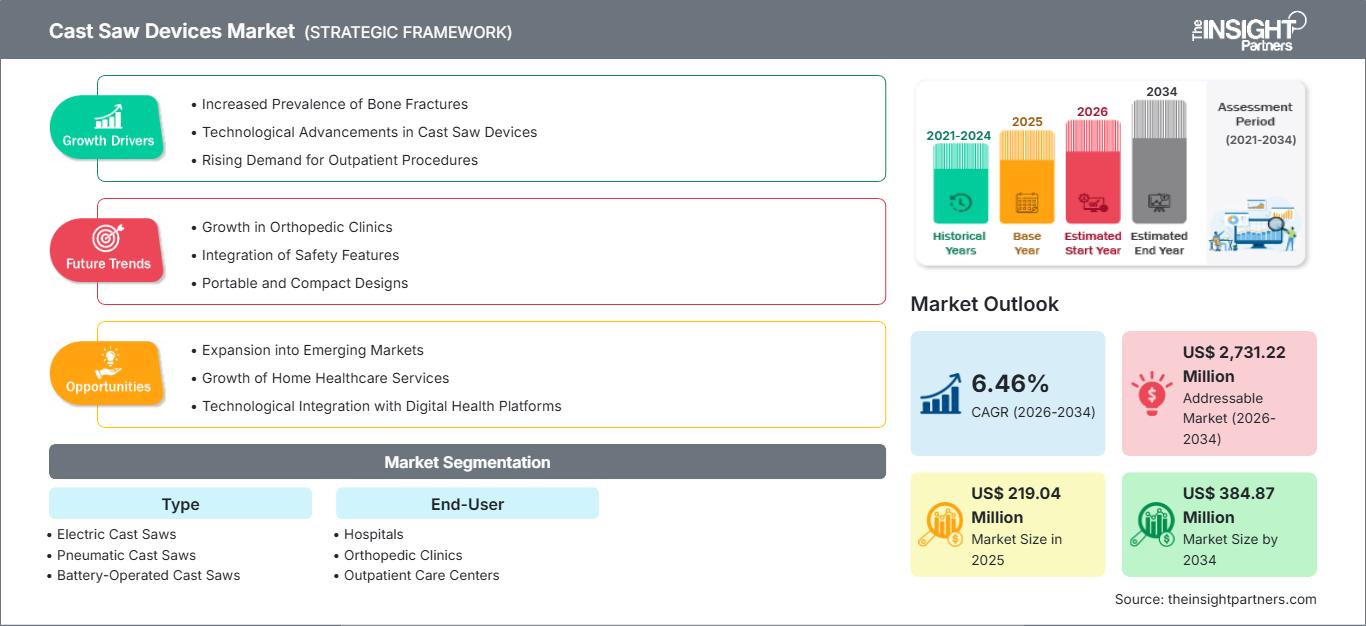
The Cast Saw Devices Market was valued at US$ 219.04 Million in 2025 and is projected to reach US$ 384.87 Million by 2034, registering a CAGR of 6.46% during 2026–2034. The demand will be backed up due to increased number of patients requiring fracture management, replacement of old cast removal devices and more applications for ergonomic devices that can effectively reduce vibration, heat, noise, and airborne particulates in hospitals, orthopedic clinics and ambulatory care centers.
In North America, the Cast Saw Devices Market size is forecasted to grow at a CAGR of 5.8%–6.3% in 2026-2034. Developed network of orthopedic facilities, regular equipment replacement cycle, and procurement policies focusing on dust collection and operator safety will contribute to the market growth. The U.S. continues to play an important role due to hospitals and specialty clinics considering the total cost of ownership, availability of blades and compatibility with artificial casts.
Cast Saw Devices Market Assessment and Insights
- North America: The region held a 38–40% share in 2025 and is expected to record a CAGR between 5.8–6.3% during 2026–2034, supported by established trauma networks, replacement demand, and strict occupational safety practices.
- US: The country represented 82–85% of North American revenue in 2025 and is projected to register a CAGR between 5.9–6.4% during 2026–2034.
- Europe: Europe accounted for a 27–29% share in 2025 and is forecast to grow at a CAGR between 5.7–6.2% during 2026–2034, led by Germany, the UK, France, Italy, and Spain.
- Asia Pacific: Asia Pacific held a 23–25% share in 2025 and is expected to expand at a CAGR between 7.4–8.0% during 2026–2034, with China, Japan, India, and South Korea driving adoption.
- Largest Segment: Electric cast saws captured a 56–60% market share in 2025 and are expected to grow at a CAGR between 5.8–6.3% during 2026–2034.
- High Growth Segment: Battery-operated cast saws represented an 18–22% market share in 2025 and are projected to register a CAGR between 8.1–8.8% during 2026–2034.
- Key companies analyzed in detail: Essity AB, Smith & Nephew plc, Stryker Corporation, De Soutter Medical Limited, HEBUmedical GmbH, Medezine Limited, Rimec S.r.l., Oscimed SA, Shanghai Bojin Medical Instrument Co., Ltd., and Hanshin Medical Co., Ltd.
Source: The Insight Partners' analysis based on proprietary research, government publications, company annual reports, investor presentations, industry databases, and expert interviews.
Cast removal equipment has progressed from large and cumbersome cutters requiring main power to more compact oscillators with improved electric motor performance, balance in hand piece, tool-less blade changes, and dust extraction. Blade treatments and vibration minimization are currently under optimization by manufacturers, while standardization and rationalization are taking place during the production of components. Therefore, procurement has changed from the selection of the unit according to its cutting ability to filtration efficiency, acoustic performance, maintainability, availability of accessories, and operator fatigue.
In the forecast period, investments will be made in battery-based units, units suitable for pediatrics, and portable units for use in outpatient care. Growth in orthopedic surgery in Asia Pacific and some Middle Eastern markets will increase the addressable market size. Quality specifications for medical devices, dust control regulations in occupations, and initiatives of hospitals to enhance the patient experience will further drive demand for differentiating systems with safety, maintainability, and filtration capability.
Cast Saw Devices Market Report Scope
| Report Attribute | Details |
|---|---|
| Market size in 2025 | US$ 219.04 Million |
| Market Size by 2034 | US$ 384.87 Million |
| Global CAGR (2026 - 2034) | 6.46% |
| Historical Data | 2021-2024 |
| Forecast period | 2026-2034 |
Cast Saw Devices Market Analysis
The Cast Saw Devices market will be driven by fractures, sports injuries, orthopedics, and repeat removal of either plaster or synthetic casts. The demand cycle takes place within an eco-system consisting of motor and blade suppliers, device manufacturers, regional distributors, biomedical services firms, and treatment facilities. Purchases by hospitals are often made by tender, but clinics tend to make greater use of distributor stocks and service packages. Product availability will require motors, bearings, blade coatings, filter media, housings, and medically approved power supplies.
Supply dynamics will benefit device makers able to ensure replacement blades, filters, hoses, and spare parts in multiple regions. Electric models have an advantage based on their installed base, although cordless units are getting better in terms of workflow flexibility. Rising prices of components and certification costs can put smaller suppliers at a disadvantage, while modular devices make it easier to cut assembly costs. Refurbished units create competitive pressures in developed markets, but buyers are paying increasing attention to life-cycle costs versus initial cost alone.
The competitive nature of the Cast Saw Devices market report is seen to be fragmented with multinational orthopedic companies alongside specialized power tool companies. Essity AB is a key player through their Delta-Cast range of fracture management products while Smith & Nephew plc and Stryker Corporation derive advantage through clinical experience. De Soutter Medical Limited stands out with extraction and cordless systems while HEBUmedical GmbH, Medezine Limited, Rimec S.r.l., and Oscimed SA engage in cast-removal engineering.
Money is being invested in quiet motors, particulate management, lightweight casings and blade designs to limit heat build up. Companies like Shanghai Bojin Medical Instrument Co., Ltd. and Hanshin Medical Co., Ltd. can cater to price sensitive and growing Asia markets while other players concentrate on documentation, accessibility and training of clinicians. Positioning will depend on the ability to provide an integrated system of products like saws, vacuums, blades, filters, protective strips among others.
● REPORT CUSTOMIZATION
Tailor This Report To Align With Your Specific Business Requirements
This report can be customized to align precisely with your business objectives, scope, and target markets. Customization options include tailored segmentation, geography, competitive analysis, and strategic insights to support informed decision-making.
Customize This Report →WHAT YOU CAN ADJUST
- ● Segmentations
- ● Geography
- ● Competitive Analysis
- ● Language Preferences
Cast Saw Devices Market: Strategic Insights
Regional Insights
North America Cast Saw Devices Market
North America held a 38-40% Cast Saw Devices Market share in 2025 and will register growth at a CAGR of 5.8-6.3% between 2026 and 2034. North America is fueled by extensive emergency department utilization, well-developed orthopedic referral systems, and periodic replacement programs. Institutions emphasize durability in cutting, minimal vibrations, dust management, and availability of biomed service centers.
Demand is influenced by ambulatory shifts, volume of sports medicine, and requirement for efficiency in blades because of synthetic casts. Contribution from Canada comes from provincial hospitals and specialty clinics while Mexico provides opportunities for private health care provision. Competition will have to be dealt with by regional suppliers in terms of refurbishing but good filtration, ergonomics, consistency of consumables, and predictability in maintenance may support premium positioning.
U.S. Cast Saw Devices Market
The US accounted for 82–85% of the North American revenues in 2025 and is expected to record a CAGR of 5.9–6.4% over 2026–2034. Diverse clients include large hospital chains, urgent care facilities, pediatric orthopedics departments, and independent practitioners. Increasingly, standardized procurement teams evaluate noise levels, thermal performance, blade changing speed, filtration, warranties, and turnaround time along with the cost of purchase.
There is access to possible customers through the efforts of Stryker Corporation, Essity AB, Smith & Nephew plc, and specialized distributors, while De Soutter Medical Limited enters the market with extraction capabilities and battery-powered models. Depending on the setting, the use changes accordingly since there is a need for durable models in hospitals for various casts, compact models in clinics, and portable models for outpatients. Second-hand systems are available, and as such, there is an incentive for the OEMs to improve their services.
Europe Cast Saw Devices Market
Europe was a 27-29% market share in 2025 and predicted to experience growth at a CAGR of 5.7-6.2% for 2026-2034. Europe is led by Germany through hospital density, technical procurement procedures, and established medical device manufacturing companies. Procurement focuses on compliance documents, low acoustic noise generation, dust extraction capabilities, and durability in terms of continuous usage in the clinics.
United Kingdom has strengths in terms of centralized purchasing process and trustful processes. France creates demand via public hospitals and orthopedic professionals. Italy and Spain create demand opportunities through equipment replacement and private organizations. However, the Nordics have value in terms of ergonomic and low exposure system. De Soutter Medical Limited, HEBUmedical GmbH, Medezine Limited, Rimec S.r.l., Essity AB, and Oscimed SA increase regional availability through specialty product lines and distributors.
APAC Cast Saw Devices Market
Asia-Pacific accounts for 23-25% in 2025 and is anticipated to exhibit a CAGR of 7.4-8.0% in 2026-2034. Asia-Pacific holds the leading position due to technological developments in hospitals, local manufacturing, and increase in orthopedic procedures. In Japan, the main focus is on accuracy, minimal noise level, and after-sales service.
In India, there is scope for volume through private hospitals and trauma centers. In South Korea, there is investment in advanced procurement. Australia's market derives strength through demand via existing hospitals and sports medicine centers. Policy-driven development of healthcare infrastructure and localization of medical devices will improve accessibility.
Middle East & Africa Cast Saw Devices Market
The Middle East and Africa market is forecast to grow at a CAGR of 5.4–6.0% during 2026–2034. Saudi Arabia leads through hospital investment and health-system modernization, while the UAE supports premium device demand from specialist and private facilities.
South Africa remains an important subregional distribution base. The Rest of MEA offers selective opportunities linked to trauma care and urban hospitals. Energy-backed infrastructure spending in Gulf countries supports procurement, whereas limited biomedical servicing, import dependence, currency pressures, and uneven consumable availability constrain adoption elsewhere.
Segmentation Analysis
Type
The Type segment is expected to grow at a CAGR of 6.2–6.8% during 2026–2034. Cast Saw Devices Market scope within this category reflects different requirements for continuous performance, portability, air supply, and maintenance. Electric models lead established facilities, pneumatic systems serve compatible clinical environments, and battery-operated devices are gaining attention where maneuverability, rapid room turnover, and freedom from power cables influence purchasing decisions.
- Electric Cast Saws: Electric systems maintain the leading position because they provide continuous power, familiar operating characteristics, broad blade compatibility, and straightforward integration with extraction units in hospitals and established orthopedic departments.
- Pneumatic Cast Saws: Pneumatic devices serve facilities equipped with appropriate compressed-air infrastructure, offering durable operation and motor characteristics suited to repeated use, although installation requirements restrict adoption in smaller outpatient environments.
- Battery-Operated Cast Saws: Cordless systems are strategically important for mobile workflows, emergency care, pediatric departments, and smaller clinics, where compact storage, maneuverability, and reduced cable management can improve procedural efficiency.
End-User
The End-User segment is projected to expand at a CAGR of 6.1–6.7% during 2026–2034. Adoption depends on patient throughput, capital budgets, infection-control procedures, staff training, and access to technical support. Hospitals remain the principal purchasers, orthopedic clinics constitute a focused replacement market, and outpatient care centers create growth potential as suitable fracture-management and follow-up services migrate to lower-cost settings.
- Hospitals: Hospitals contribute substantial revenue through emergency, trauma, pediatric, and orthopedic departments, requiring robust systems, extraction accessories, multiple blade configurations, documented safety performance, and dependable service coverage for sustained utilization.
- Orthopedic Clinics: Specialty clinics favor compact, ergonomic devices that support predictable daily workloads, quick blade replacement, low noise, and controlled heat while minimizing storage requirements and maintenance disruption.
- Outpatient Care Centers: Outpatient centers represent an expanding customer group as follow-up procedures decentralize, creating demand for portable equipment, simple operation, manageable consumable costs, and distributor-led technical support.
Opportunity Snapshot
| End-User | Revenue Contribution (High/Medium/Low) | Trend Tag | Adoption Stage (Emerging/Scaling/Mature) |
| Hospitals | High | Dust Control | Mature |
| Orthopedic Clinics | Medium | Compact Systems | Scaling |
| Outpatient Care Centers | Medium | Mobile Removal | Emerging |
Cast Saw Devices Market Growth Drivers and Impact Analysis
Expanding Fracture Treatment and Orthopedic Follow-Up Volumes
Growing trauma caseloads, sports injuries, age-related falls, and orthopedic follow-up requirements create recurring demand for safe cast removal. Each immobilization procedure produces a subsequent removal requirement unless an alternative brace is used, establishing a direct link between casting activity and device utilization. Higher patient throughput increases blade consumption and accelerates equipment replacement. Hospitals consequently require systems that preserve cutting consistency during repeated use, while clinics seek dependable devices that minimize appointment delays. The impact extends beyond unit sales because installed equipment generates continuing demand for blades, filters, hoses, protective accessories, maintenance, and staff training. Suppliers that align system capacity with department throughput can strengthen recurring revenue and reduce customer dependence on unplanned third-party repairs.
Greater Attention to Dust, Noise, Heat, and Operator Ergonomics
Cast removal can generate particulate matter, vibration, acoustic discomfort, and blade heat, making occupational and patient-experience considerations increasingly influential in procurement. Integrated extraction, efficient filtration, balanced handpieces, protective blade features, and vibration attenuation allow manufacturers to address these concerns at system level. Pediatric departments particularly value quieter operation because intimidating sound can heighten patient anxiety and complicate procedures. For clinicians, lighter equipment and improved balance can reduce wrist fatigue during repeated removals. These factors encourage replacement of functional but outdated devices before mechanical failure. Vendors can capture value by documenting filtration specifications, heat-management practices, noise characteristics, and maintenance requirements rather than relying solely on cutting speed claims. Demonstrable workflow improvements can also support tender differentiation.
Migration of Suitable Procedures Toward Outpatient Settings
Healthcare systems are directing suitable follow-up services toward orthopedic clinics, ambulatory facilities, and outpatient care centers to reduce hospital congestion and treatment costs. Cast removal aligns with this shift because it generally requires modest space but dependable equipment and trained personnel. Decentralization creates demand for portable saws that are easier to store, move, clean, and maintain than traditional fixed systems. Distributor support becomes particularly important because smaller facilities may lack dedicated biomedical engineering teams. Manufacturers can respond with bundled kits, scheduled maintenance, intuitive controls, and standardized consumables. As installed bases broaden beyond major hospitals, device volumes can rise even when utilization per location remains moderate. This transition also strengthens the commercial case for battery-operated systems and compact extraction configurations.
Cast Saw Devices Market Future Trends
Adoption of Sensor-Assisted Safety and Maintenance Functions
Cast Saw Devices Market trends will increasingly include electronic functions that help clinicians monitor device condition and procedural risk. Future systems may incorporate motor-load sensing, thermal alerts, blade-life indicators, filter-status monitoring, and service reminders without materially complicating operation. These features could reduce reliance on subjective maintenance decisions and help facilities identify dull blades or restricted extraction before performance deteriorates. Manufacturers will need to balance added intelligence with cleaning requirements, battery consumption, electromagnetic compatibility, and affordability. The strongest adoption is likely in high-throughput hospitals, where device utilization can justify connected maintenance records and where preventable downtime has measurable operational consequences.
Growth of Cordless and Procedure-Specific Product Platforms
Battery technology and efficient brushless motors are expected to support lighter cordless platforms with longer operating periods and more stable performance under load. Product development will extend beyond general-purpose cutters toward configurations optimized for pediatric procedures, emergency departments, mobile teams, and outpatient clinics. Interchangeable batteries and standardized chargers may allow cast saws to fit broader orthopedic power-tool ecosystems. Suppliers will also refine blade geometries for different cast materials and anatomical locations. Commercial success will depend on validated runtime, charging speed, battery replacement economics, and continued access to consumables. Cordless adoption will therefore advance fastest where mobility generates clear workflow value rather than serving as a cosmetic feature.
Cast Saw Devices Market Opportunities
Build Integrated Cast-Removal Systems for Emerging Healthcare Networks
Cast Saw Devices Market Forecasts indicate attractive expansion potential in countries adding trauma centers, orthopedic departments, and private outpatient facilities. Manufacturers can address this opportunity with tiered packages combining cutters, extraction equipment, blades, filters, protective strips, training, and preventive maintenance. Local distributor certification is essential because customers require installation support and dependable consumable replenishment. Investment should prioritize markets where hospital construction aligns with rising insurance coverage and specialist availability. Regional repair hubs can reduce downtime and overcome procurement concerns regarding imported equipment. Suppliers should avoid competing solely on entry price, instead demonstrating lifecycle cost, parts availability, clinical usability, and standardized training across multi-site provider networks.
Develop Service, Refurbishment, and Consumable Revenue Models
A substantial installed base of older electric saws creates opportunities beyond new-device sales. Manufacturers and authorized partners can establish inspection programs, fixed-price servicing, certified refurbishment, blade subscriptions, and filter-replenishment agreements. These models provide predictable customer spending while helping suppliers maintain visibility into equipment condition and replacement timing. Digital service records can support compliance documentation and facilitate fleet-level procurement decisions. Certified refurbishment can also address budget-sensitive clinics without conceding the market entirely to unverified secondary sellers. To protect brand reputation, providers need defined acceptance criteria, traceable components, electrical testing, and clear warranty terms. Consistent consumable supply can convert episodic capital purchases into recurring commercial relationships.
Recent Developments
- March 2026: Stryker Corporation showcased additions to its orthopedic portfolio at the AAOS Annual Meeting, including continued development of its power-tool platforms and the Mako Robotic Power System. Although focused on operative applications, the development demonstrates ongoing investment in compact, controlled orthopedic cutting technologies and reinforces the company’s engineering capabilities across powered instrument categories.
- October 2025: Smith & Nephew plc launched CORIOGRAPH Pre-Op Planning and Modeling Services for total shoulder arthroplasty in the United States. The launch expanded its orthopedic technology portfolio and strengthened relationships with hospital and specialty surgical customers that also influence procurement of supporting orthopedic equipment, clinical workflow solutions, and powered instruments.
- May 2025: Essity AB issued an updated fracture-management product portfolio covering immobilization, casting accessories, protective products, and cast-removal solutions under its Delta-Cast offering. The portfolio emphasized a continuum-of-care approach, professional education, and supporting equipment, reinforcing the company’s established presence in casting workflows used by hospitals and orthopedic practices.
Frequently Asked Questions

- Comprehensive Market Sizing and Forecast Analysis
- Detailed Segmentation Analysis
- In-Depth Market Dynamics Assessment
- Regional and Country-Level Insights
- Competitive Landscape and Company Benchmarking
- Strategic Business Intelligence
Recent Reports
Testimonials

The Insight Partners' SCADA System Market report is comprehensive, with valuable insights on current trends and future forecasts. The team was highly professional, responsive, and supportive throughout. We are very satisfied and highly recommend their services.
RAN KEDEM Partner, Reali Technologies LTDs
I requested a report on a very specific software market and the team produced the report in a few days. The information was very relevant and well presented. I then requested some changes and additions to the report. The team was again very responsive and I got the final report in less than a week.
JEAN-HERVE JENN Chairman, Future Analytica
We worked with The Insight Partners for an important market study and forecast. They gave us clear insights into opportunities and risks, which helped shape our plans. Their research was easy to use and based on solid data. It helped us make smart, confident decisions. We highly recommend them.
PIYUSH NAGPAL Sr. Vice President, High Beam Global
The Insight Partners delivered insightful, well-structured market research with strong domain expertise. Their team was professional and responsive throughout. The user-friendly website made accessing industry reports seamless. We highly recommend them for reliable, high-quality research services
YUKIHIKO ADACHI CEO, Deep Blue, LLC.
This is the first time I have purchased a market report from The Insight Partners.While I was unsure at first, I visited their web site and felt more comfortable to take the risk and purchase a market report.I am completely satisfied with the quality of the report and customer service. I had several questions and comments with the initial report, but after a couple of dialogs over email with their analyst I believe I have a report that I can use as input to our strategic planning process.Thank you so much for taking the extra time and making this a positive experience.I will definitely recommend your service to others and you will be my first call when we need further market data.
JOHN SUZUKI President and Chief Executive Officer, Board Director, BK Technologies
I wish to appreciate your support and the professionalism you displayed in the course of attending to my request for information regarding to infectious disease IVD market in Nigeria. I appreciate your patience, your guidance, and the fact that you were willing to offer a discount, which eventually made it possible for us to close a deal. I look forward to engaging The Insight Partners in the future, all thanks to the impression you have created in me as a result of this first encounter.
DR CHIJIOKE ONYIA MANAGING DIRECTOR, PineCrest Healthcare Ltd.Reason to Buy
- Informed Decision-Making
- Understanding Market Dynamics
- Competitive Analysis
- Identifying Emerging Markets
- Customer Insights
- Market Forecasts
- Risk Mitigation
- Boosting Operational Efficiency
- Strategic Planning
- Investment Justification
- Tracking Industry Innovations
- Aligning with Regulatory Trends





 Get Free Sample for