
Cell Culture Media Market Size, Trends & Demand by 2034
Coverage: By Type (Lysogeny Broth, Serum-Free Media, Specialty Media, Classical Media, Stem Cell Media, Chemically Defined Media, Others); Application (Biopharmaceuticals, Biological Drug Discovery, Cancer Research, Tissue Engineering, Stem Cell Technologies, Other Applications); End User (Academic Institute, Research and Development Laboratory, Biotechnology Industry, Other End Users) , and Geography (North America, Europe, Asia Pacific, and South and Central America)
- Status : Data Released
- Report Code : TIPRE00018318
- Category : Life Sciences
- No. of Pages : 150
- Available Report Formats :


- Last update date : September 09, 2026


2025 Market Size
US$ 4.87 Bn
Base year value
2034 Forecast
US$ 14.27 Bn
Projected by 2034
CAGR 2026-2034
12.69 %
Growth rate
Addressable Market
US$ 83.50 Bn
(2026-2034)
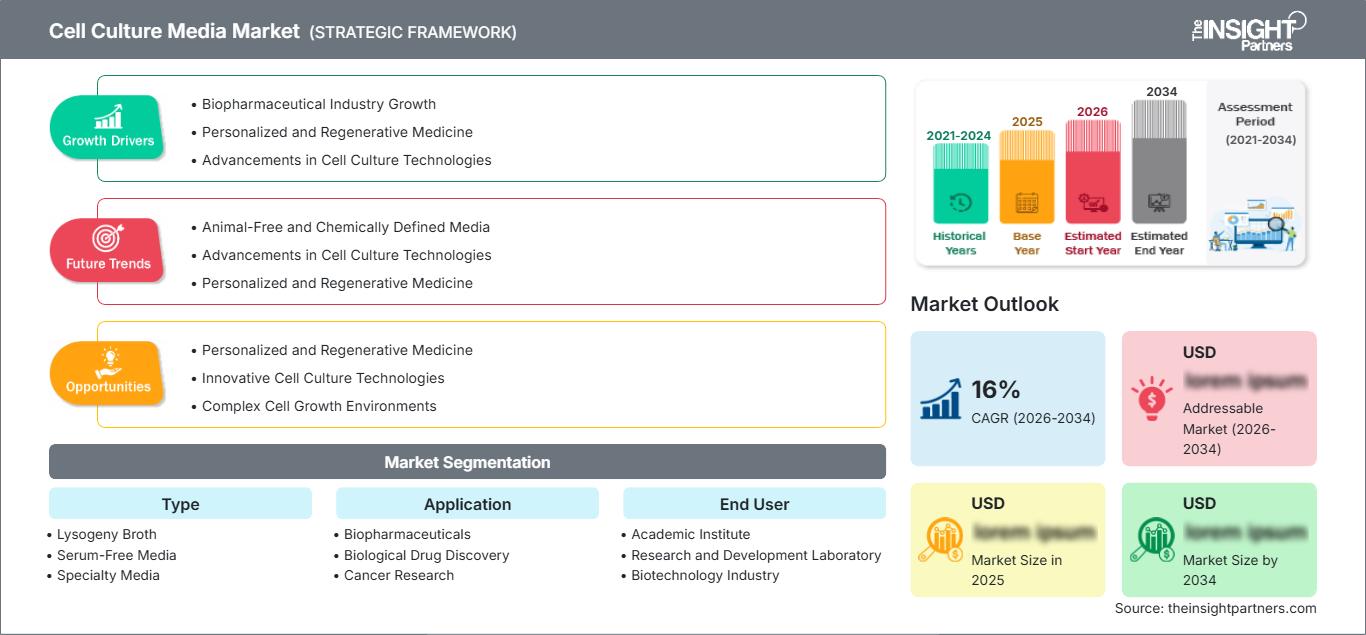
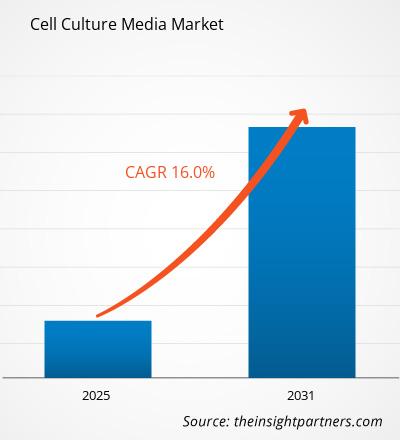
The Cell Culture Media Market was valued at US$ 4.87 Billion in 2025 and is projected to reach US$ 14.27 Billion by 2034. It is expected to register a CAGR of 12.69% during 2026–2034. Expansion is driven by the rise in manufacturing biologics, drug discovery through cell-based techniques, research into regenerative medicine, and movement towards serum free media.
North America continues to hold its position as the leading market, and the North America Cell Culture Media Market Size is expected to grow at an estimated CAGR of 12.0%-12.8% between 2026 and 2034. High concentration of biopharmaceutical manufacturing facilities, presence of pipelines for cell and gene therapies, well-established academic research facilities, and need for GMP compatible media are the factors driving growth in this region.
Cell Culture Media Market Assessment and Insights
- North America: The region accounted for an estimated 37.5–39.5% share in 2025 and is projected to grow at a CAGR of 12.0–12.8% during 2026–2034, supported by biologics manufacturing, biomedical research, and advanced therapy development.
- US: The US represented approximately 84.0–87.0% of North American revenue in 2025 and is expected to register a CAGR of 12.1–12.9% during 2026–2034. Europe: Europe held an estimated 26.0–28.0% share in 2025 and is forecast to expand at a CAGR of 11.6–12.4% during 2026–2034. Germany, the UK, and France remain leading national markets.
- Asia Pacific: Asia Pacific captured an estimated 24.0–26.0% share in 2025 and is projected to grow at a CAGR of 13.8–14.6% during 2026–2034. China, Japan, South Korea, and India are major contributors.
- Largest Segment: Serum-Free Media held an estimated 32.0–34.0% market share in 2025 and is anticipated to grow at a CAGR of 13.2–14.0% during 2026–2034.
- High Growth Segment: Chemically Defined Media accounted for an estimated 14.0–16.0% market share in 2025 and is projected to register a CAGR of 14.5–15.3% during 2026–2034.
- Key companies analyzed in detail: Thermo Fisher Scientific Inc.; Becton, Dickinson and Company; Cytiva, a Danaher Corporation business; Corning Incorporated; Sartorius AG; PromoCell GmbH; HiMedia Laboratories Private Limited; Bio-Rad Laboratories, Inc.; Sera Scandia A/S; Vitro Diagnostics, Inc.
Source: The Insight Partners' analysis based on proprietary research, government publications, company annual reports, investor presentations, industry databases, and expert interviews.
The development of cell culture media has seen a shift from standard basal media formulations towards application-oriented, serum-free, xeno-free, and defined media. The biopharmaceutical manufacturers are optimizing the nutritional formulation in relation to cell lines and downstream processing demands. Ready-to-use solutions will be important for laboratory use, but concentrated and powdered forms will also play an important role for large-scale manufacturing needs. Suppliers will be combining media development with process characterization, single-use bioreactor systems, analytical monitoring, and customized manufacture to minimize the risk of technology transfer from discovery through clinical development and commercialization.
It is likely that during the forecast period, investments will shift in favor of local manufacturing, regional raw materials, and customization in line with GMP requirements. In the Asia-Pacific region, the importance of local manufacturers will increase because of biotech clusters formed by the government along with the domestic manufacturing of biologics. The European market will focus on animal-free ingredients with traceable materials, while the US-based companies will require scalable media formulations for advanced therapeutics.
Cell Culture Media Market Report Scope
| Report Attribute | Details |
|---|---|
| Market size in 2025 | US$ 4.87 Billion |
| Market Size by 2034 | US$ 14.27 Billion |
| Global CAGR (2026 - 2034) | 12.69% |
| Historical Data | 2021-2024 |
| Forecast period | 2026-2034 |
Cell Culture Media Market Analysis
The Cell Culture Media Market is being driven by rising demand for monoclonal antibodies, recombinant proteins, vaccines, viral vectors, and cell-based therapies. The media manufacturer has an important place in the value chain since nutrient formulation affects viability, yield, glycosylation, and consistency of the product. There are upstream processes which link up raw materials supplier, formulators, filters, packagers, bioreactors, contract manufacturers, and testing labs. Process intensification further drives demand for feeds and supplements to ensure higher density cell cultures for sustained manufacturing.
There are changing trends in the supply chain such as double sourcing, regional manufacturing, and control of recombinant proteins, amino acids, vitamins, buffers, and trace elements. Biomanufacturers want to have Certificates of Analysis and Change Notification agreements as well as component origin. Thus, supply and technical support become as important as the performance of the formula.
The analysis of the Cell Culture Media Market includes competitive activities in wide product portfolios, specialized formulations, process development services, and geographical availability. Thermo Fisher Scientific Inc. offers their Gibco media along with the bioprocessing tools and workflows, and Cytiva provides their media alongside their upstream manufacturing. On the contrary, Sartorius AG uses its bioprocessing platform as a way to differentiate, and Corning Incorporated differentiates its product by combining media availability with cell culture and lab equipment.
Investments are being made in customized media, animal component-free formulations, scalable manufacturing, and formulation development time reduction. HiMedia Laboratories Private Limited and local competitors can compete using local manufacturing and delivery, and Bio-Rad Laboratories, Inc. and Becton, Dickinson and Company use proximity to research products as a differentiation factor. Reproducibility, documentation, cell line knowledge, cooperation, and raw material robustness differentiate these companies from each other.
● REPORT CUSTOMIZATION
Tailor This Report To Align With Your Specific Business Requirements
This report can be customized to align precisely with your business objectives, scope, and target markets. Customization options include tailored segmentation, geography, competitive analysis, and strategic insights to support informed decision-making.
Customize This Report →WHAT YOU CAN ADJUST
- ● Segmentations
- ● Geography
- ● Competitive Analysis
- ● Language Preferences
Cell Culture Media Market: Strategic Insights
Regional Insights
North America Cell Culture Media Market
The North America is estimated to occupy 37.5–39.5% of the Cell Culture Media Market Share in 2025 and is forecast to grow at a CAGR of 12.0–12.8% for the period 2026–2034. The region consists of commercial biologics facilities, contract development organizations, academic medical centers, and advanced therapy developers. It benefits from its existing bioreactor inventory, creating recurring demand for media across process development and validated commercial production.
There is a trend toward adopting serum-free, chemically defined, and animal origin free media, which facilitate raw material qualification. The United States dominate in the manufacture of products consumed in the region; however, Canada also adds value via vaccine research, stem cell studies, and biotech clusters. Local availability of inventories, scientists, and customized manufacturing facilities would help address the shortened timelines required.
U.S. Cell Culture Media Market
In 2025, the US accounted for 84.0%–87.0% of North American revenue and will register a CAGR of 12.1%–12.9% during 2026–2034. Biopharmaceutical manufacturing, research universities, therapeutic startups, and contract manufacturing organizations drive demand. The NIH being a large funder of biomedical research strengthens laboratory use and aids translational initiatives that need reproducible culture environments.
Thermo Fisher Scientific Inc., Corning Incorporated, Bio-Rad Laboratories, Inc., Becton, Dickinson and Company, and Cytiva have well-established commercial or technical presences for the US market. The biopharmaceuticals remain the primary application segment; however, there is a growing need for products that are used for developing cancer models, stem cell technology, viral vector manufacturing, and tissue engineering. Purchase considerations include electronic documentation, lot-to-lot consistency, scalability, technical support, and agreements rather than just unit cost.
Europe Cell Culture Media Market
Europe accounted for 26.0–28.0% in 2025 and is expected to witness a CAGR of 11.6–12.4% till 2034. Germany is the market leader due to its biopharmaceutical manufacturing capability, research institutes, and supply chain. Sartorius AG and PromoCell GmbH enhance the region’s formulation and bioprocessing know-how, which includes customized and GMP-compliant solutions for cell therapy.
Academic research, biotech clusters, organoids, and advanced therapy are driving the demand in the UK. The commercial customers emphasize traceability and compatibility with clinical manufacturing.
France is making progress in pharmaceutical manufacturing and public research and regenerative medicine programs. Italy and Spain are establishing translational research networks, biotechnology companies, and contract manufacturing facilities. In these regions, emphasis on animal origin-free reagents, raw materials risk management, and standardized production records enhances the adoption of serum-free and chemically defined formulations.
APAC Cell Culture Media Market
The Asia-Pacific region accounted for the 24.0%–26.0% share in 2025 and is expected to experience a CAGR of 13.8%–14.6% over 2026–2034. China dominates due to domestic biologics production, vaccine production, and raw material production within its territory. Advanced bioprocess technology and pharmaceutical market needs in Japan and South Korea also support growth.
The development of biosimilar drugs, vaccines, contract research organizations (CROs), and biomedical research in India is on the rise, whereas Australia continues to hold strong biomedical and stem cell research networks. Biotec parks with governmental support, improvements in cold chain infrastructure, and regional manufacturing capacities will decrease reliance on imports.
Middle East & Africa Cell Culture Media Market
The Middle East and Africa market is projected to expand at a CAGR of 9.2–10.0% during 2026–2034. Saudi Arabia leads regional investment through healthcare localization, research infrastructure, and planned biotechnology capacity. The UAE is building life-science free zones, diagnostic laboratories, and precision-health platforms.
The country still represents an important player in research into vaccines, infections, and cellular biology. The other markets rely heavily on their imports. Cold chain facilities, technical training, stock availability, and lab quality control systems will decide on implementation rather than diversification of the energy sector alone.
Segmentation Analysis
Type
The Type segment is projected to register a CAGR of 12.5–13.3% during 2026–2034. The Cell Culture Media Market scope across product types extends from standardized microbiological and classical formulations to highly controlled media for stem cells and biomanufacturing. Purchasing is shifting toward reproducibility, lower contamination risk, higher productivity, and regulatory-compatible documentation, although cost-effective classical products remain essential for routine laboratories.
- Lysogeny Broth: Demand remains anchored in bacterial culture, plasmid preparation, recombinant protein research, and teaching laboratories, making the formulation strategically important for recurring, high-volume molecular biology workflows.
- Serum-Free Media: This category holds the leading position because manufacturers seek improved consistency, simplified purification, lower adventitious-agent risk, and better alignment with regulated biologics and vaccine production.
- Specialty Media: Adoption is driven by primary cells, immune cells, neurons, epithelial cells, and organoids requiring tailored nutrients, growth factors, and supplements to preserve relevant physiological characteristics.
- Classical Media: DMEM, MEM, RPMI, and related formulations remain widely used because protocols are established, performance is familiar, and laboratories can adapt products with sera, supplements, or growth factors.
- Stem Cell Media: Demand is expanding across pluripotent and mesenchymal stem cell research, disease modeling, differentiation studies, regenerative medicine, and applications requiring feeder-free or xeno-free culture conditions.
- Chemically Defined Media: Strategic importance is increasing because known component composition supports reproducibility, process control, regulatory review, and systematic optimization for high-value biologics and advanced therapies.
Application
The Application segment of the Cell Culture Media is expected to grow at a CAGR of 12.6–13.4% during 2026–2034. Biopharmaceutical production generates recurring industrial demand, while drug discovery and disease modeling broaden laboratory consumption. Media selection is increasingly application-led, with developers matching formulations to productivity, phenotype retention, differentiation, transfection efficiency, or three-dimensional tissue performance.
- Biopharmaceuticals: This application leads consumption through commercial manufacturing of antibodies, recombinant proteins, vaccines, biosimilars, and viral vectors, where media performance directly affects yield, quality, and economics.
- Biological Drug Discovery: Pharmaceutical researchers require consistent media for target validation, toxicity testing, high-throughput screening, and efficacy studies using increasingly complex cellular models.
- Cancer Research: Tumor cell lines, patient-derived cells, spheroids, and organoids create demand for specialized formulations that preserve heterogeneity and improve translational relevance in oncology studies.
- Tissue Engineering: Scaffold-based cultures and three-dimensional constructs require media supporting cell survival, extracellular-matrix interaction, differentiation, and longer culture intervals, creating opportunities for customized supplements.
- Stem Cell Technologies: Expansion, reprogramming, gene editing, and directed differentiation require tightly controlled media capable of sustaining potency, genetic stability, and reproducible cell identity.
End User
The End User segment of the Cell Culture Media is forecast to register a CAGR of 12.3–13.1% during 2026–2034. Biotechnology companies represent the most commercially intensive customers because they consume media across discovery, process development, clinical production, and commercial manufacturing. Academic and independent laboratories remain influential in testing novel formulations and generating early demand for specialized products.
- Academic Institute: Universities purchase classical and specialty products for basic biology, disease modeling, training, stem cell research, and collaborative translational programs, with grant cycles influencing ordering patterns.
- Research and Development Laboratory: Independent and corporate laboratories prioritize flexible pack sizes, technical support, rapid availability, and protocol compatibility across screening, assay development, and validation activities.
- Biotechnology Industry: Biotechnology companies require scalable, consistent, and well-documented media for biologics, vaccines, vectors, and cell therapies, creating the strongest opportunity for supply agreements and customization.
Opportunity Snapshot
| Application | Revenue Contribution (High/Medium/Low) | Trend Tag | Adoption Stage |
| Biopharmaceuticals | High | Intensified Bioprocessing | Mature |
| Biological Drug Discovery | High | Predictive Models | Scaling |
| Cancer Research | Medium | Tumor Organoids | Scaling |
| Tissue Engineering | Medium | Scaffold Culture | Emerging |
| Stem Cell Technologies | High | Xeno-Free Expansion | Scaling |
| Other Applications | Low | Custom Formulations | Emerging |
Cell Culture Media Market Growth Drivers and Impact Analysis
Expansion of biologics and advanced therapy manufacturing
Biologics, biosimilars, vaccines, viral vectors, and cell therapies require controlled culture environments across development and production. Every increase in upstream capacity creates recurring demand for basal media, feeds, supplements, and application-specific formulations. The commercial impact extends beyond volume because manufacturers pay premiums for consistency, documentation, scale-up support, and secure supply. Regulatory oversight of biological products also encourages stronger raw-material characterization and change control. Suppliers that connect media optimization with bioreactor conditions and downstream quality attributes can become embedded in validated processes, raising switching costs. This dynamic favors long-term technical partnerships rather than transactional purchasing and supports demand for customized, GMP-aligned products.
Transition toward serum-free and chemically defined formulations
Manufacturers are reducing reliance on animal serum because variability, contamination risk, ethical considerations, and downstream purification complexity can complicate process control. Serum-free and chemically defined formulations provide more predictable composition and enable systematic assessment of how nutrients influence growth, productivity, and critical quality attributes. Their adoption is particularly relevant in monoclonal antibody, vaccine, stem cell, and gene therapy workflows. Commercially, the transition increases average product value and encourages collaborative media development. It also creates demand for recombinant proteins and qualified supplements while requiring suppliers to demonstrate component traceability, stability, and lot consistency. Serum-free media already represent the largest product category, reinforcing the structural nature of this shift.
Increasing use of physiologically relevant cellular models
Drug developers are adopting primary cells, co-cultures, spheroids, organoids, and tissue-engineered models to improve biological relevance before clinical testing. These systems require more specialized nutrient profiles than conventional immortalized cell lines and often depend on defined growth factors, extracellular-matrix components, and differentiation supplements. The resulting impact is a wider catalog of cell-specific products and greater demand for protocol support. Media suppliers can create value by validating formulations for particular tissues, endpoints, and analytical systems. Adoption also expands the customer base beyond biomanufacturing into toxicology, precision oncology, developmental biology, and personalized medicine, while encouraging smaller pack formats and premium specialty products.
Cell Culture Media Market Future Trends
Data-guided formulation and real-time process optimization
Cell Culture Media Market trends will increasingly reflect the convergence of media chemistry, high-throughput experimentation, process analytical technology, and predictive modeling. Developers will use multivariate data to identify nutrient limitations, forecast metabolite accumulation, and adjust feeding strategies before productivity declines. Media suppliers may offer formulation libraries, digital models, and analytics alongside physical products. In intensified and perfusion processes, continuous measurement will enable more precise nutrient delivery and waste management. Commercial adoption will depend on interoperable data systems, explainable models, and validation practices that satisfy regulated manufacturing requirements. These capabilities could shorten development cycles while improving transferability between laboratory and commercial scales.
Localized production and modular customization
Regionalized manufacturing will become more important as biopharmaceutical companies seek shorter lead times, dual sourcing, and protection from logistics disruption. Suppliers are expected to establish modular capacity capable of producing standard products and customer-specific formulations within the same quality framework. Customization will extend beyond nutrient concentration to packaging, hydration format, stability profile, and compatibility with closed processing. Asia Pacific will receive particular investment as domestic biologics capacity expands, while North American and European customers will prioritize redundancy and transparent provenance. Competitive advantage will increasingly depend on formulation turnaround time, local technical support, qualified raw-material alternatives, and consistent methods across production sites.
Cell Culture Media Market Opportunities
GMP-aligned media for cell and gene therapy scale-up
Advanced therapy developers frequently encounter gaps when transferring research protocols into controlled clinical manufacturing. Suppliers can address this challenge by offering development packages that combine xeno-free formulations, raw-material risk assessments, scalability studies, stability testing, and regulatory documentation. The opportunity is investment-intensive but offers high customer retention because qualified media become integrated into manufacturing dossiers. Partnerships with cell therapy developers, hospitals, and contract manufacturers can accelerate formulation validation and create recurring clinical demand. PromoCell GmbH’s move into customized GMP-aligned media services illustrates how specialist suppliers are positioning around research-to-commercial transitions. Similar investments can target immune cells, stem cells, viral vectors, and regenerative medicine processes.
Integrated cell-and-media platforms for translational research
Combining characterized cells with validated media can reduce variability and shorten experimental setup for academic and industrial researchers. Suppliers can build platform offerings around mesenchymal stromal cells, induced pluripotent stem cells, organoids, immune cells, or disease-specific primary cells. Revenue can arise from bundled products, protocols, training, and application support. FUJIFILM Biosciences’ collaboration with NextCell Pharma AB demonstrates the commercial logic of pairing standardized stromal cells with compatible expansion media. Investors should prioritize platforms with reproducible cell identity, global distribution, and credible translational use cases. Such offerings can differentiate suppliers from catalog-only competitors while generating data that supports subsequent clinical-grade product development.
Recent Developments
- May 2026: FUJIFILM Biosciences and NextCell Pharma AB launched a global commercial platform combining NextCell-Cord research-use-only umbilical cord-derived mesenchymal stromal cells with FUJIFILM Biosciences PRIME-XV MSC Expansion XSFM medium. The bundled offering is intended to improve consistency and accessibility for immunology, regenerative medicine, and cell therapy research while reducing challenges related to cellular heterogeneity and inefficient expansion.
- March 2026: Sartorius AG launched the Eveo Cell Therapy Platform, an integrated system developed to improve efficiency and scalability in autologous cell therapy manufacturing. The platform reflects growing supplier emphasis on closed, coordinated workflows that connect cell processing, culture conditions, and manufacturing control, creating opportunities for compatible media and consumables across clinical and commercial production environments.
- September 2025: PromoCell GmbH announced its entry into GMP-aligned custom cell culture media services for cell-based therapy and regenerative medicine. The offering includes customized excipient-grade manufacturing and technical guidance across research, preclinical, clinical, and commercial stages, extending the company’s specialized media capabilities into regulated translational workflows.
Frequently Asked Questions

- Comprehensive Market Sizing and Forecast Analysis
- Detailed Segmentation Analysis
- In-Depth Market Dynamics Assessment
- Regional and Country-Level Insights
- Competitive Landscape and Company Benchmarking
- Strategic Business Intelligence
Recent Reports
Testimonials

The Insight Partners provided valuable market intelligence that supported our global go-to-market strategy. Their team was professional, responsive, and attentive to our feedback, providing thoughtful analysis and helpful methodological clarifications throughout the project.
Junmo Kim Chief Financial Officer (CFO), Enertech Co., Ltd.
The Insight Partners' SCADA System Market report is comprehensive, with valuable insights on current trends and future forecasts. The team was highly professional, responsive, and supportive throughout. We are very satisfied and highly recommend their services.
RAN KEDEM Partner, Reali Technologies LTDs
I requested a report on a very specific software market and the team produced the report in a few days. The information was very relevant and well presented. I then requested some changes and additions to the report. The team was again very responsive and I got the final report in less than a week.
JEAN-HERVE JENN Chairman, Future Analytica
We worked with The Insight Partners for an important market study and forecast. They gave us clear insights into opportunities and risks, which helped shape our plans. Their research was easy to use and based on solid data. It helped us make smart, confident decisions. We highly recommend them.
PIYUSH NAGPAL Sr. Vice President, High Beam Global
The Insight Partners delivered insightful, well-structured market research with strong domain expertise. Their team was professional and responsive throughout. The user-friendly website made accessing industry reports seamless. We highly recommend them for reliable, high-quality research services
YUKIHIKO ADACHI CEO, Deep Blue, LLC.
This is the first time I have purchased a market report from The Insight Partners.While I was unsure at first, I visited their web site and felt more comfortable to take the risk and purchase a market report.I am completely satisfied with the quality of the report and customer service. I had several questions and comments with the initial report, but after a couple of dialogs over email with their analyst I believe I have a report that I can use as input to our strategic planning process.Thank you so much for taking the extra time and making this a positive experience.I will definitely recommend your service to others and you will be my first call when we need further market data.
JOHN SUZUKI President and Chief Executive Officer, Board Director, BK Technologies
I wish to appreciate your support and the professionalism you displayed in the course of attending to my request for information regarding to infectious disease IVD market in Nigeria. I appreciate your patience, your guidance, and the fact that you were willing to offer a discount, which eventually made it possible for us to close a deal. I look forward to engaging The Insight Partners in the future, all thanks to the impression you have created in me as a result of this first encounter.
DR CHIJIOKE ONYIA MANAGING DIRECTOR, PineCrest Healthcare Ltd.Reason to Buy
- Informed Decision-Making
- Understanding Market Dynamics
- Competitive Analysis
- Identifying Emerging Markets
- Customer Insights
- Market Forecasts
- Risk Mitigation
- Boosting Operational Efficiency
- Strategic Planning
- Investment Justification
- Tracking Industry Innovations
- Aligning with Regulatory Trends





 Get Free Sample for