
Cell Proliferation Kit Market Growth, Trends & Demand by 2034
Cell Proliferation Kit Market Size and Forecasts (2021–2034), Global and Regional Share, Trends, and Growth Opportunity Analysis Report Coverage : by Assay Type (DNA Synthesis Cell Proliferation Assay, Metabolic Activity Cell Proliferation Assay, Antigen Associated Cell Proliferation Assay); Method (Colorimetry, Fluorescence); End User (Pharma & Biotech Companies, Academic & Research Institutes); and Geography (North America, Europe, Asia Pacific, and South and Central America)
- Status : Data Released
- Report Code : TIPRE00040085
- Category : Life Sciences
- No. of Pages : 150
- Available Report Formats :


- Last update date : September 09, 2026


2025 Market Size
US$ 657.54 Mn
Base year value
2034 Forecast
US$ 1,016.05 Mn
Projected by 2034
CAGR 2026-2034
4.95 %
Growth rate
Addressable Market
US$ 7,593.65 Mn
(2026-2034)
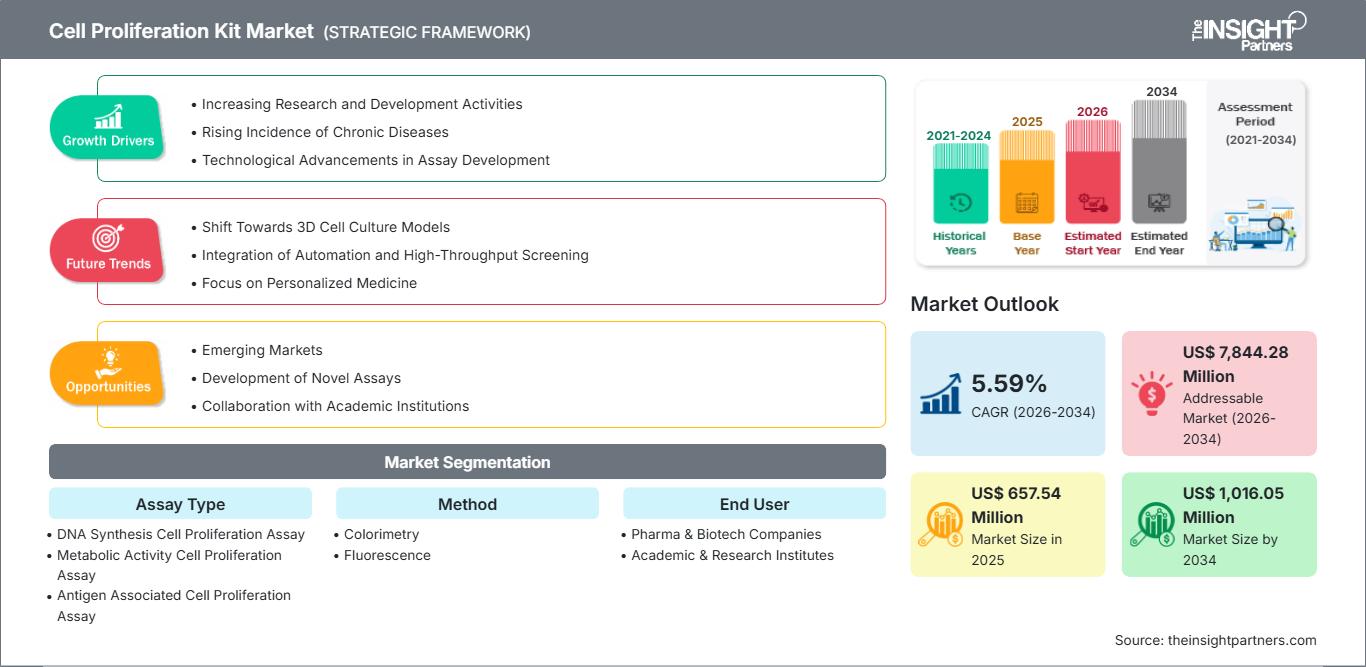
The Cell Proliferation Kit market was valued at US$ 657.54 million in 2025 and is expected to reach US$ 1016.05 million by 2034; it is estimated to record a CAGR of 4.95% during 2026-2034.
Cell Proliferation Kit Market Assessment and Insights
- North America: The region accounted for an estimated 36–38% share in 2025 and is projected to grow at a 5.2–5.8% CAGR between 2026–2034, supported by biopharmaceutical pipelines, research funding, and high-throughput screening infrastructure.
- US: The country represented 82–85% of North American revenue in 2025 and is expected to record a 5.3–5.9% CAGR between 2026–2034, reflecting concentrated pharmaceutical and academic purchasing.
- Europe: Europe held approximately 27–29% share in 2025 and is forecast to expand at a 4.9–5.5% CAGR between 2026–2034, led by Germany, the UK, and France.
- Asia Pacific: Asia Pacific generated an estimated 23–25% share in 2025 and is projected to register a 6.3–7.0% CAGR between 2026–2034, with China, Japan, South Korea, and India supporting adoption.
- Largest Segment: Metabolic Activity Cell Proliferation Assay captured an estimated 44–47% market share in 2025 and is expected to expand at a 5.1–5.7% CAGR during 2026–2034.
- High Growth Segment: Fluorescence represented approximately 43–46% market share in 2025 and is projected to register a 6.1–6.8% CAGR during 2026–2034, driven by sensitivity and multiplexing advantages.
- Key companies analyzed in detail: Thermo Fisher Scientific Inc., Merck KGaA, Bio-Rad Laboratories, Inc., Promega Corporation, Abcam Limited, Cell Signaling Technology, Inc., Revvity, Inc., Becton, Dickinson and Company, Sigma-Aldrich, Inc., and Roche Diagnostics International Ltd.
Source: The Insight Partners' analysis based on proprietary research, government publications, company annual reports, investor presentations, industry databases, and expert interviews.
Cell proliferation assays have moved from time-consuming assays using radioactivity towards more consistent and well-defined assays like colorimetric, fluorescent and antigen-based assays that can be used with microplate readers, imaging systems and flow cytometers. Manufacturers have been focusing more and more on developing ready-to-use assay kits having stabilized components, reduced incubation times, expanded dynamic range and ability to work with either 96- or 384-well systems.
During the forecast period, increased development of biomedical facilities in China, India, South Korea, and the Gulf states would increase the pool of users from the currently established labs in the West. Increased investment in translational oncology, biosimilars, cellular therapies and pharmaceutical production would drive the usage of assays. Emphasis by the regulatory bodies on replicable preclinical results would favor validated assay kits having clear performance specifications, whereas funding and laboratory infrastructure would make such tools available to smaller organizations.
Cell Proliferation Kit Market Report Scope
| Report Attribute | Details |
|---|---|
| Market size in 2025 | US$ 657.54 Million |
| Market Size by 2034 | US$ 1,016.05 Million |
| Global CAGR (2026 - 2034) | 4.95% |
| Historical Data | 2021-2024 |
| Forecast period | 2026-2034 |
Cell Proliferation Kit Market Analysis
The Cell Proliferation Kit Market will be propelled by the continuous requirement to measure cell response in assays for screening, target validation, toxicity, and model disease creation. Kits act as intermediaries between reagent manufacturers and end users such as distributors, instrument providers, contract research organizations, pharmaceutical labs, and academic institutions. There will always be a recurring demand as reagents are used with every plate, unlike in the case of current readers and cytometers, which provide the benefit of having an installed base.
Companies that have control over antibody, dye, substrate, and enzymes manufacture are at an advantage in supply chain dynamics. Quality assurance is key because variation from one lot to another may affect the output of experiments. Hence, there is an investment in standard formulations, technical services, application notes, and regional stocks. Colorimetric kits will remain broadly available, while fluorescence-based kits will be favored in applications where the researcher requires low detection limit and automation.
Based on the Cell Proliferation Kit Market Report, the competitive landscape is characterized by moderate fragmentation whereby general life science companies compete against assay vendors. Thermo Fisher Scientific Inc. and Merck KGaA take advantage of their wide range of reagents and instruments. Promega Corporation focuses on homogenous assays and luminescence assays. Bio-Rad Laboratories, Inc., Becton, Dickinson and Company, and Revvity, Inc. link assay usage to cytometry, imaging, or detection instrumentation.
Positioning strategies are becoming more and more focused on the integration of workflows and not just the performance of reagents in isolation. Abcam Limited and Cell Signaling Technology, Inc. facilitate the study of antigens due to their knowledge of antibodies. Roche Diagnostics International Ltd. and Sigma-Aldrich, Inc. leverage their laboratory distribution networks and molecular biology portfolios. Priorities in investment include multiplexing capability, automation compatible packaging, validation for 3D cell culture and digital protocol support.
● REPORT CUSTOMIZATION
Tailor This Report To Align With Your Specific Business Requirements
This report can be customized to align precisely with your business objectives, scope, and target markets. Customization options include tailored segmentation, geography, competitive analysis, and strategic insights to support informed decision-making.
Customize This Report →WHAT YOU CAN ADJUST
- ● Segmentations
- ● Geography
- ● Competitive Analysis
- ● Language Preferences
Cell Proliferation Kit Market: Strategic Insights
Regional Insights
North America Cell Proliferation Kit Market
The North American segment held about 36-38% market share in 2025 and is expected to grow at a 5.2-5.8% CAGR over 2026-2034. North America derives the strength from having pharmaceutical R&D clusters, experienced contract laboratories, sophisticated university infrastructure, and prevalence of microplate reader, imaging, and flow cytometer technologies. The Cell Proliferation Kit Market Share is boosted by the repetitive need of kits in oncology, immuno-oncology, regenerative medicines, and toxicology.
The United States is the major source of revenues, whereas Canada drives the demand for kits via academic medicine, biotechnology clusters, and public research institutes. The buying trend shifts towards more integrated test platforms with minimized manual interventions and laboratory-to-laboratory comparability. In fiscal 2025, the NIH made US$26.503 billion expenditures on research project grants, which represent a 3% annual growth, but the competition among the applicants is tightening. Such an environment drives scientists to prefer reproducible multi-purpose kits, which can be used for several test endpoints.
U.S. Cell Proliferation Kit Market
The US accounted for about 82-85% of North American sales in 2025 and is forecast to grow at a 5.3-5.9% CAGR over 2026-2034. Major vendors have commercial, manufacturing, or application support activities in this market, leading to better availability and support of their products. Proliferation assays are used in oncology, immunology, antibody drug conjugate, targeted protein degradation, and safety testing applications.
Purchasers in academic medical centers comprise yet another major group of buyers, owing to the relevance of proliferation assay for basic cellular biology and translational science. Automation, screening in 384-well format, disease models, organoids, and three-dimensional culturing set up demands for reproducibility and compatibility of assays. It is increasingly frequent that proliferation assays are correlated with cytotoxicity, apoptosis, or metabolism to distinguish growth arrest from cell death. Biomedical research funding by federal agencies and biotechnology clusters financed by venture capital constitute structural characteristics in this case, although budget limitations hinder acquisition of equipment and reagents.
Europe Cell Proliferation Kit Market
Europe accounted for 27-29% share in 2025 and will witness a CAGR of 4.9-5.5% from 2026 to 2034. Germany is the front-runner owing to pharmaceutical production, applied biosciences, and advanced research facilities. Germany focuses on standard workflows, automation compatibility, and documentation of the reagents' quality, facilitating high-end fluorescence and antigen-based kits.
The UK is home to some leading universities, oncology research centers, and biotech hubs. The UK research system facilitates early testing of no-wash, multiplex, and 3D cell culture assay systems. Public biomedical institutions of France and pharmaceutical discovery drive the market there, while the presence of national translational research networks in France ensures demand for precise cell-based assays.
Italy and Spain support themselves through the creation of research centers based in universities and hospitals concentrating on cancer biology, immunology, and tissue engineering. Purchase processes are relatively cost-conscious, leading to increased demand for colorimetric test kits from distributors. Replacement of radiometric methods, the need for reproducibility, and international cooperation in research among countries in Europe ensure constant usage, despite differences in budget allocation among different countries.
APAC Cell Proliferation Kit Market
Share of Asia Pacific region stood at about 23-25% in 2025 and is estimated to exhibit growth at a CAGR of 6.3-7.0% between 2026 and 2034. Leading contributors include pharmaceutical production from China, biotechnology cluster growth and high research facilities, screening equipment from Japan, and bio-pharmaceutical and cell therapy development in South Korea.
Increasing contract research and biosimilars development in India will create a need for affordable and scalable kits. Highly advanced university and medical research network in Australia are among the regional factors. Government policies in favor of domestic biotechnology, laboratory modernization, and translational medicine can promote usage.
Middle East & Africa Cell Proliferation Kit Market
The Middle East and Africa region is forecast to expand at a 4.4–5.1% CAGR during 2026–2034. Saudi Arabia leads through healthcare diversification, university investment, and new biotechnology infrastructure, while the UAE is developing research laboratories linked to precision medicine and advanced healthcare services.
South Africa remains an important African research center with established universities and infectious-disease capabilities. Elsewhere, adoption is constrained by laboratory funding, cold-chain availability, and instrument access. Energy-funded economic diversification and shared research facilities in Gulf countries should improve purchasing capacity, while distributor partnerships will remain essential across the rest of the region.
Segmentation Analysis
Assay Type
Assay type is projected to register a 5.3–5.9% CAGR during 2026–2034. The Cell Proliferation Kit Market scope includes direct DNA synthesis measurements, metabolic proxies, and antigen-associated markers, enabling laboratories to select products according to throughput, biological specificity, equipment availability, and sample type. Demand is shifting toward assays that separate proliferative activity from metabolic changes and permit combination with cytotoxicity or imaging endpoints.
- DNA Synthesis Cell Proliferation Assay: These assays directly track newly synthesized DNA through nucleoside incorporation, supporting mechanistic oncology, cell-cycle, and drug-response studies where researchers require stronger biological specificity than indirect metabolic readouts.
- Metabolic Activity Cell Proliferation Assay: Metabolic formats maintain the broadest installed base because they provide economical, scalable, and familiar workflows for routine viability, proliferation, cytotoxicity, and compound-screening applications.
- Antigen Associated Cell Proliferation Assay: Antigen-associated kits detect markers such as Ki-67 and are strategically important when metabolic activity may not accurately reflect division, particularly in cell-cycle arrest studies and complex models.
Method
Method-based demand is expected to expand at a 5.5–6.1% CAGR during 2026–2034. Instrument availability, required sensitivity, multiplexing needs, and laboratory budgets shape purchasing decisions. Colorimetry remains accessible for routine experiments, whereas fluorescence benefits from automated screening, lower cell-number detection, and compatibility with multiple markers. Suppliers offering protocols validated across common readers can reduce switching barriers and support broader laboratory adoption.
- Colorimetry: Colorimetric kits remain widely used in academic and routine screening laboratories because absorbance readers are broadly available, protocols are familiar, and per-well costs remain manageable for repeated experiments.
- Fluorescence: Fluorescence methods are gaining strategic importance in high-content and low-cell-number workflows, offering stronger sensitivity, wider multiplexing options, and compatibility with automated imaging or flow-based analysis.
End User
End-user demand is projected to record a 5.4–6.0% CAGR during 2026–2034. Pharmaceutical and biotechnology companies contribute high-volume recurring consumption through discovery pipelines, while academic and research institutes generate diversified demand across disease biology and method development. Vendor decisions depend on throughput, reproducibility, procurement cycles, technical support, and the ability to transfer protocols between early research and industrial screening environments.
- Pharma & Biotech Companies: These organizations represent the strongest commercial opportunity because proliferation measurements support target validation, efficacy testing, toxicology, biologics development, and standardized high-throughput compound screening.
- Academic & Research Institutes: Academic users sustain broad assay diversity through cancer, immunology, stem cell, and fundamental biology projects, although purchasing is more sensitive to grant timing and reagent affordability.
Opportunity Snapshot
| End User | Revenue Contribution (High/Medium/Low) | Trend Tag | Adoption Stage (Emerging/Scaling/Mature) |
| Pharma & Biotech Companies | High | Pipeline Screening | Mature |
| Academic & Research Institutes | Medium | Translational Models | Scaling |
Cell Proliferation Kit Market Growth Drivers and Impact Analysis
Expansion of Oncology and Targeted-Therapy Research
The rising cancer burden is increasing the number and diversity of preclinical programs that require repeatable measurements of tumor-cell growth, treatment response, and resistance. WHO and IARC reported an estimated 20 million new cancer cases in 2022 and project annual incidence to approach 35 million by 2050. These epidemiological conditions support sustained research into small molecules, biologics, antibody-drug conjugates, and combination therapies. Each program can require proliferation testing across multiple cell lines, concentrations, treatment periods, and replicates. Consequently, kit consumption rises with experimental complexity rather than solely with the number of drug candidates. Vendors that validate products for three-dimensional cultures, patient-derived cells, and difficult tumor models can address higher-value applications and improve protocol transfer between discovery groups.
Automation of Pharmaceutical Screening Workflows
Automation is increasing the number of experimental wells processed while reducing tolerance for multistep washing, manual reagent preparation, and unstable signals. Pharmaceutical and contract research laboratories increasingly use 96-well and 384-well formats to compare compound libraries and dose-response relationships. This operating model favors homogeneous add-and-read kits, premixed reagents, automation-compatible packaging, and broad assay windows. The commercial impact extends beyond higher kit volumes because automated laboratories often standardize one validated method across multiple programs. Once integrated into robotic liquid-handling and analytical systems, replacement becomes operationally costly. Suppliers can therefore build recurring revenue through dependable lot performance, software-compatible protocols, and technical support. Products that combine proliferation with cytotoxicity or another endpoint can further reduce plate usage and improve screening efficiency.
Greater Emphasis on Reproducible Preclinical Evidence
Research organizations are scrutinizing variability arising from cell density, incubation time, metabolic state, reagent preparation, and instrument settings. Standardized commercial kits address part of this challenge through defined components, optimized controls, traceable manufacturing, and documented protocols. The market impact is strongest in collaborative programs where results must be transferred among discovery, toxicology, and external research teams. Buyers increasingly assess inter-assay precision, dynamic range, cell-line validation, signal stability, and compatibility with serum or three-dimensional matrices rather than focusing only on unit price. This shift supports suppliers with rigorous quality systems and detailed application data. It also creates an opening for reference controls, digital protocol tools, and training services that improve experimental consistency without requiring customers to develop assays internally.
Cell Proliferation Kit Market Future Trends
Proliferation-Specific Readouts Will Complement Metabolic Assays
The leading Cell Proliferation Kit Market trends will include wider adoption of direct or proliferation-specific measurements when cellular metabolism does not accurately represent division. DNA synthesis and Ki-67 detection can help researchers identify cell-cycle arrest without misclassifying increased cell size or metabolic activity as proliferation. Vendors will position these formats alongside established MTT, MTS, WST, and resazurin products rather than replacing them universally. Product development will emphasize no-wash protocols, shorter treatment windows, multiplexed cytotoxicity measurement, and validation in organoids or spheroids. Promega Corporation’s wash-free Ki-67 system illustrates this movement toward metabolism-independent, plate-based readouts compatible with 96-well and 384-well workflows.
Integrated Multiparameter and Three-Dimensional Workflows
Future kits will increasingly support simultaneous assessment of proliferation, viability, cytotoxicity, apoptosis, or cell identity within the same experimental workflow. Multiparameter designs can reduce sample consumption and reveal whether a candidate suppresses division, causes cell death, or produces a transient metabolic response. Compatibility with spheroids, organoids, co-cultures, and patient-derived models will become a stronger purchasing criterion as discovery programs seek more physiologically representative evidence. Suppliers will need to optimize reagent penetration, signal uniformity, and analysis protocols for complex cultures. Instrument partnerships and prevalidated assay panels may accelerate adoption by reducing method-development time for laboratories transitioning from conventional two-dimensional monolayers.
Cell Proliferation Kit Market Opportunities
Localized Supply and Technical Support in Asia Pacific
Asia Pacific offers an investment opportunity for localized reagent finishing, regional inventory, distributor training, and multilingual application support. Cell Proliferation Kit Market Forecasts indicate that the region’s 6.3–7.0% CAGR will exceed growth in established Western markets as China, India, South Korea, and Southeast Asian countries expand pharmaceutical and academic research. Suppliers can improve conversion by offering smaller pack sizes for university laboratories and bulk configurations for contract research or industrial screening. Local validation using commonly studied cell lines can strengthen confidence, while dependable inventory can mitigate import delays and cold-chain risk. Partnerships with biotechnology parks, shared laboratories, and regional instrument providers provide efficient commercial entry routes.
Assay Bundles for Translational and Complex Cell Models
Manufacturers can create differentiated bundles pairing proliferation kits with apoptosis, cytotoxicity, oxidative stress, or cell-cycle reagents. Such combinations allow researchers to interpret treatment effects more comprehensively and reduce the time required to source compatible products. Commercial priorities should include validation in organoids, spheroids, immune-cell co-cultures, stem cells, and patient-derived samples. Vendors can also offer application-specific protocols for oncology, immunotherapy, regenerative medicine, and antibody development. Bundled controls, analysis templates, and consultation services would support adoption among laboratories without dedicated assay-development teams. This strategy can increase revenue per experiment while establishing a common reagent ecosystem across discovery and validation stages.
Recent Developments
- July 2026: DeNovix Inc. released CellGlow, a ready-to-use AO/PI viability assay for automated cell counting. Precision-coated, surface-stabilized fluorophores are supplied in strip tubes for room-temperature bench storage, and samples require no incubation before analysis. The assay works with the CellDrop Automated Cell Counter and other automated counting platforms.
- June 2026: Promega Corporation launched the Lumit Cell Proliferation Assay for Human Ki-67 in the UK. The homogeneous, wash-free assay uses NanoBiT luciferase technology and supports 96-well and 384-well microplates. It measures a metabolism-independent proliferation marker and is compatible with three-dimensional culture workflows.
- May 2025: Amerigo Scientific introduced an expanded range of cell proliferation and viability assay kits for drug discovery, immunology, regenerative medicine, and cancer research. The products were presented as compatible with microscopy, flow cytometry, microplate readers, and high-content screening, with streamlined protocols designed to reduce hands-on time.
Frequently Asked Questions

- Comprehensive Market Sizing and Forecast Analysis
- Detailed Segmentation Analysis
- In-Depth Market Dynamics Assessment
- Regional and Country-Level Insights
- Competitive Landscape and Company Benchmarking
- Strategic Business Intelligence
Recent Reports
Testimonials

The Insight Partners provided valuable market intelligence that supported our global go-to-market strategy. Their team was professional, responsive, and attentive to our feedback, providing thoughtful analysis and helpful methodological clarifications throughout the project.
Junmo Kim Chief Financial Officer (CFO), Enertech Co., Ltd.
The Insight Partners' SCADA System Market report is comprehensive, with valuable insights on current trends and future forecasts. The team was highly professional, responsive, and supportive throughout. We are very satisfied and highly recommend their services.
RAN KEDEM Partner, Reali Technologies LTDs
I requested a report on a very specific software market and the team produced the report in a few days. The information was very relevant and well presented. I then requested some changes and additions to the report. The team was again very responsive and I got the final report in less than a week.
JEAN-HERVE JENN Chairman, Future Analytica
We worked with The Insight Partners for an important market study and forecast. They gave us clear insights into opportunities and risks, which helped shape our plans. Their research was easy to use and based on solid data. It helped us make smart, confident decisions. We highly recommend them.
PIYUSH NAGPAL Sr. Vice President, High Beam Global
The Insight Partners delivered insightful, well-structured market research with strong domain expertise. Their team was professional and responsive throughout. The user-friendly website made accessing industry reports seamless. We highly recommend them for reliable, high-quality research services
YUKIHIKO ADACHI CEO, Deep Blue, LLC.
This is the first time I have purchased a market report from The Insight Partners.While I was unsure at first, I visited their web site and felt more comfortable to take the risk and purchase a market report.I am completely satisfied with the quality of the report and customer service. I had several questions and comments with the initial report, but after a couple of dialogs over email with their analyst I believe I have a report that I can use as input to our strategic planning process.Thank you so much for taking the extra time and making this a positive experience.I will definitely recommend your service to others and you will be my first call when we need further market data.
JOHN SUZUKI President and Chief Executive Officer, Board Director, BK Technologies
I wish to appreciate your support and the professionalism you displayed in the course of attending to my request for information regarding to infectious disease IVD market in Nigeria. I appreciate your patience, your guidance, and the fact that you were willing to offer a discount, which eventually made it possible for us to close a deal. I look forward to engaging The Insight Partners in the future, all thanks to the impression you have created in me as a result of this first encounter.
DR CHIJIOKE ONYIA MANAGING DIRECTOR, PineCrest Healthcare Ltd.Reason to Buy
- Informed Decision-Making
- Understanding Market Dynamics
- Competitive Analysis
- Identifying Emerging Markets
- Customer Insights
- Market Forecasts
- Risk Mitigation
- Boosting Operational Efficiency
- Strategic Planning
- Investment Justification
- Tracking Industry Innovations
- Aligning with Regulatory Trends





 Get Free Sample for