
Cell Surface Markers Detection Market Share, Growth & Forecast by 2034
Cell Surface Markers Detection Market Size and Forecasts (2021 - 2034), Global and Regional Share, Trends, and Growth Opportunity Analysis Report Coverage : by Product (Flow Cytometry, Hematology Analyzers, Cell Imaging Systems, Reagents and Kits, Other Products); Application (Disease Diagnosis and Identification, Research, Drug Discovery, Other Applications); and Geography (North America, Europe, Asia Pacific, and South and Central America)
- Status : Data Released
- Report Code : TIPRE00040080
- Category : Life Sciences
- No. of Pages : 150
- Available Report Formats :


- Last update date : September 09, 2026


2025 Market Size
US$ 6.40 Bn
Base year value
2034 Forecast
US$ 11.89 Bn
Projected by 2034
CAGR 2026-2034
7.11 %
Growth rate
Addressable Market
US$ 82.49 Bn
(2026-2034)
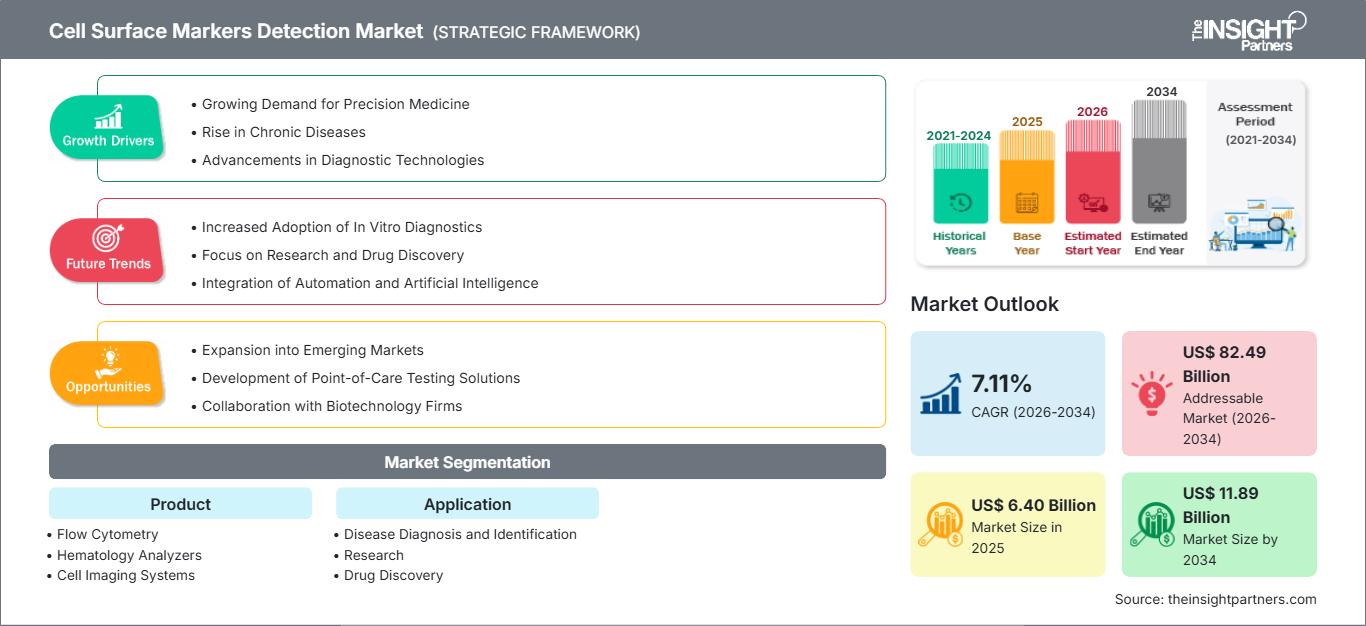
The Cell Surface Markers Detection Market was valued at US$ 6.40 Billion in 2025 and is projected to reach US$ 11.89 Billion by 2034, expanding at a CAGR of 7.11% during 2026–2034. Demand for this market is driven by the growing accuracy of immunophenotyping, increasing application of cell-based assay testing, and incorporation of molecular testing within clinical diagnosis, translational research, and drug discovery procedures.
In the case of North America, the Cell Surface Markers Detection Market Size is projected to grow at a projected CAGR of 6.6-7.2% over 2026-2034. High usage of flow cytometry tests for clinical purposes, well-established networks of hematopathology, and immuno-oncology research investments are driving demand. Flow cytometric tests for hematological neoplasms are categorized as Class II devices in the U.S.
Cell Surface Markers Detection Market Assessment and Insights
- North America: The region represented an estimated 38–41% share in 2025 and is projected to record a 6.6–7.2% CAGR between 2026–2034, supported by clinical immunophenotyping, biopharmaceutical research, and mature laboratory infrastructure.
- US: The country accounted for approximately 82–85% of North American revenue in 2025 and is expected to expand at a 6.5–7.1% CAGR during 2026–2034.
- Europe: Europe held an estimated 27–30% share in 2025 and is forecast to grow at a 6.3–6.9% CAGR during 2026–2034, led by Germany, the UK, and France.
- Asia Pacific: Asia Pacific captured approximately 22–25% in 2025 and is projected to register a 8.0–8.7% CAGR during 2026–2034, with China, Japan, India, and South Korea driving adoption.
- Largest Segment: Flow Cytometry held an estimated 42–46% market share in 2025 and is projected to advance at a 7.2–7.8% CAGR during 2026–2034.
- High Growth Segment: Drug Discovery represented approximately 19–22% market share in 2025 and is expected to grow at a 8.1–8.8% CAGR during 2026–2034.
- Key companies analyzed in detail: Abbott Laboratories, Danaher Corporation, Beckman Coulter, Inc., Becton, Dickinson and Company, Bio-Rad Laboratories, Inc., Thermo Fisher Scientific Inc., Merck KGaA, Miltenyi Biotec B.V. & Co. KG, Revvity, Inc., F. Hoffmann-La Roche Ltd, and Agilent Technologies, Inc.
Source: The Insight Partners' analysis based on proprietary research, government publications, company annual reports, investor presentations, industry databases, and expert interviews.
Laboratory workflows have evolved from low-parameter antigen detection to spectral, imaging-based and highly multiplexed single cell analyses. The instrument manufacturers are employing sensitive optics, automated compensation, standardized reagent kits, and machine learning analytics to minimize variability. There is increasing trend towards adoption of integrated solutions, which would link antibodies, fluorochromes, controls, instruments, and software. Modularity also allows laboratories to add features to existing cytometers without replacement of the entire system, thereby lowering capital requirements and increasing number of measurable parameters.
During the forecast period, laboratories in Asia Pacific and certain regions of Middle East will receive investments owing to increase in capacity of oncology facilities, biobanking and translational research initiatives. The regulatory requirement for validated workflows, quality control systems, software validation and sample processing protocols will favor the manufacturers offering instrument-reagent portfolios. The rising incidences of cancer will drive the need for scalable analytical tools; however, reimbursement policy, specialist availability and standardization among laboratories will affect the clinical adoption rate.
Cell Surface Markers Detection Market Report Scope
| Report Attribute | Details |
|---|---|
| Market size in 2025 | US$ 6.40 Billion |
| Market Size by 2034 | US$ 11.89 Billion |
| Global CAGR (2026 - 2034) | 7.11% |
| Historical Data | 2021-2024 |
| Forecast period | 2026-2034 |
Cell Surface Markers Detection Market Analysis
The key drivers for growth of the Cell Surface Markers Detection Market include the need for determining immune cell population, differentiation of hematologic cancers, evaluation of therapeutic efficacy, and selection of study subjects. The value chain includes antibody production, fluorochrome labeling, assay development, instrumentation, software application, distribution, laboratory testing, and interpretation of results. Quality and supply reliability of reagents are crucial factors since multicolor tests need reproducible performance parameters.
The supply environment is favorable to those companies which provide not only instrumentation but also recurrent consumables, support services, and analysis tools. High-dimensional cell surface markers detection generates the need for brighter fluorochromes and standardized multiplex panels in addition to compensation, spectral unmixing, and storage of large volumes of data. Flow cytometry allows rapid examination of thousands of single cells and finds wide application in immunology, oncology, virology, and molecular biology.
In the Cell Surface Markers Detection market report, it was found that there is a concentrated instrument market and a diversified one for reagents and antibodies. Becton, Dickinson and Company and Danaher Corporation use competitive advantage through their cytometer systems, software, and laboratory presence. Thermo Fisher Scientific Inc., Bio-Rad Laboratories, Inc., Merck KGaA, and Miltenyi Biotec B.V. & Co. KG are using reagents, cell sorting, antibodies, and research workflow integration as competitive factors.
Spectral capability, imaging, automation, application expertise, and system interoperability are the new key areas to position strategically in this market. Abbott Laboratories, F. Hoffmann-La Roche Ltd, and Beckman Coulter, Inc. have an edge in the field of clinical diagnostics, whereas Revvity, Inc. and Agilent Technologies, Inc. are strong in imaging and drug development workflows. There is an increasing trend towards platforms capable of reducing time in panel design and improving reproducibility.
● REPORT CUSTOMIZATION
Tailor This Report To Align With Your Specific Business Requirements
This report can be customized to align precisely with your business objectives, scope, and target markets. Customization options include tailored segmentation, geography, competitive analysis, and strategic insights to support informed decision-making.
Customize This Report →WHAT YOU CAN ADJUST
- ● Segmentations
- ● Geography
- ● Competitive Analysis
- ● Language Preferences
Cell Surface Markers Detection Market: Strategic Insights
Regional Insights
North America Cell Surface Markers Detection Market
North America represented an estimated 38–41% of the Cell Surface Markers Detection Market Share in 2025 and is forecasted to witness 6.6–7.2% CAGR from 2026–2034. The market demand emanates from established hematopathology services, biopharmaceutical research spending, large cancer center network presence, and adoption of spectral cytometry technology. Additionally, clinical labs also enjoy well-established procurement processes and availability of experienced flow cytometry personnel.
Some of the players within this industry are the instrument manufacturers, antibody suppliers, contract research organizations, academic core facilities, and reference laboratories. Special controls for Class II devices in the US require that the following information must be submitted about the device’s intended use, structure, composition, software, method, technique, quality control testing, sample preparation, and analysis, and result reporting.
U.S. Cell Surface Markers Detection Market
The U.S. accounted for approximately 82-85% of North American revenues in 2025, and growth is anticipated at a rate of 6.5-7.1% CAGR during 2026-2034. High prevalence of oncology networks, pharmaceutical drug pipeline programs, NIH research programs, and well-established technology for immunophenotyping drive instrument and reagent purchases. While diagnosis of diseases takes precedence, immunotherapy, cell therapy, vaccine research, and biomarker discovery increase research applications.
Becton, Dickinson and Company, Danaher Corporation, Thermo Fisher Scientific Inc., Bio-Rad Laboratories, Inc., and Agilent Technologies, Inc. have strong operations or commercial presence. There is a growing trend towards adopting higher parameters that assess cell identity, cell activation, cell exhaustion, and cell responses simultaneously. FDA endorsement of flow cytometry systems for diagnosing hematological neoplasms allows clinical usage of this technology; however, analysis should continue to be combined with pathology findings.
Europe Cell Surface Markers Detection Market
Europe had 27-30% share in 2025 and is projected to have a CAGR of 6.3-6.9% during 2026-2034. Germany is the leading country, driven by molecular diagnostic laboratories, biotechnology centers, and hospital laboratories. The UK is the key driver, driven by genomics, immunology, academic medicine, and early drug discovery.
France has centralization of cancer treatment and public research, while Italy and Spain have hematology and translational oncology programs. Reproducibility, test validation, data management, and consistency in multiple sites are being prioritized in Europe, thereby driving the adoption of standard panels and quality control materials.
But regional purchasing is yet not harmonized in national health care sectors. Whereas the budget cuts in the clinical market can lead to replacement cycles, the research market will adopt modular spectral systems and automation. The presence of Merck KGaA, Miltenyi Biotec B.V. & Co. KG, F. Hoffmann-La Roche Ltd, and foreign cytometer manufacturers in the regions increases technical support and distribution.
APAC Cell Surface Markers Detection Market
Asia Pacific occupied approximately 22% to 25% market share in 2025 and expected to grow at a 8.0% to 8.7% CAGR until 2034. In terms of revenue generation, China takes lead because of its modern hospitals, biotechnology funding, and increase in oncological studies. Japan has well-equipped diagnostic and pharmaceutical labs, whereas South Korea focuses on biopharmaceuticals and cellular research.
India is setting up diagnostic facilities and contract research facilities, whereas Australia provides mature academic and clinical infrastructure. Precision medicine, local biotechnology, and research contribute to the purchase of instruments. Asia contributed to 50.7% to cancer incidence rate globally in 2024.
Middle East & Africa Cell Surface Markers Detection Market
The market in the area is forecast to grow at a CAGR of 6.9-7.6% in the period between 2026-2034. Saudi Arabia is the key market owing to hospital investments, establishment of labs and national life-science initiatives. In UAE, there is growth owing to reference laboratories and medical research, whereas South Africa is significant for pathology, infectious disease research and academic cytometry.
In other countries, limitations exist owing to capital expenses, supply of reagents, maintenance and shortage of skilled personnel. Programs for infrastructure development in Gulf states owing to energy funds help in the building of labs, but for their sustainable use, training needs to be provided.
Segmentation Analysis
Product
Product demand is projected to increase at a 7.0–7.6% CAGR during 2026–2034. The Cell Surface Markers Detection Market scope covers instruments that capture phenotypic signals, analyzers that classify blood-cell populations, imaging systems that add spatial context, and consumables supporting target recognition. Purchasing decisions balance parameter capacity, throughput, sensitivity, installed-base compatibility, software usability, validation requirements, and recurring reagent expenditure.
- Flow Cytometry: Flow cytometry occupies the leading product position because it combines rapid single-cell measurement, multiparameter analysis, sorting compatibility, and mature protocols for immunology, hematology, oncology, and therapeutic research.
- Hematology Analyzers: Hematology analyzers address high-throughput clinical workflows by automating blood-cell counting and classification, supporting routine screening while directing abnormal specimens toward more detailed immunophenotyping and specialist review.
- Cell Imaging Systems: Cell imaging systems provide morphological and spatial information that complements marker intensity, making them strategically relevant for phenotypic screening, cell-interaction studies, tissue models, and image-based drug discovery.
- Reagents and Kits: Reagents and kits generate recurring revenue because antibodies, dyes, buffers, controls, and prepared panels are consumed per assay and critically influence specificity, reproducibility, signal resolution, and laboratory efficiency.
Application
Application revenue is expected to grow at a 7.1–7.7% CAGR during 2026–2034. Clinical diagnosis provides durable demand, while research and drug discovery increase requirements for multiplexed immune profiling. Application selection determines panel composition, sample preparation, throughput, documentation, and analytical complexity. Diagnostic laboratories prioritize validated interpretation and reproducibility, whereas discovery users demand flexibility, higher dimensionality, and integration with genomic or functional data.
- Disease Diagnosis and Identification: This application maintains a leading position through leukemia and lymphoma classification, immune-status assessment, and abnormal-cell identification, with adoption supported by clinically understood markers and established laboratory protocols.
- Research: Academic and translational researchers use marker detection to characterize immune subsets, stem cells, cellular differentiation, infection responses, and disease mechanisms, sustaining demand for adaptable panels and shared instruments.
- Drug Discovery: Drug discovery is strategically important for target validation, mechanism studies, toxicity assessment, patient stratification, and pharmacodynamic monitoring, particularly across immuno-oncology, autoimmune disease, and cell-based therapeutic programs.
Opportunity Snapshot
The Cell Surface Markers Detection Market Forecasts indicate that application-led investment will increasingly follow assay volume, clinical relevance, and data complexity.
| Application | Revenue Contribution (High/Medium/Low) | Trend Tag | Adoption Stage (Emerging/Scaling/Mature) |
| Disease Diagnosis and Identification | High | Clinical Phenotyping | Mature |
| Research | High | Immune Profiling | Scaling |
| Drug Discovery | Medium | Biomarker Screening | Scaling |
| Other Applications | Low | Workflow Expansion | Emerging |
Cell Surface Markers Detection Market Growth Drivers and Impact Analysis
Rising Burden of Cancer and Hematologic Disorders
Cancer incidence creates sustained requirements for cellular classification, immune profiling, and treatment monitoring. The International Agency for Research on Cancer estimated nearly 20 million new cancer cases and 9.7 million deaths in 2022, with annual cases projected to reach 35 million by 2050. Flow cytometric marker panels are particularly important in leukemia, lymphoma, myeloma, and minimal residual disease workflows because abnormal populations may be distinguished through combinations of lineage and maturation antigens. As oncology services expand, laboratories require instruments, antibodies, controls, software, and trained interpretation. The commercial impact extends beyond initial equipment placement because every diagnostic or monitoring test consumes reagents and quality-control materials, creating recurring demand across hospital and reference-laboratory networks.
Expansion of High-Parameter Single-Cell Analysis
Multiparameter analysis allows laboratories to extract more biological information from limited samples, improving the characterization of heterogeneous tumors, immune responses, and therapeutic mechanisms. Spectral cytometry measures broader fluorophore emission profiles and uses computational unmixing to distinguish overlapping signals. New modular systems can provide up to 88 detection channels and multiple autofluorescence channels, demonstrating how instrumentation is moving beyond conventional peak-based detection. This transition increases demand for validated antibody combinations, brighter fluorochromes, calibration materials, analytical software, data infrastructure, and training. Suppliers that coordinate these components can capture more value per laboratory while reducing integration burdens for users. High-parameter workflows also support longitudinal studies because researchers can evaluate several immune-cell states within one standardized assay.
Growing Role of Biomarkers in Drug Development
Biopharmaceutical developers increasingly use cell-surface phenotypes to confirm target expression, identify responsive subpopulations, evaluate immune activation, and monitor pharmacodynamic effects. These capabilities are relevant to monoclonal antibodies, checkpoint inhibitors, bispecific molecules, vaccines, and engineered cell therapies. Marker-based assays can improve candidate selection by connecting drug exposure with changes in defined cellular populations. They also support trial enrichment and exploratory endpoint development when backed by controlled methods and prespecified interpretation. Commercial laboratories consequently need scalable platforms that transfer reliably from discovery into regulated studies. Suppliers benefit through instrument placements, customized panels, assay-development services, and long-term reagent consumption. Regulatory interest in minimal residual disease and biomarker-supported oncology development further encourages investment in sensitive, reproducible cellular measurement workflows.
Cell Surface Markers Detection Market Future Trends
Convergence of Spectral Cytometry, Imaging, and Artificial Intelligence
The principal Cell Surface Markers Detection Market trends will involve convergence between spectral information, cellular morphology, and computational interpretation. Instruments will increasingly capture fluorescence, scatter, and image-based features within one workflow, allowing researchers to distinguish cells with similar antigen patterns but different structures or spatial distributions. Artificial intelligence-assisted quality control may flag unstable staining, anomalous populations, and compensation errors before final interpretation. Vendors will focus on traceable algorithms, explainable classification, and interoperable data formats because clinical laboratories require oversight rather than opaque automation. This convergence should raise analytical value per sample while shifting competitive differentiation from hardware specifications toward integrated evidence, software usability, and reproducibility.
Greater Standardization of Complex Marker Panels
High-dimensional assays will move from individually designed laboratory experiments toward curated, application-specific panels supported by reference controls and standardized analysis templates. This transition is necessary because manual sample preparation, gating, reagent handling, and instrument settings can introduce variability. Professional working groups and clinical laboratories are already emphasizing harmonization for hematological malignancy testing. Future products are likely to include preconfigured antibody combinations, digital panel-design tools, lot-specific performance documentation, and cloud-enabled interlaboratory comparison. Standardization will expand access beyond specialist centers, but suppliers must preserve sufficient flexibility for new biomarkers. Commercial advantage will favor companies that demonstrate cross-site reproducibility without materially increasing processing time or technical burden.
Cell Surface Markers Detection Market Opportunities
Localized Reagent Manufacturing in High-Growth Asian Markets
Regional production of antibodies, buffers, controls, and prepared panels offers an investable opportunity in China, India, South Korea, and selected Southeast Asian markets. Local manufacturing can shorten lead times, reduce exposure to import disruption, and improve support for country-specific procurement requirements. Companies should prioritize widely used immune and hematology panels before expanding into specialized oncology or cell-therapy applications. Partnerships with hospital laboratories can generate local validation evidence and strengthen technical training. The opportunity is amplified by Asia’s substantial cancer burden and expanding biotechnology base. Successful investment will require consistent raw materials, cold-chain control, lot comparability, regulatory expertise, and compatibility with instruments already installed across public and private laboratories.
Workflow Solutions for Decentralized and Mid-Throughput Laboratories
Many regional hospitals and research institutions cannot justify high-end systems designed for major core facilities. Vendors can address this gap through compact analyzers, modular spectral upgrades, simplified software, remote support, and application-specific reagent packages. Investment should focus on reducing hands-on preparation, calibration complexity, and interpretation variability rather than competing solely on maximum parameter counts. Subscription service, reagent-rental, and managed-maintenance models can lower initial capital requirements while improving supplier revenue visibility. Laboratories adopting these systems could refer only ambiguous cases to specialist centers, preserving local turnaround times. The opportunity depends on credible training, quality assurance, connectivity, and escalation pathways that protect analytical reliability as testing becomes more geographically distributed.
Recent Developments
- April 2026: Beckman Coulter, Inc. expanded global access to Apostle MiniMax High-Efficiency Isolation Kits for isolating cell-free DNA, cell-free RNA, and total cell-free nucleic acids from liquid-biopsy specimens, strengthening its sample-preparation portfolio for multimodal analysis. Although centered on nucleic-acid isolation, the expansion supports laboratories combining cellular phenotyping with complementary molecular characterization.
- September 2025: Beckman Coulter, Inc. introduced IR820 and IR870 infrared dye antibody conjugates for human phenotyping experiments. The products were designed to offer single-laser excitation, limited interference with other fluorochrome emissions, and low autofluorescence background, providing laboratories with additional options for expanding complex flow-cytometry panels.
- June 2025: Becton, Dickinson and Company presented the BD FACSDiscover A8 Cell Analyzer and FlowJo version 11 at CYTO 2025. The analyzer combines high-parameter spectral immunophenotyping with real-time imaging cytometry, while the software update supports analysis of increasingly complex single-cell datasets and higher-dimensional research workflows.
Frequently Asked Questions

- Comprehensive Market Sizing and Forecast Analysis
- Detailed Segmentation Analysis
- In-Depth Market Dynamics Assessment
- Regional and Country-Level Insights
- Competitive Landscape and Company Benchmarking
- Strategic Business Intelligence
Recent Reports
Testimonials

The Insight Partners provided valuable market intelligence that supported our global go-to-market strategy. Their team was professional, responsive, and attentive to our feedback, providing thoughtful analysis and helpful methodological clarifications throughout the project.
Junmo Kim Chief Financial Officer (CFO), Enertech Co., Ltd.
The Insight Partners' SCADA System Market report is comprehensive, with valuable insights on current trends and future forecasts. The team was highly professional, responsive, and supportive throughout. We are very satisfied and highly recommend their services.
RAN KEDEM Partner, Reali Technologies LTDs
I requested a report on a very specific software market and the team produced the report in a few days. The information was very relevant and well presented. I then requested some changes and additions to the report. The team was again very responsive and I got the final report in less than a week.
JEAN-HERVE JENN Chairman, Future Analytica
We worked with The Insight Partners for an important market study and forecast. They gave us clear insights into opportunities and risks, which helped shape our plans. Their research was easy to use and based on solid data. It helped us make smart, confident decisions. We highly recommend them.
PIYUSH NAGPAL Sr. Vice President, High Beam Global
The Insight Partners delivered insightful, well-structured market research with strong domain expertise. Their team was professional and responsive throughout. The user-friendly website made accessing industry reports seamless. We highly recommend them for reliable, high-quality research services
YUKIHIKO ADACHI CEO, Deep Blue, LLC.
This is the first time I have purchased a market report from The Insight Partners.While I was unsure at first, I visited their web site and felt more comfortable to take the risk and purchase a market report.I am completely satisfied with the quality of the report and customer service. I had several questions and comments with the initial report, but after a couple of dialogs over email with their analyst I believe I have a report that I can use as input to our strategic planning process.Thank you so much for taking the extra time and making this a positive experience.I will definitely recommend your service to others and you will be my first call when we need further market data.
JOHN SUZUKI President and Chief Executive Officer, Board Director, BK Technologies
I wish to appreciate your support and the professionalism you displayed in the course of attending to my request for information regarding to infectious disease IVD market in Nigeria. I appreciate your patience, your guidance, and the fact that you were willing to offer a discount, which eventually made it possible for us to close a deal. I look forward to engaging The Insight Partners in the future, all thanks to the impression you have created in me as a result of this first encounter.
DR CHIJIOKE ONYIA MANAGING DIRECTOR, PineCrest Healthcare Ltd.Reason to Buy
- Informed Decision-Making
- Understanding Market Dynamics
- Competitive Analysis
- Identifying Emerging Markets
- Customer Insights
- Market Forecasts
- Risk Mitigation
- Boosting Operational Efficiency
- Strategic Planning
- Investment Justification
- Tracking Industry Innovations
- Aligning with Regulatory Trends





 Get Free Sample for