
Cellular-based M2M VAS Market Size, Trends & Demand by 2034
Coverage: By Type (2G, 3G, 4G, Others); Application (Automotive, Transportation and Logistics, Healthcare, Energy and Utilities, Retail, Consumer Electronics) , and Geography (North America, Europe, Asia Pacific, and South and Central America)
- Status : Data Released
- Report Code : TIPRE00021368
- Category : Technology, Media and Telecommunications
- No. of Pages : 150
- Available Report Formats :


- Last update date : July 28, 2026


2025 Market Size
US$ 3.12 Bn
Base year value
2034 Forecast
US$ 3.66 Bn
Projected by 2034
CAGR 2026-2034
1.77 %
Growth rate
Addressable Market
US$ 30.69 Bn
(2026-2034)
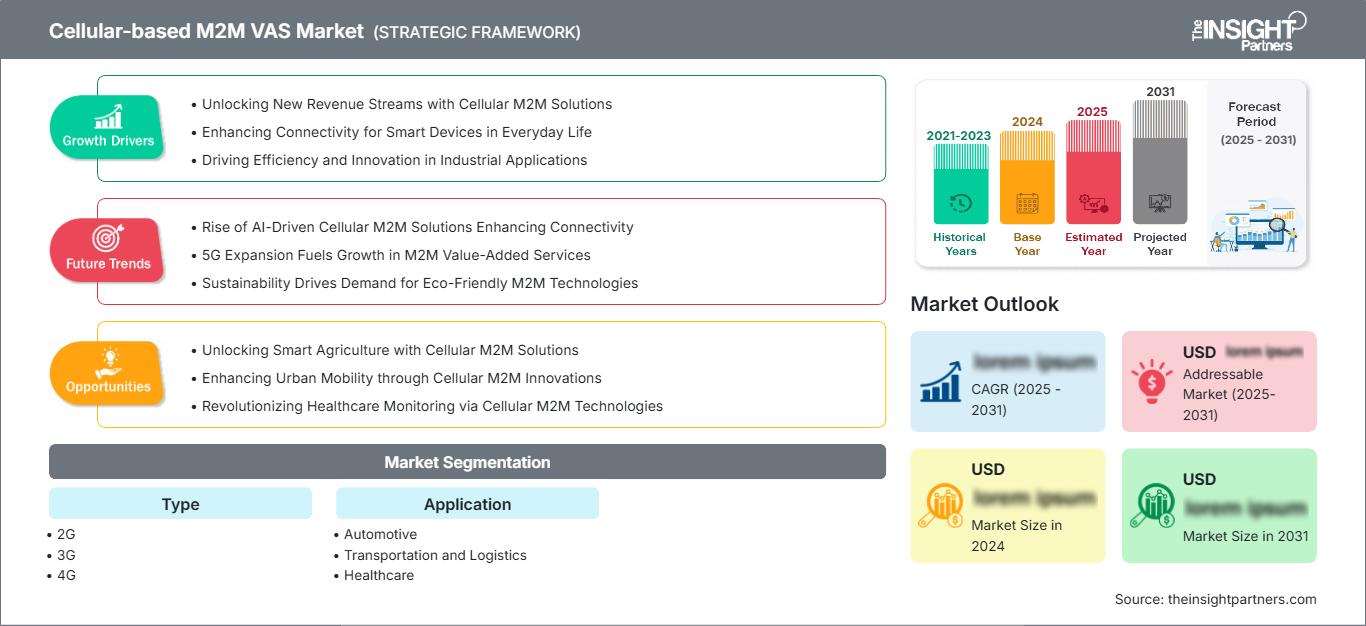
The cellular-based m2m vas market recorded a valuation of US$ 3.12 Billion in 2025 and is projected to reach US$ 3.66 Billion by 2034, advancing at a modest CAGR of 1.77% between 2026 and 2034. This subdued trajectory reflects a maturing value-added services layer built atop legacy cellular machine-to-machine connectivity as networks gradually transition toward newer standards.
The cellular-based m2m vas market size in North America is estimated to grow at a CAGR of 1.4-2.1% through 2034, supported by continued reliance on established M2M infrastructure across fleet telematics and utility metering. Regulatory pressure to retire legacy 2G and 3G networks tempers expansion while sustaining demand for migration and value-added support services.
Cellular-based M2M VAS Market Assessment and Insights
- North America: The region holds an estimated 32-36% share in 2025, growing at a CAGR of 1.4-2.1% between 2026-2034, as enterprises maintain legacy M2M deployments while gradually migrating toward newer cellular standards.
- US: The United States accounts for 86-91% share within North America in 2025, growing at a CAGR of 1.5-2.2% between 2026-2034, reflecting steady fleet and utility metering demand.
- Europe: Europe holds an estimated 26-29% share in 2025, growing at a CAGR of 1.2-1.9% between 2026-2034, with Germany and the United Kingdom leading adoption across automotive and utility applications.
- Asia Pacific: Asia Pacific commands a 24-27% share in 2025, expanding at the fastest CAGR of 2.0-2.8% between 2026-2034, led by China and Japan's continued industrial M2M deployment scale.
- Largest Segment: The 4G segment under Type leads with a 48-52% market share in 2025, growing at a CAGR of 2.4-3.1% between 2026-2034, as networks migrate away from 2G and 3G infrastructure.
- High Growth Segment: The Healthcare application segment shows the fastest expansion with a 12-15% share in 2025, projected to grow at a CAGR of 3.2-4.1% between 2026-2034, driven by remote patient monitoring adoption.
- Key companies analyzed in detail: AT&T Inc., T-Mobile US, Inc. (Sprint), Verizon Communications Inc., Vodafone Group Plc, Amdocs Limited, Sierra Wireless (Semtech Corporation), Numerex Corp. (Sierra Wireless), Digi International Inc., Thales Group (Gemalto), KDDI Corporation.
Source: The Insight Partners' analysis based on proprietary research, government publications, company annual reports, investor presentations, industry databases, and expert interviews.
Basic value-added services of cellular M2M started out with just plain connectivity management layers that were developed based on 2G networks for basic telemetry uses like vehicle tracking and vending machine monitoring. With the advancement of 3G and 4G networks, more value-added service options have emerged such as device management, data analytics, and security services, providing organizations the ability to derive more value from their connected devices beyond just basic connectivity services.
Going forward, opportunities for growth will involve device replacement driven by the end-of-life timeline of the carriers’ networks and gradual geographic penetration in Latin America and Africa, where the traditional cellular M2M service will still be more cost-effective than alternative LPWAN technologies. Regulatory initiatives related to connected vehicle safety data reports and utility grid modernization initiatives are expected to drive ongoing value-added services requirements regardless of the overall technology migration trend that is occurring.
Cellular-based M2M VAS Market Report Scope
| Report Attribute | Details |
|---|---|
| Market size in 2025 | US$ 3.12 Billion |
| Market Size by 2034 | US$ 3.66 Billion |
| Global CAGR (2026 - 2034) | 1.77% |
| Historical Data | 2021-2024 |
| Forecast period | 2026-2034 |
Cellular-based M2M VAS Market Analysis
Demand for cellular-based m2m vas market growth stems primarily from enterprises operating large device fleets that require centralized management, billing, and diagnostic services layered atop basic cellular connectivity. This ecosystem involves mobile network operators that provide the connectivity infrastructure, platform providers that give the device management and analytics capabilities, module providers, and systems integrators who integrate such services into specific vertical applications within transportation and utilities.
The supply chain dynamics are limited by the increasingly rapid phase-out of 2G and 3G networks around several geographies, making it imperative for the operators as well as their enterprise customers to migrate to the newer options in a structured manner. This migration process not only generates immediate value-added service requirements around network audit and device planning but also limits future growth for certain service offerings.
Competitive positioning within the cellular-based m2m vas market analysis shows telecom operators, including AT&T Inc., Verizon Communications Inc., and Vodafone Group Plc, leveraging existing network infrastructure to bundle value-added services with core connectivity contracts, while specialist platform providers differentiate through vertical-specific analytics and device management capabilities.
Investment activity concentrates on network migration support tools and billing platform modernization, with Amdocs Limited expanding operator-facing monetization software while Sierra Wireless, operating under Semtech Corporation, and Digi International Inc. strengthen module and gateway portfolios supporting multi-generation cellular compatibility, reflecting a strategic emphasis on transition-period service continuity across enterprise customer bases.
● REPORT CUSTOMIZATION
Tailor This Report To Align With Your Specific Business Requirements
This report can be customized to align precisely with your business objectives, scope, and target markets. Customization options include tailored segmentation, geography, competitive analysis, and strategic insights to support informed decision-making.
Customize This Report →WHAT YOU CAN ADJUST
- ● Segmentations
- ● Geography
- ● Competitive Analysis
- ● Language Preferences
Cellular-based M2M VAS Market: Strategic Insights
Regional Insights
North America Cellular-based m2m vas market
North America held an estimated 32-36% share of the global cellular-based m2m vas market in 2025 and is projected to grow at a CAGR of 1.4-2.1% through 2034. Growth remains modest as the region's mature M2M installed base, particularly across fleet telematics and utility metering, transitions gradually from legacy network dependency toward newer cellular standards and value-added service models.
Structural drivers include established billing and device management infrastructure among regional carriers, alongside regulatory requirements around connected vehicle emergency reporting that sustain baseline value-added service demand. Network sunset timelines set by major carriers continue to compel enterprise customers to engage migration-support services, providing a steady, if unspectacular, revenue stream for value-added service providers through the forecast period.
U.S. Cellular-based m2m vas market Market
The United States represents approximately 86-91% share of North America's cellular-based m2m vas market in 2025, growing at a CAGR of 1.5-2.2% between 2026-2034. This dominant position reflects the concentration of major cellular carriers and large enterprise M2M deployments across trucking, utility, and industrial monitoring applications nationwide.
Company presence remains strong domestically, with AT&T Inc., Verizon Communications Inc., and T-Mobile US, Inc. maintaining extensive M2M customer bases requiring ongoing value-added support. Application trends show steady demand from fleet management and smart metering, while healthcare remote monitoring emerges as an incremental growth contributor within an otherwise stable, mature application landscape.
Europe Cellular-based m2m vas market Market
Europe accounted for an estimated 26-29% share of the global cellular-based m2m vas market in 2025, growing at a CAGR of 1.2-1.9% through 2034, with Germany identified as the leading country given its strong automotive telematics base and extensive industrial M2M deployment across manufacturing regions.
Germany's automotive and industrial sectors sustain consistent demand for fleet and asset tracking value-added services, supported by established carrier infrastructure and strong enterprise adoption across major manufacturing hubs.
The United Kingdom maintains steady demand through utility metering and logistics tracking applications, with carriers offering bundled value-added services to support enterprise customers managing large connected device fleets.
France, Italy, and Spain collectively contribute moderate demand across transportation and utility applications, with France's logistics sector and Italy's industrial base sustaining incremental regional value-added service consumption.
APAC Cellular-based m2m vas market Market
Asia Pacific held an estimated 24–27% cellular-based M2M VAS market share in 2025 and is projected to register the fastest regional CAGR of 2.0–2.8% through 2034, with China identified as the leading country supported by its extensive industrial M2M deployment and logistics tracking scale.
Japan and South Korea contribute steady demand from established manufacturing and automotive telematics sectors, while India and Australia show gradual adoption tied to utility modernization. KDDI Corporation maintains a strong regional presence, and policy-driven industrial digitization continues to support incremental value-added service growth.
Middle East & Africa cellular-based m2m vas market Market
The Middle East and Africa region is projected to grow at a CAGR of 1.8-2.5% between 2026-2034, with Saudi Arabia identified as the leading market given its expanding utility infrastructure and logistics sector requiring fleet and asset monitoring value-added services across large-scale industrial projects.
The UAE contributes steady demand through logistics and smart utility applications, while South Africa and the Rest of MEA show emerging adoption tied to energy infrastructure monitoring, supported by gradual carrier network modernization investment across the broader region.
Segmentation Analysis
Type
The Type segment is projected to grow at a CAGR of 1.9-2.6% between 2026-2034.
The 4G sub-segment dominates as networks continue migrating away from legacy standards, while 3G maintains residual relevance during transition periods and 2G faces steady decline as carriers execute planned network sunsets across major regional markets, within the cellular-based m2m vas market scope.
- 2G: Legacy connectivity supports remaining low-bandwidth applications such as basic asset tracking, though carrier network sunsets are steadily reducing its installed base globally.
- 3G: Intermediate-generation connectivity retains use among devices pending upgrade cycles, particularly in regions where full 4G migration remains incomplete across enterprise fleets.
- 4G: Higher-bandwidth connectivity supports advanced telematics, video monitoring, and data-intensive applications, positioning it as the preferred standard for new M2M deployments.
Application
The Application segment is projected to grow at a CAGR of 1.8-2.5% between 2026-2034.
Automotive leads application-based demand given extensive fleet telematics and connected vehicle service requirements, while Healthcare represents the fastest-growing application as remote patient monitoring adoption accelerates, together anchoring diversified value-added service consumption across the broader application landscape.
- Automotive: Connected vehicle diagnostics, fleet tracking, and emergency call services represent the largest and most established application driving sustained value-added service demand.
- Transportation and Logistics: Asset tracking and supply chain visibility applications rely on value-added analytics to optimize routing and reduce operational inefficiencies across distribution networks.
- Healthcare: Remote patient monitoring devices increasingly depend on managed cellular connectivity services to ensure reliable, secure data transmission for clinical applications.
- Energy and Utilities: Smart metering and grid monitoring applications require device management and billing value-added services to support large-scale utility infrastructure deployments.
- Retail: Point-of-sale connectivity and inventory tracking applications utilize value-added services for centralized device management across distributed retail locations.
- Consumer Electronics: Connected wearables and portable devices rely on lightweight value-added connectivity management to support consumer-facing cellular applications.
Opportunity Snapshot
| Application | Revenue Contribution | Trend Tag | Adoption Stage |
| Automotive | High | Fleet Telematics | Mature |
| Transportation and Logistics | High | Asset Tracking | Mature |
| Healthcare | Medium | Remote Monitoring | Emerging |
| Energy and Utilities | Medium | Smart Metering | Scaling |
| Retail | Low | POS Connectivity | Mature |
| Consumer Electronics | Low | Wearable Devices | Emerging |
Cellular-based M2M VAS Market Growth Drivers and Impact Analysis
Network Sunset Timelines Compelling Enterprise Migration Support
Carriers in North America, Europe, and Asia have established clear time frames for shutting down 2G and 3G networks, which will force companies running large device networks to develop plans for migrating to 4G-enabled devices and services. This situation results in immediate demand for services like network assessment and auditing, logistics of replacing devices, and billing reconciliation for value-added services. Utility companies that run large numbers of smart meters, and logistics companies that monitor large vehicle fleets are at risk if they do not migrate properly, making them potential customers for value-added service providers. While this development will ensure revenue streams in the short to medium term, it also means the imminent obsolescence of services offered through legacy platforms.
Regulatory Mandates Supporting Connected Vehicle Services
Regulations dictating automatic emergency call systems and vehicle-to-vehicle safety reports in several geographical locations continue to ensure that there is some level of steady demand for cellular M2M value-added services among auto manufacturers. The regulations demand a reliable and monitored connection with additional diagnostic and reporting components, meaning that auto manufacturers have to keep paying for these services and cannot just incorporate connectivity into the device once and for all. Telematics programs offered by insurance companies providing premiums based on usage also contribute to this trend because the insurance companies have to utilize value-added analytics platforms to interpret data from the vehicles obtained via cellular connections.
Utility Grid Modernization Programs Sustaining Metering Demand
Utility firms operating in both developed and developing nations keep on spending money to build a smart metering ecosystem that will help them in having better visibility in their grid system, save costs, and promote the integration of renewable energy sources. In order to have cell-based meters operate successfully, there is a need for value-added services such as device management, updating of firmware remotely, and a platform that will enable them to aggregate data from these meters for use in operations by the utility company. Energy organizations worldwide have prioritized grid digitization, thereby increasing the demand for a connectivity management layer in these projects. The growing deployment of meters by utility companies in Asia Pacific and the Middle East has brought about value-added service demands for vendors with good ties with utility companies.
Cellular-based M2M VAS Market Future Trends
Gradual Convergence with LPWAN and NB-IoT Alternatives
Cellular-based m2m vas market trends increasingly point toward convergence between traditional cellular M2M value-added services and lower-power wide-area alternatives, including NB-IoT and LTE-M, which offer extended battery life and lower connectivity costs for specific use cases. Value-added service providers are adapting their platforms to support hybrid connectivity management across multiple network types rather than remaining exclusively tied to traditional cellular standards. This convergence allows enterprises to select the most cost-effective connectivity option per device type while maintaining unified management and analytics through a single service layer, gradually reshaping how value-added platforms are architected and positioned competitively.
Increased Emphasis on Cybersecurity for Legacy Device Fleets
Due to delays in complete hardware refresh cycles, older fleets of cellular M2M devices pose increasing risks in terms of cybersecurity and require the provision of additional security functions as part of value-added services offered by the vendors. Device authentication, anomaly detection, and firmware updates become a norm as opposed to an add-on, especially in the case of utility and healthcare verticals where sensitive operational data is processed. The reasoning behind this lies in the fact that legacy M2M technology creates an attack vector for hackers and thus should be considered an integral feature of value-added services.
Cellular-based M2M VAS Market Opportunities
Migration Advisory Services for Enterprise Fleet Operators
Substantial opportunity exists for value-added service providers to develop dedicated migration advisory offerings supporting enterprises navigating the transition away from sunsetting 2G and 3G networks, according to cellular-based m2m vas market forecasts spanning the coming years. Fleet operators, utilities, and logistics companies often lack internal expertise to plan large-scale device replacement efficiently, creating demand for structured consulting engagements covering hardware selection, phased rollout planning, and cost optimization. Providers that package migration advisory services alongside core connectivity offerings can capture incremental revenue while strengthening customer retention through the transition period. Early investment in dedicated migration teams and standardized assessment frameworks would position providers favorably as network sunset deadlines approach across multiple regional markets simultaneously.
Vertical-Specific Analytics Platforms for Healthcare Monitoring
Healthcare remote monitoring represents a comparatively underdeveloped opportunity within the broader value-added service landscape, given its fast growth trajectory relative to more mature applications such as automotive and logistics. Providers investing in healthcare-specific analytics capabilities, including secure data handling compliant with clinical data protection requirements and integration with electronic health record systems, could capture premium-priced contracts from hospital networks and medical device manufacturers. Partnerships between connectivity providers and healthcare technology firms would accelerate validated product development while addressing the specialized reliability and security standards this vertical demands. As remote patient monitoring adoption continues expanding globally, early movers in healthcare-focused value-added platforms stand to build durable, differentiated positioning within this higher-growth application segment.
Frequently Asked Questions

- Comprehensive Market Sizing and Forecast Analysis
- Detailed Segmentation Analysis
- In-Depth Market Dynamics Assessment
- Regional and Country-Level Insights
- Competitive Landscape and Company Benchmarking
- Strategic Business Intelligence
Recent Reports
Testimonials

The Insight Partners' SCADA System Market report is comprehensive, with valuable insights on current trends and future forecasts. The team was highly professional, responsive, and supportive throughout. We are very satisfied and highly recommend their services.
RAN KEDEM Partner, Reali Technologies LTDs
I requested a report on a very specific software market and the team produced the report in a few days. The information was very relevant and well presented. I then requested some changes and additions to the report. The team was again very responsive and I got the final report in less than a week.
JEAN-HERVE JENN Chairman, Future Analytica
We worked with The Insight Partners for an important market study and forecast. They gave us clear insights into opportunities and risks, which helped shape our plans. Their research was easy to use and based on solid data. It helped us make smart, confident decisions. We highly recommend them.
PIYUSH NAGPAL Sr. Vice President, High Beam Global
The Insight Partners delivered insightful, well-structured market research with strong domain expertise. Their team was professional and responsive throughout. The user-friendly website made accessing industry reports seamless. We highly recommend them for reliable, high-quality research services
YUKIHIKO ADACHI CEO, Deep Blue, LLC.
This is the first time I have purchased a market report from The Insight Partners.While I was unsure at first, I visited their web site and felt more comfortable to take the risk and purchase a market report.I am completely satisfied with the quality of the report and customer service. I had several questions and comments with the initial report, but after a couple of dialogs over email with their analyst I believe I have a report that I can use as input to our strategic planning process.Thank you so much for taking the extra time and making this a positive experience.I will definitely recommend your service to others and you will be my first call when we need further market data.
JOHN SUZUKI President and Chief Executive Officer, Board Director, BK Technologies
I wish to appreciate your support and the professionalism you displayed in the course of attending to my request for information regarding to infectious disease IVD market in Nigeria. I appreciate your patience, your guidance, and the fact that you were willing to offer a discount, which eventually made it possible for us to close a deal. I look forward to engaging The Insight Partners in the future, all thanks to the impression you have created in me as a result of this first encounter.
DR CHIJIOKE ONYIA MANAGING DIRECTOR, PineCrest Healthcare Ltd.Reason to Buy
- Informed Decision-Making
- Understanding Market Dynamics
- Competitive Analysis
- Identifying Emerging Markets
- Customer Insights
- Market Forecasts
- Risk Mitigation
- Boosting Operational Efficiency
- Strategic Planning
- Investment Justification
- Tracking Industry Innovations
- Aligning with Regulatory Trends





 Get Free Sample for