
Cellulose Casings Market Size, Trends & Demand by 2034
Coverage: by Type (Small Caliber Collagen Casings (Diameter Less Than 35mm), Large Caliber Collagen Casings (Diameter Larger Than 35mm)); Application (Non Edible Cellulose Casings, Edible Cellulose Casings) , and Geography (North America, Europe, Asia Pacific, and South and Central America)
- Status : Data Released
- Report Code : TIPRE00012665
- Category : Chemicals and Materials
- No. of Pages : 150
- Available Report Formats :


- Last update date : August 06, 2026


2025 Market Size
US$ 685.61 Mn
Base year value
2034 Forecast
US$ 914.7 Mn
Projected by 2034
CAGR 2026-2034
3.26 %
Growth rate
Addressable Market
US$ 7,268.91 Mn
(2026-2034)
The global Cellulose Casings market was valued at US$ 685.61 million in 2025 and is expected to reach US$ 914.7 million by 2034; it is estimated to record a CAGR of 3.26% during 2026-2034.
Cellulose Casings Market Assessment and Insights
- North America: North America accounted for a 30–34% share in 2025 and is anticipated to grow at a CAGR of 3.2%–3.8% during 2026–2034. Strong industrial meat processing capacity, automation investments, and compliance with food safety regulations continue to support regional demand.
- U.S.: The U.S. represented 78–82% of the North American market in 2025 and is projected to register a CAGR of 3.3%–3.9% during 2026–2034, supported by large-scale processed meat manufacturing and continuous production upgrades.
- Europe: Europe held a 28–32% share in 2025 and is forecast to expand at a CAGR of 3.1%–3.7% during 2026–2034. Germany, Spain, Italy, France, and the UK remain the leading manufacturing and consumption centers owing to mature processed meat industries.
- Asia Pacific: Asia Pacific captured a 24–28% share in 2025 and is expected to record the fastest regional expansion with a CAGR of 4.2%–4.8% during 2026–2034. China, Japan, South Korea, India, and Australia are driving demand through expanding food processing capacity and urban consumption.
- Largest Segment: Non-Edible Cellulose Casings accounted for 62–66% market share in 2025 and are projected to grow at a CAGR of 3.4%–3.9% during 2026–2034, reflecting widespread adoption in high-volume industrial sausage production.
- High Growth Segment: Edible Cellulose Casings represented 34–38% of the Cellulose Casings Market share in 2025 and are expected to expand at a CAGR of 4.1%–4.7% during 2026–2034, supported by innovation in convenience foods and premium processed meat applications.
- Key companies analyzed in detail: Atlantis-Pak, LLC, DeWied International, Inc., Fabios S.r.l., Kalle GmbH, Nitta Gosei Co., Ltd., Qingdao Artificial Casing Co., Ltd., Shenguan Holdings (Group) Limited, Viscofan, S.A., Viskase Companies, Inc., and Viskoteepak Holding AB.
Source: The Insight Partners' analysis based on proprietary research, government publications, company annual reports, investor presentations, industry databases, and expert interviews.
Continuous improvements in regenerated cellulose technology have transformed industrial casing production by enhancing dimensional consistency, tensile strength, and compatibility with automated filling equipment. Manufacturers are increasingly integrating precision extrusion, advanced drying systems, and quality monitoring technologies to improve production efficiency while minimizing material waste. Rising emphasis on food safety, processing efficiency, and standardized product appearance has reinforced the adoption of cellulose casings across commercial meat processing facilities. Furthermore, sustainability initiatives encouraging optimized resource utilization and lower manufacturing emissions are influencing innovation strategies among leading producers, supporting the long-term evolution of the Cellulose Casings market.
Future expansion is expected to be supported by investments in emerging food manufacturing economies, increasing automation across meat processing facilities, and the modernization of regional processing infrastructure. Regulatory emphasis on food hygiene, traceability, and manufacturing consistency is encouraging greater adoption of standardized casing materials. Manufacturers are also strengthening regional production capabilities and expanding distribution networks to improve supply resilience. These developments, combined with increasing processed protein consumption across developing economies, are expected to sustain steady long-term demand while creating new opportunities for technology-driven product differentiation and manufacturing efficiency.
Cellulose Casings Market Report Scope
| Report Attribute | Details |
|---|---|
| Market size in 2025 | US$ 685.61 Million |
| Market Size by 2034 | US$ 914.7 Million |
| Global CAGR (2026 - 2034) | 3.26% |
| Historical Data | 2021-2024 |
| Forecast period | 2026-2034 |
Cellulose Casings Market Analysis
Increasing demand for processed meat products, higher automation across food processing facilities, and the need for standardized manufacturing are collectively supporting the Cellulose Casings Market growth worldwide. Meat processors increasingly prefer cellulose casings because they deliver uniform diameter, excellent mechanical strength, and compatibility with high-speed stuffing and peeling equipment. Growing urbanization and changing dietary habits have accelerated the consumption of packaged sausages, hot dogs, and smoked meat products, encouraging manufacturers to invest in advanced casing technologies. Improvements in regenerated cellulose production, quality assurance systems, and process automation further enhance manufacturing efficiency while reducing production losses across industrial processing lines.
The value chain encompasses wood pulp suppliers, cellulose solution manufacturers, casing producers, food processing equipment providers, sausage manufacturers, distributors, and retail channels. Stable availability of purified cellulose raw materials, integrated production facilities, and long-term procurement agreements help maintain supply continuity. Leading producers continue to optimize extrusion technologies, drying systems, and quality inspection processes to improve productivity and deliver consistent product performance for industrial food manufacturers.
Cellulose Casings Market analysis indicates that competition is centered on technological capabilities, manufacturing scale, product consistency, and global distribution networks rather than pricing alone. Major manufacturers such as Viscofan, S.A., Kalle GmbH, Viskase Companies, Inc., Viskoteepak Holding AB, and Shenguan Holdings (Group) Limited continue investing in capacity expansion, process automation, and sustainable manufacturing technologies. Regional suppliers, including Atlantis-Pak, LLC, Qingdao Artificial Casing Co., Ltd., Fabios S.r.l., Nitta Gosei Co., Ltd., and DeWied International, Inc., are strengthening their positions by offering specialized products tailored to diverse meat processing applications.
Investment activity increasingly emphasizes production modernization, energy-efficient manufacturing, digital quality control, and geographic expansion into high-growth food processing regions. Companies are integrating automated inspection systems, advanced extrusion equipment, and resource-efficient production technologies to improve operational performance and reduce manufacturing costs. Strategic collaborations with meat processors, customized product development, and expansion of regional distribution networks continue to strengthen competitive positioning while enabling manufacturers to address evolving customer requirements related to food safety, production efficiency, and sustainable industrial operations.
● REPORT CUSTOMIZATION
Tailor This Report To Align With Your Specific Business Requirements
This report can be customized to align precisely with your business objectives, scope, and target markets. Customization options include tailored segmentation, geography, competitive analysis, and strategic insights to support informed decision-making.
Customize This Report →WHAT YOU CAN ADJUST
- ● Segmentations
- ● Geography
- ● Competitive Analysis
- ● Language Preferences
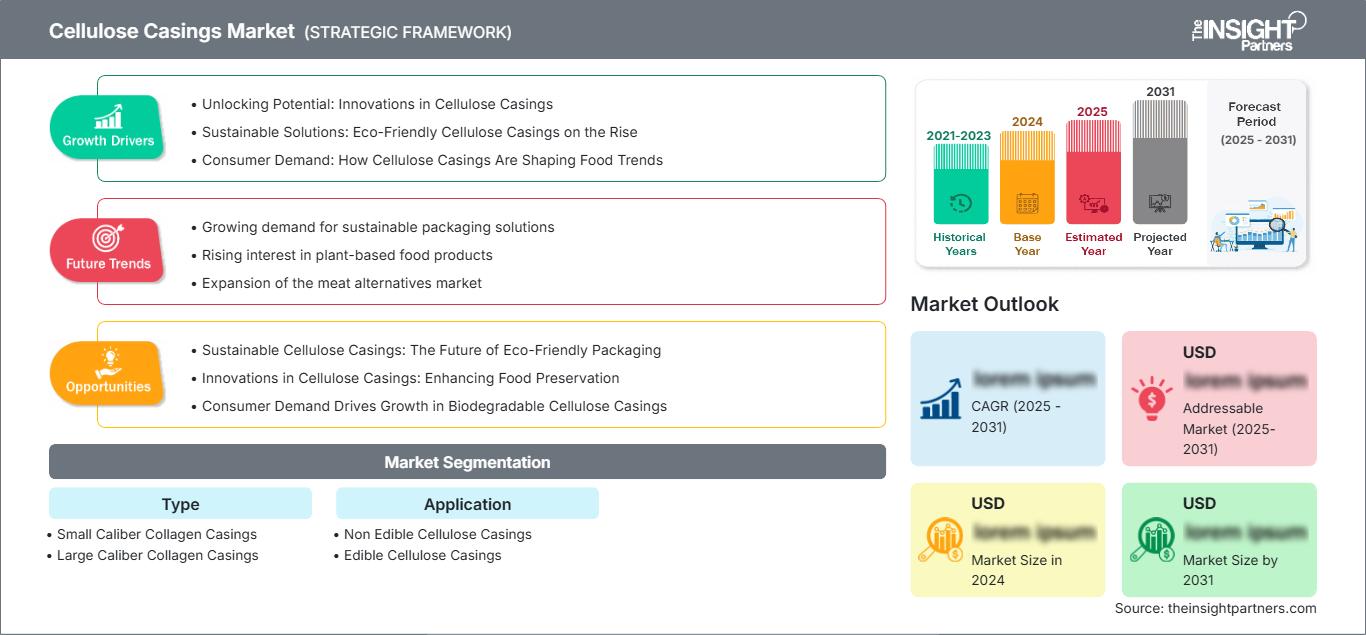
Cellulose Casings Market: Strategic Insights
Regional Insights
North America Cellulose Casings
North America held 30%-34% of the Cellulose Casings Market share in 2025 and is likely to grow at a CAGR of 3.2%-3.8% between 2026 and 2034. The region has a very advanced meat processing industry, uses automated sausage production machinery, and has stringent food safety regulations set by authorities like the USDA and FDA. The consistent consumer preference for packaged meat products, including high-end processed meat products, is driving investment in casing systems.
The increasing use of cellulose casings by meat processing companies in the U.S. and Canada is helping to improve production efficiency and production rates. Investments are also being made in sustainable processing, peelability, and stronger regenerated cellulose material according to the changing processing needs. Increasing modernization of food manufacturing plants, along with exports of processed meat products, is anticipated to drive steady regional demand in the forecast period.
U.S. Cellulose Casings Market
The U.S. represented 78–82% of the North American market in 2025 and is anticipated to register a CAGR of 3.3%–3.9% during 2026–2034. The country remains the largest regional consumer owing to its extensive processed meat industry, advanced food manufacturing infrastructure, and high penetration of automated sausage production equipment. The presence of global casing manufacturers and long-established meat processors further strengthens domestic demand.
Innovations in product development, processing automation, and the production of pre-cooked meat products are major drivers of market growth. Manufacturers are focusing on improving efficiency, ensuring product quality, and adhering to food safety regulations. This helps promote the use of superior cellulose casings in the country, which is a regional market leader.
Europe Cellulose Casings Market
The Europe region accounted for 28–32% market share in 2025 and is estimated to grow at a CAGR of 3.1%–3.7% over the forecast period from 2026 to 2034. Germany has continued to maintain its position as the leading regional market due to its advanced meat-processing industry and strong manufacturing base.
The UK region continues to see stable demand, driven by the consumption of convenience foods and advances in food processing techniques. The regions of France, Italy, and Spain are contributing majorly owing to the presence of a well-established meat processing industry and increasing export of specialty sausages. Manufacturers in the region continue to pursue sustainable production practices, automation, and casing improvements in response to strict food quality standards in Europe.
APAC Cellulose Casings Market
The Asia Pacific region held 24% to 28% of the worldwide Cellulose Casings Market in 2025 and is expected to grow at a CAGR of 4.2% to 4.8% from 2026 to 2034. The leading contributors in the region include China, Japan, South Korea, India, and Australia, driven by increased production of processed foods and urban consumption.
Growing government initiatives toward the modernization of the food processing industry, investment in cold chain infrastructure, and industrialization have continued to boost production capacity in the region. Growing consumer preference for convenient protein products further supports the adoption of industrial cellulose casing solutions across APAC.
Middle East & Africa Cellulose Casings Market
The Middle East & Africa market is projected to record a CAGR of 3.4%–4.0% during 2026–2034. Saudi Arabia remains the leading market, followed by the UAE and South Africa, supported by investments in domestic food processing and the expansion of the packaged food industry.
Infrastructure development, improved cold chain logistics, and increased investment in the food processing industry are contributing to rising demand in the region. The consumption of processed meat products, along with advancements in food production facilities, is likely to present an opportunity for cellulose casing manufacturers across the Rest of the Middle East & Africa.

Segmentation Analysis
Type
The Type segment is projected to register a CAGR of 3.6%–4.1% between 2026 and 2034. The Cellulose Casings Market scope has increased significantly in recent years due to companies' focus on casing types that boost manufacturing efficiency, product uniformity, and the suitability of the process for automated filling and peeling techniques. Investments in industrial meat processing and the need for consistent sausage quality have driven advancements in this area.
- Small Caliber Collagen Casings – Primarily utilized for frankfurters, hot dogs, breakfast sausages, and snack sausages, these casings support high-speed industrial production by providing consistent diameter, reliable stuffing performance, and efficient automated peeling after processing.
- Large Caliber Collagen Casings – Widely adopted for bologna, salami, luncheon meats, and cooked sausage products, these casings enable uniform product dimensions, improved smoke permeability, and efficient handling during industrial-scale processing operations.
Application
The Application segment is projected to expand at a CAGR of 3.7%–4.3% during 2026–2034. Demand continues to increase as meat processors select cellulose casings based on processing requirements, product characteristics, and end-use applications. Improvements in casing durability, processing efficiency, and product presentation are supporting broader adoption across industrial food manufacturing while encouraging manufacturers to develop specialized solutions for different sausage categories.
- Non-Edible Cellulose Casings – The leading application segment, extensively used for frankfurters, hot dogs, smoked sausages, and processed meat products because of superior peelability, dimensional stability, and suitability for continuous automated production environments.
- Edible Cellulose Casings – Increasingly adopted for specialty processed meat products requiring convenience and product differentiation. Continuous innovation in edible casing formulations supports improved texture, consumer acceptance, and premium product positioning.
Opportunity Snapshot
| Application | Revenue Contribution | Trend Tag | Adoption Stage |
| Non-Edible Cellulose Casings | High | Automated Peeling | Mature |
| Edible Cellulose Casings | Medium | Premium Sausages | Scaling |
Cellulose Casings Market Growth Drivers and Impact Analysis
Growing Consumption of Processed Meat Products Worldwide
Rising demand for processed meat products remains one of the strongest factors supporting the expansion of the cellulose casing industry. Urbanization, changing lifestyles, and increasing consumption of convenient protein-based foods have encouraged meat processors to expand production capacities across developed and emerging economies. Cellulose casings provide excellent dimensional consistency, smoke permeability, and compatibility with automated stuffing and peeling systems, making them well-suited for high-volume manufacturing. Foodservice expansion, modern retail growth, and greater availability of packaged sausages have further strengthened demand. As processors continue investing in productivity improvements and standardized manufacturing, cellulose casings are expected to remain an essential component of industrial sausage production, supporting steady long-term market expansion across global food processing industries.
Automation and Modernization of Meat Processing Facilities
The increasing adoption of automated food processing equipment is accelerating demand for high-performance cellulose casings capable of maintaining consistent quality during high-speed manufacturing. Modern sausage production lines require casing materials with uniform diameter, reliable tensile strength, and efficient peelability to minimize downtime and maximize operational efficiency. Manufacturers are investing in advanced extrusion technologies, digital quality monitoring, and precision manufacturing systems to improve product consistency while reducing waste. Automation also enables processors to achieve higher throughput while complying with increasingly stringent food safety regulations. As industrial meat processors continue upgrading production facilities worldwide, demand for technologically advanced cellulose casings is expected to increase steadily throughout the forecast period.
Stringent Food Safety and Product Standardization Requirements
The regulatory authorities and food industries are now placing greater emphasis on hygiene, traceability, and consistency in product quality across all levels of meat processing. The cellulose casing ensures standardization of the manufacturing process due to its uniform size, efficient capacity, and suitability for automated inspection. With such qualities, the casings will enable food manufacturers to avoid any defects and inefficiency in the manufacturing process. The international market for processed meat products requires strict adherence to quality standards, hence the need for manufacturers to incorporate new manufacturing technologies and sustainable production practices.
Cellulose Casings Market Future Trends
Increasing Adoption of Sustainable Manufacturing Technologies
Sustainability is becoming a defining trend shaping the Cellulose Casings Market trends over the coming decade. Manufacturers are incorporating energy-efficient production processes, reduced water use, waste minimization, and sustainable energy into their manufacturing. Increased use of digital control systems and efficient manufacturing technologies is resulting in improved operational performance and environmental outcomes. Consumers have begun prioritizing manufacturers that practice responsible sourcing and sustainable manufacturing processes. Due to increased sustainability requirements in food supply chains worldwide, producers that engage in sustainable manufacturing strategies are expected to strengthen their competitive positions and improve long-term operational resilience.
Digital Quality Control and Smart Manufacturing Integration
Industry 4.0 technologies have revolutionized the manufacture of cellulose casings through automated inspection, AI-driven quality control, and predictive maintenance. The adoption of digital technologies, such as machine vision, sensor-based process monitoring, and analytics, has helped make the process more consistent and minimize disruptions in manufacturing. Digital manufacturing will enable early identification of process defects, improve traceability, and increase production efficiency. There is increasing demand by food processors for cellulose casings with consistent performance, and supply has led to greater adoption of intelligent manufacturing platform are expected to accelerate, enhancing product quality while supporting operational excellence and long-term competitiveness across the global industry.
Cellulose Casings Market Opportunities
Expansion into Emerging Food Processing Markets
Rapid industrialization of the food processing industry across the Asia-Pacific, Latin America, the Middle East, and parts of Africa presents significant opportunities for manufacturers. Rising disposable incomes, expanding cold-chain infrastructure, and increasing consumption of processed protein products are encouraging investment in modern meat-processing facilities. Cellulose Casings Market forecasts indicate that establishing regional manufacturing, technical, and distribution facilities would help enhance customer relationships and minimize supply chain risks. Forming strategic alliances with meat-processing companies in the region and developing products locally could help capitalize on fresh demand in emerging economies.
Development of High-Performance Specialty Casing Solutions
Growing customer demand for premium processed meat products creates opportunities for innovation in specialized cellulose casing technologies. Manufacturers can differentiate their offerings by developing products with improved strength, enhanced smoke permeability, superior peelability, and compatibility with advanced automated processing equipment. Continued investment in material science, precision manufacturing, and customized product solutions will enable suppliers to address evolving processor requirements across premium sausage categories. Companies focusing on research and development, customer-specific product optimization, and sustainable manufacturing technologies are expected to strengthen competitive positioning while expanding revenue opportunities in higher-value food processing applications.
Recent Developments
- September 2025: BASF SE introduced Ultramid® H33 L, the world's first thermoplastic polyamide with high water permeability for artificial sausage casings. The material enables smoke penetration and in-casing drying while providing higher mechanical strength than conventional cellulose or collagen casings, allowing thinner-walled artificial casings and improved manufacturing efficiency for processed meat producers.
- January 2025: Panasonic Holdings Corporation announced the development of a cellulose fiber molding technology that uses high-concentration cellulose fiber compounds to produce precision-molded components with improved strength and reduced environmental impact. The innovation demonstrates advances in cellulose material processing that could support sustainable material development across packaging and industrial applications, encouraging broader innovation in cellulose-based products
Frequently Asked Questions

- Comprehensive Market Sizing and Forecast Analysis
- Detailed Segmentation Analysis
- In-Depth Market Dynamics Assessment
- Regional and Country-Level Insights
- Competitive Landscape and Company Benchmarking
- Strategic Business Intelligence
Recent Reports
Testimonials

The Insight Partners provided valuable market intelligence that supported our global go-to-market strategy. Their team was professional, responsive, and attentive to our feedback, providing thoughtful analysis and helpful methodological clarifications throughout the project.
Junmo Kim Chief Financial Officer (CFO), Enertech Co., Ltd.
The Insight Partners' SCADA System Market report is comprehensive, with valuable insights on current trends and future forecasts. The team was highly professional, responsive, and supportive throughout. We are very satisfied and highly recommend their services.
RAN KEDEM Partner, Reali Technologies LTDs
I requested a report on a very specific software market and the team produced the report in a few days. The information was very relevant and well presented. I then requested some changes and additions to the report. The team was again very responsive and I got the final report in less than a week.
JEAN-HERVE JENN Chairman, Future Analytica
We worked with The Insight Partners for an important market study and forecast. They gave us clear insights into opportunities and risks, which helped shape our plans. Their research was easy to use and based on solid data. It helped us make smart, confident decisions. We highly recommend them.
PIYUSH NAGPAL Sr. Vice President, High Beam Global
The Insight Partners delivered insightful, well-structured market research with strong domain expertise. Their team was professional and responsive throughout. The user-friendly website made accessing industry reports seamless. We highly recommend them for reliable, high-quality research services
YUKIHIKO ADACHI CEO, Deep Blue, LLC.
This is the first time I have purchased a market report from The Insight Partners.While I was unsure at first, I visited their web site and felt more comfortable to take the risk and purchase a market report.I am completely satisfied with the quality of the report and customer service. I had several questions and comments with the initial report, but after a couple of dialogs over email with their analyst I believe I have a report that I can use as input to our strategic planning process.Thank you so much for taking the extra time and making this a positive experience.I will definitely recommend your service to others and you will be my first call when we need further market data.
JOHN SUZUKI President and Chief Executive Officer, Board Director, BK Technologies
I wish to appreciate your support and the professionalism you displayed in the course of attending to my request for information regarding to infectious disease IVD market in Nigeria. I appreciate your patience, your guidance, and the fact that you were willing to offer a discount, which eventually made it possible for us to close a deal. I look forward to engaging The Insight Partners in the future, all thanks to the impression you have created in me as a result of this first encounter.
DR CHIJIOKE ONYIA MANAGING DIRECTOR, PineCrest Healthcare Ltd.Reason to Buy
- Informed Decision-Making
- Understanding Market Dynamics
- Competitive Analysis
- Identifying Emerging Markets
- Customer Insights
- Market Forecasts
- Risk Mitigation
- Boosting Operational Efficiency
- Strategic Planning
- Investment Justification
- Tracking Industry Innovations
- Aligning with Regulatory Trends





 Get Free Sample for