Cervical Total Disc Replacement Market Size & Overview
The Cervical Total Disc Replacement Market was valued at US$ 1.8 Billion in 2025 and is projected to reach US$ 4.58 Billion by 2034, registering a 10.93% CAGR during 2026–2034. The report discusses artificial disc implants used for treating diseased cervical intervertebral discs without sacrificing mobility through the various kinds of disc implants, their material compositions, biomechanical designs, and care facilities for patients who are eligible for cervical disc disease.
Within the geography of North America, the Cervical Total Disc Replacement Market size is anticipated to grow at a rate of approximately ~10% CAGR till 2034. The commercial presence of the market is backed by the availability of spine surgery expertise, cervical arthroplasty training, and expanding regulation of single and dual level cervical disc replacements.
Increased prevalence of cervical degenerative condition symptoms, preference for motion sparing procedures among eligible patients, and increased surgical expertise drive Cervical Total Disc Replacement Market growth. The demand is based on diagnostics, failure of non-surgical treatment, anatomical suitability, reimbursement, and comparison of the procedure with anterior cervical discectomy and fusion surgery. Therefore, market development occurs according to eligible procedure volume rather than the total number of people suffering from neck pain. Supply chain consists of alloy, ceramic and polymer suppliers, device manufacturers, custom machine shops, laboratories, regulatory bodies, distributors, hospitals, ambulatory surgery centers, and spinal surgeons. Reliability of supply chain depends on controlled materials specifications, manufacturing process validation, sterilization, tools and implants availability by different anatomical sizes. Training and procedural support are crucial elements of business development due to the impact on surgeon's confidence.
The Cervical Total Disc Replacement Market Report highlights a research-driven competitive landscape. Medtronic plc and Globus Medical, Inc. offer a combination of proven spine portfolios and strong customer network, whereas Centinel Spine, LLC specializes in total disc replacement. Spineart SA and Spine Innovations SAS bring unique European-developed technologies to the market, and AxioMed LLC brings new concepts of viscoelastic design to the market. Stryker Corporation, DePuy Synthes, Highridge Medical, LLC, and Orthofix Medical Inc. impact the broader cervical treatment market. Investments flow into indications expansion, biomechanics distinction, instrumentation simplicity, and evidence to be able to make decisions by payers and surgeons. The strategic competitive edge relies on the ability to align implant design to anatomy and manage the cost and complexity of tray sets and inventories. Smaller companies that have focused evidence strategy can compete with large suppliers, but scale provides benefits.
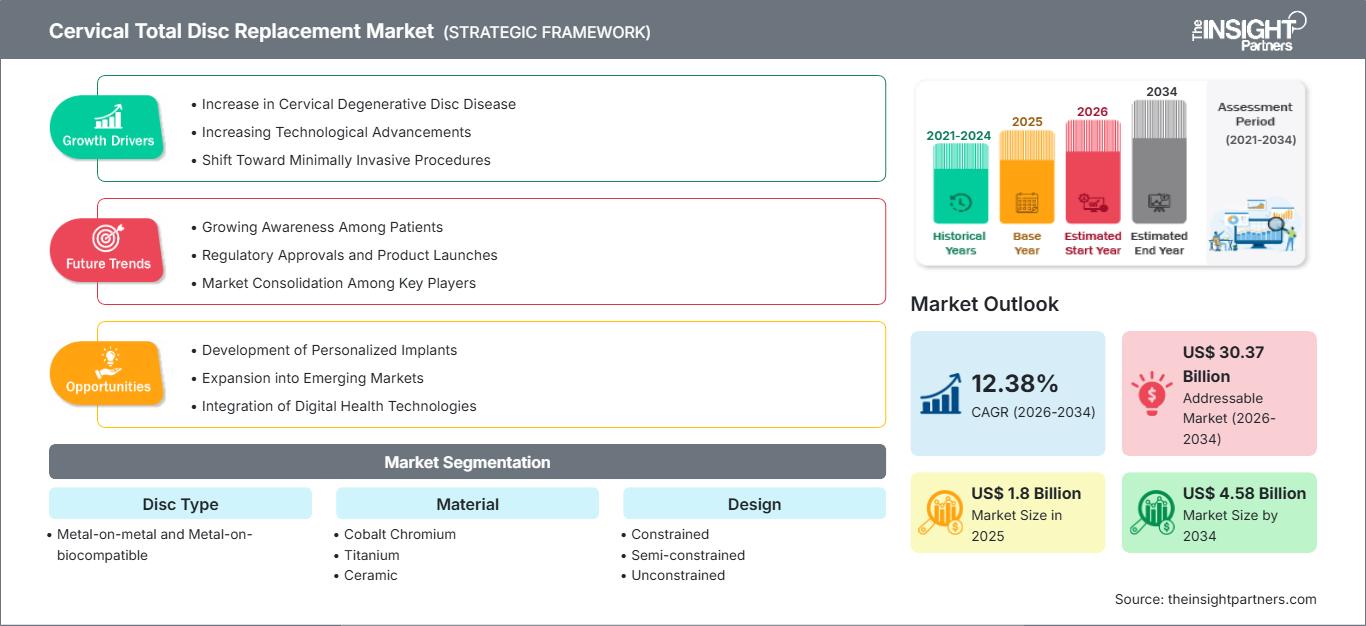
Cervical Total Disc Replacement Market Assessment and Insights
Regional Outlook
- North America: ~43% of the global market in 2025 | ~10% CAGR through 2034. Market position: North America leads through extensive spine-care infrastructure, established reimbursement pathways, concentrated clinical research, surgeon familiarity with arthroplasty, and availability of multiple differentiated cervical disc systems.
- US: ~90% of North American market revenue in 2025 | ~10% CAGR through 2034. Market position: The US anchors regional demand through FDA-regulated product adoption, specialist surgical networks, multilevel treatment options, advanced hospital purchasing, and increasing use of outpatient pathways for suitable cases.
- Europe: ~29% of the global market in 2025 | ~10% CAGR through 2034. Market position: Europe is a mature adoption center supported by long-standing clinical experience. Germany leads the region, while the UK, France, Italy, and Spain contribute through specialist hospitals and established orthopedic systems.
- Asia Pacific: ~21% of the global market in 2025 | ~14% CAGR through 2034. Market position: Asia Pacific is the fastest-growing region as advanced spine-care capacity expands. China leads regional demand, followed by meaningful adoption activity in Japan, South Korea, India, and Australia.
Segment Outlook
- Hospitals: ~67% Share in 2025 | ~10% CAGR through 2034. Market position: Hospitals lead because cervical arthroplasty requires specialist surgeons, imaging, anesthesia, neurological assessment, implant inventory, and postoperative capabilities suited to complex patients and multilevel procedures.
- Ambulatory Surgical Center: ~22% Share in 2025 | ~15% CAGR through 2034. Market position: Ambulatory surgical centers provide the strongest growth outlook as selected procedures shift toward outpatient pathways supported by focused teams, efficient operating-room turnover, and standardized discharge protocols.
Competitive Coverage
Medtronic plc, Globus Medical, Inc., Stryker Corporation, Orthofix Medical Inc., AxioMed LLC, Centinel Spine, LLC, Highridge Medical, LLC, DePuy Synthes, Spine Innovations SAS, Spineart SA
Methodology
The Insight Partners follows Data Collection & Secondary Research, Primary Research, Data Analysis, and Data Triangulation & Final Review to validate market estimates and insights.
Source: The Insight Partners' analysis based on proprietary research, government publications, company annual reports, investor presentations, industry databases, and expert interviews.
Cervical Total Disc Replacement Market Trends
Patient-Specific Implant Selection and Anatomical Matching
Emerging Cervical Total Disc Replacement Market trends increasingly emphasize matching footprint, height, fixation, and kinematics to individual anatomy. Rather than relying on a uniform implant concept, surgeons may select among differentiated endplate geometries, centers of rotation, and motion constraints. Digital planning and improved imaging could make sizing decisions more reproducible, while broader implant families may reduce compromises at surgery. The strategic implication is a shift from single-product selling toward configurable platforms. Manufacturers must balance anatomical choice against inventory complexity, instrument burden, and training requirements if personalized selection is to remain economically practical.
Evidence Integration Across the Implant Lifecycle
Clinical evidence will increasingly extend beyond regulatory approval into registries, post-market surveillance, long-term imaging, and real-world functional outcomes. Hospitals and payers are likely to evaluate not only initial safety and effectiveness but revision patterns, motion retention, return to activity, and resource utilization. Digital collection of patient-reported outcomes can help manufacturers identify performance differences across designs and subgroups. Companies that integrate evidence generation with product development may refine indications and training faster. However, this trend raises investment requirements and favors suppliers capable of maintaining consistent data quality across countries and healthcare settings.
Cervical Total Disc Replacement Market Growth Factors
Expanding Clinical Acceptance of Motion Preservation
Clinical acceptance is strengthening as surgeons gain experience in selecting patients whose cervical anatomy, pathology, alignment, and facet-joint condition support arthroplasty. Unlike fusion, total disc replacement is designed to maintain movement at the treated segment, creating a differentiated value proposition for eligible patients. The real-world impact extends across referral behavior, informed consent, hospital formulary decisions, and surgeon training. Broader acceptance can increase procedure conversion, but growth remains bounded by contraindications and the need for disciplined selection. Manufacturers that support education with long-term evidence, transparent indications, and reproducible surgical techniques are better positioned to translate clinical interest into sustained use.
Broader Availability of Multilevel Treatment Options
Regulatory expansion from one-level to eligible two-level use increases the addressable procedural pool and strengthens product differentiation. Multilevel cervical degeneration presents greater planning complexity, making approved indications, anatomical sizing, instrumentation, and evidence especially important. As additional systems establish multilevel credentials, hospitals can evaluate arthroplasty against fusion and hybrid approaches across a wider set of cases. The commercial impact includes higher implant utilization per procedure, greater demand for inventory, and increased need for surgeon training. Suppliers must nevertheless demonstrate consistent outcomes because multilevel reconstruction magnifies the consequences of implant positioning, patient selection, and postoperative biomechanics.
Migration of Selected Procedures Toward Outpatient Care
Ambulatory migration supports adoption by aligning selected cervical procedures with efficient care pathways. Specialized centers can streamline preoperative assessment, instrumentation, operating-room turnover, pain management, and discharge. This creates purchasing opportunities for systems with compact trays, intuitive techniques, predictable sizing, and dependable local support. Outpatient expansion does not eliminate hospital demand, as complex patients and multilevel cases may require broader resources. Instead, it creates a complementary channel within the Cervical Total Disc Replacement Market, encouraging manufacturers to tailor training, logistics, and economic propositions to both acute-care hospitals and ambulatory facilities.
Cervical Total Disc Replacement Market Opportunities
Commercial Expansion Across Asia Pacific Spine Centers
Asia Pacific creates an actionable opportunity for manufacturers able to combine clinical education, regulatory planning, tiered distribution, and reliable implant supply. Cervical Total Disc Replacement Market Forecasts indicate that regional growth will outpace mature geographies as tertiary hospitals expand advanced spine programs. Investment priorities include local surgeon training, demonstration centers, anatomy-relevant sizing, and partnerships with experienced distributors. Suppliers should differentiate country strategies because China, Japan, South Korea, India, and Australia have distinct approval, reimbursement, and procurement systems. A disciplined market-entry model can capture demand without applying a single commercial approach across structurally different healthcare environments.
Portfolio Design for Ambulatory Surgical Centers
Ambulatory surgical centers offer suppliers an opportunity to redesign the procedural proposition around efficiency rather than implant features alone. Compact instrument sets, preoperative sizing support, predictable implantation, rapid replenishment, and responsive case coverage can reduce operating friction. Manufacturers can also develop training programs that integrate patient selection, anesthesia coordination, discharge criteria, and postoperative monitoring. Commercial success will require evidence that outpatient pathways preserve quality while improving resource use. Partnerships with high-volume surgeon groups and specialty networks can accelerate adoption, particularly where purchasing decisions are less centralized than in large hospital systems.
Segmentation Analysis
Disc Type
Disc Type segment in the Cervical Total Disc Replacement Market is projected to grow at approximately ~11% CAGR during 2026–2034. Selection depends on wear behavior, imaging compatibility, surgeon experience, articulation, and patient anatomy. Metal-on-biocompatible configurations are strategically important because combinations involving polymers or ceramics can support differentiated motion and imaging characteristics. Metal-on-metal products retain established engineering relevance but face closer scrutiny around wear and material interaction.
- Metal-on-metal: These discs use metallic bearing or articulating components valued for mechanical durability and established manufacturing control. Demand depends on long-term clinical evidence, wear management, fixation reliability, and surgeon familiarity with the specific prosthesis.
- Metal-on-biocompatible: These systems combine metal endplates with polymer, ceramic, or related cores. Their importance is increasing as manufacturers seek controlled motion, shock absorption, reduced imaging artifact, and biomechanical behavior tailored to cervical anatomy.
Material
Material is expected to register approximately ~12% CAGR during 2026–2034. Material choice affects strength, imaging visibility, wear, osseointegration, manufacturing cost, and implant profile. The Cervical Total Disc Replacement Market scope includes cobalt chromium, titanium, and ceramic technologies, allowing manufacturers to balance load-bearing requirements with postoperative assessment and differentiated articulation.
- Cobalt Chromium: Cobalt chromium offers high strength, wear resistance, and established medical use. It remains relevant in articulating components where dimensional stability and surface finish are critical, although imaging artifact and material sensitivity influence selection.
- Titanium: Titanium is important for endplates and fixation surfaces because of its strength-to-weight characteristics, corrosion resistance, and compatibility with bone-contact technologies. Demand benefits from porous surfaces, coatings, and additive manufacturing possibilities.
- Ceramic: Ceramic components support low-wear articulation and favorable imaging characteristics in selected designs. Strategic adoption depends on fracture resistance, manufacturing consistency, cost control, and clinical evidence demonstrating durable performance under cervical loading.
Design
Design segment in the Cervical Total Disc Replacement Market is projected to advance at approximately ~13% CAGR during 2026–2034. Biomechanical configuration determines the extent and direction of permitted motion, center-of-rotation behavior, translation, and load transfer. Suppliers increasingly position implants around predictable movement, anatomical matching, and protection against excessive mobility. Surgeon preference depends on pathology, facet condition, alignment, and familiarity with implantation technique.
- Constrained: Constrained designs limit translation or rotation to create predictable movement. They remain relevant where controlled kinematics, implant stability, and reproducible positioning are priorities, but require accurate placement to avoid unfavorable loading.
- Semi-constrained: Semi-constrained systems balance guided motion with limited translation. Their clinical importance stems from combining stability with adaptability, making them suitable for manufacturers seeking broad surgeon acceptance and differentiated kinematic claims.
- Unconstrained: Unconstrained designs permit greater translation and rotational freedom to approximate physiological movement. Their growth potential depends on careful patient selection, facet-joint health, accurate implantation, and evidence that mobility remains stable over time.
End User
End User is forecast to expand at approximately ~12% CAGR during 2026–2034. Hospitals dominate current revenue because they manage complex anatomy, multilevel disease, comorbidities, and extensive implant inventories. Ambulatory surgical centers provide the strongest growth mechanism through specialized workflows and lower procedural overhead, while specialty clinics influence referrals, diagnosis, follow-up, and surgeon-led treatment selection.
- Hospitals: Hospitals lead through multidisciplinary capacity, advanced imaging, intensive perioperative support, and purchasing systems suited to complex or multilevel surgery. Academic centers also contribute clinical research, training, and post-market evidence.
- Ambulatory Surgical Center: These centers are scaling for carefully selected procedures through focused surgical teams, efficient scheduling, standardized anesthesia, and rapid discharge. Their strategic importance rises as payers and providers seek lower-cost care settings.
- Specialty Clinics: Specialty clinics support diagnosis, conservative-treatment documentation, surgical referral, and long-term follow-up. Clinics linked to experienced spine surgeons can accelerate patient education and appropriate selection for motion-preserving procedures.
Opportunity Snapshot
| End User | Revenue Contribution | Trend Tag | Adoption Stage |
| Hospitals | High | Multilevel Care | Mature |
| Ambulatory Surgical Center | Medium | Outpatient Shift | Scaling |
| Specialty Clinics | Medium | Patient Selection | Scaling |
Regional Insights
North America Cervical Total Disc Replacement Market
North America is expected to record ~10% CAGR till 2034. Its dominance is driven by the presence of spine referral networks, adequate surgical facilities, familiarity with cervical arthroplasty, and the need for structured clinical data due to stringent regulatory processes. The role of hospitals will be prominent for complex/multilevel patients, whereas specialty outpatient centers will gain relevance for selective patients.
Commercial success will be driven by differentiated implants as well as ongoing efforts for educating surgeons. North America has fixed-center, mobile-core, constrained, semi-constrained, and unconstrained implants available with varying materials and fixation techniques. This enables anatomy-specific selection but also calls for additional education/training and inventory management. Canada makes its contributions through its advanced hospital systems, even though the US dominates in terms of regional sales and launches.
U.S. Cervical Total Disc Replacement Market
The US accounts for approximately ~90% of North American revenue in 2025 and is expected to grow at ~10% CAGR through 2034. FDA premarket approval requirements, dedicated spine centers, and clinical-trial participation shape product availability. The Cervical Total Disc Replacement Market share is concentrated in the country because it combines a large commercially insured population with high-value implant purchasing and specialist capacity.
The Medtronic plc, Globus Medical, Inc., Centinel Spine, LLC, Spineart SA, and others have to engage in competition on the basis of evidence, indication, implant, instrumentation, and hospitals. Application patterns are gradually emerging as a means of separating one-level reconstruction procedures from eligible two-level procedures. Ambulatory surgery facilities have been growing in importance wherever the patient, surgeon, anesthesia, and aftercare make day surgery possible.
Europe Cervical Total Disc Replacement Market
Europe accounts for ~29% of global revenues in 2025 and is predicted to grow by ~10% CAGR until 2034. Clinical experience, specialized spine procedures, and availability of multiple design options help explain the maturity of Europe. Germany is considered the strongest market in Europe due to well-developed infrastructure, experienced surgeons, and wide adoption of motion preserving technologies.
The UK is noted for having very advanced clinical practice and comprehensive procurement and health economic analysis. France creates demand using tertiary healthcare providers and indigenous innovations in medical devices, such as the development of viscoelastic cervical implants. Italy and Spain generate demand using public and private spine clinics; but regional differences exist due to the payment structure, procurement process, surgeon preference, and queues.
Competition in Europe goes further than availability of implants. Compliance of medical device, clinical evidence, reimbursement, tendering, distribution, and training define scalability. Spine Innovations SAS and Spineart SA help increase the level of innovation in the region, while multinational suppliers offer wide geographical coverage. Growth will be limited as cervical arthroplasty technology is adopted in several countries already; however, system replacement, more designs, and patient selection can maintain growth.
APAC Cervical Total Disc Replacement Market
Asia Pacific holds approximately ~21% of global revenue in 2025 and is forecast to grow at ~14% CAGR through 2034, making it the fastest-growing region. China is the leading country in Asia Pacific, supported by its patient base, expanding tertiary hospitals, medical-device manufacturing capabilities, and growing access to advanced spine procedures.
Japan and South Korea make contributions to surgery through their technically advanced surgery systems. India is likely to have growth opportunities through its private hospitals and medical tourism. Australia has established clinical procedures and regulations in place. There is potential for improvements in accessibility through regional policy support towards hospital upgradation, manufacturing, and medical technologies.
Middle East & Africa Cervical Total Disc Replacement Market
The Middle East & Africa market is projected to record approximately ~12% CAGR through 2034. Saudi Arabia is assessed as the leading country in the Middle East & Africa, supported by hospital investment, specialist recruitment, and healthcare transformation programs. The UAE benefits from premium private care and medical tourism, while South Africa has the region’s most developed sub-Saharan surgical infrastructure.
Public investments made from energy sources fund construction of hospitals in the Gulf states, which helps improve access to advanced implants and imaging. Adoption in other regions is hindered by cost factors, lack of coverage, and specialization. Competent distributors, trained doctors, and reliable equipment maintenance will continue to be key considerations in dealing with Saudi Arabia, UAE, South Africa, and Rest of MEA.
Cervical Total Disc Replacement Market Report Scope
| Report Attribute | Details |
|---|---|
| Market size in 2025 | US$ 1.8 Billion |
| Market Size by 2034 | US$ 4.58 Billion |
| Global CAGR (2026 - 2034) | 10.93% |
| Historical Data | 2021-2024 |
| Forecast period | 2026-2034 |
| Segments Covered | Disc Type, Material, Design, End User |
| Region scope | North America, Europe, Asia-Pacific, South and Central America, Middle East and Africa |
Recent Developments
- August 2026: Spineart SA – Spineart announced FDA approval of the BAGUERA C cervical disc for one and two contiguous levels. The company stated that the approval was supported by two randomized controlled trials involving nearly 600 US patients, while the device had accumulated nearly two decades of international clinical experience.
- October 2025: Centinel Spine, LLC – The FDA approved two-level indications for the prodisc C Vivo and prodisc C SK systems, extending their use to one or two contiguous levels from C3 to C7 in eligible patients. The approval followed an IDE program involving 480 enrolled subjects across 31 centers.
- February 2025: Orthofix Medical Inc. – Orthofix discontinued its M6-C and M6-L artificial disc product lines while redirecting investment toward spinal fixation and deformity correction. The company retained post-market and regulatory responsibilities, illustrating how portfolio economics and capital allocation can reshape competitive supply even for established arthroplasty technologies.
Frequently Asked Questions

Recent Reports






