
Chemical Injection Skids Market Growth, Trends & Demand by 2034
Coverage: by Function (Antifoam Chemical Injection Skids, Corrosion Inhibitor Chemical Injection Skids, Demulsifying Chemical Injection Skids, Scale Inhibitor Chemical Injection Skids, Others); End-user Industry (Petrochemicals, Chemical, Energy and Power, Oil and Gas, Water Treatment, Others) , and Geography (North America, Europe, Asia Pacific, and South and Central America)
- Status : Data Released
- Report Code : TIPRE00005838
- Category : Chemicals and Materials
- No. of Pages : 150
- Available Report Formats :


- Last update date : August 28, 2026


2025 Market Size
US$ 3.31 Bn
Base year value
2034 Forecast
US$ 4.74 Bn
Projected by 2034
CAGR 2026-2034
3.89 %
Growth rate
Addressable Market
US$ 36.23 Bn
(2026-2034)
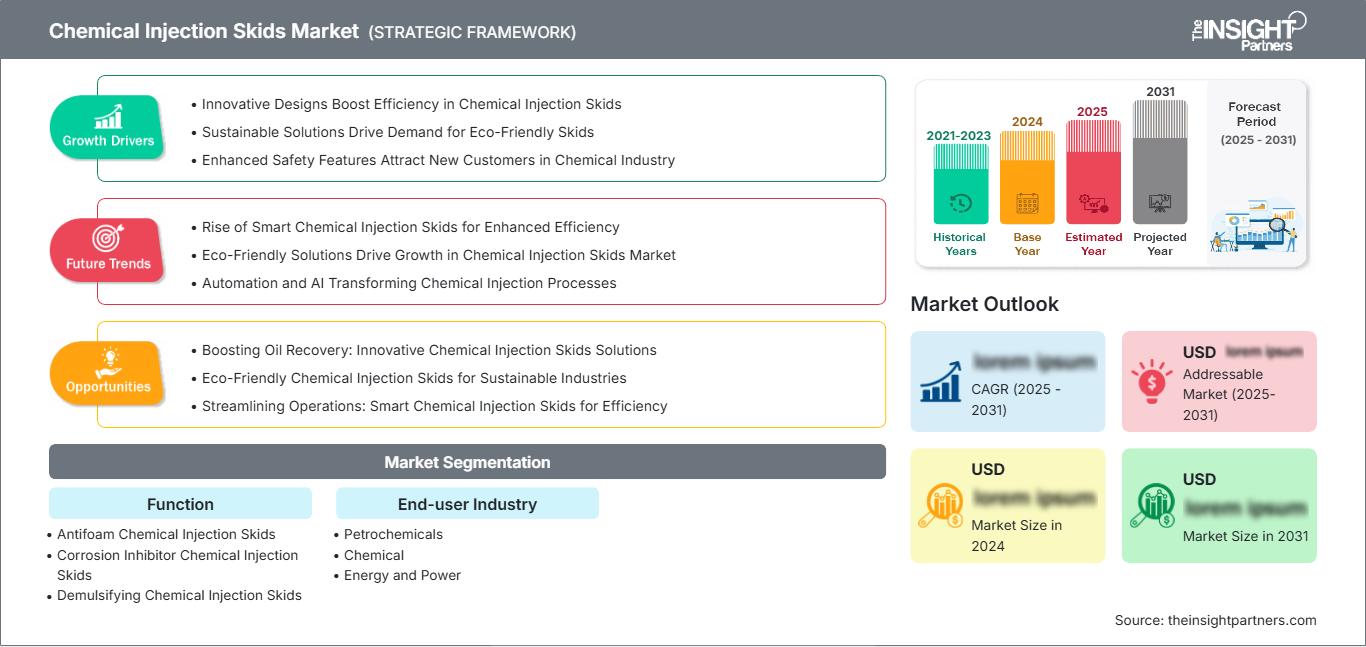
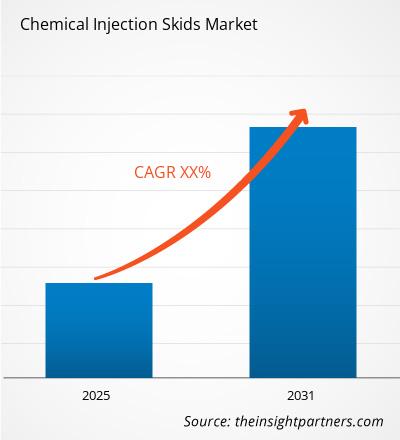
The Chemical Injection Skids market was valued at US$ 3.31 Billion in 2025 and is projected to reach US$ 4.74 Billion by 2034, registering a CAGR of 3.89% during 2026–2034. Demand is supported by asset-integrity requirements, controlled chemical dosing, corrosion and scale prevention, and expanding process automation across oil and gas, petrochemicals, chemical manufacturing, power generation, and water treatment facilities.
North America remains an important technology and deployment center, with the Chemical Injection Skids Market size outlook supported by mature oil and gas infrastructure, refinery operations, and increasing automation of chemical-management systems. Regional growth is estimated at 3.5–4.2% CAGR during 2026–2034, supported by pipeline integrity programs, unconventional production, replacement demand, and upgrades toward remotely monitored dosing systems.
Chemical Injection Skids Market Assessment and Insights
- North America: North America held an estimated 30–33% share in 2025 and is projected to grow at 3.5–4.2% CAGR between 2026–2034, supported by oil and gas infrastructure, refinery modernization, water treatment, and automated chemical dosing requirements.
- U.S.: The U.S. represented approximately 78–82% of North American demand in 2025, with growth estimated at 3.6–4.3% CAGR during 2026–2034, driven by shale production, refining, pipelines, and asset-integrity programs.
- Europe: Europe accounted for approximately 20–23% share in 2025 and is expected to register 3.2–3.9% CAGR during 2026–2034, with Germany, the UK, Italy, France, and Norway supporting process, energy, and water-treatment applications.
- Asia Pacific: Asia Pacific represented approximately a 32–35% share in 2025 and is forecast to expand at a 4.3–5.0% CAGR during 2026–2034, led by China, India, Australia, Indonesia, Malaysia, Japan, and South Korea.
- Largest Segment: Corrosion Inhibitor Chemical Injection Skids held approximately 28–31% market share in 2025, with an estimated 3.8–4.5% CAGR during 2026–2034, reflecting persistent asset-integrity requirements.
- High Growth Segment: Scale Inhibitor Chemical Injection Skids represented approximately 22–25% function share in 2025 and are projected to grow at 4.1–4.8% CAGR during 2026–2034, supported by production-water challenges.
- Key companies analyzed in detail: AES Arabia Ltd., Carotek, Inc., Casainox Flow Solutions Sdn. Bhd., SUEZ Water Technologies & Solutions, Intech Process Automation Inc., ITC S.L., LEWA GmbH, Petrak Industries, Inc., Petronash Engineering Services Pvt. Ltd., Proserv Group Inc.
Source: The Insight Partners' analysis based on proprietary research, government publications, company annual reports, investor presentations, industry databases, and expert interviews.
Chemical Injection Skids are transitioning from traditional pump tank systems into modular and automated units comprising metering pumps, instrumentation, control panels, calibration devices, valves, and monitors. Customization of standard design is increasing installation efficiency. Increasing demands from offshore and onshore facilities for redundant pumps, corrosion-resistant systems, remote monitoring, and reliable performance at high-pressure and temperature levels are evident.
Investment over the forecast period is likely to focus more on compact and modular systems, digital monitoring, energy-efficient metering, and remote operation system. The growing number of projects in emerging regions such as Asia and the Middle East will contribute towards new installations. Matured markets such as North America and Europe are expected to witness replacement and upgradation activity. The rising demand for chemical efficiency and process safety will drive the need for automation.
Chemical Injection Skids Market Report Scope
| Report Attribute | Details |
|---|---|
| Market size in 2025 | US$ 3.31 Billion |
| Market Size by 2034 | US$ 4.74 Billion |
| Global CAGR (2026 - 2034) | 3.89% |
| Historical Data | 2021-2024 |
| Forecast period | 2026-2034 |
Chemical Injection Skids Market Analysis
The Chemical Injection Skids Market is intrinsically linked with the need to ensure flow assurance and integrity of equipment used in hydrocarbon or industrial processes. The use of skids ensures proper delivery of corrosion inhibitors, scale inhibitors, demulsifiers, antifoam chemicals, among others. The supply chain consists of the chemical suppliers, metering pump manufacturers, skid fabricators, instrumentation firms, automation suppliers, EPCs, operators, and maintenance services firms.
Factors that influence demand include the production process, nature of fluids, pressure levels, chemical compatibility, point of injection, and facility layout. The oil and gas sector continues to be one of the key users due to the potential for untreated fluids to corrode equipment, create scaling, emulsion challenges, and reduce flow capacity. The water treatment and chemical plants have to dose properly.
According to Chemical Injection Skids Market analysis, the competition among global engineering firms competing with regional skid manufacturers and specific dosing system suppliers appears highly fragmented. Exposure to industrial and water treatment sectors comes from SUEZ Water Technologies & Solutions while dosing processes are offered by LEWA GmbH. Oil and gas engineering is covered well by Petronash Engineering Services Pvt. Ltd. whereas energy industry-specific solutions come from Proserv Group Inc.
Strategic investments are targeted now more than ever to modular engineering, digital instruments, remote diagnostics, and application-based packages. Exposure to process industries in the Middle East is a distinct competitive advantage for AES Arabia Ltd. Whereas Intech Process Automation Inc. offers automation solutions. Additional strength comes from such companies as Carotek, Inc., ITC S.L., Casainox Flow Solutions Sdn. Bhd., and Petrak Industries, Inc. Competitive advantage will increasingly rely on engineering flexibility, compliance, commissioning capabilities, and aftermarket support.
● REPORT CUSTOMIZATION
Tailor This Report To Align With Your Specific Business Requirements
This report can be customized to align precisely with your business objectives, scope, and target markets. Customization options include tailored segmentation, geography, competitive analysis, and strategic insights to support informed decision-making.
Customize This Report →WHAT YOU CAN ADJUST
- ● Segmentations
- ● Geography
- ● Competitive Analysis
- ● Language Preferences
Chemical Injection Skids Market: Strategic Insights
Regional Insights
North America Chemical Injection Skids Market
North America accounted for approximately 30–33% of the Chemical Injection Skids Market share in 2025 and is projected to expand at a 3.5–4.2% CAGR through 2034. Advantages include mature oil and gas production, mature pipelines, mature refineries, and mature water treatment facilities. While the United States continues to be the major market for the region, Canada contributes via oil sands, traditional oil and gas production, mature pipelines, and mature industries.
There is an increased emphasis on the automation of chemical dosing due to the fact that proper chemical injection can decrease corrosion, scaling, fouling, and downtime. Replacement of old pumps and control systems becomes a regular need, and remote monitoring will allow operators to increase visibility in their operations. A mature engineering environment is another advantage of the region since there is an opportunity to provide custom skid packages for offshore, midstream, refineries, petrochemicals, and municipalities.
U.S. Chemical Injection Skids Market
The U.S. represented approximately 78–82% of North American Chemical Injection Skids Market in 2025 and is expected to grow at a 3.6–4.3% CAGR through 2034. Production of shale, refining, gathering operations, and pipeline networks create an ongoing need for anti-corrosion and anti-scale operations. Chemical injection is especially significant among sites in which varying fluid composition may influence dosage needs.
The use base is found within power production, water purification, and chemical processing. An increasing trend involves automation, backup pumps, alarm systems and monitoring of chemical usage. Manufacturers may win back orders for replacements rather than provide entirely new solutions. The American market is thus made up of both new-build projects and brownfield upgrades, as well as a services-oriented buying practice, while oil and gas remains a key source of demand.
Europe Chemical Injection Skids Market
Europe comprised around a 20–23% Chemical Injection Skids Market in 2025 and is estimated to register a CAGR of 3.2–3.9% through 2034. The UK, Germany, Norway, France, Italy, and Spain are key demand centers in the region, driven by energy infrastructure, chemical manufacturing, industrial water treatment, and process industries. Norway and the UK are specifically significant from an offshore application and asset integrity perspective.
Germany is a leading process-equipment and chemical-manufacturing country, whereas France is an industrial processing, energy, and water treatment demand center. Italy and Spain are demand centers in chemical processing, utilities, refining, and industrial water management. Europe places increasing importance on compact equipment, safety systems, documentation, and efficient use of chemicals. Manufacturers capable of meeting rigorous engineering specifications and instrumentation in conjunction with plant control systems are expected to thrive in both replacement and project demand scenarios.
APAC Chemical Injection Skids Market
APAC represents a roughly 32-35% Chemical Injection Skids Market share in 2025 and is anticipated to register a 4.3-5.0% CAGR until 2034, thus being one of the key growth markets. China drives demand, while India, Australia, Indonesia, Malaysia, Japan, and South Korea follow. Industrialization, refining operations, petrochemical growth, and energy infrastructures drive the installations.
China and India drive manufacturing and process industry applications, while Australia and Southeast Asia offer offshore and LNG-related projects. Japan and South Korea will drive via their highly developed chemical and industrial facilities. Rising infrastructure spending, local manufacturing, and adoption of automation solutions will further drive demand. The APAC region's growth dynamics match those in the global energy markets, where developing countries make an increasingly significant contribution to rising energy demand.
Middle East & Africa Chemical Injection Skids Market
The Middle East & Africa is projected to grow at a 3.9–4.7% CAGR through 2034, supported by oil and gas production, refinery investments, petrochemical projects, desalination, and industrial infrastructure. Saudi Arabia represents the leading market, followed by the UAE, Qatar, Oman, and South Africa. Local manufacturing and engineering capabilities are increasingly important for project execution.
Saudi Arabia and the UAE offer strong opportunities through refinery, petrochemical, and gas developments, while South Africa provides applications in mining, chemicals, power, and water treatment. The rest of the MEA demand is concentrated around hydrocarbon production and industrial infrastructure. Harsh operating environments increase requirements for corrosion-resistant materials, redundant dosing systems, reliable controls, and service support, strengthening the value of engineered injection packages.
Segmentation Analysis
Function
Function determines chemical-selection requirements, metering accuracy, pump configuration, materials, and control architecture. Corrosion Inhibitor Chemical Injection Skids are estimated to grow at a 3.8–4.5% CAGR during 2026–2034, supported by pipeline, well, refinery, and process-equipment protection. The segment benefits from recurring dosing requirements and asset-integrity programs.
- Antifoam Chemical Injection Skids: These systems control foam formation in processing equipment, improving throughput and operational stability. Demand is relevant to petrochemical, chemical, wastewater, and industrial processes where uncontrolled foam affects separation or production efficiency.
- Corrosion Inhibitor Chemical Injection Skids: These packages protect pipelines, vessels, wells, and process equipment from corrosive fluids. They remain strategically important where asset integrity, operating life, and leak prevention influence production economics.
- Demulsifying Chemical Injection Skids: Demulsifier systems support the separation of oil and water in production and processing facilities. Their importance increases where crude characteristics require controlled chemical treatment to improve separation performance and downstream process stability.
- Scale Inhibitor Chemical Injection Skids: These packages reduce mineral deposition in wells, pipelines, heat exchangers, and processing systems. Adoption is particularly relevant where produced-water chemistry creates persistent scaling risks and increases maintenance requirements.
End-user Industry
End-user Industry determines skid capacity, chemical type, pressure requirements, automation level, and procurement specifications. The Chemical Injection Skids Market scope spans Petrochemicals, Chemical, Energy and Power, Oil and Gas, and Water Treatment. Oil and gas remain the largest application base, while water treatment and petrochemicals provide diversification.
- Petrochemicals: Petrochemical facilities require accurate dosing for corrosion control, process conditioning, foam management, and separation. Modular packages support integration with continuous production systems and complex process-control architectures.
- Chemical: Chemical plants use injection skids for controlled reagent addition, process conditioning, corrosion protection, and production optimization. Equipment selection is highly dependent on chemical compatibility, pressure, temperature, and hazardous-area requirements.
- Energy and Power: Power plants use chemical dosing for water conditioning, corrosion management, and process protection. Reliable metering and automated monitoring are important because dosing errors can affect equipment performance and maintenance schedules.
- Oil and Gas: Oil and gas represent the core demand center because chemical injection is essential for corrosion prevention, scale management, flow assurance, separation, and production optimization across upstream, midstream, and downstream assets.
- Water Treatment: Water-treatment facilities use chemical injection systems for disinfection, pH adjustment, coagulation, and conditioning. Demand is supported by municipal infrastructure, industrial wastewater treatment, and requirements for accurate and reliable chemical dosing.
Opportunity Snapshot
| End-user Industry | Revenue Contribution | Trend Tag | Adoption Stage |
|---|---|---|---|
| Petrochemicals | High | Process Integrity | Scaling |
| Chemical | Medium | Precision Dosing | Scaling |
| Energy and Power | Medium | Water Conditioning | Mature |
| Oil and Gas | High | Asset Integrity | Mature |
| Water Treatment | High | Smart Dosing | Scaling |
Chemical Injection Skids Market Growth Drivers and Impact Analysis
Increasing Focus on Corrosion and Scale Prevention
Asset integrity remains a fundamental driver because corrosion and scale can restrict flow, reduce equipment efficiency, increase maintenance requirements, and create unplanned downtime. Chemical injection skids provide controlled delivery of inhibitors at defined rates, allowing operators to manage changing process conditions without relying on manual chemical addition. The impact is particularly significant in oil and gas facilities where pipelines, wells, separators, and processing equipment operate under challenging conditions. In water treatment and power generation, accurate chemical dosing similarly supports equipment protection and process reliability. Greater emphasis on preventive maintenance is encouraging operators to specify redundant pumps, automated controls, calibration systems, and monitoring instruments. This shifts procurement toward engineered packages rather than standalone pumps, increasing the value of complete skid systems.
Growth of Refining, Petrochemical, and Gas Infrastructure
Expansion and modernization of refining, petrochemical, LNG, and gas-processing infrastructure creates recurring demand for chemical injection packages. New facilities require dedicated systems for corrosion inhibition, demulsification, scale control, antifoam treatment, and other process chemicals, while existing plants require replacement and modernization of aging dosing equipment. The IEA expects petrochemical feedstocks to remain a major source of oil-demand growth from 2026, with China and the U.S. leading additions to petrochemical capacity. This infrastructure outlook supports continued investment in chemical-management systems even as overall oil-demand growth moderates. Suppliers capable of meeting project specifications, hazardous-area requirements, instrumentation standards, and commissioning schedules can benefit from EPC-led procurement and brownfield upgrade programs.
Increasing Adoption of Automated Chemical Dosing
Automation is changing chemical injection from fixed manual dosing toward controlled, monitored, and adjustable treatment systems. Modern skids can combine metering pumps with flow measurement, pressure monitoring, level sensing, programmable logic controllers, alarms, and remote communication. Such integration allows operators to adjust chemical dosage according to production rates or process conditions, reducing under-dosing and excessive chemical consumption. The commercial effect extends beyond equipment sales because automation creates demand for engineering integration, commissioning, software, maintenance, and replacement services. In remote oil and gas facilities, automated systems can reduce the frequency of manual intervention and improve operational visibility. As industrial operators increasingly connect equipment to centralized control environments, digital-ready skid architecture should become a more common procurement requirement.
Chemical Injection Skids Market Future Trends
Integration of Remote Monitoring and Predictive Maintenance
Chemical Injection Skids Market trends are moving toward connected systems capable of transmitting pump, pressure, flow, tank-level, and alarm information to centralized monitoring platforms. Remote visibility can help operators identify abnormal dosing, pump degradation, empty chemical tanks, blocked injection points, and other conditions before they cause process disruptions. Predictive maintenance can further improve reliability by using operating data to identify deviations from normal performance. This trend is particularly relevant to offshore platforms, remote pipelines, and geographically dispersed production assets where site visits are expensive. Suppliers that integrate industrial communication protocols, edge monitoring, and user-friendly dashboards can differentiate their packages from conventional mechanically controlled systems. Over time, digital connectivity should increasingly become a standard feature in premium injection-skid specifications.
Shift Toward Modular and Containerized Packages
Modular and containerized systems are gaining attention because they simplify transportation, installation, commissioning, and future expansion. Instead of constructing dosing infrastructure entirely at the project site, manufacturers can assemble pumps, tanks, piping, controls, instrumentation, and safety equipment within standardized modules. Factory testing can identify integration issues before shipment and reduce installation activities at operating facilities. Containerized configurations are especially relevant to temporary projects, offshore installations, remote production sites, and facilities with limited available space. Modular architecture can further support redundancy and capacity expansion by allowing additional units to be installed without redesigning the entire system. This approach is expected to strengthen procurement flexibility and shorten project execution schedules while maintaining application-specific customization.
Chemical Injection Skids Market Opportunities
Expansion of Integrated Digital Skid Solutions
The Chemical Injection Skids Market Forecasts indicate an opportunity for suppliers to move beyond equipment fabrication toward integrated digital solutions combining metering hardware, instrumentation, control logic, communications, and lifecycle analytics. Customers can benefit from centralized visibility of dosing rates, chemical inventories, pump conditions, and alarms across multiple facilities. Vendors can create additional value through remote commissioning support, predictive maintenance, performance reporting, and service contracts. Investment should prioritize open communication architectures and scalable control systems that can integrate with existing plant automation rather than requiring complete infrastructure replacement. Suppliers with strong engineering and software capabilities can target brownfield facilities where customers want better monitoring without major capital expenditure. This approach can increase recurring service revenue and strengthen customer retention beyond the initial skid purchase.
Localization of Manufacturing in Emerging Energy Markets
Emerging energy markets offer opportunities for localized engineering, fabrication, assembly, testing, and maintenance of chemical injection packages. Regional manufacturing can shorten delivery times, reduce transportation costs, improve spare-parts availability, and provide closer technical support. Saudi Arabia, India, China, Southeast Asia, and selected African markets are attractive because of expanding energy, petrochemical, industrial, and water-treatment infrastructure. Local production can be combined with globally sourced pumps, valves, instrumentation, and control components, allowing suppliers to balance cost with established technology. Partnerships with EPC contractors and national energy companies can provide access to recurring projects and approved vendor programs. Companies that establish regional service centers alongside fabrication capabilities may gain advantages in commissioning, maintenance, and rapid-response support.
Recent Developments
- June 2025: Amarinth Limited — Amarinth secured a US$15 million order for chemical injection skids for LNG fields in Nigeria. The order highlights demand for engineered chemical dosing systems in LNG infrastructure, where injection equipment is used to support production reliability, corrosion management, and process-fluid treatment under demanding operating conditions.
- August 2026: Steel Hawk Engineering Sdn Bhd — Steel Hawk Engineering was appointed by Petronas Carigali Sdn Bhd as a panel contractor for engineering, procurement, construction, and commissioning works. The five-year appointment covers call-out projects and includes the company's capabilities in EPCC for chemical injection skids, facility improvements, and maintenance services across Malaysia's oil and gas sector.
Frequently Asked Questions

- Comprehensive Market Sizing and Forecast Analysis
- Detailed Segmentation Analysis
- In-Depth Market Dynamics Assessment
- Regional and Country-Level Insights
- Competitive Landscape and Company Benchmarking
- Strategic Business Intelligence
Recent Reports
Testimonials

The Insight Partners' SCADA System Market report is comprehensive, with valuable insights on current trends and future forecasts. The team was highly professional, responsive, and supportive throughout. We are very satisfied and highly recommend their services.
RAN KEDEM Partner, Reali Technologies LTDs
I requested a report on a very specific software market and the team produced the report in a few days. The information was very relevant and well presented. I then requested some changes and additions to the report. The team was again very responsive and I got the final report in less than a week.
JEAN-HERVE JENN Chairman, Future Analytica
We worked with The Insight Partners for an important market study and forecast. They gave us clear insights into opportunities and risks, which helped shape our plans. Their research was easy to use and based on solid data. It helped us make smart, confident decisions. We highly recommend them.
PIYUSH NAGPAL Sr. Vice President, High Beam Global
The Insight Partners delivered insightful, well-structured market research with strong domain expertise. Their team was professional and responsive throughout. The user-friendly website made accessing industry reports seamless. We highly recommend them for reliable, high-quality research services
YUKIHIKO ADACHI CEO, Deep Blue, LLC.
This is the first time I have purchased a market report from The Insight Partners.While I was unsure at first, I visited their web site and felt more comfortable to take the risk and purchase a market report.I am completely satisfied with the quality of the report and customer service. I had several questions and comments with the initial report, but after a couple of dialogs over email with their analyst I believe I have a report that I can use as input to our strategic planning process.Thank you so much for taking the extra time and making this a positive experience.I will definitely recommend your service to others and you will be my first call when we need further market data.
JOHN SUZUKI President and Chief Executive Officer, Board Director, BK Technologies
I wish to appreciate your support and the professionalism you displayed in the course of attending to my request for information regarding to infectious disease IVD market in Nigeria. I appreciate your patience, your guidance, and the fact that you were willing to offer a discount, which eventually made it possible for us to close a deal. I look forward to engaging The Insight Partners in the future, all thanks to the impression you have created in me as a result of this first encounter.
DR CHIJIOKE ONYIA MANAGING DIRECTOR, PineCrest Healthcare Ltd.Reason to Buy
- Informed Decision-Making
- Understanding Market Dynamics
- Competitive Analysis
- Identifying Emerging Markets
- Customer Insights
- Market Forecasts
- Risk Mitigation
- Boosting Operational Efficiency
- Strategic Planning
- Investment Justification
- Tracking Industry Innovations
- Aligning with Regulatory Trends





 Get Free Sample for