
Chemical Leavening Agents Market Growth, Share & Trends by 2034
Coverage: by Product (Organic, General); End Users (Bakery, Confectionery, Others) , and Geography (North America, Europe, Asia Pacific, and South and Central America)
- Status : Data Released
- Report Code : TIPRE00011867
- Category : Chemicals and Materials
- No. of Pages : 150
- Available Report Formats :


- Last update date : September 03, 2026


2025 Market Size
US$ 3.63 Bn
Base year value
2034 Forecast
US$ 5.31 Bn
Projected by 2034
CAGR 2026-2034
4.32 %
Growth rate
Addressable Market
US$ 40.60 Bn
(2026-2034)
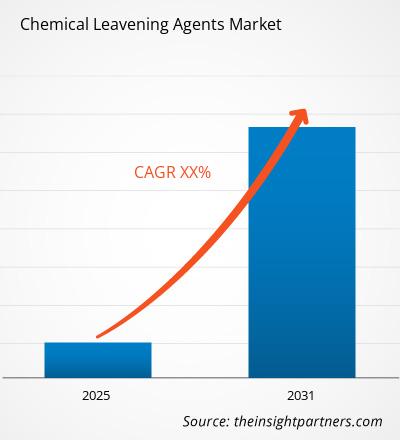
The Chemical Leavening Agents Market is projected to expand from US$ 3.63 Billion in 2025 to US$ 5.31 Billion by 2034, registering a CAGR of 4.32% during 2026–2034. This market includes chemical processes for producing gases which inflate dough and batters in the process of baking, and its uses are largely restricted to bakery and confectionary items.
North America is structurally an important market, with existing baking industry structure, packaging of foods, and constant reformulations into convenient products. The Chemical Leavening Agents Market size is dependent on the demand for baking powder and similar systems, while clean-label formulations, reduction of sodium content, ease of processing, and tailored release mechanisms have become important factors in purchase decisions of large food manufacturers.
Chemical Leavening Agents Market Assessment and Insights
- North America: North America is estimated to account for a 24–28% share in 2025 and expand at a CAGR of 4.2–4.8% between 2026 and 2034, supported by mature bakery manufacturing, packaged foods, and formulation innovation.
- U.S.: The U.S. represents approximately a 19–22% share of the global market in 2025 and is projected to grow at a CAGR of 4.3–4.9% between 2026 and 2034, supported by industrial baking demand.
- Europe: Europe holds an estimated 23–27% share in 2025 and is expected to register a CAGR of 4.0–4.6% between 2026 and 2034, with Germany, France, the UK, Italy, and Spain supporting demand through established bakery industries.
- Asia Pacific: APAC is estimated at a 29–33% share in 2025 and is projected to grow at a CAGR of 5.0–5.7% between 2026 and 2034, led by China, India, Japan, South Korea, and Australia.
- Largest Segment: Bakery is estimated to hold a 54–59% market share in 2025, growing at a CAGR of 4.4–5.0% during 2026–2034, reflecting broad formulation requirements.
- High Growth Segment: Granulated products are estimated at 20–25% market share in 2025, with a CAGR of 5.0–5.7% during 2026–2034, supported by controlled handling and specialized formulations.
- Key companies analyzed in detail: Archer Daniels Midland Company, Cargill, Incorporated, Clabber Girl Corporation, Corbion N.V., Eagle International, Kudos Blends, Novonesis A/S, Puratos Group NV, Richest Group, Weikfield Foods Private Limited.
Source: The Insight Partners' analysis based on proprietary research, government publications, company annual reports, investor presentations, industry databases, and expert interviews.
The technology involved in formulating agents is shifting from the traditional method of using acid-base blends to formulations that ensure controlled reaction times, moisture control, thermal stability, and specialized application capabilities. Economics of the production process will be based increasingly on sodium bicarbonate, acidulants, starches, accurate blending processes, proper packing and regulation compliance. Therefore, the manufacturers of chemical leavening agents are now differentiated through consistent quality and technical support instead of availability of commodities.
During the forecast period, it is anticipated that investments will be made mainly in flexible blending process, specialty leavening agents and production capacity within regions near food-processing industries. The new Asian markets present an opportunity with the growth of organized baking, while producers in Europe and North America focus on re-formulations and reduction of sodium in the products among other issues.
Chemical Leavening Agents Market Report Scope
| Report Attribute | Details |
|---|---|
| Market size in 2025 | US$ 3.63 Billion |
| Market Size by 2034 | US$ 5.31 Billion |
| Global CAGR (2026 - 2034) | 4.32% |
| Historical Data | 2021-2024 |
| Forecast period | 2026-2034 |
Chemical Leavening Agents Market Analysis
The development of the Chemical Leavening Agents Market correlates directly with the growth of the bakery/confectionery segment since leavens control volume, structure, texture, crumb, spreading properties, and product consistency. The demand comes from food producers/industrial bakeries and is transferred further to ingredient distributors, formulators, and specialized blenders. Sodium bicarbonate and acid systems lay the technical basis; starch and carriers determine the system's stability, flowability, and moisture resistance. More and more often, purchasing decisions take into account system properties in automatic lines.
For the supply side, it depends on the price and availability of inorganic/organic acid sources, sodium bicarbonate, starch, and packaging materials. Manufacturers should reconcile low-cost formulations with high-speed reactions and shelf-stability. Regional sources minimize the risk of logistics problems, while centralized production allows controlling quality consistency of batches. From customers' point of view, supplier qualification includes technical data, food safety standards, application information, and ability to modify leavening systems for various types of dough and processing temperature.
Chemical Leavening Agents Market Report has been analyzed to reveal a fragmented competition featuring global food ingredients players along with dedicated leavening agents providers. The key companies are Archer Daniels Midland Company and Cargill, Incorporated, which have wide range of food ingredients as well as relationships with customers. Corbion N.V. and Puratos Group NV are involved in providing specialty food ingredients and bakery solutions. Clabber Girl Corporation and Weikfield Foods Private Limited have significant relevance in baking applications.
Customization, technical service, and supply become more and more important for companies' positioning than mere availability of products. The role of Novonesis A/S increases due to its additional food biotechnology expertise. Richest Group operates in ingredient supply and formulation ecosystem. Strategic investment is expected in application laboratories, regional distribution networks, automation of mixing and low sodium formulas. Providers able to combine leavening chemistry with bakery formulation requirements will have advantage in customer retention and value creation.
● REPORT CUSTOMIZATION
Tailor This Report To Align With Your Specific Business Requirements
This report can be customized to align precisely with your business objectives, scope, and target markets. Customization options include tailored segmentation, geography, competitive analysis, and strategic insights to support informed decision-making.
Customize This Report →WHAT YOU CAN ADJUST
- ● Segmentations
- ● Geography
- ● Competitive Analysis
- ● Language Preferences
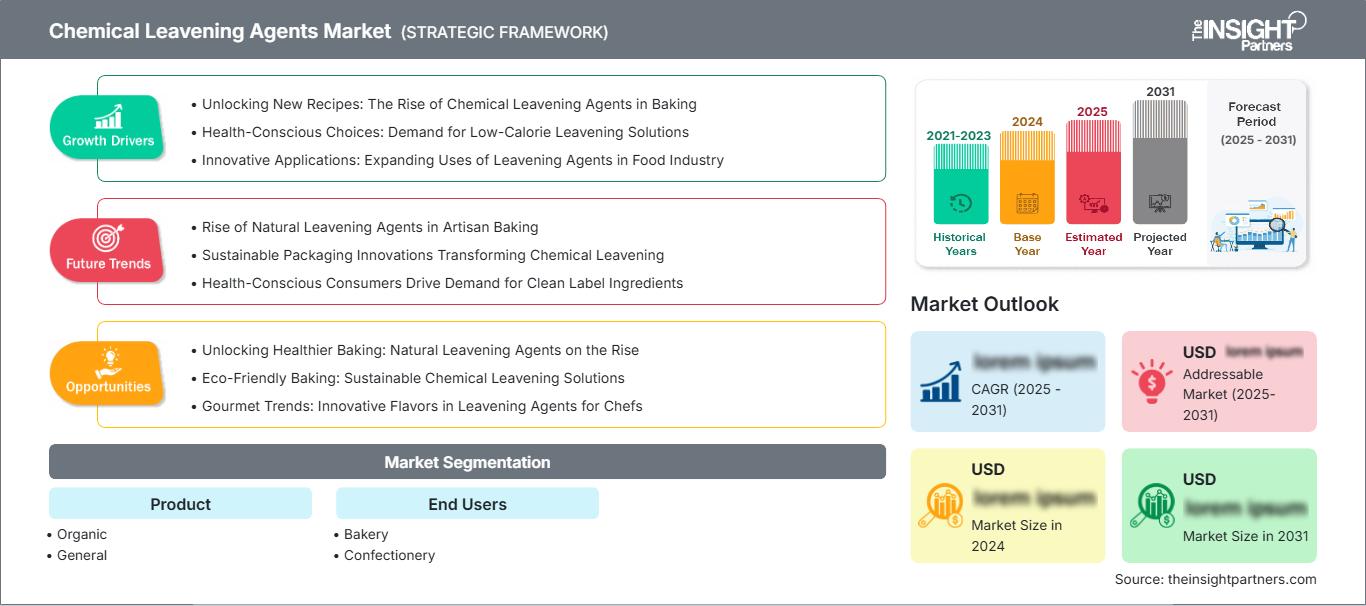
Chemical Leavening Agents Market: Strategic Insights
Regional Insights
North America Chemical Leavening Agents Market
North America accounts for a 24-28% Chemical Leavening Agents Market share in 2025, growing at a CAGR of 4.2-4.8% until 2034. Dominance in the region is driven by the US due to its substantial commercial baking operations, packaged foods industry, and existing distribution infrastructure. Demand covers alternatives to bread, cakes, cookies, muffins, biscuits, pancakes, and bakery mixes.
Sodium reduction, controlled delivery, and formulation-specific systems would be important categories for regional producers. Predictability is important in industrial baking because of the impact of automation on minor changes in the formulation. While Canada presents demand through packaged bakery goods and food service categories, Mexico represents the opportunity for processed food manufacture and modern retail distribution networks. Regulation compliance, efficiency in formulation, and clarity of ingredients will remain vital considerations for procurement. Thus, the demand from North America can be described as a stable base consumption with growth possibilities through reformulation.
U.S. Chemical Leavening Agents Market
The U.S. represents about 19-22% share of the worldwide Chemical Leavening Agents Market in 2025 and is forecasted to exhibit a CAGR of 4.3-4.9% for the forecast period of 2026-2034. This is driven by industrial bakery applications, private label food production, foodservice, and domestic bakery products. Some of the firms like Clabber Girl Corporation, Cargill, Incorporated, and Archer Daniels Midland Company have contributed to the ingredients market landscape.
Demand for applications includes cakes, cookies, biscuits, muffins, quick breads, and dry baking mixes. Food makers tend to consider leavening systems on the basis of their gas release characteristics, salt levels, sensory qualities, and suitability for high-volume production. Reformulations have been creating opportunities for the development of blends that offer volume and texture properties along with nutrition. U.S. continues to be the leader in innovations due to the availability of large-scale food companies to adopt tailor-made systems.
Europe Chemical Leavening Agents Market
The European region will have an expected 23-27% share in 2025 with a CAGR forecasted at 4.0-4.6% over 2025-2034. The German market is prominent due to a high amount of manufacturing facilities for bakeries as well as ingredient-processing capabilities. Other markets include the UK, France, Italy, and Spain with demand provided by bakery, confectionary, and food service sectors.
The UK market has the need for convenience products, baked product formulation, reformulation, and constant performance during large batches production. In Germany, the industrial baking facilities and knowledge of ingredients play an important role. The market drivers in France, Italy, and Spain are long traditions of bakery and confectionery industry, but the requirements may differ from region to region. The European manufacturers focus on the aspects of sodium management, clean label formulations, and documentation.
APAC Chemical Leavening Agents Market
APAC is forecasted to constitute a 29-33% share in 2025 and is expected to grow at a CAGR of 5.0-5.7% up until 2034. Leading the region in terms of demand are China, followed by Japan, India, South Korea, and Australia. The growing presence of organized bakery production and consumption of packaged food drive adoption.
China and India represent large volume potential due to the growing presence of bakery formats in the modern sense. Japan and South Korea focus on formulations and quality of products, whereas Australia is characterized by an advanced packaged food and bakery market. Investment into food processing, urbanization, retail modernization, and changing consumer demands contribute to demand growth in the region.
Middle East & Africa Chemical Leavening Agents Market
MEA is an upcoming demand region, due to food processing investments, urbanization, and development in commercial bakeries. Saudi Arabia and the UAE are major Gulf players, whereas South Africa is the base for industrial food processing. RoMEA participates with regional bakery manufacturing.
Factors that affect demand include population increase, growth in the hospitality industry, infrastructure development, and increased presence of packaged bakery products. Saudi Arabia gains from localization projects within food manufacturing, and UAE acts as the key processing and distribution area. South Africa offers mature food manufacturing combined with regional exports. MEA is projected to show a CAGR of 3.5% – 4.2%, with future growth depending on local investments, availability of ingredients, and efficient supply chain.
Segmentation Analysis
Product
Product segmentation comprises Organic and General systems. Product selection depends on acid chemistry, reaction profile, processing conditions, finished-food requirements, and formulation economics. The segment is expected to expand at a CAGR of 4.0–4.7% during 2026–2034. The Chemical Leavening Agents Market scope increasingly includes specialized systems designed for controlled performance and formulation flexibility.
- Organic: Organic leavening systems address formulations requiring specific ingredient positioning and controlled chemical reactions. Their strategic importance is increasing where manufacturers seek differentiated formulations, specialized bakery characteristics, or compatibility with particular product-development requirements.
- General: General systems remain foundational for mainstream bakery and confectionery applications because they provide familiar processing performance, broad availability, and established cost structures across high-volume commercial formulations.
Form
Form includes Powdered and Granulated products. Form affects handling, dispersion, storage stability, dosing accuracy, and reaction control. The segment is projected to grow at a CAGR of 4.4–5.2% during 2026–2034, with manufacturers evaluating formats according to equipment and formulation requirements.
- Powdered: Powdered leavening agents remain widely adopted because they disperse efficiently in dry mixes and support established industrial dosing systems. Their broad compatibility makes them important for standardized bakery and confectionery formulations.
- Granulated: Granulated systems provide opportunities for controlled handling and specialized reaction behavior. Their strategic relevance increases where manufacturers require improved flow properties, reduced dust, or differentiated release characteristics.
End Users
End Users comprise Bakery and Confectionery applications. These customers purchase leavening systems according to product texture, volume, process conditions, ingredient declarations, and finished-product specifications. The segment is expected to grow at a CAGR of 4.3–5.0% during 2026–2034 as industrial food production expands.
- Bakery: Bakery represents the dominant end-use category because cakes, biscuits, muffins, quick breads, and related products require dependable gas generation. Industrial bakeries prioritize consistent performance across automated production environments.
- Confectionery: Confectionery applications require controlled expansion, texture development, and compatibility with specialized recipes. Demand is supported by product diversification and increasing commercial production of baked confectionery items.
Opportunity Snapshot
| End Users | Revenue Contribution | Trend Tag | Adoption Stage |
|---|---|---|---|
| Bakery | High | Texture Control | Mature |
| Confectionery | Medium | Product Reformulation | Scaling |
Chemical Leavening Agents Market Growth Drivers and Impact Analysis
Expansion of Industrial Bakery and Packaged Food Production
Growth in industrial bakery production directly increases consumption of chemical leavening systems because commercial manufacturers require repeatable gas generation across high-volume batches. Expansion of packaged cakes, biscuits, muffins, pancakes, and dry mixes creates recurring ingredient demand. Automated production lines further increase the value of consistent particle size, reaction timing, and dispersion. Large manufacturers typically qualify suppliers against stringent specifications, encouraging investment in formulation expertise and quality systems. As food producers expand product ranges, suppliers can benefit from customized leavening blends designed for different moisture levels and baking profiles. The impact extends beyond volume because higher manufacturing complexity increases demand for technical support. This driver, therefore, supports both conventional leavener consumption and specialty formulation development across established and emerging food-processing markets.
Demand for Consistent Product Quality and Process Efficiency
Commercial food manufacturers increasingly prioritize process consistency because variations in leavening performance can affect product volume, texture, appearance, and yield. Chemical systems that release gas at predictable stages help processors maintain uniform results despite changes in production speed, mixing conditions, or oven profiles. This requirement encourages customers to evaluate suppliers based on technical performance rather than ingredient price alone. Formulation specialists can therefore capture value by developing systems tailored to specific equipment and recipes. Improved dosing accuracy can further reduce waste and production variability, particularly in automated facilities. The resulting commercial impact is stronger demand for engineered blends, technical consultation, and quality assurance. Suppliers with application laboratories and robust batch-control systems are better positioned to support customers seeking lower production losses and reliable finished-product characteristics.
Rising Reformulation Activity Across Bakery Applications
Food manufacturers are reformulating products in response to nutritional targets, consumer expectations, retailer specifications, and changing ingredient preferences. Leavening systems are affected because reducing sodium or changing acid components can alter reaction behavior and finished-product characteristics. Reformulation, therefore, creates demand for alternative combinations that preserve volume, texture, taste, and processability. Suppliers with strong formulation capabilities can help customers optimize ingredient ratios without requiring extensive equipment changes. The commercial effect is particularly relevant for packaged bakery products where consistency and label positioning influence purchasing decisions. Reformulation also creates opportunities for smaller specialty suppliers that can respond quickly to application-specific requirements. Over time, this driver should increase the share of technically differentiated products within procurement portfolios, while encouraging larger ingredient companies to strengthen bakery application expertise and collaborative product development.
Chemical Leavening Agents Market Future Trends
Precision-Controlled Leavening Systems
Precision-controlled systems are expected to become increasingly important as industrial bakeries adopt more automated production and demand tighter product specifications. Future formulations will emphasize reaction timing, moisture sensitivity, thermal behavior, and compatibility with different mixing and baking processes. Digital recipe management may further support precise dosing and formulation consistency across production facilities. The Chemical Leavening Agents Market trends landscape is therefore shifting toward application-engineered systems rather than standardized ingredients alone. Suppliers can differentiate through controlled-release technologies, particle engineering, and tailored acid combinations. This direction is particularly relevant for products requiring consistent height, crumb structure, and appearance. As manufacturers expand production across multiple locations, standardized performance becomes strategically important, creating opportunities for suppliers that can reproduce formulations reliably across regional manufacturing environments and changing raw-material conditions.
Lower-Sodium and Label-Conscious Formulation Development
Future product development is expected to place greater emphasis on lower-sodium formulations and ingredient systems that align with evolving nutritional and labeling objectives. Reducing sodium bicarbonate can affect flavor, browning, pH, and gas generation, requiring careful balancing of acidulants and processing conditions. Suppliers are likely to invest in formulation platforms that maintain functional performance while addressing nutritional targets. The trend also encourages greater transparency around ingredient functionality and sourcing. For manufacturers, successful reformulation can support product renovation without requiring major changes to production equipment. For suppliers, technical collaboration becomes an important competitive tool because customers need assistance validating new systems at pilot and commercial scale. This trend should gradually increase demand for application-specific blends and strengthen the role of formulation science in purchasing decisions.
Chemical Leavening Agents Market Opportunities
Regional Specialty Blending Capacity in APAC
Expansion of bakery manufacturing in APAC creates opportunities for suppliers to establish regional specialty blending and technical-service capabilities. Local production can shorten lead times, improve responsiveness, and reduce exposure to international freight disruptions. China and India are particularly attractive because their food-processing ecosystems combine large populations with expanding organized bakery channels. Investors can prioritize facilities capable of producing multiple formulations rather than single standardized products, allowing suppliers to serve diverse customer requirements. Local application laboratories can further strengthen relationships by supporting recipe optimization and troubleshooting. The opportunity is especially relevant for companies that already possess acidulant, bicarbonate, starch, or specialty ingredient portfolios. Regional capacity can also improve supply resilience while enabling manufacturers to tailor products to local processing conditions, regulatory requirements, and customer preferences.
Integrated Bakery Formulation Partnerships
Suppliers can capture additional value by moving beyond ingredient transactions toward integrated formulation partnerships with industrial bakeries and food manufacturers. Customers increasingly need assistance balancing leavening chemistry with flour characteristics, moisture, mixing, baking temperature, and desired texture. A collaborative model can include laboratory testing, pilot trials, formulation optimization, and production-scale validation. Such services create switching costs because customers become dependent on validated technical specifications rather than generic ingredient grades. The Chemical Leavening Agents Market Forecasts, therefore, includes opportunities for companies that combine manufacturing scale with application expertise. Strategic partnerships can also accelerate reformulation projects involving sodium reduction, product renovation, and customized release behavior. Suppliers that document performance through reproducible testing can strengthen qualification processes and secure longer-term contracts with large food manufacturers.
Recent Developments
- March 2025 – Innophos launched LEVAIR® Fortify for Nutrient-Dense Bars, a new leavening solution designed for high-protein, soft-baked bars. According to Innophos, formulations using the technology achieved 12% greater volume, 53% softer texture, and 100% more calcium per serving compared with a high-protein control. The development is significant because increasing protein content can negatively affect texture and volume, creating demand for specialized leavening systems.
- June 2025 – Lallemand completed the acquisition of AIT Ingredients from Moulins Soufflet, a Groupe InVivo subsidiary. AIT Ingredients supplies technical and creative baking solutions, including dough improvers, flour correctors, enzymes, sourdoughs, cereal ingredients, and mixes. Lallemand stated that the acquisition would broaden its application expertise, portfolio, production capacity, and international presence across bakery, flour milling, and pasta applications.
Frequently Asked Questions

- Comprehensive Market Sizing and Forecast Analysis
- Detailed Segmentation Analysis
- In-Depth Market Dynamics Assessment
- Regional and Country-Level Insights
- Competitive Landscape and Company Benchmarking
- Strategic Business Intelligence
Recent Reports
Testimonials

The Insight Partners provided valuable market intelligence that supported our global go-to-market strategy. Their team was professional, responsive, and attentive to our feedback, providing thoughtful analysis and helpful methodological clarifications throughout the project.
Junmo Kim Chief Financial Officer (CFO), Enertech Co., Ltd.
The Insight Partners' SCADA System Market report is comprehensive, with valuable insights on current trends and future forecasts. The team was highly professional, responsive, and supportive throughout. We are very satisfied and highly recommend their services.
RAN KEDEM Partner, Reali Technologies LTDs
I requested a report on a very specific software market and the team produced the report in a few days. The information was very relevant and well presented. I then requested some changes and additions to the report. The team was again very responsive and I got the final report in less than a week.
JEAN-HERVE JENN Chairman, Future Analytica
We worked with The Insight Partners for an important market study and forecast. They gave us clear insights into opportunities and risks, which helped shape our plans. Their research was easy to use and based on solid data. It helped us make smart, confident decisions. We highly recommend them.
PIYUSH NAGPAL Sr. Vice President, High Beam Global
The Insight Partners delivered insightful, well-structured market research with strong domain expertise. Their team was professional and responsive throughout. The user-friendly website made accessing industry reports seamless. We highly recommend them for reliable, high-quality research services
YUKIHIKO ADACHI CEO, Deep Blue, LLC.
This is the first time I have purchased a market report from The Insight Partners.While I was unsure at first, I visited their web site and felt more comfortable to take the risk and purchase a market report.I am completely satisfied with the quality of the report and customer service. I had several questions and comments with the initial report, but after a couple of dialogs over email with their analyst I believe I have a report that I can use as input to our strategic planning process.Thank you so much for taking the extra time and making this a positive experience.I will definitely recommend your service to others and you will be my first call when we need further market data.
JOHN SUZUKI President and Chief Executive Officer, Board Director, BK Technologies
I wish to appreciate your support and the professionalism you displayed in the course of attending to my request for information regarding to infectious disease IVD market in Nigeria. I appreciate your patience, your guidance, and the fact that you were willing to offer a discount, which eventually made it possible for us to close a deal. I look forward to engaging The Insight Partners in the future, all thanks to the impression you have created in me as a result of this first encounter.
DR CHIJIOKE ONYIA MANAGING DIRECTOR, PineCrest Healthcare Ltd.Reason to Buy
- Informed Decision-Making
- Understanding Market Dynamics
- Competitive Analysis
- Identifying Emerging Markets
- Customer Insights
- Market Forecasts
- Risk Mitigation
- Boosting Operational Efficiency
- Strategic Planning
- Investment Justification
- Tracking Industry Innovations
- Aligning with Regulatory Trends





 Get Free Sample for