
Chlorinated Polyethylene Market Growth, Share & Trends by 2034
Coverage: By Product Type (CPE 135A, CPE 135B, Others); Application (Impact Modifier, Wire and Cable Jacketing, Hose and Tubing, Adhesives, Magnetics, IR ABS, Others), and Geography (North America, Europe, Asia Pacific, and South and Central America)
- Status : Data Released
- Report Code : TIPRE00015614
- Category : Chemicals and Materials
- No. of Pages : 150
- Available Report Formats :


- Last update date : September 01, 2026


2025 Market Size
US$ 1.73 Bn
Base year value
2034 Forecast
US$ 2.96 Bn
Projected by 2034
CAGR 2026-2034
6.12 %
Growth rate
Addressable Market
US$ 21.20 Bn
(2026-2034)
The Chlorinated Polyethylene Market is valued at US$ 1.73 Billion in 2025 and is projected to reach US$ 2.96 Billion by 2034, registering a CAGR of 6.12% during 2026–2034. The market is supported by demand for impact-modified PVC, flexible and flame-resistant wire and cable compounds, industrial hoses, and specialty elastomer formulations. Product performance, downstream PVC processing capacity, and regional manufacturing economics continue to influence supplier positioning and application development.
North American demand is expected to expand at an estimated 4.8–5.5% CAGR during 2026–2034, supported by the replacement of aging electrical infrastructure and continued requirements for durable industrial polymer compounds. The Chlorinated Polyethylene Market size outlook is further influenced by wire and cable production, industrial hose consumption, construction renovation, and demand for materials offering weatherability, oil resistance, flame performance, and low-temperature impact strength.
Chlorinated Polyethylene Market Assessment and Insights
- North America: North America is estimated to account for a 10–12% share in 2025 and grow at a 4.8–5.5% CAGR between 2026 and 2034, supported by electrical infrastructure upgrades, industrial applications, and demand for durable polymer compounds.
- U.S.: The U.S. represents approximately an 8–10% share of global demand in 2025 and is projected to expand at a 4.9–5.5% CAGR during 2026–2034, led by wire, cable, and industrial applications.
- Europe: Europe holds an estimated 8–10% share in 2025 and is projected to grow at a 3.8–4.6% CAGR between 2026 and 2034. Germany, Italy, France, the UK, and Spain support demand through electrical, automotive, construction, and specialty polymer applications.
- Asia Pacific: Asia Pacific commands 73.62% share in 2025 and is expected to grow at a 5.7–6.0% CAGR during 2026–2034. China leads regional consumption, followed by Japan, South Korea, India, and Australia, supported by extensive polymer-processing capacity.
- Largest Segment: CPE 135A is estimated at 52–55% market share in 2025 and is expected to grow at a 5.7–6.0% CAGR during 2026–2034, reflecting broad PVC impact-modifier usage.
- High Growth Segment: Hose and Tubing represents an estimated 7–10% market share in 2025 and is projected to grow at a 6.4–6.9% CAGR during 2026–2034, supported by industrial durability requirements.
- Key companies analyzed in detail: Hangzhou Keli Chemical Co., Ltd., Jiangsu Tianteng Chemical Industry Co., Ltd., Novista Group, S&E Specialty Polymers, Shandong Gaoxin Chemical Co., Ltd., Shandong Xiansheng Plastic Industry Co., Ltd., Shandong Xuye New Materials Co., Ltd., Resonac Holdings Corporation, Sundow Polymers Co., Ltd., and Weifang Yaxing Chemical Co., Ltd.
Source: The Insight Partners' analysis based on proprietary research, government publications, company annual reports, investor presentations, industry databases, and expert interviews.
The evolution of the industry is moving away from generic CPE grades towards application-specific compositions of CPE, having controlled chlorine content, molecular weight, crystallinity, and processing. The producers are increasingly developing their products by differentiation into impact modification, cable jacketing, hose compounds, and special rubber grades. The examples of such specialization include Resonac’s ELASLEN product family, which consists of various grades with different levels of chlorine content and structure. Manufacturing economics are related to polyethylene feedstock, chlorine source, energy, and chemical integration.
Future growth will probably be seen in Asia, while North America and Europe will have a trend of production of high-performance grades and adherence to regulations. Such factors as electrification, industrial automation, construction renovation, and durable polymer goods can ensure investments in the future. Manufacturers’ policies will probably be aimed at grade quality, technical services, applications, and logistics rather than capacities. The growing concern of regulators about halogenated materials will help in optimization and substitution.
Chlorinated Polyethylene Market Report Scope
| Report Attribute | Details |
|---|---|
| Market size in 2025 | US$ 1.73 Billion |
| Market Size by 2034 | US$ 2.96 Billion |
| Global CAGR (2026 - 2034) | 6.12% |
| Historical Data | 2021-2024 |
| Forecast period | 2026-2034 |
Chlorinated Polyethylene Market Analysis
Chlorinated Polyethylene Market expansion will be dependent on PVC processing, electricity, industrial rubber, and construction products. Value chain starts from the beginning with the use of polyethylene and chlorine raw materials to chlorination control, drying, finishing, grading, packing, and formulation by compounders. CPE manufacturers then become competitive in terms of chlorine distribution, structure, purity, particle properties, processability, and support. Chemical clusters may help in terms of nearness to the raw materials and reduced logistics cost.
Strong demand exists where manufacturers have the need for impact resistance, weathering, flame resistance, oil resistance, and chemical resistance. CPE 135A will continue to serve the role of impact modifier in PVC applications whereas high viscosity grades will serve in specialized compounding. Supply situation will depend on polyethylene pricing, chlorine availability, energy costs, environmental demands, and shipping conditions. Asian manufacturers get an advantage due to large downstream PVC and polymer compounding industry while regional manufacturers in North America and Europe put more emphasis on specialized applications.
Competitive Chlorinated Polyethylene Market Analysis suggests the presence of a fragmented supplier structure featuring active involvement from Asia and application-oriented suppliers. Weifang Yaxing Chemical Co., Ltd., Sundow Polymers Co., Ltd., Shandong Gaoxin Chemical Co., Ltd., and Shandong Xuye New Materials Co., Ltd. represent key companies in the Chinese manufacturing base. Resonac Holdings Corporation features differentiated grades in its range of products, ELASLEN, which highlights the significance of product engineering in mature markets.
Key areas for investment include process efficiency, specialty grades, environmental attributes, and technical cooperation in downstream applications. Hangzhou Keli Chemical Co., Ltd., Jiangsu Tianteng Chemical Industry Co., Ltd., Novista Group, and S&E Specialty Polymers make up for a diversified group of suppliers, while Shandong Xiansheng Plastic Industry Co., Ltd. is a contributor to the regional manufacturing scene. Strategic positioning can be expected to become stronger with the help of supply contracts, specialized grades, exports, and application development.
● REPORT CUSTOMIZATION
Tailor This Report To Align With Your Specific Business Requirements
This report can be customized to align precisely with your business objectives, scope, and target markets. Customization options include tailored segmentation, geography, competitive analysis, and strategic insights to support informed decision-making.
Customize This Report →WHAT YOU CAN ADJUST
- ● Segmentations
- ● Geography
- ● Competitive Analysis
- ● Language Preferences
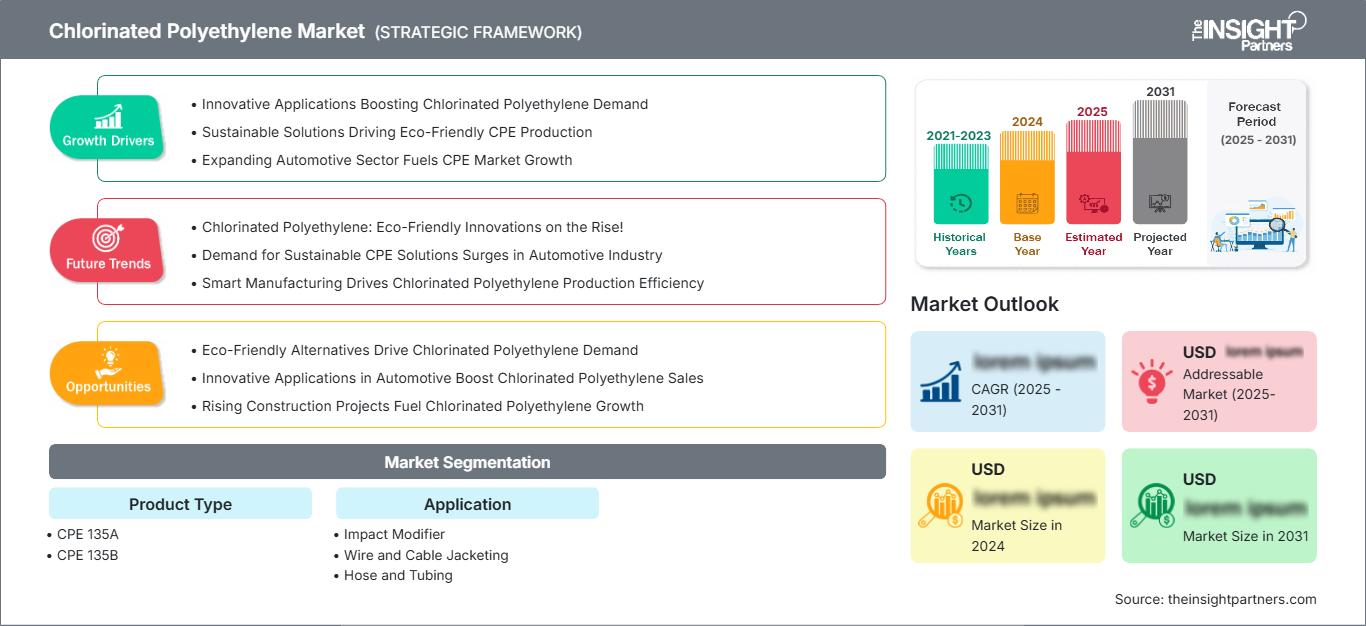
Chlorinated Polyethylene Market: Strategic Insights
Regional Insights
North America Chlorinated Polyethylene Market
In 2025, North America is forecasted to account for 10–12% of the total market share driven by demand in the United States and fueled by electrical applications, industrial hoses, automotive parts, and specialty polymer compounds. The region is expected to experience 4.8–5.5% CAGR over 2026–2034 owing to a focus on materials that are durable, oil-resistant, weather-resistant, chemical-resistant, and flame resistant.
The United States is the primary demand center in the region owing to the existing infrastructure for PVC fabrication as well as wire and cables. Canada and Mexico add through construction products, industrial parts, and cross-border manufacturing activities. Regulation focusing on material performance and fire resistance further bolsters the preference for engineered materials in certain applications.
U.S. Chlorinated Polyethylene Market
Demand for the U.S., which represents about 82-85% of North American demand in 2025, or 8-10% of total global demand, is forecasted to grow at a CAGR of 4.9-5.5% through 2034. Demand drivers include electrical distribution, industrial equipment, wire and cable compounds, and replacement infrastructure.
For companies that serve the U.S. market, competition is no longer on price alone but on grade consistency, application engineering, and delivery reliability. CPE continues to be important where there is need for oil, weather, flex, and flame resistance in cable jackets and industrial applications. Additional demand from data infrastructure, industrial automation, utility upgrades, and durable PVC should continue to offer opportunities.
Europe Chlorinated Polyethylene Market
Europe represents approximately 8–10% Chlorinated Polyethylene Market share in 2025 and is expected to register a 3.8–4.6% CAGR through 2034. Germany is the leading country, supported by automotive, industrial machinery, electrical equipment, and specialty polymer processing. The UK, France, Italy, and Spain contribute through construction, infrastructure, industrial manufacturing, and electrical applications.
Industrial compounds and products for infrastructure dominate the market in the UK; moreover, purchases become more efficient and regulated regarding material efficiency. Germany enjoys a diverse manufacturing sector and advanced abilities to develop compounds. In France, there is demand for compounds in both industrial and electrical markets; in Italy and Spain, consumption is supported by the cable industry, construction, automotive, and polymer processing sectors.
APAC Chlorinated Polyethylene Market
APAC has a market share of 73.62% in 2025, and its growth is expected to reach 5.7 to 6.0%, CAGR, from 2026 to 2034, making APAC the largest region. China is the main market, and other markets include Japan, South Korea, India, and Australia, due to polymer processing and electrical manufacturing.
The key drivers for APAC are the growth of industry and infrastructure development, as well as increasing demand for cables and hoses. China relies on chemical and polymer production. Japan and South Korea use engineering polymers, India has infrastructure and electrical manufacturing.
Middle East & Africa Chlorinated Polyethylene Market
The Middle East & Africa is estimated to represent 3–5% of global demand in 2025 and is expected to grow at a 4.2–5.0% CAGR through 2034. Saudi Arabia leads regional demand, followed by the UAE and South Africa, with infrastructure, utilities, construction, and industrial projects supporting consumption.
Saudi Arabia benefits from petrochemical integration and infrastructure investment, while the UAE supports demand through construction and industrial development. South Africa provides a manufacturing and mining-related application base. The rest of MEA remains smaller but offers opportunities through power infrastructure, water systems, industrial equipment, and construction. Energy availability and regional logistics will continue influencing supplier economics.
Segmentation Analysis
Product Type
Product differentiation is based on molecular characteristics and processing behavior. CPE 135A remains the principal grade for PVC impact modification, while CPE 135B is increasingly relevant where flexibility and processing performance are required. The product segment is expected to register a 6.1–6.8% CAGR from 2026 to 2034. The Chlorinated Polyethylene Market scope, therefore, extends from conventional PVC modification into electrical, hose, elastomer, and specialty polymer applications.
- CPE 135A: CPE 135A maintains a strong position in PVC impact modification because it balances processability, flexibility, impact resistance, and compatibility with common rigid PVC formulations used in profiles and construction products.
- CPE 135B: CPE 135B addresses applications requiring different rheological and mechanical characteristics. Its strategic importance increases where compounders need higher performance in specialized formulations, including selected rubber and cable applications.
Application
Application demand is diversified across impact modifiers, wire and cable jacketing, hose and tubing, adhesives, magnetics, and IR ABS. The application segment is expected to expand at a 6.0–6.4% CAGR during 2026–2034, reflecting broader use of engineered polymer compounds.
- Impact Modifier: Impact modification remains the principal application because CPE improves toughness and weather resistance in rigid PVC products. Demand is supported by profiles, pipes, siding, and other products requiring durable outdoor performance.
- Wire and Cable Jacketing: Cable applications value CPE for flexibility, flame performance, oil resistance, and weatherability. Electrification and infrastructure modernization support demand for compounds designed for demanding operating environments.
- Hose and Tubing: Hose and tubing applications require resistance to oils, chemicals, heat, and mechanical stress. CPE therefore provides a performance-oriented option for industrial and automotive compound formulations.
- Adhesives: CPE can function as a specialty polymer component where adhesion, flexibility, and chemical resistance are required. Its role is concentrated in selected industrial formulations rather than broad commodity adhesive production.
- Magnetics: Magnetic rubber formulations use CPE where flexibility and compatibility with magnetic fillers are important. Specialty grade control can support consistent processing and dimensional stability in molded magnetic components.
- IR ABS: IR ABS applications represent a specialized demand area where CPE-based formulations can provide selected performance characteristics. Growth depends on specialized compound development and adoption by downstream manufacturers.
Opportunity Snapshot
| Application | Revenue Contribution | Trend Tag | Adoption Stage |
|---|---|---|---|
| Impact Modifier | High | PVC Toughening | Mature |
| Wire and Cable Jacketing | High | Cable Electrification | Scaling |
| Hose and Tubing | Medium | Industrial Durability | Scaling |
| Adhesives | Medium | Specialty Bonding | Scaling |
| Magnetics | Low | Flexible Magnets | Emerging |
| IR ABS | Low | Specialty Blends | Emerging |
Chlorinated Polyethylene Market Growth Drivers and Impact Analysis
Expansion of durable PVC and polymer infrastructure products
Infrastructure building, renovation, utilities, and industrial development have continued needs for profiles, piping, sidings, and other PVC materials. CPE is considered desirable as it can increase impact resistance without compromising weathering and processing properties. This factor influences the manufacturers through stable demand for standard grades and drives compounders to make adjustments to their formulations based on the processing conditions of the PVC resins. The growing emerging markets of Asia are especially significant since increased construction and utility systems lead to high quantities of PVC products. As for the suppliers, the impact goes beyond the resin volumes as the customers demand consistency in extrusion and molding processes. Manufacturers that can offer constant chlorine distribution and particles will be able to build stronger customer relations.
Electrification and expanding wire and cable applications
Expansion of electricity networks, industrial automation, telecommunications infrastructure, and charging-related equipment is increasing demand for durable cable materials. CPE offers a combination of flexibility, weather resistance, oil resistance, and flame performance that can be valuable in selected jacketing compounds. The impact is most felt where cables work outdoors or in an industrial setting that will be subjected to both mechanical and chemical exposure. Growth in demand has prompted compounders to consider the use of CPE vis-à-vis other materials based on temperature grades, flammability, flexibility, cost, and regulations. Manufacturers have thus taken to developing new grades and technical support to help cable makers. The significance of regional factors cannot be overlooked since European and North American consumers can impose higher standards than their Asian counterparts.
Broader use of engineered elastomer compounds
In terms of usage, CPE is now considered for many applications outside the scope of impact modifiers for PVC. The properties of chemical resistance, weatherability, flexibility, and flame resistance make CPE suitable for industrial hoses, rubber goods, specialty adhesives, magnetic compounds, and some polymer blends. In terms of applications, such diversity limits reliance on one specific area and opens additional chances for optimizing CPE for particular uses. From the commercial perspective, that translates into increased attention to the chemical composition, percentage of chlorine, viscosity, and ability to interact with fillers. Compounders can choose CPE grades to tailor performance and costs of their mixes without having to resort to the universal formula.
Chlorinated Polyethylene Market Future Trends
Greater specialization of CPE grades for application-specific performance
Future Chlorinated Polyethylene Market trends are expected to emphasize application-specific grades rather than broad commodity specifications. Producers are likely to refine molecular weight, chlorine distribution, crystallinity, viscosity, and particle characteristics for particular downstream formulations. Cable compounds may prioritize flame behavior and flexibility, while impact-modifier grades may focus on toughness and processing efficiency. Specialty hose applications can require optimized resistance to oils, chemicals, temperature variation, and mechanical stress. This specialization should increase the value of technical collaboration between resin producers and compounders. Digital process monitoring and improved quality-control systems may further reduce batch variability. Over time, customers could increasingly purchase performance-defined grades supported by application data rather than selecting materials only according to basic resin classification.
Increasing emphasis on lower-impact manufacturing and material efficiency
Environmental considerations are likely to influence future CPE production through energy efficiency, process optimization, emissions control, and improved material utilization. Producers operating large chemical facilities may seek lower energy consumption per unit of output and more efficient chlorine utilization. Downstream processors can similarly reduce material use by optimizing formulation design and product thickness while maintaining required performance. Regulatory scrutiny of halogen-containing materials will encourage suppliers to provide clearer technical documentation and application guidance. However, substitution will remain application-dependent because alternatives may not reproduce the same combination of weatherability, oil resistance, flame performance, and cost. The resulting market direction is therefore expected to favor optimized CPE formulations in applications where performance requirements justify continued use.
Chlorinated Polyethylene Market Opportunities
Localized supply and technical support in high-growth Asian markets
Investment opportunities exist in regional supply networks serving India, Southeast Asia, and other expanding polymer-processing markets. Import-dependent customers can benefit from shorter lead times, technical inventory, and localized formulation support. Producers can establish application laboratories or distributor partnerships close to PVC processors and cable manufacturers, allowing faster grade qualification and customer troubleshooting. India is particularly relevant because its expanding electrical, infrastructure, automotive, and construction industries can support demand for durable polymer compounds. Companies entering these markets should prioritize consistent CPE 135A and CPE 135B quality, regulatory documentation, packaging suited to local logistics, and technical personnel capable of supporting compound formulation. Such strategies can reduce dependence on spot trading and improve customer retention while creating a platform for specialty-grade development.
Premium formulations for cables, hoses, and specialty compounds
Chlorinated Polyethylene Market Forecasts indicate that higher-value opportunities can emerge from specialized formulations rather than simple volume expansion. Suppliers can target cable jacketing, industrial hoses, specialty rubber, magnetic compounds, and technically demanding PVC products where performance requirements are more stringent. Investment should focus on formulation laboratories, application testing, flame-performance evaluation, and customer co-development. Producers can differentiate through controlled molecular characteristics and documented performance rather than competing exclusively on resin price. Partnerships with compounders can accelerate qualification and create application-specific specifications that are harder for competing suppliers to displace. This strategy is particularly attractive in mature markets where volume growth is moderate, but customers are willing to pay for consistent performance, regulatory support, and dependable supply.
Recent Developments
- April 2025: Sundow Polymers Co., Ltd. showcased its WELLPREN® Chlorinated Polyethylene (CPE) portfolio at CHINAPLAS 2025 in Shenzhen, highlighting applications in wire and cable products and other high-performance polymer uses. The company also presented its Phase-II 100,000-ton CPE expansion project, supported by zero-emission production technology and advanced German environmental technologies.
- February 2026: Shivtek Spechemi Industries Ltd. announced that it was highlighting Chlorinated Polyethylene at PlastIndia 2026, with the material planned for production at India’s first domestic CPE plant. The development indicates increasing domestic CPE manufacturing capability in India and supports localized supply for polymer and plastics applications.
Frequently Asked Questions

- Comprehensive Market Sizing and Forecast Analysis
- Detailed Segmentation Analysis
- In-Depth Market Dynamics Assessment
- Regional and Country-Level Insights
- Competitive Landscape and Company Benchmarking
- Strategic Business Intelligence
Recent Reports
Testimonials

The Insight Partners provided valuable market intelligence that supported our global go-to-market strategy. Their team was professional, responsive, and attentive to our feedback, providing thoughtful analysis and helpful methodological clarifications throughout the project.
Junmo Kim Chief Financial Officer (CFO), Enertech Co., Ltd.
The Insight Partners' SCADA System Market report is comprehensive, with valuable insights on current trends and future forecasts. The team was highly professional, responsive, and supportive throughout. We are very satisfied and highly recommend their services.
RAN KEDEM Partner, Reali Technologies LTDs
I requested a report on a very specific software market and the team produced the report in a few days. The information was very relevant and well presented. I then requested some changes and additions to the report. The team was again very responsive and I got the final report in less than a week.
JEAN-HERVE JENN Chairman, Future Analytica
We worked with The Insight Partners for an important market study and forecast. They gave us clear insights into opportunities and risks, which helped shape our plans. Their research was easy to use and based on solid data. It helped us make smart, confident decisions. We highly recommend them.
PIYUSH NAGPAL Sr. Vice President, High Beam Global
The Insight Partners delivered insightful, well-structured market research with strong domain expertise. Their team was professional and responsive throughout. The user-friendly website made accessing industry reports seamless. We highly recommend them for reliable, high-quality research services
YUKIHIKO ADACHI CEO, Deep Blue, LLC.
This is the first time I have purchased a market report from The Insight Partners.While I was unsure at first, I visited their web site and felt more comfortable to take the risk and purchase a market report.I am completely satisfied with the quality of the report and customer service. I had several questions and comments with the initial report, but after a couple of dialogs over email with their analyst I believe I have a report that I can use as input to our strategic planning process.Thank you so much for taking the extra time and making this a positive experience.I will definitely recommend your service to others and you will be my first call when we need further market data.
JOHN SUZUKI President and Chief Executive Officer, Board Director, BK Technologies
I wish to appreciate your support and the professionalism you displayed in the course of attending to my request for information regarding to infectious disease IVD market in Nigeria. I appreciate your patience, your guidance, and the fact that you were willing to offer a discount, which eventually made it possible for us to close a deal. I look forward to engaging The Insight Partners in the future, all thanks to the impression you have created in me as a result of this first encounter.
DR CHIJIOKE ONYIA MANAGING DIRECTOR, PineCrest Healthcare Ltd.Reason to Buy
- Informed Decision-Making
- Understanding Market Dynamics
- Competitive Analysis
- Identifying Emerging Markets
- Customer Insights
- Market Forecasts
- Risk Mitigation
- Boosting Operational Efficiency
- Strategic Planning
- Investment Justification
- Tracking Industry Innovations
- Aligning with Regulatory Trends





 Get Free Sample for