
Circular Dichroism (CD) Spectrometers Market Size, Trends & Growth by 2034
Circular Dichroism (CD) Spectrometers Market Size and Forecasts (2021–2034), Global and Regional Share, Trends, and Growth Opportunity Analysis Report Coverage : by Type (Manual CD Spectrometers and Automated CD Spectrometers); Application (Pharmaceuticals & Biopharmaceuticals, Academic & Research Institutes, Healthcare & Diagnostics, Food & Beverage Industry Others); End-User (Pharmaceutical Companies, Biotechnology Companies, Research Institutions, Hospitals & Diagnostic Labs); and Geography (North America, Europe, Asia Pacific, and South and Central America)
- Status : Data Released
- Report Code : TIPRE00040645
- Category : Life Sciences
- No. of Pages : 150
- Available Report Formats :


- Last update date : November 06, 2026


2025 Market Size
US$ 67 Mn
Base year value
2034 Forecast
US$ 118.61 Mn
Projected by 2034
CAGR 2026-2034
6.55 %
Growth rate
Addressable Market
US$ 839.26 Mn
(2026-2034)
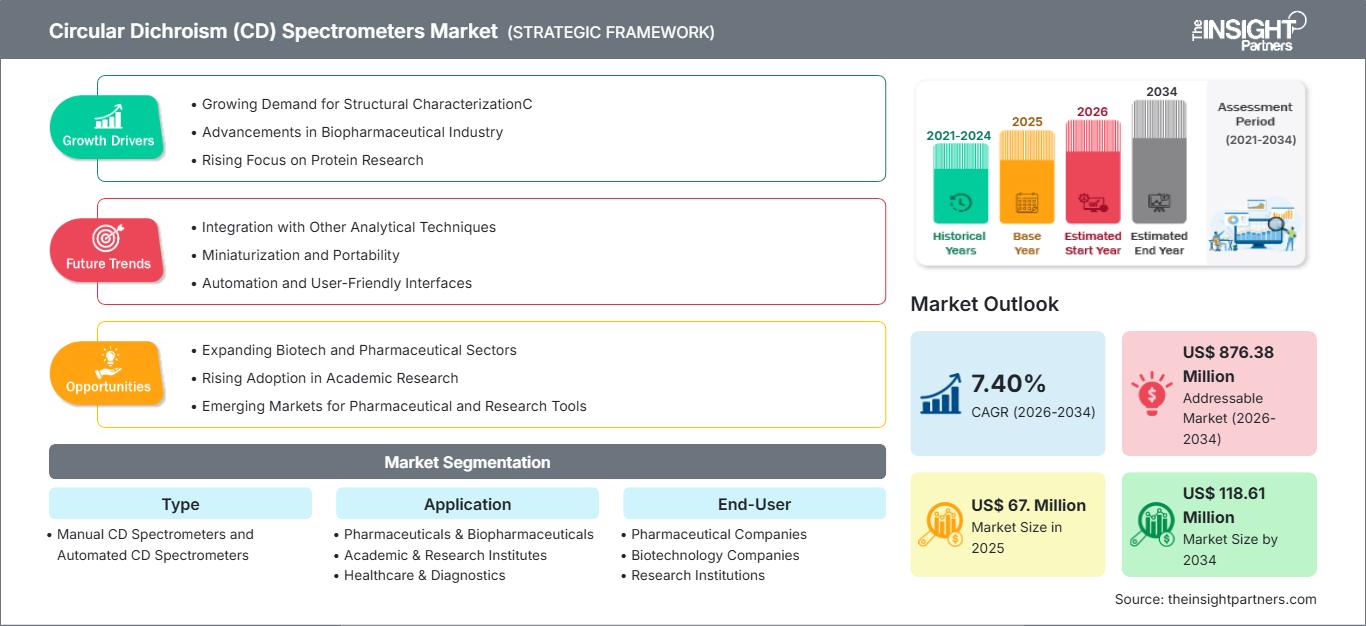
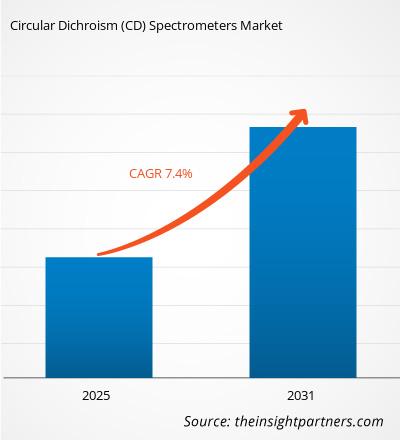
The Circular Dichroism Spectrometers Market was valued at US$ 67 Million in 2025 and is expected to reach US$ 118.61 Million by 2034, registering a CAGR of 6.55% during 2026–2034. Growth is supported by expanding biopharmaceutical research, increasing structural characterization of proteins and nucleic acids, and greater emphasis on higher-order structure assessment. Advances in detector sensitivity, temperature control, automated sample handling, and analytical software are strengthening the role of circular dichroism spectroscopy across discovery, formulation development, comparability studies, and quality-focused laboratory workflows.
Across North America, the Circular Dichroism Spectrometers Market size is projected to expand at approximately ~6% CAGR through 2034. The region benefits from established biopharmaceutical research clusters, substantial academic instrumentation infrastructure, and recurring replacement of legacy spectroscopy platforms. Demand is also supported by biologics and biosimilar development, where laboratories require reproducible structural and stability data across increasingly complex molecular candidates. Automated instruments are gaining preference among regulated laboratories seeking higher throughput, traceable workflows, and reduced operator-dependent variability.
Circular Dichroism (CD) Spectrometers Market Assessment and Insights
Regional Outlook
- North America: ~38% of the global Circular Dichroism Spectrometers Market share in 2025 | ~6% CAGR through 2034. Market position: North America leads through its concentrated biopharmaceutical research ecosystem, extensive installed laboratory base, high-value instrument procurement, and continuing adoption of higher-order structure characterization in biologic development.
- US: ~78% of North American market revenue in 2025 | ~6% CAGR through 2034. Market position: The US dominates North America through pharmaceutical research expenditure, biotechnology clusters, university core laboratories, contract research activity, and early adoption of automated analytical systems for biologics and biosimilar characterization.
- Europe: ~28% of the global market in 2025 | ~6% CAGR through 2034. Market position: Europe represents a mature instrumentation market supported by pharmaceutical research, structural biology capabilities, and established spectroscopy expertise. Germany and the UK lead regional demand, followed by France, Italy, and Spain.
- Asia Pacific: ~25% of the global market in 2025 | ~8% CAGR through 2034. Market position: Asia Pacific is the fastest-growing region as China, Japan, South Korea, India, and Australia expand biotechnology capacity, research funding, local pharmaceutical development, and access to advanced analytical instrumentation.
Segment Outlook
- Automated CD Spectrometers: ~58% Share in 2025 | ~8% CAGR through 2034. Market position: Automated platforms lead because pharmaceutical and research laboratories increasingly prioritize unattended operation, repeatable sample handling, higher throughput, integrated temperature control, and auditable analytical workflows.
- Pharmaceuticals & Biopharmaceuticals: ~46% Share in 2025 | ~8% CAGR through 2034. Market position: This application records a strong growth outlook as biologics, biosimilars, peptides, antibodies, and nucleic-acid therapeutics require structural, conformational, stability, and comparability assessments throughout development.
Competitive Coverage
JASCO Corporation, Applied Photophysics Ltd., Bio-Logic SAS, Malvern Panalytical Ltd., Thermo Fisher Scientific Inc., HORIBA, Ltd., Olympus Corporation, Shimadzu Corporation, Abcam plc, Protein Solutions Technology GmbH
Methodology
The Insight Partners follows Data Collection & Secondary Research, Primary Research, Data Analysis, and Data Triangulation & Final Review to validate market estimates and insights.
Source: The Insight Partners' analysis based on proprietary research, government publications, company annual reports, investor presentations, industry databases, and expert interviews.
Instrument demand has progressed from specialist academic measurements toward broader biopharmaceutical characterization and workflow-centered analysis. Improvements in optical throughput, photodetectors, low-volume sampling, automated cuvette handling, thermal-ramp control, stopped-flow compatibility, and simultaneous absorbance or fluorescence measurement have expanded analytical utility. Current systems can support secondary and tertiary protein structure assessment, folding and unfolding studies, ligand interactions, and chiral compound analysis. Suppliers are consequently competing on whole-workflow performance, including software usability, calibration consistency, service coverage, accessory modularity, data integrity, and compatibility with regulated laboratory practices.
Through 2034, procurement is expected to broaden in countries building biologics, biosimilar, vaccine, and advanced-therapy capabilities. Shared instrumentation centers and contract research organizations can improve system utilization in markets where individual laboratories cannot justify premium equipment. Investment will increasingly favor platforms that reduce sample consumption, automate repetitive measurements, and generate defensible comparisons across development batches. Regulatory expectations for orthogonal characterization will remain an indirect tailwind, although CD spectroscopy will continue to complement rather than replace techniques such as differential scanning calorimetry, fluorescence spectroscopy, infrared spectroscopy, and mass spectrometry.
Circular Dichroism (CD) Spectrometers Market Report Scope
| Report Attribute | Details |
|---|---|
| Market size in 2025 | US$ 67 Million |
| Market Size by 2034 | US$ 118.61 Million |
| Global CAGR (2026 - 2034) | 6.55% |
| Historical Data | 2021-2024 |
| Forecast period | 2026-2034 |
Circular Dichroism (CD) Spectrometers Market Analysis
The Circular Dichroism Spectrometers Market growth is primarily connected to the increasing complexity of molecular pipelines. Antibodies, peptides, engineered proteins, nucleic acids, and biosimilars require evidence on folding, conformational integrity, thermal stability, and molecular interactions. CD spectroscopy provides rapid, solution-state information while consuming comparatively limited sample volumes. Demand therefore extends from discovery laboratories to formulation groups, process-development teams, university core facilities, and contract research organizations.
The value chain includes optical components, light sources, monochromators, photoelastic modulators, detectors, temperature-control hardware, cuvettes, automation modules, analytical software, distribution, installation, calibration, and after-sales service. Supply advantages arise from proprietary optics, application expertise, reproducible calibration, and global technical support. Long instrument lifetimes constrain unit replacement frequency, making accessories, upgrades, software, service contracts, and application expansion important commercial levers.
Circular Dichroism Spectrometers Market analysis indicates a concentrated specialist landscape surrounded by diversified analytical-instrumentation suppliers. JASCO Corporation, Applied Photophysics Ltd., and Bio-Logic SAS compete through dedicated CD platforms, while broader suppliers leverage distribution, complementary spectroscopy portfolios, and service infrastructure. JASCO emphasizes modular multi-probe measurements, Applied Photophysics supports automated higher-order structure workflows, and Bio-Logic positions modularity and operating-cost efficiency around its MOS-500 platform.
Investment is shifting toward automation, validated software, multi-technique configurations, and application support rather than optical specifications alone. Thermo Fisher Scientific Inc., HORIBA, Ltd., Shimadzu Corporation, Olympus Corporation, Abcam plc, Malvern Panalytical Ltd., and Protein Solutions Technology GmbH contribute through adjacent instrumentation, components, reagents, channels, or laboratory technologies. Strategic positioning increasingly depends on converting instrument performance into reproducible decisions for development, comparability, and quality assessment.
● REPORT CUSTOMIZATION
Tailor This Report To Align With Your Specific Business Requirements
This report can be customized to align precisely with your business objectives, scope, and target markets. Customization options include tailored segmentation, geography, competitive analysis, and strategic insights to support informed decision-making.
Customize This Report →WHAT YOU CAN ADJUST
- ● Segmentations
- ● Geography
- ● Competitive Analysis
- ● Language Preferences
Circular Dichroism (CD) Spectrometers Market: Strategic Insights
Regional Insights
North America Circular Dichroism Spectrometers Market
North America is projected to advance at approximately ~6% CAGR through 2034. The region combines established pharmaceutical research operations, biotechnology clusters, contract development infrastructure, and globally recognized academic laboratories. These organizations use CD spectroscopy to evaluate protein secondary and tertiary structure, thermal transitions, formulation effects, molecular interactions, and stress-induced conformational change.
Regional demand increasingly favors automated systems that reduce analyst intervention and improve repeatability across larger sample sets. Adoption is further supported by instrument replacement in university core facilities and incorporation of spectroscopy into orthogonal characterization strategies. However, high acquisition costs, specialized training requirements, and competition for capital budgets can lengthen purchasing cycles. Suppliers with demonstration laboratories, application scientists, preventive-maintenance coverage, and financing options are better placed to convert research interest into system installations.
U.S. Circular Dichroism Spectrometers Market
The US accounts for approximately ~78% of North American revenue and is forecast to grow at approximately ~6% CAGR through 2034. Its position reflects the scale of pharmaceutical research, biotechnology company formation, federal research laboratories, university infrastructure, and outsourced analytical development. Protein therapeutics, biosimilars, vaccines, peptides, and oligonucleotide programs generate recurring requirements for solution-state structural measurements.
JASCO Corporation and Applied Photophysics Ltd. maintain visible application and user-support activity within the country, while diversified analytical suppliers benefit from established commercial channels. Automated CD use is expanding in laboratories that need statistically robust comparisons, temperature-controlled studies, and consistent processing of buffer-sample pairs. Academic demand remains oriented toward flexible systems supporting biomolecular research, chiral chemistry, kinetics, and material-science experiments. Procurement decisions commonly balance sensitivity, accessory breadth, software controls, service response, and instrument uptime.
Europe Circular Dichroism Spectrometers Market
Europe held approximately ~28% of global Circular Dichroism Spectrometers Market share in 2025 and is projected to register approximately ~6% CAGR through 2034. The region benefits from pharmaceutical manufacturing, biotechnology research, structural biology networks, and longstanding expertise in optical spectroscopy. European laboratories also contribute to protein engineering, biosimilar comparability, vaccine development, and characterization of chiral pharmaceutical molecules.
Germany is assessed as the leading country in Europe, supported by its pharmaceutical, chemical, biotechnology, and university research base. The UK follows through a strong life-sciences ecosystem and access to specialized biophysical characterization capabilities. Applied Photophysics Ltd. strengthens the UK instrument landscape through Chirascan platforms designed for research and automated higher-order structure analysis. France benefits from pharmaceutical research and the presence of Bio-Logic SAS, whose MOS-500 supports steady-state and rapid-kinetics applications.
France, Italy, and Spain also generate demand from university laboratories, public research organizations, hospital-linked institutes, and pharmaceutical development facilities. Italy’s opportunity is concentrated in academic research and pharmaceutical manufacturing, while Spain is strengthening biomedical research infrastructure and collaborative research networks. Across Europe, slower equipment replacement than in emerging markets is offset by demand for automation, low-volume analysis, compliant data handling, and upgrades that extend installed-system capabilities.
APAC Circular Dichroism Spectrometers Market
Asia Pacific represented approximately ~25% of global revenue in 2025 and is forecast to expand at approximately ~8% CAGR, making it the fastest-growing region through 2034. China is assessed as the leading country in Asia Pacific due to expanding pharmaceutical research, biosimilar development, university laboratories, and domestic scientific-instrument investment.
Japan maintains substantial spectroscopy expertise and benefits from the presence of JASCO Corporation and Shimadzu Corporation. South Korea’s biologics manufacturing ecosystem, India’s pharmaceutical and contract-research expansion, and Australia’s biomedical research institutions broaden the addressable customer base. Regional growth depends on capital availability, distributor capabilities, technical training, and access to calibration and maintenance support.
Middle East & Africa Circular Dichroism Spectrometers Market
The Middle East & Africa market is projected to grow at approximately ~7% CAGR through 2034. Demand remains concentrated in major universities, government laboratories, pharmaceutical quality centers, and hospital-linked research institutions. Saudi Arabia and the UAE are investing in life-sciences infrastructure and research capacity, while South Africa maintains comparatively developed biomedical and university research networks.
Saudi Arabia is emerging as the leading country in the Middle East & Africa for new high-value laboratory procurement, supported by research localization and healthcare investment. The UAE emphasizes international research partnerships and advanced laboratory infrastructure. South Africa provides a broader academic user base, while the Rest of MEA remains dependent on project funding, imported systems, regional distributors, and reliable technical support.
Segmentation Analysis
Type
Type-based purchasing reflects laboratory throughput, reproducibility requirements, budget availability, and the complexity of planned experiments. The Circular Dichroism Spectrometers Market scope includes platforms ranging from operator-led research configurations to unattended systems supporting standardized sample sequences. Automated CD Spectrometers are projected to register approximately ~8% CAGR during 2026–2034 as pharmaceutical laboratories prioritize repeatable handling, workflow efficiency, and reduced analyst variability. Manual configurations remain important where experimental flexibility, low testing volume, and budget control outweigh throughput requirements.
- Manual CD Spectrometers: Manual systems suit academic laboratories and specialized research groups conducting customized measurements, method development, or relatively limited sample runs. Their flexibility, lower configuration complexity, and compatibility with diverse accessories support exploratory biomolecular and chiral chemistry studies.
- Automated CD Spectrometers: Automated platforms serve high-throughput and regulated environments requiring unattended sample processing, consistent washing protocols, temperature control, and standardized data acquisition. Adoption is strongest where repeatability, analyst-time savings, and comparative statistical workflows justify higher capital expenditure.
Application
Application demand is centered on molecular characterization, research reproducibility, and the need to understand structural response under changing chemical or thermal conditions. Pharmaceuticals & Biopharmaceuticals are forecast to expand at approximately ~8% CAGR through 2034, driven by biologics, biosimilars, peptides, vaccines, and advanced formulation programs. Across applications, purchasing decisions depend on wavelength range, sensitivity, sample-volume requirements, accessory compatibility, temperature performance, and analytical software. Research institutions value experimental versatility, whereas industrial users emphasize method robustness and decision-ready results.
- Pharmaceuticals & Biopharmaceuticals: CD spectroscopy supports protein higher-order structure, candidate comparability, formulation response, thermal stability, folding behavior, and chiral small-molecule evaluation. Demand rises as complex therapeutic modalities require complementary analytical evidence across discovery and development.
- Academic & Research Institutes: Universities and public laboratories use CD systems for structural biology, biochemistry, chemical stereochemistry, nucleic-acid research, protein engineering, and materials studies. Shared core facilities improve utilization by serving multiple departments and externally funded projects.
- Healthcare & Diagnostics: Healthcare and diagnostic research laboratories apply CD selectively in biomarker, protein, nucleic-acid, and disease-mechanism studies. Adoption remains limited by specialized expertise requirements and the dominance of established clinical diagnostic platforms for routine testing.
- Food & Beverage Industry: Food research applications include protein conformation, ingredient interactions, thermal denaturation, enzyme behavior, and quality-related structural changes. Adoption is concentrated in advanced research and product-development laboratories rather than routine production testing.
- Others: Other applications encompass chiral materials, supramolecular chemistry, polymers, nanotechnology, environmental research, and specialty chemical development. Demand is project-specific and favors flexible platforms capable of extended wavelength measurements and accessory-based experimentation.
End-User
End-user purchasing varies according to development pipelines, available scientific expertise, sample throughput, and access to centralized instrumentation. Biotechnology Companies are projected to expand at approximately ~8% CAGR during 2026–2034 as biologics, engineered proteins, peptides, and nucleic-acid candidates move through characterization workflows. Pharmaceutical organizations seek consistency and data governance, while research institutions prioritize flexibility. Hospitals and diagnostic laboratories represent a narrower user group because CD remains primarily a research and characterization technique rather than a routine clinical platform.
- Pharmaceutical Companies: Pharmaceutical companies deploy CD spectroscopy for structural characterization, formulation development, stability investigations, process-change assessment, and comparative analysis. Purchasing emphasizes reproducibility, documentation, application support, and integration with complementary analytical methods.
- Biotechnology Companies: Biotechnology users require sensitive, sample-efficient tools for early candidate screening and molecular characterization. Modular systems help smaller organizations access thermal, kinetic, fluorescence, and absorbance measurements without acquiring multiple standalone instruments.
- Research Institutions: Research institutions constitute an important installed base for fundamental structural biology, protein science, stereochemistry, and materials research. Grant funding, core-facility utilization, multidisciplinary access, and instrument versatility substantially influence purchasing schedules.
- Hospitals & Diagnostic Labs: Hospitals and diagnostic laboratories employ CD mainly in translational research, specialized protein investigations, and collaborative biomedical studies. Wider adoption depends on simplified workflows, trained personnel, validated applications, and clearer clinical utility.
Opportunity Snapshot
| End-User | Revenue Contribution | Trend Tag | Adoption Stage |
| Pharmaceutical Companies | High | Biologics HOS | Mature |
| Biotechnology Companies | High | Pipeline Characterization | Scaling |
| Research Institutions | Medium | Shared Instrumentation | Mature |
| Hospitals & Diagnostic Labs | Low | Translational Research | Emerging |
Circular Dichroism (CD) Spectrometers Market Growth Drivers and Impact Analysis
Biologics Pipelines Expand Structural Characterization Requirements
Growing development of monoclonal antibodies, recombinant proteins, peptides, vaccines, biosimilars, and nucleic-acid therapeutics is increasing demand for rapid structural assessment. Molecular conformation can change in response to formulation composition, temperature, agitation, oxidation, or manufacturing conditions. CD spectroscopy makes it possible for labs to study secondary and tertiary structures in solution and to compare stressed, reference, and developmental samples. The market impact goes beyond the sale of new systems to include temperature control systems, automated handling systems, special cuvettes, analysis software, validation services, and preventive maintenance services. Providers who have demonstrated reproducibility using relevant formulation samples are able to work with pharmaceutical development teams that want real proof.
Automation Improves Throughput and Analytical Reproducibility
Sample preparation manually, cuvette cleaning, matching of buffers, and rescan procedures could be potential throughput bottlenecks and operator-to-operator variability sources. By automating the process, laboratories would be able to achieve uniformity in terms of sample preparation order, washing procedures, and conditions of measurement. According to Applied Photophysics, the Chirascan Q100 is able to analyze 48 buffer/sample pairs within 24 hours, while with a manual instrument the analysis of about 14 samples within one day is possible for an experienced analyst. These productivity gains make a stronger justification for automation in case of comparability, forced degradation, and formulation studies.
Orthogonal Analysis Strengthens Development Decisions
Biopharmaceutical developers increasingly combine CD spectroscopy with fluorescence, calorimetry, infrared spectroscopy, chromatography, and mass spectrometry to build a more complete understanding of molecular behavior. CD contributes rapid information on conformational change without requiring labeling or extensive sample preparation. Its value is particularly strong when laboratories must distinguish true structural differences from formulation, concentration, or measurement artifacts. This driver supports modular instruments capable of simultaneous or complementary measurements and expands demand for application methods that connect spectral outputs with development decisions. Suppliers that provide training, validated workflows, and cross-technique interpretation can reduce adoption barriers among laboratories with limited in-house CD expertise.
Circular Dichroism (CD) Spectrometers Market Future Trends
Software-Assisted Spectral Interpretation Becomes More Accessible
Circular Dichroism Spectrometers Market trends increasingly point toward software that simplifies baseline correction, secondary-structure estimation, spectral comparison, quality checks, and reporting. Future platforms are expected to combine instrument control with guided method setup, automated anomaly detection, and standardized comparison workflows. This transition could make CD more accessible to formulation scientists and quality-focused users who are not spectroscopy specialists. Software will not eliminate the need for scientific judgment because buffer absorption, concentration accuracy, path length, aggregation, and sample preparation can materially affect results. Competitive differentiation will therefore depend on transparent analytical models, traceable processing, configurable acceptance criteria, and compatibility with laboratory informatics.
Integrated Biophysical Workflows Replace Isolated Measurements
Through 2034, CD instruments are expected to operate more frequently within connected biophysical characterization workflows. Laboratories increasingly seek complementary information on molecular structure, stability, binding, aggregation, and kinetics before advancing candidates. Instrument vendors may respond through interoperable software, combined measurement modes, standardized sample formats, and partnerships with providers of calorimetry, fluorescence, surface plasmon resonance, or particle-analysis technologies. Chirascan and JASCO platforms already illustrate movement toward multi-dimensional measurements and accessory-based expansion. The future value proposition will center on reducing transfers between instruments, preserving sample context, and accelerating evidence generation across candidate selection and formulation development.
Circular Dichroism (CD) Spectrometers Market Opportunities
Shared Analytical Facilities in Emerging Biotechnology Hubs
Universities, biotechnology parks, contract laboratories, and government-supported research centers can create shared-access models for countries where individual organizations cannot sustain premium instrument utilization. Circular Dichroism Spectrometers Market Forecasts indicate attractive commercial potential in Asia Pacific and selected Middle Eastern markets as biologics research and domestic pharmaceutical development expand. Vendors can address this opportunity through regional demonstration laboratories, application training, leasing, service packages, and modular configurations that allow capabilities to be added over time. Successful market entry will require dependable distributor networks and local technical support because instrument downtime, calibration delays, and limited application expertise can undermine utilization even where capital funding is available.
Low-Volume and High-Sensitivity Systems for Scarce Samples
Early discovery programs often operate with limited quantities of engineered proteins, peptides, nucleic acids, or complex biologic candidates. Systems that deliver reliable spectra from lower sample volumes can improve candidate screening while preserving material for complementary assays. Investment opportunities include microvolume cells, higher-sensitivity detectors, improved optical throughput, automated dilution, and software that identifies unsuitable measurement conditions before scarce samples are consumed. Suppliers can differentiate by validating performance in highly absorbing formulation buffers and by demonstrating reproducibility for low-concentration or structurally similar samples. This opportunity favors collaboration with biotechnology companies, contract research organizations, and academic protein-engineering centers.
Recent Developments
- January 2026: Nicoya Lifesciences Inc. – The company published an updated technical overview of Chirascan systems, detailing xenon light sources, dual-polarizing monochromators, photoelastic modulation, active nitrogen management, and avalanche photodiode detection. The publication reinforced Chirascan positioning for high-sensitivity structural characterization of proteins, nucleic acids, and other chiral molecules.
- March 2025: JASCO Corporation – JASCO presented an application demonstrating circular dichroism spectroscopy for evaluating inhibitors of beta-amyloid fibril formation. The work applied CD measurements and BeStSel analysis to investigate structural changes and aggregation behavior relevant to neurodegenerative-disease research, illustrating expansion of instrument use in protein aggregation and therapeutic research.
- October 2024: Bio-Logic SAS – Bio-Logic updated its technical material describing the MOS-500 approach to circular dichroism, including its double-grating monochromator, tunable chromatic light source, broad wavelength precision, and reduced nitrogen requirements. The update emphasized operating-cost reduction and instrument durability alongside precision in biomolecular and chiral-substance analysis.
Frequently Asked Questions

- Comprehensive Market Sizing and Forecast Analysis
- Detailed Segmentation Analysis
- In-Depth Market Dynamics Assessment
- Regional and Country-Level Insights
- Competitive Landscape and Company Benchmarking
- Strategic Business Intelligence
Recent Reports
Testimonials

The Insight Partners provided valuable market intelligence that supported our global go-to-market strategy. Their team was professional, responsive, and attentive to our feedback, providing thoughtful analysis and helpful methodological clarifications throughout the project.
Junmo Kim Chief Financial Officer (CFO), Enertech Co., Ltd.
The Insight Partners' SCADA System Market report is comprehensive, with valuable insights on current trends and future forecasts. The team was highly professional, responsive, and supportive throughout. We are very satisfied and highly recommend their services.
RAN KEDEM Partner, Reali Technologies LTDs
I requested a report on a very specific software market and the team produced the report in a few days. The information was very relevant and well presented. I then requested some changes and additions to the report. The team was again very responsive and I got the final report in less than a week.
JEAN-HERVE JENN Chairman, Future Analytica
We worked with The Insight Partners for an important market study and forecast. They gave us clear insights into opportunities and risks, which helped shape our plans. Their research was easy to use and based on solid data. It helped us make smart, confident decisions. We highly recommend them.
PIYUSH NAGPAL Sr. Vice President, High Beam Global
The Insight Partners delivered insightful, well-structured market research with strong domain expertise. Their team was professional and responsive throughout. The user-friendly website made accessing industry reports seamless. We highly recommend them for reliable, high-quality research services
YUKIHIKO ADACHI CEO, Deep Blue, LLC.
This is the first time I have purchased a market report from The Insight Partners.While I was unsure at first, I visited their web site and felt more comfortable to take the risk and purchase a market report.I am completely satisfied with the quality of the report and customer service. I had several questions and comments with the initial report, but after a couple of dialogs over email with their analyst I believe I have a report that I can use as input to our strategic planning process.Thank you so much for taking the extra time and making this a positive experience.I will definitely recommend your service to others and you will be my first call when we need further market data.
JOHN SUZUKI President and Chief Executive Officer, Board Director, BK Technologies
I wish to appreciate your support and the professionalism you displayed in the course of attending to my request for information regarding to infectious disease IVD market in Nigeria. I appreciate your patience, your guidance, and the fact that you were willing to offer a discount, which eventually made it possible for us to close a deal. I look forward to engaging The Insight Partners in the future, all thanks to the impression you have created in me as a result of this first encounter.
DR CHIJIOKE ONYIA MANAGING DIRECTOR, PineCrest Healthcare Ltd.Reason to Buy
- Informed Decision-Making
- Understanding Market Dynamics
- Competitive Analysis
- Identifying Emerging Markets
- Customer Insights
- Market Forecasts
- Risk Mitigation
- Boosting Operational Efficiency
- Strategic Planning
- Investment Justification
- Tracking Industry Innovations
- Aligning with Regulatory Trends





 Get Free Sample for