
Clean Room Robot Market Demand, Share & Growth by 2034
Coverage: By Type (Articulated Robots, SCARA Robots, Parallel Robots, Cartesian Robots, Collaborative robots); Component (Robotic Arm, End Effectors, Drives, Controllers, Sensors, Power Supply, Motors, Others); End User (Aerospace, Electrical and Electronics, Chemical Industry, Food and Beverages, Pharmaceuticals and Cosmetics, Others), and Geography (North America, Europe, Asia Pacific, and South and Central America)
- Status : Data Released
- Report Code : TIPRE00014553
- Category : Electronics and Semiconductor
- No. of Pages : 150
- Available Report Formats :


- Last update date : July 28, 2026


2025 Market Size
US$ 6.84 Bn
Base year value
2034 Forecast
US$ 11.8 Bn
Projected by 2034
CAGR 2026-2034
6.25 %
Growth rate
Addressable Market
US$ 84.38 Bn
(2026-2034)
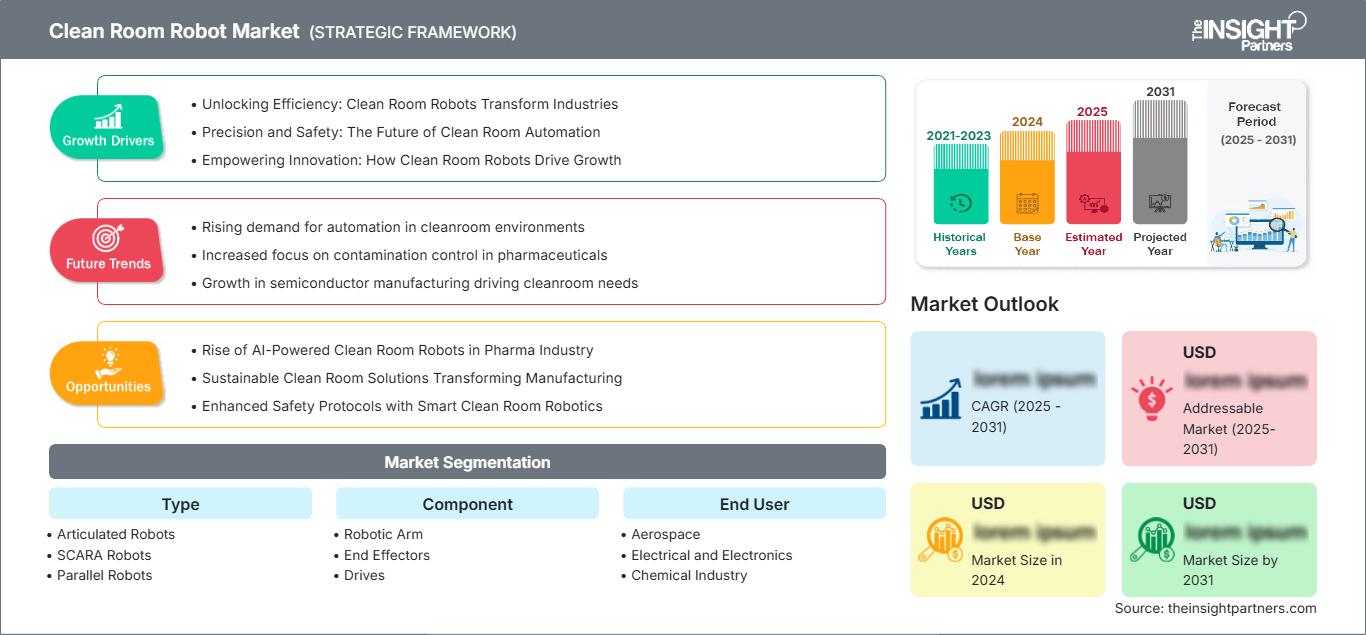
The Clean Room Robot Market size stood at US$ 6.84 Billion in 2025 and is likely to reach US$ 11.8 Billion in 2034, exhibiting a 6.25% CAGR during 2026-2034. Factors driving the market include contamination-controlled manufacturing, greater automation rate in electronics and pharmaceutical plants, and growing adoption of robots designed for ISO-compliant environments.
In North America, the market is expected to rise at a 5.8-6.4% CAGR over the forecast period, backed by reshoring of semiconductors, sterile drug manufacturing capacity, and automated medical devices. The United States will continue to dominate the region, whereas demand contribution from Canada and Mexico will come from electronics assembling, biologics packaging, and handling components.
Clean Room Robot Market Assessment and Insights
- North America held 31–34% share in 2025 and is growing at a 5.8–6.4% CAGR between 2026–2034, driven by sterile manufacturing, semiconductor fabs, and life-science automation.
- US represented 73–76% of North America in 2025 and is growing at a 5.9–6.5% CAGR between 2026–2034, reflecting advanced wafer, device, and biologics lines.
- Europe accounted for 24–27% share in 2025 and is growing at a 5.5–6.1% CAGR between 2026–2034, led by Germany, the UK, France, Italy, and Spain.
- Asia Pacific held 30–33% share in 2025 and is growing at a 6.8–7.5% CAGR between 2026–2034, led by China, Japan, South Korea, India, and Australia.
- Largest Segment Articulated Robots held 38–42% market share in 2025 and is growing at a 5.9–6.6% CAGR between 2026–2034 due to flexible handling needs.
- High Growth Segment Collaborative robots held 9–12% market share in 2025 and is growing at a 7.4–8.2% CAGR between 2026–2034 as validated human-robot workflows expand.
- Key companies analyzed in detail: ABB Ltd., DENSO WAVE INCORPORATED, FANUC Corporation, Kawasaki Heavy Industries, Ltd., KUKA AG, Mitsubishi Electric Corporation, NACHI-FUJIKOSHI CORP., OMRON Corporation, Seiko Epson Corporation, YASKAWA ELECTRIC CORPORATION.
Source: The Insight Partners' analysis based on proprietary research, government publications, company annual reports, investor presentations, industry databases, and expert interviews.
Automated systems have shifted from individual wafer handling and packaging into automated production lines, including robotic manipulators, low outgassing end effectors, servo motors, vision systems, and validated control systems. Cleanroom manufacturers currently value joint sealing, electrostatic discharge management, and cleanable surfaces since any contaminant can potentially disrupt an expensive batch. As such, the Clean Room Robot Market is being driven by reliability, availability, and compliance and not labor displacement.
During the forecast period, investment will be increasingly directed towards semiconductor capacity additions in Asia, biologics and sterile drug manufacturing in North America, and medical device production in Europe. Compliance requirements for repeatable aseptic procedures and constrained staffing will push towards modular robotic cleanrooms that reduce human interaction but still maintain traceable data logs.
Clean Room Robot Market Report Scope
| Report Attribute | Details |
|---|---|
| Market size in 2025 | US$ 6.84 Billion |
| Market Size by 2034 | US$ 11.8 Billion |
| Global CAGR (2026 - 2034) | 6.25% |
| Historical Data | 2021-2024 |
| Forecast period | 2026-2034 |
Clean Room Robot Market Analysis
The Clean Room Robot Market is driven by improved contamination controls in semiconductor, pharmaceutical, cosmetic, and precise electronic manufacturing environments. Robots will enable operators to avoid contamination risks at ISO Class 1 to 5 levels; robots provide better repeatability while handling wafers, vials, and components. The market demand is driven by growing costs of clean room floors, which require smaller SCARA, articulated, and collaborative robots to achieve higher throughput rates in square meters.
The value chain consists of robot manufacturers, suppliers of robot components, system integrators, clean room facility constructors, and certification experts. All components such as robotic arms, grippers, motors, controllers, sensors, drives, power supplies should be designed together because particle generation, temperature, vibrations, and accessibility for maintenance have a direct impact on productivity. The supply trends evolve to standard solutions for cleanrooms.
The competitiveness will be influenced by international robotics leaders with diverse motion control product lines and niche players with clean room-certified machines. ABB Ltd, FANUC Corporation, YASKAWA ELECTRIC CORPORATION, and KUKA AG focus on the payload capacity and integrated controllers, whereas DENSO WAVE INCORPORATED, OMRON Corporation, Mitsubishi Electric Corporation, NACHI-FUJIKOSHI CORP., Kawasaki Heavy Industries, Ltd., and Seiko Epson Corporation position themselves through small-sized designs, SCARA performance, and electronics automation solutions.
Positioning in the Clean Room Robot Market study has become more dependent on application libraries, services offered, and compatibility with factory data systems. The money will be invested into semiconductor tool automation, sterile filling processes, and laboratory processes where robotics can help to lower the number of rejected batches and allow continuous production.
● REPORT CUSTOMIZATION
Tailor This Report To Align With Your Specific Business Requirements
This report can be customized to align precisely with your business objectives, scope, and target markets. Customization options include tailored segmentation, geography, competitive analysis, and strategic insights to support informed decision-making.
Customize This Report →WHAT YOU CAN ADJUST
- ● Segmentations
- ● Geography
- ● Competitive Analysis
- ● Language Preferences
Clean Room Robot Market: Strategic Insights
Regional Insights
North America Clean Room Robot Market
North America held 31–34% share in 2025 and is expected to record a 5.8–6.4% CAGR. The region benefits from semiconductor reshoring, biologics capacity, and sterile medical device manufacturing. The Clean Room Robot Market share in the region is concentrated in facilities that need validated handling, particle control, and high equipment utilization.
U.S. Clean Room Robot Market
The US represented 73–76% of North America in 2025 and is projected to grow at a 5.9–6.5% CAGR. Semiconductor fabs, injectable drug plants, and medical device assembly sites are key adopters. ABB Ltd., FANUC Corporation, YASKAWA ELECTRIC CORPORATION, and OMRON Corporation maintain strong application support for electronics, healthcare, and precision manufacturing users.
Europe Clean Room Robot Market
Europe accounted for 24–27% share in 2025 and is growing at a 5.5–6.1% CAGR. Germany leads demand through automotive electronics, semiconductor equipment, and pharmaceutical production. The UK supports adoption in cell and gene therapy cleanrooms, while France, Italy, and Spain contribute through cosmetics, specialty chemicals, medical devices, and food-grade controlled environments.
APAC Clean Room Robot Market
APAC held 30–33% share in 2025 and is advancing at a 6.8–7.5% CAGR, the fastest regional pace. China leads on electronics and semiconductor capacity, Japan and South Korea anchor precision robotics demand, India expands pharmaceutical and device production, and Australia adds regulated life-science automation. Policy-backed manufacturing incentives strengthen regional procurement.
Middle East & Africa Clean Room Robot Market
Middle East and Africa is expected to grow at a 5.2–5.8% CAGR, with Saudi Arabia leading regional spending through healthcare, chemicals, and high-specification industrial infrastructure. The UAE supports pharmaceutical packaging and laboratory automation, South Africa adds medical and food applications, and the rest of MEA remains project-led but increasingly quality focused.
Segmentation Analysis
Type
Type is projected to grow at a 6.0–6.8% CAGR during 2026–2034. The Clean Room Robot Market scope is broadening as manufacturers select robots by reach, payload, footprint, particle performance, and compatibility with isolated production cells. Articulated and SCARA platforms dominate installed use, while collaborative systems gain traction where validated proximity to operators improves process flexibility.
- Articulated Robots serve multi-axis handling, equipment loading, and packaging tasks where reach and dexterity matter. Their installed base is strongest in electronics, pharmaceuticals, and medical device production.
- SCARA Robots address fast, repeatable horizontal motion in assembly, inspection, and small-part transfer. Compact footprints make them valuable in high-density cleanroom layouts.
- Parallel Robots support rapid pick-and-place for lightweight products, especially food, cosmetics, and medical packaging, where speed and controlled contact reduce contamination risk.
- Cartesian Robots provide linear precision for dispensing, wafer transfer, and laboratory automation. Their modular structure supports stable movement across defined cleanroom work envelopes.
- Collaborative robots are gaining use in validated workflows where flexible automation, small-batch production, and reduced guarding requirements help cleanroom teams manage labor constraints.
Component
Component is expected to grow at a 5.9–6.7% CAGR during 2026–2034. Demand is moving toward integrated component packages that reduce particle generation, simplify validation, and support predictive maintenance. Buyers increasingly evaluate total cell reliability rather than standalone robot price, making sensors, controllers, and cleanroom-grade motion systems central to procurement decisions.
- Robotic Arm remains the core system element, selected for payload, reach, sealing, and cleanroom certification across semiconductor, pharmaceutical, electronics, and precision assembly operations.
- End Effectors determine contact quality, gripping stability, and contamination control. Vacuum, soft-touch, and customized tools are critical for wafers, vials, trays, and delicate components.
- Drives influence smooth motion, heat generation, and energy efficiency. Cleanroom users favor reliable drives that minimize vibration and support continuous production shifts.
- Controllers coordinate motion, safety, data capture, and integration with production systems. Advanced controllers help standardize recipes and improve audit readiness.
- Sensors enable vision guidance, position feedback, force control, and process monitoring. Their role is expanding as cleanroom automation becomes more adaptive.
- Power Supply supports stable operation in controlled environments where downtime can disrupt costly batches. Reliability, compactness, and serviceability guide purchasing decisions.
- Motors provide precise actuation for high-speed, low-vibration motion. Cleanroom-grade designs must balance torque, thermal behavior, and particle-control requirements.
End User
End User is forecast to expand at a 6.1–6.9% CAGR during 2026–2034. Adoption is highest where contamination risk, product value, and regulatory scrutiny intersect. Electronics and pharmaceuticals lead procurement, while aerospace, chemicals, food and beverages, and cosmetics increasingly deploy robots to standardize clean handling, reduce manual exposure, and improve batch consistency.
- Aerospace uses cleanroom robots for precision component handling, coating, and assembly where particle control affects reliability. Demand is tied to advanced materials and electronics integration.
- Electrical and Electronics is the largest demand base, using robots for wafer, display, sensor, and PCB handling where yield protection and throughput are essential.
- Chemical Industry deploys robotic systems in controlled filling, sampling, and specialty material handling. Automation reduces operator exposure and improves repeatable processing.
- Food and Beverages applies cleanroom-compatible robots in hygienic packaging, inspection, and high-care handling. Demand reflects stricter safety expectations and faster line changeovers.
- Pharmaceuticals and Cosmetics require validated automation for sterile filling, packaging, laboratory preparation, and contamination-sensitive cosmetics production where consistency and documentation are critical.
Opportunity Snapshot
| End User | Revenue Contribution | Trend Tag | Adoption Stage |
| Aerospace | Medium | Precision Assembly | Scaling |
| Electrical and Electronics | High | Wafer Handling | Mature |
| Chemical Industry | Medium | Contained Filling | Scaling |
| Food and Beverages | Medium | Hygienic Packaging | Scaling |
| Pharmaceuticals and Cosmetics | High | Sterile Processing | Scaling |
Clean Room Robot Market Growth Drivers and Impact Analysis
Semiconductor Capacity Expansion Requires Cleaner Handling
The manufacture of semiconductors depends on the ultra-clean transport of wafers, reticles, FOUPs, and other advanced packing materials. With decreasing wafer sizes and increases in processing steps, human intervention becomes a source of yield losses which cannot be mitigated by inspection. Cleanroom robots minimize dust, increase positional repeatability, and allow for 24-hour per day loading of tools. The effect will be seen in Asia Pacific and US, where fabrication plants invest in robotic interfacing and maintenance that ensures maximum up-time.
Sterile Manufacturing Needs Repeatable Aseptic Automation
Pharmaceutical and cosmetic companies find themselves under increasing pressure to minimize contamination of products in filling, inspection, capping, and packaging. Robotic solutions allow for the separation of critical operations, repeatable execution of batches and consistent monitoring of handling operations. The driver increases the demand for compact articulated, SCARA, and collaborative robots capable of operating in disinfectant environment and proven in cleanrooms. Commercial effects include greater use of robots in manufacturing of injectable pharmaceuticals, biological substances, medical devices, and luxury cosmetics.
Labor Constraints Push Modular Cleanroom Cells
The cleanroom staff needs training, discipline, and process uniformity, but many companies face a shortage of skilled labor and high turnover in repetitive cleanroom operations. With modular robotic cells, less reliance is placed on manual intervention and companies can automate gradually, one process at a time. From the company’s perspective, the benefits include increased productivity, reduced variation in contamination rates, and more efficient use of costly cleanroom real estate. The value of this factor is especially apparent in medium-sized plants in the electronics, food, medical devices, and pharmaceuticals industries.
Clean Room Robot Market Future Trends
AI-Guided Validation and Adaptive Motion
The Clean Room Robot market trends will shift towards the use of artificial intelligence with vision, path planning, and process documentation. The new generation of robots will not only carry out predefined actions but will be able to recognize variations in the positioning of trays, any problems with gripping, and speed adjustments for protection of delicate products. The additional benefit in regulated facilities will arise from the traceable history of decisions made and ease of validation packages. Companies providing machine vision, clean room hardware, and controller data will benefit.
Collaborative Cleanroom Workflows Become Standardized
Workflows within collaborative cleanrooms will evolve from pilot operations into standard production units as sensor technology, force control, and safety technology develop. Small-batch facilities, custom medicine producers, luxury cosmetics manufacturers, and specialty electronics firms will implement cobots on repetitive, yet flexible, applications that could not be automated before. This development will bring about the need for pre-tested grippers, cleaning-resistant material, and easy programming capabilities. Rather than implementing entire assembly lines, such solutions will be combined with isolators, benches, and inspection stations.
Clean Room Robot Market Opportunities
Validated Robotics for Biologics and Injectable Lines
The high value of the batches, high sensitivity to contamination, and documentation needs make biologics, sterile injectables, and cell therapies a strong investment case for cleanroom robotic systems. According to Clean Room Robot Market Forecasts, there are many opportunities for those OEMs and integrators that provide pre-engineered modules of aseptic handling, cleanable end effectors and validation services. Customers will be looking for products that reduce qualification times and can integrate with filling, inspection, and packaging equipment.
Localized Semiconductor Tool Automation Ecosystems
Regionalization of the semiconductor production chain presents new prospects for robot producers, motion control producers, and clean room specialists in regard to automation kits localization. Newly launched fabrication plants need automation solutions for wafers handling, testing, transportation, and packaging which will allow for quick servicing according to local standards. These companies will be able to capitalize on their products through establishment of engineering facilities, spare parts centers, and collaboration with equipment manufacturers, focusing on long-term orders. This opportunity exists mainly in China, South Korea, Japan, United States, and India.
Recent Developments
- May 2025: Pudu Robotics, a global leader in service robotics, has announced the launch of the PUDU CC1 Pro, an AI-powered autonomous cleaning robot. The award-winning PUDU CC1 established a new standard with its four-in-one cleaning solution that combines sweeping, scrubbing, vacuuming, and dust-mopping. Building on the success of its predecessor, the PUDU CC1 Pro enhances intelligent cleaning automation by integrating powerful AI-driven perception and decision-making throughout every stage of the cleaning process.
- March 2026: Cleanfix Robotics, the Swiss manufacturer of professional autonomous cleaning robots, announces the upcoming launch of a new generation of robotic floor cleaning technology designed for large-scale commercial and industrial environments.
- June 2025: Seiko Epson Corporation (TSE: 6724, "Epson") is developing its first collaborative robot solution, with a planned launch in 2025. Designed to enhance efficiency and productivity across a wide range of industries-including manufacturing, logistics, and the rapidly evolving life sciences and pharmaceutical sectors—this new solution represents a significant expansion of Epson's automation portfolio. Initial sales are planned for Japan and Europe, with a phased rollout to additional regions to follow.
Frequently Asked Questions

- Comprehensive Market Sizing and Forecast Analysis
- Detailed Segmentation Analysis
- In-Depth Market Dynamics Assessment
- Regional and Country-Level Insights
- Competitive Landscape and Company Benchmarking
- Strategic Business Intelligence
Recent Reports
Testimonials

The Insight Partners' SCADA System Market report is comprehensive, with valuable insights on current trends and future forecasts. The team was highly professional, responsive, and supportive throughout. We are very satisfied and highly recommend their services.
RAN KEDEM Partner, Reali Technologies LTDs
I requested a report on a very specific software market and the team produced the report in a few days. The information was very relevant and well presented. I then requested some changes and additions to the report. The team was again very responsive and I got the final report in less than a week.
JEAN-HERVE JENN Chairman, Future Analytica
We worked with The Insight Partners for an important market study and forecast. They gave us clear insights into opportunities and risks, which helped shape our plans. Their research was easy to use and based on solid data. It helped us make smart, confident decisions. We highly recommend them.
PIYUSH NAGPAL Sr. Vice President, High Beam Global
The Insight Partners delivered insightful, well-structured market research with strong domain expertise. Their team was professional and responsive throughout. The user-friendly website made accessing industry reports seamless. We highly recommend them for reliable, high-quality research services
YUKIHIKO ADACHI CEO, Deep Blue, LLC.
This is the first time I have purchased a market report from The Insight Partners.While I was unsure at first, I visited their web site and felt more comfortable to take the risk and purchase a market report.I am completely satisfied with the quality of the report and customer service. I had several questions and comments with the initial report, but after a couple of dialogs over email with their analyst I believe I have a report that I can use as input to our strategic planning process.Thank you so much for taking the extra time and making this a positive experience.I will definitely recommend your service to others and you will be my first call when we need further market data.
JOHN SUZUKI President and Chief Executive Officer, Board Director, BK Technologies
I wish to appreciate your support and the professionalism you displayed in the course of attending to my request for information regarding to infectious disease IVD market in Nigeria. I appreciate your patience, your guidance, and the fact that you were willing to offer a discount, which eventually made it possible for us to close a deal. I look forward to engaging The Insight Partners in the future, all thanks to the impression you have created in me as a result of this first encounter.
DR CHIJIOKE ONYIA MANAGING DIRECTOR, PineCrest Healthcare Ltd.Reason to Buy
- Informed Decision-Making
- Understanding Market Dynamics
- Competitive Analysis
- Identifying Emerging Markets
- Customer Insights
- Market Forecasts
- Risk Mitigation
- Boosting Operational Efficiency
- Strategic Planning
- Investment Justification
- Tracking Industry Innovations
- Aligning with Regulatory Trends





 Get Free Sample for