
Cloud Computing Education Market Demand, Size & Forecast by 2034
Cloud Computing Education Market Size and Forecasts (2021–2034), Global and Regional Share, Trends, and Growth Opportunity Analysis Report Coverage : By Service Model (SaaS, PaaS, and IaaS), Deployment Model (Private Cloud, Public Cloud, Hybrid Cloud, and Community Cloud), User Type (K-12 and Higher Education)
- Status : Data Released
- Report Code : TIPRE00039778
- Category : Technology, Media and Telecommunications
- No. of Pages : 150
- Available Report Formats :


- Last update date : July 28, 2026


2025 Market Size
US$ 69.03 Bn
Base year value
2034 Forecast
US$ 316.98 Bn
Projected by 2034
CAGR 2026-2034
20.99 %
Growth rate
Addressable Market
US$ 1,812.75 Bn
(2026-2034)
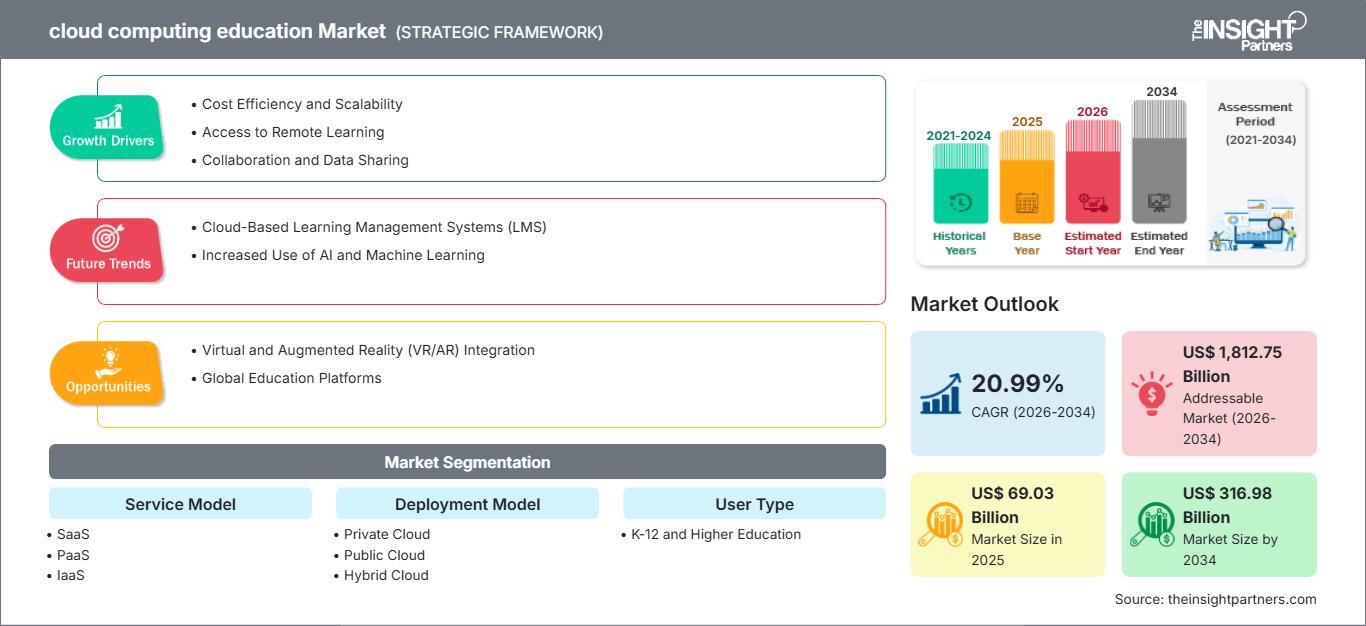
The cloud computing education market is reshaping how academic institutions and enterprises deliver technical training, driven by rising demand for scalable, cost-efficient digital learning infrastructure. Valued at US$ 69.03 Billion in 2025, the market is projected to reach US$ 316.98 Billion by 2034, registering a CAGR of 20.99% between 2026 and 2034. This growth trajectory reflects accelerating adoption of cloud-hosted learning management systems, virtual labs, and certification pathways across K-12 and higher education institutions worldwide.
North America remains a pivotal growth engine, with institutional cloud deployment supported by federal digital literacy funding and enterprise-driven reskilling programs. Regional expansion is estimated at between 19% and 22% CAGR through 2034. The cloud computing education market size across this region continues to benefit from mature broadband infrastructure, established vendor ecosystems, and strong institutional willingness to migrate legacy learning systems toward flexible, subscription-based cloud platforms.
Cloud Computing Education Market Assessment and Insights
- North America: The region commands an estimated 34-38% share in 2025 and is projected to grow at a CAGR of 19-22% between 2026 and 2034, supported by early cloud maturity, dense vendor concentration, and sustained institutional technology budgets.
- US: The United States drives the bulk of regional demand, holding roughly 78-82% share within North America and expanding at a CAGR of 19-21% through 2034.
- Europe: Europe accounts for an estimated 24-27% share in 2025, growing at a CAGR of 20-23% between 2026 and 2034, led by the United Kingdom and Germany where digital education policy and enterprise upskilling remain strong priorities.
- Asia Pacific: The region holds an estimated 22-25% share in 2025 and is forecast to expand at a CAGR of 22-25% through 2034, led by China and India where national digital skilling missions and expanding higher education enrollment accelerate cloud platform adoption.
- Largest Segment: The Service Model segment leads with an estimated 42-46% share in 2025 and a CAGR of 20-23% between 2026 and 2034, reflecting institutions' preference for ready-to-deploy learning software.
- High Growth Segment: The User Type segment, anchored by K-12 digitization, holds an estimated 22-26% share in 2025 and is projected to grow fastest at a CAGR of 23-26% through 2034.
- Key companies analyzed in detail: Adobe Inc., Cisco Systems, Inc., IBM Corporation, VMware, Inc., Microsoft Corporation, NEC Corporation, NetApp, Inc., Amazon Web Services, Inc., Ellucian Inc., and Sandvine Corporation.
Source: The Insight Partners' analysis based on proprietary research, government publications, company annual reports, investor presentations, industry databases, and expert interviews.
Educational technology adoption has moved through distinct phases, beginning with on-premises computer labs, progressing toward hybrid virtual desktop infrastructure, and now converging around fully managed cloud-native learning environments. Institutions increasingly favor subscription-based delivery over capital-intensive hardware procurement, a shift accelerated by pandemic-era remote learning mandates. Vendors have responded by embedding AI-assisted tutoring, adaptive assessment engines, and integrated certification tracking directly within their cloud learning suites, deepening platform stickiness across both K-12 and higher education segments.
Looking ahead, cloud computing education is expected to expand into emerging geographies where national digital skilling missions and public-private funding partnerships are lowering adoption barriers. Regulatory tailwinds, including data residency mandates and accessibility standards, are prompting vendors to localize infrastructure. Rising venture and corporate investment in EdTech cloud platforms further signals sustained confidence in long-term institutional demand across primary, secondary, and tertiary education systems globally.
Cloud Computing Education Market Report Scope
| Report Attribute | Details |
|---|---|
| Market size in 2025 | US$ 69.03 Billion |
| Market Size by 2034 | US$ 316.98 Billion |
| Global CAGR (2026 - 2034) | 20.99% |
| Historical Data | 2021-2024 |
| Forecast period | 2026-2034 |
Cloud Computing Education Market Analysis
Institutional demand for scalable digital learning infrastructure continues to anchor cloud computing education market growth, as universities and school districts replace fragmented on-premises systems with unified cloud platforms. The value chain spans infrastructure providers, platform developers, content publishers, and systems integrators, each contributing specialized capabilities that collectively support end-to-end virtual learning delivery, from enrollment management to certification issuance and outcome analytics.
Supply-side dynamics favor vendors offering modular, interoperable architectures that integrate with existing student information systems. Institutions increasingly prioritize vendors capable of supporting hybrid deployment models, given budget constraints and varying regional data governance requirements. This has intensified competition among established infrastructure providers and specialized education technology firms, each seeking to differentiate through certification partnerships, localized content, and dedicated K-12 or higher education tooling.
Competitive dynamics within the cloud computing education market analysis reveal a landscape shaped by both global infrastructure leaders and specialized education technology firms. Amazon Web Services, Inc. and Microsoft Corporation maintain broad infrastructure footprints supporting virtual classrooms and certification pathways, while IBM Corporation and Cisco Systems, Inc. emphasize enterprise-grade networking and hybrid deployment tools tailored to large university systems. Ellucian Inc. differentiates through purpose-built higher education administrative and learning platforms.
Investment activity remains concentrated on AI-enabled learning analytics, adaptive content delivery, and expanded certification ecosystems. VMware, Inc. and NetApp, Inc. continue strengthening virtualization and storage capabilities supporting large-scale institutional deployments, while NEC Corporation and Adobe Inc. focus on regional education partnerships and content creation tools respectively. Sandvine Corporation supports network policy management underpinning bandwidth-intensive virtual learning environments across distributed campuses.
● REPORT CUSTOMIZATION
Tailor This Report To Align With Your Specific Business Requirements
This report can be customized to align precisely with your business objectives, scope, and target markets. Customization options include tailored segmentation, geography, competitive analysis, and strategic insights to support informed decision-making.
Customize This Report →WHAT YOU CAN ADJUST
- ● Segmentations
- ● Geography
- ● Competitive Analysis
- ● Language Preferences
Cloud Computing Education Market: Strategic Insights
Regional Insights
North America cloud computing education Market
North America holds an estimated 34-38% share of the global cloud computing education market share in 2025 and is projected to expand at a CAGR of 19-22% between 2026 and 2034. Growth is anchored by sustained federal and state-level digital literacy funding, extensive broadband penetration, and mature enterprise reskilling budgets across both public and private education systems.
Institutions across the region continue migrating legacy learning management infrastructure toward cloud-native platforms, driven by cost efficiency and scalability requirements. Community colleges and vocational training providers increasingly adopt modular SaaS-based learning tools to support workforce reskilling initiatives, while large public university systems favor hybrid deployment models that balance data governance obligations with operational flexibility across distributed campuses.
U.S. cloud computing education Market
The United States represents approximately 78-82% of the North American cloud computing education market and is expected to grow at a CAGR of 19-21% through 2034. Extensive vendor presence, including deep integration with major public cloud infrastructure providers, continues to support rapid institutional migration toward subscription-based learning platforms.
Application trends within the country emphasize AI-assisted tutoring, virtual laboratory environments for STEM disciplines, and integrated certification tracking tied to workforce credentials. Enterprise training divisions increasingly complement traditional academic programs, particularly in cloud certification pathways offered through partnerships between technology vendors and community college systems, reinforcing sustained demand across both K-12 and higher education institutions nationwide.
Europe cloud computing education Market
Europe accounts for an estimated 24–27% share of the global market in 2025, expanding at a CAGR of 20–23% through 2034, according to the Cloud Computing Education Market forecast, with the United Kingdom leading regional adoption. Government-backed digital skills strategies and university modernization funding continue to support institutional migration toward cloud-hosted learning infrastructure across the region.
The United Kingdom benefits from established higher education digitization programs and strong vendor partnerships supporting virtual classroom deployment across further education colleges. Germany follows closely, driven by vocational training digitization and enterprise upskilling mandates tied to industrial workforce transformation across manufacturing-heavy regions and technical universities nationwide.
France, Italy, and Spain collectively contribute a growing share, supported by national digital education roadmaps and expanding public investment in cloud infrastructure for secondary and tertiary institutions. Adoption remains concentrated among urban university networks, though rural connectivity investments are gradually extending platform reach into underserved regional education systems across these southern European markets.
APAC cloud computing education Market
Asia Pacific holds an estimated 22-25% share of the cloud computing education market in 2025 and is forecast to grow at a CAGR of 22-25% through 2034, the fastest among major regions. China leads adoption, supported by national digital skilling missions and expanding higher education enrollment.
India follows closely, driven by government-backed digital university initiatives and a large pool of technical graduates seeking cloud certification credentials. Japan, South Korea, and Australia contribute steady demand through enterprise reskilling programs and university partnerships with global infrastructure vendors, while industrial policy support across the region continues to accelerate institutional cloud migration timelines.
Middle East & Africa cloud computing education Market
The Middle East and Africa region is projected to expand at a CAGR of 18–21% between 2026 and 2034, with Cloud Computing Education Market trends indicating strong growth driven by digital learning initiatives and cloud-based academic infrastructure adoption. Saudi Arabia leads adoption through national digital transformation programs tied to broader economic diversification strategies. The UAE follows closely, supported by smart education initiatives across federal and private universities.
South Africa anchors demand across the African continent, driven by expanding internet infrastructure and public-private digital literacy partnerships. The Rest of the MEA region shows a gradual uptake, constrained by connectivity gaps but supported by energy and infrastructure investment programs enabling broader institutional cloud platform access across secondary education systems.
Segmentation Analysis
Service Model
The Service Model segment is projected to grow at a CAGR of 20–23% between 2026 and 2034, anchoring the cloud computing education market scope through its dominant role in supporting scalable institutional deployment. Adoption is driven by lower upfront infrastructure costs and simplified vendor management, with SaaS-based learning platforms remaining the preferred entry point for both K-12 districts and higher education systems seeking rapid digital transformation.
- SaaS: Software-as-a-Service platforms dominate institutional adoption due to minimal infrastructure requirements, enabling schools and universities to deploy learning management systems, virtual classrooms, and assessment tools without dedicated technical staff.
- PaaS: Platform-as-a-Service supports developers building custom educational applications and integrations, appealing to larger university systems and EdTech vendors requiring flexible, code-level customization of learning environments.
- IaaS: Infrastructure-as-a-Service serves institutions requiring granular control over virtual computing resources, commonly used for research computing, data-intensive coursework, and specialized STEM laboratory simulations.
Deployment Model
The Deployment Model segment is projected to grow at a CAGR of 19–22% between 2026 and 2034, reflecting institutions' varied approach to balancing cost, control, and data governance obligations. Public cloud adoption continues to accelerate due to affordability, while hybrid configurations gain traction among large university systems managing sensitive student records alongside publicly accessible course content and collaborative learning tools.
- Private Cloud: Private cloud deployment appeals to institutions with strict data governance requirements, particularly research universities managing sensitive student records and proprietary academic research datasets.
- Public Cloud: Public cloud remains the most widely adopted model, favored for its cost efficiency and rapid scalability across K-12 districts and community colleges with constrained technology budgets.
- Hybrid Cloud: Hybrid cloud configurations balance flexibility and governance, increasingly adopted by large university systems integrating legacy administrative systems with modern cloud-native learning platforms.
- Community Cloud: Community cloud supports shared infrastructure among consortiums of institutions, enabling cost-sharing arrangements for regional education networks and multi-campus university systems.
User Type
The User Type segment is projected to grow at a CAGR of 23–26% between 2026 and 2034, representing the fastest-growing category within the cloud computing education market. Accelerated digitization mandates across primary and secondary schools, combined with sustained higher education modernization budgets, continue to expand cloud platform penetration across both academic tiers globally.
- K-12: K-12 institutions increasingly adopt cloud-based learning platforms to support remote instruction, standardized testing infrastructure, and personalized learning tools, driven by state-level digital literacy funding mandates.
- Higher Education: Higher education institutions leverage cloud infrastructure for research computing, virtual laboratories, and integrated student information systems, supporting large-scale enrollment management and certification programs.
Opportunity Snapshot
| End User Type | Revenue Contribution | Trend Tag | Adoption Stage |
| K-12 | High | Digital Classrooms | Scaling |
| Higher Education | High | Research Computing | Mature |
Cloud Computing Education Market Growth Drivers and Impact Analysis
Institutional Migration Toward Subscription-Based Learning Infrastructure
The healthcare, energy, and governmental sectors offer substantial opportunities to those vendors who have the ability to develop data governance platforms specific to the requirements of each sector. There is an underserved market for vertical data governance platforms that do not adequately cater to the unique requirements in terms of regulatory compliance and technological integration with respect to clinical data or critical infrastructure telemetry. Those vendors who invest in vertical certifications and regulatory compliance are likely to be able to offer premium positioning in these segments. With greater compliance issues in the areas of both health care data privacy and energy infrastructure security becoming common, the platforms with vertical expertise will gain an outsized share in these segments.
Expansion of Government-Backed Digital Skilling Initiatives
Digital skilling programs designed for bridging technology skills deficiencies in the labor force persist in expanding through national governments in North America, Europe, and the Asia Pacific region, directly benefiting cloud computing education infrastructure providers. Public investment programs become more inclined towards incorporating cloud literacy curriculum into secondary and vocational education, generating steady demand for certified cloud training software. These public investments sometimes involve private sector participation, wherein technology companies offer free or reduced-price cloud training certifications for an increased presence within institutions. This type of program has been especially successful in developing countries, due to government subsidies that cover otherwise exorbitant technological expenses. Cloud computing credentials being highly valued in today’s labor market, institutions are under increasing pressure to incorporate standardized cloud training into curricula.
Rising Enterprise Demand for Certified Cloud Workforce Training
Corporate businesses now utilize cloud certification programs to solve the ongoing problem of talent shortages in cloud architecture, cloud security, and cloud data engineering positions. Such needs go beyond academic institutions to the corporate learning departments that work with cloud providers to offer standardized, credible training programs for their employees. Certifications programs that relate directly to specific vendor infrastructures are preferred by enterprises since they cut down the time needed to onboard on cloud technology platforms. This has resulted in cloud vendors developing enterprise learning programs together with academic-based ones to increase demand for their programs. The push for digital transformation is increasingly becoming more pronounced in industries such as manufacturing, healthcare, and finance, and therefore, cloud certifications programs continue to be favored over others.
Cloud Computing Education Market Future Trends
Integration of Adaptive AI-Driven Learning Pathways
Current cloud computing educational trends are now pointing more toward the incorporation of more adaptive learning pathways driven by artificial intelligence to tailor content delivery to the learner's progress and comprehension. The use of machine learning is now being incorporated into cloud learning portals to be able to change the degree of difficulty of courses and make recommendations to the learners. This way, educational institutions will no longer have to adhere to a set curriculum. As time goes by, the use of tutoring driven by artificial intelligence will be adopted in learning management systems, especially in higher education and K-12 personalized learning programs.
Convergence of Certification Ecosystems Across Vendors
The developing convergence between competitive certification systems is predicted to impact procurement decisions within organizations during the next decade. No longer do educational institutions seek to invest their money in a one-vendor training system, but are asking for a system of credentialing that allows the individual to acquire skills in multiple cloud systems simultaneously. It is because of the understanding that multi-cloud system proficiency will be more advantageous in the workforce compared to single-vendor knowledge. There will be increased collaborations between competitive cloud infrastructure providers and accreditation agencies, as well as standardized benchmark requirements for cloud systems competency.
Cloud Computing Education Market Opportunities
Expansion Into Underserved Rural and Emerging Market Institutions
There is a considerable amount of opportunity for vendors who are prepared to commit resources toward developing cloud learning platforms in disadvantaged rural districts and emerging markets, which are limited by a lack of connectivity and technology resources. Collaborations between vendors and regional telecommunications companies, in conjunction with a subsidized licensing approach, could enable significant latent demand in community colleges and secondary schools that have thus far been left out of digital education efforts. Vendors focusing on light-weight, low-bandwidth cloud learning platform architecture can leverage early mover advantages in this space. As national governments increasingly build out rural broadband networks, organizations located in these regions will be in need of affordable cloud learning platforms, allowing vendors to form relationships with institutions before their competition.
Development of Industry-Aligned Micro-Credentialing Programs
Growing employer demand for verifiable, skills-specific credentials presents a clear opportunity for vendors to expand micro-credentialing programs directly aligned with in-demand cloud computing roles. Rather than pursuing lengthy degree-based pathways, learners increasingly seek shorter, stackable certification tracks that demonstrate practical competency in specific cloud domains such as security, data engineering, or infrastructure management. Vendors that partner directly with employers to design curricula matching real-world hiring requirements can differentiate their platforms while improving completion and job-placement outcomes. This approach also supports continuing education divisions within universities seeking to serve working professionals alongside traditional degree-seeking students, creating diversified revenue streams and strengthening long-term institutional partnerships across both academic and corporate training channels.
Frequently Asked Questions

- Comprehensive Market Sizing and Forecast Analysis
- Detailed Segmentation Analysis
- In-Depth Market Dynamics Assessment
- Regional and Country-Level Insights
- Competitive Landscape and Company Benchmarking
- Strategic Business Intelligence
Recent Reports
Testimonials

The Insight Partners' SCADA System Market report is comprehensive, with valuable insights on current trends and future forecasts. The team was highly professional, responsive, and supportive throughout. We are very satisfied and highly recommend their services.
RAN KEDEM Partner, Reali Technologies LTDs
I requested a report on a very specific software market and the team produced the report in a few days. The information was very relevant and well presented. I then requested some changes and additions to the report. The team was again very responsive and I got the final report in less than a week.
JEAN-HERVE JENN Chairman, Future Analytica
We worked with The Insight Partners for an important market study and forecast. They gave us clear insights into opportunities and risks, which helped shape our plans. Their research was easy to use and based on solid data. It helped us make smart, confident decisions. We highly recommend them.
PIYUSH NAGPAL Sr. Vice President, High Beam Global
The Insight Partners delivered insightful, well-structured market research with strong domain expertise. Their team was professional and responsive throughout. The user-friendly website made accessing industry reports seamless. We highly recommend them for reliable, high-quality research services
YUKIHIKO ADACHI CEO, Deep Blue, LLC.
This is the first time I have purchased a market report from The Insight Partners.While I was unsure at first, I visited their web site and felt more comfortable to take the risk and purchase a market report.I am completely satisfied with the quality of the report and customer service. I had several questions and comments with the initial report, but after a couple of dialogs over email with their analyst I believe I have a report that I can use as input to our strategic planning process.Thank you so much for taking the extra time and making this a positive experience.I will definitely recommend your service to others and you will be my first call when we need further market data.
JOHN SUZUKI President and Chief Executive Officer, Board Director, BK Technologies
I wish to appreciate your support and the professionalism you displayed in the course of attending to my request for information regarding to infectious disease IVD market in Nigeria. I appreciate your patience, your guidance, and the fact that you were willing to offer a discount, which eventually made it possible for us to close a deal. I look forward to engaging The Insight Partners in the future, all thanks to the impression you have created in me as a result of this first encounter.
DR CHIJIOKE ONYIA MANAGING DIRECTOR, PineCrest Healthcare Ltd.Reason to Buy
- Informed Decision-Making
- Understanding Market Dynamics
- Competitive Analysis
- Identifying Emerging Markets
- Customer Insights
- Market Forecasts
- Risk Mitigation
- Boosting Operational Efficiency
- Strategic Planning
- Investment Justification
- Tracking Industry Innovations
- Aligning with Regulatory Trends





 Get Free Sample for