
CNC Machine Market Size, Trends & Demand by 2034
Coverage: by Machine Type (Lathe Machines, Milling Machines, Laser Machines, Grinding Machines, Welding Machines, Others); End-user Industry (Aerospace and Defense, Automotive, Industrial, Metals and MIning, Power and Energy, Others) , and Geography (North America, Europe, Asia Pacific, and South and Central America)
- Status : Data Released
- Report Code : TIPRE00006648
- Category : Manufacturing and Construction
- No. of Pages : 150
- Available Report Formats :


- Last update date : September 07, 2026


2025 Market Size
US$ 100.71 Bn
Base year value
2034 Forecast
US$ 250.35 Bn
Projected by 2034
CAGR 2026-2034
10.65 %
Growth rate
Addressable Market
US$ 1,555.24 Bn
(2026-2034)
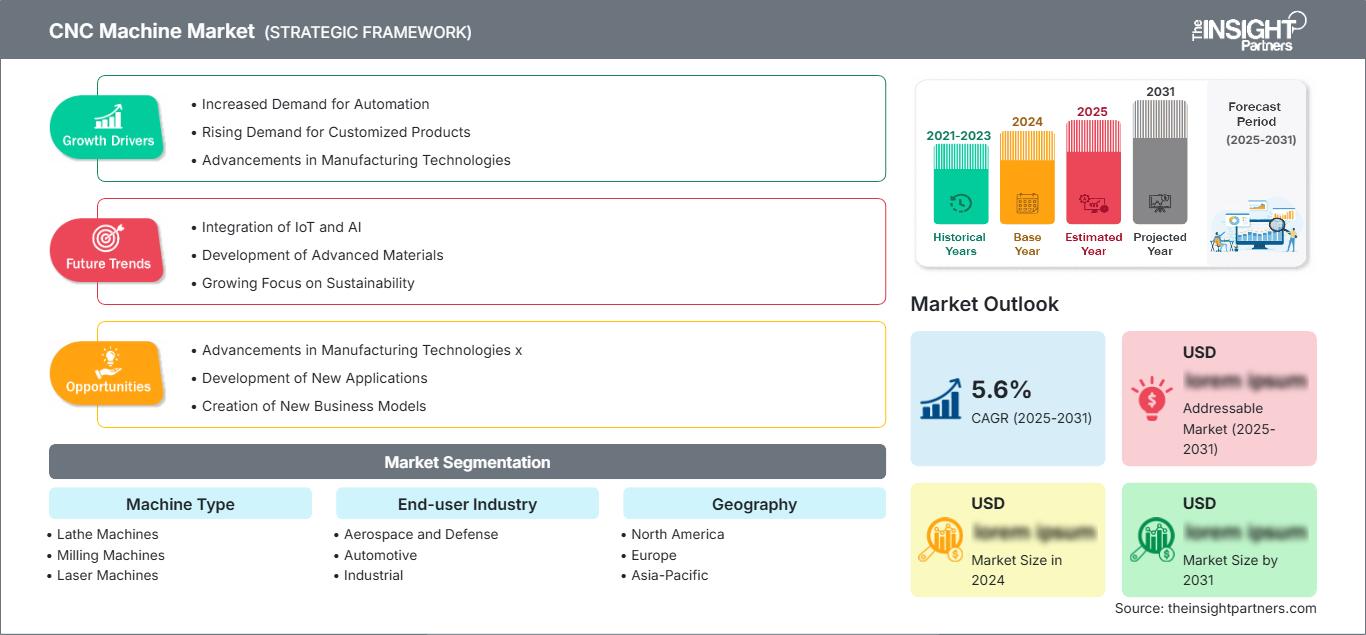
The global CNC Machine market was valued at US$ 100.71 billion in 2025 and is expected to reach US$ 250.35 billion by 2034; it is estimated to record a CAGR of 10.65% during 2026-2034.
CNC Machine Market Assessment and Insights
- North America held 21–23% CNC machine market share in 2025 and is forecast to grow at 10.5–11.5% CAGR during 2026–2034, supported by reshoring, aerospace programs, defense procurement, and automation-led modernization.
- US represented 78–82% of North America in 2025 and should expand at 10.8–11.8% CAGR through 2034 as manufacturers replace aging equipment.
- Europe accounted for 25–27% share in 2025 and is expected to post 9.5–10.5% CAGR during 2026–2034, led by Germany, Italy, France, Spain, and the UK.
- Asia Pacific captured 45–47% share in 2025 and is projected to record 13.5–14.5% CAGR through 2034, with China, Japan, South Korea, and India anchoring demand.
- Largest Segment Lathe machines held 38–42% market share in 2025 and are expected to register 10.5–11.5% CAGR during 2026–2034.
- High Growth Segment Aerospace and defense held 15–18% market share in 2025 and is forecast to grow at 13.5–14.5% CAGR during 2026–2034.
- Key companies analyzed in detail: DMG MORI CO., LTD., FANUC CORPORATION, Haas Automation, Inc., Hurco Companies, Inc., OKUMA CORPORATION, Yamazaki Mazak Corporation, Fagor Automation, S. Coop., Makino Milling Machine Co., Ltd., DN Solutions Co., Ltd., and Hyundai WIA Corporation.
Source: The Insight Partners' analysis based on proprietary research, government publications, company annual reports, investor presentations, industry databases, and expert interviews.
The design of the production is changing from individual three-axis machines to multi-axis machines that can perform multiple tasks and are connected with robots, metrology, and production floor software. Enhanced controls lead to better tool paths, while thermal compensation, in-process inspection, and digital twins result in lower scrap rates and fewer setup loops. The 2025 launch of the FANUC’s FS500i-A featured CPU performance improvement by a factor of 2.7 times, which shows control layer development. In terms of machines, process consolidation leads to performing turning, milling, grinding, and inspecting during less number of setups.
Until 2034, investments will be made in India, Southeast Asia, Mexico, and the Gulf, as industrial policy will bring components’ production closer to end markets. Backlogs in aerospace, projects for electrification, and grid infrastructure will maintain demand for precision components. According to IEA’s 2025 estimate, global energy investment was estimated to amount to US$ 3.3 trillion per year, which includes US$ 2.2 trillion in clean energy.
CNC Machine Market Report Scope
| Report Attribute | Details |
|---|---|
| Market size in 2025 | US$ 100.71 Billion |
| Market Size by 2034 | US$ 250.35 Billion |
| Global CAGR (2026 - 2034) | 10.65% |
| Historical Data | 2021-2024 |
| Forecast period | 2026-2034 |
CNC Machine Market Analysis
The expansion of the CNC machine market is driven by increasing component sophistication, increased tolerances, shortened product cycles, and the consistent shortage of labor. The restrictions in aerospace aircraft capacity are particularly significant because IATA recorded a total of 35,550 commercial airplanes in June 2025, of which 30,300 were operational aircraft. The normalization of the supply will not take place before 2031-2034. This backlog creates demand for machining of structures, engines, landing gears, and components for maintenance.
The value chain comprises castings, forgings, cutting tools, spindles, controls, drives, sensors, integrators, distributors, and service organizations. The supply chain is vulnerable to precision bearings, semiconductors, and special steels. However, modularity of the control systems and regional manufacturing mitigate lead time risk. The buyer is increasingly concerned with the total cost per machined part, including energy consumption, tool consumption, productivity, software compatibility, and labor availability.
The CNC Machine Market Analysis highlights differentiated competition among integrated machine makers, controls vendors, and value-added sellers. DMG MORI CO., LTD., OKUMA CORPORATION, Yamazaki Mazak Corporation, and Makino Milling Machine Co., Ltd. focus on accuracy, multitasking, and application engineering capabilities. The control layer is reinforced by FANUC CORPORATION and Fagor Automation, S. Coop., while accessible platforms, distribution channels, and services define the competitive edge of Haas Automation, Inc., Hurco Companies, Inc., DN Solutions Co., Ltd., and Hyundai WIA Corporation.
Investments are focused on the combination of machine capabilities with lifetime support, automation packages, and cybersecurity features. Competitive positioning is based on open connectivity, fast setup, financing, and local applications engineering experience. The vendors extend their demo centers, training cooperation, and channel reach to facilitate the entry for small manufacturing companies. Roadmaps of new products involve high-rigidity machines with subscription services, condition monitoring, and energy dashboard features to generate service revenues and increase retention rate.
● REPORT CUSTOMIZATION
Tailor This Report To Align With Your Specific Business Requirements
This report can be customized to align precisely with your business objectives, scope, and target markets. Customization options include tailored segmentation, geography, competitive analysis, and strategic insights to support informed decision-making.
Customize This Report →WHAT YOU CAN ADJUST
- ● Segmentations
- ● Geography
- ● Competitive Analysis
- ● Language Preferences
CNC Machine Market: Strategic Insights
Regional Insights
North America CNC machine market
The CNC machine market share in North America was 21–23% in 2025, with a projected 10.5–11.5% CAGR during 2026–2034. Reshoring of semiconductor, defense, medical, and transportation components is increasing demand for flexible cells capable of high-mix manufacturing. Strong systems-integration capacity helps plants combine machines with robots, inspection, tool management, and production software.
Aerospace, energy, and mining applications in Canada, while Mexico’s automotive and appliance sectors increase capabilities regionally. Within the US, there is an incentive on home-produced chips, batteries, and infrastructure to boost orders for precision equipment. Limitations involve high financial costs and technician scarcity, which encourage leasing and training programs for automation. Companies that have local components and applications will benefit from replacement business through modernization of older equipment.
U.S. CNC machine market
The US represented 78–82% of North American revenue in 2025 and is expected to expand at 10.8–11.8% CAGR through 2034. Aerospace and Defense Programs, Semiconductor Manufacturing, Electric Mobility, and Medical Manufacturing drive requirements for 5 axis machining, mill turn centers, and precise machinery under controlled environment. US manufacturers also need machines that can accommodate short production runs and frequent changes to engineering specifications.
Haas Automation, Inc. is the key domestic manufacturer for affordable machine tools, while DMG MORI CO., LTD., FANUC CORPORATION, OKUMA CORPORATION, Yamazaki Mazak Corporation, and Hurco Companies, Inc. have strong sales, service, and training networks. Trends are towards unmanned production, machine-based inspection, and digital part programs. Customers prefer machines that can be easily integrated with cobots and retain operator knowledge on mixed fleets.
Europe CNC machine market
Europe held 25–27% share in 2025 and is projected to grow at 9.5–10.5% CAGR during 2026–2034. The Germans excel in automotive design and production, machine tool manufacturing, automation technologies and high-tech exports. The Italians add specialized machinery, whereas the French add aerospace and military markets. The energy efficiency policies give an advantage to innovative drives, regenerations and consumption control at machine level.
The British benefit in aerospace, motor sports, medical devices and military sectors, where certification and production of small batches call for sophisticated five axis machining. Investments come from suppliers implementing automation to overcome labor shortages, influenced by customer service and financing considerations. University affiliated manufacturing centers speed up piloting digital twins, hybrid approaches and sustainable machining technologies.
Germany is still the market leader with the assistance of thick networks in the automotive industry, industrial machinery and engineering sectors. France focuses on aerostructures and energy equipment, Italy caters to flexible manufacturing and industrial design, whereas Spain is a combination of all of the automotive, rail, wind energy, and aerospace industries. In all of these markets, manufacturing focuses on process integration and control.
APAC CNC machine market
Asia Pacific accounted for 45–47% share in 2025 and should record 13.5–14.5% CAGR through 2034. The lead for China is through scale of manufacturing, EVs, electronics, and indigenous machine tool manufacturing. Japan and South Korea provide quality machinery, controls, semiconductors, and automotives.
India’s production incentives and infrastructure initiatives have increased the need among automotive, defense, rail, and general engineering manufacturers. Australia brings in mining, maintenance, and energy applications. Policies supporting localized manufacturing, automation, and exportability push buyers to shift from manual machines to CNC machines.
Middle East & Africa CNC machine market
Middle East and Africa should expand at 8.5–9.5% CAGR during 2026–2034. Saudi Arabia leads as localization programs develop defense, energy, metals, and industrial capacity. The UAE supports aerospace maintenance and precision engineering, while South Africa serves mining equipment, automotive production, and repair.
Rest-of-MEA demand centers on infrastructure maintenance and imported equipment support. Oil and gas diversification, renewable projects, and transport investment create opportunities for rugged machines, training, and local service. Adoption remains constrained by financing and skills gaps, favoring modular platforms and turnkey application packages.
Segmentation Analysis
Machine Type
The CNC machine market scope by machine type spans subtractive, thermal, finishing, and joining platforms. This main segment is expected to grow at 11.5–12.5% CAGR during 2026–2034 as manufacturers combine process flexibility with automation. Selection depends on geometry, material, tolerance, batch size, and throughput. Multitasking configurations gain strategic relevance by reducing workholding, transfers, floor space, and accumulated dimensional error.
- Lathe Machines retain the leading position because shafts, fasteners, hubs, and rotational components remain fundamental across automotive, industrial, energy, and aerospace production, with automation improving unattended output.
- Milling Machines serve prismatic and complex components, gaining strategic importance through five-axis capability, high-speed spindles, probing, and software that compress setup time and improve surface quality.
- Laser Machines address flexible sheet and profile processing, where rapid changeovers, programmable nesting, and automation support high product variety across fabricated metal, transport, and energy applications.
- Grinding Machines remain essential for tight tolerances and surface integrity in bearings, gears, tools, aerospace parts, and powertrain components, particularly where finishing accuracy determines service life.
- Welding Machines gain importance as programmable joining cells support repeatability, traceability, and safer production, especially for fabricated structures, transportation equipment, energy systems, and heavy industrial assemblies.
End-user Industry
The end-user industry segment is projected to advance at 12.0–13.0% CAGR during 2026–2034. Automotive remains a volume anchor, while aerospace and defense provide the strongest growth through complex geometry, difficult materials, and documentation requirements. Industrial, metals and mining, and power and energy users prioritize reliability, large work envelopes, and lifecycle support. Procurement increasingly reflects production resilience and local service access.
- Aerospace and Defense requires certified, traceable machining of titanium, aluminum, nickel alloys, and composites, supporting premium five-axis, mill-turn, probing, and adaptive-control platforms.
- Automotive sustains high-volume demand for powertrain, chassis, mold, battery, and electric-drive components, while flexible cells help manufacturers manage model proliferation and mixed propulsion portfolios.
- Industrial encompasses machinery, tooling, electronics, medical, and general engineering, favoring versatile machines that balance job-shop flexibility, rapid programming, accuracy, and affordable automation.
- Metals and MIning relies on robust turning, milling, grinding, and repair capability for large wear components, processing equipment, and maintenance parts exposed to demanding operating environments.
- Power and Energy supports precision production for turbines, valves, pumps, generators, storage systems, and grid equipment, requiring difficult-material expertise, large envelopes, and dependable process control.
Opportunity Snapshot
| End Users | Revenue Contribution | Trend Tag | Adoption Stage |
| Aerospace and Defense | High | Complex Parts | Scaling |
| Automotive | High | EV Tooling | Mature |
| Industrial | High | Flexible Cells | Mature |
| Metals and MIning | Medium | Heavy Repair | Scaling |
| Power and Energy | Medium | Turbine Parts | Scaling |
| Others | Low | Niche Precision | Emerging |
CNC Machine Market Growth Drivers and Impact Analysis
Precision Demand from Aerospace and Defense Programs
An aircraft backlog and military modernization equate to a consistent demand for advanced machined parts over long periods of time. According to IATA, there was an operational fleet of 30,300 aircraft as of June 2025, and a normalization in supply is projected between 2031 and 2034. Machining of titanium parts, aircraft engine, landing, and housing components calls for five-axis technology, thermal stability, probing, and documentation. For this reason, suppliers purchase equipment which allows for consolidation and tracking of the process. However, the need for standardization, palletization, and tool handling in order to optimize the spindle time without jeopardizing the certification applies not only to premium machines.
Factory Automation under Skilled-Labor Constraints
Firms finding themselves short on skilled machinists are designing their processes to work in an unmanned manner rather than replacing the workers. Robotic tending, pool pallets, probing, automatic tool measurement, and condition monitoring allow fewer workers to oversee more spindles. FANUC’s showcasing of the integration between CNC and cobots using the common language of G-code is one example of how vendors are reducing programming difficulty. This particular driver shifts procurement considerations towards simplicity, accessibility, interfaces, and support. The additional benefit lies in the expansion of the target audience from small plants that have considered automation to be difficult before. The practical benefits include more productive hours, less manual handling, consistency, and responsiveness in the case of high-mix production.
Electrification and Energy Infrastructure Investment
Energy system investments generate a varied range of demand for machined products in renewable power generation, energy grids, energy storage systems, nuclear power plants, and conventional power infrastructure. According to IEA estimates, the world was investing $3.3 trillion in energy investments in 2025, out of which $2.2 trillion was invested in clean energy, which was double the $1.1 trillion investment in fossil fuels. The high capital requirements help produce turbine hubs, gearbox components, valves, pumps, generator components, battery manufacturing equipment, and grid infrastructure equipment. It provides advantages to CNC suppliers if project owners try to localize their supply chain and need consistent quality production. It benefits from large envelope machines and repair applications.
CNC Machine Market Future Trends
Closed-Loop, AI-Assisted Machining
The CNC machine market trends increasingly point toward closed-loop production in which machines adjust parameters using sensor, metrology, and historical process data. Digital twins will validate programs before cutting, while anomaly detection will identify bearing, spindle, and tool degradation earlier. FANUC’s 2025 CNC Design Studio exemplifies the connection between design and shop-floor simulation. Over time, adaptive feed control and automated compensation should reduce dependence on operator intuition without removing engineering oversight. Adoption will begin in high-value aerospace, mold, semiconductor, and medical applications, then diffuse into general industry as software becomes easier to deploy across mixed equipment fleets.
Process Consolidation and Hybrid Manufacturing
Future production cells will combine more operations within one controlled platform, including turning, milling, grinding, gear cutting, inspection, and selected additive processes. DMG MORI’s 2025 NTX generation integrates machining formerly assigned to specialized equipment, reflecting this direction. Consolidation reduces handling, work-in-process inventory, and cumulative alignment error while making unattended production more practical. Hybrid deposition and machining will remain selective, strongest for repair, high-value geometry, and material-efficient near-net-shape production. The commercial advantage will shift from maximum standalone speed toward verified output per footprint, with software orchestration and automation determining realized productivity across variable batch sizes.
CNC Machine Market Opportunities
Automation Packages for Small and Mid-Sized Manufacturers
Small and mid-sized manufacturers represent a scalable opportunity for pre-engineered automation that avoids prolonged systems integration. Suppliers can package machines, cobots, vises, probing, tool management, safety systems, and standard software around defined part families. The CNC machine market forecasts support investment in channel training, application templates, and financing that lowers acquisition friction. The strongest offerings will guarantee commissioning milestones and measurable productive hours rather than selling isolated hardware. Partnerships with technical colleges can create operator pipelines, while remote diagnostics can extend service reach. Vendors that simplify redeployment between jobs can address high-mix shops, where conventional fixed automation often fails to deliver acceptable utilization.
Localized Service and Retrofit Ecosystems in Emerging Hubs
Rapid industrialization in India, Southeast Asia, Mexico, Saudi Arabia, and the UAE creates an opportunity beyond new-machine sales. Installed fleets require controls upgrades, spindle service, geometry calibration, automation retrofits, cybersecurity support, and operator training. Building regional parts inventory and certified service partners can improve uptime while generating recurring revenue. Suppliers should prioritize clusters where automotive, aerospace, energy, and defense investments overlap, because shared applications justify deeper technical teams. Retrofit pathways also let customers modernize incrementally when capital budgets are constrained. Companies able to support mixed-brand environments can secure trusted-adviser positions before replacement cycles begin, strengthening future equipment consideration.
Recent Developments
- March 2026: DMG MORI CO., LTD. – launched the NMV 3000/5000 DCG second-generation five-axis vertical machining centers. The company reported 49% greater Y-axis rigidity, spindle speed increased from 12,000 to 20,000 min-1, aluminum material removal 2.67 times higher, and cycle times 17% faster, alongside automation options for unattended production
- December 2025: FANUC CORPORATION – introduced CNC Design Studio, a digital-twin product designed to connect engineering design and the shop floor. The release strengthens FANUC’s simulation-led CNC workflow, helping machine builders and users validate machining behavior digitally, reduce commissioning risk, and support more integrated production planning before programs reach physical equipment.
- September 2025: DMG MORI CO., LTD. – launched the NTX third-generation mill-turn series, combining turning, milling, gear cutting, grinding, and measurement within one platform. Full closed-loop axis control, thermal suppression, CELOS X guidance, and multiple automation choices target labor shortages, high precision, complex parts, and sustained unattended operation
Frequently Asked Questions

- Comprehensive Market Sizing and Forecast Analysis
- Detailed Segmentation Analysis
- In-Depth Market Dynamics Assessment
- Regional and Country-Level Insights
- Competitive Landscape and Company Benchmarking
- Strategic Business Intelligence
Recent Reports
Testimonials

The Insight Partners provided valuable market intelligence that supported our global go-to-market strategy. Their team was professional, responsive, and attentive to our feedback, providing thoughtful analysis and helpful methodological clarifications throughout the project.
Junmo Kim Chief Financial Officer (CFO), Enertech Co., Ltd.
The Insight Partners' SCADA System Market report is comprehensive, with valuable insights on current trends and future forecasts. The team was highly professional, responsive, and supportive throughout. We are very satisfied and highly recommend their services.
RAN KEDEM Partner, Reali Technologies LTDs
I requested a report on a very specific software market and the team produced the report in a few days. The information was very relevant and well presented. I then requested some changes and additions to the report. The team was again very responsive and I got the final report in less than a week.
JEAN-HERVE JENN Chairman, Future Analytica
We worked with The Insight Partners for an important market study and forecast. They gave us clear insights into opportunities and risks, which helped shape our plans. Their research was easy to use and based on solid data. It helped us make smart, confident decisions. We highly recommend them.
PIYUSH NAGPAL Sr. Vice President, High Beam Global
The Insight Partners delivered insightful, well-structured market research with strong domain expertise. Their team was professional and responsive throughout. The user-friendly website made accessing industry reports seamless. We highly recommend them for reliable, high-quality research services
YUKIHIKO ADACHI CEO, Deep Blue, LLC.
This is the first time I have purchased a market report from The Insight Partners.While I was unsure at first, I visited their web site and felt more comfortable to take the risk and purchase a market report.I am completely satisfied with the quality of the report and customer service. I had several questions and comments with the initial report, but after a couple of dialogs over email with their analyst I believe I have a report that I can use as input to our strategic planning process.Thank you so much for taking the extra time and making this a positive experience.I will definitely recommend your service to others and you will be my first call when we need further market data.
JOHN SUZUKI President and Chief Executive Officer, Board Director, BK Technologies
I wish to appreciate your support and the professionalism you displayed in the course of attending to my request for information regarding to infectious disease IVD market in Nigeria. I appreciate your patience, your guidance, and the fact that you were willing to offer a discount, which eventually made it possible for us to close a deal. I look forward to engaging The Insight Partners in the future, all thanks to the impression you have created in me as a result of this first encounter.
DR CHIJIOKE ONYIA MANAGING DIRECTOR, PineCrest Healthcare Ltd.Reason to Buy
- Informed Decision-Making
- Understanding Market Dynamics
- Competitive Analysis
- Identifying Emerging Markets
- Customer Insights
- Market Forecasts
- Risk Mitigation
- Boosting Operational Efficiency
- Strategic Planning
- Investment Justification
- Tracking Industry Innovations
- Aligning with Regulatory Trends





 Get Free Sample for