
Coil Assisted Flow Diverters Market Trends & Forecast 2034
Coverage: By Application (Wide-Neck Bifurcation Aneurysms and Narrow-Neck Bifurcation Aneurysms) and End User (Hospitals, Clinics, and Ambulatory Surgical Centers)
- Status : Data Released
- Report Code : TIPRE00022687
- Category : Life Sciences
- No. of Pages : 150
- Available Report Formats :


- Last update date : December 15, 2025


2025 Market Size
US$ 373.51 Mn
Base year value
2034 Forecast
US$ 719.10 Mn
Projected by 2034
CAGR 2026-2034
7.54 %
Growth rate
Addressable Market
US$ 4,920.59 Mn
(2026-2034)
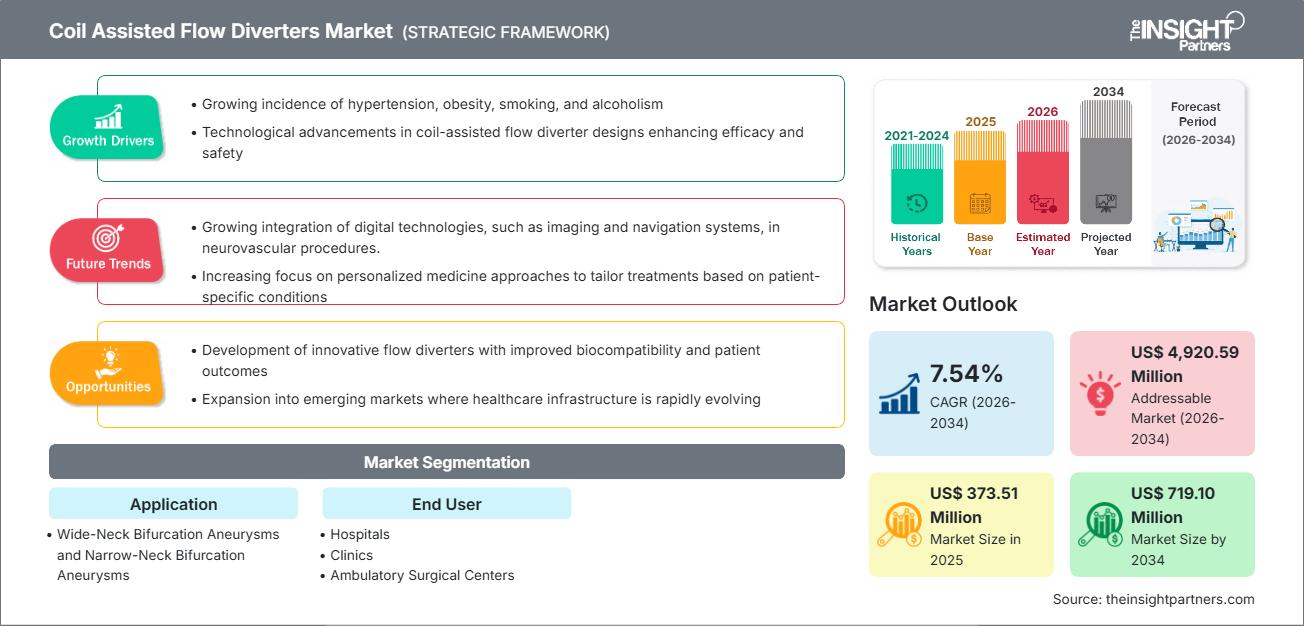
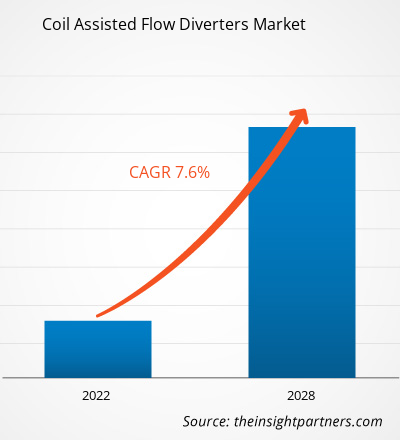
The Coil Assisted Flow Diverters Market size is expected to reach US$719.10 million by 2034, growing significantly from US$373.51 million in 2025. The market is anticipated to register a Compound Annual Growth Rate (CAGR) of 7.54% during the forecast period of 2026–2034.
Coil Assisted Flow Diverters Market Analysis
The global coil assisted flow diverters market forecast exhibits strong growth, driven primarily by the increasing global incidence of intracranial aneurysms with severe risks of hemorrhagic stroke. Market growth is highly dependent on the widespread and growing adoption of minimally invasive neurovascular procedures since these approaches are preferred for shorter patient recovery times and lower systemic risks compared to conventional open surgery. Successful integration of coils with flow diversion technology is one of the main clinical advancements. This combined technique offers superior flow modulation and better mechanical stabilization, leading to improved rates of complete aneurysm occlusion and a decreased risk of aneurysm recurrence post-treatment, thereby solidifying its position as a preferred therapeutic strategy for complex aneurysm morphologies.
Coil Assisted Flow Diverters Market Overview
Coil-assisted flow diverters are sophisticated, high-precision neurovascular implants used in the endovascular treatment of intracranial aneurysms. These devices work by redirecting blood flow away from the aneurysm sac (flow diversion), at the same time, utilizing embolic coils placed inside the aneurysm for enhanced mechanical stabilization and thrombogenesis. This unique, two-pronged approach is particularly effective in the cases of problematic vascular lesions such as wide-neck and bifurcation aneurysms, which are considered poorly suited for conventional coiling in many instances. The market environment is characterized by intense investment in research and development focused on miniaturization, enhanced radiopacity, and anti-thrombogenic coatings. Furthermore, the market benefits from increasing regulatory approvals for innovative delivery systems and high adoption rates in specialized neurovascular centers globally.
Market Research Highlights
- Global market for Coil Assisted Flow Diverters was valued at US$ 373.51 Million in 2025
- Annual market size is expected to reach US$ 719.10 Million by 2034
- Total addressable market (TAM) during 2026-2034 is projected to reach approximately US$ 4,920.59 Million
- Market is anticipated to register a CAGR of 7.54% during the forecast period
- The United States represents a key market, supported by Growing incidence of hypertension, obesity, smoking, and alcoholism, Technological advancements in coil-assisted flow diverter designs enhancing efficacy and safety, as well as evolving industry dynamics
- Market analysis covers North America, Europe, Asia-Pacific, South and Central America, Middle East and Africa, with growth evaluated across the forecast period
- Market opportunities such as Development of innovative flow diverters with improved biocompatibility and patient outcomes, Expansion into emerging markets where healthcare infrastructure is rapidly evolving are expected to influence market dynamics and addressable market
- Report profiles industry participants, including Balt USA LLC, MicroPort Scientific Corporation, Stryker Corporation, Penumbra, Inc., Medtronic., Acandis GmbH, MicroVention Inc, Johnson and Johnson Services, Inc., Lepu Medical Technology Co. Ltd., Cerus Endovascular, while analyzing competitive strategies and innovation developments
-
Source: The Insight Partners' analysis based on proprietary research, government publications, company annual reports, investor presentations, industry databases, and expert interviews.
● REPORT CUSTOMIZATION
Tailor This Report To Align With Your Specific Business Requirements
This report can be customized to align precisely with your business objectives, scope, and target markets. Customization options include tailored segmentation, geography, competitive analysis, and strategic insights to support informed decision-making.
Customize This Report →WHAT YOU CAN ADJUST
- ● Segmentations
- ● Geography
- ● Competitive Analysis
- ● Language Preferences
Coil Assisted Flow Diverters Market: Strategic Insights
-
Get Top Key Market Trends of this report.This FREE sample will include data analysis, ranging from market trends to estimates and forecasts.
Coil Assisted Flow Diverters Market Drivers and Opportunities
Market Drivers:
- Rising Prevalence of Intracranial: The increasing identification of intracranial aneurysms, largely due to advancements in diagnostic imaging (e.g., CT angiography, MRI), is expanding the diagnosed patient population requiring immediate or prophylactic endovascular treatment.
- Increasing Demand for Minimally Invasive Neurovascular Procedures: There is a significant global shift away from complex, high-risk open neurosurgery toward endovascular approaches, which offer reduced patient trauma, shorter hospital stays, and faster returns to normal life, thereby driving demand for advanced flow diverters.
- Technological Advancements in Coil-Assisted Flow Diverter Systems: Continuous innovation, particularly concerning the mesh density, scaffolding material, and controlled deployment mechanisms of flow diverters, is improving device maneuverability, reducing procedural complications, and increasing treatment success rates for complex anatomies.
Market Opportunities:
- Expansion in Emerging Markets: Emerging economies in Asia-Pacific and Latin America are rapidly upgrading their neurovascular treatment capabilities and investing in specialized surgical centers. These regions present substantial untapped opportunities for manufacturers to introduce advanced, high-efficacy flow diversion technologies.
- Next-generation device development: The continued burden of post-procedure dependence on antiplatelet medication dictates the need for devices with either bioresorbable components or an enhanced anti-thrombogenic coating, and thus presents the principal developmental opportunity in improving patient safety and long-term results.
- Strategic Partnerships for Innovation and Global Distribution: Collaborations between leading flow diverter manufacturers and high-volume neurosurgery centers facilitate critical clinical research, and partnerships with local distributors are essential for navigating complex regulatory pathways and expanding market penetration across diverse global geographies.
Coil Assisted Flow Diverters Market Report Segmentation Analysis
The market for coil assisted flow diverters is analyzed based on the types of aneurysms treated and the clinical settings where the procedures are performed. Below is the standard segmentation approach used in most industry reports:
By Application:
- Wide-Neck Bifurcation Aneurysms
- Narrow-Neck Bifurcation Aneurysms
By End User:
- Hospitals
- Specialty Clinics and Ambulatory Surgical Centers (ASCs)
By Geography:
- North America
- Europe
- Asia Pacific
- South & Central America
- Middle East & Africa
Coil Assisted Flow Diverters Market Report Scope
| Report Attribute | Details |
|---|---|
| Market size in 2025 | US$ 373.51 Million |
| Market Size by 2034 | US$ 719.10 Million |
| Global CAGR (2026 - 2034) | 7.54% |
| Historical Data | 2021-2024 |
| Forecast period | 2026-2034 |
| Segments Covered |
By Application
|
| Regions and Countries Covered |
North America
|
| Market leaders and key company profiles |
|
Coil Assisted Flow Diverters Market Players Density: Understanding Its Impact on Business Dynamics
The Coil Assisted Flow Diverters Market is growing rapidly, driven by increasing end-user demand due to factors such as evolving consumer preferences, technological advancements, and greater awareness of the product's benefits. As demand rises, businesses are expanding their offerings, innovating to meet consumer needs, and capitalizing on emerging trends, which further fuels market growth.
Coil Assisted Flow Diverters Market Share Analysis by Geography
North America holds the largest market share, characterized by its mature healthcare system and high expenditure on cutting-edge neurovascular technologies. Conversely, the Asia-Pacific region is set to be the engine of future growth.
The market shows a different growth trajectory in each region due to factors such as healthcare regulation, physician expertise density, and public awareness regarding neurological health. Below is a summary of market share and trends by region:
North America
- Market Share: Holds the largest market share due to the highest concentration of specialized neurointerventionalists and early access to FDA-approved advanced flow diverter devices.
- Key Drivers: Strong R&D presence leading to rapid product innovation and clinical adoption.
- Trends: Increasing consolidation of care within specialized stroke centers and high demand for next-generation systems with rapid deployment features.
Europe
- Market Share: Retains a significant share, supported by well-established, centrally funded public healthcare systems and a strong commitment to adopting evidence-based minimally invasive treatments across key Western European nations.
- Key Drivers: National stroke action plans emphasizing rapid access to endovascular treatment.
- Trends: Growth driven by the expansion of neurovascular networks in Eastern Europe and increasing clinical focus on long-term follow-up and recurrence prevention data for existing implants.
Asia Pacific
- Market Share: Fastest-growing region globally, driven by surging healthcare spending, rapidly expanding modern hospital infrastructure, and a large, aging population, which is susceptible to aneurysms.
- Key Drivers: The Growing medical tourism segment is seeking high-quality neurovascular interventions.
- Trends: High potential for cost-competitive flow diverter solutions and a strong emphasis on localized clinical training to meet the increasing demand from a rapidly expanding patient pool.
South and Central America
- Market Share: Emerging market with improving adoption rates, primarily localized in Brazil, Mexico, and Argentina. Growth is stimulated by public-private health initiatives aimed at addressing neurological disease burdens.
- Key Drivers: Increasing investment in advanced imaging and catheterization labs.
- Trends: Cloud-based and remote training models are gaining traction to educate surgeons in less-accessible areas, while cost-effectiveness remains a key purchasing criterion.
Middle East and Africa
- Market Share: Developing market with high growth potential, especially in the GCC nations, due to rising governmental and private sector investments in specialized medical infrastructure and advanced technology procurement.
- Key Drivers: High purchasing power in Gulf nations for cutting-edge devices.
- Trends: Strategic alliances with European and North American manufacturers to ensure the transfer of technology and clinical best practices.
Coil Assisted Flow Diverters Market Players Density: Understanding Its Impact on Business Dynamics
High Market Density and Competition
The coil assisted flow diverters market is highly concentrated, with intense competition among a few global giants who possess robust R&D pipelines and expansive distribution networks. Companies like Medtronic, Stryker, and Penumbra constantly strive to capture market share through clinical evidence and superior device mechanics.
This competitive environment pushes vendors to differentiate through:
- Superior Anti-Thrombogenic Coatings: Developing specialized coatings on the flow diverter surface to minimize the risk of clot formation and improve device biocompatibility, potentially reducing the required duration of aggressive antiplatelet therapy.
- Device Flexibility and Conformability: Innovating stent designs that offer greater flexibility for easier navigation through complex, tortuous cerebrovascular anatomy while maintaining optimal wall apposition upon deployment.
- Integration of Imaging Markers: Incorporating enhanced radiopaque elements to ensure superior visibility under fluoroscopy, simplifying the intricate process of precise placement by the neurointerventionalist.
- Portfolio Breadth: Offering a comprehensive range of flow diverter sizes and coil types to treat the widest possible spectrum of aneurysm sizes and shapes across varying clinical needs.
Major Companies operating in the Coil Assisted Flow Diverters Market are:
- Balt USA LLC
- MicroPort Scientific Corporation
- Stryker Corporation
- Penumbra, Inc.
- Medtronic
- Acandis GmbH
- MicroVention Inc.
- Johnson and Johnson Services, Inc.
- Lepu Medical Technology Co. Ltd.
Disclaimer: The companies listed above are not ranked in any particular order.
Coil Assisted Flow Diverters Market News and Recent Developments
- MicroPort NeuroTech published 12-month safety data from the Trace-IA registry, showing a 92.84% event-free survival rate in 1,281 patients treated with Tubridge™ for intracranial aneurysms. In November 2024, the company completed the first implantation of Tubridge™ Plus in China, featuring full-body radiopacity and single-person deployment through a 27-microcatheter.
- Stryker announced the commercialization of Surpass Elite® flow diverter in the U.S., South Korea, and Europe on July 22, 2025. The device incorporates BioStealth surface technology to reduce thrombin generation and improve vessel-wall apposition. Surpass Elite® received FDA clearance and CE marking in 2024, reinforcing Stryker’s leadership in neurovascular innovation.
- Penumbra introduced the MIDWAY 43 and MIDWAY 62 catheters in May 2024 to facilitate the delivery of embolization tools, including flow diverters. The designs allow for superior trackability and support that complement Penumbra's neurovascular access portfolio in the treatment of complex aneurysms.
Coil Assisted Flow Diverters Market Report Coverage and Deliverables
The "Coil Assisted Flow Diverters Market Size and Forecast (2021–2034)" report provides a detailed analysis of the market covering the following areas:
- Coil Assisted Flow Diverters Market size and forecast at global, regional, and country levels for all the key market segments covered under the scope
- Coil Assisted Flow Diverters Market trends, as well as market dynamics such as drivers, restraints, and key opportunities
- Detailed PEST and SWOT analysis
- Coil Assisted Flow Diverters Market analysis covering key market trends, global and regional framework, major players, regulations, and recent market developments
- Industry landscape and competition analysis covering market concentration, heat map analysis, prominent players, and recent developments in the Coil Assisted Flow Diverters Market
- Detailed company profiles
Frequently Asked Questions

- Comprehensive Market Sizing and Forecast Analysis
- Detailed Segmentation Analysis
- In-Depth Market Dynamics Assessment
- Regional and Country-Level Insights
- Competitive Landscape and Company Benchmarking
- Strategic Business Intelligence
Recent Reports
Testimonials

The Insight Partners provided valuable market intelligence that supported our global go-to-market strategy. Their team was professional, responsive, and attentive to our feedback, providing thoughtful analysis and helpful methodological clarifications throughout the project.
Junmo Kim Chief Financial Officer (CFO), Enertech Co., Ltd.
The Insight Partners' SCADA System Market report is comprehensive, with valuable insights on current trends and future forecasts. The team was highly professional, responsive, and supportive throughout. We are very satisfied and highly recommend their services.
RAN KEDEM Partner, Reali Technologies LTDs
I requested a report on a very specific software market and the team produced the report in a few days. The information was very relevant and well presented. I then requested some changes and additions to the report. The team was again very responsive and I got the final report in less than a week.
JEAN-HERVE JENN Chairman, Future Analytica
We worked with The Insight Partners for an important market study and forecast. They gave us clear insights into opportunities and risks, which helped shape our plans. Their research was easy to use and based on solid data. It helped us make smart, confident decisions. We highly recommend them.
PIYUSH NAGPAL Sr. Vice President, High Beam Global
The Insight Partners delivered insightful, well-structured market research with strong domain expertise. Their team was professional and responsive throughout. The user-friendly website made accessing industry reports seamless. We highly recommend them for reliable, high-quality research services
YUKIHIKO ADACHI CEO, Deep Blue, LLC.
This is the first time I have purchased a market report from The Insight Partners.While I was unsure at first, I visited their web site and felt more comfortable to take the risk and purchase a market report.I am completely satisfied with the quality of the report and customer service. I had several questions and comments with the initial report, but after a couple of dialogs over email with their analyst I believe I have a report that I can use as input to our strategic planning process.Thank you so much for taking the extra time and making this a positive experience.I will definitely recommend your service to others and you will be my first call when we need further market data.
JOHN SUZUKI President and Chief Executive Officer, Board Director, BK Technologies
I wish to appreciate your support and the professionalism you displayed in the course of attending to my request for information regarding to infectious disease IVD market in Nigeria. I appreciate your patience, your guidance, and the fact that you were willing to offer a discount, which eventually made it possible for us to close a deal. I look forward to engaging The Insight Partners in the future, all thanks to the impression you have created in me as a result of this first encounter.
DR CHIJIOKE ONYIA MANAGING DIRECTOR, PineCrest Healthcare Ltd.Reason to Buy
- Informed Decision-Making
- Understanding Market Dynamics
- Competitive Analysis
- Identifying Emerging Markets
- Customer Insights
- Market Forecasts
- Risk Mitigation
- Boosting Operational Efficiency
- Strategic Planning
- Investment Justification
- Tracking Industry Innovations
- Aligning with Regulatory Trends






 Get Free Sample for