
Coma Diagnosis and Treatment Market Size, Share & Demand by 2034
Coverage: by : Type (Toxic Encephalopathy, Anoxic Brain Injury); Diagnosis (Physical Examination, Brain Scans); Treatment (Medical Treatment); End User (Hospitals, Speciality clinics), and Geography (North America, Europe, Asia Pacific, and South and Central America)
- Status : Data Released
- Report Code : TIPRE00007558
- Category : Life Sciences
- No. of Pages : 150
- Available Report Formats :


- Last update date : November 12, 2026


2025 Market Size
US$ 6.48 Bn
Base year value
2034 Forecast
US$ 12.06 Bn
Projected by 2034
CAGR 2026-2034
7.15 %
Growth rate
Addressable Market
US$ 83.69 Bn
(2026-2034)
The Coma Diagnosis and Treatment Market was valued at US$ 6.48 Billion in 2025 and is expected to reach US$ 12.06 Billion by 2034, registering a CAGR of 7.15% during 2026–2034. Growth is supported by increasing neurological emergencies, traumatic and nontraumatic brain injuries, critical-care admissions, and demand for rapid identification of reversible causes. Wider deployment of CT, MRI, electroencephalography, physiological monitoring, and structured neurological assessment is strengthening clinical decision-making across emergency and intensive-care pathways.
North America remains a clinically advanced market, with an estimated CAGR of ~7% through 2034. The Coma Diagnosis and Treatment Market size in the region is supported by established neurocritical-care networks, high emergency imaging availability, standardized trauma protocols, and substantial hospital investment in integrated diagnostic platforms. Expanding use of continuous neurological monitoring and advanced brain imaging is improving the identification of seizures, cerebral edema, vascular injury, metabolic abnormalities, and treatment-related complications. Multidisciplinary care models also support sustained demand across acute diagnosis, stabilization, and recovery assessment.
Coma Diagnosis and Treatment Market Assessment and Insights
Regional Outlook
- North America: ~39% of the global Coma Diagnosis and Treatment Market share in 2025 | ~7% CAGR through 2034. Market position: North America leads through extensive critical-care capacity, high CT and MRI accessibility, established trauma systems, and early adoption of neurological monitoring and clinical decision-support technologies.
- US: ~84% of North American market revenue in 2025 | ~7% CAGR through 2034. Market position: The US dominates North America through its large hospital network, specialized neurocritical-care units, strong device-company presence, and routine application of multimodal diagnostics in trauma, stroke, poisoning, and post-cardiac-arrest care.
- Europe: ~30% of the global market in 2025 | ~7% CAGR through 2034. Market position: Europe represents a mature market supported by universal hospital access, structured emergency pathways, and established neurology expertise. Germany leads, while the UK, France, Italy, and Spain maintain substantial diagnostic demand.
- Asia Pacific: ~23% of the global market in 2025 | ~9% CAGR through 2034. Market position: Asia Pacific is the fastest-growing region as China, Japan, India, South Korea, and Australia expand imaging capacity, tertiary hospital infrastructure, emergency medicine coverage, and access to critical-care monitoring.
Segment Outlook
- Diagnosis: ~64% Share in 2025 | ~8% CAGR through 2034. Market position: Diagnosis leads because coma requires urgent cause differentiation, repeated neurological assessment, imaging, laboratory investigation, and physiological monitoring before clinicians can select an appropriate intervention.
- End User: ~58% Share in 2025 | ~8% CAGR through 2034. Market position: The segment benefits from expanding hospital and specialty-care capacity, increasing referrals to neurological centers, and rising investment in coordinated acute-care, monitoring, and rehabilitation pathways.
Competitive Coverage
FUJIFILM Holdings Corporation, GE HealthCare Technologies Inc., Siemens Healthineers AG, Koninklijke Philips N.V., Shimadzu Corporation, Nihon Kohden Corporation, Masimo Corporation, Geistlich Pharma AG, Zimmer Biomet Holdings, Inc., Stryker Corporation
Methodology
The Insight Partners follows Data Collection & Secondary Research, Primary Research, Data Analysis, and Data Triangulation & Final Review to validate market estimates and insights.
Source: The Insight Partners' analysis based on proprietary research, government publications, company annual reports, investor presentations, industry databases, and expert interviews.
Management of clinical situations has advanced from reliance on response at bedside and structural imaging to multimodal evaluation using neurological tests, CT, MRI, electroencephalography, lab tests, brain oxygenation, and cardiopulmonary monitoring. Portable technology and faster image generation are shortening delays for unstable patients. Technology companies are developing diagnostic technologies that incorporate image reconstruction algorithms, automation, remote evaluation, and data management. Capital investments, specialist training, software integration, and different emergency room facilities need to be addressed by the suppliers in addition to tertiary hospitals.
Between 2023 and 2034, the investments are expected to flow towards affordable imaging, miniature monitoring technology, algorithm development for analysis, and consciousness test. The future healthcare system is developing more stroke centers, trauma networks, and ICUs, hence providing new purchasing avenues that will be available beyond the urban hospitals. The regulations based on safety, cybersecurity, clinical trials, and algorithm transparency would affect the commercialization. There would be increased collaborations between imaging technology firms, monitoring technology firms, hospitals, and neurological software developers.
Coma Diagnosis and Treatment Market Report Scope
| Report Attribute | Details |
|---|---|
| Market size in 2025 | US$ 6.48 Billion |
| Market Size by 2034 | US$ 12.06 Billion |
| Global CAGR (2026 - 2034) | 7.15% |
| Historical Data | 2021-2024 |
| Forecast period | 2026-2034 |
Coma Diagnosis and Treatment Market Analysis
The drivers of the Coma Diagnosis and Treatment market include the need for prompt identification of treatable etiologies. Differentiation between structural injury, poisoning, hypoxic injury, infectious processes, seizures, and metabolic problems needs to be done quickly. Therefore, the ecosystem is represented by emergency medicine physicians, neurologists, intensivists, radiologists, laboratories, imaging equipment manufacturers, monitoring companies, drug suppliers, and rehabilitation professionals.
The demand is generated in the hospital emergency and intensive care setting, where the physical examination leads to laboratory studies and brain imaging. In the imaging equipment market, the competition is based on factors such as speed of acquisition, image quality, transportability, connectivity, and service lifetime. Hospitals tend to use systems that reduce examination times and provide stable results regardless of the lack of staff. The supply environment is still dependent on semiconductors, detectors, software upgrades, service engineers, and budgeting cycles.
Market analysis for coma diagnosis and treatment reveals a market structure featuring wide-ranging imaging firms, specialists in physiological monitoring, and medical technology firms targeting neurological interventions. GE HealthCare Technologies Inc., Siemens Healthineers AG, Koninklijke Philips N.V., FUJIFILM Holdings Corporation, and Shimadzu Corporation compete via image quality, workflow automation, installations, and digitalization capabilities.
Monitoring capabilities are enhanced by Nihon Kohden Corporation and Masimo Corporation via neurological and physiological data, whereas Stryker Corporation and Zimmer Biomet Holdings, Inc. are pertinent due to neurology technology and hospital connections. Geistlich Pharma AG has less of a strategic relevance to the described market compared to the leading diagnostics firms. Areas for investment include AI-driven reconstruction, portability of imaging, command centers, remote specialist connections, and tools that decrease the time gap between presentation, diagnosis, and intervention.
● REPORT CUSTOMIZATION
Tailor This Report To Align With Your Specific Business Requirements
This report can be customized to align precisely with your business objectives, scope, and target markets. Customization options include tailored segmentation, geography, competitive analysis, and strategic insights to support informed decision-making.
Customize This Report →WHAT YOU CAN ADJUST
- ● Segmentations
- ● Geography
- ● Competitive Analysis
- ● Language Preferences
Coma Diagnosis and Treatment Market: Strategic Insights
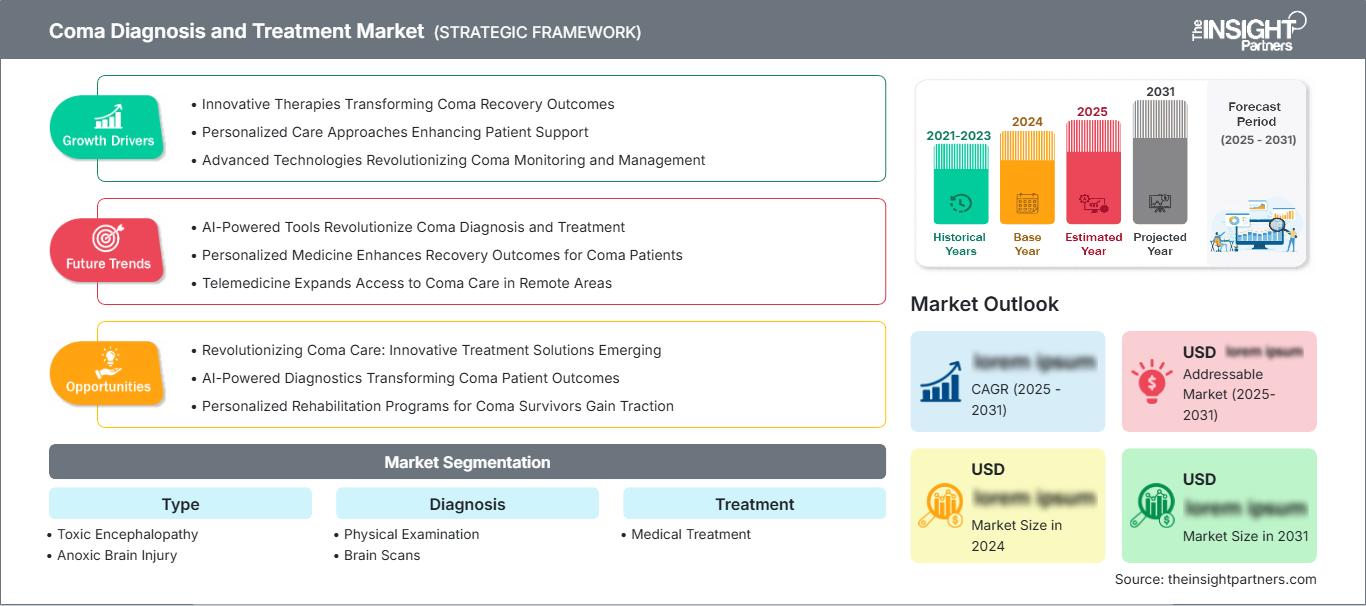
Regional Insights
North America Coma Diagnosis and Treatment Market
North America is estimated to expand at a CAGR of ~7% through 2034. Its Coma Diagnosis and Treatment Market share is reinforced by high emergency-department utilization, organized trauma networks, neurocritical-care specialization, and broad access to CT and MRI. Hospitals frequently combine rapid structural imaging with laboratory testing, electroencephalography, pupil assessment, oxygenation monitoring, and serial neurological examination.
Regional buying is more inclined towards a workflow approach that allows emergency doctors, radiologists, neurologists, and intensivists to access information without repeating procedures. The involvement of Canada is through publicly financed hospital upgrades and the clustering of tertiary neurological facilities, while that of Mexico is in the form of emerging market opportunities through major hospitals, both private and public.
U.S. Coma Diagnosis and Treatment Market
The US accounts for approximately ~84% of North American revenue and is expected to record a CAGR of ~7% through 2034. It has been shaped by its geographic location, which includes an established base of imaging equipment, intensive care units, recognized trauma centers, and specialists. The diagnostic needs include traumatic brain injuries, strokes, overdoses, metabolic events, infections, seizures, and post-cardiac arrest neurological examinations.
Some of the major players who have an established presence in the market include GE HealthCare Technologies Inc., Siemens Healthineers AG, Koninklijke Philips N.V., Masimo Corporation, Stryker Corporation, and Zimmer Biomet Holdings, Inc. The acquisition process is increasingly looking at automation, remote reading, integration, radiation reduction, and shorter time for diagnosis. Academic medical centers also contribute by assessing advanced MRI, quantification, continuous electroencephalography, and biomarkers before implementation.
Europe Coma Diagnosis and Treatment Market
Europe represents approximately ~30% of global revenue in 2025 and is projected to grow at a CAGR of ~7% through 2034. The demand is underpinned by the presence of universal or widespread hospital networks, the availability of ambulances, expertise in neurology, as well as the presence of stroke and trauma protocols. The European clinical practice guidelines appreciate the value of the integration of standardized bedside assessment with electrophysiological examination and neuroimaging as required.
The country with the most developed market is Germany, due to its robust hospital infrastructure, medical engineering, and advanced imaging availability. The UK has a focus on coordinated emergency, neuroscience, and critical care protocols; however, the timing of equipment acquisition is affected by the replacement of the equipment and the need for personnel. France ensures its demand due to its university hospitals and regional emergency networks.
It is possible to observe an increased attention to post-acute neurological care and specialist rehabilitation in Italy. Spain is characterized by the availability of transplantation services, emergency medicine, and stroke care services. In all these countries, hospitals consider the technologies such as low-helium MRI, fast reconstructions, energy saving, and remote technical assistance.
APAC Coma Diagnosis and Treatment Market
Asia Pacific contributes approximately ~23% of global revenue in 2025 and is forecast to expand at a CAGR of ~9%, making it the fastest-growing region. China is the leading country in Asia Pacific because of its hospital scale, imaging installations, domestic manufacturing, and continued development of tertiary care. Japan provides a mature market for advanced imaging and neurophysiological monitoring.
India is developing its capabilities via metropolitan as well as tier two cities, while South Korea is focused on digitally-enabled hospitals. Australia already has its capability developed via trauma and critical care pathways within urban regions. Regional developments occur due to construction of hospitals, localization of medical equipment manufacture, development of public insurance systems, and capabilities enhancement strategies for emergency, stroke, and intensive care capabilities.
Middle East & Africa Coma Diagnosis and Treatment Market
The Middle East & Africa market is expected to register a CAGR of ~6% through 2034. Saudi Arabia represents a leading country in the Middle East & Africa through hospital expansion, specialized medical-city investment, and modernization of emergency and critical-care services. The UAE supports demand through advanced private hospitals, medical tourism, and concentrated access to imaging technologies.
South Africa remains an important sub-Saharan market, although access differs between private facilities and resource-constrained public hospitals. The rest of the region presents uneven adoption because electricity reliability, maintenance access, specialist availability, and capital funding affect equipment utilization. Opportunities are strongest for durable systems, remote support, portable monitoring, and modular diagnostic infrastructure.
Segmentation Analysis
Type
The type segment captures major etiological pathways that shape diagnostic urgency, care intensity, and resource requirements. The clinical cause influences testing priorities, monitoring duration, prognosis, and potential reversibility. Toxic Encephalopathy is projected to record a CAGR of ~8% during 2026–2034, supported by greater recognition of drug-related, occupational, metabolic, and environmental neurological injury. Buyers prioritize flexible diagnostic platforms that can support rapid differential assessment across emergency and intensive-care environments.
- Toxic Encephalopathy: Demand arises from medication toxicity, substance exposure, metabolic disruption, and industrial or environmental agents. Diagnosis often requires clinical history, laboratory investigation, imaging, electrophysiology, and continuous monitoring to distinguish reversible dysfunction from structural damage.
- Anoxic Brain Injury: This category is associated with interrupted cerebral oxygen supply following cardiac arrest, respiratory failure, drowning, or severe systemic events. It requires repeated prognostic assessment, temperature-management support, imaging, electroencephalography, and close physiological surveillance.
Diagnosis
Diagnosis is central to the Coma Diagnosis and Treatment Market scope because clinicians must promptly establish severity, identify reversible causes, and recognize lesions requiring urgent intervention. The category benefits from increasing use of multidisciplinary protocols and repeated assessment rather than reliance on a single examination. Brain Scans are expected to grow at a CAGR of ~8% during 2026–2034 as hospitals expand access to faster CT, advanced MRI, perfusion assessment, and automated image reconstruction.
- Physical Examination: Bedside assessment evaluates responsiveness, brainstem reflexes, pupil behavior, motor patterns, breathing, and possible confounders. Its universal availability makes it the first diagnostic step, while serial examinations help detect neurological deterioration or emerging consciousness.
- Brain Scans: CT and MRI identify hemorrhage, infarction, edema, mass effect, trauma, hydrocephalus, and other structural abnormalities. Faster acquisition and algorithm-assisted reconstruction strengthen their role in emergency triage and treatment planning.
Treatment
The treatment segment covers coordinated interventions intended to stabilize the patient, reverse the underlying cause, prevent secondary brain injury, and manage complications. Medical Treatment is projected to register a CAGR of ~7% through 2034. Adoption is linked to intensive-care availability, rapid etiological diagnosis, and protocol-based management involving airway support, circulation, seizure control, antidotes, infection management, metabolic correction, and intracranial-pressure strategies. Treatment demand therefore varies according to cause, severity, comorbidities, and hospital capability.
- Medical Treatment: Clinical management may include respiratory and cardiovascular stabilization, antidotal therapy, antiseizure medication, antimicrobial treatment, metabolic correction, temperature control, nutrition, and prevention of pressure injury, thrombosis, aspiration, and hospital-acquired infection.
End User
End-user demand reflects differences in acuity, equipment access, staffing, referral patterns, and continuity of care. Hospitals remain pivotal because unconscious patients often require emergency imaging, laboratory testing, ventilation, and continuous monitoring. Specialty Clinics are projected to expand at a CAGR of ~8% through 2034, supported by neurological follow-up, consciousness assessment, rehabilitation coordination, and post-acute evaluation. The category’s outlook depends on stronger referral networks connecting emergency stabilization with specialist review and longer-term recovery management.
- Hospitals: Hospitals command high revenue contribution because they integrate emergency departments, imaging, laboratories, operating rooms, intensive-care units, pharmacies, and multidisciplinary specialists. Their purchasing decisions emphasize uptime, rapid workflows, service coverage, and interoperability.
- Specialty Clinics: Neurology and rehabilitation-focused clinics support post-acute assessment, medication review, functional monitoring, and caregiver planning. Adoption is increasing where health systems shift suitable follow-up procedures away from expensive inpatient environments.
Opportunity Snapshot
| End Users | Revenue Contribution | Trend Tag | Adoption Stage |
| Hospitals | High | Integrated Neurocare | Mature |
| Specialty Clinics | Medium | Recovery Pathways | Scaling |
Coma Diagnosis and Treatment Market Growth Drivers and Impact Analysis
Rising Burden of Acute Neurological and Systemic Emergencies
Growth is caused by environmental factors that may hinder consciousness, such as brain trauma, stroke, poisoning, heart attack, infection, breathing difficulties, seizures, and metabolic disorders. Rapid evaluation is needed in emergencies since a delay in recognizing the presence of bleeding, lack of blood flow, poison, or seizure may result in a lower level of effectiveness in treatment. An increased rate of emergency cases results in the need for CT scans, MRI scans, diagnostic tests, electroencephalography, assessment of pupils, and monitoring of the cardiorespiratory system. The commercial benefits range from selling machines to updating software, maintenance, supplies, training, and networking.
Expansion of Imaging and Neurocritical-Care Infrastructure
Emergency departments, stroke units, trauma centers, intensive care beds, and diagnostic imaging capabilities are being developed by health systems. This will increase the number of potential patients who can be tested for coma as high-resolution scanners, coupled with monitoring technology, can be applied for various neurological and critical conditions. The reduction in physical size, faster image generation, reduced helium requirements, and energy efficiency have decreased certain obstacles in deployment. In January 2025, Siemens Healthineers launched their MRI, CT, X-ray, and artificial intelligence-driven ultrasound machines in India, highlighting the focus of suppliers in developing diagnostic capability through accessibility and workflow optimization.
Increasing Adoption of Multimodal Neurological Monitoring
Bedside examination alone may be affected by sedation, paralysis, language barriers, metabolic abnormalities, or subtle cognitive-motor dissociation. Clinical practice is therefore moving toward combined use of serial examination, electrophysiology, imaging, physiological signals, and laboratory results. A 2025 expert roadmap highlighted heterogeneity in coma definitions and the importance of structured identification, diagnosis, treatment, prognostication, and shared decision-making. This shift increases demand for interoperable platforms capable of presenting time-synchronized information. The market impact includes stronger purchasing interest in continuous electroencephalography, automated pupil measurement, oxygenation monitoring, centralized data review, and decision-support tools designed for intensive-care workflows.
Coma Diagnosis and Treatment Market Future Trends
AI-Assisted Imaging and Integrated Decision Support
Coma Diagnosis and Treatment Market trends will increasingly involve algorithms that improve reconstruction, detect abnormalities, prioritize urgent examinations, and organize multimodal clinical information. Future systems are expected to combine imaging, electrophysiology, laboratory findings, vital signs, and treatment history while keeping final decisions under clinician oversight. The transition will depend on representative validation, explainability, cybersecurity, integration with hospital systems, and monitoring for performance drift. GE HealthCare’s 2025 radiology portfolio emphasized AI-enabled imaging, structured reporting, cloud capabilities, and workflow automation, indicating the direction of major diagnostic-platform investment. Adoption should be strongest where these tools demonstrate shorter reporting times and more consistent interpretation.
Portable Diagnostics and Decentralized Specialist Access
Diagnostic pathways are expected to move closer to emergency bays, intensive-care beds, ambulances, and hospitals without resident neurological specialists. Portable monitoring, simplified neuroimaging, secure image transfer, and remote consultation can reduce transfers and shorten evaluation time for unstable patients. This trend will not replace advanced tertiary imaging, but it can improve initial triage and determine which patients require escalation. Manufacturers will need to prioritize durability, battery performance, intuitive operation, infection control, and connectivity under variable network conditions. Commercial models combining equipment, software, training, and remote clinical support could accelerate adoption in rural and underserved healthcare systems.
Coma Diagnosis and Treatment Market Opportunities
Integrated Neurocritical-Care Platforms for Hospitals
Coma Diagnosis and Treatment Market Forecasts indicate an opportunity for vendors to connect imaging, neurophysiological monitoring, physiological surveillance, laboratory data, and clinical documentation within one workflow. Hospitals frequently operate these components through separate systems, increasing interpretation time and limiting longitudinal review. Suppliers can pursue partnerships with academic centers to validate integrated dashboards, alert logic, and outcome-oriented protocols. Investment should focus on interoperability, secure application programming interfaces, configurable clinical views, and compatibility with existing equipment. A platform strategy also creates recurring revenue through software subscriptions, analytics, service contracts, cybersecurity updates, and staff training, while helping hospitals protect prior capital investment.
Affordable Diagnostic Capacity in Emerging Healthcare Systems
A substantial opportunity exists in modular systems for hospitals that cannot support high-end tertiary infrastructure. Vendors can develop compact scanners, portable electroencephalography, simplified monitoring, remote reporting, and predictable maintenance packages. Financing partnerships, operator certification, spare-parts localization, and regional service hubs can address practical adoption barriers more effectively than equipment-only sales. The strongest opportunities should emerge where governments are expanding emergency medicine, trauma coverage, stroke services, and intensive-care capacity. Solutions must be designed around local staffing, electricity reliability, patient volume, referral logistics, and reimbursement. Investment aligned with these operating conditions can broaden access while establishing long-term service and replacement relationships.
Recent Developments
- November 2025: Koninklijke Philips N.V. – Philips expanded its precision-neurology strategy through a partnership with Cortechs.ai focused on quantitative neuroimaging. The collaboration supports automated brain MRI analysis and a more integrated diagnostic workflow, with potential relevance for neurological assessment and longitudinal evaluation across complex brain conditions.
- September 2025: GE HealthCare Technologies Inc. – GE HealthCare announced its intention to acquire icometrix, strengthening its neurology portfolio with AI-powered brain MRI assessment and reporting capabilities. The planned integration of icobrain with MRI systems is intended to support quantitative neurological analysis, workflow efficiency, and personalized imaging pathways.
- June 2025: Koninklijke Philips N.V. – Philips announced European availability of its CE-marked SmartCT release for intelligent three-dimensional imaging in stroke and neurovascular procedures. Designed for the Azurion neuro biplane system, the technology provides brain tissue, vascular, and device visualization within the angiography suite, potentially reducing transfers for separate imaging.
Frequently Asked Questions

- Comprehensive Market Sizing and Forecast Analysis
- Detailed Segmentation Analysis
- In-Depth Market Dynamics Assessment
- Regional and Country-Level Insights
- Competitive Landscape and Company Benchmarking
- Strategic Business Intelligence
Recent Reports
Testimonials

The Insight Partners provided valuable market intelligence that supported our global go-to-market strategy. Their team was professional, responsive, and attentive to our feedback, providing thoughtful analysis and helpful methodological clarifications throughout the project.
Junmo Kim Chief Financial Officer (CFO), Enertech Co., Ltd.
The Insight Partners' SCADA System Market report is comprehensive, with valuable insights on current trends and future forecasts. The team was highly professional, responsive, and supportive throughout. We are very satisfied and highly recommend their services.
RAN KEDEM Partner, Reali Technologies LTDs
I requested a report on a very specific software market and the team produced the report in a few days. The information was very relevant and well presented. I then requested some changes and additions to the report. The team was again very responsive and I got the final report in less than a week.
JEAN-HERVE JENN Chairman, Future Analytica
We worked with The Insight Partners for an important market study and forecast. They gave us clear insights into opportunities and risks, which helped shape our plans. Their research was easy to use and based on solid data. It helped us make smart, confident decisions. We highly recommend them.
PIYUSH NAGPAL Sr. Vice President, High Beam Global
The Insight Partners delivered insightful, well-structured market research with strong domain expertise. Their team was professional and responsive throughout. The user-friendly website made accessing industry reports seamless. We highly recommend them for reliable, high-quality research services
YUKIHIKO ADACHI CEO, Deep Blue, LLC.
This is the first time I have purchased a market report from The Insight Partners.While I was unsure at first, I visited their web site and felt more comfortable to take the risk and purchase a market report.I am completely satisfied with the quality of the report and customer service. I had several questions and comments with the initial report, but after a couple of dialogs over email with their analyst I believe I have a report that I can use as input to our strategic planning process.Thank you so much for taking the extra time and making this a positive experience.I will definitely recommend your service to others and you will be my first call when we need further market data.
JOHN SUZUKI President and Chief Executive Officer, Board Director, BK Technologies
I wish to appreciate your support and the professionalism you displayed in the course of attending to my request for information regarding to infectious disease IVD market in Nigeria. I appreciate your patience, your guidance, and the fact that you were willing to offer a discount, which eventually made it possible for us to close a deal. I look forward to engaging The Insight Partners in the future, all thanks to the impression you have created in me as a result of this first encounter.
DR CHIJIOKE ONYIA MANAGING DIRECTOR, PineCrest Healthcare Ltd.Reason to Buy
- Informed Decision-Making
- Understanding Market Dynamics
- Competitive Analysis
- Identifying Emerging Markets
- Customer Insights
- Market Forecasts
- Risk Mitigation
- Boosting Operational Efficiency
- Strategic Planning
- Investment Justification
- Tracking Industry Innovations
- Aligning with Regulatory Trends





 Get Free Sample for