
Commodity Plastics Market Share, Demand & Growth by 2034
Coverage: by Type (Polyethylene (PE), Polyvinyl Chloride (PVC), Polystyrene (PS), Polypropylene (PP), Poly(Methyl Methacrylate) (PMMA), Others); End-Use Industry (Packaging, Automotive, Electrical and Electronics, Consumer Goods, Building and Construction, Textile, Medical and Pharmaceutical, Others) , and Geography (North America, Europe, Asia Pacific, and South and Central America)
- Status : Data Released
- Report Code : TIPRE00004665
- Category : Chemicals and Materials
- No. of Pages : 150
- Available Report Formats :


- Last update date : August 17, 2026


2025 Market Size
US$ 533.80 Bn
Base year value
2034 Forecast
US$ 685.90 Bn
Projected by 2034
CAGR 2026-2034
2.82 %
Growth rate
Addressable Market
US$ 5,535.13 Bn
(2026-2034)
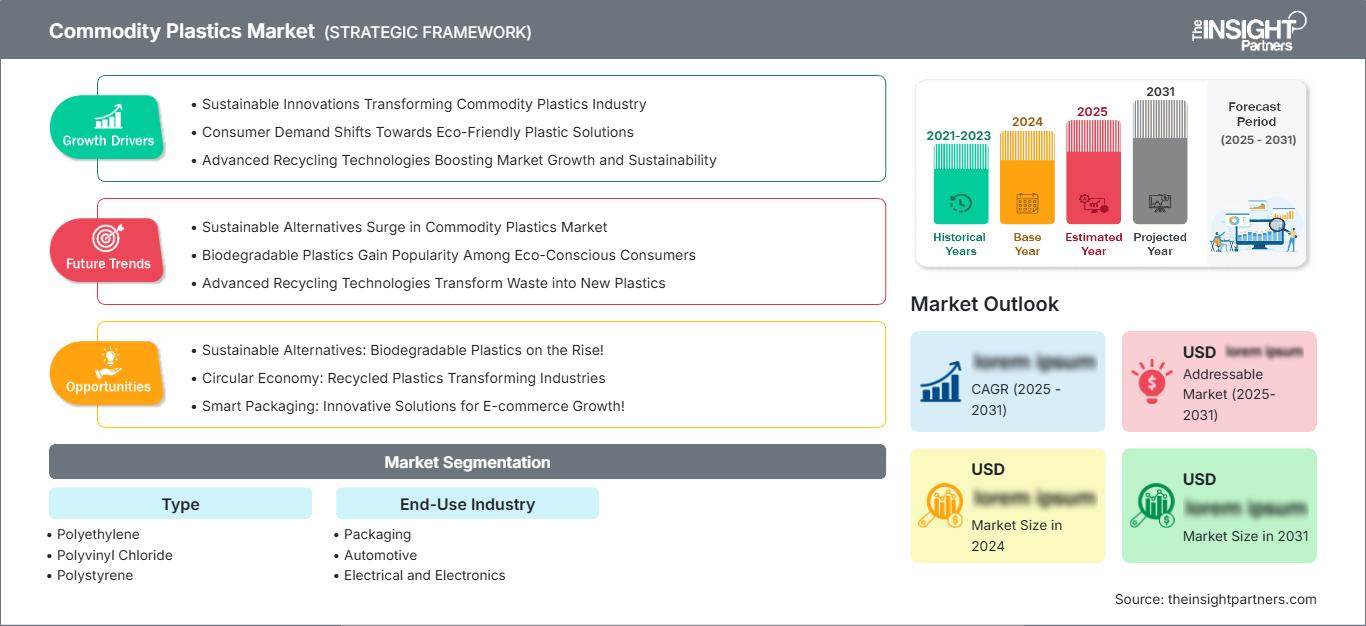
The commodity plastics market was worth US$ 533.80 billion in 2025 and forecasted to attain US$ 685.90 billion by 2034, registering a compound annual growth rate of 2.82% from 2026 to 2034. Commodity plastic is driven by its high consumption in packaging, construction, automotive, healthcare, consumer goods, and electric applications. The continued investments in petrochemicals infrastructure and advancements in polymer processing technology alongside the circular economy continue to bolster the resilience of the industry in the face of growing sustainability regulations.
In North America, the petrochemical integration, ample availability of shale feedstocks, and consistent investments in polymer manufacturing continue to boost the competitiveness of the industry. The commodity plastics market size in the region gets boosted by the demand for packaging, resilient construction activities, and the use of lightweight material in the transport sector. The regional market size is anticipated to grow at a compound annual growth rate of 2.4–2.8% through 2034.
Commodity Plastics Market Assessment and Insights
- North America: Accounted for 22–24% commodity plastics market share in 2025 and is projected to grow at a CAGR of 2.4–2.8% during 2026–2034, supported by integrated petrochemical production, abundant ethane feedstock, and sustained packaging and automotive demand.
- U.S.: Represented 82–86% of North American revenue in 2025 and is anticipated to register a CAGR of 2.5–2.9% during 2026–2034, driven by extensive resin production capacity, strong exports, and continuous investment in circular plastics technologies.
- Europe: Held 18–20% share in 2025 and is forecast to expand at a CAGR of 2.0–2.5% during 2026–2034. Germany, France, Italy, Spain, and the UK remain major manufacturing hubs despite increasing environmental regulations and energy cost pressures.
- Asia Pacific: Captured 47–49% share in 2025 and is expected to record the fastest regional expansion at a CAGR of 3.2–3.6% during 2026–2034, led by China, India, Japan, and South Korea through manufacturing growth and rising packaging consumption.
- Largest Segment: Packaging accounted for 38–42% market share in 2025 and is projected to grow at a CAGR of 2.9–3.3% during 2026–2034, supported by flexible packaging, food preservation, healthcare products, and e-commerce logistics.
- High Growth Segment: Medical and Pharmaceutical represented 6–8% market share in 2025 while expanding at a CAGR of 4.0–4.5% during 2026–2034, driven by sterile packaging, disposable medical devices, and pharmaceutical manufacturing requirements.
- Key companies analyzed in detail: BASF SE, Exxon Mobil Corporation, Formosa Plastics Corporation, INEOS AG, LG Chem Ltd., LyondellBasell Industries Holdings B.V., Mitsubishi Chemical Corporation, Saudi Basic Industries Corporation (SABIC), China Petroleum & Chemical Corporation (Sinopec), Sumitomo Chemical Company, Limited.
Source: The Insight Partners' analysis based on proprietary research, government publications, company annual reports, investor presentations, industry databases, and expert interviews.
Growth in downstream manufacturing industries has had an immense impact on the commodity plastics market over the last decade. The packaging industry has been showing preference towards lightweight and durable polymers, whereas the automotive sector keeps replacing traditional materials with plastics to enhance the fuel efficiency and lower emissions. At the same time, plastic producers are adopting cutting-edge polymerization technology, mechanical recycling process and diversified feedstock sources to ensure greater supply resilience and compliance with the changing sustainability regulations. Growth in the commodity plastics market is driven by increased industrialization in developing economies.
In the coming years, investment trend will stay focused on Asia Pacific, North America, and some Middle Eastern countries, as the presence of competitive feedstocks will enable expansion of production capacities. Increased support from policies towards recyclable content, chemical recycling technology and circularity of material management will encourage producers to upgrade their facilities. Moreover, digital manufacturing solutions, AI-based production optimization and lifecycle assessments will help to improve efficiency and meet growing environmental compliance demands.
Commodity Plastics Market Report Scope
| Report Attribute | Details |
|---|---|
| Market size in 2025 | US$ 533.80 Billion |
| Market Size by 2034 | US$ 685.90 Billion |
| Global CAGR (2026 - 2034) | 2.82% |
| Historical Data | 2021-2024 |
| Forecast period | 2026-2034 |
Commodity Plastics Market Analysis
The industry of commodity plastics still enjoys its crucial position within the value chain in global manufacturing. Packaging is the largest consuming sector due to growing needs in food packaging, healthcare items, personal care packaging, and e-commerce deliveries. The use of polymers in building materials, automotive parts, consumer goods, and electrical equipment is also persistent because commodity plastics are inexpensive to produce and exhibit good mechanical properties, chemical resistance, and processability. The commodity plastics market analysis shows that the availability of raw materials, efficiency in logistics, and integration of petrochemical facilities are the main factors affecting the competitive and price environment.
The supply side is becoming more and more dependent on refining and petrochemical complexes that can utilize ethane and naphtha and increase recycling capacity. Companies continue to spend money on mechanical and chemical recycling for improving the circularity of their activities without deterioration of product performance. At the same time, governments in all developed countries introduce recycled content requirements and extended producer responsibility regulations, stimulating companies to rethink their product design and use more sustainable polymers.
Market competition will remain intense as existing global players continue increasing production capacity while at the same time making investments in low carbon production processes. The main players such as BASF SE, Exxon Mobil Corporation, Formosa Plastics Corporation, INEOS AG, LG Chem Ltd., LyondellBasell Industries Holdings B.V., Mitsubishi Chemical Corporation, Saudi Basic Industries Corporation (SABIC), China Petroleum & Chemical Corporation (Sinopec), and Sumitomo Chemical Company, Limited make efforts through portfolio optimization, capacity modernization, strategic alliances, and recycling innovations to gain competitive advantage in global markets. Their diverse production capabilities allow flexibility in case of feedstock cost fluctuations.
Investment in advanced recycling technology, bio-based feedstocks, digital manufacturing solutions, and energy efficient production technology will keep on rising. At the same time, companies are enhancing their regional supply chain to ensure reliability in supplies to packaging, automotive, health care, and electronics companies. While there is growing regulatory pressure with respect to single use plastics, steady demand from key industries and constant innovation in recyclable polymers formulations will ensure stable market fundamentals.
● REPORT CUSTOMIZATION
Tailor This Report To Align With Your Specific Business Requirements
This report can be customized to align precisely with your business objectives, scope, and target markets. Customization options include tailored segmentation, geography, competitive analysis, and strategic insights to support informed decision-making.
Customize This Report →WHAT YOU CAN ADJUST
- ● Segmentations
- ● Geography
- ● Competitive Analysis
- ● Language Preferences
Commodity Plastics Market: Strategic Insights
Regional Insights
North America Commodity Plastics Market
The North American market held a 22% to 24% share of the global commodity plastics market in 2025 and is likely to grow at a CAGR of 2.4% to 2.8% between 2026 and 2034. North America possesses large reserves of shale gas, a well-developed petrochemicals and polymers industry, and a solid recycling sector. Both the United States and Canada are still significant producers of polyethylene, polypropylene, and polyvinyl chloride used domestically or exported. The investments into recycling technologies will add competitive edge to the industry in the long run.
Major drivers of demand include packaging, construction, automotive, consumer goods, and healthcare industries. According to the data provided by the American Chemistry Council, constant investments in petrochemical manufacturing and recycling infrastructure lead to production efficiencies and increased resilience of the supply chain. New regulations favoring recycled content and extended producer responsibility motivate companies to choose sustainable solutions while preserving their production capacities. Investments into chemical recycling and low-carbon manufacturing processes will allow steady growth of the market over the forecast period.
U.S. Commodity Plastics Market
United States accounted for 82–86% share of North America polymer market in 2025 and is expected to witness a CAGR of 2.5–2.9% over 2026-2034. United States features some of the largest integrated petrochemicals complexes in the world thanks to favorable availability of ethane raw materials from shale gas extraction process. Large manufacturing capabilities allow companies to serve packaging, automotive, healthcare, construction and consumer goods industries domestically and at strong export capabilities in polymer markets around the world.
Some of the key industry players such as Exxon Mobil Corporation, LyondellBasell Industries Holdings B.V., and BASF SE keep developing their efficiencies through digital manufacturing capabilities, polymer technologies development and recycling. Increasing application of lightweighting materials in the transportation sector and rising use of food grade and pharmaceutical packaging drive further domestic polymer demand. At the same time, sustainability programs on federal and state level are driving investments into mechanical and chemical recycling plants for manufacturers.
Europe Commodity Plastics Market
The share of Europe in the worldwide market stood at 18-20%, while the CAGR of growth during the forecast period (2026-2034) will be 2.0-2.5%. Germany retains the leading production position because of the well-developed chemical industry and polymer processing. Meanwhile, the UK will keep working on building infrastructure for recycling plastics, whereas France will focus on the legislation regarding sustainable packaging. Italy and Spain still act as significant centers for manufacturing with regard to packaging, automotive, consumer goods, and industry in Southern Europe.
Germany enjoys its highly integrated chemical industry and high exports of engineered polymer materials, while the UK will continue developing its domestic recycling infrastructure. France encourages using recycled content via national sustainability strategies, while Italian packaging and consumer goods industries will steadily consume polymers. Spain will help the industry grow owing to increasing construction and automotive manufacturing activities. Even though high energy prices could be considered among disadvantages, innovations in recycling and material efficiency are supposed to help maintain competitiveness during the forecast period.
APAC Commodity Plastics Market
Asia Pacific accounted for 47–49% of the global market in 2025 and is projected to register the highest regional CAGR of 3.2–3.6% during 2026–2034. China remains the dominant producer and consumer, while India, Japan, South Korea, and Australia continue expanding production capacity and downstream manufacturing across packaging, electronics, automotive, and construction industries.
Rapid industrialization, urbanization, expanding middle-class consumption, and government support for domestic manufacturing continue driving polymer demand throughout the region. Investments in integrated petrochemical complexes and recycling infrastructure further strengthen long-term production capabilities while supporting export competitiveness.
Middle East & Africa Commodity Plastics Market
The Middle East & Africa market is projected to grow at a CAGR of 2.8–3.2% during 2026–2034. Saudi Arabia remains the leading regional producer due to abundant hydrocarbon feedstocks and large-scale petrochemical investments. The UAE continues expanding downstream manufacturing capabilities, while South Africa supports demand through packaging, construction, and consumer industries.
Strategic investments in integrated refining and petrochemical projects are strengthening regional export competitiveness. Infrastructure development, industrial diversification programs, and increasing local polymer processing activities across the Gulf Cooperation Council countries are expected to sustain market expansion, while rising recycling initiatives gradually improve resource efficiency and environmental performance.
Segmentation Analysis
Type
The Type segment is projected to expand at a CAGR of 2.7–3.0% during 2026–2034. The commodity plastics market scope continues to broaden as manufacturers increasingly utilize high-volume polymers across packaging, automotive, consumer goods, electrical equipment, and construction applications. Continuous improvements in polymer processing, lightweight product development, and recyclability are supporting sustained demand. While regulatory pressure encourages circular material usage, commodity plastics remain indispensable because of their cost-effectiveness, durability, chemical resistance, and large-scale manufacturing compatibility.
- Polyethylene (PE): Polyethylene remains the largest product category owing to its extensive use in flexible packaging, films, bottles, containers, pipes, and industrial products. High processability, moisture resistance, and cost efficiency continue to support widespread adoption.
- Polyvinyl Chloride (PVC): PVC maintains strong demand across construction, healthcare, and infrastructure owing to its durability, corrosion resistance, insulation properties, and long service life in pipes, window profiles, cables, and flooring applications.
- Polystyrene (PS): Polystyrene continues serving food packaging, consumer products, insulation materials, and laboratory equipment where lightweight characteristics, dimensional stability, and ease of molding remain commercially valuable despite sustainability challenges.
- Polypropylene (PP): Polypropylene experiences strong demand across automotive components, rigid packaging, textiles, household products, and medical applications because of its excellent fatigue resistance, lightweight properties, and favorable balance between performance and affordability.
- PolyMethyl Methacrylate (PMMA): PolyMethyl Methacrylate is increasingly utilized in automotive lighting, architectural glazing, signage, medical devices, and consumer electronics where high optical clarity, weather resistance, and surface durability provide significant functional advantages.
End-Use Industry
The End-Use Industry segment is anticipated to register a CAGR of 2.9–3.2% during 2026–2034. Rising demand from packaging, transportation, healthcare, electronics, and infrastructure development continues to sustain global polymer consumption. Manufacturers are increasingly focusing on lightweight materials, improved recyclability, and application-specific formulations to satisfy changing customer requirements while complying with evolving environmental regulations and circular economy objectives.
- Packaging: Packaging represents the dominant end-use industry owing to continuous demand from food and beverage, healthcare, personal care, industrial, and e-commerce sectors requiring lightweight, durable, and cost-effective plastic materials.
- Automotive: Automotive manufacturers increasingly utilize commodity plastics to reduce vehicle weight, improve fuel efficiency, enhance design flexibility, and support electric vehicle production through lightweight interior and exterior components.
- Electrical and Electronics: Electrical and electronics applications continue expanding through demand for insulation materials, appliance housings, connectors, cable protection, and electronic device components requiring reliable electrical performance and dimensional stability.
- Consumer Goods: Consumer goods manufacturers utilize commodity plastics extensively across household products, furniture, toys, kitchenware, storage solutions, and personal care products because of their affordability and design versatility.
- Building and Construction: Construction applications maintain stable polymer demand through pipes, insulation, flooring, roofing membranes, doors, windows, and structural components that require corrosion resistance, durability, and low maintenance requirements.
- Textile: Textile applications increasingly incorporate polypropylene and other commodity plastics into fibers, nonwoven fabrics, carpets, geotextiles, industrial fabrics, and hygiene products because of their lightweight characteristics and processing efficiency.
- Medical and Pharmaceutical: Medical and pharmaceutical applications continue gaining importance through disposable medical devices, diagnostic products, sterile packaging, laboratory consumables, and pharmaceutical containers that require consistent quality, safety, and regulatory compliance.
Opportunity Snapshot
| End-Use Industry | Revenue Contribution | Trend Tag | Adoption Stage |
|---|---|---|---|
| Packaging | High | Flexible Packs | Mature |
| Automotive | Medium | Lightweighting | Scaling |
| Electrical and Electronics | Medium | Miniaturization | Scaling |
| Consumer Goods | High | Premium Packaging | Mature |
| Building and Construction | High | Green Buildings | Mature |
| Textile | Medium | Nonwoven Fibers | Scaling |
| Medical and Pharmaceutical | Low | Sterile Devices | Emerging |
Commodity Plastics Market Growth Drivers and Impact Analysis
Expansion of Flexible Packaging and Food Safety Requirements
The packaging industry continues to account for the largest share of global polymer consumption, making it one of the strongest growth drivers for commodity plastics. Rising urbanization, changing consumer purchasing patterns, and expanding e-commerce activities have increased demand for lightweight, durable, and cost-effective packaging materials. Food manufacturers are increasingly adopting polyethylene and polypropylene films to improve product shelf life, reduce transportation costs, and minimize food waste. Healthcare and pharmaceutical packaging requirements are also strengthening polymer demand because of stringent hygiene and contamination control standards. At the same time, advancements in recyclable mono-material packaging and high-performance barrier films are enabling manufacturers to comply with evolving sustainability regulations while maintaining product functionality. These developments are expected to support stable long-term demand across both developed and emerging economies.
Growing Infrastructure and Construction Investments
Infrastructure modernization and urban development continue to stimulate demand for commodity plastics across residential, commercial, and industrial construction projects. Polyvinyl chloride, polyethylene, and polypropylene are increasingly utilized in pipes, insulation systems, window profiles, flooring, roofing membranes, and cable protection because they offer corrosion resistance, lightweight characteristics, and long operational life. Large-scale infrastructure investments across Asia Pacific, the Middle East, and selected North American markets are supporting sustained consumption of polymer-based construction materials. Governments are also promoting energy-efficient buildings and sustainable infrastructure, encouraging wider adoption of durable plastic products that improve thermal performance and reduce maintenance costs. These structural investments continue strengthening long-term market fundamentals despite periodic fluctuations in construction activity.
Technological Advancements in Recycling and Circular Manufacturing
Growing environmental awareness and increasingly stringent regulations are accelerating investments in advanced recycling technologies throughout the plastics value chain. Mechanical recycling remains the dominant recovery method, while chemical recycling technologies are expanding to process mixed and difficult-to-recycle plastic waste into high-quality feedstocks. Major manufacturers continue investing in circular production systems, digital process optimization, and recycled-content polymer development to reduce greenhouse gas emissions and improve resource efficiency. Collaboration between resin producers, packaging manufacturers, recycling companies, and consumer brands is also strengthening circular material flows. As governments continue implementing extended producer responsibility frameworks and recycled-content mandates, these innovations are expected to improve long-term competitiveness while supporting sustainable industry development.
Commodity Plastics Market Future Trends
Acceleration of Circular Economy Business Models
Circular economy strategies are becoming a defining trend across the global plastics industry as manufacturers increasingly prioritize recyclable product designs, recycled-content integration, and advanced recovery technologies. The commodity plastics market trends indicate that collaboration between resin producers, converters, consumer brands, and waste management companies will continue expanding to improve material recovery rates and reduce landfill dependence. Digital product traceability, design-for-recycling principles, and chemical recycling technologies are expected to gain wider commercial adoption, enabling producers to manufacture high-quality polymers with improved sustainability credentials while meeting evolving regulatory requirements and customer expectations across multiple end-use industries.
Increasing Adoption of Digital Manufacturing Technologies
Digital transformation is reshaping polymer manufacturing through artificial intelligence, predictive maintenance, industrial automation, and real-time production monitoring. Manufacturers are increasingly deploying smart manufacturing platforms to optimize energy consumption, improve process efficiency, reduce production downtime, and maintain consistent product quality. Digital twins, machine learning algorithms, and advanced quality control systems are expected to enhance operational flexibility while supporting rapid product customization. These technological developments will improve supply chain resilience, reduce manufacturing costs, and enable producers to respond more efficiently to changing customer requirements and evolving sustainability objectives throughout the forecast period.
Commodity Plastics Market Opportunities
Expansion of Sustainable Medical and Healthcare Applications
The healthcare industry continues to create attractive investment opportunities for polymer manufacturers as global demand for disposable medical devices, diagnostic equipment, pharmaceutical packaging, and laboratory consumables increases. The commodity plastics market Forecasts indicate that investments in high-purity polymer grades, sterile packaging materials, and recyclable medical plastics will continue expanding throughout the forecast period. Manufacturers capable of developing regulatory-compliant, lightweight, and recyclable healthcare materials are expected to strengthen their competitive positions while benefiting from increasing healthcare expenditure, aging populations, and expanding pharmaceutical manufacturing activities across both developed and emerging economies.
Investments in Advanced Recycling Infrastructure
Significant opportunities are emerging from expanding investments in advanced recycling infrastructure, particularly chemical recycling technologies capable of processing mixed plastic waste streams. Governments, petrochemical producers, consumer goods companies, and packaging manufacturers are increasingly collaborating to establish integrated circular value chains that improve resource efficiency and reduce dependence on virgin fossil-based feedstocks. Companies investing in high-quality recycled resin production, digital waste tracking systems, and low-carbon manufacturing technologies are expected to capture long-term competitive advantages. Strategic partnerships across the plastics ecosystem will also accelerate commercialization of innovative recycling solutions while supporting compliance with future environmental regulations and corporate sustainability commitments.
Recent Developments
- August 2026: Univar Solutions LLC (“Univar Solutions” or “the Company”), a leading global solutions provider to users of specialty ingredients and chemicals, acquired H.M. Royal, a highly respected 101-year-old specialty distributor of rubber, plastics, and adhesive additives. The addition of H.M. Royal strengthens the Performance Materials business within the Ingredients + Specialties from Univar Solutions division, expanding access to specialized products, technical knowledge, and long-standing customer relationships, particularly on the East and West Coasts, where H.M. Royal has a strong presence.
- August 2026: Mutares SE & Co. KGaA acquired SABIC's regional Engineering Thermoplastics (ETP) business across the Americas and Europe in a transaction valued at USD 450 million. The deal is the largest acquisition in Mutares' history and represents a significant milestone in the company's expansion strategy. Following the completion of the transaction, the acquired business will operate under the new name NexPoint Materials, while also serving as the foundation of Mutares' newly established Chemicals & Materials business segment.
Frequently Asked Questions

- Comprehensive Market Sizing and Forecast Analysis
- Detailed Segmentation Analysis
- In-Depth Market Dynamics Assessment
- Regional and Country-Level Insights
- Competitive Landscape and Company Benchmarking
- Strategic Business Intelligence
Recent Reports
Testimonials

The Insight Partners' SCADA System Market report is comprehensive, with valuable insights on current trends and future forecasts. The team was highly professional, responsive, and supportive throughout. We are very satisfied and highly recommend their services.
RAN KEDEM Partner, Reali Technologies LTDs
I requested a report on a very specific software market and the team produced the report in a few days. The information was very relevant and well presented. I then requested some changes and additions to the report. The team was again very responsive and I got the final report in less than a week.
JEAN-HERVE JENN Chairman, Future Analytica
We worked with The Insight Partners for an important market study and forecast. They gave us clear insights into opportunities and risks, which helped shape our plans. Their research was easy to use and based on solid data. It helped us make smart, confident decisions. We highly recommend them.
PIYUSH NAGPAL Sr. Vice President, High Beam Global
The Insight Partners delivered insightful, well-structured market research with strong domain expertise. Their team was professional and responsive throughout. The user-friendly website made accessing industry reports seamless. We highly recommend them for reliable, high-quality research services
YUKIHIKO ADACHI CEO, Deep Blue, LLC.
This is the first time I have purchased a market report from The Insight Partners.While I was unsure at first, I visited their web site and felt more comfortable to take the risk and purchase a market report.I am completely satisfied with the quality of the report and customer service. I had several questions and comments with the initial report, but after a couple of dialogs over email with their analyst I believe I have a report that I can use as input to our strategic planning process.Thank you so much for taking the extra time and making this a positive experience.I will definitely recommend your service to others and you will be my first call when we need further market data.
JOHN SUZUKI President and Chief Executive Officer, Board Director, BK Technologies
I wish to appreciate your support and the professionalism you displayed in the course of attending to my request for information regarding to infectious disease IVD market in Nigeria. I appreciate your patience, your guidance, and the fact that you were willing to offer a discount, which eventually made it possible for us to close a deal. I look forward to engaging The Insight Partners in the future, all thanks to the impression you have created in me as a result of this first encounter.
DR CHIJIOKE ONYIA MANAGING DIRECTOR, PineCrest Healthcare Ltd.Reason to Buy
- Informed Decision-Making
- Understanding Market Dynamics
- Competitive Analysis
- Identifying Emerging Markets
- Customer Insights
- Market Forecasts
- Risk Mitigation
- Boosting Operational Efficiency
- Strategic Planning
- Investment Justification
- Tracking Industry Innovations
- Aligning with Regulatory Trends





 Get Free Sample for