
Concrete Block and Brick Manufacturing Market Size, Share & Forecast by 2034
Coverage: By Product (Concrete Block, Brick, AAC Block); Application (Residential Construction, Commercial Construction), and Geography (North America, Europe, Asia Pacific, and South and Central America)
- Status : Data Released
- Report Code : TIPRE00016027
- Category : Chemicals and Materials
- No. of Pages : 150
- Available Report Formats :


- Last update date : August 27, 2026


2025 Market Size
US$ 2.32 Bn
Base year value
2034 Forecast
US$ 3.88 Bn
Projected by 2034
CAGR 2026-2034
5.87 %
Growth rate
Addressable Market
US$ 28.07 Bn
(2026-2034)
The concrete block and brick manufacturing market was valued at US$ 2.32 Billion in 2025 and is projected to reach US$ 3.88 Billion by 2034, expanding at a CAGR of 5.87% during 2026–2034. The market is supported by continued residential development, commercial construction, infrastructure requirements, and replacement of conventional masonry products with standardized, factory-produced systems offering improved dimensional consistency, installation efficiency, durability, and thermal performance.
North America presents a structurally resilient opportunity, supported by renovation activity, housing construction, commercial development, and continued preference for durable masonry envelopes. The concrete block and brick manufacturing market size is also influenced by regional production capacity, transportation economics, and increasing specification of products with recycled content, improved thermal characteristics, environmental declarations, and documented lifecycle performance.
Concrete Block and Brick Manufacturing Market Assessment and Insights
- North America: North America represented 25–29% share in 2025 and is projected to grow at a 5.4–6.0% CAGR during 2026–2034, supported by residential construction, commercial projects, renovation, and established masonry supply chains.
- US: The US accounted for 70–74% of North American demand in 2025 and is expected to grow at a 5.5–6.1% CAGR through 2034, supported by housing and non-residential construction.
- Europe: Europe represented 27–31% share in 2025 and is projected to grow at a 4.9–5.5% CAGR, with Germany, the UK, France, Italy, and Spain supported by renovation and energy-efficiency requirements.
- Asia Pacific: Asia Pacific represented 31–35% share in 2025 and is projected to expand at a 6.6–7.2% CAGR, with China, India, Japan, South Korea, and Australia driving construction-material demand.
- Largest Segment: Concrete Block held a 46–50% market share in 2025 and is projected to grow at a 5.8–6.3% CAGR during 2026–2034, reflecting broad structural and masonry applications.
- High Growth Segment: AAC Block held a 12–16% market share in 2025 and is projected to grow at a 6.8–7.5% CAGR, supported by lightweight construction and thermal-efficiency requirements.
- Key companies analyzed in detail: Acme Brick Company, Boral Limited, Brickworks Limited, CEMEX S.A.B. de C.V., General Shale, Inc., Lignacite Ltd, Midland Concrete Products, Midwest Block and Brick, Wienerberger AG, and Xella Group.
Source: The Insight Partners' analysis based on proprietary research, government publications, company annual reports, investor presentations, industry databases, and expert interviews.
There has been an increasing trend towards batch automation in processes such as batching, molding, cutting, curing, kiln operations, quality checking, and optimization of materials. In concrete block manufacturing, there is an increasing need for mechanized manufacturing to increase consistency and efficiency, while in AAC manufacturing, processes such as aeration, cutting, and autoclaving are important. Similarly, brick manufacturing is becoming more complex in order to solve issues related to energy use, consistency, flexibility, and environmental performance.
The next phase of development in the Concrete Block and Brick Manufacturing Market share is expected to emphasize energy-efficient manufacturing, circular material flows, lightweight wall systems, digital process monitoring, and products supported by environmental documentation. Producers are also broadening portfolios beyond conventional masonry to capture renovation, façade, insulation, paving, and wall-system demand. Regional capacity additions and acquisitions are likely to remain important because transportation costs can materially affect the economics of bulky masonry products, encouraging manufacturing closer to major construction markets.
Concrete Block and Brick Manufacturing Market Report Scope
| Report Attribute | Details |
|---|---|
| Market size in 2025 | US$ 2.32 Billion |
| Market Size by 2034 | US$ 3.88 Billion |
| Global CAGR (2026 - 2034) | 5.87% |
| Historical Data | 2021-2024 |
| Forecast period | 2026-2034 |
Concrete Block and Brick Manufacturing Market Analysis
Demand for concrete masonry products is closely connected with housing completions, commercial floor space, institutional projects, industrial facilities, and renovation. The concrete block and brick manufacturing market growth is therefore influenced by construction cycles as well as material substitution. The value chain spans cement, aggregates, sand, clay, lime, gypsum, pigments, and additives, followed by mixing, forming, curing or firing, finishing, packaging, distribution, and installation. Local production is critical because products are heavy and relatively costly to transport over long distances.
The supply dynamics of various materials differ. For concrete blocks, easy availability of aggregate sources and well-equipped block manufacturing units in proximity to the construction sites is essential. In contrast, fired bricks require the availability of proper clays along with energy consumption for operating the kilns. AAC needs dedicated machinery and autoclaves to manufacture but offers lighter products for contemporary wall systems. Increasingly, the manufacturers are adopting an approach towards managing their product range considering the construction norms, climatic conditions, raw material availability, and customer demands.
Competitive intensity remains high in the Concrete Block and Brick Manufacturing Market report because regional producers compete alongside multinational building-material groups. Acme Brick Company and General Shale, Inc. hold strong North American positions in the masonry industry, whereas Boral Limited and Brickworks Limited enjoy large-scale building materials production capabilities in Australia and North America. CEMEX S.A.B. de C.V. operates in concrete products within a broader construction materials portfolio, while Wienerberger AG and Xella Group hold considerable expertise in masonry and wall systems in Europe and internationally.
Increasingly, strategic positioning comes down to manufacturing efficiency, geographic reach, differentiation, and sustainability attributes. Wienerberger AG boasts over 200 manufacturing plants in 28 countries and spent some EUR 23 million on R&D in 2025, showing how much is invested in technology in the broader building materials industry. Xella Group is working on increasing the circularity of AAC, whereas Brickworks Limited keeps on innovating masonry products with recycled ingredients and sustainability reporting.
● REPORT CUSTOMIZATION
Tailor This Report To Align With Your Specific Business Requirements
This report can be customized to align precisely with your business objectives, scope, and target markets. Customization options include tailored segmentation, geography, competitive analysis, and strategic insights to support informed decision-making.
Customize This Report →WHAT YOU CAN ADJUST
- ● Segmentations
- ● Geography
- ● Competitive Analysis
- ● Language Preferences
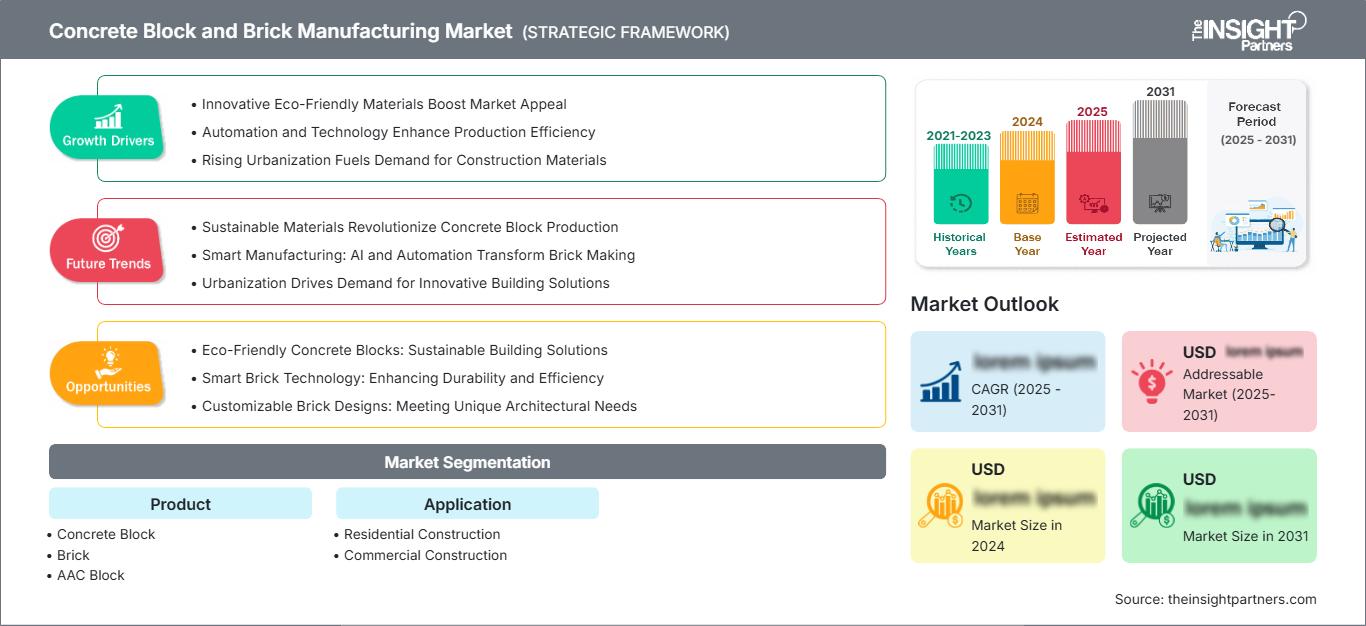
Concrete Block and Brick Manufacturing Market: Strategic Insights
Regional Insights
North America Concrete Block and Brick Manufacturing Market
North America accounted for 25–29% share in 2025 and is forecast to expand at a 5.4–6.0% CAGR through 2034, according to the Concrete Block and Brick Manufacturing Market forecast. The U.S. dominates regional consumption, while Canada contributes through residential, institutional, commercial, and infrastructure construction. Demand is supported by housing requirements, renovation of aging buildings, commercial redevelopment, and continued use of masonry for durable building envelopes. Regional producers benefit from localized plants because transportation distances can materially affect delivered product costs.
The concrete block continues to enjoy relevance in applications related to structure, foundation, partitions, and commerce, whereas brick continues to be relevant in façade and architectural applications. Product differentiation is more about aesthetic, thermal, and durable features, as well as recyclability and efficiency of installation. As seen in the case of Brickworks Limited’s North America division, regional exposure is critical, as the firm has indicated that the Midwest, Northeast, and Mid-Atlantic states accounted for about 90% of its sales in the US in the six months to December 2024.
U.S. Concrete Block and Brick Manufacturing Market
The U.S. accounted for 70–74% of North American demand in 2025 and is projected to register a 5.5–6.1% CAGR through 2034. Housing construction, remodeling, commercial facilities, industrial buildings, schools, healthcare facilities, and infrastructure-related projects support demand. Concrete blocks are widely used in structural and utility applications, while architectural brick remains important for exterior façades, institutional projects, and residential design. Local manufacturing provides a significant competitive advantage because products are bulky and require dependable delivery, reflecting key Concrete Block and Brick Manufacturing Market trends.
Acme Brick Company, General Shale, Inc., CEMEX S.A.B. de C.V., and Midwest Block and Brick are the companies that have a presence in the regional masonry industry ecosystem. Preferences in terms of application differ state by state depending on weather conditions, building regulations, construction practices, and traditions in architecture. The rising demand for durability, good heat resistance, and products with recycled content prompts manufacturers to develop their product range further. Brickworks Limited also has operations in North America in the field of masonry.
Europe Concrete Block and Brick Manufacturing Market
Europe represented 27–31% share in 2025 and is expected to grow at a 4.9–5.5% CAGR through 2034, with Germany leading the regional market. The UK, France, Italy, and Spain remain significant demand centers. Renovation, building-energy performance, infrastructure refurbishment, and tighter environmental requirements are shaping product selection. Manufacturers increasingly emphasize lightweight construction, thermal efficiency, circularity, and lower-impact production, supporting ongoing Concrete Block and Brick Manufacturing Market growth.
Despite the recent problems in the construction sector, the UK is still a key market for bricks. In Germany, there is a diversified production base for masonry that has profited from renovations and energy efficiency. France, Italy, and Spain play a role through residential constructions and renovations. Wienerberger AG is one of the key manufacturers in Europe with a diversified range of building envelope solutions, whereas Xella Group is a leader in the lightweight and AAC wall systems segment in Europe.
APAC Concrete Block and Brick Manufacturing Market
Asia Pacific represented 31–35% share in 2025 and is projected to grow at a 6.6–7.2% CAGR, with China and India representing the leading demand centers. Japan, South Korea, and Australia contribute through renovation, commercial development, infrastructure, and industrial construction. Rapid urban development and housing requirements support masonry consumption, while industrialized production is gaining importance in major construction markets, highlighting key developments in the Concrete Block and Brick Manufacturing Market analysis.
The size of the construction industry in China ensures the continued demand for concrete blocks and bricks, while the use of standardized masonry and AAC construction in India is rising. Both Japan and South Korea focus on construction systems that are sustainable and efficient, while Australia continues to maintain its reliance on brick and masonry construction. The importance placed by governments on housing development, efficient infrastructure, resource efficiency, and energy performance is helping to modernize products.
Middle East & Africa Concrete Block and Brick Manufacturing Market
The Concrete Block and Brick Manufacturing Market in the Middle East & Africa is projected to expand at a 5.8–6.5% CAGR through 2034, supported by urbanization, housing, commercial projects, infrastructure, and industrial diversification. Saudi Arabia leads regional demand, followed by the UAE and South Africa, while the rest of MEA contributes through residential construction, public infrastructure, and industrial facilities. High temperatures and logistics requirements encourage localized manufacturing.
The extensive development plans in Saudi Arabia promote the use of concrete blocks and masonry, while the UAE capitalizes on its commercial, residential, hospitality, and infrastructure developments. South Africa represents a masonry market with existing demand owing to housing and infrastructure needs. In the rest of MEA, the availability of locally sourced aggregates and clay plays a role in determining the products. Production plants for masonry in the region will help mitigate logistical risks and meet project specifications.
Segmentation Analysis
Product
The Concrete Block and Brick Manufacturing Market Product segment is expected to expand at a 5.9–6.4% CAGR during 2026–2034. Product selection is increasingly determined by structural requirements, thermal performance, construction speed, availability of local raw materials, and installation practices. Concrete blocks retain broad structural relevance, while bricks remain important for façades and architectural applications. AAC Block is gaining attention where reduced dead load, faster installation, and improved thermal performance are priorities.
- Concrete Block: Concrete Block maintains the broadest application base because of structural strength, dimensional consistency, local production availability, and suitability for foundations, walls, partitions, commercial structures, and utility construction.
- Brick: Brick remains strategically important for durable façades, residential architecture, institutional buildings, and renovation. Its longevity, appearance, weather resistance, and established installation practices support continued demand despite competition from alternative wall systems.
- AAC Block: AAC Block is increasingly selected for lightweight wall construction because lower density can reduce structural loads while thermal and installation characteristics support energy-efficient and faster construction practices.
Application
The Concrete Block and Brick Manufacturing Market Application segment is expected to register a 5.6–6.1% CAGR during 2026–2034. Residential construction provides a broad demand base, while commercial construction generally requires greater specification around durability, fire performance, aesthetics, structural characteristics, and project schedules. Renovation also influences product selection as developers seek materials that combine installation efficiency with improved building-envelope performance.
- Residential Construction: Residential Construction provides substantial recurring demand, particularly for walling, façades, partitions, landscaping, and low-rise structures. Product selection is increasingly influenced by thermal efficiency, aesthetics, availability, installation speed, and lifecycle durability.
- Commercial Construction: Commercial Construction supports technically demanding applications in offices, retail facilities, schools, hospitals, industrial buildings, and mixed-use projects, where performance specifications, architectural appearance, and construction scheduling influence purchasing decisions.
Opportunity Snapshot
| Application | Revenue Contribution | Trend Tag | Adoption Stage |
| Residential Construction | High | Lightweight Walls | Mature |
| Commercial Construction | High | Façade Systems | Scaling |
Concrete Block and Brick Manufacturing Market Growth Drivers and Impact Analysis
Housing construction and urban development
The housing development will remain a key factor driving demand, as the masonry products are integrated into walling, façades, partitions, foundations, and landscaping. Urban population growth and housing shortages make governments and private developers expand their construction activities, thus generating a demand for uniform building materials on a recurring basis. The use of factory-manufactured blocks and bricks ensures uniformity in dimensions and quality, making it possible for the contractor to achieve better efficiency when installing products than in the case of traditional production that varies widely. This demand driver is especially important for the emerging economies in the context of their transition from informal to formal construction. Additionally, existing mature markets are sustained due to the renovation and replacement of old housing stocks. The suppliers who can offer different formats and performance levels will be able to meet different demands.
Energy-efficiency requirements for building envelopes
There is an increasing emphasis on thermal performance, energy usage, and occupant comfort within the framework of building codes and developer preference, thus increasing demand for masonry that has better insulation properties. AAC blocks are important in this context due to the cellular composition, which offers better thermal insulation and lower density when compared to traditional dense masonry. Brick and concrete block producers are taking steps such as cavity wall systems, insulated masonry construction, lighter versions and facade products to respond to this change. There is an increasing influence of energy performance demands in Europe and developed Asia Pacific markets, where building codes increasingly take account of energy consumption. The business implications go beyond product-specific ones, as the producers will be able to earn from the sale of complete walls and technical specifications.
Industrialized construction and manufacturing automation
The industrialization of construction encourages more standardized masonry products that can be mass-produced with consistent production and labor costs. Automation of batching, molding, cutting, curing, firing, packaging, and quality control helps ensure better process control while decreasing reliance on labor-intensive operations. It becomes especially relevant in times of labor shortages and short construction cycles. AAC manufacture has natural advantages in manufacturing conditions, whereas concrete block factories can achieve automation of molding and palletizing operations. Brick manufacturers have adopted advanced kiln control systems to help monitor energy usage and product consistency. As a result, capital expenditures, production capacity, and economies of scale become crucial. Larger players can enjoy economies of scale, whereas smaller local manufacturers can compete with location, product customization, and distribution efficiency.
Concrete Block and Brick Manufacturing Market Future Trends
Digitalized manufacturing and predictive quality control
Manufacturing plants are increasingly adopting process integration, whereby all production settings, raw material characteristics, machine performance, and finished product properties are digitally measured. Predictive analytics, during the forecast period, will enable manufacturers to detect any anomalies before the finished products are dispatched from the factory in terms of dimensional correctness, strength variation, moisture level, and energy efficiency. Processes such as kiln and autoclave will be ideal candidates for optimization, as temperature, pressure, retention time, and material content have a direct impact on product quality. Other applications, such as automated palletizing and logistics, will help to eliminate any physical handling. The use of this technology could also facilitate traceability in environmental declarations and specific customer requirements. Investments will mostly be made by large-scale manufacturers with multiple plants and sufficient amounts of data. Modular automation systems will also help regional manufacturers to adopt advanced process monitoring without constructing new plants.
Circular masonry and lower-impact product portfolios
The issue of circularity is expected to become more pronounced as producers will strive to minimize waste generation and reuse production residues. According to Xella Group, in 2025, there was a 90% reduction in the amount of AAC and calcium-silicate units production residues disposed of as landfill and an enhanced system for reintroducing AAC materials into production. This is a clear sign that the issue of circularity could be integrated into sustainability reporting practices in manufacturing economics. The producers of brick and concrete products are also increasingly resorting to recycled aggregates and contents and environmental product declarations. In due time, buyers might start comparing masonry products based on lifecycle parameters rather than traditional technical ones. It offers advantages to those who are able to combine recycled materials with performance, environmental characteristics, and quality of production without adding significantly to cost.
Concrete Block and Brick Manufacturing Market Opportunities
Expansion of AAC capacity in emerging construction centers
The Concrete Block and Brick Manufacturing Market presents significant opportunities through AAC, which addresses demand for lightweight, thermally efficient, and installation-friendly wall systems in rapidly urbanizing markets. India, Southeast Asia, the Middle East, and parts of Africa offer attractive conditions where housing requirements coincide with efforts to improve construction productivity and building performance. Establishing regional AAC plants can reduce transportation costs and improve product availability because finished units are bulky relative to their value. Investors can differentiate through plant automation, optimized raw-material sourcing, technical training, and partnerships with developers and contractors. Local certification and engineering support are equally important because adoption depends on confidence in structural, fire, moisture, and thermal performance. Producers entering these markets should therefore evaluate not only plant economics but also distribution density, construction standards, contractor familiarity, and the availability of suitable raw materials.
Premium masonry systems for renovation and architectural applications
The Concrete Block and Brick Manufacturing Market offers significant opportunities in renovation and architectural construction by enabling manufacturers to move beyond commodity masonry toward higher-value products with distinctive aesthetics, documented environmental characteristics, and enhanced performance. The mature markets in Europe, North America, and Australia have significant needs in renovation that can generate the need for façade materials, thin brick systems, special finishes, light-weighting, and masonry materials with recycled content. The company can increase its profitability by providing unique designs and technical support for architects, contractors, and developers. The environmental declaration of products and other transparency instruments can help in securing specifications in cases where projects consider the impact embodied in the projects. Product databases and BIM-based technical data can also help in increasing the visibility of the product during the design phase.
Recent Developments
- June 2026: Suncrete, Inc. (Nasdaq: RMIX) ("Suncrete" or the "Company"), a ready-mix concrete logistics and distribution platform strategically located in Oklahoma, Arkansas, Louisiana and Texas, acquired ABC Block Company (ABC), a concrete product supplier. Headquartered in Little Rock, Arkansas, ABC provides high-quality concrete products to businesses, residences, and public spaces in and around Arkansas, Louisiana, Missouri, and Mississippi, and maintains a fleet of more than 40 delivery vehicles.
- March 2026: Manbro Industries Limited completed its strategic acquisition of Green AAC Block and Mortar Private Limited, marking a significant expansion in its business portfolio. This acquisition represents Manbro Industries Limited's continued focus on strategic growth and diversification in the construction materials sector, positioning the company to capitalize on opportunities in the AAC block and mortar market segment.
Frequently Asked Questions

- Comprehensive Market Sizing and Forecast Analysis
- Detailed Segmentation Analysis
- In-Depth Market Dynamics Assessment
- Regional and Country-Level Insights
- Competitive Landscape and Company Benchmarking
- Strategic Business Intelligence
Recent Reports
Testimonials

The Insight Partners' SCADA System Market report is comprehensive, with valuable insights on current trends and future forecasts. The team was highly professional, responsive, and supportive throughout. We are very satisfied and highly recommend their services.
RAN KEDEM Partner, Reali Technologies LTDs
I requested a report on a very specific software market and the team produced the report in a few days. The information was very relevant and well presented. I then requested some changes and additions to the report. The team was again very responsive and I got the final report in less than a week.
JEAN-HERVE JENN Chairman, Future Analytica
We worked with The Insight Partners for an important market study and forecast. They gave us clear insights into opportunities and risks, which helped shape our plans. Their research was easy to use and based on solid data. It helped us make smart, confident decisions. We highly recommend them.
PIYUSH NAGPAL Sr. Vice President, High Beam Global
The Insight Partners delivered insightful, well-structured market research with strong domain expertise. Their team was professional and responsive throughout. The user-friendly website made accessing industry reports seamless. We highly recommend them for reliable, high-quality research services
YUKIHIKO ADACHI CEO, Deep Blue, LLC.
This is the first time I have purchased a market report from The Insight Partners.While I was unsure at first, I visited their web site and felt more comfortable to take the risk and purchase a market report.I am completely satisfied with the quality of the report and customer service. I had several questions and comments with the initial report, but after a couple of dialogs over email with their analyst I believe I have a report that I can use as input to our strategic planning process.Thank you so much for taking the extra time and making this a positive experience.I will definitely recommend your service to others and you will be my first call when we need further market data.
JOHN SUZUKI President and Chief Executive Officer, Board Director, BK Technologies
I wish to appreciate your support and the professionalism you displayed in the course of attending to my request for information regarding to infectious disease IVD market in Nigeria. I appreciate your patience, your guidance, and the fact that you were willing to offer a discount, which eventually made it possible for us to close a deal. I look forward to engaging The Insight Partners in the future, all thanks to the impression you have created in me as a result of this first encounter.
DR CHIJIOKE ONYIA MANAGING DIRECTOR, PineCrest Healthcare Ltd.Reason to Buy
- Informed Decision-Making
- Understanding Market Dynamics
- Competitive Analysis
- Identifying Emerging Markets
- Customer Insights
- Market Forecasts
- Risk Mitigation
- Boosting Operational Efficiency
- Strategic Planning
- Investment Justification
- Tracking Industry Innovations
- Aligning with Regulatory Trends





 Get Free Sample for