
Concrete Bonding Agents Market Trends, Share & Demand by 2034
Concrete Bonding Agents Market Size and Forecasts (2021 - 2034), Global and Regional Share, Trends, and Growth Opportunity Analysis Report Coverage : by Bonding Agent Type (Cementous Latex-Based and Epoxy-Based); Application (Repairing, Flooring, Decorative); End-User Industry (Residential and Non-Residential); and Geography (North America, Europe, Asia Pacific, and South and Central America)
- Status : Data Released
- Report Code : TIPRE00040368
- Category : Chemicals and Materials
- No. of Pages : 150
- Available Report Formats :


- Last update date : August 27, 2026


2025 Market Size
US$ 3.49 Bn
Base year value
2034 Forecast
US$ 6.38 Bn
Projected by 2034
CAGR 2026-2034
6.93 %
Growth rate
Addressable Market
US$ 44.57 Bn
(2026-2034)
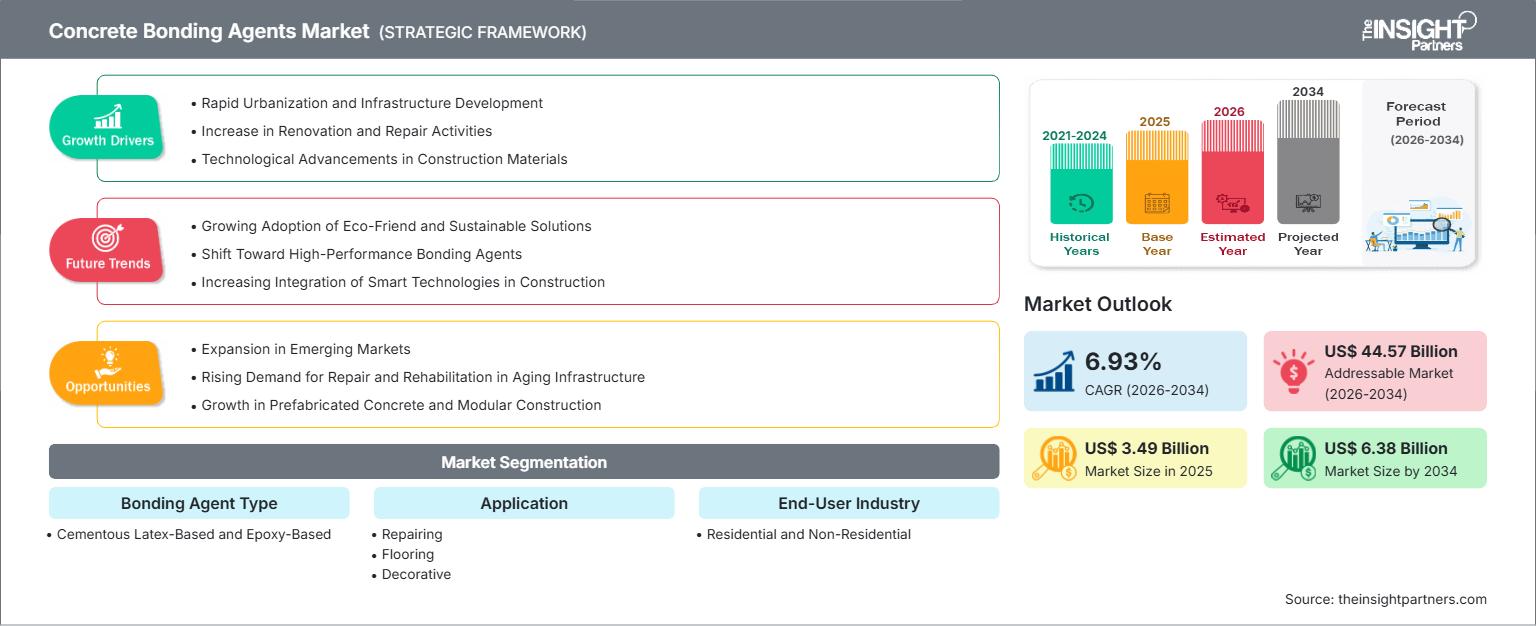
The Concrete Bonding Agents Market is valued at US$ 3.49 Billion in 2025 and is projected to reach US$ 6.38 Billion by 2034, registering a CAGR of 6.93% during 2026–2034. Demand is supported by concrete rehabilitation, structural strengthening, flooring installation, and new-to-old concrete bonding. Product development increasingly emphasizes durability, moisture tolerance, application efficiency, and compatibility with cementitious substrates across construction environments.
In North America, the Concrete Bonding Agents Market size is expected to expand at an estimated 6.5–7.2% CAGR during 2026–2034, supported by bridge rehabilitation, aging building maintenance, commercial refurbishment, and resilient infrastructure programs. Epoxy and polymer-modified systems benefit from requirements for high bond strength, rapid installation, and performance under demanding exposure conditions. Renovation activity also creates recurring demand because bonding primers are frequently incorporated into broader concrete repair systems.
Concrete Bonding Agents Market Assessment and Insights
- North America: North America accounted for a modeled 28–32% share in 2025 and is projected to grow at a 6.5–7.2% CAGR between 2026–2034, supported by rehabilitation spending and established specifications for structural repair materials.
- US: The US represented 82–86% of North American demand in 2025 and is expected to grow at a 6.4–7.1% CAGR during 2026–2034, led by infrastructure rehabilitation and commercial renovation.
- Europe: Europe held a modeled 24–28% share in 2025 and is projected to expand at a 5.8–6.6% CAGR between 2026–2034, with Germany, the UK, France, Italy, and Spain supporting renovation-led consumption.
- Asia Pacific: Asia Pacific represented 27–31% share in 2025 and is forecast to register a 7.0–8.0% CAGR between 2026–2034, with China, India, Japan, South Korea, and Australia providing diverse construction and infrastructure demand.
- Largest Segment: Cementous bonding agents held a modeled 45–50% market share in 2025 and are expected to grow at a 6.2–6.8% CAGR during 2026–2034, reflecting broad repair compatibility.
- High Growth Segment: Epoxy-Based bonding agents held a modeled 25–30% market share in 2025 and are expected to grow at a 7.5–8.2% CAGR during 2026–2034, driven by structural applications.
- Key companies analyzed in detail: Sika AG, The Euclid Chemical Co, MAPEI Corp, Adhesives Technology Corp, Evonik Industries AG, Arkema SA, HB Fuller Co, Freudenberg SE, Mitsubishi Chemical Corp, Solvay SA.
Source: The Insight Partners' analysis based on proprietary research, government publications, company annual reports, investor presentations, industry databases, and expert interviews.
Concrete Bonding Agents Market share is influenced by the evolution of bonding technology from basic cementitious bonding slurries toward polymer-modified, latex-based, and epoxy systems engineered for specific substrate conditions. The current developments focus on aspects like adhesive properties, open time, moisture resistance, and curing. The companies are progressively viewing the use of bonding agents as part of complete repair systems rather than as individual products. Such developments will favor high-value end uses that involve the repair of bridges, parking lots, industrial floors, tunnels, retaining structures, and buildings.
In terms of development over the forecast period, the products will focus on low-emission products, ease of application methods, and the capability of being used in conjunction with repair mortars, overlays, coatings, and strengthening systems. Growing construction markets are expected to raise the use of bonding agents owing to the development of infrastructure and increasing maintenance regulations.
Concrete Bonding Agents Market Report Scope
| Report Attribute | Details |
|---|---|
| Market size in 2025 | US$ 3.49 Billion |
| Market Size by 2034 | US$ 6.38 Billion |
| Global CAGR (2026 - 2034) | 6.93% |
| Historical Data | 2021-2024 |
| Forecast period | 2026-2034 |
Concrete Bonding Agents Market Analysis
Concrete rehabilitation creates recurring consumption because deterioration from moisture, corrosion, thermal cycling, loading, and environmental exposure requires compatible repair systems. The Concrete Bonding Agents Market growth is therefore linked to both new construction and the maintenance cycle of existing structures. The value chain spans resin and polymer producers, formulated bonding-agent manufacturers, distributors, contractors, concrete repair specialists, flooring installers, and infrastructure owners.
Demand varies from one application to another. Cementitious and latex systems cater to the general needs of repairs and overlays, while epoxies have an edge over other materials when there is a need for good bonding power, chemical resistance, or substrates that are hard to work with. The companies differentiate themselves in terms of formulation, curing characteristics, package type, technical assistance, and compatibility with other repair products.
Competitive positioning increasingly depends on portfolio breadth and system integration rather than standalone adhesive performance, as highlighted in the Concrete Bonding Agents Market report. Sika AG and MAPEI Corp maintain extensive concrete repair portfolios, while The Euclid Chemical Co emphasizes specialized concrete construction and repair products. Adhesives Technology Corp provides structural epoxy expertise, and Arkema SA, Evonik Industries AG, and Solvay SA contribute advanced polymer and specialty-chemical technologies to the broader materials ecosystem.
Localization of production, services, and formulation is an area where investments are being directed. HB Fuller Co provides adhesives knowledge for construction use, whereas Freudenberg SE and Mitsubishi Chemical Corp offer participation through specialty materials technology. Differentiation strategies have now started revolving around fast curing properties, sustainability characteristics, substrate compatibility, and labor efficiency. Such features will allow companies to protect their margins where lifecycle efficiency is preferred over the low cost of raw materials.
● REPORT CUSTOMIZATION
Tailor This Report To Align With Your Specific Business Requirements
This report can be customized to align precisely with your business objectives, scope, and target markets. Customization options include tailored segmentation, geography, competitive analysis, and strategic insights to support informed decision-making.
Customize This Report →WHAT YOU CAN ADJUST
- ● Segmentations
- ● Geography
- ● Competitive Analysis
- ● Language Preferences
Concrete Bonding Agents Market: Strategic Insights
Regional Insights
North America Concrete Bonding Agents Market
North America represented 28–32% of global demand in 2025 and is expected to expand at a 6.5–7.2% CAGR through 2034, according to the Concrete Bonding Agents Market forecast. There is already an existing technology and experience in the rehabilitation of concrete structures, maintenance of infrastructure, renovation of commercial buildings, and expertise on polymer and epoxy-based bonding compounds among contractors in the area. The U.S. is the main market for the products, but Canada participates through infrastructure rehabilitation and institutional building construction.
Structural rehabilitation can be regarded as a stable source of consumption of products. Bonding compounds are used with repair mortars, overlays, crack repair compounds, and strengthening materials where adhesion is required between existing and new substrates. More infrastructure owners opt to extend the service life of structures rather than replacing them, resulting in repetitive market opportunities.
U.S. Concrete Bonding Agents Market
The U.S. accounted for 82–86% of North American demand in 2025 and is projected to grow at a 6.4–7.1% CAGR through 2034. Demand is supported by bridge rehabilitation, transportation infrastructure, commercial property maintenance, industrial flooring, and renovation of aging concrete structures. Sika AG, The Euclid Chemical Co, and Adhesives Technology Corp maintain established product and technical-service positions across these applications, reflecting key Concrete Bonding Agents Market trends.
Rehabilitation represents the dominant end-use, although flooring and aesthetic applications constitute supplementary volumes from commercial, industrial, institutional, and residential rehabilitation efforts. Systems featuring controlled curing properties and ease of application represent preferred solutions on the part of many contractors. Federal and state infrastructure programs, along with the ongoing maintenance needs of an extensive bridge and road network, ensure that there is a substantial underlying market for bonding primers and adhesives.
Europe Concrete Bonding Agents Market
Europe represented 24–28% share in 2025 and is expected to register a 5.8–6.6% CAGR through 2034. Germany is the leading market, followed by the UK, France, Italy, and Spain. Renovation policies and the need to improve existing building performance are strengthening demand for repair-oriented construction materials, particularly where structural preservation is combined with energy-efficiency upgrades, supporting continued growth in the Concrete Bonding Agents Market.
The UK sustains its demand through infrastructure maintenance and renovations of commercial and residential buildings. Germany takes advantage of its needs for industry, infrastructure, and building renovations, whereas France relies on its infrastructure renovations and residential renovations. Italy and Spain offer further chances through renovation, tourism building renovation, transportation infrastructure, and renovation of old concrete structures.
APAC Concrete Bonding Agents Market
Asia Pacific held 27–31% share in 2025 and is expected to grow at a 7.0–8.0% CAGR through 2034, making it the leading high-growth region in the Concrete Bonding Agents Market. China remains the largest demand center, while India, Japan, South Korea, and Australia contribute through infrastructure, commercial construction, industrial facilities, and refurbishment.
China combines extensive construction activity with large infrastructure requirements, while India benefits from transport, urban development, and public infrastructure investment. Japan and South Korea emphasize repair and high-performance materials for mature infrastructure, whereas Australia has demand from civil infrastructure and commercial construction. Product localization, contractor training, and distribution expansion are expected to influence adoption across developing Asian markets.
Middle East & Africa Concrete Bonding Agents Market
The Concrete Bonding Agents Market in the Middle East & Africa is expected to grow at a 6.2–7.0% CAGR through 2034, supported by infrastructure development, urban expansion, industrial projects, and refurbishment. Saudi Arabia represents a leading regional market, followed by the UAE and South Africa. Demand is concentrated around commercial structures, transport assets, industrial facilities, and large-scale development projects.
Saudi Arabia and the UAE benefit from substantial construction and infrastructure programs, while South Africa provides a more maintenance-oriented demand profile. The broader region favors products capable of handling high temperatures, demanding substrates, and rapid project schedules. Suppliers with local technical support and reliable distribution are better positioned because application conditions, project specifications, and contractor capabilities can vary substantially across countries.
Segmentation Analysis
Bonding Agent Type
Bonding Agent Type remains a central purchasing criterion because substrate condition, required bond strength, curing environment, and project economics determine formulation selection. The segment is expected to expand at a 6.2–7.8% CAGR during 2026–2034. The Concrete Bonding Agents Market scope is broadening as contractors increasingly use specialized systems for structural repair, flooring, overlays, and new-to-old concrete interfaces.
- Cementous: Cementous systems retain broad adoption because they integrate naturally with cement-based repair materials, are comparatively economical, and suit routine concrete overlays, patching, and substrate preparation.
- Latex-Based: Latex-based formulations provide improved adhesion and flexibility over conventional cementitious slurries, supporting repair mortars, toppings, and applications where moisture tolerance and ease of use are important.
- Epoxy-Based: Epoxy systems occupy higher-performance applications requiring strong structural adhesion, chemical resistance, moisture tolerance, and dependable bonding between concrete, steel, masonry, and repair materials.
Application
The Concrete Bonding Agents Market application segment is shaped by the condition and intended function of the concrete substrate and is projected to grow at a 6.4–7.9% CAGR during 2026–2034. Repairing remains the largest consumption area because bonding agents are integral to rehabilitation systems, while flooring and decorative applications broaden demand across commercial and residential projects.
- Repairing: Repairing represents the core application because bonding agents improve adhesion between existing concrete and repair mortars, overlays, and structural restoration materials used across buildings and infrastructure.
- Flooring: Flooring applications require reliable substrate adhesion for cementitious and resin systems, particularly in industrial, commercial, institutional, warehouse, and refurbishment projects exposed to abrasion and chemical loads.
- Decorative: Decorative applications use bonding agents to improve attachment of renders, finishes, overlays, and surface treatments, supporting aesthetic renovation where substrate preparation determines long-term finish performance.
End-User Industry
In the Concrete Bonding Agents Market, the End-User Industry segment determines project specifications, procurement channels, and performance requirements. The segment is forecast to grow at a 6.1–7.6% CAGR during 2026–2034. Non-residential projects typically require higher-performance systems because infrastructure, commercial, industrial, and institutional structures face greater exposure and operational constraints.
- Residential: Residential use is supported by renovation, flooring, façade repair, waterproofing-related rehabilitation, and small structural repairs, with purchasing decisions influenced strongly by ease of application and material cost.
- Non-Residential: Non-residential demand is strategically important because commercial, industrial, institutional, transportation, and infrastructure projects require durable bonding systems capable of meeting specified performance and service-life requirements.
Opportunity Snapshot
| Application | Revenue Contribution | Trend Tag | Adoption Stage |
| Repairing | High | Structural Repair | Mature |
| Flooring | Medium | Resin Flooring | Scaling |
| Decorative | Low | Surface Renewal | Scaling |
Concrete Bonding Agents Market Growth Drivers and Impact Analysis
Infrastructure rehabilitation and concrete service-life extension
Aging infrastructure creates a recurring requirement in the Concrete Bonding Agents Market for materials that can restore structural performance without full replacement. The need for adhesion between the old substrate and the new mortar or overlay application has led to increased use of bonding primers in concrete repair applications. This would translate to opportunities for such products for application in bridges, tunnels, parking structures, retaining walls, water facilities, and transportation infrastructure. There will be a commercial implication due to the fact that there will be a need for several materials that work together instead of one single material. There is predictable demand in North America and Europe due to existing maintenance programs, whereas the developing countries are starting their programs.
Expansion of commercial and industrial refurbishment
Demand for concrete repair systems and floorings comes from the construction sector through commercial, warehouse, factory, institutional, and retail buildings undergoing refurbishment. There is an increasing need for quicker shut-down periods and predictability, along with increased longevity, because extended construction shut-down periods result in loss of income. The use of bonding agents serves this purpose since the use of bonding agents increases the adhesion qualities of concrete repair and resurfacing systems that can be installed on existing substrates. Epoxy resin materials become significant when there is a need for chemical resistance, abrasion, heavy traffic, or moisture-resistant floorings. Latex-based and cementitious floorings have continued significance in general renovation works. With increased activity of refurbishment in the construction industry, manufacturers can capitalize on application-oriented floorings along with contractor assistance. This leads to less dependency on construction starts and greater dependency on renovation cycles.
Performance requirements and formulation innovation
Technical requirements are pushing manufacturers beyond basic adhesion toward formulations combining bond strength with moisture tolerance, controlled curing, chemical resistance, low shrinkage, and application flexibility. This development increases the addressable value of specialized bonding agents because contractors can select products according to substrate and exposure conditions rather than relying on generic materials. Polymer modification, reactive latex chemistry, and epoxy formulations enable suppliers to target difficult environments, including damp concrete, vertical surfaces, industrial floors, and structural interfaces. Formulation innovation also allows manufacturers to improve application productivity through longer open times, simplified mixing, and reduced preparation requirements. Over time, these improvements can encourage replacement of conventional bonding methods with engineered systems, supporting premiumization while maintaining demand across both repair and new construction applications.
Concrete Bonding Agents Market Future Trends
Lower-impact formulations and material efficiency
Future product development is likely to emphasize formulations that reduce material consumption, simplify packaging, and improve lifecycle performance without compromising adhesion. Manufacturers will increasingly evaluate polymer selection, solvent content, curing requirements, and compatibility with lower-carbon repair mortars. Water-based and reactive systems can gain attention where contractors require easier handling and reduced environmental burden. Another emerging direction is formulation efficiency, allowing thinner application layers while maintaining the required bond performance. Digital technical documentation and standardized application guidance may also become more important as suppliers seek consistent field outcomes across contractors. These developments can shift competition toward lifecycle value rather than initial product price. Over the longer term, bonding agents that combine durability, application efficiency, and environmental performance should gain preference in renovation projects governed by increasingly detailed sustainability specifications.
Digitally supported specification and application
Digitalization is expected to influence how bonding agents are selected, specified, and applied. Product-selection platforms can increasingly connect substrate characteristics, environmental conditions, repair mortar compatibility, and curing requirements to recommended systems. Manufacturers may also use digital tools to provide project documentation, technical approvals, application videos, and batch-level information to contractors and distributors. These capabilities can reduce application errors and improve confidence in specialized products, particularly in markets where technical labor availability is constrained. Data from construction projects may eventually support more precise product development by identifying recurring failure modes and application challenges. For suppliers, digital technical services can strengthen customer relationships without relying solely on physical sales coverage. This trend should favor manufacturers capable of combining chemistry expertise with accessible technical support.
Concrete Bonding Agents Market Opportunities
Regional manufacturing and distribution localization
Localized manufacturing represents an opportunity for suppliers seeking stronger positions in high-growth construction markets. Producing or formulating products closer to customers can reduce transportation requirements, improve inventory responsiveness, and enable adaptation to regional raw materials and climatic conditions. Asia Pacific, the Middle East, and selected Latin American markets offer particularly relevant opportunities because construction activity varies significantly across countries and project specifications can favor locally supported systems. Manufacturers can establish regional hubs, contract manufacturing arrangements, or technical distribution partnerships rather than relying entirely on imported products. The Concrete Bonding Agents Market Forecasts indicate that localization can also improve contractor engagement because technical support, product availability, and training become easier to coordinate. Such strategies are most attractive where demand is sufficiently concentrated to support consistent capacity utilization and distributor economics.
Integrated repair-system portfolios
More value could be added to bonding agents by bundling them with repair mortars, corrosion inhibitors, crack repair, waterproofing, floorings, and structural reinforcement products. Project managers generally favor products that minimize compatibility issues and make it easier to source materials for their projects, especially rehabilitation work projects, which tend to be quite complicated. A bundled package will enable manufacturers to play a role in many phases of a project rather than bidding against other manufacturers for a mere bond agent. This will allow them to differentiate on service delivery by offering services such as substrate analysis, product recommendation, application, and system documentation. It is applicable in both well-developed markets where advanced repair technology exists and emerging markets where project managers appreciate ready-made solutions.
Recent Developments
- June 2026: Holcim completed the acquisition of Xella, a leader in the highly attractive European walling market with projected 2026 net sales of EUR 1 billion. The acquisition expands Holcim’s building solutions portfolio with the addition of brands for both new build and the energy-efficient repair and refurbishment market. These include prefabricated Ytong and Hebel autoclaved aerated concrete (AAC) modular systems, Silka calcium silicate elements, and, Multipor mineral insulation.
- August 2025: Saint-Gobain strengthened its construction chemicals business with the acquisition of three companies: Interstar Materials in North America, Isoltech in Italy, and Soquimic in Peru. Collectively, these acquisitions generated around €25 million in additional annual revenue and benefitted from Chryso’s expertise in innovation, R&D, and low-carbon solutions.
Frequently Asked Questions

- Comprehensive Market Sizing and Forecast Analysis
- Detailed Segmentation Analysis
- In-Depth Market Dynamics Assessment
- Regional and Country-Level Insights
- Competitive Landscape and Company Benchmarking
- Strategic Business Intelligence
Recent Reports
Testimonials

The Insight Partners provided valuable market intelligence that supported our global go-to-market strategy. Their team was professional, responsive, and attentive to our feedback, providing thoughtful analysis and helpful methodological clarifications throughout the project.
Junmo Kim Chief Financial Officer (CFO), Enertech Co., Ltd.
The Insight Partners' SCADA System Market report is comprehensive, with valuable insights on current trends and future forecasts. The team was highly professional, responsive, and supportive throughout. We are very satisfied and highly recommend their services.
RAN KEDEM Partner, Reali Technologies LTDs
I requested a report on a very specific software market and the team produced the report in a few days. The information was very relevant and well presented. I then requested some changes and additions to the report. The team was again very responsive and I got the final report in less than a week.
JEAN-HERVE JENN Chairman, Future Analytica
We worked with The Insight Partners for an important market study and forecast. They gave us clear insights into opportunities and risks, which helped shape our plans. Their research was easy to use and based on solid data. It helped us make smart, confident decisions. We highly recommend them.
PIYUSH NAGPAL Sr. Vice President, High Beam Global
The Insight Partners delivered insightful, well-structured market research with strong domain expertise. Their team was professional and responsive throughout. The user-friendly website made accessing industry reports seamless. We highly recommend them for reliable, high-quality research services
YUKIHIKO ADACHI CEO, Deep Blue, LLC.
This is the first time I have purchased a market report from The Insight Partners.While I was unsure at first, I visited their web site and felt more comfortable to take the risk and purchase a market report.I am completely satisfied with the quality of the report and customer service. I had several questions and comments with the initial report, but after a couple of dialogs over email with their analyst I believe I have a report that I can use as input to our strategic planning process.Thank you so much for taking the extra time and making this a positive experience.I will definitely recommend your service to others and you will be my first call when we need further market data.
JOHN SUZUKI President and Chief Executive Officer, Board Director, BK Technologies
I wish to appreciate your support and the professionalism you displayed in the course of attending to my request for information regarding to infectious disease IVD market in Nigeria. I appreciate your patience, your guidance, and the fact that you were willing to offer a discount, which eventually made it possible for us to close a deal. I look forward to engaging The Insight Partners in the future, all thanks to the impression you have created in me as a result of this first encounter.
DR CHIJIOKE ONYIA MANAGING DIRECTOR, PineCrest Healthcare Ltd.Reason to Buy
- Informed Decision-Making
- Understanding Market Dynamics
- Competitive Analysis
- Identifying Emerging Markets
- Customer Insights
- Market Forecasts
- Risk Mitigation
- Boosting Operational Efficiency
- Strategic Planning
- Investment Justification
- Tracking Industry Innovations
- Aligning with Regulatory Trends





 Get Free Sample for