
Conductive Polymers Market Trends, Demand & Growth by 2034
Coverage: By Class (Conjugated Conducting Polymers, Charge Transfer Polymer, Ionically Conducting Polymers, Conductively Filled Polymers, and Others), Application (Anti-Static Packaging and Coating, Electrostatic Coating, Batteries, Printed Circuit Board, Product Components, Material Handling, Bio Implants, and Others), End-User (Automotive, Aerospace, Electronics And Electrical, Industrial, Healthcare, and Others
- Status : Data Released
- Report Code : TIPRE00003676
- Category : Chemicals and Materials
- No. of Pages : 150
- Available Report Formats :


- Last update date : August 27, 2026


2025 Market Size
US$ 4.67 Bn
Base year value
2034 Forecast
US$ 10.10 Bn
Projected by 2034
CAGR 2026-2034
8.95 %
Growth rate
Addressable Market
US$ 66.11 Bn
(2026-2034)
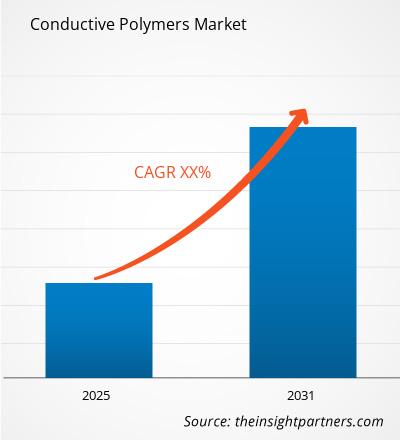
The Conductive Polymers Market is valued at US$ 4.67 Billion in 2025 and is projected to reach US$ 10.10 Billion by 2034, expanding at a CAGR of 8.95% during 2026–2034. Growth is supported by rising demand for electrically functional materials across electronics, automotive systems, batteries, packaging, and advanced industrial components. Increasing integration of conductive functionality into lightweight polymer matrices is also broadening the addressable application base.
North America continues to be a technologically advanced consumer hub, where the Conductive Polymers Market size is bolstered by applications in electronics manufacturing, aerospace industry, electric mobility, and highly advanced ESD protection. Growth in North America is expected to be in the range of 7.5–8.5% CAGR for 2026–2034. Investment in semiconductors, battery manufacturing, and advanced materials is fueling the demand for conductive polymers.
Conductive Polymers Market Assessment and Insights
- North America: North America accounts for a 34–38% share in 2025 and is projected to grow at a 7.5–8.5% CAGR between 2026–2034, supported by electronics, aerospace, automotive, and industrial applications requiring reliable conductivity and ESD control.
- US: The US represents 78–82% of North America's 2025 demand, with growth of 7.5–8.5% CAGR during 2026–2034, led by electronics, aerospace, defense, and battery manufacturing.
- Europe: Europe holds a 22–26% share in 2025 and is expected to grow at a 7.5–8.5% CAGR during 2026–2034, with Germany, France, the UK, Italy, and Spain supporting automotive, electronics, healthcare, and industrial demand.
- Asia Pacific: Asia Pacific represents a 28–32% share in 2025 and is forecast to expand at an 9.5–10.5% CAGR during 2026–2034, led by China, Japan, South Korea, India, and Taiwan through electronics, batteries, and manufacturing expansion.
- Largest Segment: Conductively Filled Polymers is estimated to hold a 48–52% market share in 2025 and grow at an 8.0–9.0% CAGR during 2026–2034, reflecting broad industrial usability.
- High Growth Segment: Batteries is estimated to account for a 16–20% market share in 2025 and expand at a 10.5–11.5% CAGR during 2026–2034, driven by electrification.
- Key companies analyzed in detail: 3M Company, Covestro AG, Eeonyx Corporation, Henkel AG & Co. KGaA, Hyperion Catalysis International, Inc., KEMET Corporation, MacDermid, Inc., Merck & Co., Inc., Avient Corporation, The Lubrizol Corporation
Source: The Insight Partners' analysis based on proprietary research, government publications, company annual reports, investor presentations, industry databases, and expert interviews.
Conductive polymers market transition from traditional static discharge applications to advanced materials with electrical, thermal, sensory, shielding, and electrochemical capabilities is taking place. Polymer blends feature a combination of carbon-based filler, intrinsic conducting properties, and functional interface design. Material production processes move towards development of application-specific compounds, coating systems, films, and dispersions to achieve optimal balance between conductivity, elasticity, processability, durability, and price in different end markets.
In the coming years, rising number of production sites in the Asia Pacific region will attract more processing capacity and application development projects. Development of electric vehicles, semiconductor assembly, flexible electronics, and batteries is expected to provide opportunities for further investments. Increasing regulatory attention to material safety, efficiency, recycling, and electronic waste disposal drives suppliers to reformulate products while retaining their conductivity and compatibility with current equipment.
Conductive Polymers Market Report Scope
| Report Attribute | Details |
|---|---|
| Market size in 2025 | US$ 4.67 Billion |
| Market Size by 2034 | US$ 10.10 Billion |
| Global CAGR (2026 - 2034) | 8.95% |
| Historical Data | 2021-2024 |
| Forecast period | 2026-2034 |
Conductive Polymers Market Analysis
Demand is being increasingly driven by the requirement for control of electrical performance and not just conductivity. Manufacturers of electronic equipment use conductive and dissipative materials in order to address electrostatic discharge, electromagnetic interference, and grounding. Battery makers require conductive coatings and functional polymers in order to improve electrode performance. In much the same way, automotive and aerospace manufacturers need lightweight materials that have electrical properties without needing much metallic parts.
The supply chain in the Conductive Polymers Market Report comprises specialized polymer producers, conductive material suppliers, compounders, coating makers, components manufacturers, and original equipment manufacturers. Raw materials availability and the cost of carbon conductive materials, specialized polymers, and chemicals affect prices. Supply, therefore, is becoming formulation-driven and suppliers are stressing on dispersion properties, reliability, surface resistance, thermal stability, and compatibility with molding and coating applications.
Competitiveness in the Conductive Polymers Market will be influenced by a number of factors such as material science competencies, application engineering, customer qualification cycle, and geographical manufacturing footprint. 3M Company provides an extensive range of electronics materials, while Covestro AG specializes in high-performance polymer platforms. Henkel AG & Co. KGaA has a portfolio of conductive materials and electronics as well as battery processing technologies, while Eeonyx Corporation provides conductive coatings and electroactive textiles.
Specialist companies like Hyperion Catalysis International, Inc. and KEMET Corporation serve the needs for advanced conductive material and electronic components, while MacDermid, Inc. serves the electronics and surface treatment markets. Merck & Co., Inc., Avient Corporation, and The Lubrizol Corporation have increased competitiveness by using specialty materials, engineered polymer platforms, and custom formulations. Increasing investments are being made in high-performance functional materials and not commodity conductivity solutions.
● REPORT CUSTOMIZATION
Tailor This Report To Align With Your Specific Business Requirements
This report can be customized to align precisely with your business objectives, scope, and target markets. Customization options include tailored segmentation, geography, competitive analysis, and strategic insights to support informed decision-making.
Customize This Report →WHAT YOU CAN ADJUST
- ● Segmentations
- ● Geography
- ● Competitive Analysis
- ● Language Preferences
Conductive Polymers Market: Strategic Insights

Regional Insights
North America Conductive Polymers Market
North America accounts for around 34%-38% of the Conductive Polymers Market Share in 2025, and is projected to grow at a 7.5%-8.5% CAGR until 2034. The US continues to be the major demand hub driven by semiconductor production, aerospace, defense, electric vehicles, and advanced electronics. Canada provides demand through automotive, industrial, and resource processing applications that involve static protection and functional polymers.
The regional environment is served by a well-established supplier base of specialty chemicals, compounding companies, electronics makers, and aerospace contractors. Growing investments within the region in semiconductor and battery production are generating more demands for ESD-safe packaging, conductive coatings, polymers, and process materials. Demand is also shifting towards lighter EMI shielding materials with growing electronic content in automotive and industrial machinery. The material suppliers with good qualification skills stand to gain from OEM initiatives.
U.S. Conductive Polymers Market
The United States accounts for 78-82% of North America's demand and will have growth of 7.5-8.5% CAGR until 2034. The main application areas include advanced electronics, aerospace and defense, automotive industry, medical devices, and semiconductor fabrication. In the United States, the domestic producers pay special attention to the materials that unite electrical properties with light weight.
Some of the competitors include companies such as 3M Company, Henkel AG & Co. KGaA, Hyperion Catalysis International, Inc., KEMET Corporation, among others. In the electronics segment, the main applications are concerned with ESD protection, conductive adhesives, PCB materials, and EMI management. The automotive segment includes applications such as batteries, sensors, and lightweight electrical components. It means that the demand is becoming more specification-oriented.
Europe Conductive Polymers Market
Europe is estimated to hold a 22–26% share in 2025 and grow at a 7.5–8.5% CAGR through 2034. Germany leads the region because of its automotive manufacturing base, industrial automation, electronics capabilities, and specialty-chemical ecosystem. France and Italy contribute through aerospace, automotive, industrial equipment, and electrical applications.
The UK retains relevance in the fields of aerospace and defense technology, advanced materials, and electronics; Germany retains its importance through the demand generated by automotive electrification and engineering applications; France is assisted by the aerospace and transportation manufacturing industry, while Italy and Spain generate extra demand in automotive parts, industrial machines, consumer electronics, and renewable energy applications. Purchasers in Europe are assessing conductivity along with recycling ability, chemical resistance, mechanical strength, and processing ease.
APAC Conductive Polymers Market
APAC accounts for 28–32% of demand in 2025 and is projected to grow at a CAGR of 9.5-10.5% until 2034. China tops regional consumption, followed by Japan and South Korea, while India is witnessing rapid development through localization of electronics and automotive products. Australia, on the other hand, makes its contribution via specific industrial and material applications.
The electronics and battery manufacturing scale offered by China gives it the best regional demand base, while Japan and South Korea offer demand for semiconductors, displays, automobiles, and components. India is witnessing an expansion of the electronics ecosystem, which increases the demand for ESD-safeguarding packaging solutions and components. The favorable policy environment of the region towards domestic manufacturing, semiconductors, electric mobility, and batteries would help expedite adoption. Hence, APAC emerges as the major growth engine for the Conductive Polymers Market geographically.
Middle East & Africa Conductive Polymers Market
Middle East and Africa demand is smaller than that of the major manufacturing regions but is supported by infrastructure, industrial automation, energy projects, and growing electronics requirements. The region is expected to expand at approximately 6.5–7.5% CAGR through 2034, with Saudi Arabia and the UAE representing leading Gulf markets.
Advanced ecosystems for manufacturing and infrastructure are being developed by Saudi Arabia and the UAE, whereas South Africa is offering the largest industrial and automotive applications in the region. The RoMEA region continues to have its needs restricted to the use of electrical equipment, energy infrastructure, packaging, and industrial processing. Energy diversification and infrastructure modernization should provide an opportunity for a gradual acceptance of polymer materials.
Segmentation Analysis
Class
The Class segment is expected to grow at an 8.0–9.0% CAGR during 2026–2034. Material selection depends on the required conductivity mechanism, processing route, mechanical properties, and end-use environment. Conductively filled systems remain important for scalable industrial applications, while intrinsically conducting and ionically conducting materials address specialized electronics, energy, sensing, and biomedical requirements. The Conductive Polymers Market scope is therefore expanding as suppliers tailor polymer chemistry and additive architecture to application-specific performance targets.
- Conjugated Conducting Polymers: These materials support applications requiring intrinsic electrical activity, including sensors, flexible electronics, electrochemical devices, and specialized coatings where controlled conductivity and molecular functionality are important.
- Charge Transfer Polymer: Charge-transfer systems serve specialized electronic and electrochemical applications where controlled charge movement is required, offering opportunities in functional devices and advanced material architectures.
- Ionically Conducting Polymers: These polymers are important for electrochemical applications, particularly batteries and related energy systems, where ionic transport, flexibility, and interface stability influence device performance.
- Conductively Filled Polymers: Filled polymers combine conventional processing with conductive additives, making them highly adaptable for antistatic components, shielding, packaging, automotive parts, and industrial products.
Application
The Application segment is forecast to expand at an 8.5–9.5% CAGR during 2026–2034. Demand is diversifying beyond antistatic products toward batteries, printed electronics, PCB-related uses, and bio-integrated technologies. Application requirements increasingly emphasize conductivity consistency, dimensional stability, adhesion, thermal performance, and compatibility with automated production, creating opportunities for specialized formulations.
- Anti-Static Packaging and Coating: These applications protect sensitive electronic components from electrostatic discharge and support safer handling, storage, and transportation across semiconductor and electronics manufacturing environments.
- Electrostatic Coating: Conductive formulations enable controlled electrostatic behavior in coating processes, supporting industrial components and surfaces where charge dissipation and uniform coating performance are operational priorities.
- Batteries: Conductive polymers support electrode and interface functionality, with demand increasing as battery manufacturers pursue improved conductivity, processing efficiency, energy density, and scalable production.
- Printed Circuit Board: PCB applications require conductive and functional materials compatible with miniaturized electronics, surface treatment, interconnection, shielding, and increasingly dense circuit architectures.
- Product Components: Conductive polymer components can replace or supplement metal parts where lightweight construction, electrical functionality, design flexibility, and integrated performance provide manufacturing advantages.
- Material Handling: Conductive polymer materials are used in trays, containers, flooring-related products, and handling systems designed to control electrostatic buildup during sensitive manufacturing operations.
- Bio Implants: Conductive polymers offer opportunities for implantable and bioelectronic technologies because electrical activity can be integrated with flexible polymer structures and specialized interfaces.
End-User
The End-User segment is projected to grow at an 8.5–9.5% CAGR during 2026–2034. Electronics and electrical industries represent a major demand base, while automotive and healthcare applications are expanding as embedded electronics, sensing, electrification, and connected devices become more prevalent. Industrial users continue to value reliable ESD management and engineered component performance.
- Automotive: Electrification, sensor integration, electronic control systems, and lightweighting are increasing requirements for conductive and static-dissipative polymer components across vehicles and supporting manufacturing processes.
- Aerospace: Aerospace applications prioritize low weight, reliability, electrical functionality, and environmental durability, creating demand for advanced conductive materials in components, coatings, and electronic systems.
- Electronics And Electrical: Semiconductor, consumer electronics, PCB, display, and electrical-equipment manufacturers require controlled conductivity, ESD protection, EMI management, and process-compatible polymer materials.
- Industrial: Industrial users apply conductive polymers across automation, material handling, equipment components, coatings, and protective systems where charge management and mechanical performance are simultaneously required.
- Healthcare: Healthcare applications include medical devices, sensors, wearables, and emerging bioelectronic technologies where flexible conductive materials can enable new device architectures and functional interfaces.
Opportunity Snapshot
| End Users | Revenue Contribution (High/Medium/Low) | Trend Tag | Adoption Stage |
| Automotive | High | E-Mobility | Scaling |
| Aerospace | Medium | Lightweighting | Scaling |
| Electronics And Electrical | High | EMI Control | Mature |
| Industrial | High | ESD Systems | Mature |
| Healthcare | Medium | Bioelectronics | Emerging |
Conductive Polymers Market Growth Drivers and Impact Analysis
Electrification and Increasing Electronic Content in Vehicles
Vehicle electrification is expanding the quantity and complexity of electrical systems requiring controlled conductivity, insulation, shielding, and thermal management. Conductive polymers can provide electrical functionality while reducing weight and simplifying component integration compared with selected metallic solutions. Battery packs, power electronics, sensors, connectors, charging systems, and electronic control units create multiple material interfaces where polymer performance is increasingly important. Automotive qualification cycles also encourage suppliers to develop formulations with predictable electrical resistance, thermal stability, chemical durability, and dimensional consistency. As OEMs increase platform commonality across electric and hybrid models, qualified material formulations can potentially be deployed across multiple vehicle programs. This driver therefore supports both volume expansion and movement toward higher-value application-specific conductive polymer grades.
Expansion of Semiconductor and Advanced Electronics Manufacturing
The expansion of semiconductor, display, PCB, and advanced electronics manufacturing is increasing demand for materials that control electrostatic discharge and electromagnetic interference without compromising production efficiency. Sensitive components can be damaged by uncontrolled electrostatic events, making static-dissipative packaging, trays, tapes, coatings, and handling systems important throughout manufacturing and logistics. Miniaturization is also increasing the need for precise electrical characteristics in compact assemblies. Suppliers are consequently developing materials with tighter resistance ranges, improved cleanliness, thermal stability, and compatibility with automated processing. Regional manufacturing investments are particularly important because new fabrication and assembly capacity creates recurring requirements across equipment, packaging, process materials, and component supply chains. This driver supports sustained demand from both established electronics hubs and emerging manufacturing locations.
Demand for Lightweight Multifunctional Materials
Manufacturers increasingly seek materials that perform several functions within a single component or coating. Conductive polymers can combine electrical functionality with low density, flexibility, corrosion resistance, chemical compatibility, and design freedom, reducing the need for separate conductive elements in selected applications. This multifunctionality is particularly relevant to aerospace, industrial automation, wearables, medical devices, and connected products where space and weight constraints are significant. Material developers are therefore focusing on additive dispersion, surface engineering, polymer architecture, and processing methods that preserve mechanical performance while achieving targeted electrical properties. The resulting value proposition extends beyond simple conductivity and allows suppliers to compete on system-level performance. Greater acceptance of multifunctional materials should expand the addressable application base and support premium specialty formulations.
Conductive Polymers Market Future Trends
Integration of Conductivity into Flexible and Printed Structures
The next phase of material development in the Conductive Polymers Market Trends is likely to emphasize conductivity integrated directly into flexible surfaces rather than added through rigid wires or separate components. Printed electronics, smart textiles, flexible sensors, wearable devices, and intelligent packaging can benefit from polymer systems that retain conductivity during bending, stretching, and repeated mechanical movement. Water-based dispersions, printable formulations, and laser-structured surfaces are expected to gain attention because they can support scalable manufacturing while reducing assembly complexity. Suppliers will increasingly optimize electrical properties together with adhesion, elongation, wash durability, environmental resistance, and recyclability. These developments should broaden the role of conductive polymers from protective and static-control products toward functional electronic architectures, particularly where conventional metal conductors create limitations in flexibility, weight, or design freedom.
Higher-Performance Materials for Energy and Thermal Applications
Energy applications are likely to become a major innovation pathway as battery architectures evolve toward higher power density and more demanding manufacturing conditions. Future formulations will focus on improving conductive networks, electrode adhesion, ionic transport, processing efficiency, and long-term interface stability. Conductive polymer technologies may also increasingly intersect with thermal management, flexible heating, sensors, and power-electronic components. Material suppliers are expected to combine polymer chemistry with carbon nanotubes, conductive carbon structures, and other engineered additives to achieve targeted multifunctionality. Commercial success will depend on balancing conductivity with cost, processability, environmental stability, and compatibility with existing production equipment. As battery and electronic-device manufacturers scale automated production, materials capable of maintaining consistent performance across high-throughput processes should gain a competitive advantage.
Conductive Polymers Market Opportunities
Localized Specialty-Material Production in Emerging Manufacturing Hubs
Emerging electronics and automotive manufacturing centers offer opportunities for suppliers to establish regional compounding, formulation, technical service, and application-development capabilities in the Conductive Polymers Market Forecast. Local production can reduce lead times and improve responsiveness for customers that require customized electrical characteristics, rapid qualification support, and consistent supply. India and Southeast Asian manufacturing ecosystems are particularly relevant because electronics assembly, electric mobility, and industrial production are expanding simultaneously. Suppliers can pursue partnerships with compounders, OEMs, electronics manufacturers, and battery producers to establish application-specific grades before competitors achieve local qualification. Investment should prioritize scalable formulation platforms rather than isolated products, allowing the same conductive technology to serve packaging, components, coatings, and material-handling applications. Local technical centers can further accelerate customer validation and reduce adoption barriers.
Advanced Conductive Platforms for Healthcare and Smart Wearables
Healthcare wearables, smart textiles, flexible sensors, and bioelectronic devices present a longer-term opportunity for differentiated conductive polymer platforms. Unlike conventional industrial applications, these products require conductivity to coexist with flexibility, comfort, durability, and in some cases biocompatibility or controlled interaction with biological environments. Suppliers can target specialized coatings, conductive films, flexible electrodes, sensor substrates, and textile-integrated circuits. Strategic partnerships with medical-device developers, textile manufacturers, and electronics designers can help translate laboratory formulations into scalable commercial products. The opportunity is particularly attractive for companies capable of combining polymer chemistry, conductive additives, printing technologies, and application engineering. Early participation can establish material specifications and qualification relationships before these emerging applications reach broader production volumes.
Recent Developments
- May 2026: PolyJoule unveiled 3rd-generation, self-extinguishing, conductive polymer chemistry for battery energy storage systems. The energy storage technology, spun out from MIT, is based on a new proprietary chemistry developed by PolyJoule that includes a new conductive polymer cathode and a liquid salt electrolyte.
- September 2025: Premix transformed its conductive polymer manufacturing with AI and automation. Premix's new facility in North Carolina features end-to-end automation to provide real-time monitoring of critical parameters like melt temperature, carbon black dispersion and electrical conductivity.
Frequently Asked Questions

- Comprehensive Market Sizing and Forecast Analysis
- Detailed Segmentation Analysis
- In-Depth Market Dynamics Assessment
- Regional and Country-Level Insights
- Competitive Landscape and Company Benchmarking
- Strategic Business Intelligence
Recent Reports
Testimonials

The Insight Partners' SCADA System Market report is comprehensive, with valuable insights on current trends and future forecasts. The team was highly professional, responsive, and supportive throughout. We are very satisfied and highly recommend their services.
RAN KEDEM Partner, Reali Technologies LTDs
I requested a report on a very specific software market and the team produced the report in a few days. The information was very relevant and well presented. I then requested some changes and additions to the report. The team was again very responsive and I got the final report in less than a week.
JEAN-HERVE JENN Chairman, Future Analytica
We worked with The Insight Partners for an important market study and forecast. They gave us clear insights into opportunities and risks, which helped shape our plans. Their research was easy to use and based on solid data. It helped us make smart, confident decisions. We highly recommend them.
PIYUSH NAGPAL Sr. Vice President, High Beam Global
The Insight Partners delivered insightful, well-structured market research with strong domain expertise. Their team was professional and responsive throughout. The user-friendly website made accessing industry reports seamless. We highly recommend them for reliable, high-quality research services
YUKIHIKO ADACHI CEO, Deep Blue, LLC.
This is the first time I have purchased a market report from The Insight Partners.While I was unsure at first, I visited their web site and felt more comfortable to take the risk and purchase a market report.I am completely satisfied with the quality of the report and customer service. I had several questions and comments with the initial report, but after a couple of dialogs over email with their analyst I believe I have a report that I can use as input to our strategic planning process.Thank you so much for taking the extra time and making this a positive experience.I will definitely recommend your service to others and you will be my first call when we need further market data.
JOHN SUZUKI President and Chief Executive Officer, Board Director, BK Technologies
I wish to appreciate your support and the professionalism you displayed in the course of attending to my request for information regarding to infectious disease IVD market in Nigeria. I appreciate your patience, your guidance, and the fact that you were willing to offer a discount, which eventually made it possible for us to close a deal. I look forward to engaging The Insight Partners in the future, all thanks to the impression you have created in me as a result of this first encounter.
DR CHIJIOKE ONYIA MANAGING DIRECTOR, PineCrest Healthcare Ltd.Reason to Buy
- Informed Decision-Making
- Understanding Market Dynamics
- Competitive Analysis
- Identifying Emerging Markets
- Customer Insights
- Market Forecasts
- Risk Mitigation
- Boosting Operational Efficiency
- Strategic Planning
- Investment Justification
- Tracking Industry Innovations
- Aligning with Regulatory Trends





 Get Free Sample for