
Connected Home Security System Market Size, Share & Demand by 2034
Coverage: By Component (Software, Hardware, Service); Technology (WI-FI, BLUETOOTH, ZIGBEE, Others); Home Type (Apartments , Independent Homes, Independent Homes) , and Geography (North America, Europe, Asia Pacific, and South and Central America)
- Status : Data Released
- Report Code : TIPTE100001357
- Category : Electronics and Semiconductor
- No. of Pages : 150
- Available Report Formats :


- Last update date : July 28, 2026


2025 Market Size
US$ 6.68 Bn
Base year value
2034 Forecast
US$ 16.22 Bn
Projected by 2034
CAGR 2026-2034
10.37 %
Growth rate
Addressable Market
US$ 101.69 Bn
(2026-2034)
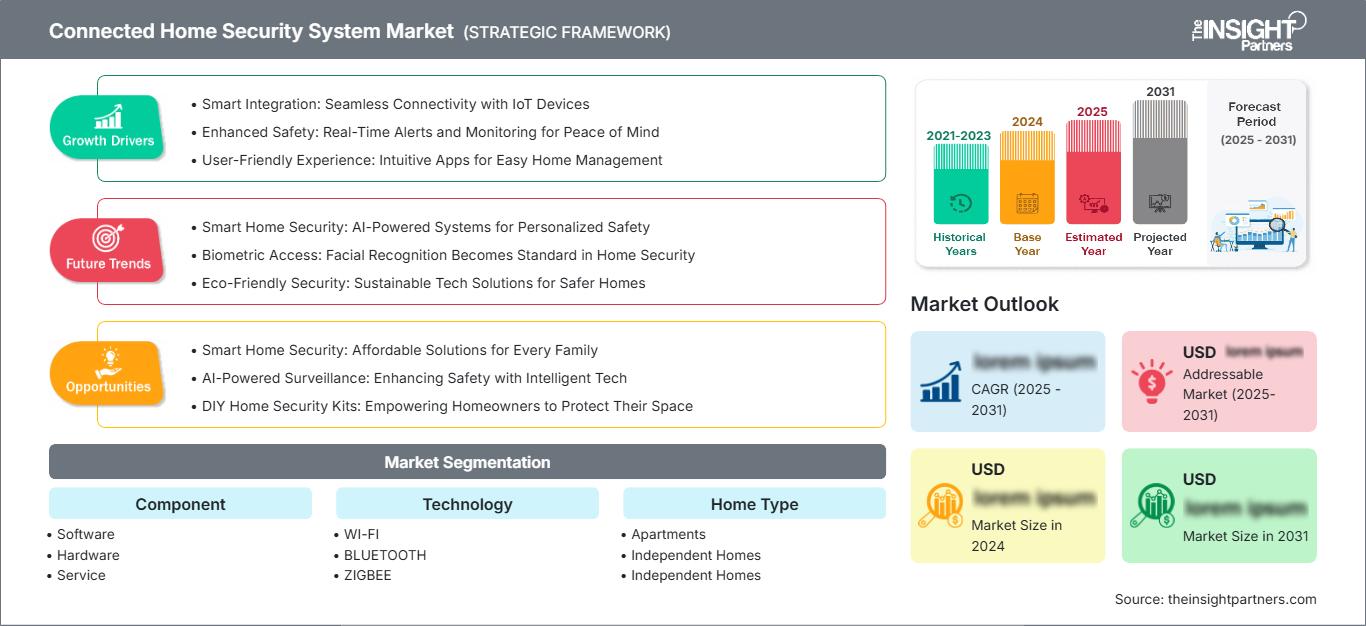
The Connected Home Security System Market has been evaluated at US$ 6.68 Billion in 2025 and is expected to reach US$ 16.22 Billion in 2034, witnessing a CAGR of 10.37% during 2026-2034. The movement towards adoption is from individual alarms to comprehensive solutions that encompass cameras, locking mechanisms, sensors, apps, professional monitoring and automation of the entire home.
For North America, the Connected Home Security System Market Size is driven by the presence of broadband, smartphone-based control, insurance-based monitoring programs, and high level of awareness regarding residential security. North America is expected to register a CAGR of 9.4-9.8% during 2026-2034 due to professional monitoring, DIY solutions and artificial intelligence based alerts.
Connected Home Security System Market Assessment and Insights
- North America accounted for 34–37% share in 2025 and is expected to grow at a CAGR of 9.4–9.8% during 2026–2034, led by monitored security adoption.
- US represented 78–82% of North America in 2025 and is projected to grow at a CAGR of 9.3–9.7% during 2026–2034.
- Europe held 22–25% share in 2025 and is forecast to expand at a CAGR of 8.6–9.1%, led by the UK, Germany, France, Italy, and Spain.
- Asia Pacific captured 25–28% share in 2025 and is projected to grow at a CAGR of 11.6–12.2%, led by China, Japan, South Korea, India, and Australia.
- Largest Segment Hardware held 46–49% market share in 2025, expanding at a CAGR of 9.6–10.1% during 2026–2034.
- High Growth Segment Service held 23–26% market share in 2025, expanding at a CAGR of 11.2–11.8% during 2026–2034.
- Key companies analyzed in detail: ADT Inc., AT&T Inc., Canary Connect, Inc., Comcast Corporation, Honeywell International Inc., Verizon Communications Inc., Alarm.com Holdings, Inc., Ooma, Inc., Frontpoint Security Solutions, LLC, Tyco Security Products, Resideo Technologies, Inc., and Ring LLC.
Source: The Insight Partners' analysis based on proprietary research, government publications, company annual reports, investor presentations, industry databases, and expert interviews.
Platform architecture is undergoing a transition whereby sensors, cameras, and access devices are moving from hardware-based to application-based systems. Wi-Fi will be important for video transmission while Bluetooth will allow the connection of devices and Zigbee will support low power mesh networks. Device manufacturers are trying to achieve an equilibrium between device sourcing, cybersecurity needs, and installer distribution channels in the light of families swapping their old alarms for integrated systems that integrate prevention, detection, and response.
Demand in future is anticipated to increase in the area of apartment living in cities, builder packages and subscriptions with broadband and wireless services. Issues of data privacy and emergencies will make regulatory bodies prefer vendors that offer dependable devices with well-defined monitoring structures. Future markets will develop through smart cities, affordable cameras and mobile payments.
Connected Home Security System Market Report Scope
| Report Attribute | Details |
|---|---|
| Market size in 2025 | US$ 6.68 Billion |
| Market Size by 2034 | US$ 16.22 Billion |
| Global CAGR (2026 - 2034) | 10.37% |
| Historical Data | 2021-2024 |
| Forecast period | 2026-2034 |
Connected Home Security System Market Analysis
The driving forces behind the Connected Home Security System Market growth include the growing need for real-time notification capabilities, remote control functionality, video verification services, and integrated safety functionalities. People want all of their security systems including doorbells, smart locks, motion sensors, alarms, and cameras to be controlled through one app on a mobile device. The availability of broadband and smartphones provides the basis for the scalable value chain from manufacturers, telecom operators, monitoring services providers, cloud computing services, installation services, and insurers.
The key drivers of the supply side include the cost of semiconductors, the availability of wireless modules, the need for cybersecurity compliance, and the economics of service subscriptions. The hardware margins may suffer due to the consumers’ sensitivity to price, however, software analytics and monitoring services will increase the lifetime value of the ecosystem.
The Connected Home Security System Market report reveals that the industry is competitive and consists of security companies, telecom operators, software platform firms, and building automation companies. The competition in this industry includes ADT Inc., Alarm.com Holdings, Inc., Comcast Corporation, AT&T Inc., Verizon Communications Inc., Honeywell International Inc., Resideo Technologies, Inc., and Ring LLC.
Priorities for investments have shifted towards artificial intelligence sensors, false alarm reduction, video analytics, cellular backup, and privacy protection. Channel strategy varies according to the type of company: telecom operators focus on connectivity packages, security firms focus on professional monitoring, and device companies on self-installation services. This makes it possible for the coexistence of premium and value solutions in the apartment and stand-alone home categories.
● REPORT CUSTOMIZATION
Tailor This Report To Align With Your Specific Business Requirements
This report can be customized to align precisely with your business objectives, scope, and target markets. Customization options include tailored segmentation, geography, competitive analysis, and strategic insights to support informed decision-making.
Customize This Report →WHAT YOU CAN ADJUST
- ● Segmentations
- ● Geography
- ● Competitive Analysis
- ● Language Preferences
Connected Home Security System Market: Strategic Insights
Regional Insights
North America Connected Home Security System Market
In 2025, North America represented 34-37% market share and will expand at a CAGR of 9.4-9.8% in 2026-2034. The region enjoys widespread broadband connectivity, monitoring solutions, and affordability in terms of cost incurred by consumers who value integrated protection services. Insurance schemes and professional support help in adoption of devices in suburban independent as well as multi-family households.
Moreover, the Connected Home Security System Market share in North America is also due to extensive participation of vendors through telecoms, alarm monitoring, and smart devices. These are marketed with AI-based notifications, video verification, and cellular connectivity as standard offerings. This is because people purchase these systems not just for intrusion prevention but for safety, convenience, and automation together.
U.S. Connected Home Security System Market
In 2025, the US made up 78-82% of North America and it is expected to grow at a CAGR of 9.3-9.7% between 2026 and 2034. Market depth has been aided by national brand monitors, broadband bundles, retailing of DIY kits, as well as high consumer awareness about video doorbells, smart locks, and mobile security applications.
Corporate penetration has been widespread with ADT Inc., Alarm.com Holdings, Inc., Comcast Corporation, AT&T Inc., Verizon Communications Inc., Ooma, Inc., Frontpoint Security Solutions, LLC, Resideo Technologies, Inc., and Ring LLC having been operating using various channel models. Application trends have seen more use of remote video surveillance, mobile app-based arming, theft prevention, and professional alarm verification.
Europe Connected Home Security System Market
Europe was responsible for a share of 22-25% in 2025 and projected to grow at a CAGR of 8.6-9.1% in 2026-2034. The United Kingdom is a frontrunner in the adoption rate owing to the penetration of monitored alarm systems, availability in retailers, and interest from consumers for connected camera solutions.
Germany comes next with its market driven by privacy regulations, energy efficient houses, and preferences for professionally installed security devices. France, Italy, and Spain are witnessing growth due to apartment security, smart intercoms, and broadband-connected device bundles. Adoption in Europe is more regulation-driven as compared to North America, thus data protection, secure cloud storage, and transparency of controls are important features for providers.
APAC Connected Home Security System Market
Share of APAC was 25-28% in 2025, and the region is forecasted to expand at a CAGR of 11.6-12.2% between 2026 and 2034. Leading among these countries is China owing to its spending on intelligent cities, manufacturing of devices locally, and use of application-based cameras and locks.
Others like Japan, South Korea, India, and Australia make contributions due to apartments in the urban setting, increasing aged population, telecom packages, and heightened awareness of remote monitoring.
Middle East & Africa Connected Home Security System Market
Middle East & Africa is projected to grow at a CAGR of 10.1–10.7% during 2026–2034. Saudi Arabia and the UAE lead through premium housing, smart community developments, and high investment in digital infrastructure.
South Africa and the Rest of MEA show demand for video surveillance, alarms, and mobile alerts where security concerns are acute. Energy-efficient buildings, gated communities, and telecom connectivity upgrades create a practical foundation for broader connected protection.
Segmentation Analysis
Component
The Component segment is expected to grow at a CAGR of 10.0–10.6% during 2026–2034. The Connected Home Security System Market scope includes physical devices, embedded and cloud software, and managed services that together determine user experience, reliability, and recurring revenue. Hardware leads installed value, while services expand faster as monitoring, video storage, and support subscriptions mature.
- Software enables mobile control, event history, AI detection, device orchestration, and cloud updates, making it central to differentiation as households demand simpler interfaces and stronger privacy controls.
- Hardware includes cameras, sensors, hubs, locks, sirens, and panels, remaining the largest revenue base because every deployment requires reliable devices with wireless connectivity and battery resilience.
- Service covers professional monitoring, installation, maintenance, emergency response coordination, and subscriptions, giving vendors recurring revenue and improving customer retention after initial equipment purchase.
Technology
The Technology segment is projected to grow at a CAGR of 10.2–10.8% during 2026–2034. Wireless protocols determine installation cost, video performance, battery life, and interoperability. Wi-Fi is central for bandwidth-heavy cameras, Bluetooth simplifies setup and proximity control, while Zigbee supports low-power sensor networks that can remain stable in larger residences.
- WI-FI supports connected cameras, doorbells, hubs, and cloud recording because households already maintain routers, making it the most practical protocol for video-heavy security deployments.
- BLUETOOTH is important for onboarding, smart lock control, and short-range authentication, especially where users prefer app-based access without complex hub configuration.
- ZIGBEE remains strategically relevant for low-power sensors, mesh coverage, and multi-device networks, particularly in larger homes where battery efficiency and dependable signaling matter.
Home Type
The Home Type segment is estimated to grow at a CAGR of 10.3–10.9% during 2026–2034. Adoption patterns vary by dwelling design, ownership model, and installation flexibility. Apartments favor compact, wireless, and landlord-compatible systems, while independent homes support broader device networks including outdoor cameras, garage sensors, smart locks, and professional monitoring packages.
- Apartments generate demand for renter-friendly cameras, smart locks, compact alarms, and app alerts, making wireless installation and low upfront cost critical purchasing factors.
- Independent Homes account for wider deployments involving perimeter cameras, yard signage, smart lighting links, garage control, and professional monitoring, supporting higher equipment and subscription value.
- Independent Homes also benefit from replacement cycles as owners add AI analytics, cellular backup, and integrated fire or water detection to older alarm systems.
Opportunity Snapshot
| Home Type | Revenue Contribution | Trend Tag | Adoption Stage |
| Apartments | Medium | Renter Kits | Scaling |
| Independent Homes | High | Perimeter AI | Mature |
| Independent Homes | High | Monitoring Bundles | Scaling |
Connected Home Security System Market Growth Drivers and Impact Analysis
Shift Toward Verified, App-Based Residential Protection
Homeowners now have greater preference for technology that authenticates events using video, sensor technology, and mobile notifications prior to escalating any emergencies. This not only decreases instances of false alarms but also ensures more reliability during responses while providing monitoring companies an easier time adhering to municipal alarm laws. The greatest effect can be seen in stand-alone residences where there may be several points of entry, as well as the delivery of packages, posing different types of threats. Technology vendors who offer easy-to-use applications and reliable authentication can turn security into a subscription service.
Telecom and Broadband Bundling Expands Addressable Demand
Telecom operators are extending home connectivity relationships into security by bundling cameras, sensors, backup connectivity, and monitoring with broadband or wireless plans. This lowers customer acquisition cost, simplifies billing, and creates a trusted route to mainstream households that may not seek traditional alarm dealers. Bundling also supports cellular backup, a critical feature when power or home internet is unavailable. The market impact is broader penetration in apartments and value-oriented homes, where affordability and self-install convenience matter as much as technical sophistication.
AI Sensing and Analytics Improve System Relevance
AI-enabled motion classification, person detection, and adaptive alerts are improving the usefulness of connected security systems by filtering routine activity and prioritizing meaningful events. Camera-based analytics help detect package theft and perimeter intrusion, while privacy-preserving sensing can support occupancy awareness without continuous video. These capabilities reduce alert fatigue and make subscriptions easier to justify. Providers that invest in analytics can differentiate beyond device specifications, while users gain more accurate monitoring. This shift strengthens long-term service retention and expands use cases into aging-in-place, comfort automation, and home safety.
Connected Home Security System Market Future Trends
Privacy-Preserving Ambient Intelligence
The Connected Home Security System Market trends point toward ambient sensing that identifies presence, movement, and anomalies without relying only on cameras. This direction addresses privacy concerns in bedrooms, elder-care spaces, and shared apartments while still improving event context. Radar-like sensing, edge AI, and encrypted local processing are likely to become premium differentiators. As platforms learn household routines, alerts can become more contextual, reducing unnecessary notifications. The result will be security systems that act less like isolated alarms and more like adaptive home awareness layers.
Interoperable Security Across Smart Home Ecosystems
Interoperability will become a stronger purchasing criterion as households combine locks, cameras, lights, voice assistants, thermostats, and sensors from multiple brands. Standards-based onboarding and cross-platform automation can reduce installation friction while preserving vendor-specific monitoring services. Security providers will need to support open integrations without weakening data protection or alarm reliability. Over time, the winning platforms will be those that allow customers to add devices gradually, maintain professional response options, and avoid being locked into fragmented systems that are difficult to manage.
Connected Home Security System Market Opportunities
Builder and Multifamily Security Packages
New residential construction and managed apartment communities create a channel for preconfigured security packages that reduce installation complexity. Builders can bundle smart locks, smoke and carbon monoxide alerts, leak detection, and video doorbells into move-in-ready homes, while property managers can standardize access control and resident safety features. Connected Home Security System Market Forecasts indicate that these embedded routes will become increasingly important as consumers expect smart protection at occupancy. Vendors should target builder partnerships, property technology integrations, and service tiers that allow residents to upgrade monitoring after move-in.
Subscription Expansion Through Safety and Care Use Cases
Providers can expand recurring revenue by moving beyond intrusion alerts into broader home safety, including fall-risk awareness, smoke and carbon monoxide notifications, water leak detection, and emergency assistance. Aging populations and remote caregiving needs create demand for unobtrusive monitoring that respects privacy while improving response readiness. Bundled service tiers can combine security, wellness alerts, and maintenance diagnostics. This opportunity is especially relevant for established monitoring providers because they already operate response infrastructure, customer support, and trusted safety brands.
Recent Developments
- November 2025: IKEA is launching 21 new smart home products focusing on lighting, sensors, and control — all built to work with Matter, the universal smart home standard. The launch marks a significant step in making smart home technology easier to use, more affordable, and better adapted to real-life needs in the home.
- July 2026: Telecom operators are increasingly seeking revenue streams beyond connectivity to drive recurring income and strengthen customer loyalty. Although demand for Smart Home Security continues to rise, many operators have found it challenging to launch their own security services due to the substantial investment needed in technology, service operations, and ecosystem integration.
- January 2026: Chamberlain Group (CG), a Blackstone portfolio company and global leader in intelligent access and monitoring solutions, today introduced the myQ Secure View 3-in-1 Smart Lock, representing the company's most significant expansion from garage door innovation into intelligent access for the entire home. The new device reflects CG's strategic transition from leadership in a single category to a comprehensive smart home security ecosystem, extending its decades of access control expertise from the garage to the front door.
Frequently Asked Questions

- Comprehensive Market Sizing and Forecast Analysis
- Detailed Segmentation Analysis
- In-Depth Market Dynamics Assessment
- Regional and Country-Level Insights
- Competitive Landscape and Company Benchmarking
- Strategic Business Intelligence
Recent Reports
Testimonials

The Insight Partners' SCADA System Market report is comprehensive, with valuable insights on current trends and future forecasts. The team was highly professional, responsive, and supportive throughout. We are very satisfied and highly recommend their services.
RAN KEDEM Partner, Reali Technologies LTDs
I requested a report on a very specific software market and the team produced the report in a few days. The information was very relevant and well presented. I then requested some changes and additions to the report. The team was again very responsive and I got the final report in less than a week.
JEAN-HERVE JENN Chairman, Future Analytica
We worked with The Insight Partners for an important market study and forecast. They gave us clear insights into opportunities and risks, which helped shape our plans. Their research was easy to use and based on solid data. It helped us make smart, confident decisions. We highly recommend them.
PIYUSH NAGPAL Sr. Vice President, High Beam Global
The Insight Partners delivered insightful, well-structured market research with strong domain expertise. Their team was professional and responsive throughout. The user-friendly website made accessing industry reports seamless. We highly recommend them for reliable, high-quality research services
YUKIHIKO ADACHI CEO, Deep Blue, LLC.
This is the first time I have purchased a market report from The Insight Partners.While I was unsure at first, I visited their web site and felt more comfortable to take the risk and purchase a market report.I am completely satisfied with the quality of the report and customer service. I had several questions and comments with the initial report, but after a couple of dialogs over email with their analyst I believe I have a report that I can use as input to our strategic planning process.Thank you so much for taking the extra time and making this a positive experience.I will definitely recommend your service to others and you will be my first call when we need further market data.
JOHN SUZUKI President and Chief Executive Officer, Board Director, BK Technologies
I wish to appreciate your support and the professionalism you displayed in the course of attending to my request for information regarding to infectious disease IVD market in Nigeria. I appreciate your patience, your guidance, and the fact that you were willing to offer a discount, which eventually made it possible for us to close a deal. I look forward to engaging The Insight Partners in the future, all thanks to the impression you have created in me as a result of this first encounter.
DR CHIJIOKE ONYIA MANAGING DIRECTOR, PineCrest Healthcare Ltd.Reason to Buy
- Informed Decision-Making
- Understanding Market Dynamics
- Competitive Analysis
- Identifying Emerging Markets
- Customer Insights
- Market Forecasts
- Risk Mitigation
- Boosting Operational Efficiency
- Strategic Planning
- Investment Justification
- Tracking Industry Innovations
- Aligning with Regulatory Trends





 Get Free Sample for