
Consumer Robots Market Trends, Size & Growth by 2034
Coverage: By Component (Hardware, Software, Services); Type (Autonomous, Semi-Autonomous); End Users (Healthcare, Education, BFSI, IT, Retail, Others) , and Geography (North America, Europe, Asia Pacific, and South and Central America)
- Status : Data Released
- Report Code : TIPRE00026891
- Category : Electronics and Semiconductor
- No. of Pages : 150
- Available Report Formats :


- Last update date : July 28, 2026


2025 Market Size
US$ 13.38 Bn
Base year value
2034 Forecast
US$ 99.98 Bn
Projected by 2034
CAGR 2026-2034
25.04 %
Growth rate
Addressable Market
US$ 432.43 Bn
(2026-2034)
Consumer Robots Market is forecast to be worth US$ 13.38 Billion in 2025 and to reach US$ 99.98 Billion by 2034, with a CAGR of 25.04% through 2026-2034. The market is growing due to the convergence of household automation, assisted living, edtech and service robotics due to low-cost sensors, improved embedded artificial intelligence and interconnectivity within devices, making consumer robots increasingly practical for daily environments.
North America Consumer Robots Market size is driven by smart home penetration, population aging trends and early adoption of artificial intelligence-based cleaning, companion and education robots. North American demand is forecast to grow at 23-25% CAGR through 2026-2034, with the United States acting as the center for premium products, healthcare trials and retail channels.
Consumer Robots Market Assessment and Insights
- North America held 34–37% share in 2025 and is growing at a CAGR range of 23–25% during 2026–2034, led by smart homes, eldercare trials, and premium autonomous cleaning adoption.
- US represented 78–82% of North America in 2025 and is growing at a CAGR range of 23–25% during 2026–2034, driven by connected-home platforms.
- Europe accounted for 22–25% share in 2025 and is growing at a CAGR range of 22–24% during 2026–2034, with Germany, the UK, France, Italy, and Spain leading adoption.
- Asia Pacific captured 30–33% share in 2025 and is growing at a CAGR range of 27–30% during 2026–2034, supported by China, Japan, South Korea, India, and Australia.
- Largest Segment Hardware held 58–62% market share in 2025 and is growing at a CAGR range of 23–25% during 2026–2034 as sensors, motors, batteries, and navigation modules remain core cost centers.
- High Growth Segment Software held 20–24% market share in 2025 and is growing at a CAGR range of 28–31% during 2026–2034 as AI perception, mapping, voice interfaces, and fleet learning expand.
- Key companies analyzed in detail: iRobot Corporation, Jibo, Inc., 3D Robotics, Inc., Honda Motor Co., Ltd., Bossa Nova Robotics, Inc., Neato Robotics, Inc., SoftBank Robotics Group Corp., Blue Frog Robotics SAS, RoboDynamics Corporation, Ecovacs Robotics Co., Ltd.
Source: The Insight Partners' analysis based on proprietary research, government publications, company annual reports, investor presentations, industry databases, and expert interviews.
Consumer Robots Market technology evolution has seen a transition from monolithic products to multifunctional systems integrating lidar, vision-based SLAM, edge artificial intelligence, and voice command functionalities. Product development is also becoming more dynamic through scaling of electronics manufacturing facilities in Asia to produce cheaper motors, batteries, optical sensing systems, and processors, alongside product-life-cycle extension with software upgrades.
Future development in the Consumer Robots Market will be influenced by the emerging geographies that will see uptake of connected devices and personal service robotics in upper-middle class households in India, Southeast Asia, and Gulf region economies. Future investments will be in modular robotics platforms, cloud computing robotics, and safety aspects of AI, while policy considerations in healthcare, education, and accessibility will drive greater acceptance of assistive robots.
Consumer Robots Market Report Scope
| Report Attribute | Details |
|---|---|
| Market size in 2025 | US$ 13.38 Billion |
| Market Size by 2034 | US$ 99.98 Billion |
| Global CAGR (2026 - 2034) | 25.04% |
| Historical Data | 2021-2024 |
| Forecast period | 2026-2034 |
Consumer Robots Market Analysis
The Consumer Robots Market is motivated by three types of consumer demand – convenience, healthcare assistance, and interactive education. While the largest portion of sales is represented by robot vacuum cleaners, the consumers are increasingly demanding robots to navigate the space, avoid obstacles, plan their actions and collaborate with speakers, mobile devices, and security cameras. The healthcare consumers require mobility assistance, monitoring, and companionship, while education facilities are trying out programmable robots for teaching sciences and coding.
The value chain includes semiconductor manufacturers, actuators manufacturers, batteries manufacturers, software companies, cloud services providers, and retail stores. In terms of supply dynamics, manufacturers benefit from having control over firmware, navigation software, and after-sale service, and being able to ensure stable procurement of components. With robot usage involving greater amounts of personal information, cybersecurity, device reliability, and data transparency become purchasing considerations besides the price and performance.
The consumer robots market report can be considered highly competitive and may be divided into two groups – existing manufacturers of home robots and robotics companies in general. The former includes iRobot Corporation, which competes with Ecovacs Robotics Co., Ltd., while the latter includes SoftBank Robotics Group Corp. and Honda Motor Co., Ltd., whose focus is on serviceability, mobility, and human interaction capability. Companies focused specifically on social interaction capability and specialized platforms include Blue Frog Robotics SAS and RoboDynamics Corporation.
Trends in financing are shifting from hardware sales to investment in artificial intelligence-enabled devices, subscription-based services, and platform collaboration. Such companies as Jibo, Inc., 3D Robotics, Inc., Bossa Nova Robotics, Inc., and Neato Robotics, Inc. demonstrate how the design and autonomous capabilities as well as knowledge of retail robotics can affect product roadmaps despite category change.
● REPORT CUSTOMIZATION
Tailor This Report To Align With Your Specific Business Requirements
This report can be customized to align precisely with your business objectives, scope, and target markets. Customization options include tailored segmentation, geography, competitive analysis, and strategic insights to support informed decision-making.
Customize This Report →WHAT YOU CAN ADJUST
- ● Segmentations
- ● Geography
- ● Competitive Analysis
- ● Language Preferences
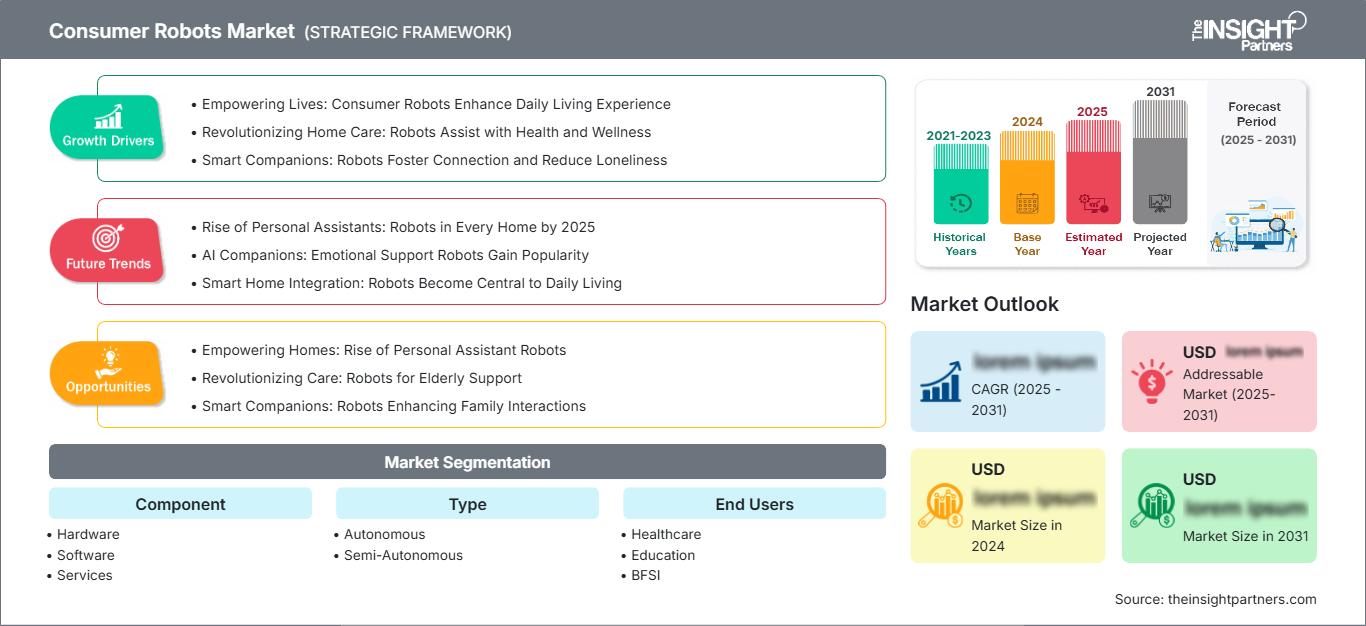
Consumer Robots Market: Strategic Insights
Regional Insights
North America Consumer Robots Market
The Consumer Robots Market share of North America stands at 34–37% in 2025 and is projected to exhibit a CAGR of 23–25% over 2026–2034. The growth in the market is being driven by the increasing presence of smart speakers, advanced home appliances replacement cycle, and effective e-commerce platforms for connected robot sales.
There is the added structural support through healthcare and education usage of Consumer Robots. The assisted living centers are looking at the use of monitoring and companionship devices, while the schools are utilizing programmable robots for increasing interest in STEM subjects. There is additional support from local engineering capabilities, cloud computing services, and retail services network.
U.S. Consumer Robots Market
United States comprised 78% to 82% of North America’s area in 2025, and is expected to grow at a 23% to 25% CAGR during 2026 to 2034. Areas of demand are robotic floor cleaning, pet families, elder care assistance, and automated security routines, with app control and voice-based ecosystems making robots easy to use.
There is a notable presence of firms in the market, with iRobot Corporation being the key domestic player and SoftBank Robotics Group Corp. helping with service robotics. Increasingly, Americans are comparing aspects such as suction capacity, precision of mapping, automated docking, obstacle avoidance, and service quality in their purchases.
Europe Consumer Robots Market
The Europe market had a share of 22–25%, with a 22–24% CAGR for 2026–2034. Germany is leading in this market due to its engineering acceptance, appliance retailing, and pilot studies in healthcare robotics, whereas UK needs compact domestic robots in relation to smaller houses, online retailing, and home automation.
In France, Italy, and Spain, robotic development is taking place on the grounds of domestic convenience, demographic age, and hospitality services. GDPR data management is an important consideration in this regard as the robots gather maps, images, and behavioral patterns. The robot makers offering transparency in storage and reliable repair channels will have greater acceptability.
APAC Consumer Robots Market
The market share held by APAC region was 30-33%, while the CAGR forecasted for this period is 27-30% during 2026-2034. China has been leading with the advantages of volume production, frequent product changes, and adoption of e-commerce services. Japan and South Korea are adding to this by virtue of their acceptance of companion and assistive robots.
India and Australia, even though early-stage regions, will be contributing through higher spending on connected appliances, education robotics, and home service. The policies adopted for artificial intelligence technology, electronics manufacture, and aging care innovations will be adding positively to the prospects of this region.
Middle East & Africa Consumer Robots Market
Middle East & Africa region is expected to experience a 21–23% CAGR growth period from 2026 to 2034 on the back of smart city developments, luxury retail and hospitality applications, and wealthy individuals' homes. Energy campuses and new infrastructures provide a controlled environment for the test deployment of service robots.
South Africa and rest of MEA continue to be selective regions on account of their educational, security, and commercial cleaning applications proximity without being household-driven. Affordability and availability of repairs can limit the market size in these regions, but there are good entry points into these regions.
Segmentation Analysis
Component
The component segment is expected to grow at a 24–27% CAGR during 2026–2034. Consumer Robots Market scope is widening as hardware reliability, software intelligence, and post-sale services become interdependent. Buyers increasingly evaluate total ownership experience, including updates, repairability, battery durability, and privacy controls, not only upfront device performance.
- Hardware remains the largest revenue contributor because motors, lidar, cameras, batteries, processors, cleaning systems, and chassis design define device capability, durability, and bill-of-material economics.
- Software is strategically important as mapping, perception, voice control, scheduling, cybersecurity, and personalization determine whether robots move from appliance status to adaptive household assistants.
- Services include maintenance, warranties, cloud functions, installation support, and replacement parts, becoming more relevant as consumers expect longer device life and dependable after-sales experiences.
Type
The type segment is projected to grow at a 24–26% CAGR during 2026–2034. Autonomous devices are gaining preference where consumers value hands-free routines, while semi-autonomous robots remain relevant for price-sensitive applications and supervised environments. Navigation quality, obstacle handling, and user intervention frequency are becoming critical purchase differentiators.
- Autonomous robots dominate high-value adoption because they complete tasks with minimal supervision, using mapping, docking, obstacle avoidance, and adaptive scheduling to improve household convenience.
- Semi-Autonomous robots address users who prefer manual oversight, lower prices, or controlled task execution, particularly in education, retail demonstrations, and simpler cleaning applications.
End Users
The end users segment is expected to grow at a 25–28% CAGR during 2026–2034 as robots move beyond homes into healthcare, education, BFSI, IT, and retail settings. Adoption is strongest where robots reduce repetitive tasks, support engagement, or provide consistent service quality in controlled environments with measurable operational benefits.
- Healthcare uses consumer-facing robots for companionship, reminders, mobility support, and remote monitoring, with aging populations and caregiver shortages strengthening long-term demand.
- Education relies on programmable and social robots to teach coding, problem-solving, and interaction skills, making affordability and curriculum alignment central to adoption.
- BFSI adoption is selective, focused on branch assistance, queue guidance, and customer engagement where robots can standardize repetitive interactions without replacing advisory roles.
- IT organizations use robots for demonstrations, workplace assistance, facility support, and innovation labs, often linking devices with cloud platforms, security systems, and analytics tools.
- Retail applies robots for customer guidance, shelf scanning, inventory visibility, and experiential engagement, with measurable labor support and data capture shaping deployment decisions.
Opportunity Snapshot
| End Users | Revenue Contribution | Trend Tag | Adoption Stage |
| Healthcare | High | Assistive Care | Scaling |
| Education | Medium | STEM Bots | Scaling |
| BFSI | Low | Branch Guide | Emerging |
| IT | Medium | Cloud Labs | Scaling |
| Retail | High | Shelf Scan | Scaling |
Consumer Robots Market Growth Drivers and Impact Analysis
AI Navigation and Perception Lower User Intervention
Improved navigation is the strongest operational driver because consumers abandon robots that require frequent rescue, remapping, or manual cleaning. Lidar, structured light, visual recognition, and edge processors now allow devices to identify furniture, cables, pets, flooring changes, and room boundaries with better consistency. The impact is visible in higher willingness to pay for premium docks, automatic mop washing, and obstacle avoidance features. For manufacturers, better perception reduces returns, improves ratings, and creates software-update opportunities after sale. The market suppliers that combine sensing accuracy with simple app controls can convert occasional appliance buyers into repeat ecosystem customers.
Aging Populations Increase Demand for Assistive Functions
Demographic pressure is expanding the role of robots from convenience devices to support tools for independent living. Older adults and caregivers value reminders, fall-adjacent monitoring, medication prompts, telepresence, and companionship features when these functions are easy to operate and nonintrusive. Healthcare systems also face staffing constraints, making consumer-grade assistive robots attractive for home and community care pilots. The commercial impact is a broader buyer base that includes families, insurers, senior living operators, and public programs. However, adoption requires careful design around safety, privacy, accessibility, and emotional acceptance, especially in markets with strict healthcare data expectations.
Smart-Home Ecosystems Improve Purchase Confidence
Connected-home ecosystems reduce friction by letting consumers manage robots through familiar apps, speakers, and automation routines. Integration with lighting, security, thermostats, and home networks helps robots perform context-aware tasks, such as cleaning after occupancy changes or avoiding rooms during scheduled calls. Retailers benefit because bundled demonstrations make capabilities easier to explain than standalone specifications. This driver also supports service revenue through cloud features, mapping storage, and multi-device controls. The main risk is interoperability fragmentation, so companies that support common standards, reliable updates, and transparent permissions should achieve stronger Consumer Robots Market retention.
Consumer Robots Market Future Trends
Agentic Home Robots Move Beyond Scheduled Tasks
Consumer Robots Market trends point toward agentic devices that interpret context rather than only follow schedules. Future robots will combine environmental memory, user preferences, object recognition, and natural-language instructions to recommend or initiate actions with permission. A cleaning robot, for example, may identify high-traffic zones, adjust frequency after guests leave, and coordinate with air purifiers or security systems. This shift will make software trust more important than mechanical performance alone. Vendors will need explainable controls, opt-in automation, and local processing options so consumers understand what the robot perceives, stores, and changes inside the home.
Multi-Scenario Service Robots Enter Shared Spaces
Shared spaces will become a practical testing ground for robots that bridge consumer and light-commercial use. Apartment complexes, schools, clinics, hotels, and senior living communities can deploy devices for cleaning, guidance, delivery, reception, and monitoring without the complexity of heavy industrial automation. These environments provide repeatable layouts, measurable tasks, and staff oversight, allowing vendors to refine safety and service models. Over time, successful shared-space deployments can influence household adoption because consumers see robots operating reliably in familiar public settings. The trend also supports leasing, managed services, and fleet analytics revenue.
Consumer Robots Market Opportunities
Healthcare and Senior Living Partnerships
Healthcare providers, senior living operators, and insurers offer a high-value route for Consumer Robots Market Forecasts because they can validate outcomes beyond household convenience. Vendors can build partnerships around medication reminders, telepresence, social engagement, and facility support, then convert pilots into subscription or service contracts. Investment should prioritize safety certification, caregiver dashboards, multilingual interfaces, and privacy-preserving analytics. The opportunity is strongest where robots complement staff rather than appear to replace human care. Companies that document reduced caregiver workload, improved adherence, or higher resident engagement will have stronger procurement arguments and defensible pricing.
Education Robotics Platforms for Skill Development
Education offers a durable opportunity because robots can make coding, AI literacy, teamwork, and problem-solving tangible for students. Schools and training centers need affordable devices, lesson plans, teacher support, and secure classroom management tools, not only attractive hardware. Vendors can differentiate through curriculum partnerships, modular accessories, and cloud dashboards that measure learning progress without exposing student data. The opportunity also extends to after-school programs, vocational training, and university labs. Scalable education models can create early brand familiarity, supporting future household and workplace adoption as students become confident robot users.
Recent Developments
- July 2026: US-based AI startup Generalist AI, founded by former Google DeepMind scientists and backed by NVIDIA NVentures, has unveiled GEN-1, its latest embodied foundation model, achieving a 99% task success rate and a 3x improvement in speed. As part of this breakthrough project, Elite Robots collaborated with Generalist AI to support real-world data collection and algorithm validation using its collaborative robot (cobot) platform.
- July 2026: XPENG has introduced TuringViT, a vision encoder designed for vision-language and vision-language-action models that support smart driving, smart cockpit systems, and its IRON humanoid robot program. The company has released two versions of the technology: TuringViT-18L and TuringViT-24L. According to XPENG, at a resolution of 1536×1536, TuringViT-18L delivers 3.04 times the throughput of Seed1.5-ViT and 2.16 times the throughput of SigLIP2-ViT-L.
- July 2026: Mondo Robotics, a robotics company focused on creating accessible robots for consumers, has launched its first robot, Beni, on Kickstarter. Beni is a portable, all-terrain robot designed to follow users independently while recording their experiences. It automatically captures everyday moments with cinema-grade camera movement, eliminating the need for tripods or relying on others to take photos and videos.
Frequently Asked Questions

- Comprehensive Market Sizing and Forecast Analysis
- Detailed Segmentation Analysis
- In-Depth Market Dynamics Assessment
- Regional and Country-Level Insights
- Competitive Landscape and Company Benchmarking
- Strategic Business Intelligence
Recent Reports
Testimonials

The Insight Partners' SCADA System Market report is comprehensive, with valuable insights on current trends and future forecasts. The team was highly professional, responsive, and supportive throughout. We are very satisfied and highly recommend their services.
RAN KEDEM Partner, Reali Technologies LTDs
I requested a report on a very specific software market and the team produced the report in a few days. The information was very relevant and well presented. I then requested some changes and additions to the report. The team was again very responsive and I got the final report in less than a week.
JEAN-HERVE JENN Chairman, Future Analytica
We worked with The Insight Partners for an important market study and forecast. They gave us clear insights into opportunities and risks, which helped shape our plans. Their research was easy to use and based on solid data. It helped us make smart, confident decisions. We highly recommend them.
PIYUSH NAGPAL Sr. Vice President, High Beam Global
The Insight Partners delivered insightful, well-structured market research with strong domain expertise. Their team was professional and responsive throughout. The user-friendly website made accessing industry reports seamless. We highly recommend them for reliable, high-quality research services
YUKIHIKO ADACHI CEO, Deep Blue, LLC.
This is the first time I have purchased a market report from The Insight Partners.While I was unsure at first, I visited their web site and felt more comfortable to take the risk and purchase a market report.I am completely satisfied with the quality of the report and customer service. I had several questions and comments with the initial report, but after a couple of dialogs over email with their analyst I believe I have a report that I can use as input to our strategic planning process.Thank you so much for taking the extra time and making this a positive experience.I will definitely recommend your service to others and you will be my first call when we need further market data.
JOHN SUZUKI President and Chief Executive Officer, Board Director, BK Technologies
I wish to appreciate your support and the professionalism you displayed in the course of attending to my request for information regarding to infectious disease IVD market in Nigeria. I appreciate your patience, your guidance, and the fact that you were willing to offer a discount, which eventually made it possible for us to close a deal. I look forward to engaging The Insight Partners in the future, all thanks to the impression you have created in me as a result of this first encounter.
DR CHIJIOKE ONYIA MANAGING DIRECTOR, PineCrest Healthcare Ltd.Reason to Buy
- Informed Decision-Making
- Understanding Market Dynamics
- Competitive Analysis
- Identifying Emerging Markets
- Customer Insights
- Market Forecasts
- Risk Mitigation
- Boosting Operational Efficiency
- Strategic Planning
- Investment Justification
- Tracking Industry Innovations
- Aligning with Regulatory Trends





 Get Free Sample for