
Copper Mining Market Size, Trends & Growth by 2034
Coverage: By Mining Technique (Open-pit Mining, Underground Mining); Application (Equipment manufacturing, Building and Construction, Infrastructure and Transportation, Others) , and Geography (North America, Europe, Asia Pacific, and South and Central America)
- Status : Data Released
- Report Code : TIPRE00029659
- Category : Manufacturing and Construction
- No. of Pages : 150
- Available Report Formats :


- Last update date : September 08, 2026


2025 Market Size
US$ 9.78 Bn
Base year value
2034 Forecast
US$ 13.15 Bn
Projected by 2034
CAGR 2026-2034
3.34 %
Growth rate
Addressable Market
US$ 104.11 Bn
(2026-2034)
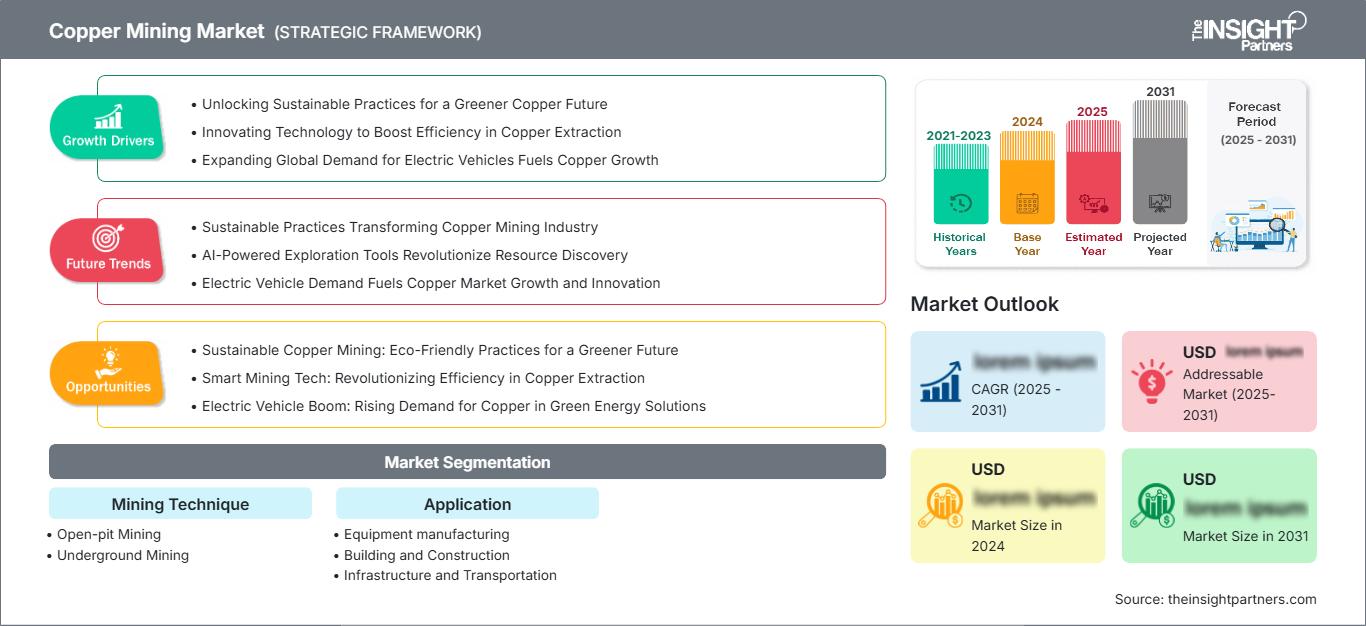
The copper mining market was valued at US$ 9.78 Billion in 2025 and is projected to reach US$ 13.15 Billion by 2034, expanding at a CAGR of 3.34% during 2026–2034. The outlook reflects measured capacity additions, sustained consumption across equipment manufacturing, building and construction, and infrastructure and transportation, and the long development cycles associated with bringing new copper resources into commercial production.
Across North America, the copper mining market size is expected to advance at a modelled 2.8–3.4% CAGR through 2034. Grid modernization and domestic mineral-security programs support project economics, while established Arizona and Canadian mining clusters provide processing expertise and supplier depth. Permitting duration, water availability, and ore-grade variability temper the pace, encouraging brownfield expansions, leaching improvements, and operational digitization rather than reliance on greenfield developments alone.
Copper Mining Market Assessment and Insights
- North America: Share in 2025 is modelled at 15–18%, with CAGR between 2026–2034 of 2.8–3.4%, supported by brownfield projects, U.S. grid investment, established Canadian expertise, and policy attention to secure mineral supply.
- US: The country represents 58–62% of North American value in 2025 and is projected to grow at 2.9–3.5% through 2034, led by Arizona operations.
- Europe: Share in 2025 is estimated at 7–10%, with CAGR between 2026–2034 of 2.2–2.8%; Poland, Spain, Sweden, and Serbia lead regional mine development and output.
- Asia Pacific: Estimated 24–28% copper mining market share in 2025, with CAGR between 2026–2034 of 3.8–4.4%; China, Australia, Indonesia, and India anchor production and investment.
- Largest Segment: Open-pit Mining holds a 68–72% market share in 2025 and is expected to post a 3.0–3.5% CAGR during 2026–2034.
- High Growth Segment: Infrastructure and Transportation accounts for 24–28% in 2025 and is forecast to record a 4.2–4.8% CAGR during 2026–2034.
- Key companies analyzed in detail: Freeport-McMoRan Inc., Glencore plc, Amerigo Resources Ltd., BHP Group Limited, Corporación Nacional del Cobre de Chile, Southern Copper Corporation, Hindustan Copper Limited, First Quantum Minerals Ltd., Rio Tinto plc, and Zijin Mining Group Co., Ltd.
Source: The Insight Partners' analysis based on proprietary research, government publications, company annual reports, investor presentations, industry databases, and expert interviews.
Production technology has been transformed from optimization of equipment to orebody awareness, autonomous hauling, condition-based maintenance, and process control. The operators of open-pit mines are becoming more adept at combining fleet electrification pilot tests with coarse particle extraction and leaching advancements, while those of underground mines are deploying block caving, demand-driven ventilation, and remote operations. These developments follow from declining grades, increasing stripping ratio, limited water supplies, and labor shortages. As a result, the copper mining sector now values operators who derive additional amounts of metal from the same footprint without proportional rises in energy use, water consumption, and waste disposal.
Moving forward, the investment community will continue to focus on brownfields in established mining districts and selected greenfields in Africa, Latin America, Australia, and Central Asia. Public investment, strategic alliances, and critical minerals policy can help with risk management despite continued importance of permit and community support. Investment flows will also be geared towards desalination, renewable energy, tailings recycling, and traceability to make projects capable of delivering to clients while maintaining flexibility due to high construction costs and lengthy startup periods.
Copper Mining Market Report Scope
| Report Attribute | Details |
|---|---|
| Market size in 2025 | US$ 9.78 Billion |
| Market Size by 2034 | US$ 13.15 Billion |
| Global CAGR (2026 - 2034) | 3.34% |
| Historical Data | 2021-2024 |
| Forecast period | 2026-2034 |
Copper Mining Market Analysis
Copper mining market expansion is driven by grid strengthening, renewable energy production, electric vehicles, data centers, and traditional construction. IEA data put the total consumption of copper at 26.7 million tons in 2024, growing to 31.3 million tons in 2030 under the existing policies. Copper mine companies convert the demand for copper into concentrate and cathode using exploration, extraction, crushing, concentration, smelting, refining, and related logistics.
Supply is less elastic compared to demand as discoveries, permits, infrastructures, and start-ups take many years. The lower quality of ore leads to more transportation of materials for each ton of copper, and water scarcity and electricity supply influence the operational costs. Hence, brownfield expansion, residual leaching, and increased recovery provide quicker and riskier supplies than greenfield mines.
According to the copper mining market analysis, there is a highly competitive market with diversified miners and specialized copper miners, each with long life assets. Freeport-McMoRan Inc., BHP Group Limited, Rio Tinto plc, Glencore plc, and Zijin Mining Group Co., Ltd. have both capital and technological capability, while Amerigo Resources Ltd. distinguishes itself by tailings extraction, and Hindustan Copper Limited by its integrated domestic strategy.
Resource quality, political stability, access to infrastructure, and opportunity for growth have become crucial aspects of positioning. Corporación Nacional del Cobre de Chile and Southern Copper Corporation highlight their district-wide resources, while First Quantum Minerals Ltd. integrates project development with operational efficiency. Capital spending decisions follow a clear logic of phased expansions, water system construction, smelter connections, renewable energy, and controls.
● REPORT CUSTOMIZATION
Tailor This Report To Align With Your Specific Business Requirements
This report can be customized to align precisely with your business objectives, scope, and target markets. Customization options include tailored segmentation, geography, competitive analysis, and strategic insights to support informed decision-making.
Customize This Report →WHAT YOU CAN ADJUST
- ● Segmentations
- ● Geography
- ● Competitive Analysis
- ● Language Preferences
Copper Mining Market: Strategic Insights
Regional Insights
North America copper mining market
North America held a modelled 15–18% copper mining market share in 2025 and is expected to expand at a 2.8–3.4% CAGR through 2034. The U.S. offers big-scale open-pit mines and downstream demand, Canada offers financing and services for exploration, and Mexico offers production that is cost-competitive. Grid replacements, manufacturing investment, and mineral security policies increase demand visibility in the long term.
Expansion in the copper mining market is limited by permitting, engagement with communities, access to water, and aging ore bodies. Companies are focusing on expanding life spans of brownfield mines, using leaching technology, building autonomous fleets, and signing renewable energy agreements. Ecosystems in equipment and engineering, spanning borders, as well as support from the federal and provincial governments can help build infrastructure more economically.
U.S. Copper Mining Market
The U.S. represented 58–62% of North American market value in 2025 and is projected to grow at a 2.9–3.5% CAGR during 2026–2034. According to the USGS, there was approximately 1.1 million tonnes of mine output produced in 2024, out of which 70% was contributed by Arizona. Freeport-McMoRan Inc. is a major component of the domestic mining capacity because of the mines of Morenci among others in southwest regions, along with Kennecott of Rio Tinto plc.
Construction comprised 42% of the total consumption of copper and copper alloys in the United States in 2024, followed by electrical and electronic products at 23% and transportation equipment at 18%, as per the USGS figures.
Europe Copper Mining Market
Europe accounted for an estimated 7–10% share in 2025 and is forecast to grow at a 2.2–2.8% CAGR. Poland leads current regional production, while Spain, Sweden, Serbia, Finland, and Türkiye maintain meaningful assets or development pipelines. The Critical Raw Materials framework strengthens interest in domestic extraction, but environmental review and local consent shape timelines.
What the UK brings to the table is financing, engineering, insurance, and listed companies but not actual mined output. What Germany and France bring is mining machinery, automation, power requirements, and processing capacity. What Italy and Spain contribute is fabrication and infrastructure consumption, with Spain contributing operating mines as well. Regional strategy now focuses on responsible sourcing and recyclability.
APAC Copper Mining Market
APAC held a modelled 24–28% share in 2025 and should record a 3.8–4.4% CAGR through 2034, the fastest regional pace. China leads by investment scale and processing integration, while Australia and Indonesia provide substantial mine capacity and project pipelines.
Japan and South Korea secure feed through overseas investment and recycling, whereas India is accelerating exploration and domestic capacity ambitions. Grid construction, urban infrastructure, industrial policy, and renewable deployment sustain demand. Australia’s transparent project framework and Indonesia’s downstream policy materially influence capital allocation.
Middle East & Africa Copper Mining Market
Middle East and Africa is projected to expand at a 3.6–4.2% CAGR through 2034. Zambia and the Democratic Republic of the Congo anchor African supply growth, while South Africa provides mining services and transport connections. Power availability and corridor infrastructure remain decisive.
Saudi Arabia is building exploration and processing capability under economic diversification programs, and the UAE contributes investment and trading networks. Rest-of-MEA opportunities center on underexplored belts, renewable-powered operations, and regional beneficiation. Policy stability, transmission build-out, rail capacity, and transparent fiscal terms will determine project conversion.
Segmentation Analysis
Mining Technique
The Mining Technique segment is expected to record a 3.1–3.6% CAGR during 2026–2034. The copper mining market scope covers open-pit and underground extraction, each governed by orebody geometry, depth, stripping ratio, grade, geotechnical risk, and infrastructure. Open pits retain scale advantages, while underground development becomes strategically important as surface resources mature and operators pursue deeper extensions with automation and block-caving systems.
- Open-pit Mining: This method holds the leading position because large porphyry deposits support high-throughput fleets, centralized concentrators, and phased pushbacks, although deeper pits raise haulage, energy, and waste-management requirements.
- Underground Mining: Demand is increasing for deeper, higher-grade extensions where surface expansion is constrained. Block caving, remote equipment, digital ventilation, and geotechnical monitoring improve economics and worker exposure management.
Application
The Application segment is projected to post a 3.4–3.9% CAGR through 2034. Demand spans equipment manufacturing, building and construction, and infrastructure and transportation. Electrical conductivity, durability, recyclability, and compatibility with high-efficiency systems sustain copper intensity. Grid upgrades and transport electrification raise the strategic value of reliable mined supply, while conventional construction provides a broad, relatively stable consumption base.
- Equipment manufacturing: Motors, transformers, industrial machinery, electronics, and cooling systems require conductive and thermally efficient copper. Factory automation and data-center equipment support resilient orders, though design efficiency moderates unit intensity.
- Building and Construction: Wiring, plumbing, HVAC, and distributed-energy systems make this a large, established application. Urbanization, renovation, safety codes, and building electrification sustain dependable demand across economic cycles.
- Infrastructure and Transportation: Transmission networks, railways, electric vehicles, charging systems, and renewable interconnections create the strongest growth profile, linking mine investment directly to public infrastructure and mobility programs.
Opportunity Snapshot
| Application | Revenue Contribution | Trend Tag | Adoption Stage |
| Equipment manufacturing | Medium | Industrial Automation | Mature |
| Building and Construction | High | Building Electrification | Mature |
| Infrastructure and Transportation | High | Grid Mobility | Scaling |
Copper Mining Market Growth Drivers and Impact Analysis
Grid Expansion Raises Structural Copper Requirements
The copper mining market forecast shows that electricity grids require conductors, transformers, substations, switchgear, and linkages through generation, transmission, and distribution. Copper requirements for clean technologies from IEA’s outlook to 2025 are seen as reaching 7.7 million tonnes in 2024 and 10.9 million tonnes in 2030, creating a solid offtake signal in the form of grid development. To mining companies, this will mean conversion of reserves, capacity expansion of concentrators, and extension of mine lives since grid projects usually take more than one budget period to complete. This is especially true in locations where there is rapid interregional transmission and renewable energy integration from government authorities.
Constrained Project Pipeline Supports Capacity Investment
Copper production capacity adjusts slowly to price signals due to the time involved with exploration, feasibility, permitting, construction, and production ramp-up that may take longer than ten years. According to IEA estimates, primary supply will increase from 22.5 million tonnes in 2024 to 25.9 million tonnes in 2030, and concentration will be higher as well. This situation gives strong reasons for expanding brownfield projects, developing satellite deposits, treating tailings, and increasing recovery rates. Mining companies with permitted land, existing concentrators, access to water sources, and electricity connections enjoy certain advantages in this situation. In reality, investments go into staged modules providing protection and earlier returns.
Urban Infrastructure Sustains Broad-Based Consumption
Structures and transportation use copper in electrical wiring, plumbing, engines, signaling, tracks, charging equipment, and distributed energy resources. USGS estimated in 2024 that construction of buildings accounted for 42% of copper and alloy products consumption in the United States. This indicates the strength of traditional demand along with the demand created by energy transition. Urban renewal, data centers, railroad electrification, and climate resilient power grids expand the clientele of the copper mining market. Diversity of uses helps to reduce dependence on one technology cycle and to plan ahead. The mining sector profits from more stable concentrate consumption but needs to meet smelter criteria regarding quality and logistics.
Copper Mining Market Future Trends
AI-Enabled Orebody and Process Control
There is a growing trend in the copper mining market whereby there is an increased adoption of integrated digital twin technology that brings together geological modeling, drilling, dispatching, comminution, floatation, and maintenance processes. In terms of the forecast period, machine learning will move from stand-alone pilots to decision support tools with closed loops for adjustment of grind, reagents usage, and haulage as per the changing ore types. The benefits that come along with the technology are not limited to mere automation, but there will be improved reconciliation, lower dilution, and concentrate stability. Larger mine sites will adopt the technology faster than small mines because of their existing sensor networks.
Water-Constrained Mining Reshapes Project Design
The copper mining market trends show that future developments will more likely consider water infrastructure as a critical input into the production process rather than an auxiliary service. The processes of desalination, dry-stack/thickened tailings, water filtration, and continuous basin monitoring will be key factors in obtaining permits and raising funds, particularly in arid regions where copper is mined. Coastal pipeline infrastructure and pumping with the use of renewable sources of energy will allow for securing the supply of water, but increase both the financial costs and the consumption of energy. It is necessary to optimize the ratio between ore extraction and water consumption during the development of the project.
Copper Mining Market Opportunities
Brownfield Recovery and Tailings Reprocessing
There is inherent value in existing mines, in stockpiles, in historical tailings, and in mineralized extensions in close proximity to existing facilities. There is an opportunity for investors to capitalize on modular leach plants, regrind circuits, flotation improvements, and sensor-based ore sorting to produce more copper at lower costs than the equivalent of building a new greenfield mine from scratch. It is possible that the projected copper mining market will be favorable to well-planned processes to define resources, understand the metallurgy, and scale up with respect to available water and power sources.
Strategic Partnerships in Emerging Copper Belts
Africa, Central Asia, and selected Latin American jurisdictions offer large resource potential but require coordinated infrastructure and risk sharing. Mining companies, sovereign investors, development institutions, equipment suppliers, and power developers can form staged partnerships covering exploration, rail, transmission, processing, and workforce development. Action should begin with transparent fiscal frameworks, baseline environmental studies, and early community agreements before major engineering commitments. Shared infrastructure can improve project economics and reduce duplication, particularly for landlocked deposits. Investors should prioritize districts with scalable resources, credible export corridors, and diversified power options, while using milestone-based funding to manage geological, political, and execution uncertainty.
Recent Developments
- April 2026: Freeport-McMoRan Inc. – reported a phased restart at the Grasberg Block Cave following the 2025 mud-rush disruption, while revising 2026 operating-rate expectations. The update highlighted remediation complexity, production-recovery timing, and the global supply significance of the Indonesian asset.
- May 2025: Rio Tinto plc – continued the underground ramp-up at Oyu Tolgoi, a key source of future copper growth. Subsequent production reporting linked improved output to higher underground contribution, demonstrating the strategic importance of block-cave execution, materials handling, and coordinated open-pit and underground scheduling.
Frequently Asked Questions

- Comprehensive Market Sizing and Forecast Analysis
- Detailed Segmentation Analysis
- In-Depth Market Dynamics Assessment
- Regional and Country-Level Insights
- Competitive Landscape and Company Benchmarking
- Strategic Business Intelligence
Recent Reports
Testimonials

The Insight Partners' SCADA System Market report is comprehensive, with valuable insights on current trends and future forecasts. The team was highly professional, responsive, and supportive throughout. We are very satisfied and highly recommend their services.
RAN KEDEM Partner, Reali Technologies LTDs
I requested a report on a very specific software market and the team produced the report in a few days. The information was very relevant and well presented. I then requested some changes and additions to the report. The team was again very responsive and I got the final report in less than a week.
JEAN-HERVE JENN Chairman, Future Analytica
We worked with The Insight Partners for an important market study and forecast. They gave us clear insights into opportunities and risks, which helped shape our plans. Their research was easy to use and based on solid data. It helped us make smart, confident decisions. We highly recommend them.
PIYUSH NAGPAL Sr. Vice President, High Beam Global
The Insight Partners delivered insightful, well-structured market research with strong domain expertise. Their team was professional and responsive throughout. The user-friendly website made accessing industry reports seamless. We highly recommend them for reliable, high-quality research services
YUKIHIKO ADACHI CEO, Deep Blue, LLC.
This is the first time I have purchased a market report from The Insight Partners.While I was unsure at first, I visited their web site and felt more comfortable to take the risk and purchase a market report.I am completely satisfied with the quality of the report and customer service. I had several questions and comments with the initial report, but after a couple of dialogs over email with their analyst I believe I have a report that I can use as input to our strategic planning process.Thank you so much for taking the extra time and making this a positive experience.I will definitely recommend your service to others and you will be my first call when we need further market data.
JOHN SUZUKI President and Chief Executive Officer, Board Director, BK Technologies
I wish to appreciate your support and the professionalism you displayed in the course of attending to my request for information regarding to infectious disease IVD market in Nigeria. I appreciate your patience, your guidance, and the fact that you were willing to offer a discount, which eventually made it possible for us to close a deal. I look forward to engaging The Insight Partners in the future, all thanks to the impression you have created in me as a result of this first encounter.
DR CHIJIOKE ONYIA MANAGING DIRECTOR, PineCrest Healthcare Ltd.Reason to Buy
- Informed Decision-Making
- Understanding Market Dynamics
- Competitive Analysis
- Identifying Emerging Markets
- Customer Insights
- Market Forecasts
- Risk Mitigation
- Boosting Operational Efficiency
- Strategic Planning
- Investment Justification
- Tracking Industry Innovations
- Aligning with Regulatory Trends





 Get Free Sample for