
Cyanate Ester Resins Market Demand, Share & Growth by 2034
Coverage: by Application (Adhesives, Composites and Others), End User (Electrical & Electronics, Aerospace & Defense and Others), and Geography (North America, Europe, Asia Pacific, and South and Central America)
- Status : Data Released
- Report Code : TIPRE00003202
- Category : Chemicals and Materials
- No. of Pages : 150
- Available Report Formats :


- Last update date : June 30, 2026


2025 Market Size
US$ 222.39 Mn
Base year value
2034 Forecast
US$ 572.25 Mn
Projected by 2034
CAGR 2026-2034
11.07 %
Growth rate
Addressable Market
US$ 3,508.98 Mn
(2026-2034)
The cyanate ester resins market is becoming increasingly important for high-performance materials. This is due to its excellent thermal stability, low dielectric properties, and strong mechanical performance. The market is valued at US$ 222.39 million in 2025 and is expected to grow to about US$ 572.25 million by 2034, with an estimated CAGR of 11.07% from 2026 to 2034. The rising use of these resins in aerospace composites, electronics, and critical structural applications supports long-term market growth and drives ongoing innovation in resin formulations.
North America is a key market for cyanate ester resins, fueled by ongoing investments in aerospace upgrades, defense technologies, and electronic manufacturing. The regional market is expected to see a CAGR of around 10.4% through 2034, driven by the growing demand for lightweight composite structures and high-frequency electronic materials. Ongoing research and strong partnerships between resin manufacturers and end-use industries further enhance regional competitiveness.
Cyanate Ester Resins Market Assessment and Insights
- North America: North America accounted for 36–40% share in 2025 and is projected to grow at a CAGR of 10.4–10.9% during 2026–2034. Strong aerospace manufacturing, defense procurement, semiconductor innovation, and advanced composite production continue to support regional leadership in the cyanate ester resins market size.
- U.S.: The U.S. represented 78–82% of the North American market in 2025 and is anticipated to expand at a CAGR of 10.5–11.0% through 2034, supported by defense electronics, satellite technologies, and commercial aerospace investments.
- Europe: Europe held 26–30% share in 2025 and is forecast to register a CAGR of 10.0–10.6%. Germany, France, and the UK remain leading contributors due to strong aerospace supply chains, advanced automotive composites, and electronics manufacturing capabilities.
- Asia Pacific: Asia Pacific captured 27–31% share in 2025 and is expected to witness the fastest expansion at a CAGR of 11.8–12.4%. China, Japan, South Korea, and India continue investing in electronics production, defense capabilities, semiconductor manufacturing, and composite-intensive transportation systems.
- Largest Segment – Aerospace & Defense: Aerospace & Defense accounted for 54–58% market share in 2025 and is projected to grow at a CAGR of 11.2–11.7%, driven by increasing demand for lightweight, high-temperature composite structures.
- High Growth Segment – Composites: Composites represented 46–50% market share in 2025 and are anticipated to record a CAGR of 11.8–12.3%, supported by expanding applications in aerospace structures, radomes, automotive components, and electronic laminates.
- Key companies analyzed in detail: Huntsman Corporation, Hexcel Corporation, Henkel AG & Co. KGaA, Lonza Group AG, Mitsubishi Gas Chemical Company, Inc., Novoset, LLC, Solvay SA, Teijin Limited, Argosy International Inc., Maida Development Company, Inc.
Source: The Insight Partners' analysis based on proprietary research, government publications, company annual reports, investor presentations, industry databases, and expert interviews.
Increasing performance expectations in the aerospace, electrical, and defense industries have changed cyanate ester resins from specialized materials to key engineering polymers. Manufacturers are continually improving resin chemistry to provide better dimensional stability, less moisture absorption, and improved processability while meeting demanding operating conditions. These advances have opened up new opportunities beyond traditional aerospace uses, such as in telecommunications, semiconductor packaging, and high-performance industrial systems.
Future market growth is likely to be driven by advancements in composite manufacturing, rising electrification efforts, and the ongoing miniaturization of electronic devices. Companies are increasingly investing in new resin formulations that offer high thermal resistance and better manufacturing efficiency. As supply chains mature and production capabilities grow, the market is set to benefit from wider industrial adoption and a stronger focus on material reliability in mission-critical applications.
Cyanate Ester Resins Market Report Scope
| Report Attribute | Details |
|---|---|
| Market size in 2025 | US$ 222.39 Million |
| Market Size by 2034 | US$ 572.25 Million |
| Global CAGR (2026 - 2034) | 11.07% |
| Historical Data | 2021-2024 |
| Forecast period | 2026-2034 |
Cyanate Ester Resins Market Analysis
Growing demand for materials that can withstand extreme thermal and mechanical conditions continues to boost the cyanate ester resins market. Industries that need high dimensional stability, low dielectric constants, and strong resistance to moisture are increasingly choosing cyanate ester systems over traditional thermosetting materials. This shift is especially noticeable in aerospace structures, high-frequency communication gear, radar components, and electronic packaging applications where long-term reliability directly impacts operational efficiency.
The market includes specialty chemical producers, resin formulators, composite manufacturers, component makers, OEMs, and research institutions. Working together across this value chain has sped up product innovation, allowing for customized resin grades aimed at automated manufacturing, lightweight structural parts, and high-performance electrical insulation systems. Ongoing advancements in processing technologies also support broader commercial use in various industrial sectors.
Competition in the cyanate ester resins market relies more on technological differences than just production volume. Key players prioritize proprietary resin formulations, product development tailored to specific applications, strategic partnerships, and investments in research to enhance their market position. Companies are increasingly focusing on high-value applications where performance benefits justify higher prices and foster long-term customer relationships.
Investment activities center on advanced composite technologies, electronics materials, and sustainable manufacturing methods. Manufacturers are expanding their production capabilities and exploring hybrid resin systems that improve toughness, simplify processing, and increase compatibility with new reinforcement materials. Collaborations between chemical firms, aerospace manufacturers, and electronics suppliers are shaping product development priorities, leading to opportunities for unique solutions in rapidly changing end-user markets.
● REPORT CUSTOMIZATION
Tailor This Report To Align With Your Specific Business Requirements
This report can be customized to align precisely with your business objectives, scope, and target markets. Customization options include tailored segmentation, geography, competitive analysis, and strategic insights to support informed decision-making.
Customize This Report →WHAT YOU CAN ADJUST
- ● Segmentations
- ● Geography
- ● Competitive Analysis
- ● Language Preferences
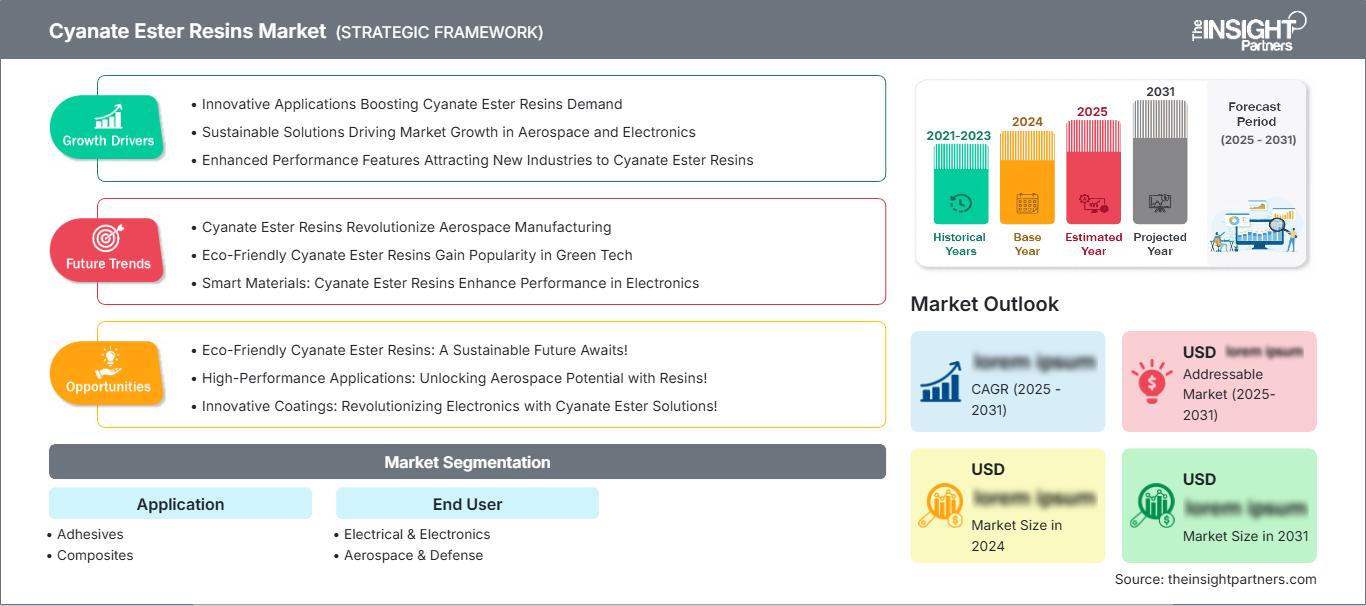
Cyanate Ester Resins Market: Strategic Insights
Regional Insights
North America Cyanate Ester Resins
North America holds a strong position in the cyanate ester resins market due to its robust aerospace manufacturing sector, strong defense programs, and significant investment in new electronic technologies. The market in this region is expected to grow at an estimated CAGR of about 10.4% through 2034. This growth is driven by the rising production of lightweight aircraft parts, satellite systems, and high-frequency communication equipment. The strong research facilities and ongoing innovation in specialty polymers further bolster the region's leading role.
Additionally, the region benefits from close teamwork among material suppliers, aerospace manufacturers, government agencies, and universities focused on developing advanced composites. The increasing use of high-performance resins in defense modernization efforts, semiconductor production, and precision electrical applications continues to create steady long-term demand. This trend encourages manufacturers to offer improved formulas with better thermal and dielectric performance.
U.S. Cyanate Ester Resins Market
The United States is the largest national market in North America, making up about 72% to 76% of regional demand. The market is expected to grow at a rate of nearly 10.6% each year until 2034, driven by ongoing investments in aerospace innovations, military upgrades, semiconductor manufacturing, and electronics. Strong domestic manufacturing skills continue to support the use of specialty resin technologies in various industrial sectors.
Major companies like Huntsman Corporation, Hexcel Corporation, Henkel AG & Co. KGaA, and Lonza Group AG are key players in ongoing product innovation and application development. Demand is growing for structural composites, electronic laminates, radome components, and advanced adhesive systems, where high thermal stability, low dielectric properties, and long operational life are critical performance needs.
Europe Cyanate Ester Resins Market
Europe holds an estimated 25 to 29 percent share of the global cyanate ester resins market. This is due to its strong aerospace manufacturing, effective automotive engineering, and increasing investments in high-performance electronic materials. The regional market is expected to grow at around 10.2 percent CAGR through 2034. Sustainability efforts and rising demand for lightweight composite materials are encouraging manufacturers to create better resin technologies that fit energy-efficient production processes.
The region's industrial strategy focuses more on improving manufacturing, collaborating on research, and achieving technological independence in key sectors like aerospace, telecommunications, and defense. Investments in next-generation composite materials and high-frequency electronic systems are creating good opportunities for specialty resin suppliers looking for long-term growth.
Germany is the top national market because of its strong industrial manufacturing, superior aerospace engineering skills, and ongoing investments in precision electronic components. The rising need for lightweight structural materials and high-temperature composites supports steady market growth across various industries.
The United Kingdom, France, Italy, and Spain together generate considerable demand through aerospace production, defense upgrades, industrial electronics, and research-driven composite development. Ongoing collaboration between manufacturers and research institutions should speed up innovation while broadening commercial uses for advanced cyanate ester resin systems in the region.
APAC Cyanate Ester Resins Market
Asia-Pacific is expected to grow the fastest, with an estimated CAGR of about 12.4% during the forecast period. By the end of this period, the region should account for roughly 29 to 33% of global demand. Rapid industrialization, growth in electronics manufacturing, rising aerospace investments, and government support for new materials are boosting prospects in both established and emerging economies.
China leads the regional market due to its strong electronics manufacturing ecosystem, growing aerospace industry, and rising investment in advanced composite production. Government initiatives that support local semiconductor development and high-value manufacturing continue to increase demand for specialty resin materials with better electrical and thermal properties.
Japan, South Korea, India, and Australia are progressively increasing their market presence through technological innovation, defense modernization, electronics manufacturing, and industrial research. Investments in high-performance composites, renewable energy infrastructure, telecommunications equipment, and advanced transportation systems are likely to promote the commercial use of cyanate ester resins across the region.
Middle East & Africa Cyanate Ester Resins Market
The Middle East and Africa market is slowly becoming a strong candidate for cyanate ester resins. This improvement is backed by expanding programs for industrial diversification, investments in infrastructure, and a rising use of engineering materials. Regional demand is expected to grow by about 9.3% each year until 2034 as governments focus on aerospace capabilities, energy diversification, and local manufacturing in key industries.
Saudi Arabia stands out as the largest market in the region. This is due to large investments in industrial growth, aerospace projects, defense manufacturing, and petrochemical diversification. National strategies for economic change continue to encourage the use of high-performance composite materials, leading to better operational efficiency across various industries.
The United Arab Emirates, South Africa, and the rest of the Middle East and Africa are seeing steady market growth. This is driven by investments in transportation infrastructure, energy projects, industrial manufacturing, and research partnerships. Increased awareness of composite technologies and greater involvement in global aerospace and electronics supply chains are likely to create strong market opportunities for the region in the long run.
Segmentation Analysis
Application
- Adhesives: High-performance adhesive formulas use cyanate ester resins to provide excellent heat resistance, low shrinkage, and strong bonding in aerospace assemblies, electronic packaging, and structural applications that face tough environmental conditions.
- Composites: Composite applications are the leading demand segment. They benefit from strong strength-to-weight characteristics, excellent thermal stability, and low dielectric properties. These features are required for aircraft structures, radomes, satellite components, and modern defense system.
End Use
- Electrical & Electronics: Growing use of high-frequency communication equipment, semiconductor packaging, printed circuit substrates, and improved electrical insulation systems keeps driving demand for cyanate ester resins with low dielectric constants and high thermal reliability.
- Aerospace & Defense: This segment is the largest consumer because of its wide use in lightweight composite structures, radomes, missile systems, aircraft interiors, satellite parts, and other important applications that need strong mechanical strength and thermal resistance.
Opportunity Snapshot
| Segment Name | Revenue Contribution | Trend Tag | Adoption Stage |
| Electrical & Electronics | High | High Frequency | Mature |
| Aerospace & Defense | High | Lightweight Aircraft | Mature |
Cyanate Ester Resins Market Growth Drivers and Impact Analysis
Growing Demand for Lightweight Aerospace Composite Materials
The aerospace industry is focused on reducing aircraft weight and improving fuel efficiency. This has led to a higher demand for composite materials that use cyanate ester resins. These resins provide a blend of high thermal stability, low moisture absorption, excellent fatigue resistance, and strong mechanical performance. They are ideal for structural aircraft components, radomes, engine-adjacent assemblies, and space applications. Their ability to maintain size and shape in tough conditions helps aerospace manufacturers meet strict safety and performance standards without losing structural strength.
The growth of commercial aviation, defense modernization programs, and increased investments in satellite deployment are driving the need for high-performance composite systems around the world. Aircraft manufacturers are using lightweight materials in both commercial and military platforms to enhance operational efficiency and cut lifecycle costs. As aerospace engineering moves towards designs that rely more on composites, suppliers of cyanate ester resins are likely to see long-term procurement opportunities and expand collaboration on product development with OEMs and composite fabricators.
Continuous Innovation in Specialty Thermosetting Resin Technologies
Material science advancements have allowed manufacturers to create cyanate ester resin systems with better toughness, easier processing, and improved compatibility with different reinforcement materials. Research is increasingly focusing on balancing better thermal performance with manufacturing efficiency. This balance supports wider commercial use in industries that need complex composite structures and precision electronic components. Improved curing technologies and hybrid resin formulations have also increased processing flexibility for manufacturers looking for high-performance options.
Innovation now allows for greater customization to meet specific application needs. This helps producers tackle unique challenges in aerospace, defense, electrical, and industrial sectors. Companies that invest in research capabilities are boosting their competitive position by offering unique products and working closely with end users. These technological improvements are expected to speed up commercialization and expand the market for cyanate ester resin applications in emerging high-value industries.
Expansion of High-Frequency Electronics and Advanced Communication Systems
Rapid deployment of high-speed communication infrastructure, radar technologies, and next-generation semiconductor devices has increased the demand for materials with excellent dielectric performance. Cyanate ester resins have low dielectric constants and low signal loss characteristics. This makes them especially suitable for high-frequency printed circuit boards, microwave systems, antenna components, and electronic packaging. Their ability to maintain electrical performance at high temperatures supports reliable operation in compact and high-performance electronic systems.
The growing use of 5G infrastructure, satellite communications, autonomous technologies, and artificial intelligence hardware is creating more opportunities for specialty resin manufacturers. Electronic device makers are looking for materials that can handle higher operating frequencies while reducing signal interference and heat damage. This trend drives ongoing investment in resin innovation, which helps the market grow in telecommunications, industrial electronics, and defense communication applications.
Cyanate Ester Resins Market Future Trends
Increasing Development of Low-Dielectric Resin Systems for Next-Generation Electronics
One of the most important future trends shaping the cyanate ester resins market is the creation of resin systems designed for next-generation electronic devices. These devices will operate at higher frequencies and greater power densities. As communication technologies move beyond traditional network structures, electronic manufacturers need materials that can reduce signal loss while providing good thermal stability. Cyanate ester resins are being improved through molecular design and changes in formulation to meet these tough electrical performance demands.
Future product development will likely focus on better processability, greater compatibility with new semiconductor packaging technologies, and simpler manufacturing. Resin suppliers are also looking into hybrid material systems that combine excellent dielectric performance with better toughness and moisture resistance. These advancements will likely enhance the role of cyanate ester resins in high-speed computing, satellite communications, autonomous systems, and new digital infrastructure where reliable signal transmission is crucial.
Broader Integration of Automated Composite Manufacturing Technologies
The rise of automated manufacturing technologies in aerospace and industrial composite production is set to change the demand for specialty resin systems. Manufacturers need materials that can support automated fiber placement, resin transfer molding, and other production techniques while delivering reliable mechanical performance. Cyanate ester resins are being improved to boost processing efficiency without losing their thermal and structural benefits.
Automation is expected to lower manufacturing costs, enhance production consistency, and speed up the commercialization of complex composite components. As production technologies become more advanced, resin suppliers will work more closely with equipment manufacturers and OEMs to create formulations that meet specific application needs. This shift is likely to broaden the market for cyanate ester resins in transportation, defense, energy, and industrial sectors looking for scalable, high-performance composite manufacturing options.
Cyanate Ester Resins Market Opportunities
Expanding Opportunities in Next-Generation Aerospace and Space Platforms
The rapid growth of commercial aircraft, reusable launch vehicles, satellites, unmanned aerial systems, and defense platforms is creating significant opportunities for the cyanate ester resins market. These applications need materials that can maintain their structure under extreme temperature changes, mechanical stress, and tough environmental conditions. Cyanate ester resins provide a good mix of low dielectric properties, excellent heat resistance, and dimensional stability, making them suitable for valuable aerospace composite structures and critical components.
Increased investments in space exploration, satellite networks, and defense modernization programs in North America, Europe, and Asia-Pacific are likely to boost the demand for advanced composite materials over the next decade. Manufacturers that focus on resin formulations that work with automated composite manufacturing, out-of-autoclave processing, and hybrid reinforcement systems will be well positioned to take advantage of new opportunities. Working together with aerospace manufacturers, research groups, and composite fabricators can further improve long-term market prospects while helping to qualify materials for the next generation of aircraft and space applications.
Rising Demand from High-Performance Electronics and Semiconductor Packaging
The growing complexity of electronic devices offers a significant growth opportunity for cyanate ester resin manufacturers. As semiconductor packaging, high-frequency communication equipment, radar systems, and data infrastructure continue to evolve, manufacturers need materials that provide excellent electrical insulation and long-term thermal reliability. Cyanate ester resins are gaining recognition for their ability to support high-speed signal transmission while reducing dielectric loss and maintaining stability under high temperatures.
The rapid growth of artificial intelligence infrastructure, cloud computing, autonomous mobility, and telecommunications is expected to drive ongoing demand for high-quality electronic materials. Companies that can create tailored resin systems with better processability, lower curing temperatures, and greater compatibility with modern manufacturing technologies will find more commercial opportunities. Investing in research partnerships and developing products for specific applications will likely give them a competitive edge as the requirements for electronic performance become stricter.
Recent Developments
- October 2025: Henkel AG & Co. KGaA expanded its strategic partnership with Dow to reduce the carbon footprint of adhesive manufacturing by incorporating low-carbon feedstocks and renewable electricity into production. The initiative supports more sustainable high-performance adhesive solutions and demonstrates continued investment in advanced materials innovation relevant to specialty resin applications.
- October 2025: Hexcel Corporation reported its third-quarter 2025 results and announced a US$350 million accelerated share repurchase program while reaffirming its long-term focus on advanced aerospace composites despite short-term market headwinds. Continued investment in high-performance composite technologies supports demand for specialty resin systems used in aerospace applications.
- September 2025: Henkel AG & Co. KGaA announced the expansion of its Brandon, South Dakota manufacturing facility with an investment of approximately US$30 million to strengthen production of thermal management and adhesive solutions serving the electronics and electric mobility sectors. The expansion enhances North American manufacturing capabilities for advanced material technologies.
Frequently Asked Questions

- Comprehensive Market Sizing and Forecast Analysis
- Detailed Segmentation Analysis
- In-Depth Market Dynamics Assessment
- Regional and Country-Level Insights
- Competitive Landscape and Company Benchmarking
- Strategic Business Intelligence
Recent Reports
Testimonials

The Insight Partners' SCADA System Market report is comprehensive, with valuable insights on current trends and future forecasts. The team was highly professional, responsive, and supportive throughout. We are very satisfied and highly recommend their services.
RAN KEDEM Partner, Reali Technologies LTDs
I requested a report on a very specific software market and the team produced the report in a few days. The information was very relevant and well presented. I then requested some changes and additions to the report. The team was again very responsive and I got the final report in less than a week.
JEAN-HERVE JENN Chairman, Future Analytica
We worked with The Insight Partners for an important market study and forecast. They gave us clear insights into opportunities and risks, which helped shape our plans. Their research was easy to use and based on solid data. It helped us make smart, confident decisions. We highly recommend them.
PIYUSH NAGPAL Sr. Vice President, High Beam Global
The Insight Partners delivered insightful, well-structured market research with strong domain expertise. Their team was professional and responsive throughout. The user-friendly website made accessing industry reports seamless. We highly recommend them for reliable, high-quality research services
YUKIHIKO ADACHI CEO, Deep Blue, LLC.
This is the first time I have purchased a market report from The Insight Partners.While I was unsure at first, I visited their web site and felt more comfortable to take the risk and purchase a market report.I am completely satisfied with the quality of the report and customer service. I had several questions and comments with the initial report, but after a couple of dialogs over email with their analyst I believe I have a report that I can use as input to our strategic planning process.Thank you so much for taking the extra time and making this a positive experience.I will definitely recommend your service to others and you will be my first call when we need further market data.
JOHN SUZUKI President and Chief Executive Officer, Board Director, BK Technologies
I wish to appreciate your support and the professionalism you displayed in the course of attending to my request for information regarding to infectious disease IVD market in Nigeria. I appreciate your patience, your guidance, and the fact that you were willing to offer a discount, which eventually made it possible for us to close a deal. I look forward to engaging The Insight Partners in the future, all thanks to the impression you have created in me as a result of this first encounter.
DR CHIJIOKE ONYIA MANAGING DIRECTOR, PineCrest Healthcare Ltd.Reason to Buy
- Informed Decision-Making
- Understanding Market Dynamics
- Competitive Analysis
- Identifying Emerging Markets
- Customer Insights
- Market Forecasts
- Risk Mitigation
- Boosting Operational Efficiency
- Strategic Planning
- Investment Justification
- Tracking Industry Innovations
- Aligning with Regulatory Trends





 Get Free Sample for