
Dairy Processing Equipment Market Size, Trends & Growth by 2034
Coverage: by Equipment Type (Pasteurizers, Homogenizers, Separators, Evaporators and Dryers, Membrane Filtration Equipment, Others); Operation (Automatic, Semi-Automatic); Application (Processed Milk, Fresh Dairy Products, Butter and Buttermilk, Cheese Milk, Others), and Geography (North America, Europe, Asia Pacific, and South and Central America)
- Status : Data Released
- Report Code : TIPRE00013531
- Category : Electronics and Semiconductor
- No. of Pages : 150
- Available Report Formats :


- Last update date : August 04, 2026


2025 Market Size
US$ 14.73 Bn
Base year value
2034 Forecast
US$ 25.92 Bn
Projected by 2034
CAGR 2026-2034
6.48 %
Growth rate
Addressable Market
US$ 183.86 Bn
(2026-2034)
The Dairy Processing Equipment Market size had been assessed to have a value of US$ 14.73 Billion in 2025 and is anticipated to reach US$ 25.92 Billion by 2034, witnessing a CAGR of 6.48% during 2026–2034. Growth can be seen as the processors update their processes including pasteurization, homogenization, separation, evaporation, drying, and filtration to ensure safety and efficiency of milk, cheese, butter, and fresh dairy processing.
Demand in North America region will grow at a rate of 5.8–6.4% on account of automation, cleaning-in-place solutions, and efficient heat treatment of the product. Growth in the Dairy Processing Equipment Market can also be attributed to premium cheese production, increased shelf-life milk, and labor efficient plant upgrades in the USA and Canada.
Dairy Processing Equipment Market Assessment and Insights
- North America held 23–26% Dairy Processing Equipment Market share in 2025 and is growing at a CAGR of 5.8–6.4% during 2026–2034, supported by automation, food safety controls, and high-value dairy output.
- US represented 79–83% of North America in 2025 and is growing at a CAGR of 5.9–6.5%, led by cheese, processed milk, and plant modernization.
- Europe accounted for 28–31% share in 2025 and is advancing at a CAGR of 5.5–6.1%, with Germany, France, Italy, the Netherlands, and the UK leading demand.
- Asia Pacific captured 34–38% share in 2025 and is expanding at a CAGR of 7.0–7.8%, led by China, India, Japan, South Korea, and Australia dairy capacity additions.
- Largest Segment Pasteurizers held 29–33% market share in 2025 and are growing at a CAGR of 6.0–6.7%, supported by safety regulation and processed milk demand.
- High Growth Segment Membrane Filtration Equipment held 13–16% market share in 2025 and is growing at a CAGR of 7.6–8.4%, driven by protein concentration and lactose-free dairy.
- Key companies analyzed in detail: FELDMEIER Equipment, Inc., GEA Group Aktiengesellschaft, Goma Engineering Private Limited, I.M.A. Industria Macchine Automatiche S.p.A., IDMC Limited, JBT Marel Corporation, Krones AG, Scherjon Equipment Holland B.V., SPX FLOW, Inc., and Tetra Pak International S.A.
Source: The Insight Partners' analysis based on proprietary research, government publications, company annual reports, investor presentations, industry databases, and expert interviews.
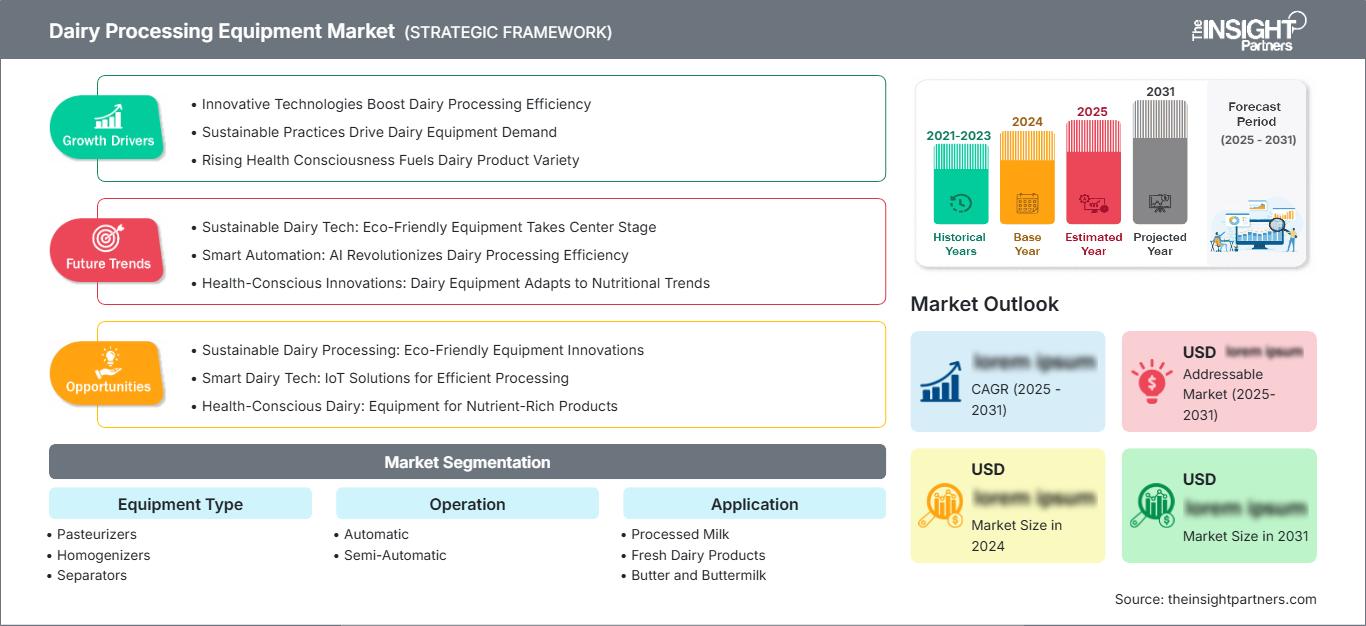
The growth in capacity in dairy processing is giving way to growth in integrated, hygienic, digitally connected, and efficient manufacturing processes. The equipment for pasteurization and separation continues to be key, along with membrane filtration, valve automation, and heat recovery that can boost efficiency and cut down waste, water, energy, and product losses. The Dairy Processing Equipment Market has evolved on the basis of such advancements as producers face increased milk consumption, diversification in their product range, and tougher microbiological standards.
The future demand would depend upon the formalization of the dairy industry in emerging markets, growth in premium cheese and yogurt ranges, and capacity investment in powder, UHT, and chilled products. The regulatory tailwinds from food safety agencies, sustainability initiatives, and tracing systems will be positive for suppliers providing comprehensive equipment, effective cleaning results, and life-cycle support services.
Dairy Processing Equipment Market Report Scope
| Report Attribute | Details |
|---|---|
| Market size in 2025 | US$ 14.73 Billion |
| Market Size by 2034 | US$ 25.92 Billion |
| Global CAGR (2026 - 2034) | 6.48% |
| Historical Data | 2021-2024 |
| Forecast period | 2026-2034 |
Dairy Processing Equipment Market Analysis
Market growth for Dairy Processing Equipment results from increasing demand for packed milk, cheese, yoghurt, butter and protein rich dairy components. The requirement of equipment which is capable of handling increased throughput while ensuring microbiological safety, stable texture, and consistency in composition is needed. Pasteurization equipment, homogenizers, separators, evaporation equipment, drying equipment and filtration equipment are used throughout the value chain from receiving raw milk to processing.
Dynamics of supply rely on the use of stainless steel production, hygienic pumps and valves, automation software, heat exchange, compressors, membranes and field service support. The cost of energy and water has become an influencing factor in making purchasing decisions as the processors tend to take into account total cost of ownership, cleanability, product recovery and downtime risk.
In Dairy Processing Equipment Market analysis, there is rivalry among integrated line manufacturers and equipment manufacturers. Competition is evident among GEA Group Aktiengesellschaft, Tetra Pak International S.A., Krones AG, SPX FLOW, Inc., JBT Marel Corporation, and I.M.A. Industria Macchine Automatiche S.p.A. FELDMEIER Equipment, Inc., Goma Engineering Private Limited, IDMC Limited, and Scherjon Equipment Holland B.V. offer specialized products to meet regional needs.
Future investments will be for modular lines, predictive maintenance, energy-saving evaporators, membrane concentration, and hygienic automation. Future strategic positions will be based on lifecycle service capabilities, presence of local commissioning teams, validated performance of clean-in-place, and ability to combine processing and packaging. Reference installations in regulated dairy plants will provide a competitive advantage for suppliers.
● REPORT CUSTOMIZATION
Tailor This Report To Align With Your Specific Business Requirements
This report can be customized to align precisely with your business objectives, scope, and target markets. Customization options include tailored segmentation, geography, competitive analysis, and strategic insights to support informed decision-making.
Customize This Report →WHAT YOU CAN ADJUST
- ● Segmentations
- ● Geography
- ● Competitive Analysis
- ● Language Preferences
Dairy Processing Equipment Market: Strategic Insights
Regional Insights
North America Dairy Processing Equipment Market
North America was valued at a share of 23-26% in 2025 and estimated to exhibit a growth rate of 5.8-6.4% during 2025-2034. The Dairy Processing Equipment Market size has gained support from increased production capabilities of cheese, long-life milk, innovations in yogurt, and upgradation of aging processing plants.
North America derives strength from well-established dairy cooperatives, significant private processors, and effective services. The demand for dairy processing equipment in North America is dominated by pasteurizers, homogenizers, separators, and membrane filter machines for producing standardized protein products and lactose-free dairy products. The trend toward replacement is sustained owing to considerations of food safety and water savings.
U.S. Dairy Processing Equipment Market
The United States accounted for 79-83% share in North America in 2025 and will witness growth at a CAGR of 5.9-6.5%. Application areas of the market include cheese milk, processed milk, butter, and fresh dairy products. Presence of key players includes Tetra Pak International S.A., GEA Group Aktiengesellschaft, SPX FLOW, Inc., JBT Marel Corporation, and FELDMEIER Equipment, Inc. for processing and service needs.
Application trends involve processors making use of high capacity pasteurizers, homogenizers, separators, and membrane systems to enhance yield, protein control, and cleaning efficiency. Consistent milk standardization is essential in cheese plants whereas shelf-life and microbial control are priorities in fluid milk processors. Limitations in labor force drive the need for automation in batching and valve routing.
Europe Dairy Processing Equipment Market
In Europe, the market had 28-31% shares in 2025 and is expected to witness growth at a CAGR of 5.5-6.1%. Germany dominates owing to its automation in the dairy sector, cheese and ingredients manufacturing. The UK focuses on chilled dairy processing and private labeling, while France, Italy, Spain, and the Netherlands make contributions through cheese, butter, milk powder, and export processing facilities.
The European processors give a high priority to energy savings, water recycling, and hygienic designs. The regulations and retailer quality initiatives favor investments into clean-in-place validation, heat recovery, and membrane concentration systems. There are no volumes of growth; however, there are premium products, sustainable objectives, and plant modernization.
APAC Dairy Processing Equipment Market
Asia Pacific had a market share of 34–38% in 2025 and is projected to expand at a CAGR of 7.0–7.8%. China dominates in industrial milk processing, whereas India incorporates milk collecting operations and cooperatives. Japan, South Korea, and Australia help through high-quality dairy products, exports, automation, and stringent quality measures.
Government policies concerning food safety, cold chain logistics, and dairy production increase demand. Processors are installing automatic pasteurization, separation, homogenization, and membrane filtration processes to enhance efficiency. Growth in urban consumption of packaged dairy products such as milk, cheese, yogurt, and flavored milk makes APAC the fastest-growing regional market opportunity.
Middle East & Africa Dairy Processing Equipment Market
Middle East & Africa is projected to grow at a CAGR of 5.7–6.3% as Saudi Arabia, the UAE, South Africa, and rest of MEA invest in dairy security, chilled distribution, and local processing. Saudi Arabia leads through integrated dairy farms and large-scale plants, while the UAE focuses on premium and imported-brand processing capacity.
Energy and water constraints make efficient heat treatment, evaporation, and cleaning systems important. Demand is supported by population growth, food security policies, and retail modernization. Equipment adoption depends on financing, technical support, and reliable service availability, especially for plants operating in high-temperature environments.
Segmentation Analysis
Equipment Type
Equipment Type is expected to grow at a CAGR of 6.1–6.8% from 2026 to 2034 as the Dairy Processing Equipment Market scope spans thermal treatment, texture control, separation, concentration, drying, and filtration. Selection depends on product mix, hygiene requirements, energy efficiency, automation level, and ability to maintain consistent quality across milk, cheese, butter, and fresh dairy lines.
- Pasteurizers remain the largest equipment category because processors need validated heat treatment for milk safety, shelf-life extension, and regulatory compliance across fluid milk, cheese milk, and cultured dairy production.
- Homogenizers support consistent texture and fat distribution in processed milk, cream, yogurt, and value-added beverages, making them important for product quality and brand consistency.
- Separators are essential for cream separation, milk standardization, impurity removal, and fat control, supporting both high-volume fluid milk and specialty dairy applications.
- Evaporators and Dryers serve milk powder, whey, and ingredient production where processors must reduce moisture efficiently while protecting flavor, solubility, and nutritional properties.
- Membrane Filtration Equipment is strategically important for protein concentration, lactose reduction, water recovery, and fractionation, supporting premium dairy ingredients and cleaner processing economics.
Operation
Operation is projected to grow at a CAGR of 6.2–6.9% during 2026–2034 as processors shift from manual plant control toward repeatable, data-supported production. Automation improves recipe control, cleaning validation, labor productivity, and traceability, while semi-automatic systems remain relevant for smaller dairies, regional plants, and staged modernization programs.
- Automatic systems are gaining preference in large plants because they reduce operator variation, improve cleaning documentation, support remote monitoring, and enable consistent product quality across shifts.
- Semi-Automatic equipment remains important for mid-sized processors that need lower capital intensity, operator flexibility, and gradual upgrades without replacing entire processing lines immediately.
Application
Application is expected to grow at a CAGR of 6.3–7.0% from 2026 to 2034 as processors diversify beyond commodity milk into cheese, cultured products, butter, and value-added dairy. Equipment demand varies by thermal profile, fat standardization, filtration need, and texture requirements, making application-specific line design central to investment decisions.
- Processed Milk generates stable equipment demand because pasteurization, homogenization, separation, and packaging integration are essential for safe, consistent, and shelf-stable fluid milk products.
- Fresh Dairy Products require flexible systems for yogurt, cream, and cultured items where texture control, gentle handling, and hygienic processing influence product quality and consumer acceptance.
- Butter and Buttermilk applications depend on separation, cream handling, churning, and thermal management, creating opportunities for processors improving fat recovery and premium product consistency.
- Cheese Milk is strategically important because cheese plants require precise standardization, pasteurization, filtration, and curd-ready milk quality to protect yield and final product characteristics.
Opportunity Snapshot
Market Opportunity Snapshot
| Application | Revenue Contribution | Trend Tag | Adoption Stage |
| Processed Milk | High | ESL Lines | Mature |
| Fresh Dairy Products | Medium | Cultured Mix | Scaling |
| Butter and Buttermilk | Medium | Fat Recovery | Mature |
| Cheese Milk | High | Yield Control | Scaling |
Dairy Processing Equipment Market Growth Drivers and Impact Analysis
Food Safety Compliance Accelerates Hygienic Line Modernization
With food safety regulations and retailer inspections pressuring processors to upgrade their existing systems with those that offer validated pasteurization, clean-in-place detection, sanitary valves, and automatic data logging capabilities, the practical consequence of such pressures is an increased demand for pasteurization, separation, homogenization and control systems equipment that limits contamination opportunities and data logging errors. Processors that work with processed milk, cheese milk, and fresh dairy products can no longer depend on manual inspections since any recall or shutdown will cost them a lot of money and reputation.
Energy and Water Efficiency Reshape Capital Spending
The dairy industry consumes a lot of energy, refrigeration, compressed air, and water, which leads to efficiency as one of the priorities for investment by the board level. Heat recovery potential for evaporators, dryers, pasteurizers, and clean-in-place technology is currently being analyzed. It leads to a change in the purchase criteria from initial cost to total cost of ownership approach. It results in a more widespread use of advanced evaporation, membrane filtration, and automated cleaning technology reducing utility consumption per liter produced. Vendors capable of quantifying their benefits and retrofitting existing plants have an edge since processors usually choose incremental upgrades rather than greenfield projects.
Product Diversification Raises Need for Flexible Processing Lines
Consumers' demands are now shifting toward longer shelf-life milk, high protein milk, lactose-free products, different cheeses, cultured milk and butter in premium varieties. This calls for flexibility of processing lines which can process various formulations with different fats content, viscosity and heat requirements without affecting hygienic standards. The industry effects include greater focus on modular systems, membrane filtration, standardization and recipe controls. Flexible processors who can switch between product formulations achieve greater efficiency and can meet the demands of retailers quicker. Equipment companies with application knowledge in milk, cheese, fresh dairy and ingredients get more orders than those with only equipment.
Dairy Processing Equipment Market Future Trends
Digital Plant Intelligence Moves from Monitoring to Optimization
Dairy Processing Equipment Market trends will increasingly center on digital tools that move beyond alarms into predictive maintenance, cleaning optimization, yield analytics, and energy benchmarking. Sensors, valve clusters, and control systems will generate plant-level data that helps operators reduce downtime and product loss. Future purchasing decisions will consider software capability, cybersecurity, and service analytics alongside mechanical performance. This trend will favor suppliers able to connect pasteurizers, separators, homogenizers, evaporators, dryers, and filtration systems into actionable dashboards. Processors will use these insights to improve quality consistency and justify upgrades through measurable operational savings.
Membrane-Based Processing Expands into Mainstream Dairy Lines
Membrane filtration will move from specialist ingredient applications into broader dairy processing as processors seek protein concentration, lactose reduction, water recovery, and gentle separation. The technology supports premium nutrition, cleaner labels, and lower thermal stress compared with some conventional methods. Future systems will combine ultrafiltration, microfiltration, reverse osmosis, and nanofiltration with automated cleaning and data monitoring. Adoption will be strongest where processors produce high-protein milk, Greek-style yogurt, cheese milk, and dairy ingredients. Suppliers that improve membrane life, fouling control, and service economics can unlock wider deployment.
Dairy Processing Equipment Market Opportunities
Turnkey Upgrades for Emerging Dairy Processing Hubs
Dairy Processing Equipment Market Forecasts support investment in turnkey and modular upgrades for emerging dairy hubs where milk formalization, urban retail, and cold-chain expansion are progressing together. Suppliers can capture opportunity by offering scalable pasteurization, separation, homogenization, and packaging-linked process lines suitable for phased capacity growth. Financing support, operator training, and local maintenance partnerships will be decisive because many processors need reliability as much as technology. The strongest opportunities lie in India, Southeast Asia, the Middle East, and Africa, where demand for safe packaged milk and value-added dairy is rising.
Retrofit Services for Sustainability and Cost Reduction
Existing dairy plants represent a major opportunity because many processors want lower energy, water, and product losses without building new facilities. Retrofit services can include heat recovery, upgraded evaporators, automated clean-in-place, membrane water recovery, hygienic valves, and digital monitoring. This investment path reduces disruption and helps processors meet sustainability targets while improving margins. Suppliers that audit current line performance and quantify savings can convert service relationships into equipment orders. The opportunity is attractive in North America and Europe, where mature plants need modernization, and in APAC where high utilization raises efficiency priorities.
Recent Developments
- April 2026: Tetra Pak International S.A. released analysis showing that modernising existing dairy processing lines can reduce greenhouse gas emissions by 40–49%, with average reductions of 47% in greenhouse gas emissions, 45% in water use, and 57% in product losses through available processing and cleaning solutions.
- January 2025: GEA Group Aktiengesellschaft launched the GEA Dairy Evaporator eZero for dairy applications, designed to reduce energy consumption by up to 60% and enable CO2 emissions reductions of up to 100% versus conventional MVR evaporators, supporting milk powder, whey powder, and infant formula production.
- September 2025: GEA Group Aktiengesellschaft introduced GEA InsightPartner EvoHDry, a digital monitoring solution for dairy and beverage processing plants that tracks parameters such as temperature, pressure, vibration, and flow to support predictive maintenance and reliability in evaporation and drying operations.
Frequently Asked Questions

- Comprehensive Market Sizing and Forecast Analysis
- Detailed Segmentation Analysis
- In-Depth Market Dynamics Assessment
- Regional and Country-Level Insights
- Competitive Landscape and Company Benchmarking
- Strategic Business Intelligence
Recent Reports
Testimonials

The Insight Partners' SCADA System Market report is comprehensive, with valuable insights on current trends and future forecasts. The team was highly professional, responsive, and supportive throughout. We are very satisfied and highly recommend their services.
RAN KEDEM Partner, Reali Technologies LTDs
I requested a report on a very specific software market and the team produced the report in a few days. The information was very relevant and well presented. I then requested some changes and additions to the report. The team was again very responsive and I got the final report in less than a week.
JEAN-HERVE JENN Chairman, Future Analytica
We worked with The Insight Partners for an important market study and forecast. They gave us clear insights into opportunities and risks, which helped shape our plans. Their research was easy to use and based on solid data. It helped us make smart, confident decisions. We highly recommend them.
PIYUSH NAGPAL Sr. Vice President, High Beam Global
The Insight Partners delivered insightful, well-structured market research with strong domain expertise. Their team was professional and responsive throughout. The user-friendly website made accessing industry reports seamless. We highly recommend them for reliable, high-quality research services
YUKIHIKO ADACHI CEO, Deep Blue, LLC.
This is the first time I have purchased a market report from The Insight Partners.While I was unsure at first, I visited their web site and felt more comfortable to take the risk and purchase a market report.I am completely satisfied with the quality of the report and customer service. I had several questions and comments with the initial report, but after a couple of dialogs over email with their analyst I believe I have a report that I can use as input to our strategic planning process.Thank you so much for taking the extra time and making this a positive experience.I will definitely recommend your service to others and you will be my first call when we need further market data.
JOHN SUZUKI President and Chief Executive Officer, Board Director, BK Technologies
I wish to appreciate your support and the professionalism you displayed in the course of attending to my request for information regarding to infectious disease IVD market in Nigeria. I appreciate your patience, your guidance, and the fact that you were willing to offer a discount, which eventually made it possible for us to close a deal. I look forward to engaging The Insight Partners in the future, all thanks to the impression you have created in me as a result of this first encounter.
DR CHIJIOKE ONYIA MANAGING DIRECTOR, PineCrest Healthcare Ltd.Reason to Buy
- Informed Decision-Making
- Understanding Market Dynamics
- Competitive Analysis
- Identifying Emerging Markets
- Customer Insights
- Market Forecasts
- Risk Mitigation
- Boosting Operational Efficiency
- Strategic Planning
- Investment Justification
- Tracking Industry Innovations
- Aligning with Regulatory Trends





 Get Free Sample for