
Dehydration Monitoring Devices Market Share, Size & Demand by 2034
Coverage: By Product Type (Wearable dehydration monitors, Non-wearable dehydration monitors), Application (Clinical, Sports & fitness, Home care & wellness, Elder care/pediatrics, Military & defense), Technology (Bioelectrical impedance analysis (BIA), Biosensors, Optical sensors, Others), End User (Hospitals & clinics, Home-care users, Sports organizations, Military & defence facilities), Distribution Channel (Direct tenders / B2B sales, Retail pharmacies & medical device stores, Online sales channels), and Geography (North America, Europe, Asia Pacific, the Middle East and Africa, and South and Central America)
- Status : Data Released
- Report Code : TIPRE00043072
- Category : Life Sciences
- No. of Pages : 150
- Available Report Formats :


- Last update date : August 17, 2026


2025 Market Size
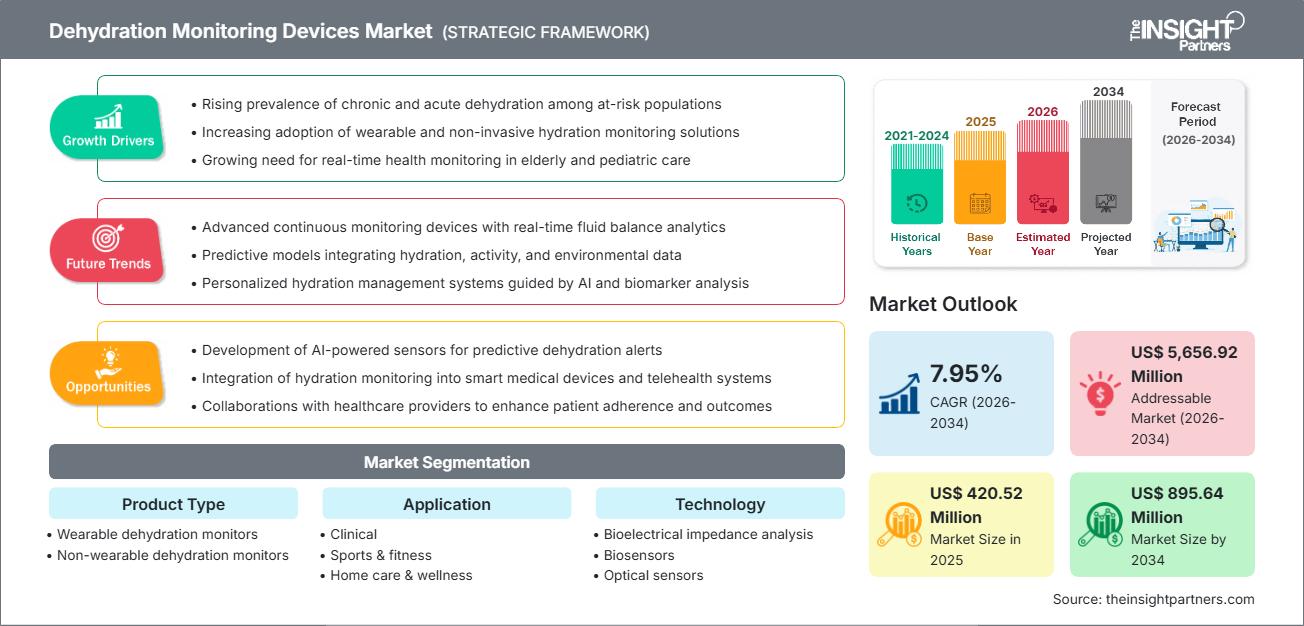
US$ 420.52 Mn
Base year value
2034 Forecast
US$ 895.64 Mn
Projected by 2034
CAGR 2026-2034
7.95 %
Growth rate
Addressable Market
US$ 5,656.92 Mn
(2026-2034)
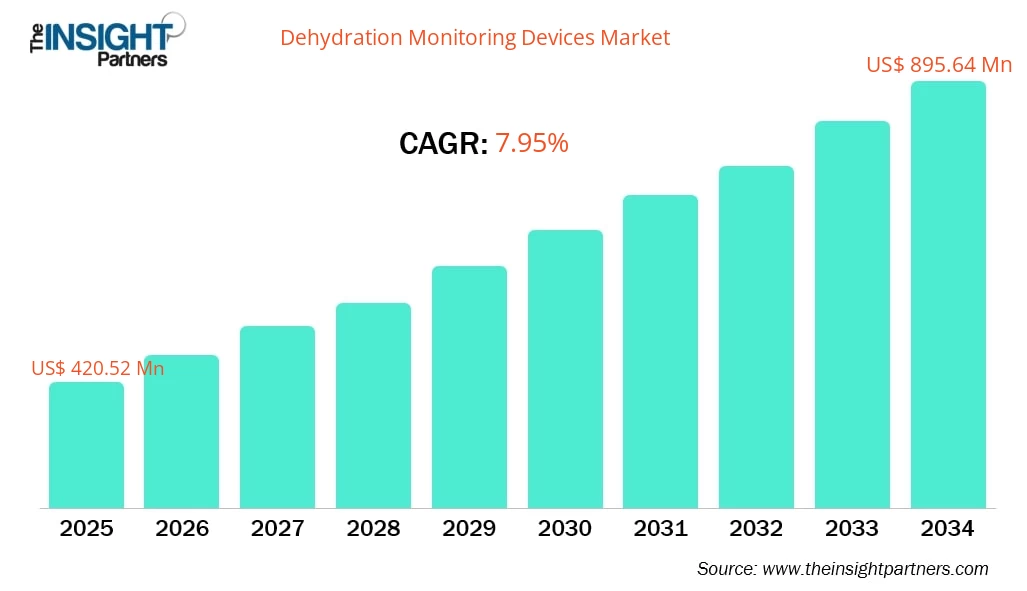
The Dehydration Monitoring Devices Market is valued at US$ 420.52 Million in 2025 and is projected to reach US$ 895.64 Million by 2034, registering a CAGR of 7.95% during 2026–2034. Expanding market is driven by the increase in demand for continuous physiologic monitoring, hydration danger consciousness, and use of wearables and other biosensor technologies in medical care, sport science, occupational safety, and wellness at home.
The North American region is projected to be a significant regional contributor due to the presence of advanced digital health systems, sports science, remote monitoring programs, and personal wellness technologies demands. The Dehydration Monitoring Devices Market size is forecast to experience a Compound Annual Growth Rate (CAGR) of 6.2-6.8 percent from 2026 to 2034.
Dehydration Monitoring Devices Market Assessment and Insights
- North America: North America is expected to account for a 40–44% share in 2025 and grow at a CAGR of 6.2–6.8% between 2026–2034, supported by connected-care infrastructure, sports adoption, and occupational heat-safety programs.
- US: The US is estimated to represent 76–80% of North America in 2025 and expand at a CAGR of 6.1–6.7% during 2026–2034, led by clinical monitoring and digital wellness adoption.
- Europe: Europe is estimated at a 27–31% share in 2025, growing at 7.1–7.7% through 2034. Germany, the UK, France, Italy, and Spain are leading demand centers because of aging populations, home care expansion, and workplace health initiatives.
- Asia Pacific: Asia Pacific is projected to hold a 20–24% share in 2025 and record 8.6–9.2% CAGR through 2034. China, Japan, South Korea, India, and Australia are key markets, supported by healthcare digitization and expanding fitness ecosystems.
- Largest Segment: Wearable dehydration monitors represent an estimated 54–58% market share in 2025 and are projected to grow at 8.2–8.8% CAGR through 2034, supported by continuous sensing and mobile connectivity.
- High Growth Segment: Biosensors represent an estimated 24–28% market share in 2025 and are expected to expand at 9.0–9.6% CAGR, reflecting advances in sweat analysis and personalized physiological monitoring.
- Key companies analyzed in detail: Kenzen Inc.; Epicore Biosystems, Inc.; Nix, Inc.; Baxter International Inc.; Koninklijke Philips N.V.; Masimo Corporation; OMRON Healthcare Co., Ltd.; Abbott Laboratories; iHydrate; Bodimetrics.
Source: The Insight Partners' analysis based on proprietary research, government publications, company annual reports, investor presentations, industry databases, and expert interviews.
Technology advances have moved from hydration prompts to physiological measurement, processing, and notifications. The design of patches, bioimpedance technology, sweat sensors, and optical methods is focused on compact designs and continuous measurements. Manufacturing processes are moving towards a combination of reusable hardware with replaceable sensing units, and cloud-based analytics allows personal interpretation. This will extend usage from sports activities to clinical, workplace, and home care areas.
Future commercialization will see improvements in sensor calibration, interoperability, and clinical validation of the technology. The growth of digital health infrastructure in the emerging Asian markets will help grow volumes, while Europe and North America represent the potential for clinically-oriented products. Regulatory requirements for digital health technologies are also being formalized, allowing companies to differentiate wellness features from clinical functions.
Dehydration Monitoring Devices Market Report Scope
| Report Attribute | Details |
|---|---|
| Market size in 2025 | US$ 420.52 Million |
| Market Size by 2034 | US$ 895.64 Million |
| Global CAGR (2026 - 2034) | 7.95% |
| Historical Data | 2021-2024 |
| Forecast period | 2026-2034 |
Dehydration Monitoring Devices Market Analysis
The Dehydration Monitoring Devices Market development is becoming increasingly associated with the integration of wearable technology, biosensors, telemedicine, and occupational health management. The sources of demand include hospitals, sports teams, businesses, armed forces, caretakers, and consumers looking for personalized hydration advice. The supply chain includes suppliers of sensors, wearable devices, mobile applications, healthcare solutions, contract manufacturers, and experts in data analysis. The most suitable technologies are sweat and bioimpedance since they enable tracking physiological changes without constant laboratory tests.
The technology intensity is still high; the material of the sensors, flexible electronics, microfluidic technologies, batteries, wireless components, and software represent the main cost drivers. The manufacturers have to take into account the balance between sensitivity of the sensors and their durability, comfort and the ability to be calibrated and produced in bulk. The combination of reusable and disposable patch solutions can provide ongoing consumption demands, while non-wearable technologies might rely on lower cost per unit and easy implementation.
According to the Dehydration Monitoring Devices Market Report, the market has a fragmented structure, which consists of diverse medical technologies providers, alongside specific biosensors providers. The core activity of Kenzen Inc. includes the physiological monitoring for heat risk environments, whereas Epicore Biosystems, Inc. concentrates on the sweat sensing and connected hydration intelligence. The activity of Nix, Inc. includes the personalized hydration for athletes and workers, with real-time sweat and electrolyte monitoring.
Positioning in the market is defined now not only by the quality of hardware, but also by the data quality, sensor integrations, software usability and evidences provided. The major companies in the segment include Baxter International Inc., Koninklijke Philips N.V., Masimo Corporation, OMRON Healthcare Co., Ltd., Abbott Laboratories. They provide already established healthcare distribution channels and connected monitoring devices. The companies like iHydrate and Bodimetrics offer specific solutions.
● REPORT CUSTOMIZATION
Tailor This Report To Align With Your Specific Business Requirements
This report can be customized to align precisely with your business objectives, scope, and target markets. Customization options include tailored segmentation, geography, competitive analysis, and strategic insights to support informed decision-making.
Customize This Report →WHAT YOU CAN ADJUST
- ● Segmentations
- ● Geography
- ● Competitive Analysis
- ● Language Preferences
Dehydration Monitoring Devices Market: Strategic Insights
Regional Insights
North America Dehydration Monitoring Devices Market
The North American market is profiled for a share of 40-44% in 2025, growing at a CAGR of 6.2-6.8% until 2034. The region is aided by its developed infrastructure for healthcare facilities, wearable penetration rate, investment in sports science, and remote monitoring procedures in place. The Dehydration Monitoring Devices market share is driven by heat safety needs of occupations and personalized wellness products demand.
The US leads regional market demands, while there are additional opportunities in Canada in the areas of sports medicine, work safety, and connected health. Medical professionals show preference for devices which have the ability to provide information about patient's physiology to doctors, whereas employers look for solutions that would help manage risks of overheating but not affect production process.
U.S. Dehydration Monitoring Devices Market
The US is estimated to represent 76–80% of North America in 2025 and grow at a 6.1–6.7% CAGR through 2034. Demand is supported by hospitals, sports organizations, occupational health programs, and home-care users. The market benefits from established digital health adoption and a broad ecosystem of sensor, software, and medical technology companies.
The clinical applications focus on physiological monitoring, whereas sport application focus on monitoring sweat rate and electrolyte composition. Kenzen Inc., Epicore Biosystems, Inc., Nix, Inc., Masimo Corporation, Abbott Laboratories, among other tech companies, contribute significantly to the domestic environment. The regulatory concern with sensor-based digital health devices also motivates the companies to define the use case, validation standards, and data management before venturing into clinical applications.
Europe Dehydration Monitoring Devices Market
Europe is forecast to be a 27–31% market by 2025 and grow with 7.1–7.7% CAGR until 2034, with Germany being one of the leading markets due to demographics, homecare, active sports lifestyle, and heat safety measures in the workplace. Both the UK and Germany can serve as good opportunities for commercialization due to their well-established healthcare system and infrastructure of telemonitoring. The UK is seen as an important market because of the growing integration of remote monitoring, preventive healthcare and connected care services into healthcare delivery. Germany will benefit from its large medical technology community and institutions' needs. France, Italy and Spain are considered important markets due to aging populations, homecare, rehabilitation, and sports medicine.
APAC Dehydration Monitoring Devices Market
The APAC region will have a market size of 20%-24% by 2025 and grow at a CAGR of 8.6%-9.2% till 2034 and is the fastest-growing region of all. While China will be leading in the scale of the region, Japan, South Korea, India, and Australia will present varied opportunities for development in the field of healthcare, sports, and occupational sectors.
Heat exposure in industries, increasing digitization of healthcare, and interest from the government towards preventive health drives the demand. Japan will focus on elderly care and home monitoring, China will use its manufacturing prowess to develop the digital health segment, whereas India and Australia will have chances in the field of occupational safety and sports.
Middle East & Africa Dehydration Monitoring Devices Market
Middle East and Africa is expected to expand at a 7.0–7.6% CAGR through 2034. Saudi Arabia leads regional opportunity, supported by healthcare modernization, large infrastructure projects, and exposure to extreme heat. The UAE is developing connected healthcare capabilities, while South Africa represents an important medical technology hub.
Demand is associated with the building sector, energy, sports, military defense, and clinical monitoring applications. Adverse weather conditions make it even more important to control heat risks, especially in outdoor working and military scenarios. The rest of MEA is less integrated because of the varying capacity of procurement and digital capabilities. As such, technology that is easier to use becomes more commercially viable.
Segmentation Analysis
Product Type
Wearable dehydration monitors are expected to remain the leading product category, with an estimated 8.2–8.8% CAGR between 2026–2034. Their adoption is supported by portability, continuous data collection, smartphone connectivity, and suitability for sports, occupational, clinical, and home environments. The Dehydration Monitoring Devices Market scope is therefore increasingly influenced by wearable comfort, battery life, sensor accuracy, and analytics.
- Wearable dehydration monitors: Wearable systems provide continuous physiological observations and personalized alerts, making them strategically important for athletes, workers, military users, and home-care populations requiring convenient monitoring.
- Non-wearable dehydration monitors: Non-wearable systems support clinical and institutional workflows where standardized measurements, ease of cleaning, and controlled testing conditions are more important than continuous personal mobility.
Application
Application demand is diversifying from sports-focused monitoring toward clinical, home-care, elder-care, pediatric, and defense settings. The segment is expected to record a 7.4–8.0% CAGR through 2034 as healthcare providers and organizations seek earlier identification of hydration-related risk. Each application requires different accuracy, workflow integration, user interface, and evidence standards.
- Clinical: Clinical use emphasizes reliable measurements, patient monitoring, integration with healthcare workflows, and evidence supporting decisions involving vulnerable or medically complex populations.
- Sports & fitness: Sports applications prioritize real-time sweat, electrolyte, and fluid-loss information that can guide training, recovery, competition preparation, and individualized hydration strategies.
- Home care & wellness: Home users favor simple interfaces, mobile connectivity, and actionable alerts that translate physiological observations into understandable hydration guidance without complex clinical workflows.
- Elder care/pediatrics: Elder-care and pediatric applications emphasize adherence, caregiver visibility, unobtrusive monitoring, and early warning capabilities because hydration status can change rapidly in vulnerable populations.
- Military & defense: Military applications require ruggedized hardware, low-maintenance operation, secure data handling, and monitoring approaches that function during prolonged activity and environmental heat exposure.
Technology
Biosensing technologies are expected to represent the fastest-growing technology group, supported by improvements in sweat analysis, microfluidics, flexible electronics, and signal processing. Dehydration Monitoring Devices Market analysis increasingly centers on technologies capable of translating physiological signals into personalized hydration information while maintaining acceptable accuracy during motion and variable environmental conditions.
- Bioelectrical impedance analysis: Bioelectrical impedance approaches assess changes in electrical properties associated with body fluid status and can support compact, reusable monitoring architectures suitable for continuous measurement.
- Biosensors: Biosensors can detect sweat-related biomarkers and support individualized hydration assessments, making them strategically important for sports, occupational heat management, and future clinical monitoring platforms.
- Optical sensors: Optical sensing can enable noninvasive measurements through light-based physiological assessment, with potential advantages in integration with watches, patches, and other consumer-facing wearable platforms.
- Others: Other approaches encompass emerging sensing and signal-processing methods that may complement established technologies as manufacturers pursue multimodal hydration assessment and broader physiological monitoring.
End User
End-user demand is increasingly shaped by the need to move physiological monitoring beyond hospitals. The segment is expected to grow at a 7.7–8.3% CAGR through 2034 as healthcare systems, sports organizations, home users, and defense facilities adopt connected monitoring tools. Deployment success will depend on affordability, workflow compatibility, data security, and actionable outputs.
- Hospitals & clinics: Hospitals and clinics require clinically useful measurements, integration with monitoring infrastructure, and clear escalation pathways for patients whose hydration status may deteriorate.
- Home-care users: Home-care users value simple wearable or handheld devices that support independent monitoring while allowing caregivers to receive meaningful alerts and longitudinal information.
- Sports organizations: Sports organizations can use centralized dashboards to monitor multiple athletes, identify hydration patterns, and incorporate individualized insights into training and recovery programs.
- Military & defence facilities: Military and defence facilities prioritize secure, durable, field-ready technologies capable of supporting personnel operating under high physical and environmental stress.
Opportunity Snapshot
| Segment Name | Revenue Contribution (High/Medium/Low) | Trend Tag | Adoption Stage |
|---|---|---|---|
| Clinical | High | Remote Monitoring | Scaling |
| Sports & fitness | High | Sweat Analytics | Mature |
| Home care & wellness | Medium | Home Alerts | Scaling |
| Elder care/pediatrics | Medium | Caregiver Alerts | Emerging |
| Military & defense | Medium | Heat Readiness | Scaling |
Dehydration Monitoring Devices Market Growth Drivers and Impact Analysis
Rising occupational exposure to extreme heat
In excess of 2.4 billion workers are subject to excessive heat in their work environments globally, and there is a huge need for efficient methods for managing heat risk and hydrating these workers. In such conditions, the value of having devices which will monitor physiological changes is greater than that of simply adhering to hydration schedules which may be predetermined. Construction sites, agriculture, utilities services, mining industries, logistics, and emergency services are all industries that would benefit from the use of such devices. There are potential markets not only for sale of individual devices but also for enterprise dashboards, subscriptions by the workforce, safety analytics, and protective gear. There is commercial potential in using monitoring technology to assist employers to identify high risks, improve break times, and implement specific hydration programs.
Expansion of personalized digital health monitoring
The broader digital health ecosystem is shifting toward continuous, personalized measurements that connect sensors with mobile applications and cloud analytics. This transition increases the addressable role of hydration monitoring because users increasingly expect health devices to provide interpretation rather than raw measurements. Integration with smartphones, smartwatches, electronic health records, and remote monitoring platforms can make hydration information part of wider physiological profiles. Commercially, this supports recurring software models, data services, and partnerships with healthcare providers, sports organizations, and employers. Manufacturers able to demonstrate reliable longitudinal data can differentiate their products from basic hydration reminders. The impact also extends to product design, encouraging smaller sensors, longer battery life, lower maintenance requirements, and algorithms capable of accounting for activity, environmental conditions, and individual physiological variability.
Growing need for monitoring vulnerable populations
Population aging and the expansion of home-based care are creating demand for technologies that help caregivers identify changing physiological conditions. The global population aged 60 years and older is projected by WHO to reach 2.1 billion by 2050, increasing the importance of convenient monitoring for elderly populations. Dehydration risk can be difficult to identify early because thirst perception, medication effects, mobility limitations, and chronic conditions can influence fluid balance. Devices that provide simple alerts or caregiver dashboards can therefore address a practical gap between periodic clinical assessment and everyday observation. Commercial impact will depend on usability, affordability, caregiver integration, and evidence that measurements provide meaningful decision support. Manufacturers that design specifically for vulnerable users can develop differentiated solutions rather than competing solely on sensor specifications.
Dehydration Monitoring Devices Market Future Trends
Multimodal hydration intelligence
Future systems are likely to combine hydration indicators with temperature, heart rate, activity, electrolyte balance, and environmental information to create broader physiological risk profiles. Instead of presenting isolated hydration readings, platforms may interpret multiple signals through machine-learning models and generate context-specific recommendations. The Dehydration Monitoring Devices Market trends will therefore move toward sensor fusion, personalized baselines, and adaptive alerts that account for workload, climate, and individual response. Wearable manufacturers may increasingly integrate hydration capabilities into broader health platforms rather than developing standalone devices. This approach can improve user convenience while creating richer longitudinal datasets. However, commercial adoption will depend on transparent validation, careful handling of algorithmic uncertainty, and clear distinction between wellness guidance and medical decision support.
Closed-loop hydration management
The next generation of platforms may move from measurement toward closed-loop hydration management, linking physiological observations with digital coaching, fluid recommendations, and organizational intervention workflows. In sports, systems could connect sweat-loss patterns with training schedules and recovery plans. In workplaces, dashboards could combine environmental heat data with individual physiological signals to prioritize interventions. In clinical and home settings, alerts could be routed to caregivers when patterns suggest elevated risk. Such systems can create recurring software value around hardware deployments while improving the practical usefulness of monitoring. Progress will depend on interoperability, cybersecurity, reliable connectivity, and evidence demonstrating that recommendations remain appropriate across different populations. Successful platforms will likely emphasize explainable outputs rather than opaque automated decisions.
Dehydration Monitoring Devices Market Opportunities
Enterprise heat-safety deployments
Large employers represent an attractive opportunity because dehydration and heat exposure affect workforce safety, productivity, and operational continuity. Vendors can package wearable sensors, supervisor dashboards, environmental monitoring, analytics, and training into enterprise programs rather than selling devices individually. The Dehydration Monitoring Devices Market Forecasts can benefit from deployment across construction, utilities, logistics, agriculture, mining, manufacturing, and public safety. Enterprise contracts can also support recurring software and consumable revenue while generating longitudinal datasets for improving algorithms. Strategic partnerships with occupational health providers, protective equipment manufacturers, insurers, and industrial technology companies could accelerate adoption. The most competitive solutions will need rugged hardware, straightforward alerts, privacy controls, and evidence that the technology can function under real workplace conditions without creating additional administrative burden.
Integration with home-care ecosystems
Home care offers an opportunity to extend hydration monitoring from episodic assessment to continuous preventive support. Device providers can integrate sensors with caregiver applications, telehealth platforms, medication-management systems, and remote patient monitoring services. This model can address elderly users, children, post-operative patients, and people managing chronic conditions where fluid balance is clinically relevant. Strategic investment should prioritize low-complexity interfaces, automated data transmission, comfortable wearability, and configurable alert thresholds. Partnerships with home-health agencies and healthcare systems can provide access to larger patient populations while generating evidence for reimbursement discussions. Vendors can also explore subscription models that combine hardware, analytics, caregiver services, and technical support. Commercial success will depend on demonstrating measurable workflow or health benefits rather than simply increasing the volume of collected physiological data.
Recent Developments
- June 2026: Epicore Biosystems, Inc. launched a new Hydration Readiness Score and expanded its Connected Hydration platform with a reusable armband, companion application, and enhanced dashboards. The release extends the company's technology from real-time hydration measurement toward longitudinal readiness and risk insights for athletes, healthcare teams, industrial workers, military personnel, caregivers, and other users.
- May 2026: Abbott Laboratories secured CE Mark for Libre Duo and Libre Duo 10 Day, combining continuous glucose and ketone monitoring in a single biowearable platform. Although focused on metabolic monitoring rather than hydration, the development demonstrates continued expansion of biosensor architectures capable of delivering continuous physiological data and connected insights through wearable platforms.
- September 2025: Koninklijke Philips N.V. and Masimo Corporation renewed and expanded their strategic collaboration to integrate Masimo monitoring technologies, including sensor technologies and AI-enabled capabilities, into Philips patient-monitoring platforms. The agreement emphasizes interoperability, connected care, and next-generation wearable monitoring, reinforcing the broader ecosystem in which specialized physiological measurements can be integrated.
Frequently Asked Questions

- Comprehensive Market Sizing and Forecast Analysis
- Detailed Segmentation Analysis
- In-Depth Market Dynamics Assessment
- Regional and Country-Level Insights
- Competitive Landscape and Company Benchmarking
- Strategic Business Intelligence
Recent Reports
Testimonials

The Insight Partners provided valuable market intelligence that supported our global go-to-market strategy. Their team was professional, responsive, and attentive to our feedback, providing thoughtful analysis and helpful methodological clarifications throughout the project.
Junmo Kim Chief Financial Officer (CFO), Enertech Co., Ltd.
The Insight Partners' SCADA System Market report is comprehensive, with valuable insights on current trends and future forecasts. The team was highly professional, responsive, and supportive throughout. We are very satisfied and highly recommend their services.
RAN KEDEM Partner, Reali Technologies LTDs
I requested a report on a very specific software market and the team produced the report in a few days. The information was very relevant and well presented. I then requested some changes and additions to the report. The team was again very responsive and I got the final report in less than a week.
JEAN-HERVE JENN Chairman, Future Analytica
We worked with The Insight Partners for an important market study and forecast. They gave us clear insights into opportunities and risks, which helped shape our plans. Their research was easy to use and based on solid data. It helped us make smart, confident decisions. We highly recommend them.
PIYUSH NAGPAL Sr. Vice President, High Beam Global
The Insight Partners delivered insightful, well-structured market research with strong domain expertise. Their team was professional and responsive throughout. The user-friendly website made accessing industry reports seamless. We highly recommend them for reliable, high-quality research services
YUKIHIKO ADACHI CEO, Deep Blue, LLC.
This is the first time I have purchased a market report from The Insight Partners.While I was unsure at first, I visited their web site and felt more comfortable to take the risk and purchase a market report.I am completely satisfied with the quality of the report and customer service. I had several questions and comments with the initial report, but after a couple of dialogs over email with their analyst I believe I have a report that I can use as input to our strategic planning process.Thank you so much for taking the extra time and making this a positive experience.I will definitely recommend your service to others and you will be my first call when we need further market data.
JOHN SUZUKI President and Chief Executive Officer, Board Director, BK Technologies
I wish to appreciate your support and the professionalism you displayed in the course of attending to my request for information regarding to infectious disease IVD market in Nigeria. I appreciate your patience, your guidance, and the fact that you were willing to offer a discount, which eventually made it possible for us to close a deal. I look forward to engaging The Insight Partners in the future, all thanks to the impression you have created in me as a result of this first encounter.
DR CHIJIOKE ONYIA MANAGING DIRECTOR, PineCrest Healthcare Ltd.Reason to Buy
- Informed Decision-Making
- Understanding Market Dynamics
- Competitive Analysis
- Identifying Emerging Markets
- Customer Insights
- Market Forecasts
- Risk Mitigation
- Boosting Operational Efficiency
- Strategic Planning
- Investment Justification
- Tracking Industry Innovations
- Aligning with Regulatory Trends





 Get Free Sample for