
Delivery Robots Market Trends, Demand & Growth by 2034
Coverage: By Type (Semi Autonomous Robots, Fully Autonomous Robots); Capacity (Up to 10 Kg, 10 50 Kg, O50 Kg); Component (Hardware, Software); End User (Retail, Food and Beverages, Postal, Healthcare, Others) , and Geography (North America, Europe, Asia Pacific, and South and Central America)
- Status : Data Released
- Report Code : TIPRE00003864
- Category : Electronics and Semiconductor
- No. of Pages : 150
- Available Report Formats :


- Last update date : August 04, 2026


2025 Market Size
US$ 2.64 Bn
Base year value
2034 Forecast
US$ 40.23 Bn
Projected by 2034
CAGR 2026-2034
35.37 %
Growth rate
Addressable Market
US$ 144.13 Bn
(2026-2034)
The Delivery Robots Market stands at US$ 2.64 Billion in 2025 and is expected to rise to US$ 40.23 Billion by 2034, growing with a CAGR of 35.37% during 2026-2034. The market is developing owing to the growth of autonomous ground robots as they are progressing from pilot projects to actual applications in last-mile, campus, retail, food service, postal and health care logistic services.
In North America, the Delivery Robots Market size is driven due to the development of university campuses networks, grocery deliveries services, laws for sidewalk automation, and restaurant companies trying to reduce their last mile costs. The region is anticipated to grow at a CAGR of 34.0-36.5% during 2026-2034, with the United States being aided by suburban density, labor restrictions, and operational data from fleet usage.
Delivery Robots Market Assessment and Insights
- North America: The region is estimated to hold 39–42% share in 2025 and grow at a CAGR of 34.0–36.5% during 2026–2034, supported by campus food delivery, grocery pilots, and maturing sidewalk rules.
- US: The country represents 76–80% of North America in 2025 and is projected to grow at a CAGR of 34.5–37.0% during 2026–2034.
- Europe: Europe accounts for 24–27% share in 2025 and is expected to grow at a CAGR of 32.0–34.5% during 2026–2034, led by the UK, Germany, Estonia, France, and Spain.
- Asia Pacific: Asia Pacific represents 22–25% share in 2025 and is forecast to grow at a CAGR of 37.5–40.0% during 2026–2034, with China, Japan, South Korea, India, and Australia anchoring demand.
- Largest Segment: Fully autonomous robots hold 58–62% market share in 2025 and are expected to grow at a CAGR of 36.0–38.5% during 2026–2034.
- High Growth Segment: Software holds 28–32% market share in 2025 and is expected to grow at a CAGR of 39.0–42.0% during 2026–2034.
- Key companies analyzed in detail: ABB Ltd.; Dispatch Inc.; Eliport S.L.; Kiwibot; Marble Robot Inc.; Nuro, Inc.; Robby Technologies, Inc.; Savioke, Inc.; Starship Technologies OÜ; TeleRetail AG; Relay Robotics, Inc.; Serve Robotics Inc.
Source: The Insight Partners' analysis based on proprietary research, government publications, company annual reports, investor presentations, industry databases, and expert interviews.
The market has transitioned from remote assistance to fleet management with the use of HD cameras, LiDAR, radar, ultrasonic sensors, GPS, visual SLAM, path planning, and cloud management. The dynamics of production are now centered around modular cargo compartments, weather-proof housing, battery switching capability, tamper-proof locks, teleoperation capabilities, and software verification. Platform vendors are also re-designing their platforms for pavements, college campuses, hospitals, hotels, logistics facilities, and low-speed roadways, as different deployment environments vary widely in terms of traffic density, load weight, curb space, and local regulations.
The future will depend upon geographies which have increasing volumes of e-commerce, labor shortage, dense food delivery market and smart cities programs. Investment in software for autonomous vehicle, fleet management, insurance, battery performance and safety around pedestrians is crucial. The regulatory tailwind is seen in areas with test corridors, speed limits, insurance requirements and data sharing regulations. The robot delivery players that can show service uptime and implementation of robots in cities will get more traction than prototypes.
Delivery Robots Market Report Scope
| Report Attribute | Details |
|---|---|
| Market size in 2025 | US$ 2.64 Billion |
| Market Size by 2034 | US$ 40.23 Billion |
| Global CAGR (2026 - 2034) | 35.37% |
| Historical Data | 2021-2024 |
| Forecast period | 2026-2034 |
Delivery Robots Market Analysis
Factors contributing to growth of Delivery Robots Market are high cost of labor for last mile, increased online ordering of food products, convenience strategy at campuses, and quick local neighborhood fulfillment requirements by retailers. They reduce dependency of delivery agents on deliveries based on short distance and narrow margins and can be operated using structured geofencing. The ecosystem consists of robot Original Equipment Manufacturers (OEM), autonomy software, sensors, battery, remote support, delivery platforms, restaurants, grocery stores, hospitals, insurance companies, and municipalities.
Supply side dynamics favor delivery platforms with capability of uptime in the presence of sidewalks, crossings, ramps, rain, snow, heat, crowds, and vandalism threats. Robot hardware needs to find a compromise between weight, load capacity, range, and visibility. Software needs to solve challenges including mapping, obstacles recognition, dispatching, fleet recharging, and exception handling. Commercial customers have started to value cost per delivery, batching orders, regulatory compliance, user app integration, and service recovery.
The competition landscape is divided but increasingly driven by data. As shown by Delivery Robots Market report, Starship Technologies OÜ and Kiwibot benefit from their food delivery and campus experience, while Nuro, Inc. provides road autonomy functions to deliver goods. ABB Ltd. and Relay Robotics, Inc. prove their strengths in enterprise and hospitality environments through navigation and payload transporting capabilities, which matter more than sidewalk scaling ability.
Current investment trends highlight the focus on economics of repeatable processes. Serve Robotics Inc. is building up its delivery fleets with restaurant and platform partners, Starship Technologies OÜ prioritizes larger robotic systems and Nuro, Inc. is moving on with autonomy licensing. Dispatch Inc., Eliport S.L., Marble Robot Inc., Robby Technologies, Inc., Savioke, Inc. and TeleRetail AG stand out as specialists in postal, retail, hospitality and controlled premise environments.
● REPORT CUSTOMIZATION
Tailor This Report To Align With Your Specific Business Requirements
This report can be customized to align precisely with your business objectives, scope, and target markets. Customization options include tailored segmentation, geography, competitive analysis, and strategic insights to support informed decision-making.
Customize This Report →WHAT YOU CAN ADJUST
- ● Segmentations
- ● Geography
- ● Competitive Analysis
- ● Language Preferences
Delivery Robots Market: Strategic Insights
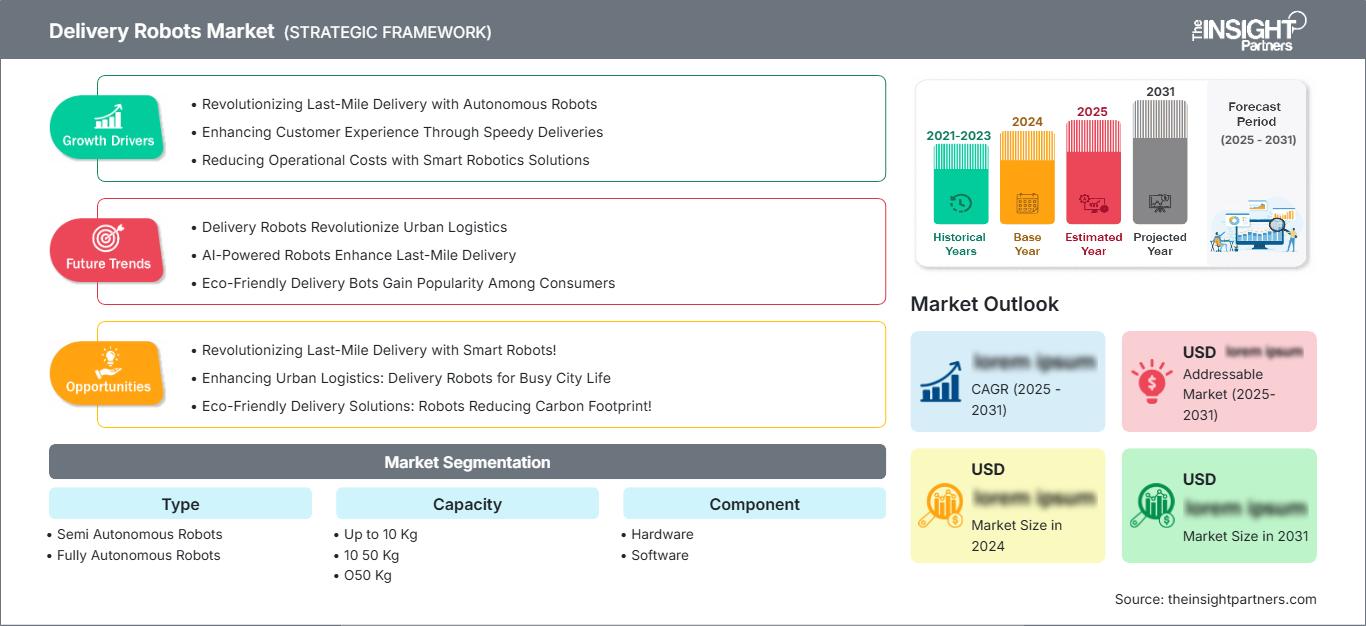
Regional Insights
North America Delivery Robots Market
North America accounts for 39–42% share in 2025 and is expected to grow at a CAGR of 34.0–36.5% through 2026–2034. North America Delivery Robots Market share is driven by university campuses, suburban grocery deliveries, integration into restaurant platforms, and city-by-city legality of slow-speed sidewalk robots. Lack of labor in hospitality and logistics enhances the attractiveness of reliable robotic delivery.
Maturity of deployment is very high in the United States, while Canada participates in providing control of pilots at campuses and high-density areas. Starship Technologies OÜ, Kiwibot, Serve Robotics Inc., Nuro, Inc., Relay Robotics, Inc., and Savioke, Inc. benefit from partnerships with foodservice companies, grocery stores, hospitals, hotels, and logistics providers. Safety certification, permission in the city, quantity of deliveries, and unlocking of applications are vital for consumers.
U.S. Delivery Robots Market
The USA makes up 76-80% of North America’s total demand in 2025 and will continue to experience growth at a CAGR of 34.5-37.0% during 2026-2034. Campus dining facilities, fast food establishments, grocery retailers, hospitals and neighborhoods are major areas of applications. Bigger fleets allow collecting information about how to optimize routes, how cars behave in traffic, and how customers are handed off.
Presence of the company is confirmed by such brands as Nuro, Inc., Serve Robotics Inc., Kiwibot, Relay Robotics, Inc., Savioke, Inc. and Starship Technologies OÜ. Major application areas include restaurant deliveries in two-mile radius, grocery deliveries to suburbs, transportation of goods at hospitals and indoor service robots for hotels. Regulations will be concentrated on speed limits, right-of-way rules, insurance, cybersecurity and incidents.
Europe Delivery Robots Market
Europe accounts for 24-27% market share in 2025 and is expected to expand at a CAGR of 32.0-34.5% in the period of 2026-2034. The UK has the advantage due to grocery and food deliveries testing, supportive local authorities, and partnership deals with delivery platforms. Germany brings the contribution of industry facilities, healthcare logistics, retail facilities and safety requirements for autonomous mobile equipment.
Estonia has strategic importance due to the origin of Starship Technologies OÜ and continues validating sidewalk deployments in various European cities. France, Italy and Spain offer their contribution due to dense urban environments, tourism zones, retail companies and sustainable city goals. European customers give priority to pedestrian safety, accessibility, privacy, and integration into courier platforms.
APAC Delivery Robots Market
The APAC region holds 22–25% market share in 2025 and is predicted to witness CAGR of 37.5-40.0% over the forecast period of 2026-2034. Leading the APAC region is China due to high density in e-commerce, electronics value chain, robotics manufacturing, and smart cities pilots. The other APAC countries are Japan and South Korea due to rising demand from aged population, hospitals, convenience retailing, and service sector favorable to automation.
The Indian and Australian markets are now shifting their focus from pilot programs towards targeted applications on campuses, malls, residential areas, and food deliveries. Some of the policies that drive the demand are digital commerce, congestion management in cities, contactless service, and government funding for robotics. Localizing hardware is one way to reduce costs; however, safety certification, good sidewalks, fleet management, and route management will play an important role.
Middle East & Africa Delivery Robots Market
The Middle East and Africa segment is estimated to have a CAGR of 28.0–31.0% between 2026 and 2034. The UAE takes the lead based on initiatives in smart cities, upscale shopping districts, automation of hospitality services, and innovation logistics zones. Saudi Arabia includes demand for major infrastructure projects, airport zones, campuses, and retail development requiring automation.
Adoption in South Africa and RoMEA will be selective, restricted to the use in security-sensitive estates, shopping complexes, hospitals, and commercial entities. Investments in energy and infrastructure enable a controlled environment that allows robots to deliver documents, food, medications, and packages. Adoption will be based on costs of imports, maintenance facilities, walkways, and regulations.
Segmentation Analysis
Type
The Type segment is projected to grow at a CAGR of 35.0–37.5% during 2026–2034. Delivery Robots Market scope spans remote-assisted robots used during early deployments and fully autonomous units built for repeatable routes. Adoption depends on safety certification, autonomy confidence, service density, teleoperation cost, and the ability to recover from blocked paths, weather changes, and complex crossings.
- Semi Autonomous Robots remain important where cities require human oversight, routes are new, or environments are irregular, allowing operators to build trust before reducing intervention levels.
- Fully Autonomous Robots lead commercial scaling because mature platforms reduce labor per delivery, improve dispatch efficiency, and support higher utilization across campuses, neighborhoods, hospitals, and retail premises.
Capacity
The Capacity segment is expected to grow at a CAGR of 34.0–36.8% during 2026–2034 as payload design determines route economics and end-use suitability. Smaller robots suit meals and small parcels, mid-capacity platforms support groceries and postal bags, and heavier robots address enterprise logistics, industrial parts, medical supplies, and multi-order batching.
- Up to 10 Kg robots dominate meal, beverage, medicine, and small parcel delivery because compact size, lower battery demand, and sidewalk maneuverability improve public acceptance.
- 10 50 Kg platforms are strategically important for groceries, postal items, retail bundles, and multi-order routes where higher payload improves revenue per trip without requiring large vehicles.
- O50 Kg robots address controlled enterprise, industrial, and healthcare environments where heavier loads, secure compartments, and predictable routes can justify higher hardware cost and supervision.
Component
The Component segment is forecast to grow at a CAGR of 36.0–39.0% during 2026–2034. Hardware still represents the larger cost base through chassis, motors, batteries, sensors, processors, locks, and cargo boxes. Software is gaining value as buyers require navigation, fleet orchestration, app integration, remote assistance, cybersecurity, analytics, and compliance reporting.
- Hardware remains essential because reliability, payload integrity, weather resistance, battery life, braking performance, and pedestrian visibility directly affect service uptime and municipal approval.
- Software is the fastest value layer as autonomy models, mapping, dispatch, route learning, remote intervention, security, and customer interfaces determine scalable delivery economics.
End User
The End User segment is projected to grow at a CAGR of 35.5–38.0% during 2026–2034 as delivery density improves across commercial services and controlled facilities. Retailers prioritize rapid local fulfillment, food operators need low-cost short trips, postal users seek parcel automation, and healthcare buyers value secure, traceable movement of meals, medicines, samples, and supplies.
- Retail users adopt robots for neighborhood fulfillment, curbside replenishment, store-to-door parcels, and shopping center services where speed and lower delivery cost improve customer retention.
- Food and Beverages remain a high-frequency use case because meals are lightweight, time-sensitive, and concentrated around campuses, offices, restaurants, residential zones, and delivery apps.
- Postal operators evaluate robots for local parcels, mailroom automation, and secure last-mile trials where predictable routes can reduce van dependency and manual walking time.
- Healthcare demand is rising in hospitals, laboratories, senior care sites, and clinics where robots can move medicines, samples, meals, linen, and supplies with traceability.
Opportunity Snapshot
| End User | Revenue Contribution | Trend Tag | Adoption Stage |
| Retail | High | Store Fulfillment | Scaling |
| Food and Beverages | High | Meal Routing | Scaling |
| Postal | Medium | Parcel Loops | Emerging |
| Healthcare | Medium | Medical Runs | Scaling |
Delivery Robots Market Growth Drivers and Impact Analysis
Last-Mile Labor Cost Pressure and Service Density
Short-distance delivery is labor intensive because couriers spend time waiting, collecting orders, traveling through congested streets, and completing handoffs for low-ticket items. Robots improve economics where routes are dense, payloads are light, and merchants can stage orders close to demand. The impact is strongest in campuses, residential neighborhoods, business parks, and mixed-use districts where many trips fall within a limited radius. Operators can reserve human couriers for longer or complex routes while robots handle repetitive local trips. This driver also changes procurement metrics, shifting attention toward cost per drop, robot utilization, intervention rate, and uptime.
Regulatory Normalization of Sidewalk Automation
Municipal rules are gradually moving from ad hoc pilots to clearer operating frameworks that define maximum speed, payload limits, right-of-way behavior, insurance obligations, accessibility safeguards, and reporting requirements. This reduces uncertainty for retailers, restaurants, hospitals, and delivery platforms considering larger contracts. The market impact is practical: vendors can plan fleet expansion only when they understand where robots may travel, how incidents are handled, and what data must be shared. Consistent rules also help insurers price risk and support financing. Cities that coordinate permits with curb management and pedestrian safety programs are likely to attract earlier commercial fleets.
Advances in Sensors, Batteries, and Fleet Software
Technical improvement is widening the range of routes robots can handle safely. Better cameras, LiDAR, radar, ultrasonic sensors, onboard processors, and machine-learning perception help devices identify pedestrians, cyclists, animals, curbs, ramps, and temporary obstacles. Battery upgrades extend duty cycles, while fleet software assigns routes, manages charging, flags exceptions, and supports remote assistance. The real-world impact is higher order capacity per robot and fewer service interruptions. Vendors that integrate hardware durability with continuously updated software can reduce intervention rates and demonstrate stronger safety performance to cities, customers, and commercial partners.
Delivery Robots Market Future Trends
AI-Guided Multi-Robot Orchestration
Delivery Robots Market trends will move toward coordinated fleets rather than isolated units. AI systems will assign orders dynamically, balance charging schedules, predict sidewalk congestion, and reroute robots around construction, crowds, or weather disruptions. This trend will be most valuable for retailers and restaurants operating many short delivery windows across compact territories. Future platforms will combine demand forecasting with live fleet telemetry so operators can stage robots before lunch peaks, campus events, or evening grocery demand. Competitive advantage will depend on lower intervention rates, better batching, and transparent performance data.
Hybrid Indoor-Outdoor Service Routes
Future deployments will increasingly connect indoor preparation points with outdoor delivery paths. Robots may collect meals inside campus dining halls, move through covered corridors, cross sidewalks, and complete outdoor customer handoffs. Hospitals, hotels, malls, airports, and mixed-use developments will use similar workflows for meals, parcels, linen, medicines, and retail orders. This trend will require better elevator integration, door access, indoor mapping, outdoor localization, and compartment security. Vendors that solve both controlled-building navigation and public-path movement will address more use cases per customer.
Delivery Robots Market Opportunities
Campus and Healthcare Fleet-as-a-Service Models
Delivery Robots Market Forecasts indicate attractive potential in campuses and healthcare networks that need predictable transport but prefer operating expense models. Vendors can bundle robots, charging docks, mapping, remote assistance, maintenance, insurance support, and analytics into fleet-as-a-service contracts. Universities gain dining convenience and reduced peak labor pressure, while hospitals improve movement of meals, samples, pharmacy items, and supplies across large facilities. This opportunity is actionable because routes are repeatable, users are known, and service-level agreements can measure delivery time, uptime, failed handoffs, and safety incidents.
Retail Micro-Fulfillment and Postal Automation Corridors
Retailers and postal operators can use delivery robots to connect micro-fulfillment nodes, stores, lockers, and nearby households within defined corridors. Investment should focus on route selection, curb access, loading workflows, secure compartments, and integration with order management systems. The opportunity is strongest where vans are inefficient for short trips, parking is limited, and customers accept scheduled neighborhood deliveries. Postal users can begin with internal campuses, business districts, and parcel loops before expanding to public sidewalks. Success requires close coordination with city authorities, accessibility groups, and insurers.
Recent Developments
- June 2026: Amazon announced a more than €10 billion investment to expand and modernize its European fulfillment network with next-generation robotics, including the deployment of the new AI-powered Proteus autonomous robot, expansion of Vulcan (robot with a sense of touch), and STARK collaborative robotic systems. The initiative also includes plans to create 25,000 new jobs across Europe, accelerate same-day and ultra-fast delivery capabilities, and improve operational efficiency by combining AI-driven automation with human workers.
- March 2026: Niantic Spatial announced a strategic partnership with Coco Robotics to accelerate autonomous last-mile delivery by integrating its Visual Positioning System (VPS) and geospatial AI into Coco’s robot fleet. The collaboration aims to improve robot localization and navigation in dense urban environments where GPS is unreliable, enabling more accurate, safe, and scalable autonomous deliveries while advancing spatial AI infrastructure for real-world robotics.
- January 2026: Pudu Robotics launched the PUDU T150, a light-payload autonomous mobile robot (AMR) designed to expand industrial automation for material handling in manufacturing, warehousing, and logistics environments. With a 150 kg payload capacity, compact design, autonomous navigation, and flexible deployment capabilities, the T150 enables efficient transport in space-constrained facilities, helping businesses improve operational efficiency, reduce manual handling, and accelerate the adoption of smart factory automation.
Frequently Asked Questions

- Comprehensive Market Sizing and Forecast Analysis
- Detailed Segmentation Analysis
- In-Depth Market Dynamics Assessment
- Regional and Country-Level Insights
- Competitive Landscape and Company Benchmarking
- Strategic Business Intelligence
Recent Reports
Testimonials

The Insight Partners' SCADA System Market report is comprehensive, with valuable insights on current trends and future forecasts. The team was highly professional, responsive, and supportive throughout. We are very satisfied and highly recommend their services.
RAN KEDEM Partner, Reali Technologies LTDs
I requested a report on a very specific software market and the team produced the report in a few days. The information was very relevant and well presented. I then requested some changes and additions to the report. The team was again very responsive and I got the final report in less than a week.
JEAN-HERVE JENN Chairman, Future Analytica
We worked with The Insight Partners for an important market study and forecast. They gave us clear insights into opportunities and risks, which helped shape our plans. Their research was easy to use and based on solid data. It helped us make smart, confident decisions. We highly recommend them.
PIYUSH NAGPAL Sr. Vice President, High Beam Global
The Insight Partners delivered insightful, well-structured market research with strong domain expertise. Their team was professional and responsive throughout. The user-friendly website made accessing industry reports seamless. We highly recommend them for reliable, high-quality research services
YUKIHIKO ADACHI CEO, Deep Blue, LLC.
This is the first time I have purchased a market report from The Insight Partners.While I was unsure at first, I visited their web site and felt more comfortable to take the risk and purchase a market report.I am completely satisfied with the quality of the report and customer service. I had several questions and comments with the initial report, but after a couple of dialogs over email with their analyst I believe I have a report that I can use as input to our strategic planning process.Thank you so much for taking the extra time and making this a positive experience.I will definitely recommend your service to others and you will be my first call when we need further market data.
JOHN SUZUKI President and Chief Executive Officer, Board Director, BK Technologies
I wish to appreciate your support and the professionalism you displayed in the course of attending to my request for information regarding to infectious disease IVD market in Nigeria. I appreciate your patience, your guidance, and the fact that you were willing to offer a discount, which eventually made it possible for us to close a deal. I look forward to engaging The Insight Partners in the future, all thanks to the impression you have created in me as a result of this first encounter.
DR CHIJIOKE ONYIA MANAGING DIRECTOR, PineCrest Healthcare Ltd.Reason to Buy
- Informed Decision-Making
- Understanding Market Dynamics
- Competitive Analysis
- Identifying Emerging Markets
- Customer Insights
- Market Forecasts
- Risk Mitigation
- Boosting Operational Efficiency
- Strategic Planning
- Investment Justification
- Tracking Industry Innovations
- Aligning with Regulatory Trends





 Get Free Sample for