
Demineralized Bone Matrix Market Trends, Share & Demand by 2034
Demineralized Bone Matrix Market Size and Forecasts (2021–2034), Global and Regional Share, Trends, and Growth Opportunity Analysis Report Coverage : by Product (Putty, Fiber, Paste); Application (Spinal Fusion, Dental, Joint Reconstruction); End User (Hospitals, Outpatient facilities); and Geography (North America, Europe, Asia Pacific, and South and Central America)
- Status : Data Released
- Report Code : TIPRE00040676
- Category : Life Sciences
- No. of Pages : 150
- Available Report Formats :


- Last update date : August 17, 2026


2025 Market Size
US$ 1.45 Bn
Base year value
2034 Forecast
US$ 2.29 Bn
Projected by 2034
CAGR 2026-2034
5.21 %
Growth rate
Addressable Market
US$ 16.97 Bn
(2026-2034)
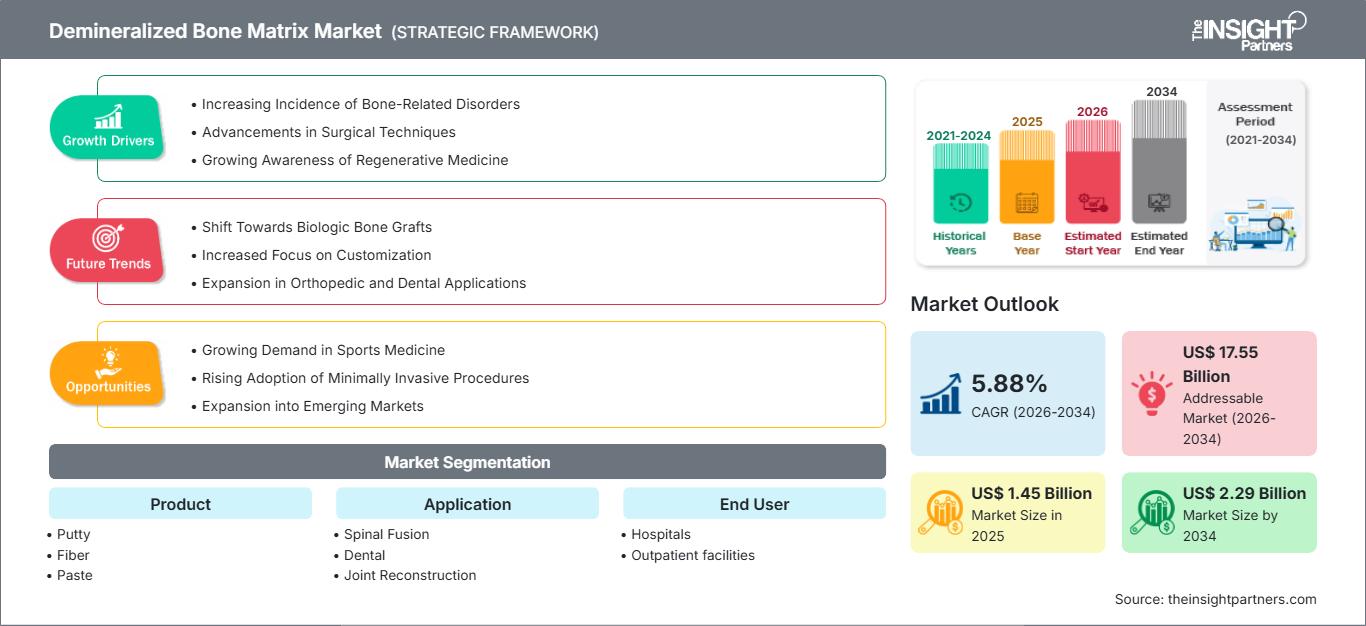
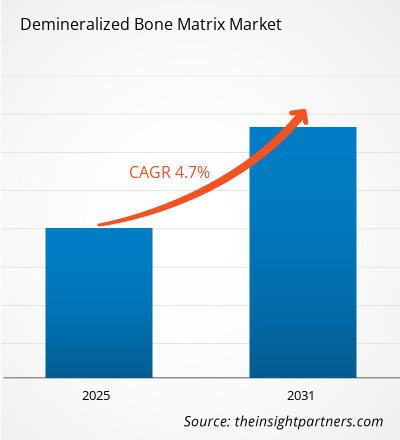
The Demineralized Bone Matrix market was valued at US$ 1.45 billion in 2025 and is expected to reach US$ 2.29 billion by 2034; it is estimated to record a CAGR of 5.21% during 2026-2034.
Demineralized Bone Matrix Market Assessment and Insights
- North America: The region represents an estimated 42–46% share in 2025 and is growing at a CAGR of 6.1–6.7% between 2026–2034. Mature orthopedic infrastructure and strong biologics adoption support regional leadership.
- US: The US accounts for approximately 78–82% of North America's 2025 market and is growing at a CAGR of 6.0–6.6% between 2026–2034, led by spinal and joint procedures.
- Europe: Europe holds an estimated 25–29% share in 2025 and is growing at a CAGR of 5.2–5.8% between 2026–2034, with Germany, the UK, France, Italy, and Spain providing established procedural demand.
- Asia Pacific: Asia Pacific represents approximately 16–20% share in 2025 and is growing at a CAGR of 6.5–7.2% between 2026–2034, led by China, Japan, South Korea, India, and Australia.
- Largest Segment: Spinal Fusion holds an estimated 47–51% market share in 2025 and is projected to grow at a CAGR of 5.9–6.4% through 2034, supported by extensive biologic graft utilization.
- High Growth Segment: Dental applications represent an estimated 14–18% market share in 2025 and are expected to expand at a CAGR of 6.5–7.1% through 2034, reflecting regenerative dental procedures.
- Key companies analyzed in detail: Zimmer Biomet Holdings, Inc., Medtronic plc, DePuy Synthes, Stryker Corporation, Arthrex, Inc., SeaSpine Holdings Corporation, Globus Medical, Inc., Berkeley Advanced Biomaterials, Inc., Xtant Medical Holdings, Inc., and LifeNet Health.
Source: The Insight Partners' analysis based on proprietary research, government publications, company annual reports, investor presentations, industry databases, and expert interviews.
More attention is now paid to putties, fiber formulations and delivery systems that aid in proper grafting. The processing technologies should help in retaining the biological nature of proteins, while sterility and proper handling is maintained at the same time. Hence, the economics of manufacturing rely on donor tissue availability, proper demineralization, validation of processing and packaging and distribution logistics of these grafts.
In the future, the growth will be driven by increasing outpatient orthopedic surgery, procedural activity in the Asia Pacific region and rising utilization of biological substances together with implants. The regulatory focus will remain on issues such as traceability of tissues, donor screening, validation of process and scientific proof. Thus, the investments in these products are shifting towards unique formulations, integrated delivery system and manufacturing capacity for grafts.
Demineralized Bone Matrix Market Report Scope
| Report Attribute | Details |
|---|---|
| Market size in 2025 | US$ 1.45 Billion |
| Market Size by 2034 | US$ 2.29 Billion |
| Global CAGR (2026 - 2034) | 5.21% |
| Historical Data | 2021-2024 |
| Forecast period | 2026-2034 |
Demineralized Bone Matrix Market Analysis
Demand is directly related to the volume of orthopedic and reconstructive surgeries, especially spinal fusions. WHO reports that there are around 1.71 billion people suffering from musculoskeletal conditions worldwide and 619 million people suffered from low back pain in 2020. This burden provides for a wide procedural foundation. Growth of the Demineralized Bone Matrix Market is also driven by the capacity of allograft products to complement autografts without causing donor site morbidities.
The value chain starts with donor acquisition and tissue characterization and then continues to processing, demineralization, biological evaluation, sterilization, packaging and distribution. It is important for suppliers to handle both tissue supply and strict quality control due to the variations in residual mineral content and their effect on handling properties and biological performance. Competing manufacturers have to offer proprietary technology in terms of processing, fiber structure, carriers and delivery systems, not only tissue supply.
Competition in the Demineralized Bone Matrix Market Report is characterized by the union of major orthopedic companies with companies specialized in tissues and biologics. Medtronic plc provides a wide variety of grafts, while Stryker Corporation incorporates DBM into their biologics line. Zimmer Biomet Holdings, Inc. and DePuy Synthes capitalize on their vast orthopedic distribution network, while Arthrex, Inc., SeaSpine Holdings Corporation, Globus Medical, Inc., Xtant Medical Holdings, Inc., Berkeley Advanced Biomaterials, Inc., and LifeNet Health compete based on specialty biologics and procedures.
The current competitive landscape is becoming more influenced by product differentiation and surgeon workflow. Products such as fiber-based matrices, preformed putties, flowables, and biologic blends may help reduce the need for preparation and facilitate better placement. Thus, DBM market analysis increasingly focuses on consistency in processing, data generation, inventory management, surgeon education, and compatibility with spinal and orthopedic systems. Priorities in investment lie with handling-focused products that still possess biological performance.
● REPORT CUSTOMIZATION
Tailor This Report To Align With Your Specific Business Requirements
This report can be customized to align precisely with your business objectives, scope, and target markets. Customization options include tailored segmentation, geography, competitive analysis, and strategic insights to support informed decision-making.
Customize This Report →WHAT YOU CAN ADJUST
- ● Segmentations
- ● Geography
- ● Competitive Analysis
- ● Language Preferences
Demineralized Bone Matrix Market: Strategic Insights
Regional Insights
North America Demineralized Bone Matrix Market
It is expected that North America will account for 42–46% of the Demineralized Bone Matrix Market Share and grow at a CAGR of 6.1–6.7% up until 2034. The United States is the largest contributor to the regional consumption owing to spinal, trauma, and joint reconstruction surgeries performed there. Awareness among providers regarding allograft products, well-developed tissue banks, and proper reimbursement channels increase the adoption rate.
Canada represents a relatively smaller but technologically mature market whereby orthopedic clinics adopt biologics within the reconstruction procedures. The region boasts of sophisticated sterilization facilities and training of surgeons. The United States retains its position as the market leader due to high procedure volumes, availability of products in the market and wide range of offerings by major orthopedic companies.
U.S. Demineralized Bone Matrix Market
In terms of North America's 2025 demand, the U.S. accounts for 78% to 82%, and the CAGR during the period from 2024 to 2034 is expected to be at 6.0% to 6.6%. Spinal fusion continues to be an area of primary application, and joint reconstruction, and trauma surgeries expand the application range. American Joint Replacement Registry has identified over 4.4 million hip and knee surgeries in its 2025 annual report database.
Hospitals are still key to the business, but patient flow toward the ambulatory sector changes purchasing trends and increases the interest in pre-assembled solutions. Medtronic plc, Stryker Corporation, Zimmer Biomet Holdings, Inc., Arthrex, Inc., and Xtant Medical Holdings, Inc. have biologics portfolio and presence in this market segment.
Europe Demineralized Bone Matrix Market
Europe’s share in 2025 is estimated to be 25–29%, and it will grow at a 5.2–5.8% CAGR during 2024-2034. The largest market in Europe is Germany, followed by the UK, France, Italy, and Spain. Mature healthcare systems and rising orthopedic procedures volume form the basis of stable demand; however, reimbursement and regulatory conditions differ.
The United Kingdom gains from developed centers for orthopedic treatment and growing interest in optimized surgical pathways. Germany possesses high procedure volume along with developed infrastructure for medical technologies. France, Italy, and Spain make their contribution due to aging population and growing reconstructive treatment. The decision-making process in Europe increasingly takes into account the presence of clinical evidence, traceability, product consistency, and procedural value, and not only the price of the product.
APAC Demineralized Bone Matrix Market
APAC is forecasted at 16-20% market share by 2025 and will register a growth rate of 6.5-7.2% CAGR until 2034. China leads the region in terms of demand, followed by Japan, South Korea, India, and Australia. Development of orthopedic capabilities, aging populations, and availability of advanced surgical techniques contribute to adoption.
China is a combination of manufacturing prowess along with healthcare investments, while Japan is an advanced orthopedic market. South Korea and Australia represent established specialist capabilities, while India offers promising volume potential in the future. Healthcare access and medical manufacturing policies may help to increase biologic graft technology adoption in the region.
Middle East & Africa Demineralized Bone Matrix Market
The Middle East and Africa represent a more limited business base, but present growth opportunities in conjunction with specialist orthopedic infrastructure. Demand in Saudi Arabia will be driven by healthcare transformation efforts, while the UAE has well-developed private hospitals and medical tourism facilities. South Africa represents the key market in sub-Saharan Africa for such advanced orthopedic treatments.
The region is expected to exhibit a growth rate of about 5.0-6.0% CAGR until 2034. Orthobiologic uptake in Saudi Arabia will be possible due to local infrastructure initiatives, development of private hospitals and growing surgical capabilities. Markets in the Rest of MEA will face limited growth due to inconsistent reimbursement systems, limited availability of specialists, and reliance on imports.
Segmentation Analysis
Product
Product is projected to expand at a 5.7–6.2% CAGR between 2026–2034. Product selection increasingly reflects the anatomical defect, surgeon preference, delivery approach, and need for precise graft placement. Putty remains commercially prominent because it combines moldability with straightforward handling, while fibers and paste address specialized placement requirements.
- Putty: Maintains strong clinical adoption because moldable consistency supports irregular defects and simplifies placement. Its compatibility with spinal and orthopedic workflows makes it strategically important for standardized operating-room use.
- Fiber: Interlocking fiber structures provide conformability and surface area while supporting retention. Demand is strengthened by applications requiring controlled packing, procedural flexibility, and compatibility with biologic fluids.
- Paste: Flowable formulations address defects requiring precise delivery into confined spaces. Their handling characteristics can reduce preparation complexity and support minimally invasive or anatomically difficult procedures.
Application
Application is expected to grow at a 6.0–6.6% CAGR during 2026–2034. Spinal fusion remains the principal demand center, while dental and joint reconstruction applications provide diversification. Demineralized Bone Matrix scope increasingly extends toward procedures where graft handling, osteoinductive potential, and compatibility with complementary biomaterials influence purchasing decisions.
- Spinal Fusion: Represents the dominant application because graft materials are routinely used to support fusion objectives. High procedural volume and continuing innovation in spinal instrumentation sustain substantial product utilization.
- Dental: Demand is supported by ridge augmentation, sinus procedures, and defect reconstruction. The segment provides an attractive pathway for products offering convenient handling and predictable integration within dental workflows.
- Joint Reconstruction: Adoption is linked to revision procedures, bone defects, and biologic augmentation. Integration with orthopedic implants and regenerative approaches creates opportunities for differentiated graft configurations.
End User
End User is forecast to register a 5.8–6.4% CAGR from 2026–2034. Hospitals retain strong purchasing influence because complex spinal and reconstructive procedures remain concentrated in institutional settings. Outpatient facilities are gaining relevance as selected orthopedic procedures migrate toward ambulatory pathways and require compact, ready-to-use biologic products.
- Hospitals: Remain the leading end-user environment because of high surgical volume, specialist availability, tissue-handling infrastructure, and established procurement processes for biologic graft materials.
- Outpatient facilities: Adoption is increasing as selected orthopedic procedures migrate toward ambulatory settings. Products requiring minimal preparation and efficient storage can better match shorter procedural workflows.
Opportunity Snapshot
| Application | Revenue Contribution | Trend Tag | Adoption Stage |
| Spinal Fusion | High | Fusion Biologics | Mature |
| Dental | Medium | Ridge Regeneration | Scaling |
| Joint Reconstruction | Medium | Revision Grafting | Scaling |
Demineralized Bone Matrix Market Growth Drivers and Impact Analysis
Rising Orthopedic Procedure Volumes
The rising requirement for orthopedic surgical procedures forms the key demand dynamic. As per WHO, the number of people suffering from musculoskeletal disorders around the world is estimated at 1.71 billion, making a broad-based customer base that consists of people with fractures, joint disorders, and back disorders. The American Joint Replacement Registry has reported over 4.4 million hip and knee procedures in the US until 2025. Higher volumes of procedures mean higher volumes of tissue required for fusion and reconstruction of bones. Higher volumes of procedures for the suppliers mean higher volumes of tissues being processed and closer relationships being built with hospitals.
Preference for Ready-to-Use Biologic Formats
Efficiency in the operating room is increasingly becoming a significant criterion in product selection for healthcare professionals looking to minimize time, staffing, and inventory needs. Moldable putties, flowable matrices, and ready-to-deliver systems offer advantages over complex graft preparation approaches in terms of preparation within the operating room. The implications of such trends on manufacturers include the emergence of competition in areas like product packaging, control of viscosities, accurate delivery, and convenience in storing products. Outpatient centers are especially favored by such products since they minimize preparation and provide consistent application in different situations. The business implications do not limit themselves to product design due to the possibility of wider surgeon acceptance and decreased need for training.
Expansion of Regenerative Orthopedic Care
Biologic treatments are now being used more frequently in addition to orthopedic implants, fixation devices, and autograft procedures. Demineralized matrixes offer allograft scaffolds in addition to the natural proteins that come along with bone formation. This opens up room for combined products using bone marrow aspirates, platelet rich plasma, cellular matrices, or artificial grafts. The result has been portfolio development that extends beyond a single form of DBM to a more holistic biologics ecosystem. This is strategically important because integrated products can lead to increased cross selling in the realms of spine, trauma, sports medicine, and reconstruction. At the same time, evidence still matters, as the clinician must feel assured that the product, manufacturing, and use are properly documented.
Demineralized Bone Matrix Market Future Trends
Procedure-Specific Graft Engineering
Future product development in the Demineralized Bone Matrix Market trends is likely to move toward increasingly procedure-specific architectures rather than generalized graft formulations. Manufacturers can tailor fiber length, particle configuration, carrier behavior, hydration response, and delivery geometry to specific surgical environments. Spinal fusion products may prioritize retention and packing, while dental products can emphasize moldability and defect conformity. Digital planning may further influence product selection by enabling surgeons to match graft formats with patient anatomy and procedure characteristics before surgery. Over time, this approach could reduce reliance on broad product categories and increase the value of specialized portfolios. Competitive differentiation will increasingly depend on how effectively manufacturers connect material science, processing control, packaging, and procedural workflow into a coherent clinical proposition.
Integrated Biologic Delivery Systems
The next stage of development is likely to emphasize integrated systems that combine DBM with biologic fluids, cellular components, or delivery technologies. Such systems can provide surgeons with greater control over hydration, consistency, placement, and compatibility with complementary graft materials. Integration may be particularly valuable in minimally invasive procedures where access limitations make conventional graft preparation difficult. Manufacturers can also use integrated systems to strengthen relationships across multiple product categories, including biologics, surgical instruments, and orthopedic implants. Regulatory and evidence requirements will influence the speed of adoption, particularly when products combine tissue-based materials with additional technologies. Companies that establish reproducible preparation protocols and clearly define intended use may be better positioned to translate integrated biologic concepts into routine clinical workflows.
Demineralized Bone Matrix Market Opportunities
Expansion Across Emerging Orthopedic Markets
Asia Pacific provides a strategic expansion opportunity because orthopedic capacity is increasing while aging populations are creating additional demand for reconstructive care. China, India, South Korea, and selected Southeast Asian markets offer different combinations of procedure growth, hospital modernization, and medical technology investment. Suppliers can pursue these markets through local distributors, surgeon education, regulatory partnerships, and regionally appropriate product portfolios. A successful approach requires more than geographic availability because tissue regulation, reimbursement, pricing, and procurement practices vary substantially. Companies can improve market access by establishing local quality and regulatory expertise while maintaining standardized manufacturing controls. Demineralized Bone Matrix Forecasts therefore support selective investment in countries where procedural growth and healthcare infrastructure are developing simultaneously.
Premium Biologics and Workflow Integration
Another opportunity in the Demineralized Bone Matrix Market Forecast lies in premium graft systems designed around surgical workflow rather than material characteristics alone. Products that combine DBM with convenient delivery mechanisms, optimized hydration, or complementary biologics can address operational challenges in hospitals and ambulatory facilities. Companies can target differentiated value through reduced preparation, predictable handling, inventory simplification, and procedure-specific configurations. Strategic investment in evidence generation can strengthen reimbursement discussions and surgeon adoption, especially where competing products have similar biological foundations. Partnerships with orthopedic implant companies, tissue organizations, and specialized distributors may broaden commercial reach. Demineralized Bone Matrix Report users evaluating suppliers should therefore assess the complete offering, including processing consistency, delivery technology, clinical evidence, training support, and supply reliability rather than comparing graft composition alone.
Recent Developments
- May 2026: Xtant Medical Holdings, Inc. launched Trivium Shaped, extending its Trivium portfolio with pre-shaped configurations of next-generation demineralized bone matrix allograft intended to support handling, preparation, and placement across surgical applications. The launch expands the company’s DBM offering toward more procedure-oriented formats and follows its earlier introduction of Trivium advanced bone graft technology.
- June 2026: Arthrex, Inc. published updated 2026 spine coding and reimbursement guidance covering AlloSync demineralized bone matrix products, including orthopedic indications for filling skeletal gaps and use as an autograft extender. The update also addressed AlloSync cancellous bone configurations and reinforced the product portfolio’s positioning across spine, pelvis, and extremity procedures.
- January 2025: LifeNet Health introduced PliaFX Flo, a flowable addition to its advanced fiber demineralized bone matrix portfolio. The pre-filled syringe format was designed to improve precision and simplify application during spine and orthopedic procedures, extending the company’s fiber technology into a delivery format intended to reduce intraoperative preparation requirements.
Frequently Asked Questions

- Comprehensive Market Sizing and Forecast Analysis
- Detailed Segmentation Analysis
- In-Depth Market Dynamics Assessment
- Regional and Country-Level Insights
- Competitive Landscape and Company Benchmarking
- Strategic Business Intelligence
Recent Reports
Testimonials

The Insight Partners provided valuable market intelligence that supported our global go-to-market strategy. Their team was professional, responsive, and attentive to our feedback, providing thoughtful analysis and helpful methodological clarifications throughout the project.
Junmo Kim Chief Financial Officer (CFO), Enertech Co., Ltd.
The Insight Partners' SCADA System Market report is comprehensive, with valuable insights on current trends and future forecasts. The team was highly professional, responsive, and supportive throughout. We are very satisfied and highly recommend their services.
RAN KEDEM Partner, Reali Technologies LTDs
I requested a report on a very specific software market and the team produced the report in a few days. The information was very relevant and well presented. I then requested some changes and additions to the report. The team was again very responsive and I got the final report in less than a week.
JEAN-HERVE JENN Chairman, Future Analytica
We worked with The Insight Partners for an important market study and forecast. They gave us clear insights into opportunities and risks, which helped shape our plans. Their research was easy to use and based on solid data. It helped us make smart, confident decisions. We highly recommend them.
PIYUSH NAGPAL Sr. Vice President, High Beam Global
The Insight Partners delivered insightful, well-structured market research with strong domain expertise. Their team was professional and responsive throughout. The user-friendly website made accessing industry reports seamless. We highly recommend them for reliable, high-quality research services
YUKIHIKO ADACHI CEO, Deep Blue, LLC.
This is the first time I have purchased a market report from The Insight Partners.While I was unsure at first, I visited their web site and felt more comfortable to take the risk and purchase a market report.I am completely satisfied with the quality of the report and customer service. I had several questions and comments with the initial report, but after a couple of dialogs over email with their analyst I believe I have a report that I can use as input to our strategic planning process.Thank you so much for taking the extra time and making this a positive experience.I will definitely recommend your service to others and you will be my first call when we need further market data.
JOHN SUZUKI President and Chief Executive Officer, Board Director, BK Technologies
I wish to appreciate your support and the professionalism you displayed in the course of attending to my request for information regarding to infectious disease IVD market in Nigeria. I appreciate your patience, your guidance, and the fact that you were willing to offer a discount, which eventually made it possible for us to close a deal. I look forward to engaging The Insight Partners in the future, all thanks to the impression you have created in me as a result of this first encounter.
DR CHIJIOKE ONYIA MANAGING DIRECTOR, PineCrest Healthcare Ltd.Reason to Buy
- Informed Decision-Making
- Understanding Market Dynamics
- Competitive Analysis
- Identifying Emerging Markets
- Customer Insights
- Market Forecasts
- Risk Mitigation
- Boosting Operational Efficiency
- Strategic Planning
- Investment Justification
- Tracking Industry Innovations
- Aligning with Regulatory Trends





 Get Free Sample for