
Dengue Testing Market Trends, Demand & Growth by 2034
Dengue Testing Market Size and Forecasts (2021 - 2034), Global and Regional Share, Trends, and Growth Opportunity Analysis Report Coverage : by Product Type (ELISA-Based Tests, RT-PCR Based Tests, Dengue IgG/IgM Rapid Test, Other Tests); End-User (Hospitals, Diagnostic Centers, Other End-Users); and Geography (North America, Europe, Asia Pacific, and South and Central America)
- Status : Data Released
- Report Code : TIPRE00040600
- Category : Life Sciences
- No. of Pages : 150
- Available Report Formats :


- Last update date : August 17, 2026


2025 Market Size
US$ 676.80 Mn
Base year value
2034 Forecast
US$ 1,023.82 Mn
Projected by 2034
CAGR 2026-2034
4.71 %
Growth rate
Addressable Market
US$ 7,721.57 Mn
(2026-2034)
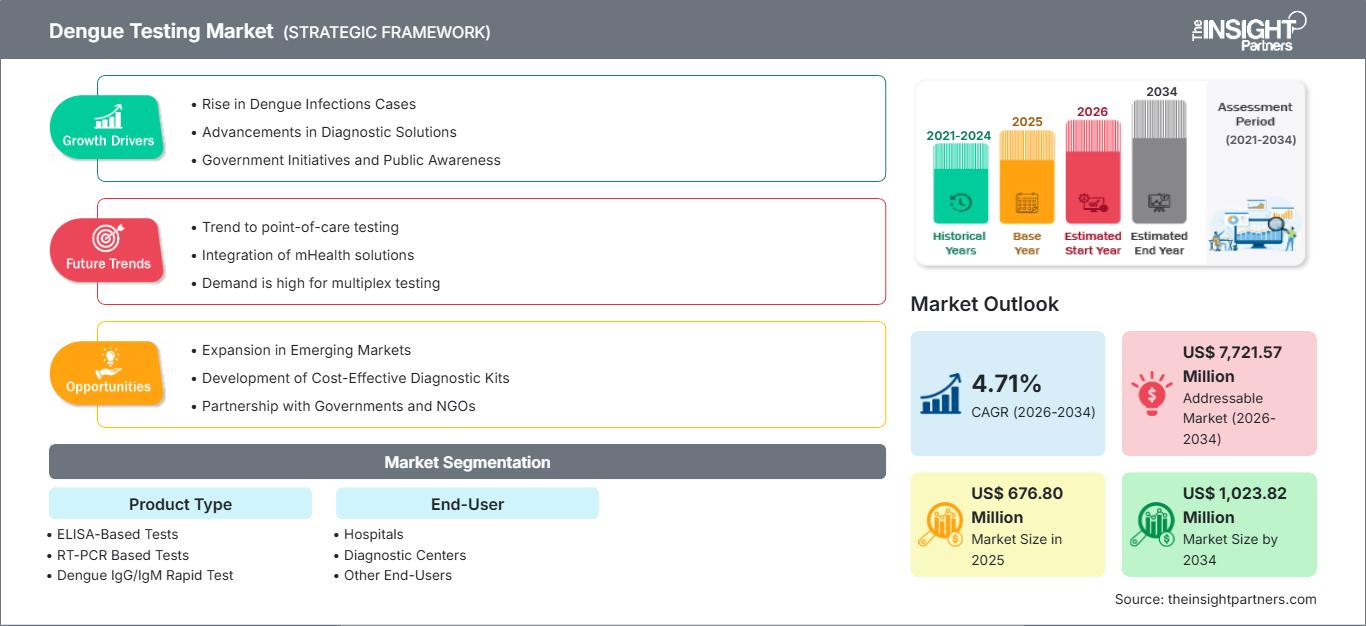
The Dengue Testing Market is valued at US$ 676.80 Million in 2025 and is projected to reach US$ 1,023.82 Million by 2034, expanding at a CAGR of 4.71% during 2026–2034. The market involves diagnostic techniques used for identifying dengue infection at various phases of disease in order to assist in clinical management and response efforts during outbreaks.
The North American region will maintain its position as an important region from the perspective of the structure of the Dengue Testing Market Size. It will be driven by travel-acquired infections, increased preparedness for surveillance, and the use of molecular and immunoassay techniques. It is projected to record a CAGR of 5.0–5.4% in the period from 2026 to 2034.
Dengue Testing Market Assessment and Insights
- North America: North America is estimated to represent a 24–28% share in 2025 and grow at a CAGR of 5.0–5.4% during 2026–2034, supported by surveillance readiness, imported infections, and advanced laboratory infrastructure.
- US: The U.S. is estimated to account for 68–72% of North American revenue in 2025, growing at a CAGR of 5.1–5.5% through 2034 as molecular and serological testing expands.
- Europe: Europe is estimated to hold a 25–29% share in 2025 and expand at a CAGR of 4.5–4.9% through 2034, led by Germany, the United Kingdom, France, Italy, and Spain, where travel-linked surveillance remains important.
- Asia Pacific: Asia Pacific is estimated to hold a 31–35% share in 2025 and grow at a CAGR of 5.2–5.7%, led by India, China, Japan, Thailand, and South Korea amid endemic transmission and improving laboratory capacity.
- Largest Segment: ELISA-Based Tests represent an estimated market share of 39–43% in 2025, with a CAGR of 4.5–5.0% between 2026 and 2034, reflecting established laboratory workflows.
- High Growth Segment: RT-PCR Based Tests represent an estimated market share of 26–30% in 2025 and are projected to grow at a CAGR of 5.8–6.4% through 2034.
- Key companies analyzed in detail: Abbott Laboratories, Becton, Dickinson and Company, bioMérieux SA, Alere Inc., MedMira Inc., Chembio Diagnostics, Inc., Tecan Group Ltd., DiaSorin S.p.A., Premier Medical Corporation, Enzo Life Sciences, Inc.
Source: The Insight Partners' analysis based on proprietary research, government publications, company annual reports, investor presentations, industry databases, and expert interviews.
Dengue test methods have moved away from mostly manual serology to more advanced immunoassay, amplification, and rapid methods. The Dengue Testing Market has been positively impacted by greater connection between analyzers, better reagent stability, and increasing focus on selection of the proper tests based on the disease stage. Future production is likely to be driven more by the need for standardized test kits which can provide high through-put while at the same time allowing for surges in demand for outbreak control.
The future growth of the market will be fueled by increasing demand for testing because of increased dengue exposure in previously lower-risk areas. It will be driven by investments into multiplex molecular systems, decentralized testing systems, better reagent stability, and digital reporting. Regulatory interest of health organizations is expected to be in favor of well validated and clearly defined products, especially those which address cross-reactivity issues with other flaviviruses.
Dengue Testing Market Report Scope
| Report Attribute | Details |
|---|---|
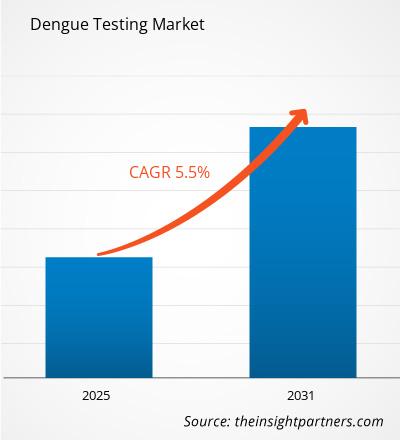
| Market size in 2025 | US$ 676.80 Million |
| Market Size by 2034 | US$ 1,023.82 Million |
| Global CAGR (2026 - 2034) | 4.71% |
| Historical Data | 2021-2024 |
| Forecast period | 2026-2034 |
Dengue Testing Market Analysis
The Dengue Testing Market Growth relies heavily on the need for distinguishing between dengue and other febrile infections, as well as choosing the right test for specific infection stages. This market demand moves from manufacturers of reagents and instruments, to distributors, to labs, to hospitals, to public health organizations. The use of molecular and antigen tests is especially appropriate during the acute stage of infection, whereas antibody-based tests have more applicability towards later stages.
Manufacturing the supply chain involves recombinant antigens, antibodies, enzymes, primers, probes, plastic materials, calibrants, and instruments. The manufacturers have to provide consistency of the reagents and handle the peaks in demand that occur in relation to monsoon periods and epidemics. The procurement process takes into account more and more the criteria of analytical characteristics, processing speed, instrument compatibility, shelf-life and cost per positive result.
The Dengue Testing Market Report shows signs of competition across diversified diagnostics vendors and targeted assay developers. Abbott Laboratories is helped by its wide-ranging infectious disease diagnostics capabilities, while bioMérieux SA focuses on automated immunoassays and infectious disease laboratory workflow. Becton, Dickinson and Company, DiaSorin S.p.A., and Tecan Group Ltd. add platform, automation, and laboratory infrastructure capabilities.
The competition will depend on having a larger capability portfolio and not only on the dengue test kit. Significant investments are being made towards automation, multiplexing, decentralization, and integrated tests that target labs with different throughput capacity. MedMira Inc., Chembio Diagnostics Inc., Premier Medical Corporation, Enzo Life Sciences Inc., and Alere Inc. are good examples of more specialized/traditional diagnostic tests, while future differentiation will depend on access, validation, distribution, and surveillance needs.
● REPORT CUSTOMIZATION
Tailor This Report To Align With Your Specific Business Requirements
This report can be customized to align precisely with your business objectives, scope, and target markets. Customization options include tailored segmentation, geography, competitive analysis, and strategic insights to support informed decision-making.
Customize This Report →WHAT YOU CAN ADJUST
- ● Segmentations
- ● Geography
- ● Competitive Analysis
- ● Language Preferences
Dengue Testing Market: Strategic Insights
Regional Insights
North America Dengue Testing Market
The North American Dengue Testing Market Share is expected to be 24%–28% in 2025, expanding at a CAGR of 5.0%–5.4% between 2026 and 2034. The North American share for the Market includes advanced lab equipment, infectious disease surveillance, and testing of individuals coming back from endemic zones. The leading demand driver in this region is the U.S., whereas Canada makes an input through travel medicine and public health laboratories.
In addition to the demand drivers, structural factors in this market include mosquito vector surveillance in south U.S. states and local transmission. Hospitals and public health laboratories have been using both the molecular and serologic approaches depending on when the symptoms appear. Immunoassay tests provide automation for lab testing processes, RT-PCR provides confirmatory and surveillance benefits.
U.S. Dengue Testing Market
U.S. holds approximately 68–72% of the total North American market by revenues in 2025 and is forecasted to experience a CAGR of 5.1–5.5% till 2034. Demand is mainly observed in public health labs, hospitals, academic medical centers, and specialized infectious disease centers. Abbott Laboratories and other leading providers of diagnostics offer a wide range of applications including confirmation in lab, surveillance, and infection detection among travelers.
Application usage tends to become more specific to the stage of infection. Molecular tests are highly useful for the acute stage, while antibody tests are more suitable once the immune system is activated. Public health labs need tests that can be used for confirmation procedures and differentiation of dengue from other flaviviral diseases. Advanced laboratory capabilities along with regular regional transmission provide robust demand foundation.
Europe Dengue Testing Market
Europe is estimated to represent a 25–29% share in 2025 and grow at a CAGR of 4.5–4.9% through 2034, with Germany positioned as the leading country. Imported cases, tourism, migration, and occasional local transmission are increasing the importance of maintaining dengue testing capacity within infectious-disease laboratories and tropical medicine centers.
The United Kingdom and Germany possess advanced reference laboratory systems and travel-associated diagnostic services, whereas France, Italy, and Spain are considered important due to international movement and vector establishment in their local regions. There is increasing demand for quick laboratory diagnosis, automated serology, and molecular diagnostics in cases presenting with clinically compatible symptoms. The issue of analysis and validation forms an important part of European procurement.
APAC Dengue Testing Market
Asia Pacific is estimated to hold a 31–35% share in 2025 and record the fastest regional expansion at a CAGR of 5.2–5.7%. India, China, Japan, South Korea, and Australia represent important markets, with India and China benefiting from extensive public-health activity and expanding diagnostic capacity.
Industrial development depends on local manufacturing, automation in laboratories, and distribution of rapid tests. Policies aimed at the surveillance of vector-transmitted diseases boost the need for rapid tests, especially at times when there is an outbreak. Testing for imported infections is done in Japan and South Korea, whereas Australia focuses on surveillance in areas vulnerable to mosquito-transmitted infections.
Middle East & Africa Dengue Testing Market
MEA will grow at a CAGR of 5.0-5.6% up until 2034, with Saudi Arabia as one of the key markets. The environment of MEA will include the emergence of dengue fever, varying availability of laboratory testing, and growth in healthcare facilities, thereby creating opportunities in both centralized and decentralized testing.
Comparatively well-developed hospitals exist in Saudi Arabia and the UAE, while South Africa will contribute with an existing laboratory network. The remainder of MEA is likely to rely on cost-effective rapid test kits. Investment in healthcare, urbanization, travel, and mosquito ecology based on climate are some of the factors that may impact testing needs.
Segmentation Analysis
Product Type
The Dengue Testing Market scope by product type reflects different diagnostic requirements across the infection timeline. ELISA-based testing remains central to standardized laboratory workflows, while molecular methods support early confirmation and serotype surveillance. Rapid antibody testing addresses decentralized settings where laboratory infrastructure is constrained. Overall product competition is expected to favor complementary portfolios, with the segment growing at a CAGR of 5.0–5.6% during 2026–2034.
- ELISA-Based Tests: Widely used in centralized laboratories for antigen and antibody detection, these assays support standardized workflows, batch processing, and epidemiological testing where laboratory infrastructure is established.
- RT-PCR Based Tests: Molecular assays provide early detection and confirmatory value, making them strategically important for acute cases, reference laboratories, serotype identification, and surveillance programs requiring high analytical specificity.
- Dengue IgG/IgM Rapid Test: Rapid antibody formats support decentralized clinical environments where quick decisions and limited laboratory infrastructure favor easy-to-use testing with minimal equipment requirements.
- Other Tests: Alternative diagnostic formats address specialized laboratory or field requirements, providing supplementary testing options where conventional molecular or immunoassay workflows may not be practical.
End-User
End-user demand is shaped by testing volume, clinical acuity, laboratory capability, and procurement structure. Hospitals remain important because suspected dengue cases frequently enter through acute-care pathways, while diagnostic centers support centralized processing and referral testing. The segment is projected to grow at a CAGR of 4.8–5.4% during 2026–2034 as testing expands across clinical and surveillance networks.
- Hospitals: Hospitals maintain a strong position because emergency, inpatient, and infectious-disease departments require timely confirmation, particularly during seasonal surges and suspected severe dengue cases.
- Diagnostic Centers: Diagnostic centers support high-throughput processing and referral testing, making them strategically important for centralized ELISA workflows, molecular assays, and testing volumes generated outside hospital networks.
- Other End-Users: Public-health laboratories, research institutions, travel clinics, and specialized facilities provide supplementary demand, particularly for surveillance, epidemiological investigations, and imported infection assessment.
Opportunity Snapshot
| Segment Name | Revenue Contribution (High/Medium/Low) | Trend Tag | Adoption Stage |
|---|---|---|---|
| Hospitals | High | Acute Testing | Mature |
| Diagnostic Centers | High | Centralized Testing | Mature |
| Other End-Users | Medium | Surveillance Testing | Scaling |
Dengue Testing Market Growth Drivers and Impact Analysis
Expansion of Surveillance for Climate-Sensitive Dengue Transmission
Changing temperature, rainfall, urbanization, and mosquito ecology are broadening the geographic conditions in which dengue transmission can occur. This increases the value of diagnostic preparedness even in locations where routine dengue testing historically represented a small laboratory category. For healthcare providers, the practical impact is greater readiness to test patients with compatible symptoms and relevant travel or exposure histories. Public-health agencies also require reliable laboratory confirmation to distinguish true transmission from syndromic signals. As surveillance expands, procurement is likely to move from episodic emergency purchasing toward planned inventories, validated algorithms, and integrated reporting. The result is a more stable demand environment for diagnostic manufacturers, particularly suppliers capable of supporting both centralized reference laboratories and decentralized clinical testing networks.
Stage-Specific Testing Requirements Improve Diagnostic Utilization
Dengue diagnosis is not served effectively by a single universal assay because detectable viral material, antigen, and antibodies change during the course of infection. This clinical reality encourages healthcare systems to combine molecular, antigen, and serological approaches according to symptom timing. The commercial impact is a broader addressable opportunity across multiple test categories rather than simple substitution between technologies. Laboratories may invest in complementary assay menus, while hospitals can use rapid formats for initial assessment and reference testing for confirmation when clinically indicated. Suppliers that clearly define specimen requirements, analytical performance, and intended-use windows can strengthen adoption because laboratory managers increasingly evaluate tests as components of diagnostic algorithms. This dynamic supports recurring reagent demand and reinforces the value of interoperable testing portfolios.
Public-Health Procurement Raises Requirements for Reliability and Scalability
Dengue outbreaks can generate sudden increases in testing volumes, placing pressure on reagent supply, analyzer capacity, laboratory staffing, and distribution networks. Public-health procurement therefore increasingly considers scalability and supply continuity alongside assay performance. Manufacturers with diversified production, established distribution channels, and stable reagent sourcing can respond more effectively when demand rises sharply. The impact extends to packaging and inventory strategy, because smaller facilities may favor ready-to-use formats while reference laboratories require higher-throughput configurations. Procurement bodies also place greater emphasis on documented performance and quality systems, particularly when diagnostic results influence surveillance decisions. Consequently, suppliers are encouraged to develop products that combine operational simplicity with standardized performance, reducing the risk that capacity constraints undermine outbreak detection and clinical management.
Dengue Testing Market Future Trends
Multiplex Arbovirus Testing Becomes More Relevant
The Dengue Testing Market trends are expected to move toward multiplex platforms capable of differentiating dengue from other febrile and arboviral infections within a coordinated workflow. This development responds to overlapping symptoms and the circulation of dengue, chikungunya, Zika, and other infections in several geographic settings. Multiplex testing can reduce sequential testing, simplify laboratory workflows, and provide broader clinical information from a single specimen. Future platforms are likely to combine molecular targets with increasingly automated interpretation, while immunoassay systems may expand panels covering complementary markers. Adoption will depend on analytical validation, reimbursement, instrument compatibility, and evidence that broader panels improve clinical decision-making. Laboratories with high seasonal variability may particularly value flexible platforms that can switch between routine testing and outbreak-oriented workloads.
Connected Diagnostics Support Real-Time Surveillance
Digital connectivity is expected to become increasingly important as health authorities seek faster integration of laboratory findings with surveillance systems. Connected analyzers, laboratory information systems, and secure reporting tools can reduce manual transcription and accelerate identification of geographic or seasonal changes in dengue activity. Future solutions may incorporate automated quality checks, result interpretation support, and dashboards that aggregate information across hospital and laboratory networks. Such capabilities could be especially valuable in regions where outbreaks move quickly between urban districts or across administrative boundaries. Manufacturers therefore have an opportunity to differentiate conventional assays through software compatibility and data interoperability rather than analytical performance alone. The strongest solutions will likely combine reliable testing with practical reporting architecture that supports clinicians, laboratories, and public-health decision-makers.
Dengue Testing Market Opportunities
Localized Manufacturing and Regional Distribution Hubs
Investment opportunities are emerging in regional manufacturing and distribution models designed to reduce dependence on long international supply chains. Local or regional production of selected reagents, consumables, and rapid testing components can improve availability during seasonal outbreaks while reducing replenishment delays. Manufacturers can pursue contract production, technology-transfer arrangements, or regional packaging facilities where regulatory conditions permit. The Dengue Testing Market Forecasts should therefore be evaluated alongside infrastructure availability, procurement mechanisms, and local laboratory capacity rather than relying solely on disease incidence. India, Southeast Asia, Latin America, and selected African markets offer differentiated opportunities because demand patterns vary between centralized laboratory testing and decentralized rapid diagnosis. Companies that align product configuration with local procurement requirements can improve market access while creating more resilient supply networks.
Affordable Decentralized Testing Platforms
Expansion of decentralized testing offers a strategic opportunity for manufacturers targeting communities where access to sophisticated laboratories remains uneven. Compact platforms that require limited equipment, tolerate variable operating environments, and deliver interpretable results can address clinical settings outside major hospitals. Commercial strategies should prioritize usability, reagent stability, training requirements, and total operating cost because procurement decisions in resource-constrained environments often extend beyond the initial test price. Partnerships with healthcare providers, distributors, public-health agencies, and laboratory networks can accelerate adoption by combining product access with implementation support. Manufacturers may also differentiate through connectivity features that transmit results to centralized surveillance systems. Such models can create recurring demand while strengthening diagnostic coverage during seasonal outbreaks and in locations where centralized laboratory transport introduces delays.
Recent Developments
- July 2026: Takeda Pharmaceutical Company Limited – Takeda announced that QDENGA became the first dengue vaccine approved in India, expanding the preventive landscape in a major dengue-endemic market. The authorization covers individuals within the approved age range and follows broader international expansion of the vaccine. The development is relevant to testing because changing vaccination coverage can influence surveillance, diagnostic interpretation, and public-health testing strategies.
- November 2025: bioMérieux SA – bioMérieux highlighted clinical evidence for its VIDAS Dengue solution at ASTMH 2025, emphasizing diagnostic approaches for tropical fever and evidence from Western Africa. The company’s automated dengue portfolio combines NS1 antigen and antibody testing, supporting stage-appropriate laboratory diagnosis. The development reinforces the role of automated serology in regions where rapid, reliable laboratory confirmation is required.
- April 2025: Abbott Laboratories – Abbott highlighted rapid dengue diagnostics as part of its broader infectious-disease preparedness work in India, emphasizing point-of-care testing capable of producing results within approximately 15–20 minutes. The company positioned decentralized diagnostics as useful for underserved communities and outbreak response, underscoring the increasing role of rapid testing outside conventional centralized laboratory environments.
Frequently Asked Questions

- Comprehensive Market Sizing and Forecast Analysis
- Detailed Segmentation Analysis
- In-Depth Market Dynamics Assessment
- Regional and Country-Level Insights
- Competitive Landscape and Company Benchmarking
- Strategic Business Intelligence
Recent Reports
Testimonials

The Insight Partners provided valuable market intelligence that supported our global go-to-market strategy. Their team was professional, responsive, and attentive to our feedback, providing thoughtful analysis and helpful methodological clarifications throughout the project.
Junmo Kim Chief Financial Officer (CFO), Enertech Co., Ltd.
The Insight Partners' SCADA System Market report is comprehensive, with valuable insights on current trends and future forecasts. The team was highly professional, responsive, and supportive throughout. We are very satisfied and highly recommend their services.
RAN KEDEM Partner, Reali Technologies LTDs
I requested a report on a very specific software market and the team produced the report in a few days. The information was very relevant and well presented. I then requested some changes and additions to the report. The team was again very responsive and I got the final report in less than a week.
JEAN-HERVE JENN Chairman, Future Analytica
We worked with The Insight Partners for an important market study and forecast. They gave us clear insights into opportunities and risks, which helped shape our plans. Their research was easy to use and based on solid data. It helped us make smart, confident decisions. We highly recommend them.
PIYUSH NAGPAL Sr. Vice President, High Beam Global
The Insight Partners delivered insightful, well-structured market research with strong domain expertise. Their team was professional and responsive throughout. The user-friendly website made accessing industry reports seamless. We highly recommend them for reliable, high-quality research services
YUKIHIKO ADACHI CEO, Deep Blue, LLC.
This is the first time I have purchased a market report from The Insight Partners.While I was unsure at first, I visited their web site and felt more comfortable to take the risk and purchase a market report.I am completely satisfied with the quality of the report and customer service. I had several questions and comments with the initial report, but after a couple of dialogs over email with their analyst I believe I have a report that I can use as input to our strategic planning process.Thank you so much for taking the extra time and making this a positive experience.I will definitely recommend your service to others and you will be my first call when we need further market data.
JOHN SUZUKI President and Chief Executive Officer, Board Director, BK Technologies
I wish to appreciate your support and the professionalism you displayed in the course of attending to my request for information regarding to infectious disease IVD market in Nigeria. I appreciate your patience, your guidance, and the fact that you were willing to offer a discount, which eventually made it possible for us to close a deal. I look forward to engaging The Insight Partners in the future, all thanks to the impression you have created in me as a result of this first encounter.
DR CHIJIOKE ONYIA MANAGING DIRECTOR, PineCrest Healthcare Ltd.Reason to Buy
- Informed Decision-Making
- Understanding Market Dynamics
- Competitive Analysis
- Identifying Emerging Markets
- Customer Insights
- Market Forecasts
- Risk Mitigation
- Boosting Operational Efficiency
- Strategic Planning
- Investment Justification
- Tracking Industry Innovations
- Aligning with Regulatory Trends





 Get Free Sample for