
Dental Amalgam Separators Market Trends, Size & Growth by 2034
Coverage: By Product Type (Type (Sedimentation Unit Type, Filtration Unit Type, Centrifuge Unit Type, Combination Unit Type, Others); End Use (Oral Hospital, Oral Clinic, General Hospital, Others), and Geography (North America, Europe, Asia Pacific, and South and Central America)
- Status : Data Released
- Report Code : TIPRE00014228
- Category : Life Sciences
- No. of Pages : 150
- Available Report Formats :


- Last update date : August 17, 2026


2025 Market Size
US$ 600.00 Mn
Base year value
2034 Forecast
US$ 1,150.00 Mn
Projected by 2034
CAGR 2026-2034
7.50 %
Growth rate
Addressable Market
US$ 7,888.25 Mn
(2026-2034)
The Dental Amalgam Separators Market was valued at US$ 600.00 Million in 2025 and is projected to reach US$ 1,150.00 Million by 2034, expanding at a CAGR of 7.50% during 2026–2034. Market scope encompasses the machinery required for filtering amalgam particles out of the wastewater generated during dental operations, facilitating environmental compliance, recycling of mercury, and proper disposal of dental waste.
North America will continue to remain structurally significant owing to the existing dental infrastructure, compliance-related regulations, and replacement requirements for separator machinery. The Dental Amalgam Separators Market Size will grow at an anticipated CAGR of 6.8% - 7.3% from 2026 to 2034.
Dental Amalgam Separators Market Assessment and Insights
- North America: North America represented an estimated 38–42% share in 2025, supported by established compliance practices and replacement activity, with the market growing at a CAGR of 6.8–7.3% between 2026–2034.
- US: The US accounted for an estimated 72–76% share of North American revenue in 2025 and is expected to grow at a CAGR of 6.7–7.2% during 2026–2034.
- Europe: Europe held an estimated 28–32% share in 2025, led by Germany, the UK, France, Italy, and Spain, with stricter mercury-management requirements supporting a 7.2–7.8% CAGR through 2034.
- Asia Pacific: Asia Pacific represented approximately 18–22% of 2025 demand, led by China, Japan, South Korea, India, and Australia, with expanding dental infrastructure supporting an 8.8–9.6% CAGR during 2026–2034.
- Largest Segment: Sedimentation Unit Type held an estimated market share of 40–44% in 2025, supported by established installation patterns, and is projected to grow at a 6.8–7.3% CAGR.
- High Growth Segment: Combination Unit Type represented approximately 18–22% market share in 2025 and is expected to record an 8.6–9.4% CAGR as facilities prioritize integrated wastewater management.
- Key companies analyzed in detail: Rebec Environmental, Solmetex, METASYS Medizintechnik GmbH, Dental Recycling North America, Crosstex International, Inc., PureWay Compliance, Inc., Alvaley, Rentokil Initial plc, DÜRR DENTAL SE, Air Techniques, Inc.
Source: The Insight Partners' analysis based on proprietary research, government publications, company annual reports, investor presentations, industry databases, and expert interviews.
The market has grown from basic gravity flow collections to more advanced and efficient systems, which are more capacity-efficient and consider maintenance needs while being tied into dental evacuation systems. Product development tends to focus on such factors as flow maintenance, compact design, easy cartridge changeover, and recycling documentation. Centralized systems become relevant for large practices as they offer possibilities of managing waste water treatment in multiple operatories with less complexity and maintenance needed.
In future, regulatory convergence and mercury minimization efforts are expected to drive changes in replacement strategies in mature markets. The new dental economies would prefer compact designs suitable for existing wet and dry vacuums, while mature markets are interested in automation and life cycle cost savings. There is an increased interest in product developments that will offer separation, collection, documentation, and recycling in one operation.
Dental Amalgam Separators Market Report Scope
| Report Attribute | Details |
|---|---|
| Market size in 2025 | US$ 600.00 Million |
| Market Size by 2034 | US$ 1,150.00 Million |
| Global CAGR (2026 - 2034) | 7.50% |
| Historical Data | 2021-2024 |
| Forecast period | 2026-2034 |
Dental Amalgam Separators Market Analysis
Increasing the demand is the issue with controlling the mercury-containing particles in dental wastewater, especially in cases when compliance with environmental requirements is a part of the operation procedure. Thus, the Dental Amalgam Separators Market expansion depends on dental chair installation, renovation process, compliance upgrading, and replacing old separators' collection system. Value chain participants include manufacturers of separators, distributors of dental equipment, installers, service companies, waste recycler, and disposal service provider.
Supply situation changes depending on technology used. Sedimentation type of the separators still remains available due to their easy installation and manufacturing process. Centrifugal and combination types require more engineering integration with vacuum and wastewater stream. Increasingly, large practices start considering total cost of ownership instead of the cost of the equipment itself and consider capacity, service intervals, collection issues, certifications and waste recycling documents in their supplier choice.
The competitive landscape includes specialist amalgam management firms along with wider firms operating in the dental equipment and environmental service segments. Based on the market analysis of the Dental Amalgam Separators Market Report, it can be said that specialization among competitors is based not just on separation systems but on compatibility, maintenance, collection capacity, and compliance support as well. Solmetex and Rebec Environmental have established themselves strongly as specialists, while DÜRR DENTAL SE and Air Techniques, Inc. utilize their wide-ranging dental utilities portfolio.
Another factor affecting strategic positioning is the availability of regional channels. METASYS Medizintechnik GmbH and PureWay Compliance, Inc. offer integrated compliance and separation solutions, whereas Dental Recycling North America offers equipment along with recycling and documentation services. Crosstex International, Inc., Alvaley, Rentokil Initial plc, and other competitors utilize distribution partnerships, environmental services, installation capabilities, or equipment specialization. Priorities for investment have changed towards recurring consumables, service, documentation, and systems.
● REPORT CUSTOMIZATION
Tailor This Report To Align With Your Specific Business Requirements
This report can be customized to align precisely with your business objectives, scope, and target markets. Customization options include tailored segmentation, geography, competitive analysis, and strategic insights to support informed decision-making.
Customize This Report →WHAT YOU CAN ADJUST
- ● Segmentations
- ● Geography
- ● Competitive Analysis
- ● Language Preferences
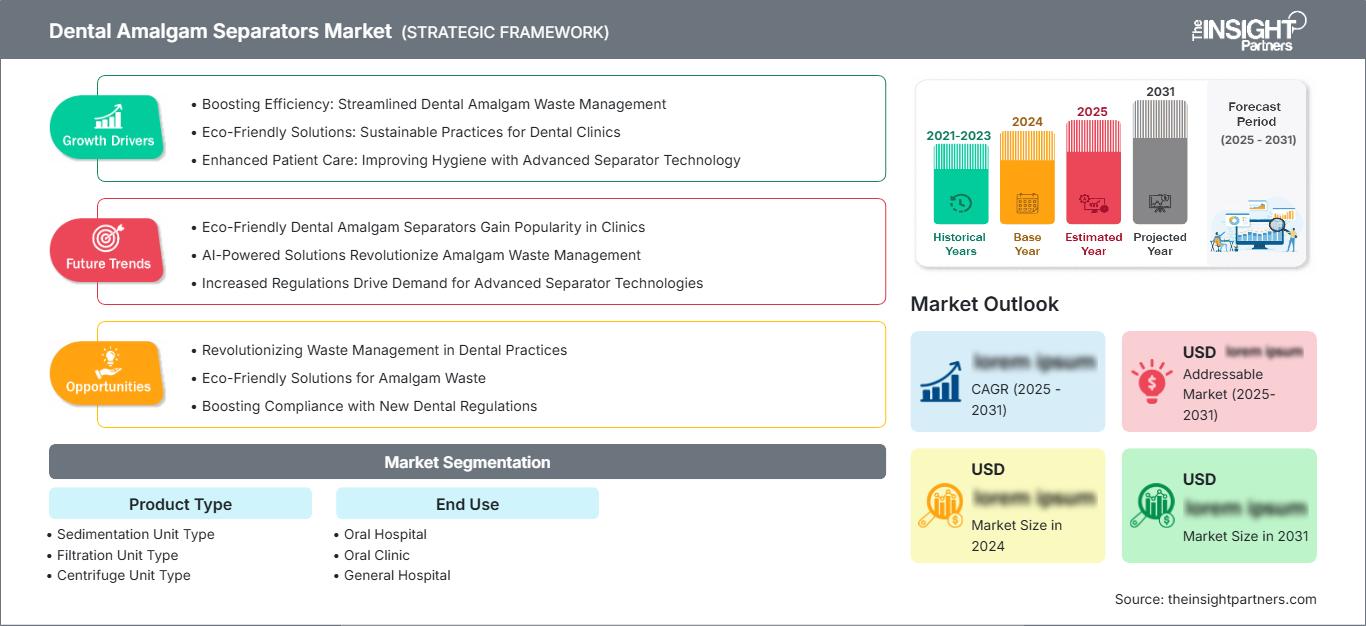
Dental Amalgam Separators Market: Strategic Insights
Regional Insights
North America Dental Amalgam Separators Market
The North American region accounts for 38-42% of the Dental Amalgam Separators Market share in 2025 and is expected to grow at a 6.8-7.3% CAGR during 2026-2034. The U.S. holds the lion's share of regional demand as dental facilities are part of existing wastewater compliance systems and have an established installed base of separation equipment. Equipment replacement and modernization along with expansion of multi-operatory facilities ensure repeat purchases. Canada contributes to the regional market as well due to similar environmental management regulations and infrastructure of dental care.
The strengths of the North American region lie in a wide understanding of amalgam waste management procedures and established channels of distribution for dental utilities equipment. Dental service organizations, hospitals, universities, and private dental practices are different buyer groups in this region; centralized systems gain popularity where several operatories use common evacuation systems. Buyers' decisions are based on size of installations, maintenance periods, recycling programs, and documentation capacity. The regional market will be dominated by replacement needs rather than new amalgam placement.
U.S. Dental Amalgam Separators Market
The United States accounts for an estimated share of 72-76% of North America’s revenue in 2025 and is projected to register a CAGR of 6.7-7.2% till 2034. Demand comes from dental practices that already exist, multi-site companies, hospitals, and dental institutions. National standards, different approaches to the adoption of these standards by the state, and facility-specific compliance programs affect purchasing behavior. Replacement is necessary since the existing separators become overloaded or outdated.
Current applications increasingly demand compatibility with wet and dry vacuum systems. Solmetex, Rebec Environmental, PureWay Compliance, Inc., Air Techniques, Inc., and Dental Recycling North America are involved in equipment manufacture, recycling, and compliance services. Larger companies prefer to install centralized solutions, while small offices can focus on compact and easy-to-service equipment. In the United States, the demand also includes ongoing purchases of collectors, recycling, documentation, and replacement parts.
Europe Dental Amalgam Separators Market
Europe accounted for an estimated 28–32% share in 2025 and is projected to grow at a 7.2–7.8% CAGR through 2034, with Germany representing the leading national market. Regulatory restrictions on dental amalgam use are simultaneously reducing new amalgam consumption while sustaining requirements for responsible management of existing amalgam and wastewater during the transition.
There exists an appreciable number of existing equipment in the UK, but regulations have been pushing towards the use of alternatives to mercury-containing restoratives. There exist excellent capacities for dental equipment manufacture and wastewater separation procedures in Germany. France, Italy, and Spain also provide demand for this type of equipment, with a network of dental practitioners and environmental regulations contributing. It is interesting about the dynamics in this market that reduced use of amalgam fillings may limit future new equipment sales, but their removal creates demand.
APAC Dental Amalgam Separators Market
APAC is estimated to hold an 18–22% share in 2025 and is expected to expand at an 8.8–9.6% CAGR, making it the fastest-growing major region. China leads regional demand, followed by Japan, South Korea, India, and Australia, where expanding dental infrastructure creates opportunities for modern wastewater-management equipment.
Issues such as industrial development, healthcare development in cities, and environmental policies are ensuring greater interest in managing dental waste. Countries like Japan and Australia already have advanced compliance programs, whereas countries like China, India, and South Korea present an opportunity for growth due to clinics, hospitals, and dental institutions. The buyers are increasingly looking for systems that are small enough to fit in existing utility infrastructures. Local companies can offer advantages through simplicity of installation, distribution agreements, and local servicing. International companies can capitalize on certification and experience of central systems.
Middle East & Africa Dental Amalgam Separators Market
Demand in Middle East & Africa is anticipated to record a CAGR of 7.0-8.0% from 2024 till 2034, driven by Saudi Arabia, followed by UAE and South Africa. Increase in private sector healthcare facilities as well as specialized dental clinics boosts adoption of the equipment, especially in urban areas.
Rest of MEA market presents fragmented demand dynamics as a result of upgrading of hospitals, spending on public health and availability of imported equipment. Energy saving and poor infrastructure promote the use of robust equipment, which requires lower energy usage, simple installation, and reliable maintenance. Equipment providers who offer logistics and technical support services for recycling can serve fragmented demand dynamics. Big hospitals and dental franchises will have centralized equipment, while independent dental clinics will have small-sized equipment.
Segmentation Analysis
Product Type
Product Type remains the primary technology dimension, with a modelled CAGR of 7.0–7.8% between 2026–2034. Product selection depends on wastewater flow, operatories served, vacuum architecture, installation space, and maintenance preferences. Market scope within this segment is expanding toward systems that integrate separation with collection, monitoring, and recycling workflows. Larger facilities increasingly evaluate capacity and lifecycle cost rather than initial purchase price.
- Sedimentation Unit Type: Sedimentation systems maintain a strong position because of straightforward installation, established operating principles, and compatibility with numerous dental wastewater configurations. They remain important for cost-sensitive practices and replacement installations.
- Filtration Unit Type: Filtration systems appeal to practices seeking compact equipment and predictable particle capture. Their strategic importance is strongest where installation space is limited and replacement logistics can be managed efficiently.
- Centrifuge Unit Type: Centrifuge systems are positioned for higher-flow environments requiring consistent separation performance. Demand is supported by multi-operatory facilities and buyers prioritizing reduced manual maintenance.
- Combination Unit Type: Combination systems integrate multiple separation mechanisms and are increasingly relevant for facilities seeking comprehensive wastewater control, higher capacity, and simplified equipment architecture.
End Use
End Use is projected to register a 7.3–8.1% CAGR from 2026–2034 as procurement increasingly reflects facility scale, operating volume, compliance oversight, and centralized utility infrastructure. The Market scope across end users extends from individual treatment environments to large institutional facilities. Hospitals and clinics generally generate the largest equipment requirement, while academic institutions provide technically demanding applications and reference environments.
- Oral Hospital: Oral hospitals require dependable separation across higher patient throughput and multiple treatment areas. Centralized systems can reduce equipment duplication while supporting standardized maintenance and waste-management procedures.
- Oral Clinic: Oral clinics represent a broad customer base, with purchasing decisions emphasizing compact footprints, compatibility with existing vacuum systems, straightforward servicing, and manageable replacement costs.
- General Hospital: General hospitals can require separation systems within broader wastewater and environmental-management programs. Procurement tends to emphasize integration, reliability, documentation, and compatibility with centralized utility infrastructure.
Opportunity Snapshot
| Segment Name | Revenue Contribution (High/Medium/Low) | Trend Tag | Adoption Stage |
|---|---|---|---|
| Oral Hospital | High | Central Vacuum | Scaling |
| Oral Clinic | High | Compact Retrofit | Mature |
| General Hospital | Medium | Utility Integration | Scaling |
Dental Amalgam Separators Market Growth Drivers and Impact Analysis
Stricter Mercury Wastewater Compliance
Regulatory requirements remain the strongest structural driver because dental facilities must control mercury-bearing wastewater rather than rely solely on chairside traps or general wastewater treatment. In the US, compliance requirements have created a durable installed base, while European mercury restrictions have reinforced separation and collection practices during the transition away from amalgam. The commercial impact is shifting from first-time penetration toward replacement, retrofit, and documentation-led purchasing. Manufacturers can therefore capture recurring revenue through collection containers, recycling programs, maintenance services, and compliance support. The driver also favors certified equipment because purchasers increasingly require evidence that systems meet applicable separation standards. As regulatory oversight becomes more systematic, suppliers with established installation networks and waste-handling partnerships should have an advantage over standalone equipment vendors.
Expansion of Multi-Operatory Dental Facilities
The consolidation of dental services into larger practices and organized healthcare facilities is changing equipment specifications. Multi-operatory sites generate higher wastewater volumes and need systems capable of supporting several treatment areas without materially reducing evacuation performance. This favors centralized separators, larger collection capacity, and designs that simplify servicing across multiple chairs. The impact extends beyond equipment revenue because larger facilities are more likely to standardize replacement schedules, purchase service contracts, and use documented recycling processes. Suppliers can therefore increase customer lifetime value by designing products around facility-level workflows rather than individual chair installations. Dental hospitals and institutional facilities also provide opportunities for long-duration procurement agreements, while standardized equipment platforms can reduce training and maintenance complexity across geographically distributed clinic networks.
Lifecycle Cost Optimization in Dental Waste Management
Purchasers are increasingly assessing separators through total cost of ownership, including installation, filter or container replacement, servicing, recycling, downtime, and documentation. This approach benefits products with high collection capacity, predictable maintenance intervals, and simple replacement procedures. The market impact is particularly relevant for larger practices where frequent maintenance can create operational interruptions and recurring labor costs. Manufacturers are responding by improving access to collection containers, simplifying installation, and integrating monitoring features that indicate when replacement is required. Recycling programs also become commercially meaningful because they transform disposal from a standalone compliance task into a managed service. As procurement teams become more financially disciplined, products that demonstrate lower lifecycle expenditure can gain share even when their initial acquisition price is not the lowest.
Dental Amalgam Separators Market Future Trends
Digitally Monitored Separation Systems
Digital monitoring is likely to become a more visible differentiator as dental practices seek preventive maintenance and better documentation. Future separators can incorporate sensors that track collection capacity, flow conditions, operating status, and service requirements, with information transmitted to practice-management dashboards or maintenance portals. This can reduce unnecessary cartridge replacement while lowering the risk of operating beyond recommended capacity. For dental service organizations, remote visibility could enable centralized management of equipment across many locations and improve procurement planning. The Dental Amalgam Separators Market trends will therefore increasingly reflect convergence between physical wastewater equipment and digital facility management. Suppliers that establish secure, simple interfaces can develop recurring software or service revenue alongside equipment sales. Data-driven maintenance may also support more consistent recycling documentation.
Integrated Wastewater and Evacuation Platforms
Future product development is expected to move beyond standalone separation devices toward integrated utility platforms combining evacuation, separation, monitoring, and waste collection. Such configurations can reduce the number of components installed in mechanical rooms and simplify responsibility for maintenance. The approach is particularly relevant to new dental facilities, hospitals, and large clinic networks where utility infrastructure can be specified during construction. Integrated architecture can also improve compatibility between vacuum performance and wastewater handling, reducing the risk that a separator becomes a bottleneck. As environmental procurement criteria become more comprehensive, buyers may evaluate water consumption, energy requirements, maintenance frequency, and recycling processes together. Manufacturers with broad dental utility portfolios are positioned to integrate these functions more efficiently than narrowly focused equipment providers.
Dental Amalgam Separators Market Opportunities
Retrofitting Aging Dental Infrastructure
A substantial opportunity exists in replacing older separation systems within established dental practices that require improved capacity, easier servicing, or compatibility with modern evacuation equipment. Suppliers can target replacement programs through distributors, certified installers, and dental service organizations rather than relying exclusively on new clinic construction. Dental Amalgam Separators Market Forecasts indicate that replacement-led revenue can remain important even as amalgam placement declines because existing fillings continue to be removed during restorative procedures. Vendors can strengthen this opportunity by offering installation kits, recycling enrollment, documentation support, and scheduled container delivery. Retrofit packages are especially attractive when they minimize plumbing changes and avoid disruption to clinical operations. A standardized upgrade pathway can shorten purchasing decisions and make equipment replacement easier to justify financially.
Regional Recycling and Compliance Networks
An additional opportunity lies in combining separators with localized recycling, collection, and compliance services. Fragmented waste-management infrastructure remains a barrier in many emerging markets, where clinics may have access to equipment but limited support for responsible collection and downstream processing. Manufacturers and environmental service providers can establish distributor-led networks that bundle installation, scheduled collection, documentation, and technical support. The Dental Amalgam Separators Market Forecasts should therefore consider service density as an important determinant of adoption outside mature markets. Partnerships with dental associations, hospital groups, and regional distributors could reduce customer acquisition costs while improving regulatory awareness. In mature markets, the same model can support automated replacement programs and recurring collection-container revenue, creating a service layer around installed equipment.
Recent Developments
- May 2026: Air Techniques, Inc. introduced the SepaStar Amalgam Separator at CDA Presents in Anaheim, positioning the system around centralized separation, intelligent monitoring, simplified maintenance, and integration with dental utility infrastructure. The company highlighted a design intended for modern practices and higher-volume environments, reinforcing the industry's shift toward performance-oriented separation systems with lower routine maintenance requirements.
- October 2025: METASYS Medizintechnik GmbH announced changes to its GREEN & CLEAN WD dispenser range while continuing the upgraded ECO II+ and ECO II+ Large centrally installed amalgam separator portfolio. The company's product updates demonstrate continued investment in integrated dental utility and wastewater-management solutions alongside broader efforts to improve operational safety and maintenance efficiency.
- September 2025: Solmetex, LLC launched its 2025 Customer Appreciation Month program featuring NXT Hg5 collection-container incentives and highlighted customer results from amalgam separation and recycling activities. The company reported that its customers had prevented more than 5 tons of mercury waste from entering public water systems, emphasizing the growing role of recycling services alongside separator equipment.
Frequently Asked Questions

- Comprehensive Market Sizing and Forecast Analysis
- Detailed Segmentation Analysis
- In-Depth Market Dynamics Assessment
- Regional and Country-Level Insights
- Competitive Landscape and Company Benchmarking
- Strategic Business Intelligence
Recent Reports
Testimonials

The Insight Partners' SCADA System Market report is comprehensive, with valuable insights on current trends and future forecasts. The team was highly professional, responsive, and supportive throughout. We are very satisfied and highly recommend their services.
RAN KEDEM Partner, Reali Technologies LTDs
I requested a report on a very specific software market and the team produced the report in a few days. The information was very relevant and well presented. I then requested some changes and additions to the report. The team was again very responsive and I got the final report in less than a week.
JEAN-HERVE JENN Chairman, Future Analytica
We worked with The Insight Partners for an important market study and forecast. They gave us clear insights into opportunities and risks, which helped shape our plans. Their research was easy to use and based on solid data. It helped us make smart, confident decisions. We highly recommend them.
PIYUSH NAGPAL Sr. Vice President, High Beam Global
The Insight Partners delivered insightful, well-structured market research with strong domain expertise. Their team was professional and responsive throughout. The user-friendly website made accessing industry reports seamless. We highly recommend them for reliable, high-quality research services
YUKIHIKO ADACHI CEO, Deep Blue, LLC.
This is the first time I have purchased a market report from The Insight Partners.While I was unsure at first, I visited their web site and felt more comfortable to take the risk and purchase a market report.I am completely satisfied with the quality of the report and customer service. I had several questions and comments with the initial report, but after a couple of dialogs over email with their analyst I believe I have a report that I can use as input to our strategic planning process.Thank you so much for taking the extra time and making this a positive experience.I will definitely recommend your service to others and you will be my first call when we need further market data.
JOHN SUZUKI President and Chief Executive Officer, Board Director, BK Technologies
I wish to appreciate your support and the professionalism you displayed in the course of attending to my request for information regarding to infectious disease IVD market in Nigeria. I appreciate your patience, your guidance, and the fact that you were willing to offer a discount, which eventually made it possible for us to close a deal. I look forward to engaging The Insight Partners in the future, all thanks to the impression you have created in me as a result of this first encounter.
DR CHIJIOKE ONYIA MANAGING DIRECTOR, PineCrest Healthcare Ltd.Reason to Buy
- Informed Decision-Making
- Understanding Market Dynamics
- Competitive Analysis
- Identifying Emerging Markets
- Customer Insights
- Market Forecasts
- Risk Mitigation
- Boosting Operational Efficiency
- Strategic Planning
- Investment Justification
- Tracking Industry Innovations
- Aligning with Regulatory Trends





 Get Free Sample for