
Dental Electrosurgical Units Market Size, Trends & Growth by 2034
Coverage: by Technology (Unipolar, Bipolar Systems); Waveform Type (fully rectified waveform, partially rectified waveform, fulguration waveform, lateral heat, others); Product Type (current generator unit, electrodes, accessories); End users (hospitals, ambulatory surgical centers, specialized (dental) clinics), and Geography (North America, Europe, Asia Pacific, and South and Central America)
- Status : Data Released
- Report Code : TIPRE00011441
- Category : Life Sciences
- No. of Pages : 150
- Available Report Formats :


- Last update date : August 24, 2026


2025 Market Size
US$ 358.75 Mn
Base year value
2034 Forecast
US$ 593.73 Mn
Projected by 2034
CAGR 2026-2034
5.76 %
Growth rate
Addressable Market
US$ 4,316.90 Mn
(2026-2034)
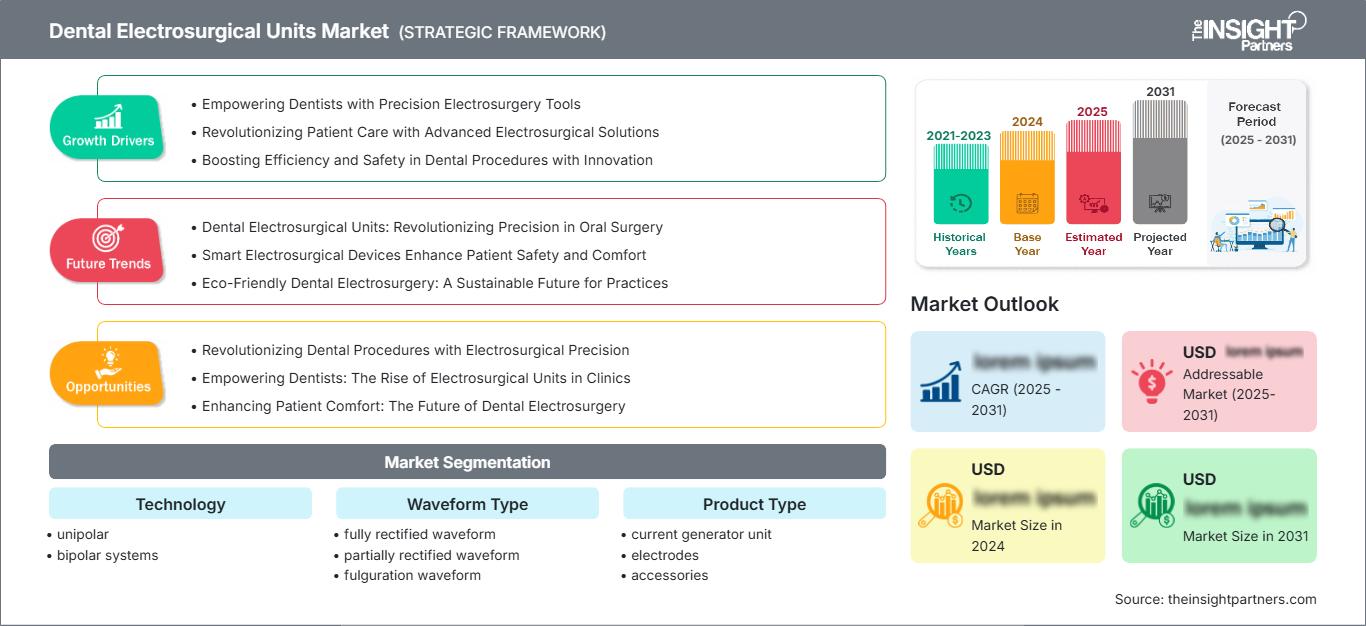
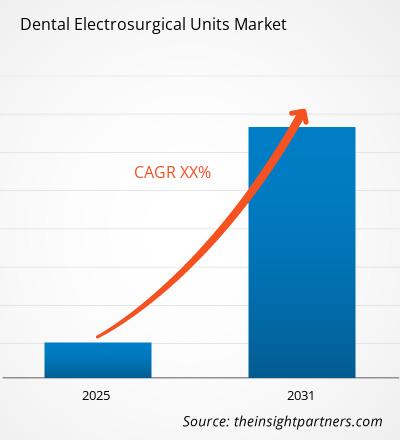
The global Dental Electrosurgical Units market was valued at US$ 358.75 million in 2025 and is expected to reach US$ 593.73 million by 2034; it is estimated to record a CAGR of 5.76% during 2026-2034.
Dental Electrosurgical Units Market Assessment and Insights
- North America: North America represents an estimated 38–42% share in 2025 and is projected to grow at a 6.2–6.6% CAGR between 2026–2034, supported by established dental practices, specialist adoption, and procedure-focused capital expenditure.
- US: The US accounts for 82–86% share of North America in 2025 and is expected to grow at a 6.1–6.5% CAGR during 2026–2034, led by specialized clinics and hospitals.
- Europe: Europe holds an estimated 27–31% share in 2025 and is forecast to grow at a 5.8–6.2% CAGR, with Germany, the UK, France, Italy, and Spain representing important demand centers.
- Asia Pacific: Asia Pacific captures an estimated 20–24% share in 2025 and is expected to register a 7.1–7.5% CAGR, with China, Japan, South Korea, India, and Australia supporting adoption.
- Largest Segment: Bipolar systems represent a 58–62% market share in 2025 and are estimated to grow at a 6.3–6.7% CAGR during 2026–2034, reflecting controlled energy delivery.
- High Growth Segment: Unipolar systems account for a 38–42% market share in 2025 and are projected to achieve a 6.8–7.2% CAGR during 2026–2034, supported by procedural versatility.
- Key companies analyzed in detail: ALSA Apparecchi Medicali S.r.l., BMS Dental, BonART Ltd., COLTENE Holding AG, Dentalaire International, Ellman International, Inc., Henry Schein, Inc., Parkell, Inc., Stryker Corporation, CONMED Corporation.
Source: The Insight Partners' analysis based on proprietary research, government publications, company annual reports, investor presentations, industry databases, and expert interviews.
The Dental Electrosurgical Units Market has developed from energy-generating machines to those that focus on predictable cut, coagulation, hemostasis, ergonomic controls, and application-specific electrodes. Bipolar setups are significant where controlled paths for current flow are necessary, while unipolar setups provide versatility in procedures performed on tissues. The currently available products are becoming more focused on accuracy, shortened procedure times, reusability/autoclaving features, and suitability with dental surgery processes.
In future, expansion will be expected in the Asia Pacific region and selected emerging dental care markets where the infrastructure is growing. Compact generators, easier-to-use controls, safety-focused accessories, and education-based marketing are some areas that will get attention from product manufacturers. The World Health Organization’s approach to improving oral health until 2030 is relevant here.
Dental Electrosurgical Units Market Report Scope
| Report Attribute | Details |
|---|---|
| Market size in 2025 | US$ 358.75 Million |
| Market Size by 2034 | US$ 593.73 Million |
| Global CAGR (2026 - 2034) | 5.76% |
| Historical Data | 2021-2024 |
| Forecast period | 2026-2034 |
Dental Electrosurgical Units Market Analysis
The demand will be supported by the requirement for effective management of soft tissues during procedures like gingival sculpting, crown-lengthening support, frenectomy, tissue excision, and hemostasis. Therefore, growth of the Dental Electrosurgical Units will depend on the volume of procedures performed and the inclination of dentists to replace or supplement traditional tools with energy-driven technologies. The market includes suppliers of generators, manufacturers of electrodes, dental distributors, dental clinics, hospitals, training centers, and service companies.
Supply considerations will still be affected by components' availability, regulatory issues, compatibility of electrodes, service provision capabilities, and distribution capabilities. Generators will tend to possess higher system value, while electrodes and other accessories will provide opportunities for repeat purchases. Distributors with broad networks within dental practices can deliver products in an efficient way, while manufacturers specializing in this field can compete with their product knowledge and ergonomics.
Competitive positioning in the Dental Electrosurgical Units Market Report uses proprietary energy platforms, clinical specialization, distribution channels, and products/services. The proprietary electrosurgery platform of COLTENE Holding AG is further supported by the extensive dental distribution channel of Henry Schein, Inc. Parkell, Inc. and Ellman International, Inc. retain relevance because of their specialization in dentistry and electrosurgery respectively, while Stryker Corporation has more experience with energy devices in surgeries.
Innovations have taken less importance while improvements in current categories have received more importance. Companies are now focusing more on convenience in control systems, standardization of processes, accessory products, workflow compatibility, and geographic distribution channels. COLTENE Holding AG saw share gains in EMEA in 2025, and also retains the production and distribution facilities in key dentistry markets.
● REPORT CUSTOMIZATION
Tailor This Report To Align With Your Specific Business Requirements
This report can be customized to align precisely with your business objectives, scope, and target markets. Customization options include tailored segmentation, geography, competitive analysis, and strategic insights to support informed decision-making.
Customize This Report →WHAT YOU CAN ADJUST
- ● Segmentations
- ● Geography
- ● Competitive Analysis
- ● Language Preferences
Dental Electrosurgical Units Market: Strategic Insights
Regional Insights
North America Dental Electrosurgical Units Market
North America had around 38–42% of the Dental Electrosurgical Units Market share in 2025 and is anticipated to expand at a CAGR of 6.2–6.6% through 2034. This region is well-supported by the presence of developed dental infrastructure, established specialist services, greater equipment awareness, and extensive clinical training. The US accounts for the dominant regional market, followed by Canada and Mexico through growth in private dentistry capacity and special procedures.
The structural demand is driven by the volume of soft-tissue procedure performed, need for equipment replacement, and technology which offers controlled cutting and coagulation. Dental practices are also faced with challenges related to labor issues and cost pressures. The ADA’s workforce report for 2025 outlines ongoing workforce issues, whereas its economic report outlines the issues of staffing, payment, and overhead cost pressures.
U.S. Dental Electrosurgical Units Market
The United States makes up around 82-86% of the North American market in 2025 and will continue growing at a CAGR of 6.1-6.5% from 2025 to 2034. The usage of this market can be found in the already existing dental clinics, hospitals, and specialized clinics where electrosurgical systems may fit in with periodontal, restorative, oral-surgical, and soft-tissue procedures.
The presence of companies includes specialized dental equipment producers and medical technology producers. COLTENE Holding AG sells PerFect TCS II for cutting and coagulation procedures, whereas Stryker Corporation produces a wider range of electrosurgical devices for surgery use.
Europe Dental Electrosurgical Units Market
Europe had a 27-31% market share in 2025 and is forecasted to grow at a CAGR of 5.8-6.2%. Germany is one of the key nations owing to its advanced dental industry and clinical infrastructure, and the UK, France, Italy, and Spain offer huge demand due to their specialization and private practices. Regulatory discipline favors performance records and device quality.
The United Kingdom and Germany remain key markets for the equipment. Germany has a well-established framework for the dental industry, while the United Kingdom has the dental practitioners and clinical specialties. Additionally, France, Italy, and Spain play their part through the provision of dental clinics, periodontics, and equipment replacements. The market share rise of COLTENE Holding AG in the EMEA region underlines the importance of this region.
APAC Dental Electrosurgical Units Market
APAC Dental Electrosurgical Units Market had an estimated market share of 20-24% in 2025 and is expected to register a CAGR of 7.1-7.5%. This will make it the most rapidly growing region. The top countries that contribute to the APAC region include China, Japan, South Korea, India, and Australia. Growth in industry, modernizing dental clinics, and availability of specialist procedures drive growth in this region.
Countries like China and India have high long-term volume potential due to the expanding dental infrastructure, while Japan and South Korea represent advanced technology. Australia has high clinical standards and adoption of equipment. Oral health policies are driving the expansion of services in the region as well, with WHO indicating a high burden of oral diseases in Southeast Asia.
Middle East & Africa Dental Electrosurgical Units Market
However, the Middle East and Africa demands are lower but structurally important, with Saudi Arabia being the largest country in terms of its demand share. According to estimates, the region will have the 5.9-6.3% CAGR through 2034 due to the growth in private healthcare investments, specialist-clinic expansion and hospitals' renovation. The UAE will be the key source of premium care, while South Africa is expected to drive demand in Sub-Saharan Africa.
The energy-intensive nature of infrastructure, import of medical equipment and the uneven distribution of specialists impact the purchase decision in the region. In this regard, Saudi Arabia and UAE enjoy the concentrated investments in healthcare facilities and advanced healthcare infrastructure, while South Africa has the developed clinical capacity in comparison with other countries in the region.
Segmentation Analysis
Technology
The technology segment comprises unipolar and bipolar systems, with bipolar systems holding the larger position because controlled current pathways can support precise tissue management. The segment is projected to grow at a 6.4–6.8% CAGR during 2026–2034. Clinical preference depends on procedure type, tissue characteristics, clinician familiarity, safety considerations, and generator compatibility.
- Unipolar systems: These systems provide broad procedural versatility and remain relevant where cutting performance and flexible electrode selection are important. Their strategic role is reinforced by applications requiring adaptable energy delivery across different soft-tissue procedures.
- Bipolar systems: Bipolar configurations maintain the leading position because energy is concentrated between active electrode surfaces, supporting controlled application. Their relevance is strongest where precision, reduced current dispersion, and predictable coagulation are priorities.
Waveform Type
The waveform segment is projected to grow at a 6.1–6.5% CAGR during 2026–2034. Product selection increasingly reflects the relationship between waveform characteristics, tissue effect, cutting precision, coagulation performance, and desired hemostasis. Clinicians generally select waveform configurations according to procedural requirements rather than equipment specifications alone.
- Fully rectified waveform: Supports controlled cutting applications where consistent energy delivery and predictable tissue interaction are important to procedural performance.
- Partially rectified waveform: Provides a balance between cutting and coagulation characteristics, supporting applications where clinicians require more tissue control than conventional cutting modes.
- Fulguration waveform: Emphasizes coagulation and hemostatic effects, making it strategically relevant for procedures where bleeding management is a primary clinical consideration.
- Lateral heat: Supports tissue coagulation through controlled thermal effects and remains relevant in procedures requiring localized hemostasis and soft-tissue management.
Product Type
Product Type segment in the Dental Electrosurgical Units Market is forecast to expand at a 6.2–6.6% CAGR during 2026–2034. Generator units form the technological core, while electrodes and accessories support application flexibility and recurring utilization. Product differentiation increasingly depends on intuitive controls, compatible consumables, serviceability, and electrode selection.
- Current generator unit: Represents the principal capital component and determines available power settings, waveform options, control interfaces, and compatibility with procedure-specific accessories.
- Electrodes: Enable application-specific tissue interaction and provide recurring replacement potential, with design, geometry, insulation, and sterilization characteristics influencing clinical usability.
- Accessories: Include supporting components that enhance system operation, maintenance, and procedural convenience, making accessory availability an important factor in lifecycle value.
End users
The End users segment in the Dental Electrosurgical Units Market is expected to register a 6.3–6.7% CAGR during 2026–2034. Dental clinics remain strategically important because they account for a large pool of procedure-oriented purchasing decisions, while hospitals and ambulatory surgical centers offer institutional demand for standardized equipment and broader procedural capabilities.
- Hospitals: Hospitals require versatile systems that can support multidisciplinary surgical environments, with purchasing decisions emphasizing safety, reliability, service support, and compatibility with institutional protocols.
- Ambulatory surgical centers: ASCs value compact systems that support efficient procedural turnover, controlled tissue management, and standardized operating workflows without excessive equipment complexity.
- Specialized clinics: Specialized dental clinics represent an important adoption channel because periodontal, oral-surgical, and soft-tissue procedures create recurring use cases for electrosurgical technology.
Opportunity Snapshot
| End users | Revenue Contribution | Trend Tag | Adoption Stage |
|---|---|---|---|
| Hospitals | High | Surgical Precision | Mature |
| Ambulatory Surgical Centers | Medium | Workflow Control | Scaling |
| Specialized Clinics | High | Soft Tissue | Scaling |
Dental Electrosurgical Units Market Growth Drivers and Impact Analysis
Rising demand for controlled soft-tissue procedures
The increasing demand for periodontal, restorative, oral surgery, and soft tissue procedures generates a need for instruments that have the ability to perform controlled cutting and coagulation functions. The electrosurgical devices can complement traditional scalpel tools where there is an emphasis on control of bleeding, visibility, and effectiveness in performance. For instance, the PerFect TCS II from COLTENE is designed to meet such needs as contouring, crown lengthening, frenectomy, and other similar uses while offering cutting and coagulation capabilities. Such a variety of uses increases the usage efficiency of the device and makes the investment cost-effective for the dental clinics considering the purchase. Oral diseases affect billions of people around the world, making the clinical background wide enough.
Greater emphasis on procedural efficiency and hemostasis
Dental practices increasingly evaluate equipment according to workflow impact rather than technical specifications alone. Electrosurgical technology can reduce reliance on repeated mechanical instruments during selected soft-tissue procedures and may support clearer operating fields through hemostatic control. This can influence chair utilization, clinician ergonomics, and procedural consistency. The market impact is strongest where practices perform sufficient volumes of periodontal or surgical procedures to justify dedicated equipment. Workforce pressures further strengthen attention to efficiency. ADA reporting identifies staffing shortages and overhead costs as significant concerns among dentists, creating incentives to select technologies that can integrate smoothly into established workflows. Manufacturers that combine simplified controls with training and service support are therefore better positioned to convert clinical interest into sustained utilization.
Expansion of specialized dental care infrastructure
Investment in specialized dental facilities is broadening the addressable base for energy-based tissue-management equipment. Growth is particularly relevant in urban centers across Asia Pacific and in private healthcare systems where specialist dentistry is becoming more accessible. New clinics can adopt modern equipment during initial fit-out, while established practices create replacement demand as older generators reach the end of useful service. This dual purchasing cycle creates resilience beyond procedure growth alone. Policy initiatives also provide an indirect tailwind by emphasizing oral-health access and service capacity. WHO's global oral-health action plan establishes targets through 2030 and calls for stronger integration of oral health within health systems. Equipment suppliers can benefit when infrastructure investment is paired with clinician training and standardized procurement.
Dental Electrosurgical Units Market Future Trends
Application-specific energy control becomes a stronger differentiator
Future systems are likely to compete increasingly through refined energy control rather than generator power alone. Manufacturers can differentiate by offering procedure-specific presets, improved feedback mechanisms, intuitive interfaces, and electrode designs matched to defined tissue applications. Such features could help clinicians select appropriate settings more consistently while reducing unnecessary complexity during treatment. The direction also aligns with broader dental technology development, where practitioners increasingly evaluate interoperability, workflow integration, and usability alongside clinical performance. Over time, application-specific platforms may encourage greater standardization across multi-location dental organizations and specialized clinics. Vendors that document clinical performance clearly and pair devices with structured education should have stronger opportunities to establish repeatable treatment protocols, particularly among practices seeking predictable outcomes rather than simply acquiring another capital device.
Compact systems and integrated workflow architectures gain relevance
Compact generators with simplified interfaces are likely to gain traction as dental practices seek to preserve valuable operatory space and limit equipment complexity. Future designs may increasingly integrate energy delivery, accessory recognition, safety controls, and procedural presets into smaller platforms. Connectivity can also become more relevant as clinics adopt broader digital workflows, although electrosurgical equipment will continue to require rigorous validation and safety controls before interoperability becomes routine. The ADA's continuing development of informatics standards illustrates the broader movement toward secure and structured technology integration in dentistry. For manufacturers, the commercial opportunity in the Dental Electrosurgical Units Market Trends lies in making energy systems easier to deploy without compromising clinical safeguards, serviceability, or compatibility with existing dental equipment.
Dental Electrosurgical Units Market Opportunities
Localized manufacturing and distribution in emerging dental markets
Dental Electrosurgical Units Market Forecasts can support investment decisions around localized distribution, training, and service infrastructure in high-growth regions. Asia Pacific offers a particularly attractive environment because China, India, Japan, South Korea, and Australia combine expanding clinical capacity with varying degrees of technology maturity. A regional strategy should distinguish premium hospital accounts from price-sensitive private practices rather than applying a uniform product model. Local distributors can improve regulatory navigation, installation, training, and maintenance while reducing purchasing friction. Manufacturers can also establish application centers that demonstrate tissue-management techniques and device safety. The opportunity is therefore broader than hardware sales: recurring revenue can arise from electrodes, accessories, servicing, training, and replacement cycles. This approach can increase utilization while building long-term channel relationships in markets where clinical education remains important.
Training-led adoption through specialized clinical networks
A second opportunity lies in building structured education around periodontal, oral-surgical, and soft-tissue applications rather than positioning electrosurgical equipment solely as capital hardware. Clinical adoption can be accelerated when dentists understand appropriate waveform selection, electrode handling, safety precautions, and procedural indications. Training partnerships with dental schools, specialist societies, distributors, and large clinic networks can create repeatable adoption pathways. This strategy also helps address the behavioral barrier associated with new technology, which dental innovation stakeholders identify as a major obstacle even after products obtain testing, approvals, and funding. Manufacturers can measure opportunity through training conversion, accessory utilization, replacement rates, and repeat purchases. Such metrics provide a practical framework for prioritizing markets where clinical education can translate directly into equipment utilization.
Recent Developments
- June 2026: COLTENE Holding AG announced its intended acquisition of SciCan and MicroMega, strengthening its dental portfolio in infection control and endodontics. The transaction reflects continued portfolio expansion around dental consumables and small equipment while broadening the company's international platform.
- May 2026: Stryker Corporation completed the acquisition of Amplitude Vascular Systems, adding next-generation intravascular lithotripsy technology to its peripheral vascular portfolio. Although broader than dentistry, the transaction demonstrates continued investment in energy-enabled medical technologies and procedural platforms.
- May 2026: Henry Schein One released its 2026 Catalyst Index, reporting that top-performing dental organizations achieved 75% case acceptance versus a 45% industry average. The release highlights the increasing importance of clinical consistency, workflow performance, and technology-enabled practice management in dental decision-making.
Frequently Asked Questions

- Comprehensive Market Sizing and Forecast Analysis
- Detailed Segmentation Analysis
- In-Depth Market Dynamics Assessment
- Regional and Country-Level Insights
- Competitive Landscape and Company Benchmarking
- Strategic Business Intelligence
Recent Reports
Testimonials

The Insight Partners' SCADA System Market report is comprehensive, with valuable insights on current trends and future forecasts. The team was highly professional, responsive, and supportive throughout. We are very satisfied and highly recommend their services.
RAN KEDEM Partner, Reali Technologies LTDs
I requested a report on a very specific software market and the team produced the report in a few days. The information was very relevant and well presented. I then requested some changes and additions to the report. The team was again very responsive and I got the final report in less than a week.
JEAN-HERVE JENN Chairman, Future Analytica
We worked with The Insight Partners for an important market study and forecast. They gave us clear insights into opportunities and risks, which helped shape our plans. Their research was easy to use and based on solid data. It helped us make smart, confident decisions. We highly recommend them.
PIYUSH NAGPAL Sr. Vice President, High Beam Global
The Insight Partners delivered insightful, well-structured market research with strong domain expertise. Their team was professional and responsive throughout. The user-friendly website made accessing industry reports seamless. We highly recommend them for reliable, high-quality research services
YUKIHIKO ADACHI CEO, Deep Blue, LLC.
This is the first time I have purchased a market report from The Insight Partners.While I was unsure at first, I visited their web site and felt more comfortable to take the risk and purchase a market report.I am completely satisfied with the quality of the report and customer service. I had several questions and comments with the initial report, but after a couple of dialogs over email with their analyst I believe I have a report that I can use as input to our strategic planning process.Thank you so much for taking the extra time and making this a positive experience.I will definitely recommend your service to others and you will be my first call when we need further market data.
JOHN SUZUKI President and Chief Executive Officer, Board Director, BK Technologies
I wish to appreciate your support and the professionalism you displayed in the course of attending to my request for information regarding to infectious disease IVD market in Nigeria. I appreciate your patience, your guidance, and the fact that you were willing to offer a discount, which eventually made it possible for us to close a deal. I look forward to engaging The Insight Partners in the future, all thanks to the impression you have created in me as a result of this first encounter.
DR CHIJIOKE ONYIA MANAGING DIRECTOR, PineCrest Healthcare Ltd.Reason to Buy
- Informed Decision-Making
- Understanding Market Dynamics
- Competitive Analysis
- Identifying Emerging Markets
- Customer Insights
- Market Forecasts
- Risk Mitigation
- Boosting Operational Efficiency
- Strategic Planning
- Investment Justification
- Tracking Industry Innovations
- Aligning with Regulatory Trends





 Get Free Sample for