
Dental Orthodontic Elastics Market Size, Demand & Growth by 2034
Coverage: By Type (Class II Elastics, Class III Elastics, Vertical Elastics, Front Cross Elastics, Others); Application (Oral Hospital, Oral Clinic, General Hospital, Others), and Geography (North America, Europe, Asia Pacific, and South and Central America)
- Status : Data Released
- Report Code : TIPRE00016687
- Category : Life Sciences
- No. of Pages : 150
- Available Report Formats :


- Last update date : August 27, 2026


2025 Market Size
US$ 1.31 Bn
Base year value
2034 Forecast
US$ 2.56 Bn
Projected by 2034
CAGR 2026-2034
7.78 %
Growth rate
Addressable Market
US$ 17.47 Bn
(2026-2034)
The Dental Orthodontic Elastics Market size is projected to expand from US$ 1.31 Billion in 2025 to US$ 2.56 Billion by 2034, registering a CAGR of 7.78% during 2026–2034. The market encompasses elastomeric products used to deliver controlled interarch and intraoral forces during orthodontic treatment. Demand is influenced by treatment volumes, clinician preference for predictable force systems, increasing adult orthodontic care, and continued adoption of fixed appliances and hybrid treatment protocols.
North America is expected to maintain a substantial position, supported by an estimated CAGR of 7.1–7.6% through 2034. The region benefits from high orthodontic treatment utilization, established specialist networks, and strong replacement demand for clinical consumables. The American Association of Orthodontists reported that active patients per member reached 696 in 2024, the highest level recorded in its survey history, reinforcing the underlying clinical volume opportunity.
Dental Orthodontic Elastics Market Assessment and Insights
- North America: North America is estimated to hold a 34–38% Dental Orthodontic Elastics Market share in 2025 and expand at a CAGR of 7.1–7.6% between 2026–2034, supported by specialist orthodontic capacity, high treatment utilization, and established distribution channels.
- US: The US represents 72–76% of North America's 2025 market and is projected to grow at a CAGR of 7.0–7.5% between 2026–2034, led by adult and adolescent treatment demand.
- Europe: Europe is estimated at a 28–32% share in 2025, with a CAGR of 6.8–7.3% between 2026–2034. Germany, the UK, France, Italy, and Spain provide the region's principal demand centers through established orthodontic practices and specialist training networks.
- Asia Pacific: Asia Pacific is estimated to account for 24–28% share in 2025 and grow at a CAGR of 8.3–8.9% between 2026–2034, led by China, Japan, South Korea, India, and Australia, with expanding private dental capacity.
- Largest Segment: Class II Elastics represents the largest segment, with a 42–46% market share in 2025 and a CAGR of 7.2–7.7% during 2026–2034, reflecting broad clinical use.
- High Growth Segment: Class III Elastics is the high-growth segment, representing a 14–18% market share in 2025 and expanding at a CAGR of 8.4–9.2% during 2026–2034.
- Key companies analyzed in detail: Henry Schein, Inc.; Hubit Co., Ltd.; G and H Orthodontics; FORESTADENT Bernhard Förster GmbH; DynaFlex; JISCOP Co., Ltd.; American Orthodontics Corporation; Dentsply Sirona Inc.; Tenco Orthodontic Products; Ormco Corporation.
Source: The Insight Partners' analysis based on proprietary research, government publications, company annual reports, investor presentations, industry databases, and expert interviews.
Markets have shifted from standardized latex loops to diverse ranges distinguished by force rating, diameter, design, packaging, and latex-free versions. The production process stresses consistent dimensions, force maintenance, patient usability, and packaging efficiency. Digitization of the treatment plan is not a substitute for elastics but modifies the prescription of interarch mechanics and incorporation of elastics in the orthodontic fixed, aligners, and hybrid treatment approaches.
For the future, the producers should focus on latex-free products, accurate determination of force, patient-friendly packaging, and digital treatment planning compatibility. New markets provide extra sales volume possibilities as the number of specialists rises and private dental practices grow. Standards of quality, labeling, biocompatibility, and traceability of the medical devices will define suppliers and production process control in international markets.
Dental Orthodontic Elastics Market Report Scope
| Report Attribute | Details |
|---|---|
| Market size in 2025 | US$ 1.31 Billion |
| Market Size by 2034 | US$ 2.56 Billion |
| Global CAGR (2026 - 2034) | 7.78% |
| Historical Data | 2021-2024 |
| Forecast period | 2026-2034 |
Dental Orthodontic Elastics Market Analysis
The treatment volume is the main source of demand, and the development of Dental Orthodontic Elastics Market becomes highly associated with orthodontic cases start, active treatment patient base, and rate of replacements. Value chain includes suppliers of polymers and latex, molding, quality control, packaging, distribution, orthodontic clinics, and hospitals. The product differentiation relies on the mechanism of force generation, elasticity restoring properties, sizes, type of latex used, and packaging performance.
The Dental Orthodontic Elastics Market report indicates that supply landscape is somewhat fragmented relative to more popular orthodontic appliances. The specialized manufacturers compete by the diversity of the product, types of the force generation, geographic distribution, and compatibility with existing treatment methods. The use of medical grade materials and control of the molding process is required since the elastics are subject to stretching, moist environment, and change of temperature.
Positioning in the Dental Orthodontic Elastics Market increasingly merges consumables with more comprehensive orthodontic product lines. The advantages of distribution are available to Henry Schein, Inc., while American Orthodontics Corporation and DynaFlex compete in orthodontic accessories and clinical consumables. FORESTADENT Bernhard Förster GmbH and Ormco Corporation offer broad orthodontic product lines, while Dentsply Sirona Inc. provides orthodontic products as part of its digital workflow solution. Hubit Co., Ltd., G and H Orthodontics, JISCOP Co., Ltd., and Tenco Orthodontic Products bolster competitive positions as specialists and regionally.
Investment focus in the Dental Orthodontic Elastics Market is changing towards materials innovation, production automation, portfolio expansion, and digital workflow compatibility. Recent developments in orthodontics point towards increased investment into ecosystems of treatment solutions rather than isolated consumables. Dentsply Sirona’s orthodontics portfolio, for instance, includes digital treatment planning, aligners, and associated appliances, while Ormco offers elastics alongside brackets, appliances, and other orthodontic accessories.
● REPORT CUSTOMIZATION
Tailor This Report To Align With Your Specific Business Requirements
This report can be customized to align precisely with your business objectives, scope, and target markets. Customization options include tailored segmentation, geography, competitive analysis, and strategic insights to support informed decision-making.
Customize This Report →WHAT YOU CAN ADJUST
- ● Segmentations
- ● Geography
- ● Competitive Analysis
- ● Language Preferences
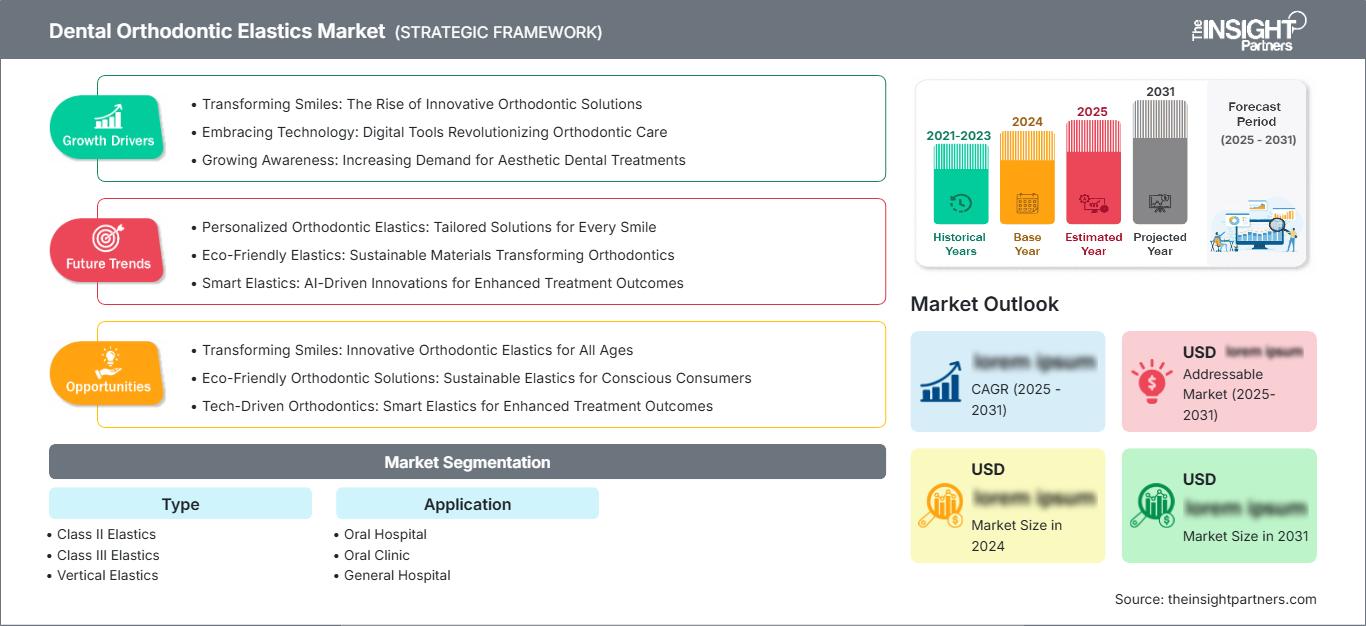
Dental Orthodontic Elastics Market: Strategic Insights
Regional Insights
North America Dental Orthodontic Elastics Market
North America is estimated to represent 34–38% of the Dental Orthodontic Elastics Market in 2025 and is projected to record a 7.1–7.6% CAGR during 2026–2034. The region is well endowed with orthodontics infrastructure, high specialist density, and recurrent consumption replacement needs. North America constitutes 72-76% of the regional market, whereas Canada is a relatively small but well-established market for treatments. High engagement of private practice practitioners ensures adequate supplies and prompt replacement.
Also, economics of treatments favor clinical consumables with force consistency and patient convenience. According to the AAO census report for 2025, there were approximately 6.66 million patients undergoing treatment in the US and Canadian membership of AAO, with adults in the US estimated at 1.91 million.
U.S. Dental Orthodontic Elastics Market Market
The US represents 72–76% of North America's 2025 Dental Orthodontic Elastics Market and is forecast to grow at a 7.0–7.5% CAGR through 2034. Henry Schein, Inc., American Orthodontics Corporation, DynaFlex, Dentsply Sirona Inc., and Ormco Corporation maintain significant commercial presence across orthodontic products and distribution channels.
Application demand spans specialist orthodontic offices, hospitals, and broader dental practices managing orthodontic cases. Adult treatment is increasingly relevant alongside adolescent care, while fixed appliances continue requiring elastic mechanics for selected corrections. The AAO reported 696 active patients per member in 2024, exceeding the previous survey high and indicating sustained clinical activity.
Europe Dental Orthodontic Elastics Market Market
Europe holds an estimated 28–32% share in 2025 and is expected to expand at a 6.8–7.3% CAGR through 2034. Germany is the dominant market, after which comes the UK, France, Italy, and Spain. Established specialist services, professional training, and the existing orthodontics supply chain drive the regional demand, with quality and compliance remaining critical factors in purchase decisions.
The UK and Germany are the dominant mature markets, with orthodontics societies, specialist treatment approaches, and wide application of fixed and mixed approaches. France, Italy, and Spain are the other sources of demand through private clinics and specialist centers. European suppliers pay more attention to latex-free products, precise control of forces, and compatibility with orthodontic practice.
APAC Dental Orthodontic Elastics Market Market
APAC is estimated to account for 24–28% share in 2025 and is projected to expand at an 8.3–8.9% CAGR. China is the leading country, followed by Japan, South Korea, India, and Australia. Rising dental infrastructure, urban specialist practices, and increasing treatment awareness support demand.
China and India provide substantial long-term volume potential, while Japan, South Korea, and Australia offer more established clinical ecosystems. Industrial capacity and expanding private healthcare investment can improve product accessibility, while policy attention to oral health supports broader treatment awareness. The regional opportunity is therefore both volume-driven and infrastructure-led.
Middle East & Africa Dental Orthodontic Elastics Market Market
Middle East and Africa is expected to expand at a 6.2–6.8% CAGR through 2034. Saudi Arabia is the dominant market, trailed by UAE and South Africa, whereas RoMEA continues to be a dispersed market. The demand in the market is focused in private dental clinics and specialty dental practices targeting urban population.
Investment in healthcare infrastructure in Saudi Arabia and UAE will fuel specialty dental penetration, whereas South Africa has a relatively mature clinical infrastructure. Public investment in energy and upgrading hospitals will indirectly aid in boosting dental capacity. Distributor-driven procurement continues to be significant for the smaller MEA markets due to specialized orthodontic consumable products.
Segmentation Analysis
Type
The Type segment is projected to expand at a CAGR of 7.5–8.0% during 2026–2034. Demand remains concentrated in clinically established interarch mechanics, while force-specific products support treatment customization. Manufacturers compete through dimensional consistency, force retention, latex-free availability, packaging convenience, and compatibility with different appliance configurations. The Dental Orthodontic Elastics Market scope increasingly includes products designed for both conventional fixed appliances and hybrid treatment protocols.
- Class II Elastics: These products address common sagittal correction requirements and remain central to orthodontic treatment protocols. Their broad clinical applicability supports recurring replacement demand and strong distributor presence.
- Class III Elastics: Class III configurations serve selected sagittal corrections and are gaining attention as clinicians manage increasingly varied malocclusion profiles. Product selection depends heavily on prescribed force and treatment mechanics.
- Vertical Elastics: Vertical elastics support bite-opening and settling mechanics, making force consistency particularly important during finishing stages and selected open-bite or occlusal correction protocols.
- Front Cross Elastics: Front cross elastics address specific transverse and anterior relationships. Their specialized application creates a narrower demand base but strengthens portfolio completeness for orthodontic suppliers.
Application
The Application segment is estimated to grow at a CAGR of 7.7–8.2% between 2026–2034. Dental clinics represent the principal channel because specialist orthodontic care is increasingly delivered through private practices and dental groups. Hospitals remain relevant for institutional care, while broader facilities contribute through multidisciplinary treatment pathways and referral networks.
- Oral Hospital: Hospitals require standardized consumables for specialist departments, training facilities, and multidisciplinary cases. Procurement emphasizes dependable supply, documented specifications, and compatibility with institutional treatment protocols.
- Oral Clinic: Clinics represent the core recurring-use channel, with frequent patient replacement requirements and clinician-driven selection. Convenience packaging, force identification, and reliable availability influence purchasing decisions.
- General Hospital: General hospitals use products selectively within dental or maxillofacial services. Demand is narrower but strategically relevant where orthodontic treatment intersects with broader surgical, pediatric, or multidisciplinary care.
Opportunity Snapshot
| Applications | Revenue Contribution | Trend Tag | Adoption Stage |
| Oral Hospital | Medium | Specialist Care | Scaling |
| Oral Clinic | High | Routine Replacement | Mature |
| General Hospital | Low | Multidisciplinary Care | Emerging |
Dental Orthodontic Elastics Market Growth Drivers and Impact Analysis
Growing Orthodontic Treatment Volumes
Increases in orthodontic volumes drive demand for elastics directly since these patients require multiple sets of replacements during their active treatment phase. According to AAO's survey for 2025, there were an average number of 696 active patients per member in 2024, while the member database of AAO shows that there were an estimated 6.66 million patients in active treatment in the US and Canada. There is a quantifiable measure of the efficiency of clinical operations within a mature market. However, worldwide, the scope of opportunity is larger since according to the WHO, 3.7 billion suffer from oral diseases, which include only a part of the orthodontic need.
Expansion of Adult Orthodontic Care
Adult orthodontic treatment is changing the purchasing profile of practices by increasing attention to comfort, aesthetics, discretion, and convenience. The AAO identifies adults as approximately one-third of orthodontic patients in its public-facing statistics, indicating that adult care is no longer a marginal component of specialist demand. As far as elastic suppliers are concerned, this will facilitate the development of lower-visibility colors, latex-free products, better packaging for the patient’s convenience, and more explicit replacement guidelines. It goes beyond product development because adult patients tend to shop around treatment options and prefer clinics that offer flexible treatment methods. Those that can provide services in both traditional and hybrid treatment methods can enhance their portfolio relevance without relying on one appliance category.
Material and Force-Control Improvements
Improvements in the science of formulation and molding of polymer will enable more consistency in force generation, recovery, dimensional accuracy, and shelf life of products. Such improvements in quality are significant for orthodontic elastics that are used repeatedly under strenuous conditions in the mouth. More consistency in force will enable manufacturers to provide less variability among batches and make the choice of force and size easier for the orthodontist. Non-latex materials will also help meet concerns about patient sensitivity and expand the availability of the product. Manufacturers making improvements in the area of process control and automatic inspection will be able to compete effectively on the basis of quality and not just cost.
Dental Orthodontic Elastics Market Future Trends
Digitally Guided Elastic Prescription
Digital treatment planning is likely to influence how orthodontists prescribe and monitor elastic mechanics, particularly as aligners, intraoral scanning, virtual setups, and hybrid treatment protocols become more integrated. Future workflows may connect prescribed elastic configurations with digital treatment stages, enabling clinicians to document force direction, wear instructions, and timing more systematically. This trend should not eliminate conventional elastics because the products remain inexpensive, disposable, and clinically versatile. Instead, digital systems may increase prescription precision and improve communication between clinicians and patients. Suppliers can respond by providing clearer product identification, standardized force classifications, QR-enabled instructions, and packaging aligned with treatment phases. Such integration could strengthen consumable traceability without materially increasing clinical complexity.
Latex-Free and Patient-Centered Product Design
The Dental Orthodontic Elastics Market trends show that future product development is expected to place greater emphasis on latex-free materials, improved elasticity recovery, softer patient handling, and packaging that supports correct daily use. As orthodontic treatment expands across age groups, suppliers will need to address differences in patient dexterity, compliance, sensitivity, and aesthetic preference. Product design can therefore move beyond force specification toward a broader usability proposition. Manufacturers may introduce more intuitive color coding, individually identified force levels, smaller replacement packs, and multilingual instructions. Environmental considerations may also affect packaging design as dental suppliers face pressure to reduce unnecessary material use. These changes can create differentiation in an otherwise standardized consumable category while maintaining the low-cost, high-frequency characteristics that underpin recurring demand.
Dental Orthodontic Elastics Market Opportunities
Localized Manufacturing and Regional Distribution
The Dental Orthodontic Elastics Market Forecasts indicate an opportunity for suppliers to expand manufacturing or final packaging closer to high-growth consumption centers. APAC offers particularly relevant potential because treatment infrastructure is expanding while supply chains remain diverse across China, India, South Korea, Japan, and Australia. Regional production can reduce lead times, improve inventory responsiveness, and support market-specific packaging requirements. Strategic partnerships with dental distributors, specialist associations, and clinic networks can provide efficient routes to market without requiring immediate large-scale direct operations. Investors should prioritize facilities capable of producing multiple diameters and force specifications because portfolio flexibility can reduce dependence on individual product lines and improve capacity utilization.
Portfolio Integration Across Orthodontic Workflows
Suppliers can capture incremental value by integrating elastics into broader orthodontic portfolios rather than treating them as standalone commodities. Bundled offerings can combine elastics with brackets, wires, hooks, separators, aligner accessories, and patient compliance materials, improving procurement efficiency for clinics. This approach also creates opportunities for private-label programs and customized packaging for dental groups. Companies with established distribution networks can use cross-selling to increase account penetration while maintaining differentiated product specifications. The strategic priority should be operational consistency rather than excessive product proliferation. A focused portfolio covering common force levels, sizes, latex-free alternatives, and specialized configurations can provide broader clinical coverage while preserving manufacturing efficiency and inventory discipline.
Recent Developments
- June 2026: Henry Schein, Inc. launched smartIPR through an exclusive US distribution agreement with Eversmile. The oscillating interproximal reduction system is designed to provide controlled enamel reduction and reflects the company's continued expansion of its orthodontic product ecosystem and clinical workflow offering.
- March 2026: Dentsply Sirona Inc. announced an orthodontic and restorative education program focused on integrating clear aligner therapy with restorative procedures. The initiative demonstrates continued emphasis on interdisciplinary workflows, digital orthodontics, treatment sequencing, and clinician education across its broader orthodontic platform.
- February 2026: FORESTADENT Bernhard Förster GmbH 2026 program included specialist orthodontic symposiums and trade events across Europe, covering conventional, hybrid, and digital treatment approaches. Its portfolio continues to include intraoral elastics, Class II and III appliances, brackets, wires, adhesives, and digital orthodontic solutions.
Frequently Asked Questions

- Comprehensive Market Sizing and Forecast Analysis
- Detailed Segmentation Analysis
- In-Depth Market Dynamics Assessment
- Regional and Country-Level Insights
- Competitive Landscape and Company Benchmarking
- Strategic Business Intelligence
Recent Reports
Testimonials

The Insight Partners' SCADA System Market report is comprehensive, with valuable insights on current trends and future forecasts. The team was highly professional, responsive, and supportive throughout. We are very satisfied and highly recommend their services.
RAN KEDEM Partner, Reali Technologies LTDs
I requested a report on a very specific software market and the team produced the report in a few days. The information was very relevant and well presented. I then requested some changes and additions to the report. The team was again very responsive and I got the final report in less than a week.
JEAN-HERVE JENN Chairman, Future Analytica
We worked with The Insight Partners for an important market study and forecast. They gave us clear insights into opportunities and risks, which helped shape our plans. Their research was easy to use and based on solid data. It helped us make smart, confident decisions. We highly recommend them.
PIYUSH NAGPAL Sr. Vice President, High Beam Global
The Insight Partners delivered insightful, well-structured market research with strong domain expertise. Their team was professional and responsive throughout. The user-friendly website made accessing industry reports seamless. We highly recommend them for reliable, high-quality research services
YUKIHIKO ADACHI CEO, Deep Blue, LLC.
This is the first time I have purchased a market report from The Insight Partners.While I was unsure at first, I visited their web site and felt more comfortable to take the risk and purchase a market report.I am completely satisfied with the quality of the report and customer service. I had several questions and comments with the initial report, but after a couple of dialogs over email with their analyst I believe I have a report that I can use as input to our strategic planning process.Thank you so much for taking the extra time and making this a positive experience.I will definitely recommend your service to others and you will be my first call when we need further market data.
JOHN SUZUKI President and Chief Executive Officer, Board Director, BK Technologies
I wish to appreciate your support and the professionalism you displayed in the course of attending to my request for information regarding to infectious disease IVD market in Nigeria. I appreciate your patience, your guidance, and the fact that you were willing to offer a discount, which eventually made it possible for us to close a deal. I look forward to engaging The Insight Partners in the future, all thanks to the impression you have created in me as a result of this first encounter.
DR CHIJIOKE ONYIA MANAGING DIRECTOR, PineCrest Healthcare Ltd.Reason to Buy
- Informed Decision-Making
- Understanding Market Dynamics
- Competitive Analysis
- Identifying Emerging Markets
- Customer Insights
- Market Forecasts
- Risk Mitigation
- Boosting Operational Efficiency
- Strategic Planning
- Investment Justification
- Tracking Industry Innovations
- Aligning with Regulatory Trends





 Get Free Sample for