
Diagnostic Radiopharmaceutical Market Size, Demand & Growth by 2034
Coverage: By Imaging Modality (Tc-99, Tl-201, Ga-67, I-123, F-18, Rb-82, Others); Application (Cardiology, Neurology, Thyroid, Others), and Geography (North America, Europe, Asia Pacific, and South and Central America)
- Status : Data Released
- Report Code : TIPRE00015276
- Category : Life Sciences
- No. of Pages : 150
- Available Report Formats :


- Last update date : July 08, 2026


2025 Market Size
US$ 4.22 Bn
Base year value
2034 Forecast
US$ 7.71 Bn
Projected by 2034
CAGR 2026-2034
6.93 %
Growth rate
Addressable Market
US$ 53.89 Bn
(2026-2034)
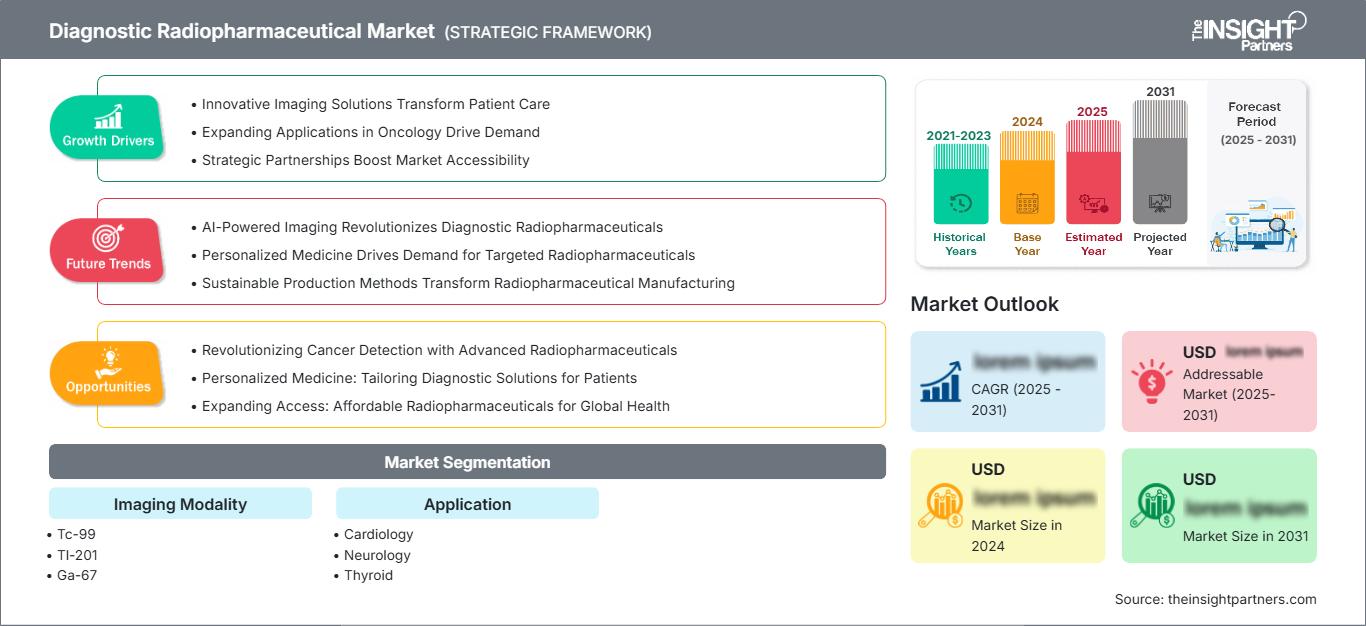
The Diagnostic Radiopharmaceutical Market was valued at US$ 4.22 Billion in 2025 and is projected to reach US$ 7.71 Billion by 2034, expanding at a CAGR of 6.93% during 2026–2034. Market growth is being supported by the increasing use of molecular imaging technologies, rising prevalence of cardiovascular and neurological disorders, and continuous advancements in PET and SPECT imaging systems. Growing clinical emphasis on early disease detection and precision diagnostics is further strengthening demand for diagnostic radiopharmaceuticals worldwide.
North America remains the most established regional market and is anticipated to register a CAGR of approximately 6.5% through 2034. The region benefits from extensive nuclear medicine infrastructure, favorable reimbursement frameworks, and widespread adoption of PET-based diagnostic procedures. Increasing utilization of F-18 tracers for oncology and neurology applications, coupled with ongoing investments in cyclotron and radiopharmacy networks, continues to reinforce regional market expansion.
Diagnostic Radiopharmaceutical Market Assessment and Insights
- North America: North America accounted for 38–41% of the diagnostic radiopharmaceutical market share in 2025 and is anticipated to expand at a CAGR of 6.6–7.2% during 2026–2034. Strong nuclear medicine infrastructure, widespread adoption of advanced diagnostic imaging, and increasing utilization of radiopharmaceuticals continue to support regional market growth.
- U.S.: The U.S. represented 80–84% of the North American diagnostic radiopharmaceutical market size in 2025 and is projected to register a CAGR of 6.7–7.3% during 2026–2034, driven by expanding oncology diagnostics, growing adoption of PET imaging, and increasing demand for advanced nuclear medicine procedures.
- Europe: Europe held 28–31% of the diagnostic radiopharmaceutical market share in 2025 and is expected to grow at a CAGR of 6.2–6.9% during 2026–2034. Germany, France, the United Kingdom, Italy, and Spain remain leading markets, supported by advanced healthcare systems and increasing use of nuclear imaging in cardiology and oncology.
- Asia Pacific: Asia Pacific accounted for 23–26% of the diagnostic radiopharmaceutical market share in 2025 and is forecast to expand at a CAGR of 7.5–8.3% during 2026–2034. China, Japan, India, South Korea, and Australia continue to lead regional demand, driven by expanding healthcare infrastructure, a rising burden of chronic diseases, and increasing radiopharmaceutical production capacity.
- Largest Segment: Imaging Modality – F-18 represented the largest diagnostic radiopharmaceutical market segment and is expected to record a CAGR of 7.1–7.8% during 2026–2034, reflecting its extensive use in PET imaging for oncology and neurology applications.
- High Growth Segment: Imaging Modality – Rb-82 is projected to grow at a CAGR of 8.0–8.7% during 2026–2034, driven by increasing adoption of cardiac PET imaging for myocardial perfusion diagnostics.
- Largest Segment: Application – Cardiology represented the largest application segment and is expected to record a CAGR of 6.8–7.4% during 2026–2034, supported by the high prevalence of cardiovascular diseases and growing preference for non-invasive diagnostic imaging.
- High Growth Segment: Application – Neurology is projected to grow at a CAGR of 7.3–8.1% during 2026–2034, driven by the rising incidence of neurodegenerative disorders and continued advancements in brain imaging technologies.
- Key companies analyzed in detail: Bayer AG; General Electric Company; Cardinal Health, Inc.; Nordion (Canada) Inc.; Siemens Healthineers AG; Bracco Imaging S.p.A.; Guerbet Group; Curium Pharma; NTP Radioisotopes SOC Ltd.; Lantheus Holdings, Inc.; Eckert & Ziegler SE.
Source: The Insight Partners' analysis based on proprietary research, government publications, company annual reports, investor presentations, industry databases, and expert interviews.
The Diagnostic Radiopharmaceutical Market report has evolved from a specialized nuclear medicine segment into a strategically important component of precision healthcare. Advances in isotope production, automated synthesis technologies, and hybrid imaging platforms have expanded clinical applications beyond traditional cardiac imaging. The market is increasingly influenced by the growing role of molecular diagnostics in treatment planning and disease monitoring.
Looking ahead, industry participants are focusing on improving isotope availability, expanding PET imaging accessibility, and developing novel tracers with enhanced specificity. Demand is expected to benefit from broader adoption of personalized medicine approaches, increasing investments in healthcare infrastructure, and rising awareness regarding the value of early-stage disease identification across multiple therapeutic areas.
Diagnostic Radiopharmaceutical Market Report Scope
| Report Attribute | Details |
|---|---|
| Market size in 2025 | US$ 4.22 Billion |
| Market Size by 2034 | US$ 7.71 Billion |
| Global CAGR (2026 - 2034) | 6.93% |
| Historical Data | 2021-2024 |
| Forecast period | 2026-2034 |
Diagnostic Radiopharmaceutical Market Analysis
The growing disease burden associated with cardiovascular disorders, neurodegenerative conditions, and thyroid abnormalities continues to drive demand for diagnostic radiopharmaceutical procedures. Healthcare providers increasingly rely on molecular imaging to obtain functional information that cannot be captured through conventional imaging modalities. This shift has elevated the importance of radiotracers in diagnostic decision-making and patient management.
The diagnostic radiopharmaceutical market ecosystem involves isotope producers, radiopharmacies, imaging equipment manufacturers, hospitals, academic institutions, and regulatory authorities. Efficient coordination across this value chain is essential because many diagnostic isotopes have short half-lives, requiring sophisticated logistics and localized production capabilities. Investments in cyclotrons and generator technologies are therefore becoming critical competitive differentiators.
Competition is characterized by a combination of multinational healthcare companies and specialized radiopharmaceutical developers. Companies such as Bayer AG, General Electric, Cardinal Health, Inc., Siemens Healthineers, Bracco Imaging, Guerbet Group, Curium, and Lanthus Holdings, Inc. are strengthening market positions through product innovation, distribution partnerships, and manufacturing expansion initiatives.
Investment activity is increasingly focused on PET tracer development, radiopharmacy infrastructure, and integrated imaging solutions. Strategic acquisitions, licensing agreements, and vertical integration efforts are becoming more common as organizations seek greater control over isotope production and distribution. Companies that can ensure reliable supply chains while supporting emerging clinical applications are expected to maintain stronger competitive positioning over the forecast period.
● REPORT CUSTOMIZATION
Tailor This Report To Align With Your Specific Business Requirements
This report can be customized to align precisely with your business objectives, scope, and target markets. Customization options include tailored segmentation, geography, competitive analysis, and strategic insights to support informed decision-making.
Customize This Report →WHAT YOU CAN ADJUST
- ● Segmentations
- ● Geography
- ● Competitive Analysis
- ● Language Preferences
Diagnostic Radiopharmaceutical Market: Strategic Insights
Regional Insights
North America Diagnostic Radiopharmaceutical Market
North America accounts for the largest share of the Diagnostic Radiopharmaceutical Market and is projected to grow at a CAGR of approximately 6.5% through 2034. Strong healthcare spending, advanced nuclear medicine infrastructure, and extensive availability of PET and SPECT imaging systems support regional leadership. The growing prevalence of Alzheimer's disease, cardiovascular conditions, and cancer continues to increase demand for advanced diagnostic imaging procedures.
The region also benefits from an established network of radiopharmacies and isotope production facilities. Continuous innovation in molecular imaging, favorable reimbursement pathways, and strong clinical adoption of F-18-based tracers contribute to sustained market growth. Investments in next-generation imaging technologies are expected to further enhance diagnostic capabilities.
U.S. Diagnostic Radiopharmaceutical Market
The U.S. represents approximately 75–80% of the North American diagnostic radiopharmaceutical market and is anticipated to expand at a CAGR of around 6.6% during the forecast period. The country's leadership is supported by high healthcare expenditure, widespread availability of PET imaging facilities, and strong clinical adoption of nuclear medicine procedures across major healthcare systems.
The presence of leading companies including Bayer AG, Cardinal Health, Inc., Siemens Healthineers, Curium, and Lanthus Holdings, Inc. strengthens domestic market development. Demand is increasingly driven by neurological imaging, cardiac perfusion studies, and precision diagnostic applications. Expanding utilization of F-18 and other PET tracers in clinical practice continues to enhance procedural volumes and diagnostic accuracy.
Europe Diagnostic Radiopharmaceutical Market
Europe accounts for approximately 25–30% of global diagnostic radiopharmaceutical market revenue and is projected to record a CAGR near 6.4% through 2034. The region benefits from established healthcare systems, strong research capabilities, and growing adoption of molecular imaging technologies. Increasing emphasis on early disease detection and personalized medicine supports market expansion.
The UK demonstrates steady growth driven by investments in nuclear medicine facilities and increasing use of PET imaging for neurological and cardiovascular assessments. National healthcare initiatives aimed at improving diagnostic efficiency continue to support demand for advanced radiopharmaceutical solutions.
Germany is at the forefront in Europe, thanks to well-established imaging facilities, a high level of radiopharmaceutical production, and extensive research. With its highly developed healthcare system, Germany sees widespread use of new diagnostic tracers by specialists across various specialties.
France, Italy, and Spain contribute significantly to the market by modernizing their diagnostic services and introducing molecular imaging technologies. The use of PET imaging and the importance of early disease detection continue to drive market growth across these countries.
APAC Diagnostic Radiopharmaceutical Market
Asia Pacific is expected to be the fastest-growing regional diagnostic radiopharmaceutical market, achieving a CAGR of approximately 8.1% through 2034 while accounting for nearly 20–25% of global revenue. Rising healthcare expenditures, expanding hospital infrastructure, and growing awareness regarding advanced diagnostic technologies are driving market expansion.
China has been leading in the regional diagnostic radiopharmaceutical market because of significant investments in nuclear medicine facilities, home-grown isotope production, and wider health coverage. Government-led diagnostic initiatives will create a conducive environment for the uptake of radiopharmaceuticals.
Japan continues to lead due to its technological progress and use of molecular imaging, whereas South Korea, India, and Australia are beginning to focus on acquiring PET imaging systems and on regulatory efforts, owing to the growing demand for precision medicine solutions.
Middle East & Africa Diagnostic Radiopharmaceutical Market
The Middle East and Africa diagnostic radiopharmaceutical market is witnessing slow growth due to efforts towards healthcare advancement and increased spending on specialized diagnostic facilities. The region is estimated to register a CAGR of about 6.8% during the forecast period as healthcare systems increasingly incorporate advanced imaging technologies.
Saudi Arabia is the top choice for the country market due to its healthcare transformation initiatives and the development of tertiary care centers. Increased focus on the early detection of diseases is motivating the use of nuclear medicine in major healthcare facilities.
The UAE is enhancing its diagnostic capabilities through technological development and health tourism. While South Africa still retains its position as an important player in healthcare infrastructure in Africa, other regions are also making advances in diagnostics.
Segmentation Analysis
Imaging Modality
- Tc-99 remains widely utilized in nuclear medicine because of favorable imaging characteristics, established clinical protocols, and broad applicability across cardiac, skeletal, and organ function assessments, supporting consistent procedural demand globally.
- Tl-201 continues to serve specialized cardiac imaging applications where myocardial perfusion assessment remains clinically relevant, particularly in facilities maintaining established SPECT-based diagnostic workflows and cardiovascular evaluation programs.
- Ga-67 supports infection and inflammation imaging in select clinical scenarios, maintaining niche importance despite increasing competition from newer tracers offering improved sensitivity and imaging efficiency.
- I-123 is extensively used in thyroid and neurological imaging due to favorable radiation characteristics, enabling detailed functional assessments while supporting accurate diagnostic decision-making in specialized applications.
- F-18 represents the dominant segment owing to superior image quality, expanding oncology and neurology applications, and widespread PET infrastructure supporting high-volume diagnostic procedures worldwide.
- Rb-82 is gaining adoption in cardiac PET imaging as healthcare providers seek enhanced diagnostic precision, workflow efficiency, and quantitative myocardial perfusion assessment capabilities.
Application
- Cardiology remains a major application area as radiopharmaceutical imaging enables detailed evaluation of myocardial perfusion, cardiac viability, and functional abnormalities supporting informed treatment planning.
- Neurology is expanding rapidly due to growing utilization of molecular imaging for Alzheimer's disease, dementia, epilepsy, and other neurological conditions requiring precise functional assessment.
- Thyroid applications maintain consistent demand through routine evaluation of thyroid function, nodular disease characterization, and diagnostic support for endocrine disorder management.
Opportunity Snapshot
| Application | Revenue Contribution | Trend Tag | Adoption Stage |
| Cardiology | High | Perfusion Imaging | Mature |
| Neurology | Medium | Brain Mapping | Scaling |
| Thyroid | Medium | Functional Assessment | Mature |
Diagnostic Radiopharmaceutical Market Growth Drivers and Impact Analysis
Rising Demand for Early and Accurate Disease Detection
Healthcare facilities today place great importance on early diagnostics, as the earlier the disease is identified, the better the chances of successful treatment and lower long-term costs. In this regard, radiopharmaceuticals are used to obtain functional and molecular data that can be overlaid on anatomical images. This allows healthcare professionals to detect abnormalities at an early stage, before structural changes have occurred. Early detection is especially important in cardiology, neurology, and thyroid disease.
The high incidence of chronic diseases worldwide underscores the need for advanced diagnostics. Nowadays, hospitals and imaging facilities use PET and SPECT techniques to make more informed treatment decisions. Diagnostic radiopharmaceutical market trends reveal increased procedure frequency, expanded tracer use, and investments in nuclear medicine development. Companies able to produce innovative radiopharmaceuticals will be in demand among all these organizations.
Expansion of PET Imaging Infrastructure Worldwide
The number of PET imaging systems available has increased substantially in both developed and developing healthcare markets. Governments, healthcare organizations, and research facilities are increasingly acquiring state-of-the-art imaging technology to better diagnose diseases and implement precision medicine. Such investments are bound to increase the demand for PET radiopharmaceuticals, especially those that use F-18 tracers.
In addition, the increasing adoption of hybrid PET/CT and PET/MRI equipment will enhance diagnostic precision and stimulate the adoption of molecular imaging techniques. This development is expected to increase the use of tracers, leading to investments across the radiopharmaceutical value chain, from isotope manufacturing to radiopharmacy and distribution. Companies in this market have begun to increase their production capacity and forge alliances.
Advancements in Molecular Imaging and Radiotracer Development
Continuous innovation in radiotracer design is expanding the clinical utility of diagnostic radiopharmaceuticals. Researchers are developing highly targeted tracers capable of visualizing specific biological pathways, improving diagnostic confidence, and supporting personalized treatment strategies. These advances are creating opportunities in the treatment of neurological disorders, cardiovascular diseases, and other complex medical conditions.
Advances in tracer specificity improve diagnostic efficiency while minimizing unnecessary medical procedures. The effects of innovation on the market go beyond product sales to include the purchase of imaging devices, clinical research activities, and investment priorities in the health sector. Companies developing advanced radiopharmaceuticals are gaining a competitive advantage by addressing an unmet need in clinical practice.
Diagnostic Radiopharmaceutical Market Future Trends
Integration of Artificial Intelligence with Molecular Imaging
AI is increasingly employed in nuclear medicine to enhance imaging interpretation, analysis, and diagnostic outcomes. The AI-based imaging software can help physicians detect disease patterns and streamline imaging processes, adding further value to radiopharmaceutical imaging services.
The future implementation of AI-based analytics will focus on developing individual imaging methods and enabling faster decision-making. To increase productivity and consistency in diagnostic outcomes, the integration of radiopharmaceutical imaging and advanced analytics will become the key feature of the market.
Growth of Precision Diagnostics and Theranostic Ecosystems
The convergence of diagnostic and therapeutic radiopharmaceutical strategies is fostering a more expansive precision medicine landscape. In line with diagnostic radiopharmaceutical market trends, diagnostic tracers are being increasingly utilized to identify suitable candidates for targeted treatments and to assess therapeutic effectiveness, reinforcing the strategic importance of molecular imaging.
In the coming years, more attention will be paid to using diagnostic processes in selecting appropriate treatment approaches for individual patients. It will lead to the creation of diagnostic agents, increase the use of radiopharmaceuticals, and foster collaboration among imaging professionals, pharmaceutical companies, and healthcare organizations.
Diagnostic Radiopharmaceutical Market Opportunities
Expansion of Nuclear Medicine Infrastructure in Emerging Economies
Many emerging markets continue to face limited access to advanced molecular imaging services despite growing disease burdens. Expanding nuclear medicine infrastructure across Asia, Latin America, the Middle East, and Africa presents a significant opportunity for radiopharmaceutical manufacturers and healthcare investors.
Businesses that establish production plants, distribution networks, and training facilities in these areas will be able to capitalize on future growth opportunities. The investments made in isotope availability and imaging access will certainly pay off as the healthcare sector modernizes and demand for advanced diagnostics increases.
Development of Novel Neurological Imaging Tracers
Neurological disorders are emerging as a rapidly growing area of unmet diagnostic need. The rising prevalence of Alzheimer’s disease and other neurodegenerative conditions is driving demand for highly specific molecular imaging agents that can detect disease in its early stages. According to the diagnostic radiopharmaceutical market forecast, these advancements are expected to support earlier diagnosis, improve patient management, and expand the role of precision imaging in neurological care.
Innovative investments in neurological tracers can help meet the rising demand for precision diagnostics and disease monitoring among clinicians. The formation of partnerships with institutions and imaging centers can accelerate commercialization and achieve differentiation in the highly competitive radiopharmaceutical market.
Recent Developments
- June, 2026: RadioMedix, Inc., announced that the U.S. Food and Drug Administration (FDA) has approved the Company’s GALLIUM GA 68 GOZETOTIDE INJECTION, also known as Ga 68 PSMA-11, a prostate-specific membrane antigen (PSMA)-targeted diagnostic radiopharmaceutical for positron emission tomography (PET) imaging in patients with prostate cancer.
- November, 2025: Siemens Healthineers announced the rebranding of PETNET Solutions and Advanced Accelerator Applications under its Radiopharma business segment. The move consolidated one of the world's largest PET radiopharmaceutical manufacturing and distribution networks, operating facilities across the U.S. and Europe to support imaging applications in oncology, cardiology, and neurology.
- August, 2025: Lanthus Holdings, Inc. reported FDA acceptance of its NDA for a new formulation of its piflufolastat F-18 PSMA PET imaging agent. The company also highlighted completion of the Life Molecular Imaging acquisition, expanding its diagnostic radiopharmaceutical portfolio with Neuraceq for Alzheimer's disease imaging.
Frequently Asked Questions

- Comprehensive Market Sizing and Forecast Analysis
- Detailed Segmentation Analysis
- In-Depth Market Dynamics Assessment
- Regional and Country-Level Insights
- Competitive Landscape and Company Benchmarking
- Strategic Business Intelligence
Recent Reports
Testimonials

The Insight Partners provided valuable market intelligence that supported our global go-to-market strategy. Their team was professional, responsive, and attentive to our feedback, providing thoughtful analysis and helpful methodological clarifications throughout the project.
Junmo Kim Chief Financial Officer (CFO), Enertech Co., Ltd.
The Insight Partners' SCADA System Market report is comprehensive, with valuable insights on current trends and future forecasts. The team was highly professional, responsive, and supportive throughout. We are very satisfied and highly recommend their services.
RAN KEDEM Partner, Reali Technologies LTDs
I requested a report on a very specific software market and the team produced the report in a few days. The information was very relevant and well presented. I then requested some changes and additions to the report. The team was again very responsive and I got the final report in less than a week.
JEAN-HERVE JENN Chairman, Future Analytica
We worked with The Insight Partners for an important market study and forecast. They gave us clear insights into opportunities and risks, which helped shape our plans. Their research was easy to use and based on solid data. It helped us make smart, confident decisions. We highly recommend them.
PIYUSH NAGPAL Sr. Vice President, High Beam Global
The Insight Partners delivered insightful, well-structured market research with strong domain expertise. Their team was professional and responsive throughout. The user-friendly website made accessing industry reports seamless. We highly recommend them for reliable, high-quality research services
YUKIHIKO ADACHI CEO, Deep Blue, LLC.
This is the first time I have purchased a market report from The Insight Partners.While I was unsure at first, I visited their web site and felt more comfortable to take the risk and purchase a market report.I am completely satisfied with the quality of the report and customer service. I had several questions and comments with the initial report, but after a couple of dialogs over email with their analyst I believe I have a report that I can use as input to our strategic planning process.Thank you so much for taking the extra time and making this a positive experience.I will definitely recommend your service to others and you will be my first call when we need further market data.
JOHN SUZUKI President and Chief Executive Officer, Board Director, BK Technologies
I wish to appreciate your support and the professionalism you displayed in the course of attending to my request for information regarding to infectious disease IVD market in Nigeria. I appreciate your patience, your guidance, and the fact that you were willing to offer a discount, which eventually made it possible for us to close a deal. I look forward to engaging The Insight Partners in the future, all thanks to the impression you have created in me as a result of this first encounter.
DR CHIJIOKE ONYIA MANAGING DIRECTOR, PineCrest Healthcare Ltd.Reason to Buy
- Informed Decision-Making
- Understanding Market Dynamics
- Competitive Analysis
- Identifying Emerging Markets
- Customer Insights
- Market Forecasts
- Risk Mitigation
- Boosting Operational Efficiency
- Strategic Planning
- Investment Justification
- Tracking Industry Innovations
- Aligning with Regulatory Trends





 Get Free Sample for