
Diagnostic Testing of STDs Market Demand, Size & Forecast by 2034
Coverage: By Disease Type (Chlamydia, Gonorrhea, Herpes simplex virus, Syphilis, Human papillomavirus (HPV) and other diseases); Testing (Laboratory Testing, Point of care (POC) Testing) , and Geography (North America, Europe, Asia Pacific, and South and Central America)
- Status : Data Released
- Report Code : TIPRE00028934
- Category : Life Sciences
- No. of Pages : 150
- Available Report Formats :


- Last update date : July 06, 2026


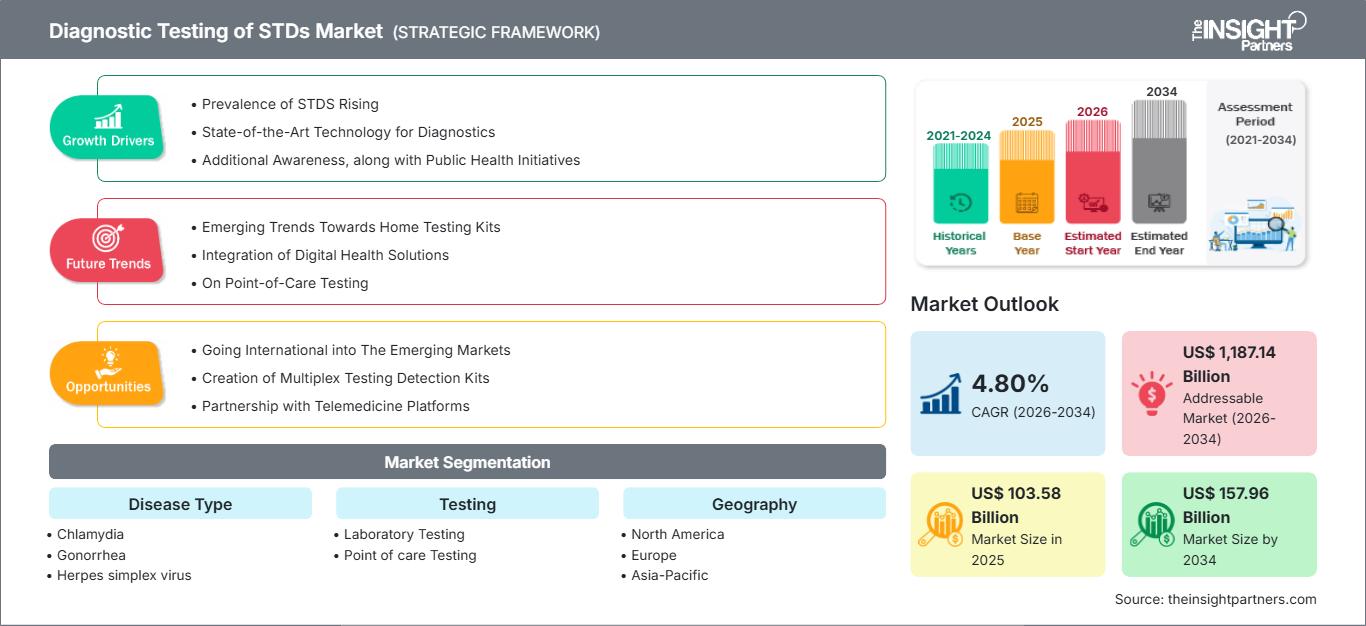
2025 Market Size
US$ 103.58 Bn
Base year value
2034 Forecast
US$ 157.96 Bn
Projected by 2034
CAGR 2026-2034
4.80 %
Growth rate
Addressable Market
US$ 1,187.14 Bn
(2026-2034)
The Diagnostic Testing of STDs market continues to demonstrate steady expansion, driven by rising global awareness and improved healthcare access. The market is valued at US$ 103.58 Billion in 2025 and is projected to reach US$ 157.96 Billion by 2034, progressing at a CAGR of 4.80% between 2026 and 2034. Increasing screening initiatives and technological integration in diagnostics are reshaping testing methodologies, emphasizing early and accurate disease detection across diverse populations.
North America remains a structurally mature yet innovation-driven region within the Diagnostic Testing of STDs market, advancing at an estimated CAGR of around 4.5%. Growth is anchored in the widespread availability of advanced diagnostic infrastructure and proactive public health policies promoting routine screening. Additionally, insurance coverage expansion and digital health integration are enabling improved testing accessibility and patient tracking, supporting sustained market stability.
Diagnostic Testing of STDs Market Assessment and Insights
- North America: North America accounted for 37–41% of the diagnostic testing of STDs market share in 2025 and is projected to expand at a CAGR of 4.6%–5.0% during 2026–2034. Growth is driven by advanced molecular diagnostics, comprehensive screening initiatives, and favorable reimbursement policies, which continue to strengthen regional diagnostic adoption.
- U.S.: The U.S. represented 82–86% of the North American market in 2025 and is anticipated to register a CAGR of 4.7%–5.1% during 2026–2034, supported by well-established laboratory infrastructure, broad screening programs, and increasing utilization of advanced molecular diagnostic technologies.
- Europe: Europe held 27–31% market share in 2025 and is expected to grow at a CAGR of 4.3%–4.7% during 2026–2034. Germany, the United Kingdom, and France remain the leading regional markets, supported by established laboratory networks and comprehensive national screening initiatives.
- Asia Pacific: Asia Pacific held 22–26% of the market share in 2025 and is projected to register a CAGR of 5.5%–5.9% during 2026–2034. China, India, and Japan are fueling expansion through healthcare modernization, broader diagnostic access, growing laboratory infrastructure investments, and rising diagnostic testing of STDs market size demand across healthcare systems.
- Largest Segment – Laboratory Testing: The laboratory testing segment represented the largest market share and is expected to grow at a CAGR of 4.8%–5.2% during 2026–2034, driven by superior analytical sensitivity, multiplex molecular assays, and high-throughput laboratory workflows.
- High Growth Segment – Point-of-Care Testing: The point-of-care testing segment is anticipated to record the highest CAGR of 6.2%–6.6% during 2026–2034, driven by decentralized healthcare models, rising demand for rapid diagnosis, expanding adoption across community healthcare settings, and strengthening diagnostic testing of STDs market forecast outlook.
- Key companies analyzed in detail: Abbott Laboratories; Becton, Dickinson and Company; bioMérieux SA; Bio-Rad Laboratories, Inc.; Danaher Corporation; DiaSorin S.p.A.; Hologic, Inc.; OraSure Technologies, Inc.; F. Hoffmann-La Roche Ltd; Thermo Fisher Scientific Inc.
Source: The Insight Partners' analysis based on proprietary research, government publications, company annual reports, investor presentations, industry databases, and expert interviews.
The Diagnostic Testing of STDs market report has evolved alongside increasing global health concerns related to sexually transmitted infections. Improvements in molecular diagnostic tools, including PCR-based assays, have enabled earlier detection and higher specificity. Healthcare systems are progressively shifting from reactive to preventive testing approaches, integrating screening programs within routine check-ups, especially among high-risk populations.
Looking ahead, the market trajectory indicates a strengthening emphasis on accessibility and decentralized diagnostics. Expansion of point-of-care technologies, combined with digital health platforms, is enhancing testing reach in underserved areas. Competitive innovation is expected to revolve around integrated testing panels and rapid diagnostics, enabling healthcare providers to deliver faster clinical decisions while reducing diagnostic complexity.
Diagnostic Testing of STDs Market Report Scope
| Report Attribute | Details |
|---|---|
| Market size in 2025 | US$ 103.58 Billion |
| Market Size by 2034 | US$ 157.96 Billion |
| Global CAGR (2026 - 2034) | 4.80% |
| Historical Data | 2021-2024 |
| Forecast period | 2026-2034 |
Diagnostic Testing of STDs Market Analysis
A mixture of disease trends and technological advancements drives the Diagnostic Testing of STDs market. Increased incidences of infections, including chlamydia and HPV, are ensuring continued demand for dependable diagnostics. Awareness campaigns advocating periodic screenings, particularly among younger demographics, are resulting in increased testing volumes. In parallel, healthcare practitioners are looking for economical options that maintain accuracy.
The value chain is characterized by a collaborative environment comprising diagnostic developers, labs, physicians, and regulators. Firms such as Abbott Labs, Roche Holding, and Hologic play key parts in establishing testing procedures, whereas supply chains guarantee availability across urban and rural areas. Furthermore, data integration emerges as an increasingly essential consideration, allowing results to be monitored and tracked electronically via digital systems.
The competitive landscape of the diagnostic testing of STDs market features technology differentiation and product portfolio expansion. Key players such as Thermo Fisher Scientific Inc. and Danaher Corporation are focusing on expanding molecular diagnostic capabilities and improving testing throughput. Strategic partnerships and product diversification remain common strategies utilized to maintain competitiveness and tap into new opportunities arising from decentralized testing spaces.
Investment focus exhibits significant bias towards innovation in rapid diagnostic technologies and multiplex testing solutions, while also allocating capital towards increasing manufacturing scale to support growing kit demands. New entrants are penetrating the market via niche innovations within point-of-care diagnostics, resulting in a competitive albeit opportunity-laden landscape across global markets.
● REPORT CUSTOMIZATION
Tailor This Report To Align With Your Specific Business Requirements
This report can be customized to align precisely with your business objectives, scope, and target markets. Customization options include tailored segmentation, geography, competitive analysis, and strategic insights to support informed decision-making.
Customize This Report →WHAT YOU CAN ADJUST
- ● Segmentations
- ● Geography
- ● Competitive Analysis
- ● Language Preferences
Diagnostic Testing of STDs Market: Strategic Insights
Regional Insights
North America Diagnostic Testing of STDs Market
North America continues to hold a leading position with steady expansion supported by robust healthcare systems and advanced diagnostic infrastructure. The region is projected to grow at approximately 4.5% CAGR, driven by high awareness levels and routine testing adoption. Government-led screening programs and the presence of leading diagnostic companies significantly contribute to consistent demand across clinical and home-testing settings.
The region also benefits from strong reimbursement frameworks and continuous investments in molecular diagnostics. Digital integration in healthcare is enhancing efficiency in testing workflows, enabling faster reporting and improved patient engagement. These structural strengths ensure sustained demand while supporting innovation-driven development.
U.S. Diagnostic Testing of STDs Market
The United States holds a prominent position within the regional diagnostic testing of STDs market structure, with its shares ranging from 75% to 80% in North America. The industry is projected to grow at an annual rate of 4.6%, driven by increased screening and improved technology. Major players such as Bio-Rad Laboratories, Inc., and Becton Dickinson Company have significant influence in this region, making possible innovations in testing.
The demand for these products is augmented by the inclusion of diagnostic tests in primary health care and the trend of using test kits at home. The transition to a preventive approach will foster regular testing, especially among high-risk patients, ensuring sustained growth and evolving testing practices.
Europe Diagnostic Testing of STDs Market
Europe accounts for an estimated 25% to 30% share of the global Diagnostic Testing of STDs market and is expected to grow at a CAGR of approximately 4.3%. The region benefits from comprehensive public healthcare systems and strong regulatory frameworks ensuring testing accuracy and quality. Government-backed screening initiatives play a central role in driving demand.
There is consistent growth in the UK due to the presence of effective sexual health programs and testing services. With greater awareness and online booking, testing has become more efficient, leading to market growth.
Germany holds the top spot in terms of technology use and well-equipped laboratories, and high investments in healthcare ensure the development of the market there. Quality diagnostics and emphasis on precise tests are important contributors to growth in Germany.
There is stability in growth trends in France, Italy, and Spain due to government efforts and increased citizen awareness. Health care facilities and improved testing are helping with growth in Southern Europe, driving steady progress.
APAC Diagnostic Testing of STDs Market
Asia-Pacific is the fastest-growing region, capturing an estimated 20% to 25% market share and expanding at a CAGR exceeding 5.5%. Rapid urbanization, increasing healthcare investments, and rising awareness about STDs are driving growth. Governments are increasingly prioritizing infectious disease control strategies and promoting widespread testing initiatives.
China is at the forefront of this region owing to its high population and the development of its healthcare infrastructure. The development of diagnostic laboratories and the government's efforts to prevent disease have been playing important roles in driving demand.
The use of advanced diagnostic tools has been widely accepted in Japan and South Korea for their high precision and efficiency. Demand is growing in India and Australia due to increased access to healthcare and health awareness programs.
Middle East & Africa Diagnostic Testing of STDs Market
The Middle East & Africa region is evolving steadily with a CAGR of around 4.7%, supported by improvements in healthcare infrastructure and rising awareness about infectious diseases. Although the market remains relatively smaller, growing urbanization and healthcare investments are contributing to increased diagnostic adoption.
Saudi Arabia emerges as the leader in this region because of its high healthcare expenditures and its aim to develop its diagnostic capabilities. The UAE is a close runner-up owing to its highly developed healthcare facilities and a focus on preventive healthcare.
South Africa emerges as an important market in Africa because of its initiatives to combat infectious diseases and make diagnostics more accessible. Other regions continue to develop gradually with more expenditure in the healthcare industry.
Segmentation Analysis
Disease Type
- Chlamydia: High prevalence and asymptomatic nature make chlamydia testing essential in routine screenings. Increasing awareness and availability of rapid diagnostics are driving consistent demand across both clinical and home-testing settings.
- Gonorrhea: Rising cases globally are prompting frequent testing, particularly in high-risk groups. Molecular diagnostics are enhancing detection accuracy, supporting improved treatment outcomes, and driving demand expansion within healthcare systems.
- Herpes simplex virus: Persistent infections and recurring symptoms contribute to continuous testing demand. Advanced diagnostic tools are improving differentiation between virus types, aiding clinical decision-making and patient management.
- Syphilis: Screening programs, especially in prenatal care, are driving demand. Early detection initiatives and point-of-care solutions are playing a crucial role in addressing infection spread and ensuring timely intervention.
- Human papillomavirus: Strong screening demand, particularly for cervical cancer prevention, drives this segment. Integration of HPV testing with routine healthcare practices significantly strengthens long-term growth potential.
Testing
- Laboratory Testing: Dominates due to high accuracy and capability for comprehensive analysis. Advanced molecular techniques and automated systems enhance throughput, making laboratory testing the preferred choice for complex diagnostics.
- Point of care Testing: Rapid growth driven by convenience and faster results. Increasing adoption in remote settings and decentralized healthcare systems is supporting the expansion of this segment globally.
Geography
- North America: Established healthcare infrastructure and high awareness levels sustain steady demand. Strong presence of leading companies ensures continuous innovation and market leadership.
- Europe: Government-backed healthcare programs and strict regulatory frameworks contribute to consistent growth across multiple countries.
- Asia-Pacific: Fastest-growing region driven by population size, healthcare investments, and rising awareness initiatives.
- South and Central America: Gradual growth supported by improving healthcare access and increasing diagnostic adoption.
- Middle East and Africa: Emerging region with rising investments in healthcare infrastructure and infectious disease management.
Opportunity Snapshot
| Testing | Revenue Contribution | Trend Tag | Adoption Stage |
| Laboratory Testing | High | PCR expansion | Mature |
| Point of Care Testing | Medium | Rapid kits | Scaling |
Diagnostic Testing of STDs Market Growth Drivers and Impact Analysis
Rising global prevalence of sexually transmitted infections
Increased incidences of sexually transmitted infections (STIs) globally are one of the primary drivers of the Diagnostic Testing of STDs market. Changes in lifestyle, lack of awareness in certain areas, and late diagnosis lead to increasing rates of infection. Conditions such as chlamydia, HPV, and syphilis are becoming more common in both mature and emerging economies.
These have led to increased screening, which is conducted more frequently among at-risk individuals. Early detection is a key goal of public health and global health movements to prevent future complications and infections.
This is evident in the growing number of test centers and programs worldwide. STD testing becomes part of regular health screening programs within the health care system. It helps maintain market demand and encourages further technological development to meet global needs.
Advancements in molecular and rapid diagnostic technologies
Technological innovations in molecular diagnostics, especially PCR-based and Nucleic Acid Amplification Tests (NAAT), are playing a pivotal role in transforming the Diagnostic Testing of STDs market. These technologies provide superior sensitivity and specificity that enable the detection of even milder infections at an initial stage. Ongoing innovation is accelerating the speed of testing and minimizing turnaround time (TAT).
Rapid diagnostic technology is also gaining importance, which will enable point-of-care testing without requiring elaborate infrastructure. This is especially beneficial for underdeveloped areas and remote locations where lab support may be difficult to obtain. Rapid results ensure timely treatments and control the spread.
The market footprint includes a larger adoption of sophisticated diagnostic devices across hospitals. Key players like Abbott Labs and Roche Holdings have been increasing investments in developing their molecular diagnostics portfolio. These developments are revolutionizing methods of testing, making it more accessible, and creating a competitive edge.
Expansion of preventive healthcare and screening programs
Preventive Healthcare has gained focus worldwide, resulting in increasing adoption of STI/STD testing. Governments & organizations are initiating screening programs to detect infections at early stages and avoid health issues in the long run, specifically in prenatal care & high-risk groups.
Digital health platforms and healthcare providers are integrating testing into regular medical services, encouraging people to undergo regular screenings, improving patient engagement and compliance, supporting appointment scheduling, and result tracking.
The market impact is evident as demand for both laboratory & Point-Of-Care (POCT) testing solutions expands. Companies align strategies to address changing healthcare needs and focus on scalable, accessible diagnostic technologies, ensuring long-term sustainability & consistent growth in the diagnostic testing of STDs market
Diagnostic Testing of STDs Market Future Trends
Integration of digital health platforms with diagnostic testing
The integration of digital health platforms with diagnostic testing represents one of the most influential diagnostic testing of STDs market trends. Telehealth services, mobile apps, and EHRs are allowing effortless communication between patients and healthcare providers, thus easing the process of testing.
Patients can now avail tests, see results, and talk to doctors on these platforms, which will encourage higher test uptake, especially among younger generations who prefer going online. Furthermore, data integration enables better disease tracking and disease management.
Moving ahead, digital health integration is anticipated to make for a much more interconnected diagnostic world. Advancements in analytics and AI may even aid in improving disease monitoring and predictive insights, thereby impacting how testing is viewed, making it more patient-friendly and accessible for everyone.
Growing adoption of self-testing and home-based diagnostic kits
Home self-testing and diagnostic kits are an emerging trend among people who prefer to maintain their privacy and seek convenient ways to test themselves for STIs. With these testing kits, people can test themselves at home and get instant results or send their samples to laboratories.
With the rising demand for reliable home test kits, the market is expanding its geographic reach, especially in underdeveloped areas. Companies like OraSure Technologies, Inc. are working hard to create self-testing products.
It is anticipated that future developments in this industry will aim to increase the accuracy and diversity of detectable STIs through self-testing kits. Further improvements to these testing kits will lead to higher diagnostic testing of STDs market growth rates.
Diagnostic Testing of STDs Market Opportunities
Expansion into emerging economies with unmet diagnostic needs
Developing countries offer lucrative growth prospects for the market, owing to unmet needs and a growing population. The lack of diagnostic services in many areas presents an opportunity that can be leveraged through strategic investments and infrastructure development.
There is now a clear emphasis by governments on health improvements in these areas. The government, along with other stakeholders, has been very active in developing diagnostic centers. The establishment of these diagnostic centers creates a conducive environment for market expansion.
These markets can be tapped by providing efficient diagnostic equipment that meets the needs of the local population. Expanding the distribution network and working with healthcare providers in the regions will increase diagnostic testing of STDs market penetration and ensure long-term success.
Development of multiplex testing platforms for comprehensive diagnostics
Testing platforms that enable simultaneous detection of multiple infections present a major opportunity for diagnostic testing of STDs market participants. They enable increased testing efficiency and reduced testing time by allowing testing for several diseases in a single test procedure. The use of multiplex testing platforms is especially useful for high-volume clinics.
There is an ever-growing demand for full diagnostic options to increase healthcare efficiency. Multiplex testing allows for the timely detection of infections and the timely making of treatment decisions.
It is crucial to conduct research and development to further improve multiplex testing. Companies that invest in development in this sphere have great potential for success. As healthcare systems continue to prioritize efficiency, multiplex testing is expected to become a key component of diagnostic strategies.
Recent Developments
- February, 2025: Abbott received 510(k) clearance from the US Food and Drug Administration for its self-collected molecular test for sexually transmitted infections. The Simpli-COLLECT STI Test is intended for self-collection of urogenital specimens in home settings and testing in a clinical laboratory for the detection of nucleic acids from Chlamydia trachomatis (CT) and Neisseria gonorrhoeae (GC), according to the FDA's website. It also screens for Trichomonas vaginalis and Mycoplasma genitalium.
- January, 2025: Roche announced that the US Food and Drug Administration (FDA) granted 510(k) clearance and Clinical Laboratory Improvement Amendments of 1988 (CLIA) waiver for its cobas liat sexually transmitted infection (STI) multiplex assay panels. These panels, including tests for chlamydia and gonorrhea (CT/NG) and chlamydia, gonorrhea, and Mycoplasma genitalium (CT/NG/MG), enable clinicians to diagnose and differentiate between multiple STIs with a single sample.
- December, 2024: OraSure Technologies, Inc. announced the acquisition of Sherlock Biosciences, Inc., a global health company bringing next-generation diagnostics to consumers and healthcare providers. This acquisition expands OraSure's innovation pipeline with the addition of Sherlock's molecular diagnostics platform, which is able to provide rapid results with strong sensitivity and specificity in a disposable format that is well-suited for over-the-counter usage. Sherlock has been developing a pipeline of other molecular tests, along with several next-generation technology platforms, including Ambient Temperature Amplification and CRISPR-based technologies that have the potential to reduce costs further and improve the performance of its platforms.
Frequently Asked Questions

- Comprehensive Market Sizing and Forecast Analysis
- Detailed Segmentation Analysis
- In-Depth Market Dynamics Assessment
- Regional and Country-Level Insights
- Competitive Landscape and Company Benchmarking
- Strategic Business Intelligence
Recent Reports
Testimonials

The Insight Partners provided valuable market intelligence that supported our global go-to-market strategy. Their team was professional, responsive, and attentive to our feedback, providing thoughtful analysis and helpful methodological clarifications throughout the project.
Junmo Kim Chief Financial Officer (CFO), Enertech Co., Ltd.
The Insight Partners' SCADA System Market report is comprehensive, with valuable insights on current trends and future forecasts. The team was highly professional, responsive, and supportive throughout. We are very satisfied and highly recommend their services.
RAN KEDEM Partner, Reali Technologies LTDs
I requested a report on a very specific software market and the team produced the report in a few days. The information was very relevant and well presented. I then requested some changes and additions to the report. The team was again very responsive and I got the final report in less than a week.
JEAN-HERVE JENN Chairman, Future Analytica
We worked with The Insight Partners for an important market study and forecast. They gave us clear insights into opportunities and risks, which helped shape our plans. Their research was easy to use and based on solid data. It helped us make smart, confident decisions. We highly recommend them.
PIYUSH NAGPAL Sr. Vice President, High Beam Global
The Insight Partners delivered insightful, well-structured market research with strong domain expertise. Their team was professional and responsive throughout. The user-friendly website made accessing industry reports seamless. We highly recommend them for reliable, high-quality research services
YUKIHIKO ADACHI CEO, Deep Blue, LLC.
This is the first time I have purchased a market report from The Insight Partners.While I was unsure at first, I visited their web site and felt more comfortable to take the risk and purchase a market report.I am completely satisfied with the quality of the report and customer service. I had several questions and comments with the initial report, but after a couple of dialogs over email with their analyst I believe I have a report that I can use as input to our strategic planning process.Thank you so much for taking the extra time and making this a positive experience.I will definitely recommend your service to others and you will be my first call when we need further market data.
JOHN SUZUKI President and Chief Executive Officer, Board Director, BK Technologies
I wish to appreciate your support and the professionalism you displayed in the course of attending to my request for information regarding to infectious disease IVD market in Nigeria. I appreciate your patience, your guidance, and the fact that you were willing to offer a discount, which eventually made it possible for us to close a deal. I look forward to engaging The Insight Partners in the future, all thanks to the impression you have created in me as a result of this first encounter.
DR CHIJIOKE ONYIA MANAGING DIRECTOR, PineCrest Healthcare Ltd.Reason to Buy
- Informed Decision-Making
- Understanding Market Dynamics
- Competitive Analysis
- Identifying Emerging Markets
- Customer Insights
- Market Forecasts
- Risk Mitigation
- Boosting Operational Efficiency
- Strategic Planning
- Investment Justification
- Tracking Industry Innovations
- Aligning with Regulatory Trends





 Get Free Sample for