
Diagnostic Ultrasound Devices Market Size, Share & Growth by 2034
Coverage: By Technology (2D, 3D and 4D, Doppler); Portability (Trolley, Compact/Handheld); Application (General Imaging, Cardiology, Obstetrics/Gynecology); End User (Hospitals, Maternity Centers), and Geography (North America, Europe, Asia Pacific, and South and Central America)
- Status : Data Released
- Report Code : TIPRE00020481
- Category : Life Sciences
- No. of Pages : 150
- Available Report Formats :


- Last update date : July 08, 2026


2025 Market Size
US$ 12.75 Bn
Base year value
2034 Forecast
US$ 17.72 Bn
Projected by 2034
CAGR 2026-2034
3.73 %
Growth rate
Addressable Market
US$ 138.42 Bn
(2026-2034)
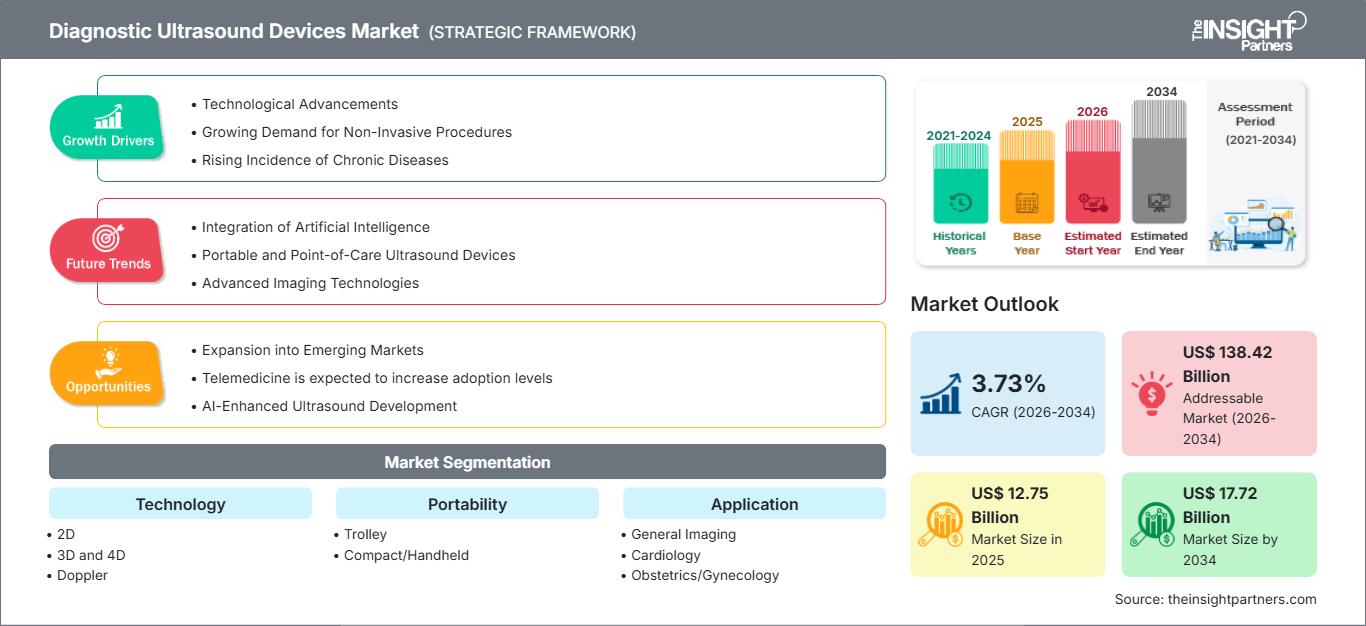
The diagnostic ultrasound devices market is demonstrating steady expansion driven by technological refinement and increased demand for non-invasive imaging modalities. The market was valued at US$ 12.75 billion in 2025 and is projected to reach US$ 17.72 billion by 2034, registering a CAGR of 3.73% from 2026 to 2034. This growth reflects rising applications across cardiology, obstetrics, and general imaging, alongside continuous improvements in imaging accuracy and device portability.
North America represents a technologically advanced landscape for the diagnostic ultrasound devices market, supported by widespread integration of imaging solutions across healthcare systems. The region is expected to grow at an estimated CAGR of approximately 3.2%–3.4%, driven by adoption of point-of-care diagnostics and AI-enabled imaging systems. Expanding outpatient care infrastructure and demand for rapid diagnostic tools are further strengthening regional growth momentum.
Diagnostic Ultrasound Devices Market Assessment and Insights
- North America: North America accounted for 34–38% share in 2025 and is anticipated to expand at a CAGR of 3.2%–3.8% during 2026–2034. Hospital modernization, expanding point-of-care imaging adoption, and well-established diagnostic imaging infrastructure continue to support regional market leadership.
- U.S.: The U.S. represented 82–86% of the North American diagnostic ultrasound devices market size in 2025 and is projected to register a CAGR of 3.3%–3.9% during 2026–2034, supported by increasing deployment of point-of-care ultrasound systems, healthcare infrastructure upgrades, and growing demand for portable diagnostic imaging.
- Europe: Europe held 26–30% of the diagnostic ultrasound devices market share in 2025 and is expected to grow at a CAGR of 3.0%–3.6% during 2026–2034. Germany, the United Kingdom, and France remain the leading regional diagnostic ultrasound devices markets due to established diagnostic imaging infrastructure and continued investments in advanced ultrasound technologies.
- Asia Pacific: Asia Pacific accounted for 24–28% share in 2025 and is forecast to expand at a CAGR of 4.5%–5.2% during 2026–2034. China, Japan, and India continue to drive regional growth through rising healthcare investments, expanding diagnostic accessibility, and increasing adoption of ultrasound imaging systems.
- Largest Segment: Application – General Imaging represented the largest diagnostic ultrasound devices market segment and is expected to record a CAGR of 3.5%–4.1% during 2026–2034, reflecting broad clinical utilization across emergency medicine, abdominal imaging, musculoskeletal assessment, and routine diagnostic procedures.
- High Growth Segment: Portability – Compact/Handheld is projected to grow at a CAGR of 5.8%–6.6% during 2026–2034, driven by expanding adoption of point-of-care diagnostics, increasing use in emergency medicine, and growing demand for home healthcare services.
- Key companies analyzed in detail: Siemens Healthineers AG; SonoScape Medical Corp.; Samsung Medison Co., Ltd.; FUJIFILM Sonosite, Inc.; GE HealthCare Technologies Inc.; Canon Medical Systems Corporation; Hitachi Healthcare Americas Corporation; CHISON Medical Technologies Co., Ltd.; Koninklijke Philips N.V.; Shenzhen Mindray Bio-Medical Electronics Co., Ltd.; Arthrex, Inc.; Becton, Dickinson and Company; Esaote S.p.A.; Fukuda Denshi Co., Ltd.; and Kalamed GmbH.
Source: The Insight Partners' analysis based on proprietary research, government publications, company annual reports, investor presentations, industry databases, and expert interviews.
The diagnostic ultrasound devices market report has transitioned into a highly adaptive segment within the broader medical imaging industry. Advancements in imaging technologies have enhanced diagnostic precision, while the shift toward portable and handheld devices has expanded accessibility across diverse healthcare settings. Key players such as Siemens, GE, Philips, and Samsung Medison continue to refine product capabilities, focusing on real-time imaging and workflow optimization.
Future diagnostic ultrasound devices market development is expected to be shaped by the integration of intelligent imaging technologies and growth in emerging economies. As healthcare providers prioritize early diagnosis and cost-effective modalities, ultrasound devices are becoming indispensable across clinical applications. The increasing role of AI, combined with improved device interoperability, will continue to influence competitive strategies and long-term market dynamics.
Diagnostic Ultrasound Devices Market Report Scope
| Report Attribute | Details |
|---|---|
| Market size in 2025 | US$ 12.75 Billion |
| Market Size by 2034 | US$ 17.72 Billion |
| Global CAGR (2026 - 2034) | 3.73% |
| Historical Data | 2021-2024 |
| Forecast period | 2026-2034 |
Diagnostic Ultrasound Devices Market Analysis
The diagnostic ultrasound devices market is driven by rising demand for safe, efficient, and real-time diagnostic solutions. The increasing prevalence of chronic disorders, particularly cardiovascular and abdominal conditions, has amplified the need for reliable imaging systems. Ultrasound technology offers advantages such as non-invasive operation, absence of radiation exposure, and relatively lower costs, making it widely adopted across healthcare settings.
The value chain consists of component manufacturers, system developers, distribution networks, and end users such as hospitals and specialty clinics. Companies such as Hitachi Medical, Esaote SpA, and Chison contribute to specialized system development, while global entities like Philips and GE focus on integrated platforms. This ecosystem fosters innovation while maintaining competitive pricing pressures.
Competitive positioning is influenced by product innovation, technological integration, and geographic expansion strategies. Firms like Sonosite (Fujifilm) emphasize portability, while Toshiba and Samsung Medison focus on imaging clarity and system efficiency. Strategic partnerships and acquisitions are increasingly used to expand product portfolios and strengthen regional presence.
Investment trends are centered on AI-enabled imaging, cloud-based data integration, and portable ultrasound systems. Companies are allocating resources toward R&D initiatives aimed at enhancing diagnostic accuracy and user experience. Emerging markets are attracting attention due to growing healthcare infrastructure investments, prompting companies to adapt pricing and product strategies.
● REPORT CUSTOMIZATION
Tailor This Report To Align With Your Specific Business Requirements
This report can be customized to align precisely with your business objectives, scope, and target markets. Customization options include tailored segmentation, geography, competitive analysis, and strategic insights to support informed decision-making.
Customize This Report →WHAT YOU CAN ADJUST
- ● Segmentations
- ● Geography
- ● Competitive Analysis
- ● Language Preferences
Diagnostic Ultrasound Devices Market: Strategic Insights
Regional Insights
North America Diagnostic Ultrasound Devices Market
North America maintains a dominant position in the diagnostic ultrasound devices market, supported by advanced healthcare infrastructure and strong adoption of innovative imaging technologies. The region is projected to grow at a CAGR of approximately 3.2%–3.4%, driven by increasing use of ultrasound in emergency and outpatient care settings.
Rising demand for point-of-care ultrasound devices is transforming clinical workflows. Healthcare providers are adopting compact systems to improve diagnostic efficiency and patient outcomes. Continuous innovation in AI-based imaging further supports market scalability and enhances diagnostic reliability.
U.S. Diagnostic Ultrasound Devices Market
The U.S. holds a significant share, contributing approximately 70%–75% of the North American market. The diagnostic ultrasound devices market is expected to expand at a CAGR of around 3.1%, supported by advanced healthcare systems and strong adoption of imaging technologies across clinical applications.
The existence of large corporations such as GE, Philips, and Siemens ensures that innovation is ongoing. The increasing adoption of portable ultrasound scanners by doctors in primary healthcare and emergency services is creating a change in demand. Additionally, the focus on early detection and chronic illness treatment is ensuring constant demand for ultrasound machines.
Europe Diagnostic Ultrasound Devices Market
Europe accounts for approximately 25%–30% of the global diagnostic ultrasound devices market, with a projected CAGR of 3.3%–3.5%. The region benefits from well-established healthcare systems and increasing adoption of advanced imaging technologies. Germany leads the market, driven by technological innovation and strong manufacturing capabilities.
UK diagnostic ultrasound devices market features an increasing number of portable ultrasound machines and an increase in outpatient diagnostic services. Public healthcare investment and a preventive approach help ensure stable demand for imaging equipment.
Germany continues to be the leader among European countries due to the developed medical technologies sector and the presence of leading manufacturers in the market. High-quality imaging technologies and constant innovations in them are highly valued.
France, Italy, and Spain contribute to regional expansion by introducing new imaging technologies in healthcare facilities. Ultrasound machines are adopted in both public and private hospitals.
APAC Diagnostic Ultrasound Devices Market
Asia Pacific diagnostic ultrasound devices market share is estimated at 20%-25%, and it is the fastest-growing region, with a CAGR of more than 4.5%. China occupies the top position in the market owing to the rapid development of healthcare infrastructure and strong manufacturing capabilities.
Japan and South Korea are making their contributions through advanced technologies and imaging technologies. India is emerging rapidly due to improved healthcare services and the need for low-cost diagnostic procedures, while Australia is contributing through steady growth and well-developed healthcare systems.
Healthcare services are being improved through government and private investments. The need for cost-effective and portable ultrasound equipment is very high in rural and semi-urban settings.
Middle East & Africa Diagnostic Ultrasound Devices Market
The Middle East & Africa diagnostic ultrasound devices market is projected to grow at a CAGR of approximately 3.5%–3.7%, supported by improving healthcare infrastructure and diagnostic capabilities. Saudi Arabia leads the region due to substantial healthcare investments and modernization programs.
The UAE demonstrates strong demand driven by private healthcare expansion and medical tourism. South Africa continues to grow steadily with increased adoption of diagnostic imaging technologies.
Across the rest of MEA, market growth is supported by infrastructure development and efforts to improve healthcare access. Energy-driven economies are investing in healthcare diversification, contributing to long-term expansion.
Segmentation Analysis
Technology
- 2D: Remains the most widely used technology due to affordability and reliability in routine diagnostics. It continues to dominate in primary care and emerging markets where cost sensitivity influences equipment adoption decisions.
- 3D and 4D: Enable advanced visualization, particularly in obstetrics and complex diagnostics. Increasing preference for enhanced imaging quality supports steady growth in specialized healthcare facilities and tertiary hospitals.
- Doppler: Crucial for cardiovascular and vascular imaging applications. Rising incidence of heart-related conditions drives adoption, with Doppler systems offering precise blood flow analysis and diagnostic accuracy.
Portability
- Trolley: Traditional systems that provide comprehensive imaging capabilities. Commonly used in hospitals due to advanced features and suitability for high patient volumes and multi-specialty diagnostic requirements.
- Compact/Handheld: Experiencing rapid traction due to point-of-care applications. These devices enable flexible usage in emergency, remote, and outpatient environments while improving accessibility and clinical efficiency.
Application
- General Imaging: Maintains leading position due to broad utility in abdominal, musculoskeletal, and soft tissue imaging. High frequency of procedures drives consistent demand across healthcare settings.
- Cardiology: A growing segment driven by increasing cardiovascular disease prevalence. Advanced ultrasound imaging is essential for heart function evaluation and continuous patient monitoring.
- Obstetrics/Gynecology: Critical for prenatal and reproductive health imaging. Frequent monitoring requirements ensure sustained demand, supported by improvements in imaging clarity and patient safety.
End User
- Hospitals: Largest consumers of ultrasound systems, driven by high patient volume and need for advanced diagnostic capabilities. Continuous technology upgrades and expansion of services drive sustained demand.
- Maternity Centers: Specialized adoption focused on prenatal and childbirth diagnostics. Increasing demand for maternal healthcare services supports steady growth in this segment.
Opportunity Snapshot
| Application | Revenue Contribution | Trend Tag | Adoption Stage |
| General Imaging | High | Routine imaging | Mature |
| Cardiology | Medium | Cardiac monitoring | Scaling |
| Obstetrics/Gynecology | High | Prenatal care | Mature |
Diagnostic Ultrasound Devices Market Growth Drivers and Impact Analysis
Growing Preference for Radiation-Free Imaging Modalities
The growing concern over patient safety and decreasing exposure to harmful radiation are greatly influencing the market for diagnostic ultrasound devices. Ultrasound offers the additional benefit of real-time imaging without exposing the patient to ionizing radiation (as with CT or X-ray systems) and, therefore, can be used effectively for certain patient groups, such as pregnant women and infants.
Companies are placing a greater emphasis on ultrasound imaging as the primary diagnostic tool because of its high efficiency and safety record. This shift has resulted in a significant increase in ultrasound device installations across both developed and developing healthcare systems. As ultrasound imaging is a more cost-effective modality than other imaging technologies (e.g., CT or X-ray), this will further impact healthcare providers' ability to optimize overall care costs. Leading ultrasound manufacturers, such as Philips and GE, are anticipating this growing demand by developing advanced imaging systems that combine enhanced patient safety, improved patient outcomes, and operational efficiencies, thereby reinforcing adoption rates.
Rapid Technological Advancements and Product Innovation
Technological innovation remains an important factor in shaping the market for ultrasound diagnostic devices. Innovations such as artificial intelligence, high-resolution imaging, and advanced Doppler capabilities have greatly improved the diagnostic capabilities of ultrasound systems. They make it possible to accurately diagnose any abnormality and to ease operators' work.
Many manufacturers are now focusing on making their products more user-friendly by incorporating software innovations that reduce dependence on the operator. Companies such as Siemens and Samsung Medison are investing heavily in research and development to develop better imaging capabilities, automated measurements, and analytics. Their effects are seen in many application sectors and patient benefits. As technology continues to evolve, product differentiation is becoming a critical factor influencing purchasing decisions and competitive positioning.
Expansion of Healthcare Infrastructure in Emerging Economies
The development of healthcare infrastructure in developing nations is a major factor driving growth in the ultrasound diagnostic devices market. There is increased government and private-sector funding for the establishment of hospitals, diagnostic centers, and primary care centers, which will increase the use of imaging devices. Ultrasound devices are preferred because they are more versatile and less expensive than other medical imaging devices.
As healthcare facilities become more widely available in regions such as Asia-Pacific and the Middle East & Africa, the adoption of imaging equipment will increase. Firms such as Mindray and Chison have opted to concentrate on manufacturing cost-effective imaging equipment for those regions. Such developments are an advantage, as they drive market growth amid challenges in healthcare facilities.
Diagnostic Ultrasound Devices Market Future Trends
Adoption of Artificial Intelligence in Imaging Workflows
Ultrasound Systems are being transformed as Artificial Intelligence (AI) is added to the equipment for diagnosis. Improvements in Accuracy by using AI to automate the image analysis process and detect anomalies in the images, along with clinical decision support. This trend is reducing reliance on highly specialized operators and making ultrasound more accessible across diverse healthcare settings.
AI-powered ultrasound systems are enhancing workflow efficiency by shortening scan durations and optimizing image acquisition processes. This advancement provides valuable support to high-volume healthcare facilities in delivering effective diagnostic imaging services. In line with diagnostic ultrasound devices market trends, AI is expected to become a standard feature in advanced ultrasound equipment, supporting predictive diagnostics and personalized healthcare solutions. The ongoing evolution of data-driven imaging platforms will further strengthen clinical capabilities and broaden the range of diagnostic applications.
Increasing Shift Toward Portable and Handheld Devices
As healthcare organizations move toward decentralized and point-of-care diagnostics, the need for portable ultrasound equipment is rapidly growing. Particularly in emergency and remote scenarios, handheld devices offer flexibility, are simple to operate, and can provide instant diagnostic insights.
As a result, product development is changing due to this trend. Companies such as SonoSite focus on developing portable equipment. In the future, improvements can enable the incorporation of their products into telemedicine applications, thanks to increased imaging quality and connectivity options. The range of ultrasound diagnostics will broaden, and the availability of medical care will increase as more people use portable equipment.
Diagnostic Ultrasound Devices Market Opportunities
Expansion in Primary Care and Preventive Diagnostics
The growing emphasis on preventive healthcare offers a valuable chance for the diagnostic ultrasound devices market. Primary care providers are including ultrasound imaging in regular patient evaluations. This enables early disease detection, which lowers healthcare costs and improves patient outcomes by catching conditions earlier.
This trend will favor manufacturers of small, inexpensive equipment suitable for use in primary care. In addition, training of healthcare providers and compatibility of such equipment with online health platforms will increase its popularity. Increased preventive diagnostics is likely to drive growth in ultrasound systems, especially in outpatient and community healthcare settings.
Growing Demand in Remote and Underserved Regions
Remote and underserved regions provide significant growth opportunities for ultrasound device makers. Limited access to advanced diagnostic tools in these areas creates a high demand for portable and affordable imaging solutions. Ultrasound devices are ideal for these environments because of their versatility and low infrastructure needs.
This opportunity can be leveraged to develop durable, battery-operated solutions designed for challenging environments. Successful deployment will require collaboration with government agencies, healthcare institutions, and stakeholders aligned with the diagnostic ultrasound devices market forecast. Addressing the needs of populations with limited access to quality healthcare will support market expansion while enhancing healthcare accessibility on a global scale.
Recent Developments
- June, 2026: Royal Philips announced regulatory clearance in the USA of Elevate Plus, bringing advanced imaging and a suite of AI and automation capabilities to Philips EPIQ Elite and Affiniti, its flagship ultrasound systems. With CE Mark and 510(k) clearance, Elevate Plus helps standardize routine exams and reduce the need for repeat scanning, delivering more consistent and high-quality ultrasound images faster across users.
- March, 2026: Samsung Medison announced that its U.S. medical imaging businesses, previously operating as Neurologica and Boston Imaging, will unify under a new corporate identity, Samsung HME (Healthcare and Medical Equipment) America. This transition brings the company’s U.S. ultrasound, digital radiography, and computed tomography (CT) operations under one integrated structure that reflects the global Samsung brand behind its technology.
- February, 2026: GE HealthCare introduced the next generation of LOGIQ general imaging ultrasound systems – an intelligently designed portfolio built to elevate clinical imaging, accelerate workflows, and unlock deeper diagnostic insight. Equipped with advanced imaging capabilities, enhanced AI-powered automation, and an expanded open digital platform, LOGIQ systems are engineered to simplify daily practice while supporting more confident, informed clinical decisions.
Frequently Asked Questions

- Comprehensive Market Sizing and Forecast Analysis
- Detailed Segmentation Analysis
- In-Depth Market Dynamics Assessment
- Regional and Country-Level Insights
- Competitive Landscape and Company Benchmarking
- Strategic Business Intelligence
Recent Reports
Testimonials

The Insight Partners provided valuable market intelligence that supported our global go-to-market strategy. Their team was professional, responsive, and attentive to our feedback, providing thoughtful analysis and helpful methodological clarifications throughout the project.
Junmo Kim Chief Financial Officer (CFO), Enertech Co., Ltd.
The Insight Partners' SCADA System Market report is comprehensive, with valuable insights on current trends and future forecasts. The team was highly professional, responsive, and supportive throughout. We are very satisfied and highly recommend their services.
RAN KEDEM Partner, Reali Technologies LTDs
I requested a report on a very specific software market and the team produced the report in a few days. The information was very relevant and well presented. I then requested some changes and additions to the report. The team was again very responsive and I got the final report in less than a week.
JEAN-HERVE JENN Chairman, Future Analytica
We worked with The Insight Partners for an important market study and forecast. They gave us clear insights into opportunities and risks, which helped shape our plans. Their research was easy to use and based on solid data. It helped us make smart, confident decisions. We highly recommend them.
PIYUSH NAGPAL Sr. Vice President, High Beam Global
The Insight Partners delivered insightful, well-structured market research with strong domain expertise. Their team was professional and responsive throughout. The user-friendly website made accessing industry reports seamless. We highly recommend them for reliable, high-quality research services
YUKIHIKO ADACHI CEO, Deep Blue, LLC.
This is the first time I have purchased a market report from The Insight Partners.While I was unsure at first, I visited their web site and felt more comfortable to take the risk and purchase a market report.I am completely satisfied with the quality of the report and customer service. I had several questions and comments with the initial report, but after a couple of dialogs over email with their analyst I believe I have a report that I can use as input to our strategic planning process.Thank you so much for taking the extra time and making this a positive experience.I will definitely recommend your service to others and you will be my first call when we need further market data.
JOHN SUZUKI President and Chief Executive Officer, Board Director, BK Technologies
I wish to appreciate your support and the professionalism you displayed in the course of attending to my request for information regarding to infectious disease IVD market in Nigeria. I appreciate your patience, your guidance, and the fact that you were willing to offer a discount, which eventually made it possible for us to close a deal. I look forward to engaging The Insight Partners in the future, all thanks to the impression you have created in me as a result of this first encounter.
DR CHIJIOKE ONYIA MANAGING DIRECTOR, PineCrest Healthcare Ltd.Reason to Buy
- Informed Decision-Making
- Understanding Market Dynamics
- Competitive Analysis
- Identifying Emerging Markets
- Customer Insights
- Market Forecasts
- Risk Mitigation
- Boosting Operational Efficiency
- Strategic Planning
- Investment Justification
- Tracking Industry Innovations
- Aligning with Regulatory Trends





 Get Free Sample for