
Diamond Bur Market Share, Size & Demand by 2034
Coverage: by Type (Single-Use, Multi-Use); Application (High-speed air driven hand pieces, Slow bending hand pieces, Slow straight hand pieces) , and Geography (North America, Europe, Asia Pacific, and South and Central America)
- Status : Data Released
- Report Code : TIPRE00012839
- Category : Chemicals and Materials
- No. of Pages : 150
- Available Report Formats :


- Last update date : July 21, 2026


2025 Market Size
US$ 1.17 Bn
Base year value
2034 Forecast
US$ 1.59 Bn
Projected by 2034
CAGR 2026-2034
3.86 %
Growth rate
Addressable Market
US$ 12.79 Bn
(2026-2034)
The Diamond Bur Market size was valued at US$ 1.17 Billion in 2025 and is projected to reach US$ 1.59 Billion by 2034, registering a CAGR of 3.86% during 2026–2034. Demand will be influenced by repetitive restoration processes, increased usage of cosmetic dentistry, and the need for precise rotary instruments that work along with the high-speed and low-speed hand pieces.
The North America region continues to be a valuable market base, with the Market being driven by the well-established dental industry, investments in private clinics, and the high adoption rate of single use instruments. The market in this region will exhibit a CAGR of 3.4 to 4.2% from 2026 to 2034.
Diamond Bur Market Assessment and Insights
- North America: Share in 2025 of 34–38% and CAGR between 3.4–4.2%. The market benefits from advanced restorative dentistry, high clinic density, and strong infection-control compliance.
- US: Share in 2025 of 76–80% of North America and CAGR between 3.5–4.3%. Demand is supported by cosmetic dentistry, DSOs, and rapid chairside replacement cycles.
- Europe: Share in 2025 of 27–31% and CAGR between 3.1–3.9%. Germany, France, Italy, Spain, and the UK lead demand through established dental technology use.
- Asia Pacific: Share in 2025 of 22–26% and CAGR between 4.5–5.3%. China, Japan, South Korea, India, and Australia support growth through clinic expansion and dental tourism.
- Largest Segment: Multi-Use burs held 58–62% market share in 2025 and CAGR of 3.2–4.0% during 2026–2034, reflecting cost efficiency in high-volume practices.
- High Growth Segment: Single-Use burs held 38–42% market share in 2025 and CAGR of 4.4–5.2% during 2026–2034, driven by sterility and compliance priorities.
- Key companies analyzed in detail: Beebur Med Ltd., Dentsply Sirona Inc., DFS-DIAMON GmbH, Drendel + Zweiling DIAMANT GmbH, HORICO Dental Hopf, Ringleb & Co. GmbH & Cie. KG, Johnson-Promident, Kerr Corporation, Komet Dental Gebr. Brasseler GmbH & Co. KG, Lasco Diamond Products Ltd., Microdont Micro Usinagem de Precisão Ltda.
Source: The Insight Partners' analysis based on proprietary research, government publications, company annual reports, investor presentations, industry databases, and expert interviews.
In precision dentistry, bur design trends have moved away from basic abrasive tools towards sophisticated instruments characterized by uniform grit distribution, specific head geometry, and high bonding of diamond particles to steel shanks. In addition, the Diamond Bur Market share is affected by the discipline involved in production processes, where producers try to strike a balance between cutting efficiency, vibration, sterilization capabilities, and reproducibility of the process.
Future demand for the diamond bur market forecast is expected to increase in developing dental markets, with increased activity of private clinics, implant centers, and aesthetic dentistry firms. Growing focus on infection prevention regulation is giving a tailwind to the segment of sterile packs, whereas the segment of reusable diamond burs remains relevant where reprocessing is economic. Priorities in investments include automation of coatings, higher quality control, and digital cataloging for better selection of burs based on procedure, speed class, grit, and result.
Diamond Bur Market Report Scope
| Report Attribute | Details |
|---|---|
| Market size in 2025 | US$ 1.17 Billion |
| Market Size by 2034 | US$ 1.59 Billion |
| Global CAGR (2026 - 2034) | 3.86% |
| Historical Data | 2021-2024 |
| Forecast period | 2026-2034 |
Diamond Bur Market Analysis
Factors such as the number of times dentists perform a procedure will influence the growth profile of the Diamond Bur Market instead of the value of investments that dentists make. Diamond burrs are continuously being used or recycled during cavity preparation, crowns trimming, veneers finishing, adjusting occlusion, and composites placement. The global oral disease prevalence, according to WHO estimates, stands at 3.5 billion patients.
Factors affecting supply include industrial diamond supply, precision of steel shanks, electroplating quality, and packaging resistant to sterilization. Manufacturers provide dentists with diamonds through distributors, group purchasing organizations, and direct digital catalogues. The market is also characterized by compatibility with handpieces, since high speed air driven hand pieces have to be stable and heat resistant differently from slow bending and slow straight hand pieces.
According to Current Diamond Bur Market report, competition is focused on clinical efficiency, sterility issues, and portfolio by applications. Companies like Dentsply Sirona Inc., Kerr Corporation, and Komet Dental Gebr. Brasseler GmbH & Co. KG offer products based on wide-scale distribution all over the world, while DFS-DIAMON GmbH, HORICO Dental Hopf, Ringleb & Co. GmbH & Cie. KG, and Drendel + Zweiling DIAMANT GmbH rely on precise production expertise.
Specialist companies including Beebur Med Ltd., Johnson-Promident, Lasco Diamond Products Ltd., and Microdont Micro Usinagem de Precisão Ltda. increase competition due to specific grit range, private labeling services, and regional market proximity. Investments are made into automated bur inspection and diamond coating technology as well as packaging solutions making clinics' inventory management easier.
● REPORT CUSTOMIZATION
Tailor This Report To Align With Your Specific Business Requirements
This report can be customized to align precisely with your business objectives, scope, and target markets. Customization options include tailored segmentation, geography, competitive analysis, and strategic insights to support informed decision-making.
Customize This Report →WHAT YOU CAN ADJUST
- ● Segmentations
- ● Geography
- ● Competitive Analysis
- ● Language Preferences
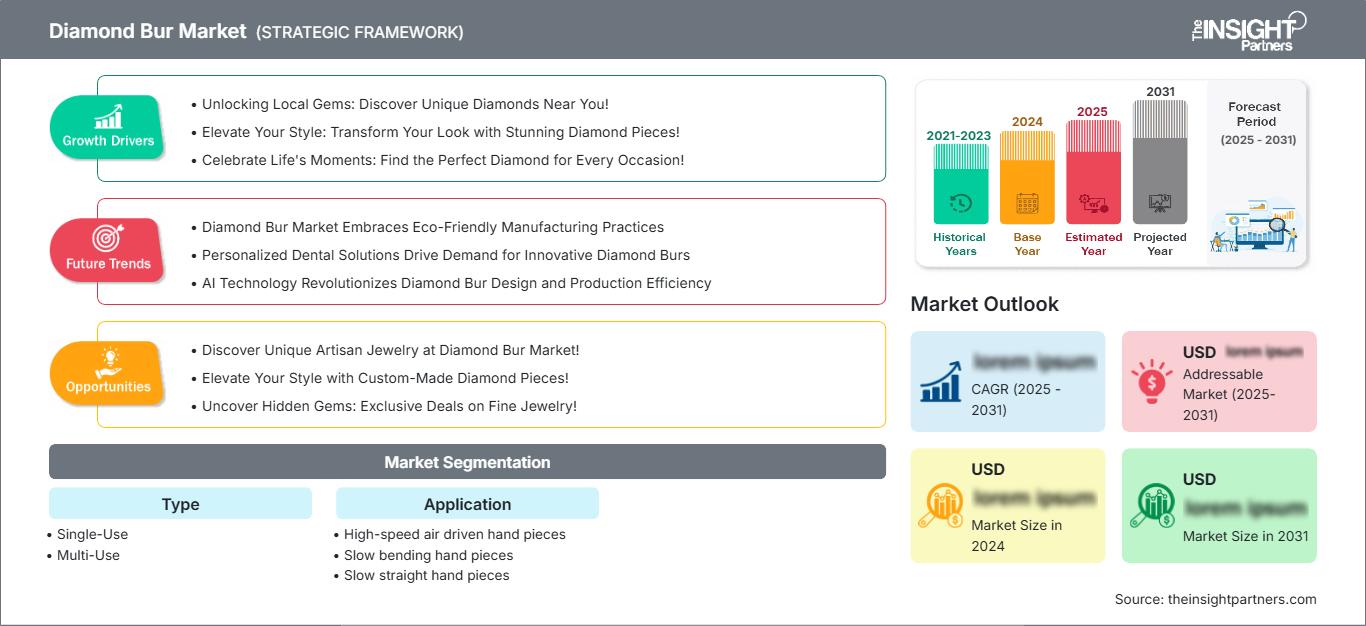
Diamond Bur Market: Strategic Insights
Regional Insights
North America Diamond Bur Market
North America accounted for 34–38% of global revenue in 2025 and is projected to grow at a 3.4–4.2% CAGR through 2034. The Diamond Bur Market share position reflects high dental insurance penetration, advanced chairside technologies, and consistent restorative demand. The CDC has reported substantial untreated decay among working-age adults, sustaining procedure volumes for rotary cutting instruments.
Demand also benefits from dental service organizations that standardize procurement across multiple clinics. Single-use burs are gaining traction where infection-control protocols and workflow efficiency justify higher unit costs. Multi-use products remain important in cost-conscious restorative practices with validated sterilization systems. Regional manufacturers and distributors maintain broad catalog access, supporting fast replenishment across high-speed and slow-speed handpiece applications.
U.S. Diamond Bur Market Market
The United States represented 76–80% of North American revenue in 2025 and is expected to expand at a 3.5–4.3% CAGR. Large private clinic networks, cosmetic dentistry demand, and implant-supported restoration workflows increase bur turnover. High-speed air driven hand pieces remain central in enamel reduction and crown preparation, creating steady consumption of fine, medium, and coarse diamond burs.
Company presence is broad, with Dentsply Sirona Inc., Kerr Corporation, Johnson-Promident, and Komet Dental Gebr. Brasseler GmbH & Co. KG serving clinics through established channels. Application trends favor sterile single-use packs for surgery-adjacent procedures and reusable burs for routine restorative work. Dentists increasingly select products by cutting consistency, heat generation, and compatibility with electric or turbine handpieces.
Europe Diamond Bur Market Market
Europe held 27–31% of global revenue in 2025 and is forecast to grow at a 3.1–3.9% CAGR through 2034. Germany leads due to strong precision-tool manufacturing, dental technology adoption, and established private practices. The UK shows resilient demand from restorative dentistry and aesthetic treatment uptake, while national procurement practices encourage validated quality and compliance documentation.
France, Italy, and Spain contribute through dense dental clinic networks, prosthodontic workloads, and growing patient interest in minimally invasive aesthetic correction. European demand favors reusable burs where sterilization infrastructure is mature, but single-use formats are expanding in settings prioritizing auditability. Regional specialists including DFS-DIAMON GmbH, Drendel + Zweiling DIAMANT GmbH, and HORICO Dental Hopf, Ringleb & Co. GmbH & Cie. KG reinforce supply depth.
APAC Diamond Bur Market Market
Asia Pacific accounted for 22–26% of global revenue in 2025 and is projected to grow at a 4.5–5.3% CAGR. China is the leading country, supported by private dental-chain expansion and urban oral-care demand. Japan and South Korea emphasize precision dentistry, while India benefits from dental tourism, rising disposable income, and expanding specialist clinics.
Australia maintains strong demand through preventive care and restorative procedure access. Policy support for healthcare infrastructure and digital clinic modernization strengthens regional adoption of high-performance burs. Manufacturers are increasingly tailoring packs, grit ranges, and price points for clinics moving from basic rotary instruments toward premium diamond-coated tools compatible with high-speed and slow-speed hand pieces.
Middle East & Africa Diamond Bur Market Market
The Middle East & Africa region is expected to grow at a 3.6–4.4% CAGR through 2034. Saudi Arabia leads demand, supported by healthcare investment, premium dental centers, and expanding medical tourism. The UAE remains important for private cosmetic dentistry, while South Africa contributes through restorative care and urban clinic networks.
Energy-linked infrastructure spending indirectly supports premium healthcare facilities in Gulf economies, creating procurement opportunities for advanced dental consumables. Rest of MEA demand remains uneven but improves where private clinics invest in modern equipment. Single-use burs are attractive in high-end clinics, while reusable products remain practical where sterilization systems and budget discipline shape purchasing.
Segmentation Analysis
Type
The Type segment is forecast to grow at a 3.7–4.5% CAGR during 2026–2034. The Diamond Bur Market trends is shaped by the balance between cost-efficient reuse and infection-control-driven disposability. Clinics select formats according to procedure type, sterilization capacity, patient turnover, and reimbursement pressure. Manufacturers must therefore maintain both validated multi-use portfolios and sterile single-use lines.
- Single-Use: Single-use burs are gaining adoption in procedures where sterility assurance, chairside speed, and auditability are prioritized. They reduce reprocessing complexity and support clinics managing high patient turnover.
- Multi-Use: Multi-use burs remain the revenue anchor because they offer lower cost per procedure when sterilization protocols are mature. Their durability and broad availability sustain demand in restorative dentistry.
Application
The Application segment is projected to register a 3.8–4.6% CAGR through 2034. Demand is closely tied to handpiece speed, bur geometry, and clinical objective. High-speed air driven hand pieces dominate enamel cutting and crown preparation, while slow bending and slow straight hand pieces support finishing, polishing, adjustment, and laboratory-related procedures.
- High-speed air driven hand pieces: This application remains the highest-volume use case because diamond burs are central to cavity preparation, crown reduction, veneer work, and rapid enamel removal in chairside dentistry.
- Slow bending hand pieces: Slow bending handpiece use supports controlled finishing, contouring, and access-sensitive procedures where torque stability and fine abrasive action matter more than rapid cutting speed.
- Slow straight hand pieces: Slow straight handpiece applications are important in prosthetic adjustment, laboratory finishing, and polishing workflows where precision, visibility, and controlled material removal are required.
Opportunity Snapshot
| Segment Name | Revenue Contribution | Trend Tag | Adoption Stage |
| High-speed air driven hand pieces | High | Crown Prep | Mature |
| Slow bending hand pieces | Medium | Controlled Finish | Scaling |
| Slow straight hand pieces | Medium | Lab Polish | Scaling |
Diamond Bur Market Growth Drivers and Impact Analysis
Rising Restorative and Aesthetic Dentistry Procedure Volumes
Demand from restorative and aesthetic dentistry is steady due to applications ranging from tooth preparation, cavity preparation, veneer finishing, crown reductions, and polishing. Global incidences of oral disease are still high, with aging populations needing more prosthodontics and restorative treatment. There is increasing pressure from patients in clinics to be subjected to quick treatments, smooth surfaces, and less invasive procedures. These demands increase the requirement for burs that have predictable abrasivity, less vibration, and faster cutting. It is advantageous for the market when dentists change their worn out burs in order to maintain high cutting performance and shorten chair time. Procedure-related demand is expected to stay strong until 2034.
Infection-Control Requirements Favor Sterile Instrument Choices
Infection control standards are dictating purchases, more specifically for clinics handling large numbers of patients or having less capacity for reprocessing. The use of single-use diamond burs decreases the burden of sterilization, removes the problem of determining the extent to which an instrument deteriorates after each sterilization process, and creates an audit trail. The use of multi-use burrs will still be necessary, but now clinics consider whether sterilization costs, including packaging and quality control, outweigh those of sterilized disposables. This has become very evident in surgical-related treatment, cosmetic dentistry practices, and corporate chains of dental facilities.
Handpiece Modernization Improves Demand for Precision Burs
Contemporary dental hand pieces are increasingly becoming more silent, ergonomical, and uniform in torque delivery, setting higher standards for bur behavior. The electric or turbine-driven devices demand those tools, which will be able to provide concentric motion without any runout and proper heat control. At the same time, high-speed air-driven hand pieces demand a cutting head that will allow efficient removal of hard tissues, while the slow-speed systems need proper finishing and polishing results. As dentists change their equipment, they have to choose appropriate suppliers of burs to make sure that the procedure will go smoothly. Thus, better hand piece performance is an additional reason to focus on premium burs.
Diamond Bur Market Future Trends
Application-Specific Bur Kits for Digital Dentistry
The Diamond Bur Markets trends will include the development of procedures kits that cater to procedures such as CAD/CAM preparations and implant-retained prosthesis. There is a rising need for standardized sequences of burs that would enable dentists to cut down on the time taken to choose the right bur set. It is expected that future product ranges will be categorized based on crown preparations, veneer finishers, zirconia modifiers, and minimally invasive cavity preparation bur sets. This enables easier learning for the clinicians, helps in maintaining better stock control and is highly beneficial for dental service providers and teaching hospitals.
Sustainable Sterile Packaging and Lower-Waste Consumables
More emphasis will be put on sustainability as the need for disposable devices increases and hospitals assess medical waste. Recycling of packaging is expected to be enhanced by manufacturers, and plastic use reduced, as well as pack size optimization without jeopardizing the process of sterility validation. Multi-use burs could be modified through coating that would increase their longevity and minimize their replacement. Procurement officers within large hospital chains might start assessing environmental implications, besides price and performance. It is clear that manufacturers who can prove environmental performance of their products will be favored.
Diamond Bur Market Opportunities
Private Dental Chain Expansion in Emerging Economies
There exists a procurement opportunity offered by private dental chains in India, China, Southeast Asia, the Gulf and Latin America where there is need for standard supply of burs. There will be need to have high quality products which should be regularly restocked together with training services. In terms of forecasts, there will be a need for Diamond Bur suppliers who will be able to offer both premium and value options within the same purchasing arrangement. Bundles with application kits, sterile use packs and distributor managed inventories might minimize clinical differences while enhancing the efficiency of operations. There exists an action-oriented opportunity here due to growing procurement centralization in organized dentistry.
Premium Single-Use Portfolios for Compliance-Led Clinics
The clinics and hospitals where there is a compliance orientation represent an obvious chance to introduce premium single-use products. The purchasers in such organizations appreciate sterilization verification, lot number tracing, and the lower risk of reprocessing, especially in cases when procedures are either invasive or aerosol. It is possible to create a competitive advantage by offering procedure-specific sterile packs, a color-coded grit system, and procurement audit documentation. Such a sales strategy will fit perfectly into efficiency considerations due to the fact that sterile burs minimize the time required from the staff to sort, clean, check, and pack tools.
Recent Developments
- November 2025: Premier Dental has launched Priva Rotary Instruments Diamond Burs, featuring SmartEdge Technology. This technology optimizes rotational accuracy with engineered diamond crystals, enhancing cutting efficiency while reducing vibration for better control. It also improves tooth surface preparation and minimizes the risk of diamond dislodgement.
- October 2025: Premier Dental has introduced Two Striper Euro diamond burs, tailored for clinicians who favor European shape numbering. These burs feature grit-indicating grooves for easier selection and are manufactured using Premier's proprietary P.B.S. brazing process. They offer sharper diamonds that stay fixed, provide quicker cuts, and enhance longevity across multiple preparations.
Frequently Asked Questions

- Comprehensive Market Sizing and Forecast Analysis
- Detailed Segmentation Analysis
- In-Depth Market Dynamics Assessment
- Regional and Country-Level Insights
- Competitive Landscape and Company Benchmarking
- Strategic Business Intelligence
Recent Reports
Testimonials

The Insight Partners' SCADA System Market report is comprehensive, with valuable insights on current trends and future forecasts. The team was highly professional, responsive, and supportive throughout. We are very satisfied and highly recommend their services.
RAN KEDEM Partner, Reali Technologies LTDs
I requested a report on a very specific software market and the team produced the report in a few days. The information was very relevant and well presented. I then requested some changes and additions to the report. The team was again very responsive and I got the final report in less than a week.
JEAN-HERVE JENN Chairman, Future Analytica
We worked with The Insight Partners for an important market study and forecast. They gave us clear insights into opportunities and risks, which helped shape our plans. Their research was easy to use and based on solid data. It helped us make smart, confident decisions. We highly recommend them.
PIYUSH NAGPAL Sr. Vice President, High Beam Global
The Insight Partners delivered insightful, well-structured market research with strong domain expertise. Their team was professional and responsive throughout. The user-friendly website made accessing industry reports seamless. We highly recommend them for reliable, high-quality research services
YUKIHIKO ADACHI CEO, Deep Blue, LLC.
This is the first time I have purchased a market report from The Insight Partners.While I was unsure at first, I visited their web site and felt more comfortable to take the risk and purchase a market report.I am completely satisfied with the quality of the report and customer service. I had several questions and comments with the initial report, but after a couple of dialogs over email with their analyst I believe I have a report that I can use as input to our strategic planning process.Thank you so much for taking the extra time and making this a positive experience.I will definitely recommend your service to others and you will be my first call when we need further market data.
JOHN SUZUKI President and Chief Executive Officer, Board Director, BK Technologies
I wish to appreciate your support and the professionalism you displayed in the course of attending to my request for information regarding to infectious disease IVD market in Nigeria. I appreciate your patience, your guidance, and the fact that you were willing to offer a discount, which eventually made it possible for us to close a deal. I look forward to engaging The Insight Partners in the future, all thanks to the impression you have created in me as a result of this first encounter.
DR CHIJIOKE ONYIA MANAGING DIRECTOR, PineCrest Healthcare Ltd.Reason to Buy
- Informed Decision-Making
- Understanding Market Dynamics
- Competitive Analysis
- Identifying Emerging Markets
- Customer Insights
- Market Forecasts
- Risk Mitigation
- Boosting Operational Efficiency
- Strategic Planning
- Investment Justification
- Tracking Industry Innovations
- Aligning with Regulatory Trends





 Get Free Sample for