
Dicamba Market Growth, Share & Trends by 2034
Coverage: By Form (Liquid, Dry); Crop Type (Cereals and Grains, Oil Seeds and Pulses, Pastures, Forage Crops); Application (Agriculture, Lawn and Turf, Others) , and Geography (North America, Europe, Asia Pacific, and South and Central America)
- Status : Data Released
- Report Code : TIPRE00009684
- Category : Chemicals and Materials
- No. of Pages : 150
- Available Report Formats :


- Last update date : July 21, 2026


2025 Market Size
US$ 460.66 Mn
Base year value
2034 Forecast
US$ 789.91 Mn
Projected by 2034
CAGR 2026-2034
6.17 %
Growth rate
Addressable Market
US$ 5,659.90 Mn
(2026-2034)
The Dicamba Market was valued at US$ 460.66 Million in 2025 and is projected to reach US$ 789.91 Million by 2034, registering a CAGR of 6.17% during 2026–2034. Demand is supported by the continued need for broadleaf weed control across cereals, grains, oilseeds, pulses, pastures, forage crops, and managed turf. Adoption is also influenced by formulation improvements, stewardship requirements, and grower focus on protecting crop yields.
Across North America, the Dicamba Market size outlook remains anchored in herbicide-resistant weed pressure, large soybean and cotton acreage, and structured applicator training. The region is estimated to grow at a 5.5–6.5% CAGR during 2026–2034 as regulatory labels evolve around drift reduction, application timing, buffer distances, and volatility management. Demand remains strongest where resistant Palmer amaranth, waterhemp, and kochia threaten field productivity.
Dicamba Market Assessment and Insights
- North America: Share in 2025 of 34–38% and CAGR between 5.5–6.5%. Demand is led by soybean, cotton, corn, and pasture weed-control programs where resistant broadleaf weeds require alternative post-emergence chemistry.
- US: Share in 2025 of 80–84% of North America and CAGR between 5.6–6.6%. Adoption depends on federal and state label approvals, applicator compliance, and strong use in row-crop systems.
- Europe: Share in 2025 of 18–22% and CAGR between 4.8–5.8%. Germany, France, Spain, and the UK lead use across cereals, pasture management, and selective non-crop vegetation programs.
- Asia Pacific: Share in 2025 of 28–32% and CAGR between 6.8–7.8%. China, India, Australia, and Japan support regional expansion through grain production, forage demand, and rising herbicide modernization.
- Largest Segment: Liquid form with market share of 64–68% in 2025 and CAGR of 6.0–6.8% during 2026–2034, supported by easier mixing, spraying, and field dosing.
- High Growth Segment: Agriculture application with market share of 86–90% in 2025 and CAGR of 6.2–7.0% during 2026–2034, driven by broadacre weed resistance management.
- Key companies analyzed in detail: BASF SE, Bayer CropScience AG, Corteva Agriscience Inc., Dow Inc., Syngenta AG, Nufarm Limited, Aero Agro Chemicals Industries Limited, SinoHarvest Corporation, Albaugh, LLC, Shanghai Bosman Industrial Co., Ltd.
Source: The Insight Partners' analysis based on proprietary research, government publications, company annual reports, investor presentations, industry databases, and expert interviews.
The application of Dicamba has developed into a highly-regulated crop protection platform based upon the biology of resistant weeds, spray technique, and low volatility chemistry. Suppliers are adapting their formulations for lower off-target movement while distributors and applicators are developing label training, spray nozzles, drift reduction additives, and stewardship tools. The manufacturing of these chemicals continues to be consolidated amongst a small number of global agrochemical suppliers with capability to manufacture active ingredients and formulate in order to distribute in row crop and pasture systems.
Demand is anticipated to grow in the future in the Asia-Pacific region and Latin American exporting farms in addition to regulated North American crops which require other herbicide modes of action. This investment will go towards compliance of formulations, precision applications, and crop management programs to ensure proper weed control without harming the environment. Regulations will drive sales towards suppliers who can demonstrate drift reduction, applicator training, and stewardship within the Dicamba Market.
Dicamba Market Report Scope
| Report Attribute | Details |
|---|---|
| Market size in 2025 | US$ 460.66 Million |
| Market Size by 2034 | US$ 789.91 Million |
| Global CAGR (2026 - 2034) | 6.17% |
| Historical Data | 2021-2024 |
| Forecast period | 2026-2034 |
Dicamba Market Analysis
The Dicamba Market growth profile is highly associated with the prevalence of resistant broadleaf weeds in addition to the need for an effective post-emergent weed killer in growers. Soybean, cotton, cereals, and pasture farming continues to depend on selective herbicides for protecting yield, controlling competition and facilitating efficient operation of fields. The demand for such herbicides is high in places where glyphosate resistance has limited their weed control choices.
The supply chain is made up of active ingredient manufacturers, formulators, distributors of crop inputs, ag retail distributors, application companies, and large farms. The supply is influenced by raw materials sourcing, registration cycles and timing of demands. The liquid form dominates due to its easy integration into ground sprayers.
The Dicamba market report indicates a highly competitive market driven by players who have a regulatory background, formulations, and technical expertise for farmers. BASF SE, Bayer CropScience AG, Syngenta AG, Corteva Agriscience Inc., and Nufarm Limited continue to be at the forefront of product innovation, labeling, and distribution. Albaugh, LLC and Shanghai Bosman Industrial Co., Ltd. aid market access through low-cost supply chains.
The strategic position in this market is becoming more about having stewardship credibility instead of market share expansion. Manufacturers are making efforts towards developing low-volatility formulations, tank mix compatibility, application guidance, and technologies that decrease the risk of misapplication. Dow Inc., Aero Agro Chemicals Industries Limited, and SinoHarvest Corporation aid the overall supply chain with chemical production, procurement, and distribution services.
● REPORT CUSTOMIZATION
Tailor This Report To Align With Your Specific Business Requirements
This report can be customized to align precisely with your business objectives, scope, and target markets. Customization options include tailored segmentation, geography, competitive analysis, and strategic insights to support informed decision-making.
Customize This Report →WHAT YOU CAN ADJUST
- ● Segmentations
- ● Geography
- ● Competitive Analysis
- ● Language Preferences
Dicamba Market: Strategic Insights
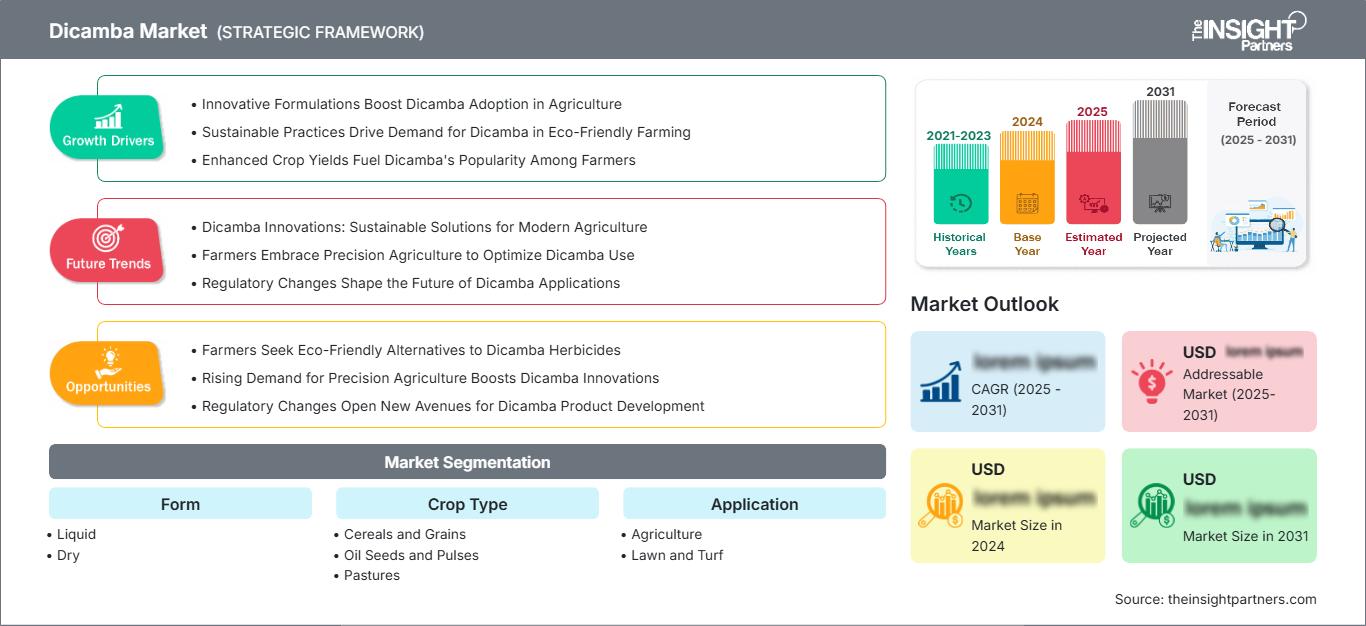
Regional Insights
North America Dicamba Market
North America held 34–38% of global revenue in 2025 and is projected to expand at a 5.5–6.5% CAGR through 2034. The Dicamba Market share position reflects extensive soybean, cotton, corn, pasture, and turf acreage requiring reliable broadleaf weed control. Herbicide-resistant waterhemp, Palmer amaranth, and kochia continue to increase the need for diversified crop-protection programs.
Regional demand is strongly influenced by regulatory review, label revisions, drift mitigation rules, and state-level implementation. EPA actions on over-the-top use for dicamba-tolerant crops have made stewardship a commercial requirement rather than a supporting practice. Manufacturers and retailers are therefore prioritizing applicator education, nozzle selection, volatility-reduction agents, and recordkeeping systems across the market.
U.S. Dicamba Market Market
The United States accounted for 80–84% of North American revenue in 2025 and is forecast to grow at a 5.6–6.6% CAGR. Demand is concentrated in soybean, cotton, corn, pasture, and lawn care programs where broadleaf weeds reduce productivity or aesthetic quality. Dicamba-tolerant crop systems remain central to purchasing decisions when labels allow compliant use.
Company presence is significant because BASF SE, Bayer CropScience AG, Syngenta AG, Corteva Agriscience Inc., Nufarm Limited, and Albaugh, LLC maintain strong distribution, technical service, and product stewardship functions. Application trends increasingly emphasize ground sprayers, drift-reduction nozzles, approved adjuvants, weather monitoring, and precision agriculture tools that support compliance within the market.
Europe Dicamba Market Market
Europe represented 18–22% of global revenue in 2025 and is expected to grow at a 4.8–5.8% CAGR. Germany is the leading country due to large cereal acreage, structured agrochemical distribution, and strong technical advisory networks. Use is more conservative than North America because regulatory frameworks emphasize environmental protection, water stewardship, and careful product labeling.
The UK supports demand through cereals, grassland, and managed vegetation applications. France, Italy, and Spain contribute through cereal systems, forage crops, and selective weed-control programs in mixed farming regions. European buyers increasingly require documented stewardship, residue compliance, and integrated weed management plans, creating opportunities for suppliers with strong regulatory documentation and agronomic service capabilities.
APAC Dicamba Market Market
Asia Pacific accounted for 28–32% of global revenue in 2025 and is projected to grow at a 6.8–7.8% CAGR. China is the leading country because of active ingredient manufacturing capacity, grain production, and broad crop-protection demand. India, Australia, Japan, and South Korea add growth through cereals, pulses, forage, and managed non-crop applications.
Industrial and policy drivers include rising food demand, farm mechanization, local agrochemical manufacturing, and government programs supporting agricultural productivity. Australia remains important because resistant weeds are a persistent farm challenge. Precision application, residue awareness, and retailer-led guidance are expected to improve responsible adoption across the market in the region.
Middle East & Africa Dicamba Market Market
The Middle East & Africa region is forecast to grow at a 5.2–6.2% CAGR through 2034. South Africa leads regional demand due to commercial agriculture, pasture management, and established crop input distribution. Saudi Arabia and the UAE support selective use through landscaping, managed turf, and high-value agricultural projects linked to food-security investment.
Energy-linked infrastructure spending indirectly supports managed green spaces around residential, industrial, tourism, and public facilities. Rest of MEA demand remains fragmented because farmer purchasing power and registration systems vary widely. Suppliers with practical stewardship training, smaller pack sizes, and reliable distribution partnerships can expand participation without weakening compliance expectations.
Segmentation Analysis
Form
The Form segment is projected to grow at a 5.9–6.7% CAGR during 2026–2034. The Dicamba Market scope across forms is shaped by application convenience, storage needs, sprayer compatibility, and transport economics. Liquid products dominate commercial field use because they support accurate tank mixing and fast application, while dry formulations retain relevance in inventory management and smaller-volume distribution.
- Liquid: Liquid dicamba is the leading form because it mixes efficiently with spray systems, supports uniform field coverage, and aligns with commercial applicator workflows across broadacre agriculture.
- Dry: Dry dicamba products remain strategically useful where shelf stability, compact transport, and flexible storage matter, particularly for distributors serving smaller farms or seasonal procurement cycles.
Crop Type
The Crop Type segment is expected to expand at a 6.0–6.8% CAGR through 2034. Adoption is strongest in crops exposed to broadleaf weed competition, resistant weed pressure, and yield loss risk. Cereals and grains provide a large demand base, while oilseeds, pulses, pastures, and forage crops strengthen recurring use across different production systems.
- Cereals and Grains: Cereals and grains represent a major demand base as growers seek dependable control of broadleaf weeds that reduce stand quality, nutrient uptake, and harvest efficiency.
- Oil Seeds and Pulses: Oil seeds and pulses show strong strategic value because soybean and related crops face persistent resistance challenges that require diversified herbicide programs.
- Pastures: Pasture applications support livestock productivity by controlling invasive broadleaf weeds that reduce forage quality, grazing efficiency, and long-term land carrying capacity.
- Forage Crops: Forage crop use is supported by dairy and livestock feed needs, where weed management improves crop uniformity, feed value, and harvest reliability.
Application
The Application segment is forecast to grow at a 6.1–6.9% CAGR during 2026–2034. Agriculture dominates because field-scale weed control directly affects yield protection and production economics. Lawn and turf applications remain smaller but stable, supported by managed landscapes, institutional grounds, golf courses, and vegetation programs that require selective broadleaf control.
- Agriculture: Agriculture is the dominant application because large farms require selective herbicides to protect yields, manage resistance, and maintain efficient weed-control programs.
- Lawn and Turf: Lawn and turf demand is tied to professional maintenance, institutional grounds, and recreational areas where broadleaf weed control supports surface quality and visual standards.
Opportunity Snapshot
| Segment Name | Revenue Contribution | Trend Tag | Adoption Stage |
| Agriculture | High | Resistance Control | Mature |
| Lawn and Turf | Low | Turf Care | Scaling |
Dicamba Market Growth Drivers and Impact Analysis
Escalating Herbicide-Resistant Broadleaf Weed Pressure
Weed resistance is the key direct factor contributing to the market since it affects productivity of the field, quality of the crops, and effectiveness of the herbicides used in this process. Palmer amaranth, waterhemp, kochia, and marestail may become effective competitors for soybean, cotton, cereals, and forage crops. Hence, growers need another active ingredient which can be used in rotation and mixture with other products within integrated weed management systems. Dicamba is still very important when its labels allow using it, because it affects weeds which are resistant to other modes of herbicide actions. Thus, the actual effect is increased demand for responsible products, structured agronomic recommendations, and investments in application technologies from farmers' side.
Need to Protect Yield Under Rising Food Demand
With global agriculture facing the challenge of increasing productivity in view of the scarcity of arable land, weed management is an economic necessity. Dicamba assists in improving crop standability by minimizing competition for light, moisture, and nutrition during critical development stages. Broad leaf weeds in cereals, oilseeds, pulses, pastures, and fodder crops may cause yield reduction and harvest difficulty. Growers have begun assessing herbicide strategies in terms of return on acres treated, resistance management, and equipment compatibility. The third factor works in favor of consistent sales in developed countries and increased purchases in emerging countries due to the spread of mechanization and commercial crop inputs.
Formulation Innovation and Stewardship Requirements
There is pressure from regulation towards innovation in terms of low volatility, approved adjuvants, drift reduction technology, and application instruction. This factor has influenced the market in that the level of compliance increases and companies have to provide their product differentiation through proper stewardship services. Farmers and retailers do not consider only the ability of product to control weeds but also its instructions on labels, compatibility with other products, weather restrictions, buffers, and need for training. Companies with strong regulation staff use the above-mentioned conditions as competitive advantages to help consumers to avoid misuse of products.
Dicamba Market Future Trends
Precision Application and Drift-Aware Digital Stewardship
The Dicamba Market Trends are likely to see greater integration of technologies such as digital agronomy, weather tracking, field mapping, and spray record keeping. Application equipment is expected to employ greater decision-making tools prior to application, such as wind speed testing, temperature warnings, nozzle testing, and buffer zone mapping. While these tools are not intended to be a replacement for following label requirements, they may help to reduce any operational uncertainty and increase traceability. With greater regulation and accountability demanded from retailers and growers, chemical companies with technology-based stewardship programs may become preferred partners.
Integrated Weed Management Built Around Multiple Modes
For future weed-control strategies, dicamba is likely to be used as part of a larger resistance management strategy rather than a one-product solution to a problem. Growers will incorporate residual herbicides before germination, crop rotation, cover crops, mechanical removal, and post-emergence herbicides to delay resistance. Such a trend is likely to have an impact on product development by focusing on blend compatibility, rotations, and agronomic solutions that suit particular regional weed issues. Suppliers of products that can fit into multiple modes of action will remain relevant regardless of increased regulatory environment. The market is thus heading towards more sophisticated sales approach, which incorporates agronomy and resistance management.
Dicamba Market Opportunities
Expansion in Asia Pacific Commercial Farming
The Asia Pacific region presents a viable option for companies whose herbicides can be complemented by good stewardship and distribution strategies. There is an increase in demand for grains, oilseeds, pulses, and forages. Therefore, China, India, Australia, and other Southeast Asian countries are improving their crop protection techniques. Investments in line with Dicamba Market Forecasts should focus on the registration process, training of retailers, small pack options, and integration with the local sprayer technology. Value creation could also come from the demonstration of efficacy in terms of crop protection, consistent weed control, and proper applications.
Low-Volatility Formulation and Stewardship Services
Manufacturers could differentiate themselves by offering both formulation improvements along with on-field stewardship programs. Using low-volatility products, volatility reduction agents, applicator certification help, and retailer training would make adoption easier in regulated markets. Such a strategy has high relevance for North American and European markets due to their regulatory requirements and their impact on product availability and grower trust. Manufacturers can improve their ability to retain customers through provision of useful decision making tools, tank mixing guidance and agronomic advice after sales. The efforts should be made in the areas of product effectiveness proof, label clarity and cooperation with distributors capable of providing training programs.
Recent Developments
- February 2026: The U.S. Environmental Protection Agency approved BASF’s Engenia dicamba herbicide registration for use on dicamba-tolerant soybean and cotton for two growing seasons, with label changes intended to reduce volatility and off-target movement. The decision restored a key tool for growers managing resistant broadleaf weeds under stricter application requirements
- February 2026: Bayer’s Stryax dicamba herbicide was included in the EPA approval covering over-the-top applications on genetically modified dicamba-tolerant soybean and cotton. The registration required updated label instructions, state-level approvals, and applicator training, reinforcing the company’s focus on compliant weed-control technologies for resistant broadleaf weed management.
- July 2025: Syngenta AG — The EPA released a proposed decision to approve new uses of Syngenta’s Tavium dicamba-based product for broadleaf weed control in dicamba-tolerant cotton and soybean. The proposal included mitigation measures such as application rate limits, aerial application restrictions, buffers, volatility reduction agents, and temperature-related controls
Frequently Asked Questions

- Comprehensive Market Sizing and Forecast Analysis
- Detailed Segmentation Analysis
- In-Depth Market Dynamics Assessment
- Regional and Country-Level Insights
- Competitive Landscape and Company Benchmarking
- Strategic Business Intelligence
Recent Reports
Testimonials

The Insight Partners' SCADA System Market report is comprehensive, with valuable insights on current trends and future forecasts. The team was highly professional, responsive, and supportive throughout. We are very satisfied and highly recommend their services.
RAN KEDEM Partner, Reali Technologies LTDs
I requested a report on a very specific software market and the team produced the report in a few days. The information was very relevant and well presented. I then requested some changes and additions to the report. The team was again very responsive and I got the final report in less than a week.
JEAN-HERVE JENN Chairman, Future Analytica
We worked with The Insight Partners for an important market study and forecast. They gave us clear insights into opportunities and risks, which helped shape our plans. Their research was easy to use and based on solid data. It helped us make smart, confident decisions. We highly recommend them.
PIYUSH NAGPAL Sr. Vice President, High Beam Global
The Insight Partners delivered insightful, well-structured market research with strong domain expertise. Their team was professional and responsive throughout. The user-friendly website made accessing industry reports seamless. We highly recommend them for reliable, high-quality research services
YUKIHIKO ADACHI CEO, Deep Blue, LLC.
This is the first time I have purchased a market report from The Insight Partners.While I was unsure at first, I visited their web site and felt more comfortable to take the risk and purchase a market report.I am completely satisfied with the quality of the report and customer service. I had several questions and comments with the initial report, but after a couple of dialogs over email with their analyst I believe I have a report that I can use as input to our strategic planning process.Thank you so much for taking the extra time and making this a positive experience.I will definitely recommend your service to others and you will be my first call when we need further market data.
JOHN SUZUKI President and Chief Executive Officer, Board Director, BK Technologies
I wish to appreciate your support and the professionalism you displayed in the course of attending to my request for information regarding to infectious disease IVD market in Nigeria. I appreciate your patience, your guidance, and the fact that you were willing to offer a discount, which eventually made it possible for us to close a deal. I look forward to engaging The Insight Partners in the future, all thanks to the impression you have created in me as a result of this first encounter.
DR CHIJIOKE ONYIA MANAGING DIRECTOR, PineCrest Healthcare Ltd.Reason to Buy
- Informed Decision-Making
- Understanding Market Dynamics
- Competitive Analysis
- Identifying Emerging Markets
- Customer Insights
- Market Forecasts
- Risk Mitigation
- Boosting Operational Efficiency
- Strategic Planning
- Investment Justification
- Tracking Industry Innovations
- Aligning with Regulatory Trends





 Get Free Sample for