
Die-cut Backer Card Market Size, Trends & Demand by 2034
Coverage: By Type (high-density polyethylene (HDPE) and solid bleached sulfate coated paperboard); Application (hospitals, clinics, ambulatory surgical centers, and others); And , and by Geography (North America, Europe, Asia Pacific, and South and Central America)
- Status : Data Released
- Report Code : TIPRE00026318
- Category : Life Sciences
- No. of Pages : 150
- Available Report Formats :


- Last update date : July 06, 2026


2025 Market Size
US$ 3.5 Bn
Base year value
2034 Forecast
US$ 5.58 Bn
Projected by 2034
CAGR 2026-2034
6.00 %
Growth rate
Addressable Market
US$ 42.63 Bn
(2026-2034)
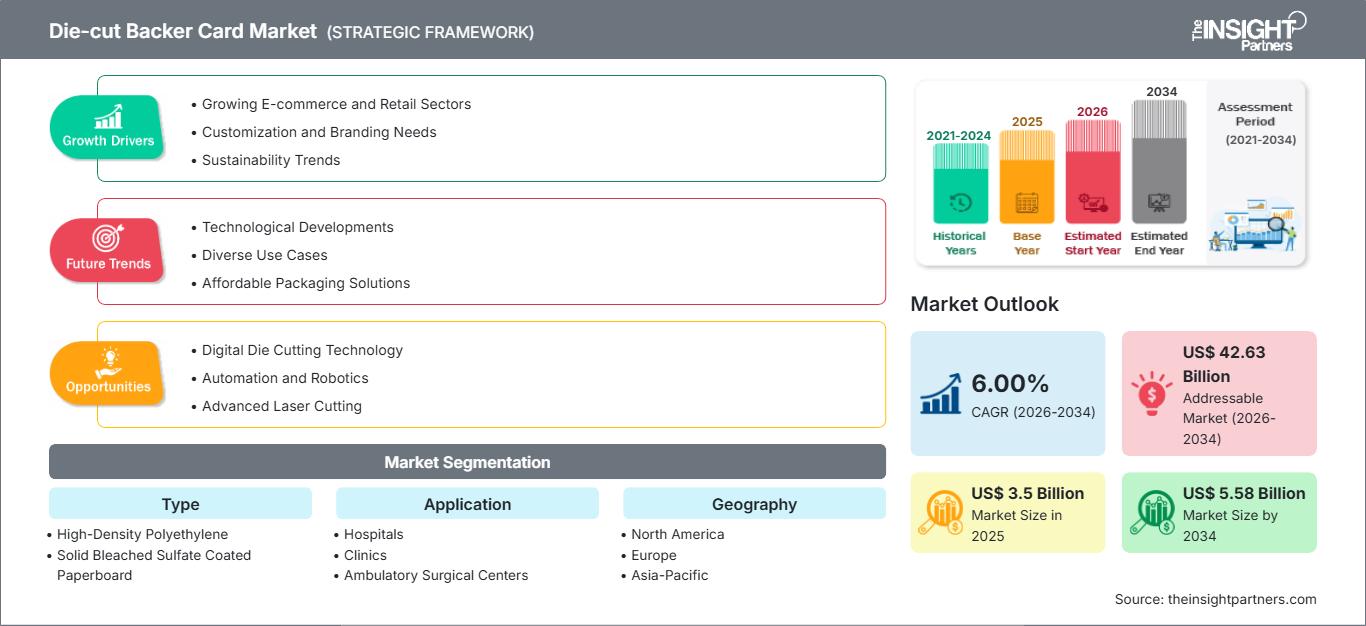
The die-cut backer card market was valued at US$ 3.5 billion in 2025 and is projected to reach US$ 5.58 billion by 2034, expanding at a CAGR of 6.00% during 2026–2034. Demand growth is being supported by the increasing need for sterile medical packaging, device protection, product traceability, and regulatory-compliant healthcare packaging solutions. Manufacturers are also focusing on precision die-cutting technologies that improve packaging consistency while supporting efficient storage and transportation.
North America remains a major revenue-generating region for the die-cut backer card market and is anticipated to register a CAGR of approximately 5.8% through 2034. The region benefits from advanced healthcare infrastructure, high surgical procedure volumes, and stringent packaging quality standards. Growing adoption of minimally invasive medical devices and expanding procurement activities across hospitals and ambulatory surgical centers continue to reinforce regional demand.
Die-cut Backer Card Market Assessment and Insights
- North America: North America accounted for 35–39% die-cut backer card market share in 2025 and is projected to expand at a CAGR of 5.8%–6.2% during 2026–2034. Growth is driven by expanding medical device production and stringent sterile packaging regulations, which continue to sustain long-term demand for high-performance medical packaging materials.
- U.S.: The U.S. represented 81–85% of the North American market in 2025 and is anticipated to register a CAGR of 5.9%–6.3% during 2026–2034, supported by robust medical device manufacturing, strict regulatory compliance requirements, and increasing adoption of sterile packaging solutions.
- Europe: Europe held 28–32% market share in 2025 and is expected to grow at a CAGR of 5.7%–6.1% during 2026–2034. Germany, the United Kingdom, and France remain key markets, supported by advanced healthcare packaging capabilities and strong medical manufacturing industries.
- Asia Pacific: Asia Pacific accounted for 22–26% share in 2025 and is forecast to expand at a CAGR of 6.8%–7.3% during 2026–2034. China, Japan, and India drive regional growth through expanding healthcare manufacturing capacity and increasing export-oriented medical packaging production.
- Largest Segment – Solid Bleached Sulfate Coated Paperboard: Solid bleached sulfate coated paperboard accounted for the largest segment of the die-cut backer card market size and is projected to expand at a CAGR of 6.1%–6.5% during 2026–2034, supported by its excellent print quality, structural strength, and suitability for sterile medical packaging applications.
- High Growth Segment – Ambulatory Surgical Centers: The ambulatory surgical centers segment is anticipated to record the highest growth rate, with a CAGR of 6.9%–7.4% during 2026–2034. According to the die-cut backer card market forecast, this growth is driven by the increasing number of outpatient procedures and the rising preference for sterile, packaged medical devices across healthcare settings.
- Key companies analyzed in detail: UFP Technologies, Inc.; PMC Medical Packaging; Nelipak Healthcare Packaging; Oliver Healthcare Packaging; Placon Corporation; Beacon Converters, Inc.; The Carnegie Textile Co.; Packaging Compliance Labs LLC; Kokorosa; WizardPins
Source: The Insight Partners' analysis based on proprietary research, government publications, company annual reports, investor presentations, industry databases, and expert interviews.
The die-cut backer card market report has evolved alongside broader developments in healthcare packaging, medical device sterilization, and product handling requirements. Healthcare providers increasingly require packaging formats that support device integrity, operational efficiency, and inventory management. As medical procedures become more specialized, packaging components are being designed to accommodate diverse device dimensions while maintaining strict compliance standards.
Future die-cut backer card market expansion will be shaped by rising healthcare expenditure, technological advancements in packaging materials, and greater emphasis on sustainability. Companies are investing in lightweight yet durable substrates, automation-compatible designs, and enhanced traceability features. The growing complexity of medical devices and increased focus on patient safety are expected to create long-term opportunities across healthcare facilities worldwide.
Die-cut Backer Card Market Report Scope
| Report Attribute | Details |
|---|---|
| Market size in 2025 | US$ 3.5 Billion |
| Market Size by 2034 | US$ 5.58 Billion |
| Global CAGR (2026 - 2034) | 6.00% |
| Historical Data | 2021-2024 |
| Forecast period | 2026-2034 |
Die-cut Backer Card Market Analysis
Growing demand for medical devices and surgical products has strengthened the role of die-cut backer cards throughout healthcare supply chains. These packaging components help secure products during transportation, maintain sterile barriers, and improve product presentation. Increasing procedure volumes in hospitals and clinics are driving procurement of packaging solutions that combine durability, compliance, and cost efficiency.
Material suppliers, converters, die-cutting specialists, healthcare distributors, and medical device manufacturers form an interconnected value chain. Improvements in converting technologies and automated packaging systems are enabling greater precision while reducing production waste. Healthcare providers increasingly favor packaging solutions that streamline storage and improve handling efficiency within clinical environments.
Competition in the die-cut backer card market is characterized by continuous material innovation, manufacturing optimization, and strategic partnerships with medical device producers. Major participants focus on improving product reliability, maintaining regulatory compliance, and supporting customized packaging requirements. The ability to deliver high-volume production with consistent quality remains a critical differentiator.
Investment activity is increasingly directed toward sustainable materials, advanced die-cutting equipment, and automated quality inspection systems. Companies such as Medtronic, Johnson & Johnson, Stryker Corporation, Olympus Corporation, B. Braun Melsungen, CONMED Corporation, Smith & Nephew, Zimmer Biomet, Biolitec AG, and Surkon Medical Ltd. influence market demand through extensive medical device portfolios requiring specialized packaging solutions. Strategic positioning increasingly depends on supply-chain resilience, customization capabilities, and compliance expertise.
● REPORT CUSTOMIZATION
Tailor This Report To Align With Your Specific Business Requirements
This report can be customized to align precisely with your business objectives, scope, and target markets. Customization options include tailored segmentation, geography, competitive analysis, and strategic insights to support informed decision-making.
Customize This Report →WHAT YOU CAN ADJUST
- ● Segmentations
- ● Geography
- ● Competitive Analysis
- ● Language Preferences
Die-cut Backer Card Market: Strategic Insights
Regional Insights
North America Die-cut Backer Card Market
North America accounts for the largest share of the die-cut backer card market and is expected to record a CAGR of around 5.8% through 2034. High healthcare spending, strong medical device manufacturing activity, and rigorous packaging regulations support sustained demand. Hospitals and surgical facilities require packaging systems capable of preserving product integrity while meeting strict safety standards.
The region benefits from mature procurement networks and widespread adoption of advanced medical technologies. Increasing outpatient procedures and growing use of minimally invasive surgical devices are expanding packaging requirements. Investments in healthcare logistics, sterilization infrastructure, and sustainable packaging materials further strengthen regional market development.
U.S. Die-cut Backer Card Market
The U.S. represents approximately 75–80% of the North American die-cut backer card market and is projected to expand at a CAGR of nearly 5.9% through the forecast period. Strong medical device production, extensive healthcare infrastructure, and high procedural volumes contribute to consistent demand across healthcare settings.
Major medical technology companies including Medtronic, Johnson & Johnson, Stryker Corporation, Zimmer Biomet, and CONMED Corporation maintain substantial operations within the country. Hospitals remain the dominant application segment, while ambulatory surgical centers continue to increase packaging consumption due to rising outpatient treatment volumes. Regulatory emphasis on sterility assurance and product traceability supports adoption of advanced die-cut packaging formats.
Europe Die-cut Backer Card Market
Europe holds an estimated 25–30% share of the global die-cut backer card market and is forecast to grow at a CAGR of approximately 5.5%. Demand is supported by established healthcare systems, strong medical technology manufacturing capabilities, and an increasing focus on sustainable packaging practices. Germany remains the leading country in the die-cut backer card market due to its extensive medical device ecosystem and advanced industrial infrastructure.
The UK die-cut backer card market benefits from growing surgical procedure volumes and modernization initiatives across healthcare facilities. Continued investment in healthcare procurement systems and increased adoption of innovative medical devices contribute to demand for compliant packaging solutions. Growth is further supported by rising attention to product safety and efficient inventory management.
Germany leads regional consumption owing to its concentration of medical technology manufacturers and healthcare institutions. France, Italy, and Spain collectively contribute significant demand through expanding healthcare expenditure, modernization of clinical infrastructure, and rising use of specialized medical devices. Across Europe, sustainability targets are encouraging greater use of recyclable and environmentally responsible packaging materials.
APAC Die-cut Backer Card Market
Asia-Pacific is expected to be the fastest-growing regional die-cut backer card market, accounting for approximately 22–27% of global demand while registering a CAGR of nearly 7.2% through 2034. Rapid healthcare infrastructure expansion, rising medical device production, and increasing healthcare access support regional growth. China represents the largest die-cut backer card market due to its extensive manufacturing base and expanding healthcare investments.
Japan and South Korea add value through their sophisticated healthcare facilities and the adoption of technologically advanced medical devices. Both of these nations remain concerned about quality and packaging efficiency; therefore, there is an opportunity to utilize high-precision die-cut backer card packaging.
Emerging countries include India and Australia, driven by healthcare modernization initiatives, hospital infrastructure, and healthcare policies. The government's efforts to build up local medical manufacturing and increase access to healthcare have created demand for packaging products that meet regulatory requirements.
Middle East & Africa Die-cut Backer Card Market
The Middle East & Africa market is projected to expand at a CAGR of approximately 6.3% through the forecast period. Rising healthcare investments, expanding hospital infrastructure, and increasing medical device imports support market development. Saudi Arabia remains the leading country market due to substantial healthcare spending and ongoing healthcare transformation initiatives.
The UAE continues to consolidate its standing as a regional healthcare center by developing cutting-edge healthcare facilities and specialized medical centers. The development creates a continuous need for packaging services that meet the high-quality standards of the global market.
South Africa is an important market in Africa due to healthcare modernization and the growing need for medical products. In the MEA region overall, infrastructure development and diversification initiatives, and growing healthcare access are creating favorable conditions for long-term market growth.
Segmentation Analysis
Type
- High-Density Polyethylene: Widely utilized for its moisture resistance, durability, and lightweight characteristics. The material supports sterile packaging applications and provides reliable protection during transportation and storage across healthcare environments.
- Solid Bleached Sulfate Coated Paperboard: Preferred where premium printability, structural rigidity, and sustainability considerations are important. The material enables high-quality graphics and supports packaging formats requiring strong visual identification.
Application
- Hospitals: Represent the largest application segment due to extensive consumption of medical devices, surgical instruments, and sterile products requiring dependable packaging solutions that maintain integrity throughout handling processes.
- Clinics: Demand is supported by growing patient volumes, diagnostic procedures, and increasing adoption of packaged medical products. Clinics require cost-effective packaging solutions that balance protection, usability, and compliance.
- Ambulatory Surgical Centers: Rapid expansion of outpatient procedures is increasing packaging requirements. Efficient storage, transportation, and sterile presentation needs make die-cut backer cards increasingly important within these facilities.
Opportunity Snapshot
| Application | Revenue Contribution | Trend Tag | Adoption Stage |
| Hospitals | High | Sterile Packaging | Mature |
| Clinics | Medium | Device Safety | Scaling |
| Ambulatory Surgical Centers | Medium | Outpatient Care | Scaling |
| Others | Low | Specialty Use | Emerging |
Die-cut Backer Card Market Growth Drivers and Impact Analysis
Rising Global Demand for Sterile Medical Device Packaging
Healthcare providers increasingly rely on sterile packaged medical devices to reduce contamination risks and improve patient outcomes. Die-cut backer cards play a crucial role in maintaining packaging integrity while facilitating storage, transportation, and clinical handling. Growth in surgical procedures, diagnostic interventions, and outpatient treatments has expanded the volume of packaged healthcare products moving through supply chains.
As more regulatory bodies focus on packaging validation and sterilization, manufacturers are investing in state-of-the-art materials and precise die-cutting technology. There is a growing need in hospitals and healthcare institutions for packaging designs that support traceability, product protection, and workflow efficiency. This directly leads to higher demand for superior backer card technology. The implications of such trends affect not just packaging manufacturers but also the material and converters.
Expansion of Healthcare Infrastructure Across Emerging Economies
The investment in large-scale healthcare infrastructure in Asia-Pacific, the Middle East, and parts of Latin America has created many new opportunities for manufacturers of medical packaging. New healthcare facilities need medical devices and sterile consumables in large quantities, which in turn results in greater demand for protective packaging materials.
The government and private healthcare facilities emphasize quality, safety, and efficiency in the development and upgrading of healthcare infrastructure. With increased sophistication, there is a growing expectation in the packaging industry as well. Die-cut backer cards can assist healthcare organizations in improving their inventory management and ensuring product quality throughout distribution.
Advancements in Sustainable and High-Performance Packaging Materials
Sustainability goals are driving buying behavior in the entire healthcare industry. Material innovations have been developed to find a balance between environmental goals and strict healthcare standards. More emphasis is being put on recyclable materials, efficient manufacturing processes, and lightweight designs within healthcare facilities and medical device companies.
Material innovations have also helped improve packaging capabilities by offering better durability, printability, and material capability to go through sterilization processes. This creates an opportunity for those firms that can offer both environmental and operational advantages. The effect in the market involves higher value products, customer retention, and increased competitiveness in bidding processes.
Die-cut Backer Card Market Future Trends
Integration of Smart Packaging and Traceability Features
Healthcare supply chains are becoming more data-driven, and there is an increasing need for packaging systems that enable tracking and verification features. Emerging die-cut backer card market trends indicate that future product generations will incorporate sophisticated labeling technologies, machine-readable codes, and electronic identification features to enhance product visibility and traceability.
There is a rising need for increased transparency in the procurement and logistics chain on the part of healthcare institutions. Improved traceability can minimize the occurrence of mistakes, streamline recalls, and help comply with regulatory mandates. Packaging suppliers who embed smart capabilities in their products will enjoy competitive advantages by meeting the needs of their customers. In the long run, the marriage of packaging and digital technologies is likely to generate new value propositions.
Greater Adoption of Automated Packaging Manufacturing
Automation is revolutionizing packaging production through increased consistency, efficiency, and quality control. Many producers now use state-of-the-art die-cutting machines, robots, and other digital tools to make the production process more efficient. Such an approach will help companies to improve efficiency, reduce material loss, and minimize human dependence.
Since healthcare clients require increasing precision and speed of production, automation becomes a key factor. In addition, automation provides scalability for companies, which will allow them to work in different market conditions. It can be expected that companies that possess highly automated production sites will have better performance and a competitive advantage in the future.
Die-cut Backer Card Market Opportunities
Development of Customized Packaging Solutions for Specialized Devices
More specialization in medical devices presents an opportunity for customized packaging solutions. Custom die-cut backer cards can cater to the geometrical configuration of the device, provide adequate protection to the products, and enable efficient clinical use. Those vendors who have the capability of providing customized solutions can secure premium contracts.
Design capabilities, prototyping facilities, and development programs can assist medical packaging companies in addressing the changing demands of customers. Medical devices require packaging partners who could add technical value to their products during the product development stage. Companies with good design and engineering skills can win the trust of their clients and secure sustained demand from them.
Expansion into Emerging Healthcare Manufacturing Hubs
There is also a group of new markets that are stimulating the creation of medical devices in their territories through industrial policy measures, infrastructure improvements, and regulatory changes. Such a move will create great opportunities for packaging providers to expand geographically. The proximity of production to end consumers will enhance efficiency and reduce logistics costs.
The possibility of forming partnerships with local healthcare product makers and distributors can be considered by both investors and producers. Early participation in the development of healthcare systems will bring access to rapidly increasing consumer markets. Those organizations must succeed in establishing production capacities in line with medical devices manufacturing clusters.
Recent Developments
- March, 2026: Nelipak Corporation, a leading global provider of healthcare packaging solutions, announced the opening of its new Asia-Pacific Technical Development Center located in Singapore. This new facility establishes an integrated technical development capability in the Asia-Pacific region combining Nelipak’s flexible and rigid sterile barrier packaging design and innovation capabilities under one roof.
- October, 2024: Bayer launched a first-of-its-kind product in the healthcare industry, polyethylene terephthalate (PET) blister packaging on its renowned brand, Aleve. Realized in partnership with pharma packaging specialist Liveo Research, this innovative solution reduces the carbon footprint of this packaging by 38%1 and marks a stride in environmental stewardship by eliminating the use of polyvinyl chloride (PVC).
- March, 2025: Atlantic Packaging introduced its Paperform paper-based blister packaging, a fully fiber-based alternative to traditional plastic blister packs. The solution uses recyclable paperboard and is designed for compatibility with existing blister machinery, directly supporting demand for paperboard-based die-cut backer card formats in retail and healthcare applications.
Frequently Asked Questions

- Comprehensive Market Sizing and Forecast Analysis
- Detailed Segmentation Analysis
- In-Depth Market Dynamics Assessment
- Regional and Country-Level Insights
- Competitive Landscape and Company Benchmarking
- Strategic Business Intelligence
Recent Reports
Testimonials

The Insight Partners' SCADA System Market report is comprehensive, with valuable insights on current trends and future forecasts. The team was highly professional, responsive, and supportive throughout. We are very satisfied and highly recommend their services.
RAN KEDEM Partner, Reali Technologies LTDs
I requested a report on a very specific software market and the team produced the report in a few days. The information was very relevant and well presented. I then requested some changes and additions to the report. The team was again very responsive and I got the final report in less than a week.
JEAN-HERVE JENN Chairman, Future Analytica
We worked with The Insight Partners for an important market study and forecast. They gave us clear insights into opportunities and risks, which helped shape our plans. Their research was easy to use and based on solid data. It helped us make smart, confident decisions. We highly recommend them.
PIYUSH NAGPAL Sr. Vice President, High Beam Global
The Insight Partners delivered insightful, well-structured market research with strong domain expertise. Their team was professional and responsive throughout. The user-friendly website made accessing industry reports seamless. We highly recommend them for reliable, high-quality research services
YUKIHIKO ADACHI CEO, Deep Blue, LLC.
This is the first time I have purchased a market report from The Insight Partners.While I was unsure at first, I visited their web site and felt more comfortable to take the risk and purchase a market report.I am completely satisfied with the quality of the report and customer service. I had several questions and comments with the initial report, but after a couple of dialogs over email with their analyst I believe I have a report that I can use as input to our strategic planning process.Thank you so much for taking the extra time and making this a positive experience.I will definitely recommend your service to others and you will be my first call when we need further market data.
JOHN SUZUKI President and Chief Executive Officer, Board Director, BK Technologies
I wish to appreciate your support and the professionalism you displayed in the course of attending to my request for information regarding to infectious disease IVD market in Nigeria. I appreciate your patience, your guidance, and the fact that you were willing to offer a discount, which eventually made it possible for us to close a deal. I look forward to engaging The Insight Partners in the future, all thanks to the impression you have created in me as a result of this first encounter.
DR CHIJIOKE ONYIA MANAGING DIRECTOR, PineCrest Healthcare Ltd.Reason to Buy
- Informed Decision-Making
- Understanding Market Dynamics
- Competitive Analysis
- Identifying Emerging Markets
- Customer Insights
- Market Forecasts
- Risk Mitigation
- Boosting Operational Efficiency
- Strategic Planning
- Investment Justification
- Tracking Industry Innovations
- Aligning with Regulatory Trends





 Get Free Sample for