
Digital Body Thermometers Market Size, Growth & Demand by 2034
Coverage: By Contact (Contact Digital Body Thermometers, Non-Contact Digital Body Thermometers); End User (Hospitals and Clinics, Homecare Setting, Others), and Geography (North America, Europe, Asia Pacific, and South and Central America)
- Status : Data Released
- Report Code : TIPRE00005181
- Category : Life Sciences
- No. of Pages : 150
- Available Report Formats :


- Last update date : July 08, 2026


2025 Market Size
US$ 830.00 Mn
Base year value
2034 Forecast
US$ 1,810.00 Mn
Projected by 2034
CAGR 2026-2034
9.05 %
Growth rate
Addressable Market
US$ 11,810.26 Mn
(2026-2034)
The Digital Body Thermometers Market is demonstrating sustained expansion as healthcare systems, households, and outpatient care providers increasingly prioritize rapid and accurate temperature monitoring. The market is valued at US$ 830.00 million in 2025 and is projected to reach US$ 1,810.00 million by 2034, advancing at a CAGR of 9.05% during 2026–2034. Growing awareness of infection surveillance, rising adoption of home-based health monitoring devices, and continuous technological improvements in non-contact measurement solutions are reinforcing long-term market development.
North America remains a pivotal revenue-generating region for the Digital Body Thermometers Market and is estimated to expand at a CAGR of approximately 8.6% through 2034. Strong healthcare infrastructure, high penetration of digital diagnostic devices, and increasing emphasis on preventive healthcare support regional demand. Additionally, growing utilization of non-contact thermometers in hospitals, clinics, and homecare environments continues to accelerate product adoption across the region.
Digital Body Thermometers Market Assessment and Insights
- North America: North America accounted for 36–39% of the digital body thermometers market share in 2025 and is anticipated to expand at a CAGR of 8.5–9.1% during 2026–2034. Strong healthcare infrastructure, widespread adoption of home monitoring devices, and increasing demand for digital health solutions continue to support regional market growth.
- U.S.: The U.S. accounted for 28–31% of the global digital body thermometers market size in 2025 and is projected to register a CAGR of 8.6–9.2% during 2026–2034, driven by growing home healthcare adoption, advanced healthcare facilities, and increasing use of digital body thermometers across clinical and residential settings.
- Europe: Europe held 27–30% of the digital body thermometers market share in 2025 and is expected to grow at a CAGR of 8.2–8.9% during 2026–2034. Germany, the United Kingdom, and France remain leading markets, supported by healthcare modernization initiatives, infection prevention programs, and rising adoption of digital diagnostic devices.
- Asia Pacific: Asia Pacific accounted for 24–27% of the digital body thermometers market share in 2025 and is forecast to expand at a CAGR of 9.8–10.5% during 2026–2034. China, Japan, India, South Korea, and Australia continue to lead regional demand, driven by rising healthcare awareness, expanding consumer healthcare expenditure, and increasing access to medical technologies.
- Largest Segment: Contact Digital Body Thermometers represented the largest digital body thermometers market segment and are expected to record a CAGR of 8.6–9.2% during 2026–2034, reflecting their established clinical reliability, affordability, and widespread use across healthcare and homecare settings.
- High Growth Segment: Non-Contact Digital Body Thermometers are projected to grow at a CAGR of 10.2–10.9% during 2026–2034, driven by increasing infection prevention priorities, greater convenience, and rising adoption across hospitals, clinics, and homecare environments.
- Largest Segment: Hospitals and Clinics represented the largest end-use segment and are expected to record a CAGR of 8.7–9.3% during 2026–2034, supported by routine patient monitoring requirements, high patient volumes, and regulatory compliance standards.
- High Growth Segment: Homecare Setting is projected to grow at a CAGR of 9.8–10.4% during 2026–2034, driven by expanding remote health monitoring, increasing self-care practices, and rising demand for convenient home-based diagnostic devices.
- Key companies analyzed in detail: Exergen Corporation; Omron Healthcare Co., Ltd.; Terumo Corporation; Citizen Systems Japan Co., Ltd.; 3M Company; Innovo Medical; Radiant Innovation Inc.; Cardinal Health, Inc.; Fairhaven Health, LLC; Kinsa Inc.
Source: The Insight Partners' analysis based on proprietary research, government publications, company annual reports, investor presentations, industry databases, and expert interviews.
The Digital Body Thermometers Market report has evolved from a basic diagnostic equipment category into an essential component of broader patient monitoring ecosystems. Product innovation has shifted focus toward improved accuracy, faster readings, contactless operation, and integration with digital health platforms. The widespread emphasis on infection prevention and patient safety has further accelerated adoption across institutional and residential healthcare settings.
Future digital body thermometers market development will be shaped by the convergence of digital healthcare, telemedicine, and connected medical devices. Manufacturers are increasingly introducing intelligent temperature-monitoring solutions capable of storing readings, enabling remote observation, and supporting clinical decision-making. As healthcare delivery becomes more decentralized, digital thermometers are expected to play a greater role in routine health assessment and disease monitoring.
Digital Body Thermometers Market Report Scope
| Report Attribute | Details |
|---|---|
| Market size in 2025 | US$ 830.00 Million |
| Market Size by 2034 | US$ 1,810.00 Million |
| Global CAGR (2026 - 2034) | 9.05% |
| Historical Data | 2021-2024 |
| Forecast period | 2026-2034 |
Digital Body Thermometers Market Analysis
The Digital Body Thermometers Market is influenced by increasing demand for reliable, easy-to-use temperature monitoring devices across both clinical and consumer environments. Growing healthcare awareness, aging populations, and recurring infectious disease concerns continue to strengthen product demand. Non-contact technologies have gained particular importance because they reduce cross-contamination risks while improving patient comfort and workflow efficiency.
The value chain encompasses sensor manufacturers, electronics suppliers, software developers, device assemblers, distributors, healthcare providers, pharmacies, and e-commerce platforms. Improvements in infrared sensing technology, battery efficiency, and digital display systems have enhanced product performance while expanding accessibility through both institutional procurement channels and retail healthcare networks.
Competition is characterized by established healthcare technology providers and specialized diagnostic equipment manufacturers. Companies including Omron Healthcare, Inc., Exergen Corporation, Terumo Corporation, Citizen Systems, 3M, Innovo Medical, Radiant Innovation Inc., Good Neighbor Pharmacy, Fairhaven Health, LLC, and Kinsa, Inc. compete through product differentiation, distribution reach, and technological innovation.
Investment activity is increasingly directed toward smart healthcare devices capable of integrating with mobile applications and digital health ecosystems. Strategic emphasis on product reliability, regulatory compliance, and user-friendly design has become critical. Companies that successfully combine clinical-grade accuracy with consumer convenience are positioned to strengthen market presence and capture emerging opportunities in both developed and developing healthcare markets.
● REPORT CUSTOMIZATION
Tailor This Report To Align With Your Specific Business Requirements
This report can be customized to align precisely with your business objectives, scope, and target markets. Customization options include tailored segmentation, geography, competitive analysis, and strategic insights to support informed decision-making.
Customize This Report →WHAT YOU CAN ADJUST
- ● Segmentations
- ● Geography
- ● Competitive Analysis
- ● Language Preferences
Digital Body Thermometers Market: Strategic Insights
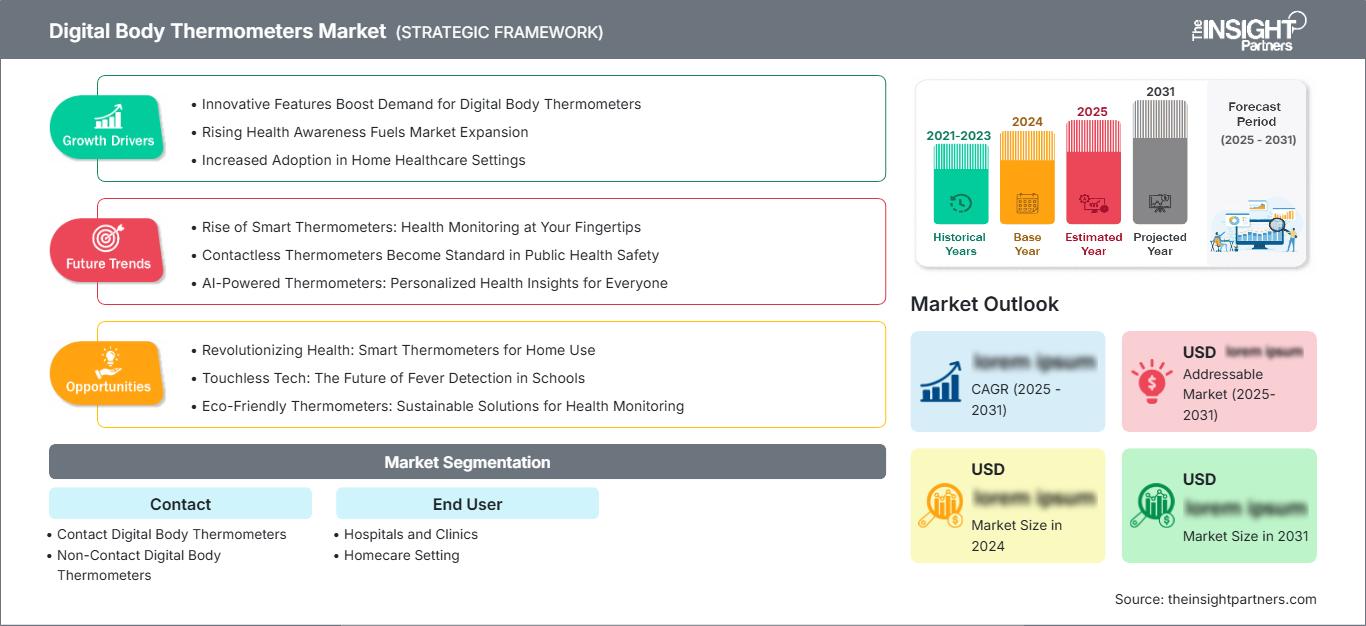
Regional Insights
North America Digital Body Thermometers Market
North America represents the largest regional digital body thermometers market and is projected to grow at a CAGR of approximately 8.6% through 2034. Strong healthcare spending, widespread digital health adoption, and established diagnostic device procurement systems continue to support market expansion. Hospitals and outpatient facilities increasingly favor advanced non-contact devices to improve operational efficiency and infection-control practices.
The use of home care services is also adding to demand in the region in its own right. The trend towards using digital thermometers in health monitoring, child care, and chronic disease management continues to rise. The increasing integration of connected health devices into telehealth platforms enhances growth prospects across the United States and Canada.
U.S. Digital Body Thermometers Market
The U.S. accounts for about 75–80% of revenue in North America and is projected to grow at a CAGR of nearly 8.8% during the forecast period. The presence of robust healthcare facilities, increased consumer awareness, and the widespread availability of modern diagnostic equipment are among the factors that fuel demand for temperature sensors. Institutional purchasers and individual consumers continue to buy temperature-monitoring sensors.
There are large distribution channels maintained by companies within the region. Infrared and smart-connecting thermometers are increasingly being used in hospitals, clinics, pharmacies, educational institutions, and individual homes. Remote patient monitoring and preventive healthcare programs fuel demand for digital temperature measurement technologies.
Europe Digital Body Thermometers Market
Europe represents a significant share of the global digital body thermometers market, accounting for approximately 24–28% of worldwide revenue. The region is anticipated to expand at a CAGR of around 8.4% through 2034. Strong public healthcare systems, growing elderly populations, and increasing investments in medical technology modernization continue to support market development.
There are many advantages that the UK stands to gain through increased acceptance of home-based healthcare and the use of digital diagnostic equipment in community healthcare initiatives. The need for non-contact thermometers remains high due to infection control considerations and growing consumer awareness of personal healthcare monitoring.
Germany continues to be the most advanced nation in Europe because of its well-developed healthcare system and strong medical devices industry. Advanced standards for clinical diagnostics and healthcare digitization efforts are some of the factors sustaining market demand for the technology.
France, Italy, and Spain are additional sources of market opportunities. Growing access to healthcare services, an aging population, and the use of home-monitoring systems have fuelled demand in these regions. Healthcare service providers in these regions have been using digital diagnostic equipment to enhance efficiency and outcomes.
APAC Digital Body Thermometers Market
Asia Pacific is projected to be the fastest-growing regional digital body thermometers market, expanding at a CAGR of approximately 10.8% through 2034 while accounting for nearly 25–30% of global revenue. Rising healthcare expenditure, expanding middle-class populations, and increased awareness of preventive healthcare are driving market penetration throughout the region.
China is the leading digital body thermometers market in the region owing to its population size, advanced healthcare facilities, and developed manufacturing facilities. Government initiatives aimed at expanding healthcare facilities and increasing access to diagnostic devices are leading to increased use of digital thermometers in healthcare.
Growth is evident in countries such as Japan, South Korea, India, and Australia due to developments in technology, demographics, and telemedicine services. Digital health solutions have been encouraged by governments, and investments in home care monitoring are driving market growth.
Middle East & Africa Digital Body Thermometers Market
The Middle East & Africa market is expected to grow at a CAGR of approximately 8.1% through 2034. Rising healthcare investments, modernization of medical facilities, and growing awareness regarding infection prevention are supporting adoption across the region. Demand is particularly increasing within hospitals, clinics, and government healthcare programs.
Saudi Arabia leads regional growth due to significant healthcare infrastructure investments and ongoing healthcare transformation initiatives. Expanding hospital networks and increased adoption of advanced diagnostic technologies continue to strengthen market prospects.
The UAE, South Africa, and the Rest of MEA are experiencing gradual but consistent market development. Healthcare infrastructure expansion, urbanization, and greater access to medical technologies are supporting demand. Broader healthcare modernization programs and public health initiatives are expected to create additional opportunities over the forecast period.
Segmentation Analysis
Contact
- Contact Digital Body Thermometers remain widely utilized in hospitals, clinics, and households due to their affordability, proven reliability, and suitability for oral, rectal, and underarm temperature measurements across diverse patient populations.
- Non-Contact Digital Body Thermometers are experiencing faster adoption owing to their ability to provide rapid readings while minimizing infection transmission risks, making them highly suitable for healthcare facilities, schools, workplaces, and public settings.
End User
- Hospitals and Clinics represent the largest end-user segment because of continuous patient monitoring requirements, stringent infection-control protocols, and the need for accurate diagnostic tools within emergency, inpatient, and outpatient care environments.
- Homecare Setting is gaining significant momentum as consumers increasingly adopt digital health devices for self-monitoring, pediatric care, elderly care, and routine health assessment supported by telemedicine and remote healthcare services.
Opportunity Snapshot
| End User | Revenue Contribution | Trend Tag | Adoption Stage |
| Hospitals and Clinics | High | Infection Control | Mature |
| Homecare Setting | Medium | Remote Monitoring | Scaling |
Digital Body Thermometers Market Growth Drivers and Impact Analysis
Growing Emphasis on Infection Prevention and Patient Safety
Healthcare institutions worldwide continue prioritizing infection prevention strategies that reduce patient exposure to communicable diseases. Temperature screening remains one of the most widely used diagnostic and monitoring practices across healthcare facilities. As hospitals seek safer workflows, non-contact digital thermometers have become increasingly important because they minimize physical interaction while maintaining efficient patient assessment.
It is not limited to hospitals, but extends to schools, workplaces, pharmacies, and other public places. Infrastructure development for temperature monitoring is being done by institutions. Manufacturers are benefiting from the increased demand for devices that are fast, accurate, and user-friendly. This driver is influencing buying behavior and compelling organizations to upgrade their equipment, supporting continuous innovation across contact and non-contact device categories.
Expansion of Home-Based Healthcare and Remote Monitoring
Healthcare delivery channels are shifting toward home settings, thereby driving high demand for easy-to-use diagnostic equipment. Digital body thermometers are now an indispensable piece of equipment in home care settings, as people can monitor their health without constantly visiting a healthcare facility.
Another factor that is contributing to the growth of this industry is the push towards remote patient monitoring projects. Physicians have started recommending that patients monitor their vital signs, such as temperature, when managing chronic diseases or during recovery. It is extremely relevant for kids, older adults, or people with weak immune systems. With telemedicine increasingly adopted in the healthcare sector, demand for home-use thermometers is expected to grow further, creating sustained revenue opportunities across consumer healthcare channels.
Advancements in Sensor Technology and Digital Connectivity
With technological advancements, digital thermometers are evolving from standalone to connected healthcare devices. Modern products have increasingly incorporated infrared sensors, Bluetooth connectivity, mobile apps, memory functions, and cloud-based data management capabilities. These innovations add clinical and consumer value and improve usability.
The end users and the healthcare providers are the ones who feel the impact in the market. Clinicians will have better access to data and will be able to monitor patients more effectively, while consumers gain greater visibility into personal health trends. By investing in intelligent temperature-monitoring solutions, companies are creating new value propositions and improving competitive differentiation. Ongoing advances in sensor accuracy, battery technology, and digital connectivity are likely to drive premiumization and market growth.
Digital Body Thermometers Market Future Trends
Integration with Connected Health Ecosystems
Digital thermometers are increasingly becoming part of broader connected healthcare environments. Manufacturers are integrating devices with mobile applications, cloud platforms, and remote monitoring systems that enable seamless sharing of health data between patients and healthcare professionals.
This trend is likely to continue as healthcare organizations increasingly adopt digital health solutions. In the future, technology is expected to deliver capabilities such as automated reporting, predictive health analytics, and seamless integration with electronic health records. These advancements will encourage greater patient engagement and support a more proactive approach to healthcare. In line with digital body thermometers market trends, companies capable of developing secure, interoperable, and user-friendly systems will be well positioned to gain a competitive advantage in the years ahead.
Rising Preference for Advanced Non-Contact Measurement Technologies
Measurement devices using non-contact methods continue to gain popularity among healthcare institutions and end consumers. The issues of accurate readings and convenient design are being tackled through technological advances in infrared sensors and tool ergonomics.
In the future, advancements will be made in the method's accuracy, speed, and applicability. This need will not disappear from hospitals, airports, educational institutions, and even households where hygiene is a valued practice. With lower manufacturing costs and easier access to technology, non-contact thermometer manufacturers will increase profits.
Digital Body Thermometers Market Opportunities
Untapped Potential Across Emerging Healthcare Markets
Emerging economies offer huge prospects owing to the continued development of healthcare infrastructure and rising healthcare awareness. Various nations are investing more in healthcare systems, including primary care, community health services, and digital healthcare, thereby creating strong prospects for the adoption of thermometers.
These companies will be able to capitalize on these opportunities by designing products that meet the healthcare needs of these regions. This may be done through region-specific distribution deals, increased retail marketing, and health education campaigns. Companies that are capable of managing the quality-cost balance will be well-placed to take advantage of this increasing demand.
Development of Smart Consumer Health Monitoring Solutions
With consumers placing more emphasis on preventive healthcare, there is an opportunity for advanced digital thermometers to provide more than just basic temperature readings. Smart devices that store health histories, generate alerts, and integrate with broader wellness platforms can meet evolving consumer expectations.
Investments in software ecosystems, artificial intelligence capabilities, and digital health partnerships can generate additional revenue streams beyond conventional hardware sales. Thermometer manufacturers that position their devices within comprehensive health-monitoring platforms can improve customer engagement and strengthen brand differentiation. The opportunity is closely aligned with the digital body thermometers market forecast, as broader healthcare digitization trends continue to shape the future of personal health management.
Recent Developments
- October, 2025: Exergen Corporation announced a global expansion initiative through the appointment of new regional commercial directors across Europe, Mexico, and Brazil. The move was designed to strengthen distribution networks and increase access to the company's temporal artery thermometer portfolio in multiple international healthcare markets.
- October, 2025: OMRON Healthcare Co., Ltd. received the 2025 Good Design Award for several healthcare products, including its skin infrared thermometer MC-F300. The recognition highlights continued innovation in user-centered diagnostic device design and reinforces the growing emphasis on accuracy, usability, and digital healthcare integration.
- June, 2025: The FDA has exempted certain clinical electronic thermometers without telethermographic or continuous temperature measurement functions from premarket notification requirements. The FDA's final exemption order fundamentally alters how traditional, intermittent digital thermometers are manufactured, imported, and sold in the United States.
Frequently Asked Questions

- Comprehensive Market Sizing and Forecast Analysis
- Detailed Segmentation Analysis
- In-Depth Market Dynamics Assessment
- Regional and Country-Level Insights
- Competitive Landscape and Company Benchmarking
- Strategic Business Intelligence
Recent Reports
Testimonials

The Insight Partners' SCADA System Market report is comprehensive, with valuable insights on current trends and future forecasts. The team was highly professional, responsive, and supportive throughout. We are very satisfied and highly recommend their services.
RAN KEDEM Partner, Reali Technologies LTDs
I requested a report on a very specific software market and the team produced the report in a few days. The information was very relevant and well presented. I then requested some changes and additions to the report. The team was again very responsive and I got the final report in less than a week.
JEAN-HERVE JENN Chairman, Future Analytica
We worked with The Insight Partners for an important market study and forecast. They gave us clear insights into opportunities and risks, which helped shape our plans. Their research was easy to use and based on solid data. It helped us make smart, confident decisions. We highly recommend them.
PIYUSH NAGPAL Sr. Vice President, High Beam Global
The Insight Partners delivered insightful, well-structured market research with strong domain expertise. Their team was professional and responsive throughout. The user-friendly website made accessing industry reports seamless. We highly recommend them for reliable, high-quality research services
YUKIHIKO ADACHI CEO, Deep Blue, LLC.
This is the first time I have purchased a market report from The Insight Partners.While I was unsure at first, I visited their web site and felt more comfortable to take the risk and purchase a market report.I am completely satisfied with the quality of the report and customer service. I had several questions and comments with the initial report, but after a couple of dialogs over email with their analyst I believe I have a report that I can use as input to our strategic planning process.Thank you so much for taking the extra time and making this a positive experience.I will definitely recommend your service to others and you will be my first call when we need further market data.
JOHN SUZUKI President and Chief Executive Officer, Board Director, BK Technologies
I wish to appreciate your support and the professionalism you displayed in the course of attending to my request for information regarding to infectious disease IVD market in Nigeria. I appreciate your patience, your guidance, and the fact that you were willing to offer a discount, which eventually made it possible for us to close a deal. I look forward to engaging The Insight Partners in the future, all thanks to the impression you have created in me as a result of this first encounter.
DR CHIJIOKE ONYIA MANAGING DIRECTOR, PineCrest Healthcare Ltd.Reason to Buy
- Informed Decision-Making
- Understanding Market Dynamics
- Competitive Analysis
- Identifying Emerging Markets
- Customer Insights
- Market Forecasts
- Risk Mitigation
- Boosting Operational Efficiency
- Strategic Planning
- Investment Justification
- Tracking Industry Innovations
- Aligning with Regulatory Trends





 Get Free Sample for