
Directional Drilling Services Market Share, Growth & Forecast by 2034
Coverage: By Type (Conventional, Rotary Steerable System); Service (Rotary Steerable System (RSS), Logging-While-Drilling(LWD), Measurement-While-Drilling (MWD) and Survey, Motors (MUD Motors), Others); Application (Onshore, Offshore), and Geography (North America, Europe, Asia Pacific, and South and Central America)
- Status : Data Released
- Report Code : TIPRE00014556
- Category : Manufacturing and Construction
- No. of Pages : 150
- Available Report Formats :


- Last update date : July 22, 2026


2025 Market Size
US$ 21.12 Bn
Base year value
2034 Forecast
US$ 38.32 Bn
Projected by 2034
CAGR 2026-2034
6.84 %
Growth rate
Addressable Market
US$ 268.49 Bn
(2026-2034)
The directional drilling services market is projected to grow from US$ 21.12 Billion in 2025 to US$ 38.32 Billion by 2034, registering a CAGR of 6.84% during 2026–2034. The market reflects sustained demand for controlled wellbore placement, longer laterals, complex reservoir access, and high-efficiency drilling programs across onshore and offshore fields, supported by operators seeking stronger recovery, fewer surface locations, and improved drilling economics.
North America remains the anchor region because shale operators continue to prioritize longer horizontal wells, pad drilling, and real-time steering. The directional drilling services market size in the region is supported by a modeled CAGR range of 5.9–6.5% through 2034, reflecting disciplined upstream spending, productivity gains, and replacement drilling needs as mature unconventional wells decline faster than conventional reservoirs.
Directional Drilling Services Market Assessment and Insights
- North America accounted for 34–37% share in 2025 and is expected to grow at a CAGR of 5.9–6.5% between 2026–2034, driven by shale optimization and mature field redevelopment.
- US represented 80–84% of North America in 2025 and is projected to expand at 5.8–6.4% CAGR between 2026–2034, led by Permian and Haynesville activity.
- Europe held 12–15% share in 2025 and may grow at 4.8–5.6% CAGR between 2026–2034, with Norway, the UK, and Germany leading demand.
- Asia Pacific captured 18–21% share in 2025 and is forecast to advance at 7.1–7.8% CAGR between 2026–2034, supported by China, India, and Australia.
- Largest Segment Onshore applications held 67–71% market share in 2025 and are projected to grow at 6.2–6.8% CAGR between 2026–2034.
- High Growth Segment Offshore applications held 29–33% share in 2025 and are projected to grow at 7.3–8.0% CAGR between 2026–2034.
- Key companies analyzed in detail: Baker Hughes Company, Crescent Directional Drilling, LP, Halliburton Company, Nabors Industries Ltd., National Energy Services Reunited Corp., NOV Inc., SLB, Weatherford International plc, Scientific Drilling International, and Leam Drilling Systems LLC.
Source: The Insight Partners' analysis based on proprietary research, government publications, company annual reports, investor presentations, industry databases, and expert interviews.
Over the past decade, the directional drilling services market has shifted from tool-assisted deviation control toward integrated well construction. The rotary steerable systems, measurement-while-drilling and logging-while-drilling services have shifted from being premium services to becoming essential productivity tools. The directional drilling service providers are now judged based on the drilling rate, wellbore quality, telemetry capability, and reservoir connectivity instead of just comparing their day rates. This has been made possible by the increasing lengths of shale laterals, drilling into deeper offshore reserves, geothermal drilling pilot projects, and appraisal drilling for carbon storage.
Future growth in the market is likely to come as new basins emerge, with drilling requiring precise execution to reduce subsurface risks and minimize the footprint on the surface. In the Middle East, Asia and Latin America, national oil companies are extending their long-reach drilling operations. There is increasing emphasis by regulators on reducing the environmental impact and improving the well integrity of the operations.
Directional Drilling Services Market Report Scope
| Report Attribute | Details |
|---|---|
| Market size in 2025 | US$ 21.12 Billion |
| Market Size by 2034 | US$ 38.32 Billion |
| Global CAGR (2026 - 2034) | 6.84% |
| Historical Data | 2021-2024 |
| Forecast period | 2026-2034 |
Directional Drilling Services Market Analysis
Demand in the directional drilling services market growth cycle is tied to operators seeking more reservoir contact from fewer wells. The IEA has highlighted that upstream investment remains necessary to offset natural field decline, while EIA data show U.S. production efficiency improving despite lower rig counts. These conditions reinforce demand for motors, survey tools, MWD, LWD, and RSS packages that help operators drill longer, faster, and more accurately.
The value chain combines downhole tools, software, surface telemetry, drilling fluids compatibility, and field engineering. Supply dynamics remain sensitive to high-specification electronics, pressure-rated sensors, and skilled personnel availability. Operators increasingly bundle directional services with drilling optimization, geosteering, and performance-based contracts, making service reliability a direct contributor to well economics.
Market analysis for the competitive directional drilling services industry indicates that there is stiff competition between large integrated companies and the specialized directional drilling companies using technical depth, basin knowledge, and tool usage as key differentiating factors. Companies like Schlumberger Limited (SLB), Halliburton Company, Baker Hughes Company, Weatherford International plc, and National Oilwell Varco Inc. focus on advanced drilling technologies and their global presence.
Strategic investments will shift towards automation in steering, reliability of measurement-while-drilling (MWD) in high temperatures, and remote operation centers. Nabors Industries Ltd. and National Energy Services Reunited Corp. have strategies that revolve around drilling platforms and regional service focus, respectively. Competitive success will depend on the reduction of trips, accurate placement of boreholes, and offshore projects due to high downtime costs.
● REPORT CUSTOMIZATION
Tailor This Report To Align With Your Specific Business Requirements
This report can be customized to align precisely with your business objectives, scope, and target markets. Customization options include tailored segmentation, geography, competitive analysis, and strategic insights to support informed decision-making.
Customize This Report →WHAT YOU CAN ADJUST
- ● Segmentations
- ● Geography
- ● Competitive Analysis
- ● Language Preferences
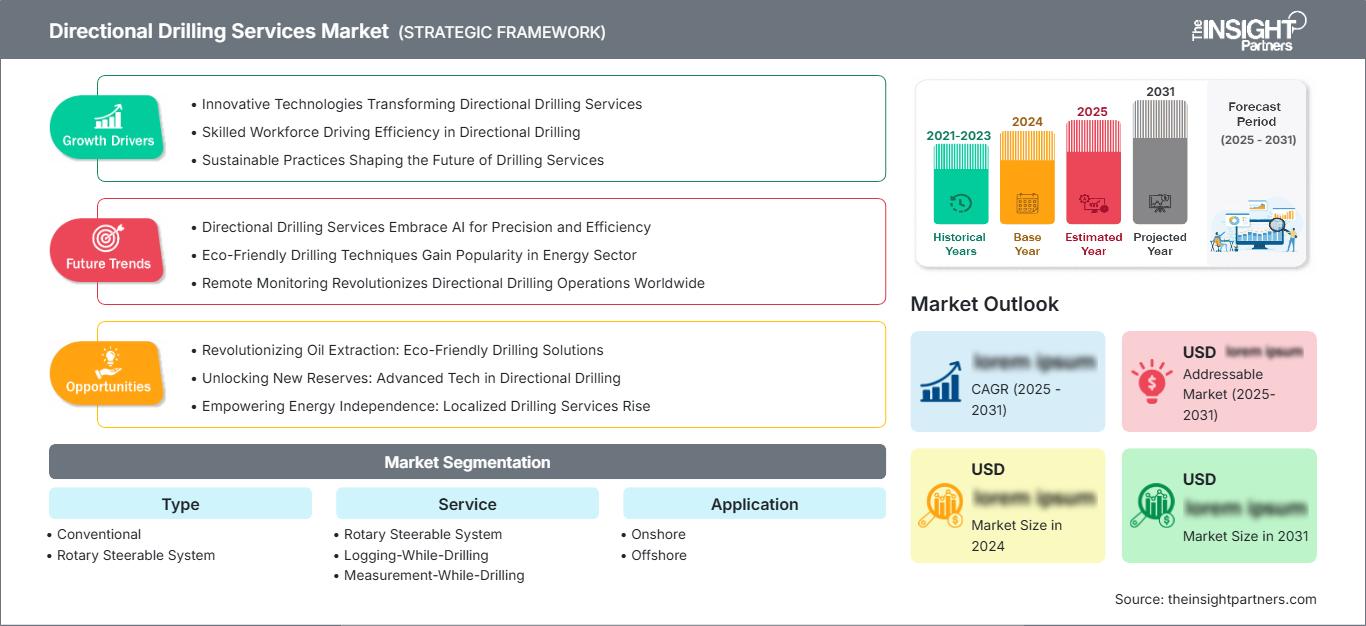
Directional Drilling Services Market: Strategic Insights
Regional Insights
North America Directional Drilling Services Market
North America accounted for 34–37% of the global directional drilling services market share in 2025 and is expected to grow at a 5.9–6.5% CAGR through 2034. This area gets the advantage of shale pad development, extended lateral lengths, and better drilling efficiency in the Permian, Eagle Ford, Bakken, and Montney. The service companies are utilizing RSS and MWD for enhancing drilling trajectory while minimizing the well cycle time.
Demand for services remains stable due to a rapid decline in unconventional wells, which results in continuous drilling and refracturing. Rig numbers depend on prices; however, directional intensity for each well increases. Demand is also growing from the production of heavy oil in Canada, tight gas, and offshore Newfoundland. In addition, U.S. operators are increasingly relating their directional performance to capital efficiency and reduced emissions.
U.S. Directional Drilling Services Market
The U.S. accounted for approximately 80–84% of the North American directional drilling market in 2025 and is expected to grow at a 5.8–6.4% CAGR from 2026 to 2034. Market demand for directional drilling is still shaped by the emphasis put by the industry on optimizing production through complicated horizontal and extended reach wells. Despite fluctuations in the level of drilling activity, the trend of focusing on more efficient wellbores, which require advanced directional drilling techniques, prevails.
The Permian Basin is the biggest region providing directional drilling services, fueled by the continued development of shale formations in the area. However, such prolific regions as Haynesville, Eagle Ford, Bakken, and Appalachian basins are also making considerable contributions to the market. Main players operating in the field – Halliburton, SLB, Baker Hughes, Weatherford, Nabors, and NOV – have a robust regional presence and provide drilling services that include directional drilling equipment, MWD/LWD solutions, and drilling automation services. There is a noticeable trend towards the usage of rotary steerable systems (RSS) in long laterals, which provide high accuracy of drilling and better performance, whereas traditional motor assemblies are still widely used in less expensive projects.
Europe Directional Drilling Services Market
Europe held 12–15% share in 2025 and is projected to grow at a 4.8–5.6% CAGR. Norway remains the leading country because mature offshore assets require sidetracks, reservoir contact optimization, and technically controlled drilling to sustain production. The UK North Sea supports demand through redevelopment and decommissioning-adjacent well work, where accuracy, well integrity, and operational efficiency remain essential.
Germany’s demand is more diversified, with geothermal drilling and subsurface energy storage creating opportunities beyond traditional oil and gas applications. France, Italy, and Spain show selective demand tied to energy security, underground storage, and specialist drilling projects rather than widespread hydrocarbon expansion. Regulatory scrutiny across the region continues to increase service requirements for documentation, precise wellbore placement, environmental performance, and compliance-driven drilling practices.
APAC Directional Drilling Services Market
APAC held 18–21% share in 2025 and is expected to grow at a 7.1–7.8% CAGR, making it one of the faster-growing regional markets. China remains the leading country, supported by continued investment in shale gas, tight oil, coalbed methane, and offshore developments aimed at strengthening domestic energy production. India is expanding exploration and production activities to reduce import dependence, while Australia sustains demand through LNG-linked gas basin development and long-reach drilling projects.
Japan and South Korea create more selective demand through geothermal energy, subsurface storage, and offshore engineering applications. Regional growth is further supported by energy security initiatives, import substitution strategies, and the increasing use of multiwell pad drilling to improve operational efficiency and reduce surface disturbance. Service providers that combine directional drilling expertise with digital subsurface interpretation and real-time drilling analytics are well-positioned to support both national oil companies and regional independent operators.
Middle East & Africa Directional Drilling Services Market
The Middle East & Africa is projected to grow at a 7.6–8.3% CAGR through 2034. Saudi Arabia is the leading country because long-reach wells and field redevelopment remain central to production reliability. The UAE is investing in high-specification drilling, while South Africa and the Rest of MEA offer selective offshore and infrastructure-linked opportunities.
National oil companies favor directional drilling where reservoir complexity, extended reach, and fewer surface locations can improve production economics. Deep gas, carbonate reservoirs, and offshore appraisal wells support higher-value service demand. Regional growth depends on project timing, procurement localization, and the availability of experienced field engineers.
Segmentation Analysis
Type
The Type segment is projected to grow at a 6.3–7.0% CAGR during 2026–2034. The directional drilling services market scope is split between cost-efficient conventional systems and higher-precision rotary steerable systems. Conventional tools remain important for standardized onshore wells, while RSS adoption rises in complex reservoirs, offshore wells, and long lateral programs where smooth wellbores and continuous steering improve completion outcomes.
- Conventional systems remain widely used in cost-sensitive onshore programs where operators need reliable deviation control, proven motors, and lower service complexity across repeatable drilling campaigns.
- Rotary Steerable System demand is increasing in complex wells because continuous steering improves borehole quality, reduces sliding time, and supports longer laterals with tighter geosteering control.
Service
The Service segment is expected to expand at a 6.7–7.4% CAGR from 2026 to 2034. Demand is moving from standalone tools toward integrated drilling intelligence, where real-time measurements, downhole steering, and survey quality determine well placement. Operators increasingly combine MWD, LWD, RSS, motors, and survey services to manage formation uncertainty and improve capital productivity.
- Rotary Steerable System services are strategically important in deepwater, extended-reach, and high-value shale wells where precise steering and reduced tortuosity influence completion efficiency.
- Logging-While-Drilling supports reservoir evaluation while drilling, allowing faster decisions on landing zones, formation boundaries, and hydrocarbon-bearing intervals before costly corrections are needed.
- Measurement-While-Drilling remains essential for inclination, azimuth, shock, vibration, and downhole conditions, supporting safer drilling and better directional control.
- Survey services provide positional accuracy and regulatory confidence, especially where collision avoidance, multiwell pad planning, and wellbore integrity are operational priorities.
- Motors remain a core workhorse for conventional directional drilling, supporting cost-effective build sections, sidetracks, and repeatable onshore wells across mature basins.
Application
The Application segment is projected to grow at a 6.5–7.2% CAGR during 2026–2034. Onshore activity provides scale through unconventional drilling, mature field redevelopment, and pad-based development, while offshore demand provides higher service intensity. Offshore projects require stronger tool reliability, pressure tolerance, and integrated data workflows because rig downtime carries higher economic exposure.
- Onshore applications dominate volume because shale, tight gas, and mature fields require repeatable directional programs, shorter cycle times, and efficient pad drilling execution.
- Offshore applications carry higher revenue intensity as operators need premium RSS, MWD, LWD, and survey reliability for deepwater wells and complex subsea targets.
Opportunity Snapshot
| Application | Revenue Contribution | Trend Tag | Adoption Stage |
| Onshore | High | Long Laterals | Mature |
| Offshore | Medium | Deepwater Steering | Scaling |
Directional Drilling Services Market Growth Drivers and Impact Analysis
Longer Laterals and Reservoir Contact Optimization
Lateral reach is being extended by operators to enhance production per surface location, increasing the technical significance of directional control. Extended wells need precise build sections, controlled well inclination, reduced tortuosity, and geosteering in order to keep the wellbore within productive zones. The effect will be most pronounced in shale formations, tight gas fields, and mature assets where additional contact can make a significant difference. Those service companies that are able to reduce sliding time, avoid dogleg problems, and ensure good completions can create a premium opportunity even during rig decline periods.
Offshore Complexity and Deepwater Redevelopment
The reason why offshore projects represent highly valued demand is that the expense of drilling time, sidetracks, and equipment malfunction is significantly greater compared to most onshore wells. The demands for reliable rotary steerable systems, high-temperature electronics, and real-time formation evaluation by deepwater and ultra-deepwater companies have become even more necessary in order to target narrow zones from restricted well slots. Redrilling operations in existing offshore fields provide more sidetrack demand, while subsea tiebacks require precise wellbore positioning.
Energy Security and Domestic Resource Development
With energy security strategies favoring nations to increase domestic hydrocarbon production, develop gas, and evaluate unconventional reservoirs with minimal impact on the environment, directional drilling can help achieve this through the ability of drilling several wells from the same location, minimizing land use, and better accessing segregated reservoirs. This can be seen in North American shales, Middle Eastern long-reach drilling, and Asian gas developments. Companies providing localized equipment, training of field engineers, and meeting procurement needs stand to gain from national development projects.
Directional Drilling Services Market Future Trends
Automated Steering and Closed-Loop Drilling
Automated steering is becoming one of the most important directional drilling services market trends because it can shorten decision cycles between downhole measurement and trajectory correction. Closed-loop systems will increasingly combine survey data, formation evaluation, vibration monitoring, and drilling parameters to recommend or execute adjustments faster than manual workflows. The next phase will focus on confidence, auditability, and integration with operator drilling centers. Adoption should accelerate in wells where target windows are narrow, drilling time is expensive, and consistency across multiwell programs matters.
Directional Drilling for Geothermal and Storage Wells
Non-oil applications should get more visibility as sources of demand, as geothermal, carbon sequestration, hydrogen storage, and gas storage projects are developed. Such wells need accurate positioning, heat resistance, and subsurface information akin to that required in upstream oil and gas projects. Although revenue in the short term may not be on par with oil and gas, involvement in early projects could allow service providers to diversify their cycles and design their tools. Countries with geothermal, carbon storage, and depleted reservoirs policies could form a pipeline of projects.
Directional Drilling Services Market Opportunities
Premium Offshore Service Packages
Offshore developments create an attractive investment pathway because tool reliability, service integration, and field engineering quality directly affect rig economics. Providers can package RSS, LWD, MWD, survey, and remote operations support into performance-linked contracts for deepwater and mature field redevelopment. The directional drilling services market forecasts indicate stronger value capture where operators prioritize fewer sidetracks, reduced nonproductive time, and accurate reservoir landing. Companies that maintain certified offshore crews and high-pressure tool inventories can improve utilization and pricing resilience.
Localized Services for National Oil Companies
National oil companies are becoming more insistent on having their local content, regional maintenance expertise, and training, in addition to technological performance. This creates possibilities for cooperation, local repair of tools, and engineering centers focused on each respective basin. The service company may distinguish itself with its ability to blend global technology with local implementation, particularly in the Middle East, Asia, and Africa. The opportunity lies not only in financial benefit but also in contractual stability.
Recent Developments
- July 2026: Halliburton won major integrated well construction contracts for the GranMorgu deepwater development offshore Suriname, operated by TotalEnergies. The agreement includes drilling and completion services for a long-term program. Halliburton will deploy a fully integrated, digital, and automation execution model that unites planning, engineering, and operations to improve performance, accelerate learning, and reduce total cost of ownership throughout well construction.
- January 2025: SLB — secured major drilling contracts from Shell for deepwater energy development across the UK North Sea, Trinidad and Tobago, and the Gulf of Mexico. The contracts included drilling services for deep and ultra-deepwater assets, strengthening SLB’s offshore execution pipeline.
Frequently Asked Questions

- Comprehensive Market Sizing and Forecast Analysis
- Detailed Segmentation Analysis
- In-Depth Market Dynamics Assessment
- Regional and Country-Level Insights
- Competitive Landscape and Company Benchmarking
- Strategic Business Intelligence
Recent Reports
Testimonials

The Insight Partners' SCADA System Market report is comprehensive, with valuable insights on current trends and future forecasts. The team was highly professional, responsive, and supportive throughout. We are very satisfied and highly recommend their services.
RAN KEDEM Partner, Reali Technologies LTDs
I requested a report on a very specific software market and the team produced the report in a few days. The information was very relevant and well presented. I then requested some changes and additions to the report. The team was again very responsive and I got the final report in less than a week.
JEAN-HERVE JENN Chairman, Future Analytica
We worked with The Insight Partners for an important market study and forecast. They gave us clear insights into opportunities and risks, which helped shape our plans. Their research was easy to use and based on solid data. It helped us make smart, confident decisions. We highly recommend them.
PIYUSH NAGPAL Sr. Vice President, High Beam Global
The Insight Partners delivered insightful, well-structured market research with strong domain expertise. Their team was professional and responsive throughout. The user-friendly website made accessing industry reports seamless. We highly recommend them for reliable, high-quality research services
YUKIHIKO ADACHI CEO, Deep Blue, LLC.
This is the first time I have purchased a market report from The Insight Partners.While I was unsure at first, I visited their web site and felt more comfortable to take the risk and purchase a market report.I am completely satisfied with the quality of the report and customer service. I had several questions and comments with the initial report, but after a couple of dialogs over email with their analyst I believe I have a report that I can use as input to our strategic planning process.Thank you so much for taking the extra time and making this a positive experience.I will definitely recommend your service to others and you will be my first call when we need further market data.
JOHN SUZUKI President and Chief Executive Officer, Board Director, BK Technologies
I wish to appreciate your support and the professionalism you displayed in the course of attending to my request for information regarding to infectious disease IVD market in Nigeria. I appreciate your patience, your guidance, and the fact that you were willing to offer a discount, which eventually made it possible for us to close a deal. I look forward to engaging The Insight Partners in the future, all thanks to the impression you have created in me as a result of this first encounter.
DR CHIJIOKE ONYIA MANAGING DIRECTOR, PineCrest Healthcare Ltd.Reason to Buy
- Informed Decision-Making
- Understanding Market Dynamics
- Competitive Analysis
- Identifying Emerging Markets
- Customer Insights
- Market Forecasts
- Risk Mitigation
- Boosting Operational Efficiency
- Strategic Planning
- Investment Justification
- Tracking Industry Innovations
- Aligning with Regulatory Trends





 Get Free Sample for