
Disinfection Robots Market Share, Growth & Demand by 2034
Coverage: By Type (UV-Disinfection Robot, Hydrogen Peroxide Vaporization Robot, Others); End User (Hospitals, Research Institutes, Others) , and Geography (North America, Europe, Asia Pacific, and South and Central America)
- Status : Data Released
- Report Code : TIPRE00019447
- Category : Electronics and Semiconductor
- No. of Pages : 150
- Available Report Formats :


- Last update date : September 28, 2026


2025 Market Size
US$ 5.22 Bn
Base year value
2034 Forecast
US$ 25.30 Bn
Projected by 2034
CAGR 2026-2034
19.17 %
Growth rate
Addressable Market
US$ 124.85 Bn
(2026-2034)
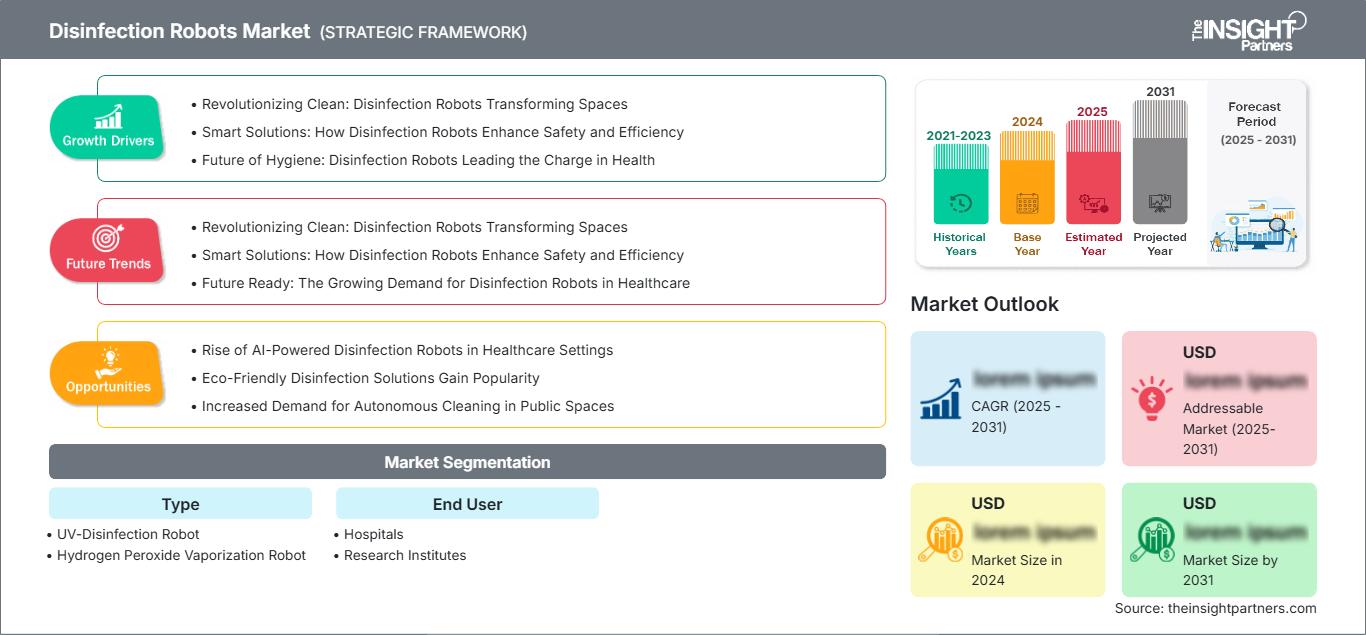
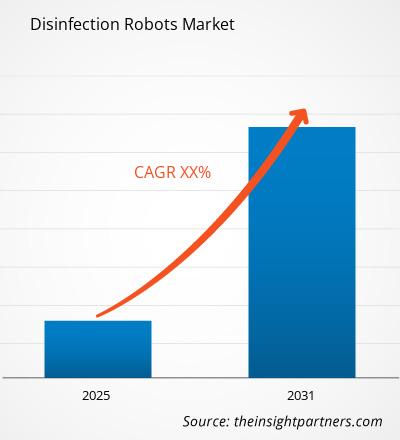
The Disinfection Robots Market is expected to grow from US$ 5.22 Billion in 2025 to US$ 25.30 Billion by 2034, at a CAGR of 19.17% from 2026 to 2034. Demand is influenced by infection prevention needs, autonomous UV robots, hydrogen peroxide robots, and increased applications in hospitals and institutes for research. The market is driven by increased adoption of evidence-based, consistent, and touch-free disinfection processes in critical healthcare and life sciences settings.
North America continues to be a significant adopter of the Disinfection Robots Market size, and its size growth can be attributed to the estimated regional CAGR of 18.5–19.5% through 2034. Hospitals, pharmaceutical clean rooms, and outpatient centers will see investments in automated turnover of patient rooms, digital cycle tracking, and FDA-compliant purchasing practices.
Disinfection Robots Market Assessment and Insights
- North America accounted for 36–39% share in 2025 and is growing at a CAGR range of 18.5–19.5% during 2026–2034, led by hospital automation, stronger infection control purchasing, and established vendor service networks.
- US represented 82–86% of North America in 2025 and is expanding at a CAGR range of 18.8–19.8%, supported by large hospital systems and FDA-authorized UV platforms.
- Europe held 24–27% share in 2025 and is growing at a CAGR range of 17.5–18.5%, with Germany, the UK, France, Italy, and Spain leading adoption through hospital hygiene modernization.
- Asia Pacific captured 21–24% share in 2025 and is advancing at a CAGR range of 20.5–21.5%, driven by China, Japan, South Korea, India, and Australia expanding hospitals and cleanroom capacity.
- Largest Segment UV-Disinfection Robot held 68–72% market share in 2025 and is growing at a CAGR range of 18.5–19.5%, reflecting faster room cycles and easier deployment.
- High Growth Segment Hydrogen Peroxide Vaporization Robot held 28–32% market share in 2025 and is growing at a CAGR range of 20.0–21.0%, supported by cleanroom and terminal disinfection use.
- Key companies analyzed in detail: Bioquell Inc., UVD Robots, STERIS plc, The Clorox Company, Xenex Disinfection Services LLC, Blue Ocean Robotics ApS, PDI Healthcare, Inc., Advanced Sterilization Products, Infection Prevention Technologies, LLC, Skytron, LLC.
Source: The Insight Partners' analysis based on proprietary research, government publications, company annual reports, investor presentations, industry databases, and expert interviews.
The technology development now proceeds from UV towers to autonomous solutions equipped with mapping tools, exposure documentation, motion sensing and fleet management systems. Production trends are being transformed, too, due to the combination by manufacturers of robotics engineering, germicidal lamps, vapor generators, batteries, and service agreements for a complete infection prevention solution. This way, market development depends on investments, validation and compatibility of automated processes within current cleaning regimes without interruptions of patient turnover.
Moving forward, future demand will be seen in the hospital capacity expansion in Asia, regulated pharmaceutical production and research institutes operating under more stringent expectations in terms of contamination control. The regional buying process will be focused on those solutions offering cycle measurements, minimal chemical usage and room layout compatibility. Public health recommendations in respect of environmental hygiene, antibiotic-resistant bacteria and reduction of healthcare-associated infections will further drive investment in those places where automation becomes a necessity due to shortage of staff.
Disinfection Robots Market Report Scope
| Report Attribute | Details |
|---|---|
| Market size in 2025 | US$ 5.22 Billion |
| Market Size by 2034 | US$ 25.30 Billion |
| Global CAGR (2026 - 2034) | 19.17% |
| Historical Data | 2021-2024 |
| Forecast period | 2026-2034 |
Disinfection Robots Market Analysis
The demand for robots is based on the need for hospitals to reduce microbial contamination through manual cleaning, while research institutions require validation technologies for cell therapy, microbiology, and pharmaceuticals. The value chain entails robot component makers, robotics systems integrators, infection preventionists, validation technologists, and maintenance services. Hospitals require robots which document exposure, reduce room downtime, and enhance environmental services staff without substituting infection control protocols in healthcare practices.
Supply factors still include the availability of lamps, autonomous navigation capability, hydrogen peroxide supplies, and calibration capability after sale. Manufacturers are now increasingly packaging hardware, training, software reporting capabilities, and maintenance together to simplify adoption. Hospitals analyze the Disinfection Robots based on cost of ownership, cycle speed, safety interlocks, and proof of efficacy against target organisms, making buying process much more technical than traditional cleaning devices.
The competitive environment consists of infection prevention professionals and robotics providers competing on efficacy claims differentiation. Bioquell Inc. stresses the importance of hydrogen peroxide vaporization technology, UVD Robots and Blue Ocean Robotics ApS concentrate on autonomous UV-C mobility technology, and Xenex Disinfection Services LLC promotes its pulsed xenon UV and its regulatory approval. STERIS plc, PDI Healthcare, Inc., Advanced Sterilization Products, Infection Prevention Technologies, LLC, Skytron, LLC, and The Clorox Company are adding credibility via distribution in established healthcare markets.
Investment will go toward autonomous operation, digital traceability, chemical-free design, and GMP cleanroom capabilities. As per the Disinfection Robots Market report, there is an opportunity for market vendors to get competitive edge by combining validated microbial reduction with service scalability and clinical workflows integration. The customers will compare different products on the basis of their regulatory compliance, uptime, room cycle efficiency, and infection prevention report compatibility.
● REPORT CUSTOMIZATION
Tailor This Report To Align With Your Specific Business Requirements
This report can be customized to align precisely with your business objectives, scope, and target markets. Customization options include tailored segmentation, geography, competitive analysis, and strategic insights to support informed decision-making.
Customize This Report →WHAT YOU CAN ADJUST
- ● Segmentations
- ● Geography
- ● Competitive Analysis
- ● Language Preferences
Disinfection Robots Market: Strategic Insights
Regional Insights
North America Disinfection Robots Market
North America held 36-39% market share in 2025 and is forecast to register a CAGR growth of 18.5-19.5% between 2026 and 2034. North America is a leading region owing to its higher investments on hospital equipment technology budgets, existing infection prevention committees, and quick evaluation of FDA-approved no-touch microbial reduction technologies.
The Disinfection Robots Market share in the region is backed by acute care hospitals which require measurable environmental hygiene results. Increasing preference for robots that are compatible with terminal room disinfection, OR turnovers, and isolation rooms is observed amongst the regional buyers. The proximity of vendors and availability of training sessions are factors which impact the procurement of such technologies.
U.S. Disinfection Robots Market Market
The US accounted for 82-86% of North America in 2025, and it is expected to grow in the CAGR range of 18.8-19.8%. The highest adoption is found in major hospital networks, academic medical centers, long-term care networks, and surgical specialties. Presence of companies is widespread, including Xenex Disinfection Services LLC, STERIS plc, Skytron, LLC, PDI Healthcare, Inc., and Infection Prevention Technologies, LLC.
Use cases are changing from outbreak containment to regular preventive disinfection of operating rooms, EDs, ICUs, and rooms at risk of infections. US purchasers have great preference for use cases involving sensors, software documentation, room mapping, and infection prevention data.
Europe Disinfection Robots Market Market
In 2025, Europe had a share of 24-27%, while it will continue to expand at a CAGR of 17.5-18.5%. In Germany, growth will be driven by investments in hospital modernization, the presence of a strong hygiene culture, and engineering. In the UK, purchases will increase in NHS trusts and private hospitals, as environmental services teams need quicker terminal cleaning validation and less dependence on manual variability.
In France, adoption will be facilitated by infection prevention projects and needs in pharmaceutical manufacturing, while in Italy and Spain, growth will happen due to hospitals improving their disinfection practices after pandemic pressure on the infrastructure. Buyers in Europe may need compliance proofing, documentation regarding the safety of chemicals, and support in services throughout the life cycle.
APAC Disinfection Robots Market Market
Asia Pacific has had a market share of 21–24% in 2025 and is expected to grow in the 20.5–21.5% CAGR range. China drives regional growth by building hospitals, increasing robot capabilities, and improving infection controls. Japan and South Korea drive growth from their high level of automation, while India and Australia increase their demand through private hospitals and laboratories.
Drivers for the industry in the region are healthcare digitalization, pharmaceutical production increase, and concern of the governments about antimicrobial resistance. Buyers seek cost-effective solutions with an efficient services network and multi-language capabilities. This market is expected to be the fastest growing of the major geographies due to the convergence of factors listed.
Middle East & Africa Disinfection Robots Market Market
The Middle East and Africa region is anticipated to see a CAGR growth of 18.0% to 19.0% in 2026–2034 owing to demand led by Saudi Arabia from investments in hospital infrastructure and medical tourism. Demand is seen coming next from the UAE for its superior healthcare institutions and smart hospitals initiatives.
While South Africa plays the crucial role for advanced private healthcare adoption in the region. Infrastructure investments from energy income, setting up of specialty hospitals, and infection prevention mandates drive selective adoption. Demand from Rest of MEA is inconsistent due to financial constraints and service limitations. But robotic technology driven by remote diagnostics, training, and chemical free operations can attract demand.
Segmentation Analysis
Type
- UV-Disinfection Robot remains the largest sub-segment because hospitals value fast cycles, no-touch surface treatment, motion safety systems, and easy integration into terminal room cleaning routines.
- Hydrogen Peroxide Vaporization Robot is strategically important for cleanrooms, isolation areas, and high-risk environments requiring broad surface coverage, sporicidal performance, and validated bio-decontamination records.
End User
The End User segment is projected to grow at a CAGR range of 19.0–20.0% during 2026–2034. Hospitals account for the primary installed base because of room turnover, patient safety, and outbreak management priorities. Research institutes are increasing adoption as advanced therapies, microbiology, and biosafety laboratories require consistent contamination control and auditable disinfection cycles.
- Hospitals dominate demand as operating rooms, ICUs, isolation wards, emergency departments, and patient rooms require repeatable environmental hygiene between clinical use and patient admission.
- Research Institutes show rising demand where biosafety, pharmaceutical, and cell-based research facilities need controlled contamination reduction without excessive manual chemical handling or documentation gaps.
Opportunity Snapshot
| End User | Revenue Contribution | Trend Tag | Adoption Stage |
| Hospitals | High | Room Turnover | Scaling |
| Research Institutes | Medium | Cleanroom Control | Emerging |
Disinfection Robots Market Growth Drivers and Impact Analysis
Healthcare-Associated Infection Reduction Priorities
Healthcare-associated infections create measurable clinical and financial pressure on hospitals, making automated environmental hygiene a board-level quality issue. Manual cleaning can vary by staff workload, room complexity, and compliance monitoring, while robotic UV-C and hydrogen peroxide vaporization systems provide repeatable cycles and digital records. The Disinfection Robots benefits when hospitals connect disinfection data with infection prevention dashboards, accreditation evidence, and environmental services productivity. Impact is strongest in ICUs, operating rooms, isolation units, and oncology wards where pathogen persistence carries higher patient risk.
Automation Response to Labor and Workflow Constraints
Environmental services departments face staffing pressure, rising cleaning workloads, and the need to reduce room turnover delays. Robots help standardize repetitive disinfection tasks while allowing staff to focus on preparation, verification, and patient-facing support. The market impact is practical: facilities can schedule off-hour cycles, document completion, and reduce variability across rooms. Adoption strengthens when robots demonstrate compatibility with existing cleaning protocols, elevator access, room maps, and safety procedures. This makes automation an operational efficiency tool rather than a stand-alone technology purchase.
Regulated Cleanroom and Research Environment Demand
Biopharmaceutical manufacturing, cell and gene therapy laboratories, and research institutes require contamination control that is consistent, validated, and auditable. Hydrogen peroxide vaporization and autonomous UV-C systems address gaps where manual wipe-downs are labor intensive or difficult to verify. The Market gains momentum as facilities align decontamination practices with GMP expectations, biosafety protocols, and batch integrity requirements. Vendors that provide validation support, cycle reports, and cleanroom-compatible materials are better positioned to capture demand beyond hospitals.
Disinfection Robots Market Future Trends
Evidence-Linked Autonomous Disinfection Platforms
Future procurement will favor platforms that combine autonomous navigation, exposure mapping, microbial reduction evidence, and facility-level analytics. Disinfection Robots Market trends are moving toward systems that generate room-by-room records, identify missed zones, and support infection prevention audits. Integration with hospital facility software and quality dashboards could transform robots from cleaning equipment into data-producing infection control assets. Over time, vendors may differentiate through validated algorithms, cloud reporting, route optimization, and predictive maintenance. This trend will reward suppliers able to prove both biological performance and operational reliability in complex healthcare environments.
Hybrid Disinfection Modalities for Complex Rooms
Hybrid systems that combine UV-C irradiation, vaporization, air movement, or robotic surface interaction are expected to gain attention for complex spaces with shadows, crevices, and irregular equipment layouts. Hospitals and laboratories increasingly understand that no single modality addresses every contamination scenario. Suppliers that can match technology to risk category, room design, and turnaround requirements will be better positioned. Future platforms may use sensors to adjust cycle paths and dosage automatically, improving efficacy while reducing unnecessary energy use, chemical exposure, and operational downtime.
Disinfection Robots Market Opportunities
Multi-Site Hospital Network Standardization
Integrated delivery networks are a major opportunity because standardized robot fleets can reduce variation across hospitals, outpatient centers, and specialty facilities. Procurement teams can negotiate enterprise service agreements, common training modules, and shared reporting formats. Disinfection Robots Market Forecasts indicate that scalable deployments will be more attractive than isolated pilots when executives can compare utilization, cycle completion, and room turnover performance across sites. Vendors should therefore develop fleet management tools, financing models, and implementation playbooks that help systems move from one-unit trials to network-wide infection prevention programs.
Pharmaceutical and Research Cleanroom Expansion
Biopharmaceutical, vaccine, and cell therapy facilities present a high-value opportunity because contamination events can disrupt production schedules and regulatory confidence. Automated disinfection can support validated room release, reduce manual chemical handling, and provide traceable documentation for quality teams. Research institutes also need flexible systems for biosafety laboratories and shared equipment areas. Suppliers with GMP expertise, validation documentation, and service coverage can build stronger margins in this customer group than in price-sensitive public hospitals, particularly where cleanroom downtime carries significant economic consequences.
Recent Developments
- July 2026: iRobot introduced its expanded floor-care portfolio with the launch of the Roomba Electro Plus 5-in-1 disinfecting hard floor cleaner alongside a new generation of Roomba robotic cleaning devices. The latest product range is designed to deliver smarter, safer, and more efficient cleaning experiences by combining advanced automation with improved floor-care technologies.
- March 2026: Pudu Robotics launched the PUDU BG1 Series, an AI-native commercial cleaning robot designed to transform large-scale floor maintenance through advanced automation and intelligent decision-making. The new scrubber-dryer robot series is built for high-demand environments such as retail complexes, warehouses, industrial facilities, and transportation hubs, providing a more adaptive approach to commercial cleaning.
- April 2026: KEENON Robotics showcased its latest autonomous cleaning innovations at Interclean Amsterdam 2026, highlighting the role of artificial intelligence, sustainable intelligence, and multi-robot collaboration in the future of facility management. The company presented a professional cleaning robot ecosystem designed to improve operational efficiency, scalability, and automation across commercial environments.
Frequently Asked Questions

- Comprehensive Market Sizing and Forecast Analysis
- Detailed Segmentation Analysis
- In-Depth Market Dynamics Assessment
- Regional and Country-Level Insights
- Competitive Landscape and Company Benchmarking
- Strategic Business Intelligence
Recent Reports
Testimonials

The Insight Partners' SCADA System Market report is comprehensive, with valuable insights on current trends and future forecasts. The team was highly professional, responsive, and supportive throughout. We are very satisfied and highly recommend their services.
RAN KEDEM Partner, Reali Technologies LTDs
I requested a report on a very specific software market and the team produced the report in a few days. The information was very relevant and well presented. I then requested some changes and additions to the report. The team was again very responsive and I got the final report in less than a week.
JEAN-HERVE JENN Chairman, Future Analytica
We worked with The Insight Partners for an important market study and forecast. They gave us clear insights into opportunities and risks, which helped shape our plans. Their research was easy to use and based on solid data. It helped us make smart, confident decisions. We highly recommend them.
PIYUSH NAGPAL Sr. Vice President, High Beam Global
The Insight Partners delivered insightful, well-structured market research with strong domain expertise. Their team was professional and responsive throughout. The user-friendly website made accessing industry reports seamless. We highly recommend them for reliable, high-quality research services
YUKIHIKO ADACHI CEO, Deep Blue, LLC.
This is the first time I have purchased a market report from The Insight Partners.While I was unsure at first, I visited their web site and felt more comfortable to take the risk and purchase a market report.I am completely satisfied with the quality of the report and customer service. I had several questions and comments with the initial report, but after a couple of dialogs over email with their analyst I believe I have a report that I can use as input to our strategic planning process.Thank you so much for taking the extra time and making this a positive experience.I will definitely recommend your service to others and you will be my first call when we need further market data.
JOHN SUZUKI President and Chief Executive Officer, Board Director, BK Technologies
I wish to appreciate your support and the professionalism you displayed in the course of attending to my request for information regarding to infectious disease IVD market in Nigeria. I appreciate your patience, your guidance, and the fact that you were willing to offer a discount, which eventually made it possible for us to close a deal. I look forward to engaging The Insight Partners in the future, all thanks to the impression you have created in me as a result of this first encounter.
DR CHIJIOKE ONYIA MANAGING DIRECTOR, PineCrest Healthcare Ltd.Reason to Buy
- Informed Decision-Making
- Understanding Market Dynamics
- Competitive Analysis
- Identifying Emerging Markets
- Customer Insights
- Market Forecasts
- Risk Mitigation
- Boosting Operational Efficiency
- Strategic Planning
- Investment Justification
- Tracking Industry Innovations
- Aligning with Regulatory Trends





 Get Free Sample for