
Dispersing agents Market Size, Share & Demand by 2034
Coverage: By Type (Suspension, Solution, Colloid, Powder, Others); End-user industry (Building and construction, Paints and coatings, Pulp and paper, Detergent, Oil and gas, Agriculture industry, Pharmaceuticals, Others.), and Geography (North America, Europe, Asia Pacific, and South and Central America)
- Status : Data Released
- Report Code : TIPRE00015889
- Category : Chemicals and Materials
- No. of Pages : 150
- Available Report Formats :


- Last update date : July 28, 2026


2025 Market Size
US$ 7.17 Bn
Base year value
2034 Forecast
US$ 12.83 Bn
Projected by 2034
CAGR 2026-2034
6.68 %
Growth rate
Addressable Market
US$ 90.41 Bn
(2026-2034)
The Dispersing Agents market size was estimated at US$ 7.17 Billion in 2025 and is expected to reach US$ 12.83 Billion by 2034, growing at a CAGR of 6.68% from 2026 to 2034. It is driven by the rising popularity of dispersion technology for coatings, construction admixtures, detergents, oil field fluids, agrochemicals, and pharmaceutical suspensions wherein particle stability, flow characteristics, and process control affect the quality of end-products.
North America is a technologically advanced region in terms of demands and the Dispersing Agents market size is propelled by an anticipated regional CAGR of 5.9-6.9%. Growth in the region is attributed to the re-formulations of low VOC coatings, shale-based oil field additives, high performing construction chemicals, and detergents.
Dispersing agents Market Assessment and Insights
- North America: Share in 2025 of 21–24% and CAGR between 5.9–6.9%. Mature coatings, detergent, oilfield, and pharmaceutical formulation activity supports demand for premium dispersing agents with tighter performance and compliance requirements.
- US: Share in 2025 of 76–80% of North America and CAGR between 6.0–7.0%. Strong coating production, oilfield chemical use, and advanced formulation capacity support stable domestic demand.
- Europe: Share in 2025 of 20–23% and CAGR between 5.3–6.3%. Germany, France, the UK, Italy, and Spain lead adoption through waterborne coatings, detergents, and sustainable specialty chemical manufacturing.
- Asia Pacific: Share in 2025 of 43–47% and CAGR between 7.1–8.1%. China, India, Japan, and South Korea dominate regional consumption through construction, coatings, paper, agriculture, and industrial processing.
- Largest Segment: Paints and coatings held a market share of 34–38% in 2025 and CAGR of 6.4–7.2% during 2026–2034, driven by pigment stabilization and low-VOC reformulation.
- High Growth Segment: Agriculture industry held a market share of 9–12% in 2025 and CAGR of 7.6–8.6% during 2026–2034, supported by suspension concentrates and seed treatment formulations.
- Key companies analyzed in detail: Arkema S.A., Ashland Inc., BASF SE, Clariant AG, Croda International Plc, Evonik Industries AG, Harmony Additives Private Limited, Solvay SA, The Dow Chemical Company, The Lubrizol Corporation.
Source: The Insight Partners' analysis based on proprietary research, government publications, company annual reports, investor presentations, industry databases, and expert interviews.
Formulation science is shifting from generic wetting agents to customized dispersant blends to enhance particle-size control, rheological management, color development, and preservation. The need for additives that prevent water-based paints and agrochemicals from forming flocs due to high solids content is driving changes in supply chains. There will be changes in production chains as manufacturers locate regional specialty mixing capabilities, explore substitute feedstocks, and create application laboratories near coatings, construction, detergent, and crop protection customers.
In the forecast period, there will be growing demand in Asia and North America for innovations in polymeric, bio-sourced, and low-foaming dispersants. Regulations limiting solvent releases, detergent formulations, and agricultural chemical safety will support dispersants that can achieve desired performance at reduced dosage. In essence, the Dispersing Agents Market will favor companies that can combine application expertise, regional technical service, and assured feedstock supplies.
Dispersing agents Market Report Scope
| Report Attribute | Details |
|---|---|
| Market size in 2025 | US$ 7.17 Billion |
| Market Size by 2034 | US$ 12.83 Billion |
| Global CAGR (2026 - 2034) | 6.68% |
| Historical Data | 2021-2024 |
| Forecast period | 2026-2034 |
Dispersing agents Market Analysis
Dispersing Agents market growth dynamics will be driven by three end-user segments such as coating paints and pigments dispersant market, solid suspensions in building and drilling fluids and detergent, agriculture and pharmaceutical suspensions. In 2024 paint and coating production was expected to stand at 48.9 billion liters and US$202 billion respectively. It underscores the importance of developing systems that use dispersing additives. Building admixtures and cementitious products also require dispersants to enhance workability, reduce water usage, and create low-clinker concrete mixtures. Additional demand comes from customers requiring lower processing defects, reduced milling cycles and improved reproducibility of product.
The supply side dynamics depends on acrylic polymers, naphthalene sulfonates, lignosulfonates, polycarboxylates, surfactants and specialty monomers. Manufacturers try to cope with raw-material price fluctuations as well as increasing customer requirements for low dosage, good compatibility and foaming reduction. Increasingly important is customer need for technical expertise which can connect additive chemistry to milling cycle, pigment concentration, stability of suspensions, rheological properties and final product performance.
Competitive analysis of the current market for dispersing agents is characterized by intense competition driven by integrated players in the field of specialty chemicals, featuring application portfolios in multiple areas. BASF SE, Clariant AG, Arkema S.A., Evonik Industries AG, Solvay SA, and The Dow Chemical Company operate through global scale, regulatory support, and coating additive platform. Ashland Inc., Croda International Plc, The Lubrizol Corporation, and Harmony Additives Private Limited are enhancing the competitiveness of the market through specialized formulation expertise.
Investments are increasingly made into aqueous dispersions, biopolymers, and digital application testing. Competitive positioning involves not only pricing but also demonstration of lower milling energy, high solids content, broad binder compatibility, and regulatory approval. Players with regional laboratories can streamline the customer qualification process and protect margins in fragmented downstream industries. The best competitive positions may be achieved by those companies that will possess constant feedstock supply, specialty polymer development, and formulation troubleshooting.
● REPORT CUSTOMIZATION
Tailor This Report To Align With Your Specific Business Requirements
This report can be customized to align precisely with your business objectives, scope, and target markets. Customization options include tailored segmentation, geography, competitive analysis, and strategic insights to support informed decision-making.
Customize This Report →WHAT YOU CAN ADJUST
- ● Segmentations
- ● Geography
- ● Competitive Analysis
- ● Language Preferences
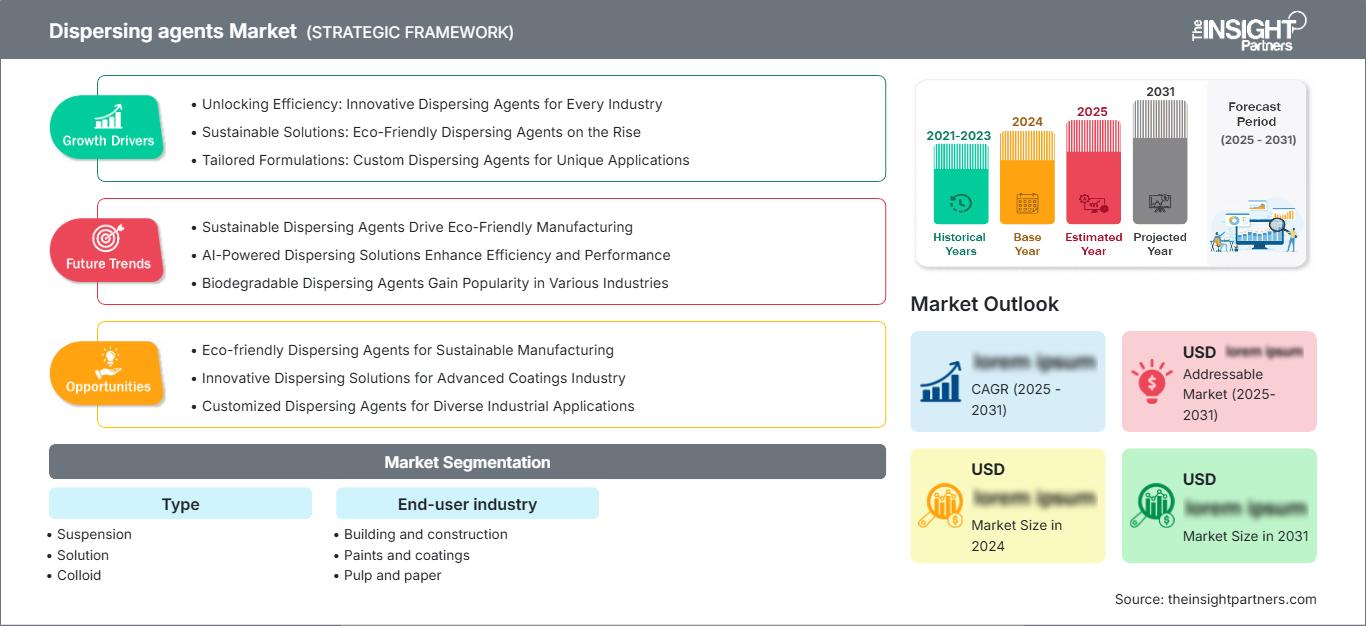
Dispersing agents Market: Strategic Insights
Regional Insights
North America Dispersing Agents Market
The North America market had 21-24% of its revenues in 2025 and is estimated to grow with 5.9-6.9% CAGR. The North American region is characterized by developed coatings industry, detergents production, construction chemicals, and oilfield services. The Dispersing Agents Market shares are strengthened by the need for additives that would increase the effectiveness of pigment wetting, drilling fluid stabilization, and control of particles distribution. Reformulation activities are also facilitated by well-developed testing facilities and interaction between chemical producers, raw materials suppliers, and downstream formulation specialists.
Growing regulatory pressure to produce low-VOC coatings and safer cleaning products increases the importance of effective dispersants packages. Technical support, tests of formulations, and reliable supply are required by local customers as well. Such requirements create advantages for integrated suppliers possessing their laboratories in the region; however, there are niches available for specialty formulators in agriculture, pulping processes, and custom-made industrial dispersions. The demand is relatively stable due to the low percentage of costs spent on dispersants in the formulation.
U.S. Dispersing Agents Market
The United States had the share of 76–80% of North American revenue in 2025 and is forecast to have the growth rate of 6.0–7.0% CAGR. The demand will be driven by significant coating manufacturers, sophisticated detergent formulation, shale oil field chemicals, and development of pharmaceutical excipients. Additional production capacity in the country enables the rapid adoption of advanced dispersant products. Purchasers seek additive solutions which may be easily validated in different facilities to avoid reformulations.
Such companies as BASF SE, The Dow Chemical Company, Ashland Inc., The Lubrizol Corporation, and Evonik Industries AG have commercial or technical presence providing their services to customers in the United States. Market application focus is on waterborne architectural coatings, oil field fluid control systems, crop protection suspensions, and health care formulations, where it is required to provide reproducible particles dispersion and regulatory confidence. Customers in the USA require quick availability of samples, safety data packages, and formulation recommendations.
Europe Dispersing Agents Market
Europe accounted for 20–23% of worldwide revenue in 2025 and is expected to witness a CAGR of 5.3–6.3%. The main countries are Germany owing to coatings, automotive, construction chemical, and specialty manufacturing capabilities. Stringent environmental regulations favor low VOC, odorless, and waterborne systems based on highly sophisticated dispersant chemistry. Manufacturers need to provide substance safety, biodegradability, and sourcing information due to sales in several EU regions by end users.
The UK profits from decorative coatings, detergent applications, and pharmaceutical formulations. France, Italy, and Spain increase consumption via renovation projects in construction, agrochemical production, pulp and paper industry, and industrial coatings. Safety during the product lifecycle, renewable resources, and documentation form the key differentiating factors among European manufacturers. Growth is modest yet the value content is high because the buyers are willing to pay for reliable products, registration assistance, and compliance with their sustainable development goals.
APAC Dispersing Agents Market
The Asia-Pacific region contributed 43-47% to the 2025 revenues and will achieve a CAGR of 7.1-8.1%. In the region, China dominates consumption driven by the manufacturing of coatings, construction materials, detergents, paper products, and agrochemicals. India gains momentum with infrastructure, crop inputs, and pharmaceutical industries growing. Local formulation companies increase demand for additives that enhance batch consistency, lower rework rate and allow higher loading of actives or pigments.
In Japan and South Korea, there is a focus on formulations that ensure precision in electronics coatings, industrial paints, and chemical process technologies. Australia provides demand from construction, mining, and agriculture applications. Policies for infrastructure, industrial localization and more environmental-friendly formulations encourage the use of suspending, colloidal, solution, and powders dispersion technology in the region. Competitors in the region include multinational companies and local manufacturers, thus, technical service, distribution and cost performance become key factors for customer retention.
Middle East & Africa Dispersing Agents Market
MEA will register a growth rate of 5.8-6.8%. Saudi Arabia will dominate this region due to energy projects, construction chemicals, paints, and infrastructure projects. In addition, UAE will generate demand through real estate projects, coatings, cleaning, and hospitality constructions. Huge construction and oilfield projects in these regions will increase the need for additives that have properties of dispersion and rheology even in conditions of heat, salinity, and long storage.
South Africa will contribute through mining chemicals, construction, agriculture, and industrial processes, whereas other regions in MEA will benefit due to selective infrastructure projects and oilfield activities. Customers in these regions prioritize additives that perform well in hot climates and in poor water conditions; thus, there is potential to develop robust dispersant systems. Manufacturers who provide warehousing facilities, training to distributors, and guidance in applications can minimize the customer's downtime.
Segmentation Analysis
Type
The Type segment is projected to grow at a 6.2–7.2% CAGR during 2026–2034. The Dispersing Agents Market scope spans liquid and solid delivery formats used to stabilize particles in waterborne, solvent-borne, and hybrid systems. Selection depends on particle size, solids loading, storage stability, dosing equipment, and compatibility with binders, surfactants, electrolytes, and active ingredients. Suppliers increasingly customize molecular weight, ionic character, and functional groups to balance dispersion efficiency with foaming, viscosity, and regulatory requirements.
- Suspension: Suspension systems are critical in agrochemicals, pharmaceuticals, coatings, and oilfield fluids because they keep insoluble particles distributed during storage, transport, and application.
- Solution: Solution dispersants support homogeneous formulations where compatibility, clarity, and rapid mixing are important, particularly in detergents, water-treatment additives, and industrial process chemicals.
- Colloid: Colloid formats serve applications requiring fine particle control, high stability, and predictable rheology, including specialty coatings, inks, ceramic slips, and advanced material processing.
- Powder: Powder dispersants are valued where logistics, shelf life, dosing flexibility, and dry blending matter, especially in cement additives, detergent powders, pigments, and construction materials.
End-user industry
The End-user industry segment is expected to advance at a 6.4–7.4% CAGR from 2026 to 2034. Demand is diversified because dispersants influence viscosity, stability, grinding efficiency, cleaning performance, active delivery, and processing consistency. Customers increasingly evaluate additives by lifecycle cost, regulatory acceptance, dosage efficiency, and compatibility with waterborne or concentrated formulations. Industries with high quality variation costs, such as coatings, pharmaceuticals, and agrochemicals, are more willing to adopt premium products that reduce batch failure risk.
- Building and construction: Construction users apply dispersants in concrete admixtures, cement grinding aids, gypsum systems, and dry-mix products to improve flow, strength development, and water reduction.
- Paints and coatings: This is the largest end-use area, relying on dispersants for pigment wetting, color development, gloss control, storage stability, and low-VOC formulation performance.
- Pulp and paper: Paper producers use dispersants to manage fillers, coatings, pitch, pigments, and deposit control, supporting runnability, print quality, and process efficiency.
- Detergent: Detergent formulators use dispersants to suspend soils, prevent redeposition, improve builder compatibility, and maintain stability in liquid, powder, and concentrated products.
- Oil and gas: Oilfield applications use dispersants in drilling fluids, cementing additives, production chemicals, and spill response products where solids control and fluid stability matter.
- Agriculture industry: Agrochemical manufacturers use dispersants in suspension concentrates, wettable powders, seed treatments, and fertilizers to improve active ingredient distribution and field application consistency.
- Pharmaceuticals: Pharmaceutical applications require tightly controlled dispersants for suspensions, topical systems, and excipient platforms where particle uniformity, stability, and safety documentation are essential.
Opportunity Snapshot
| Segment Name | Revenue Contribution | Trend Tag | Adoption Stage |
| Building and construction | High | Low Water | Scaling |
| Paints and coatings | High | Low VOC | Mature |
| Pulp and paper | Medium | Filler Control | Mature |
| Detergent | Medium | Soil Suspension | Scaling |
| Oil and gas | Medium | Fluid Stability | Mature |
| Agriculture industry | Medium | SC Formulations | Scaling |
| Pharmaceuticals | Low | Particle Safety | Emerging |
Dispersing agents Market Growth Drivers and Impact Analysis
Shift Toward Waterborne and Low-VOC Formulations
Waterborne coatings, adhesives, detergents, and industrial chemicals are becoming common as regulations and consumers tighten their tolerance on the emission of solvents. This trend has made the use of dispersants technically important since the pigments, fillers, and active ingredients should be kept stable in more challenging aqueous conditions. This trend manifests itself in increased demand for polymeric and non-ionic dispersants which prevent flocculation and retain high tinting strength in aqueous solutions. Companies that can show better results at lower concentrations can enable consumers to reduce the use of raw materials and energy for mixing, and reduce formula failures. As waterborne products are widely adopted in architecture, industry, and consumer goods, there will emerge a structural demand for the Dispersing Agents Market associated with compliance and process efficiency.
Rising Construction and Infrastructure Chemical Demand
Urbanization, housing schemes, transportation networks, and business constructions will increase the use of admixtures and cement modifiers whose action relies on dispersion technology. In concrete and mortar mixes, dispersants enhance particle packing, workability, water reduction, and strength development, thus enabling constructors to meet their durability and efficiency needs. Big scale projects also require additives that ensure stable flow during transportation and laying in changing field conditions. The effect of market dynamics will be most pronounced in Asian and Middle Eastern countries with pipelines for infrastructure development. Admixture producers who match their products to local cement chemistry and construction specifics have more chances to take high-end rather than commodity positions in the market.
Expansion of High-Solids Agriculture and Pharma Suspensions
Crop protection and pharmaceutical manufacturers increasingly formulate concentrated suspensions to improve dosing precision, transport efficiency, and application performance. These products require dispersants that prevent settling, caking, crystal growth, and inconsistent active delivery. In agriculture, suspension concentrates and wettable powders support efficient field application, while pharmaceuticals require validated excipient systems and reproducible particle behavior. The commercial impact is a shift toward higher-margin specialty dispersants supported by toxicology data, registration support, and application testing. Companies that combine chemistry design with regulatory documentation can access defensible opportunities in these technically demanding end uses. Demand will also rise where climate variability increases the need for reliable crop-input performance under diverse field conditions.
Dispersing agents Market Future Trends
Bio-Based and Circular Feedstock Integration
Future Dispersing Agents Market trends will increasingly reflect customer pressure for renewable carbon, lower toxicity, and measurable lifecycle benefits. Bio-based polymers, modified lignosulfonates, sugar-derived surfactants, and recycled-content intermediates are expected to move from niche trials into broader formulation programs. Adoption will depend on whether these materials match conventional products on dispersion stability, color acceptance, electrolyte tolerance, and shelf life. Suppliers will need transparent sourcing, reliable quality, and technical proof that sustainable alternatives do not compromise downstream processing. As procurement teams incorporate carbon and safety metrics, circular feedstock strategies will become a competitive differentiator rather than a marketing add-on. Early adoption is likely in European coatings, detergents, and construction chemicals where sustainability claims are closely scrutinized.
Digital Formulation and Application Testing
Digital formulation tools are expected to reshape additive selection by linking particle properties, binder chemistry, dosage, milling energy, and stability outcomes. Automated testing platforms can screen dispersants faster than traditional laboratory workflows, reducing development time for coatings, detergents, agrochemicals, and pharmaceutical suspensions. Data-driven recommendations will help customers identify lower-dosage products and reduce trial failures. Suppliers that build formulation databases and predictive models can deepen customer relationships and protect technical margins. Over time, digital application support may become as important as manufacturing scale because customers need faster reformulation cycles under cost, compliance, and sustainability pressure. Integration with customer trial data will make these platforms more valuable and more difficult for competitors to replicate.
Dispersing agents Market Opportunities
Localized Technical Service in Asia Pacific
Asia Pacific offers a strong opportunity for suppliers that combine local production with formulation support. Coatings, construction, paper, detergent, and agrochemical customers often require rapid troubleshooting because raw materials, water quality, pigments, and processing conditions vary by country. Investment aligned with Dispersing Agents Market Forecasts should therefore prioritize application laboratories near China, India, Japan, South Korea, and Southeast Asian manufacturing clusters. Local testing can shorten qualification cycles and support tailored products for regional binders, cement types, and active ingredients. Companies that move beyond import distribution toward technical partnership can improve customer retention and capture premium applications. Regional teams can also identify unmet needs earlier, allowing faster product localization than centralized global development models.
Premium Dispersants for Regulated End Uses
Pharmaceuticals, crop protection, food-contact coatings, and personal care adjacent applications require additives supported by strong safety, quality, and regulatory documentation. This creates an investment opportunity for suppliers with traceable feedstocks, consistent manufacturing, and validated performance data. Premium dispersants can command stronger margins when they reduce settling, improve active delivery, or simplify regulatory submissions. The opportunity is not limited to large multinational customers because regional formulators also need compliant materials to access export markets. Strategic partnerships with contract manufacturers and formulation consultants can help chemical producers expand into these defensible, specification-driven applications. Suppliers should also develop documentation packages that address impurity control, batch consistency, and long-term stability expectations.
Recent Developments
- November 2025: Lubrizol introduces sustainable dispersants, waxes, and resins tailored for the Asia-Pacific coatings and inks market, reinforcing its dedication to supporting formulators in achieving sustainability objectives.
- May 2025: EEvonik Coating Additives has launched four new AERODISP® dispersions utilizing SiO2 or Al2O3 particles to enhance waterborne inkjet ink receptive coatings. These dispersions support improved dot sharpness and resolution, crucial for the shift from analogue to digital printing. They facilitate better control over the spreading and fixation of inks on substrates. The AERODISP® dispersions are easy to incorporate and compatible with various binders and formulations, ensuring high-quality results in inkjet applications.
Frequently Asked Questions

- Comprehensive Market Sizing and Forecast Analysis
- Detailed Segmentation Analysis
- In-Depth Market Dynamics Assessment
- Regional and Country-Level Insights
- Competitive Landscape and Company Benchmarking
- Strategic Business Intelligence
Recent Reports
Testimonials

The Insight Partners' SCADA System Market report is comprehensive, with valuable insights on current trends and future forecasts. The team was highly professional, responsive, and supportive throughout. We are very satisfied and highly recommend their services.
RAN KEDEM Partner, Reali Technologies LTDs
I requested a report on a very specific software market and the team produced the report in a few days. The information was very relevant and well presented. I then requested some changes and additions to the report. The team was again very responsive and I got the final report in less than a week.
JEAN-HERVE JENN Chairman, Future Analytica
We worked with The Insight Partners for an important market study and forecast. They gave us clear insights into opportunities and risks, which helped shape our plans. Their research was easy to use and based on solid data. It helped us make smart, confident decisions. We highly recommend them.
PIYUSH NAGPAL Sr. Vice President, High Beam Global
The Insight Partners delivered insightful, well-structured market research with strong domain expertise. Their team was professional and responsive throughout. The user-friendly website made accessing industry reports seamless. We highly recommend them for reliable, high-quality research services
YUKIHIKO ADACHI CEO, Deep Blue, LLC.
This is the first time I have purchased a market report from The Insight Partners.While I was unsure at first, I visited their web site and felt more comfortable to take the risk and purchase a market report.I am completely satisfied with the quality of the report and customer service. I had several questions and comments with the initial report, but after a couple of dialogs over email with their analyst I believe I have a report that I can use as input to our strategic planning process.Thank you so much for taking the extra time and making this a positive experience.I will definitely recommend your service to others and you will be my first call when we need further market data.
JOHN SUZUKI President and Chief Executive Officer, Board Director, BK Technologies
I wish to appreciate your support and the professionalism you displayed in the course of attending to my request for information regarding to infectious disease IVD market in Nigeria. I appreciate your patience, your guidance, and the fact that you were willing to offer a discount, which eventually made it possible for us to close a deal. I look forward to engaging The Insight Partners in the future, all thanks to the impression you have created in me as a result of this first encounter.
DR CHIJIOKE ONYIA MANAGING DIRECTOR, PineCrest Healthcare Ltd.Reason to Buy
- Informed Decision-Making
- Understanding Market Dynamics
- Competitive Analysis
- Identifying Emerging Markets
- Customer Insights
- Market Forecasts
- Risk Mitigation
- Boosting Operational Efficiency
- Strategic Planning
- Investment Justification
- Tracking Industry Innovations
- Aligning with Regulatory Trends





 Get Free Sample for