
Indoor Air Quality Monitoring System Market Size, Growth & Demand by 2034
Coverage: By Component (Hardware, Software, and Services), Deployment Type (Fixed Monitoring Systems, Portable Monitoring Systems), Sampling Method (Active Monitoring Systems, Passive Monitoring, Manual Monitoring, and Others), End User Industry (Government and Regulatory Bodies, Industrial and Manufacturing Sector, Commercial and Institutional Buildings, Residential Users, and Environmental Research and Academia) and Geography (North America, Europe, Asia Pacific, Middle East and Africa, and South and Central America)
- Status : Published
- Report Code : TIPRE00043823
- Category : Electronics and Semiconductor
- No. of Pages : 293
- Available Report Formats :


- Last update date : September 04, 2026


2025 Market Size
US$ 1,780.99 Mn
Base year value
2034 Forecast
US$ 3,321.31 Mn
Projected by 2034
CAGR 2026-2034
7.2 %
Growth rate
Addressable Market
US$ 23,059.65 Mn
(2026-2034)
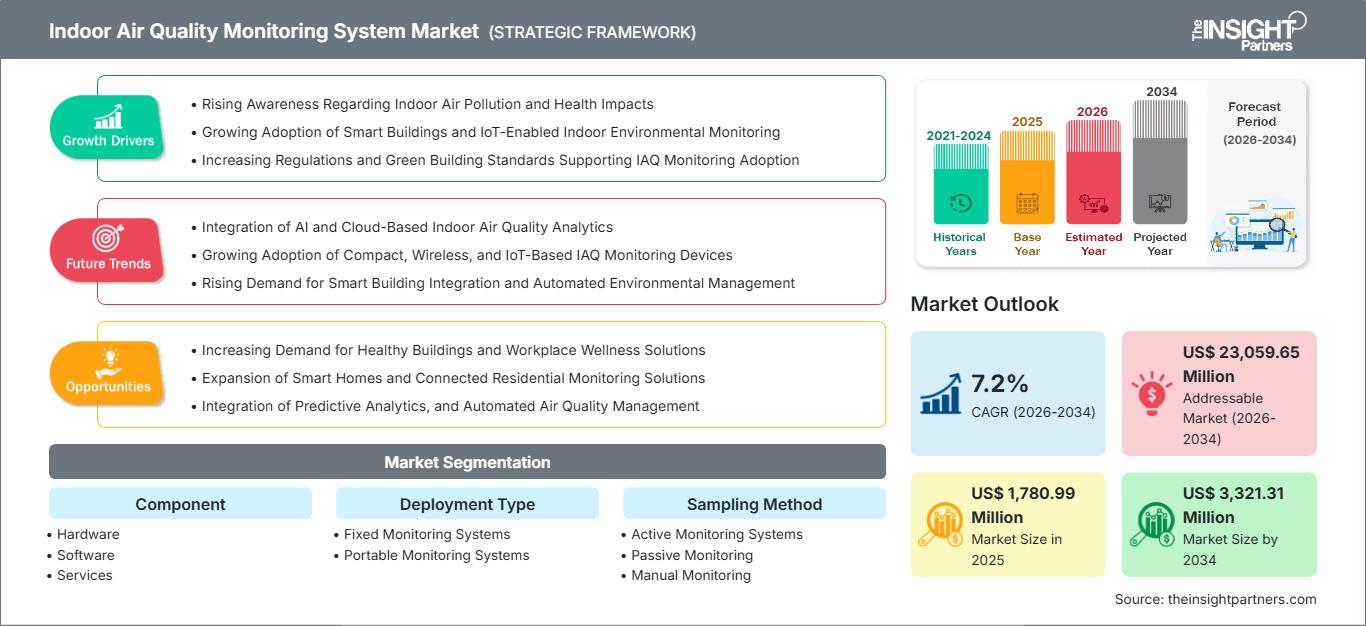
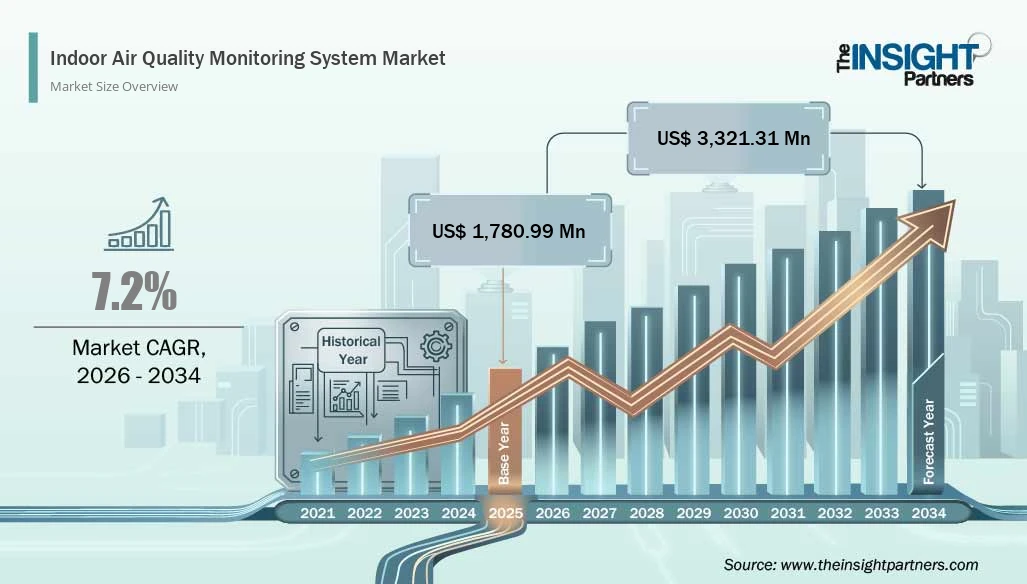
The Indoor Air Quality Monitoring System Market is poised to reach US$ 3,321.31 million by 2034 from US$ 1,780.99 million in 2025, advancing at a CAGR of 7.2% from 2026 to 2034. As building operators increasingly prioritize ventilation efficiency, occupant health, and data-driven environmental management, the market growth trajectory reflects the rising deployment of smart sensing technologies, deeper integration with building automation platforms, and the growing need for continuous monitoring of indoor environmental parameters. Looking ahead, market development will be supported by stricter air-quality expectations and the growing use of actionable building performance insights to optimize operational efficiency.
North America is expected to remain a key revenue-generating region, supported by ongoing building upgrades, school ventilation improvement initiatives, healthcare facility compliance requirements, and stronger integration of environmental monitoring with HVAC systems. In addition, the demand for real-time indoor air quality intelligence is accelerating the adoption of air quality monitoring systems across commercial and institutional buildings, reinforcing the long-term growth potential of the Indoor Air Quality Monitoring System Market size.
Indoor Air Quality Monitoring System Market Assessment and Insights
- North America: In North America, the region is expected to account for 28.4% in 2025, the demand being driven by smart-building retrofits, school IAQ programs, healthcare facilities, and HVAC automation. The annual rate of growth between 2026 and 2034 is expected to be 6.5%.
- US: In the United States, 60.4% of North American demand is expected in 2025, thanks to commercial building modernisation and institutional ventilation schemes. The annual rate of growth between 2026 and 2034 is expected to be 8.2%.
- Europe: Europe is expected to make up 40.7% of the global Indoor Air Quality Monitoring System market share in 2025, with Germany, the UK, France, Italy and Spain leading this effort. The regulations concerning building energy and the requirements for healthier buildings will result in a 6.5% CAGR between 2026 and 2034.
- Asia Pacific: The Asia Pacific region is expected to account for 23.4% by 2025, the main demand coming from China, Japan, South Korea and India; rapid construction and investment in smart buildings will give it a 8.4% CAGR from 2026 to 2034.
- Largest Segment: The largest segment is hardware, which is expected to hold a 69.4% market share in 2025 due to demand for sensor deployment and replacement and with a 7.5% CAGR.
- High Growth Segment: Portable Monitoring Systems are estimated at 34.1% market share in 2025, benefiting from flexible assessments, with an 8.1% CAGR.
- Key companies analyzed in detail: Agilent Technologies, Inc.; Emerson Electric Co.; Thermo Fisher Scientific Inc.; Siemens AG; Teledyne Technologies Incorporated; Honeywell International Inc.; HORIBA, Ltd.; 3M; Testo SE & Co. KGaA; and Aeroqual.
Source: The Insight Partners' analysis based on proprietary research, government publications, company annual reports, investor presentations, industry databases, and expert interviews.
Monitoring is now moving from using separate instruments to employing networked sensing systems that integrate measurements of particulate matter, carbon dioxide, volatile organic compounds, temperature, and humidity. There is a growing focus in production on small, multi-parameter sensors, wireless connectivity, and communication protocols that are compatible with one another. As a result, the use of such systems is expanding into a wider range of locations including offices, schools, healthcare facilities, laboratories, and homes, together with a continuous need for calibration, software, data management, and maintenance services. The indoor air quality monitoring system market is therefore becoming more integrated with building operations.
During the forecast period, investment is expected to shift towards devices that are suitable for retrofitting, edge analytics, and software which can transform sensor readings into decisions regarding ventilation and maintenance. In emerging economies there will be further opportunities as commercial construction grows and building operators take up digital facility-management methods. Since regulators are paying more attention to ventilation, energy efficiency, and occupant health, this should lead to a greater use of measurement-based interventions, especially in cases where building owners have to show their building's actual performance rather than just depending on regular inspections.
Indoor Air Quality Monitoring System Market Report Scope
| Report Attribute | Details |
|---|---|
| Market size in 2025 | US$ 1,780.99 Million |
| Market Size by 2034 | US$ 3,321.31 Million |
| Global CAGR (2026 - 2034) | 7.2% |
| Historical Data | 2021-2024 |
| Forecast period | 2026-2034 |
Indoor Air Quality Monitoring System Market Analysis
The demand is being influenced by the necessity of determining the conditions which conventional HVAC controls are unable to fully characterize. The indoor air quality monitoring system market growth is associated with the continuous measurement of carbon dioxide, particulate matter, VOCs, temperature, and humidity—especially in cases where occupancy patterns change. The EPA's guidance identifies indoor pollutant concentrations, ventilation, temperature, and humidity as important factors for assessment, and at the same time sensor technology is enabling automatic responses when thresholds are surpassed.
The ecosystem includes sensor manufacturers, suppliers of components, building-management platforms, HVAC integrators, facility managers, calibration providers, and engineering consultants. Since sensing devices and communication infrastructure are needed for each deployment, hardware continues to play a central role, whereas software provides a competitive edge through its capabilities in visualization, alerts, analytics, and integration. The current market conditions are in favour of suppliers who have a wide range of sensors, well-established calibration abilities, and who can achieve interoperability between different building automation systems.
Nowadays, competitive positioning relies more on being able to link measurements with actual operational actions than just on offering separate readings. The analysis of the Indoor Air Quality Monitoring System takes into account portfolio breadth, sensor accuracy, connectivity, software integration, and service capabilities. Siemens AG combines its IAQ sensing with building-management technologies, while Honeywell International Inc. integrates multi-parameter monitoring with its HVAC and dashboard functions.
Agilent Technologies, Inc., Emerson Electric Co., Thermo Fisher Scientific Inc., Teledyne Technologies Incorporated, HORIBA, Ltd., and 3M bring analytical, sensing, industrial, or environmental-monitoring expertise. Testo SE & Co. KGaA emphasizes professional field measurement, while Aeroqual focuses on portable and fixed air-quality monitoring applications. Investment is increasingly directed toward wireless sensing, cloud analytics, calibration services, and retrofit solutions that reduce installation complexity.
● REPORT CUSTOMIZATION
Tailor This Report To Align With Your Specific Business Requirements
This report can be customized to align precisely with your business objectives, scope, and target markets. Customization options include tailored segmentation, geography, competitive analysis, and strategic insights to support informed decision-making.
Customize This Report →WHAT YOU CAN ADJUST
- ● Segmentations
- ● Geography
- ● Competitive Analysis
- ● Language Preferences
Indoor Air Quality Monitoring System Market: Strategic Insights
Regional Insights
North America Indoor Air Quality Monitoring System Market
In 2025, North America is expected to account for 31 to 35 , with a compound annual growth rate of 7.0 to 7.6% through to 2034. The region enjoys the advantage of well-established building automation infrastructure, is seeing a high level of commercial renovation, has school indoor air quality programmes in place, and there is demand from healthcare settings. Guidance from the EPA promotes a systematic evaluation of the indoor conditions in schools and considers CO2 monitoring to be a useful sign of poor ventilation. The United States is the main regional Indoor Air Quality Monitoring System market, thanks to the widespread use of connected HVAC controls and indoor environmental sensors. In Canada, demand is met via institutional building projects and large-scale installations in schools. There is a growing preference for systems that link monitoring with ventilation control, enabling facility operators to assess varying levels of occupancy and changes in environmental conditions. The regional market also benefits from well-established service networks and building practices based on established standards, which in turn boosts ongoing demand for calibration, maintenance, and software-enabled monitoring.
U.S. Indoor Air Quality Monitoring System Market
In 2025, the United States Indoor Air Quality Monitoring System market is expected to make up 60.4% of North American demand and will see a compound annual growth rate between 6.8 and 8.2 per cent until 2034. Commercial offices, schools, healthcare facilities and public buildings are key areas of application and building modernization involves replacing traditional instruments with connected sensors. There is a growing emphasis in federal guidance on practical methods of measurement and management. The level of market acceptance is also affected by the integration of IAQ sensors with building-management systems, since Honeywell International Inc. and Siemens AG offer product lines including sensors, controls, and analytics, and Testo SE & Co. KGaA meets the needs of professionals in the field. Facility operators are becoming more inclined to choose systems that convert readings of CO2, particulate matter, humidity, and VOCs into practical decisions regarding ventilation, maintenance, and management of occupants.
Europe Indoor Air Quality Monitoring System Market
In 2025, the Europe Indoor Air Quality Monitoring System market is expected to be 40.7% and will grow at a 6.5% compound annual growth rate by 2034. Germany holds the leading position in the region, with the UK, France, Italy, and then Spain following. The continued investment in building efficiency measures, along with renovation activities and greater emphasis on healthy indoor environments, contributes to sustained monitoring investment.
In the UK, demand is connected with the management of ventilation in schools, healthcare facilities, workplaces, and commercial buildings, thanks to an increasing number of connected sensors aiding in facility decisions. In Germany demand is supported by engineering-intensive building automation and by a strong requirement for standards-based measurement. In France, Italy and Spain adoption is being extended through renovation projects in the commercial sector, in the hospitality industry, in education and in the modernisation of public buildings. Germany is still the leading country, although demand in the various regions is increasingly favouring interoperable systems that integrate IAQ information with HVAC and energy-management platforms.
APAC Indoor Air Quality Monitoring System Market
In 2025, the APAC Indoor Air Quality Monitoring System market is expected to account for 23.4% and will grow at a CAGR of 8.4% during the forecast period. China has the highest level of demand in the region, with Japan, South Korea, India and Australia coming after it. The growth in industrialization, urban construction, healthcare and smart-building projects is helping to promote adoption.
China obtains advantages through large-scale construction and industrial implementation, whereas Japan and South Korea focus on advanced building controls. India is backed by commercial development and a high level of institutional awareness, and Australia by building performance requirements. Increasingly, connected sensors are helping to optimise ventilation and energy management, thus strengthening the connection between IAQ monitoring and the digital facility infrastructure.
Middle East & Africa Indoor Air Quality Monitoring System Market
The demand in the Middle East and Africa is expected to grow at a rate of 5.5% per year on a compound annual basis until 2034; Saudi Arabia is at the forefront of adoption in the region due to its major infrastructure projects, whereas the UAE enjoys advantages from its investments in smart buildings. South Africa is still the main region for the Indoor Air Quality Monitoring System market in Africa for use by institutions and businesses.
The high energy demand for cooling means that it is strategically important to optimise ventilation in the Gulf countries. Newly built commercial complexes, healthcare facilities, hotels and public infrastructure provide opportunities for connected monitoring. In the rest of the MEA region, adoption is more selective and is focused on industrial, research and premium commercial facilities where environmental monitoring is used to meet operational or compliance goals.
Segmentation Analysis
Component
Component segmentation is projected to expand at a 7.5% CAGR between 2026–2034 in the Indoor Air Quality Monitoring System market. Hardware remains foundational because monitoring deployments require physical sensing and communication equipment. Software and services are gaining importance as customers seek centralized dashboards, analytics, calibration, maintenance, and integration. The Indoor Air Quality Monitoring System scope therefore extends beyond device sales toward recurring digital and service-based revenue.
- Hardware: Hardware maintains the leading position because every monitoring architecture requires sensing elements, controllers, communication modules, displays, or gateways. Demand increasingly favors compact multi-parameter configurations with wireless connectivity.
- Software: Software demand is increasing as facility managers require centralized dashboards, alerts, historical trends, threshold management, and integration with building-management platforms for operational decisions.
- Services: Services support installation, calibration, validation, maintenance, data interpretation, and system upgrades, making them strategically important for customers managing distributed monitoring networks.
Deployment Type
Deployment Type is expected to record a 6.7% CAGR during 2026–2034 in the Indoor Air Quality Monitoring System market. Fixed Monitoring Systems remain important for continuous facility management, whereas Portable Monitoring Systems provide flexibility for audits, troubleshooting, commissioning, and targeted investigations. The balance between permanent visibility and rapid diagnostic capability is shaping procurement strategies across diverse building portfolios.
- Fixed Monitoring Systems: Fixed systems support continuous measurement and integration with HVAC or building-management infrastructure, making them particularly suitable for offices, schools, healthcare facilities, and industrial buildings.
- Portable Monitoring Systems: Portable systems enable rapid assessments across multiple rooms or sites, supporting commissioning, troubleshooting, compliance checks, and targeted investigations without extensive permanent installation.
Sampling Method
Sampling Method is projected to advance at a 7.8% CAGR from 2026–2034. Active Monitoring Systems are favored where continuous data and automated responses are required. Passive and manual approaches remain relevant for specific investigations, validation, or cost-sensitive applications. System selection increasingly depends on required measurement frequency, pollutant type, accuracy, and integration requirements.
- Active Monitoring Systems: Active systems provide continuous or frequent readings and support automated alerts, making them strategically important for buildings where ventilation and occupancy conditions change rapidly.
- Passive Monitoring: Passive methods remain useful for longer-duration assessments and applications where lower power requirements or simpler deployment can offset limitations in continuous real-time visibility.
- Manual Monitoring: Manual monitoring supports specialist investigations, commissioning, troubleshooting, and validation where trained personnel need direct control over measurement procedures and sampling conditions.
- Others: Other approaches address specialized measurement requirements where conventional active, passive, or manual techniques do not provide the required sampling configuration.
End User Industry
End User Industry is expected to grow at a 6.5% CAGR between 2026–2034. Commercial and institutional buildings represent an important demand center because monitoring can connect occupant conditions with HVAC operation. Government programs, industrial requirements, residential awareness, and environmental research broaden the addressable customer base and application diversity.
- Government and Regulatory Bodies: Government users deploy monitoring for public facilities, policy programs, schools, and regulatory assessment, emphasizing standardized measurement, reporting, and evidence-based intervention.
- Industrial and Manufacturing Sector: Industrial facilities require monitoring around production areas, worker environments, controlled spaces, and process-related contaminants, creating demand for robust instruments and specialized services.
- Commercial and Institutional Buildings: Offices, schools, hospitals, and public buildings increasingly require continuous IAQ visibility to support ventilation management, occupant comfort, maintenance, and building-performance objectives.
- Residential Users: Residential adoption is expanding through consumer awareness and compact connected sensors that provide accessible information about particulate matter, CO2, humidity, and other environmental conditions.
- Environmental Research and Academia: Research institutions use advanced monitors for exposure studies, sensor validation, indoor-environment experiments, and development of improved measurement methodologies.
Opportunity Snapshot
| End User Industry | Revenue Contribution | Trend Tag | Adoption Stage |
|---|---|---|---|
| Government and Regulatory Bodies | Medium | Public IAQ | Scaling |
| Industrial and Manufacturing Sector | Medium | Process Safety | Scaling |
| Commercial and Institutional Buildings | High | Smart Ventilation | Mature |
| Residential Users | Medium | Home Sensing | Scaling |
| Environmental Research and Academia | Low | Sensor Research | Emerging |
Indoor Air Quality Monitoring System Market Growth Drivers and Impact Analysis
Expansion of Smart Building and HVAC Automation
The increasing link between environmental sensing and HVAC automation is raising the practical usefulness of IAQ monitoring. Rather than viewing the measurements as separate compliance records, building operators can use the data from the sensors to adjust ventilation, detect abnormal situations, and decide what maintenance to carry out. For instance, Siemens AG provides support for sensing CO2, particulate matter, VOCs, temperature, and humidity within building automation systems. Honeywell International Inc. does the same by promoting multi-parameter sensing for use with demand-controlled ventilation and for integration with building management systems. As a result, the criteria used when making purchases are changing since buyers now take into account not only sensor specifications but also interoperability, communication protocols, the availability of data, and lifecycle support. The most significant impact is seen in large commercial and institutional buildings, where central control allows monitoring data to be turned into operational decisions.
Increasing Attention to Healthier Learning and Working Environments
Schools, offices, healthcare centres and other occupied buildings are now placing greater emphasis on the measurable environmental conditions since indoor exposure can vary greatly from room to room and depending on the number of people present, the ventilation and the source of the pollutant. The EPA advises that in some cases the concentration of indoor pollutants can be much higher than that outside and suggests that a systematic evaluation of school environments should take place. This has led to a greater need for practical monitoring tools which aid facility managers in setting up baselines and in detecting ventilation problems. The effect on the Indoor Air Quality Monitoring System market goes beyond that of simply buying sensors since organisations also require the services of installation, calibration, data interpretation and maintenance. As building owners become more closely linked between the wellbeing of the occupants and the performance of the facility, monitoring is incorporated into wider preventive-management programmes rather than remaining a separate environmental measure.
Demand for Multi-Parameter, Connected Monitoring Platforms
People are becoming more likely to move from using single-parameter instruments to opting for systems that combine measurements of particulate matter, CO2, VOCs, temperature, and humidity. This change enhances situational awareness since indoor air conditions are multidimensional and can vary depending on occupancy, ventilation, the materials used, moisture levels, and air infiltration from the outside. The EPA's materials point out the increasing use of combined sensors and state that connected sensors can cause equipment to take action when certain conditions are met. For suppliers, this trend is creating a broader and more dynamic competitive environment that extends beyond hardware to include firmware, analytics, connectivity solutions, and integration services. Vendors that can deliver accurate, dependable air quality data while simplifying deployment, system interoperability, and data interpretation are likely to capture a greater share of project spending, strengthening their market position and supporting growth opportunities outlined in the Indoor Air Quality Monitoring System Market forecast.
Indoor Air Quality Monitoring System Market Future Trends
AI-Assisted Interpretation of Indoor Environmental Data
The next phase of monitoring is likely to emphasize software that interprets multiple sensor streams instead of presenting disconnected readings. Artificial intelligence will be able to detect recurring patterns of occupancy, unusual pollutant events, ventilation anomalies, and possible equipment problems. As a result, the Indoor Air Quality Monitoring System market trends will tend to offer predictive recommendations rather than simply sending threshold alerts. Cloud platforms have the capability of combining room-level data across a range of buildings, and edge processing can enable quicker responses in cases where connectivity is restricted. Eventually, procurement choices may assign more importance to data architecture, model transparency, interoperability, cybersecurity, and the capacity to turn measurements into prioritised operational actions.
Digital Twins and Portfolio-Level Environmental Intelligence
Digital twins are going to improve the link between indoor environmental monitoring and building-performance management. By linking sensor data to rooms, floors, equipment, occupancy patterns, and ventilation zones it is possible to produce a more detailed picture of how a building operates. This method allows operators to compare situations between different sites and to spot persistent problems which are hard to detect using individual measurements. In the future, systems might increasingly combine IAQ data with information on energy use, occupancy, maintenance, and building control. This kind of integration will enable scenario analysis to be carried out before any physical changes are made, helping organisations to assess ventilation strategies, sensor placement, filtration needs, and retrofit priorities with greater analytical confidence.
Indoor Air Quality Monitoring System Market Opportunities
Retrofit Programs for Existing Commercial and Institutional Buildings
Existing buildings represent a substantial opportunity since a number of the facilities already have HVAC systems but do not have detailed visibility regarding the environment. Suppliers could create retrofit packages that include wireless sensors, gateways, dashboards, and integration services in order to reduce the need for wiring and the amount of commissioning work required. The Indoor Air Quality Monitoring System Forecasts suggest that solutions which allow for a step-by-step rollout are preferable, as building owners have the option of starting with certain rooms before gradually extending the programme to all parts of their portfolio. Investment plans should focus on schools, hospitals, offices, hospitality properties, and public facilities since in these places variation in occupancy leads to real operational difficulties. Cooperation between sensor manufacturers, HVAC integrators, facility-management companies, and energy-service providers can help to lower the complexity of projects and increase the rate of adoption..
Localized Monitoring Solutions for Emerging Urban Markets
There is an opportunity for suppliers to modify their monitoring platforms to suit local building conditions, budgets, connectivity situations, and regulatory practices in emerging urban areas. In China, India, Southeast Asia, the Middle East and in some cities in Latin America there is a growing stock of commercial and institutional buildings together with greater interest in smart infrastructure. Effective strategies must involve the use of affordable hardware coupled with modular software and service capabilities that are available locally, rather than depending solely on premium configurations. Channel partnerships can help to broaden coverage for installation and calibration, while standardised interfaces can enable integration with a variety of HVAC systems. Investors should focus on scalable architectures since these allow customers to increase the density of sensors as their operational needs develop.
Recent Developments
- September 2026: HORIBA Group’s Air Quality Monitor AP-380 Series has received type approvals from certification bodies including the U.S. Environmental Protection Agency (U.S. EPA), the German Federal Environment Agency (UBA) jointly with TÜV Rheinland Energy GmbH (TÜV), CSA Group Testing UK Ltd (CSA Group) on behalf of the UK Environment Agency (EA), South Korea’s National Institute of Environmental Research (NIER), and the State Administration for Market Regulation of the People’s Republic of China (SAMR). These approvals enable the analyzers to be sold to national and local governments, and other organizations, primarily focused on Europe, the Americas, the Middle East, East Asia, and Southeast Asia
- May 2026: Siemens announced its participation in the groundbreaking Advanced Research Projects Agency for Health (ARPA-H) BREATHE program, an up to five-year initiative aimed at improving indoor air quality and reducing respiratory disease incidence by at least 25%. This effort underscores Siemens’ commitment to leveraging technology for healthier, more resilient environments. The BREATHE program intends to advance the next generation of smart and healthy buildings by developing integrated systems that will provide continual measurement and risk assessment of indoor air quality and deploy real-time interventions, like extra ventilation or disinfection, to reduce airborne threats to human health.
- July 2025: Siemens Smart Infrastructure announced a collaboration agreement with Microsoft to transform access to Internet of Things (IoT) data for buildings. The collaboration will enable interoperability between Siemens' digital building platform, Building X, and Microsoft Azure IoT Operations enabled by Azure Arc. The interoperability of Building X and Azure IoT Operations is making IoT-based data more accessible for large enterprise customers across commercial buildings, data centers, and higher education facilities and provides them with the necessary information to enhance sustainability and operations. It enables automatic onboarding and monitoring by bringing datapoints such as temperature, pressure, or indoor air quality to the cloud, for assets like heating, ventilation and air conditioning (HVAC) systems, valves, and actuators
Frequently Asked Questions

- Comprehensive Market Sizing and Forecast Analysis
- Detailed Segmentation Analysis
- In-Depth Market Dynamics Assessment
- Regional and Country-Level Insights
- Competitive Landscape and Company Benchmarking
- Strategic Business Intelligence
Recent Reports
Testimonials

The Insight Partners provided valuable market intelligence that supported our global go-to-market strategy. Their team was professional, responsive, and attentive to our feedback, providing thoughtful analysis and helpful methodological clarifications throughout the project.
Junmo Kim Chief Financial Officer (CFO), Enertech Co., Ltd.
The Insight Partners' SCADA System Market report is comprehensive, with valuable insights on current trends and future forecasts. The team was highly professional, responsive, and supportive throughout. We are very satisfied and highly recommend their services.
RAN KEDEM Partner, Reali Technologies LTDs
I requested a report on a very specific software market and the team produced the report in a few days. The information was very relevant and well presented. I then requested some changes and additions to the report. The team was again very responsive and I got the final report in less than a week.
JEAN-HERVE JENN Chairman, Future Analytica
We worked with The Insight Partners for an important market study and forecast. They gave us clear insights into opportunities and risks, which helped shape our plans. Their research was easy to use and based on solid data. It helped us make smart, confident decisions. We highly recommend them.
PIYUSH NAGPAL Sr. Vice President, High Beam Global
The Insight Partners delivered insightful, well-structured market research with strong domain expertise. Their team was professional and responsive throughout. The user-friendly website made accessing industry reports seamless. We highly recommend them for reliable, high-quality research services
YUKIHIKO ADACHI CEO, Deep Blue, LLC.
This is the first time I have purchased a market report from The Insight Partners.While I was unsure at first, I visited their web site and felt more comfortable to take the risk and purchase a market report.I am completely satisfied with the quality of the report and customer service. I had several questions and comments with the initial report, but after a couple of dialogs over email with their analyst I believe I have a report that I can use as input to our strategic planning process.Thank you so much for taking the extra time and making this a positive experience.I will definitely recommend your service to others and you will be my first call when we need further market data.
JOHN SUZUKI President and Chief Executive Officer, Board Director, BK Technologies
I wish to appreciate your support and the professionalism you displayed in the course of attending to my request for information regarding to infectious disease IVD market in Nigeria. I appreciate your patience, your guidance, and the fact that you were willing to offer a discount, which eventually made it possible for us to close a deal. I look forward to engaging The Insight Partners in the future, all thanks to the impression you have created in me as a result of this first encounter.
DR CHIJIOKE ONYIA MANAGING DIRECTOR, PineCrest Healthcare Ltd.Reason to Buy
- Informed Decision-Making
- Understanding Market Dynamics
- Competitive Analysis
- Identifying Emerging Markets
- Customer Insights
- Market Forecasts
- Risk Mitigation
- Boosting Operational Efficiency
- Strategic Planning
- Investment Justification
- Tracking Industry Innovations
- Aligning with Regulatory Trends





 Get Free Sample for