
LCD Display Market Share, Size & Demand by 2034
Coverage: By Panel Size (Microdisplays, Small & Medium-sized Panels, and Large Panels), Panel Type (Flat Panel Display, Flexible Display, Foldable Display, Curved Display, and Others), Product Type (Smartphones and Tablets, Television Sets, Monitors and Laptops, Digital Signage and Large Format Displays, Automotive Displays, Wearables, and Others), Industry Vertical (Consumer Electronics, Automotive, Sports and Entertainment, Retail, BFSI, Education, Healthcare, Aerospace and Defense, and Others) and Geography (North America, Europe, Asia Pacific, Middle East and Africa, and South and Central America)
- Status : Published
- Report Code : TIPRE00043796
- Category : Electronics and Semiconductor
- No. of Pages : 319
- Available Report Formats :


- Last update date : September 02, 2026


2025 Market Size
US$ 59.95 Bn
Base year value
2034 Forecast
US$ 93.49 Bn
Projected by 2034
CAGR 2026-2034
5.1 %
Growth rate
Addressable Market
US$ 697.62 Bn
(2026-2034)
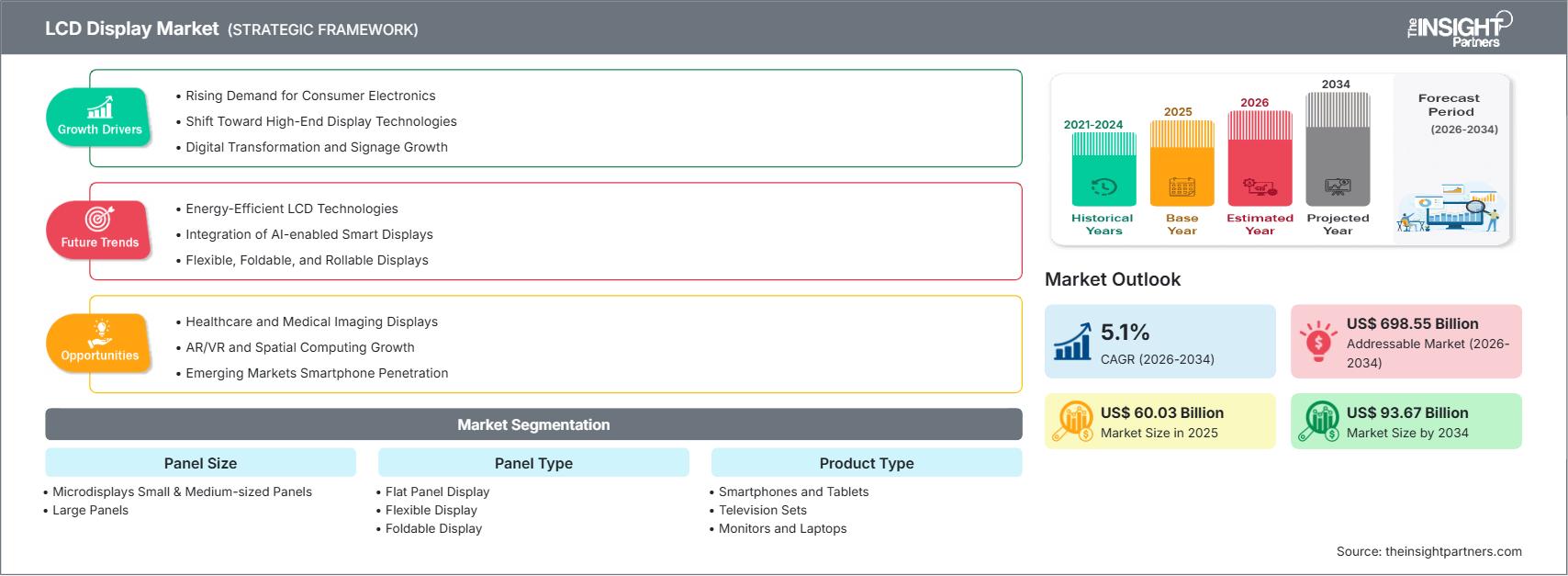
LCD Display Market was valued at US$59.95 billion in 2025 and is projected to reach US$93.49 billion by 2034, expanding at a CAGR of 5.1% during 2026–2034. The market covers LCD panels and display modules used across consumer electronics, automotive systems, retail, healthcare, education, entertainment, BFSI, aerospace and defense, and other applications. Growth is supported by expanding screen integration, larger display formats, automotive cockpit digitization, replacement demand, and continuous improvements in display performance and manufacturing efficiency.
Asia Pacific is expected to remain a significant demand center, supported by high penetration of televisions, monitors, laptops, connected vehicles, digital signage, and professional visualization systems. The regional market is projected to grow at a CAGR of 6.6% during 2026–2034. Automotive display integration, commercial display modernization, healthcare visualization, and replacement of installed screens are expected to provide sustained demand across the region.
LCD Display Market Assessment and Insights
- North America: North America accounted for 28.89% share in 2025 and is projected to grow at a CAGR of 4.3% between 2026–2034. Demand is supported by automotive displays, televisions, monitors, digital signage, healthcare systems, and enterprise visualization.
- US: The US represented 86% of North American demand in 2025 and is expected to grow at a CAGR of 4.4% during 2026–2034, supported by consumer electronics, automotive interfaces, commercial visualization, and technology-intensive applications.
- Europe: Europe represented 22.22% share in 2025 and is expected to expand at a CAGR of 3.8% during 2026–2034. Germany, the UK, France, Italy, and Spain remain key markets, with automotive, retail, industrial, and professional display demand supporting expansion.
- Asia Pacific: Asia Pacific accounted for 40.00% share in 2025 and is projected to record a CAGR of 6.6% during 2026–2034. China, Japan, South Korea, India, and Taiwan provide strong electronics manufacturing and downstream consumption ecosystems.
- Largest Segment: Large Panels held a 49% market share in 2025 and is expected to grow at a CAGR of 4.1% during 2026–2034, supported by televisions, monitors, commercial displays, and large-format applications.
- High Growth Segment: Television accounted for a 14.8% market share in 2025 and is expected to expand at a CAGR of 6.2% during 2026–2034, driven by larger screens and premium viewing requirements.
- Key companies analyzed in detail: Samsung Electronics Co., Ltd.; BOE Technology Group Co., Ltd.; LG Electronics Inc.; TCL Technology Group Corporation; SHARP CORPORATION; Panasonic Holdings Corporation; AUO Corporation; Everdisplay Optronics (Shanghai) Co., Ltd.; Innolux Corporation; Truly International Holdings Limited.
Source: The Insight Partners' analysis based on proprietary research, government publications, company annual reports, investor presentations, industry databases, and expert interviews.
LCD Display Market has evolved from a television and desktop-oriented category into a diversified display ecosystem serving consumer, automotive, commercial, industrial, and specialty applications. Production has increasingly concentrated in Asia, where panel manufacturers benefit from integrated component supply chains and large-scale fabrication. At the product level, improvements in resolution, refresh rate, brightness, energy efficiency, thinness, and backlighting have expanded the functionality of mature LCD architectures across multiple end-use categories.
The outlook remains favorable as display integration expands across vehicles, retail environments, healthcare facilities, entertainment venues, and connected consumer products. Capacity management, manufacturing localization, automotive electronics investment, and demand for larger television formats will shape supplier strategies through 2034. Regulatory emphasis on energy efficiency and electronic-product sustainability is also encouraging manufacturers to improve power performance and product lifecycles.
LCD Display Market Report Scope
| Report Attribute | Details |
|---|---|
| Market size in 2025 | US$ 59.95 Billion |
| Market Size by 2034 | US$ 93.49 Billion |
| Global CAGR (2026 - 2034) | 5.1% |
| Historical Data | 2021-2024 |
| Forecast period | 2026-2034 |
LCD Display Market Analysis
The demand for LCD panels remains driven by the combination of manufacturing maturity, competitive economics, availability of sizes, and compatibility with existing electronic systems. The diverse range of applications that require panels includes televisions, smartphones, tablets, monitors, laptops, automotive displays, and commercial screens. The value chain covers components such as glass substrates, thin-film transistor arrays, color filters, liquid-crystal materials, backlights, driver ICs, and polarizers.
The supply side depends on the utilization of production facilities, generation size, glass productivity, material prices, and panels' prices. Manufacturers from Asia have an important competitive advantage based on existing ecosystem of components and high volumes of fabrication. The suppliers control their capacity based on demand for application segments and try to avoid oversupply of panels while achieving higher yields. There are also opportunities for automotive and commercial applications that have some differentiation potential based on more stringent requirements, more customized designs, and longer lifecycles.
Positioning in the LCD Display Market is driven by the manufacturing scale, innovation capabilities, customer relations, and specializations. Samsung Electronics Co., Ltd., BOE Technology Group Co., Ltd., LG Electronics Inc., TCL Technology Group Corporation, and AUO Corporation occupy relevant positions at various segments of the display industry. Innolux Corporation, SHARP CORPORATION, Panasonic Holdings Corporation, Everdisplay Optronics (Shanghai) Co., Ltd., and Truly International Holdings Limited play a part in some consumer, automotive, industrial, and specialty applications.
The investment strategies are oriented towards the differentiation and efficiency rather than unlimited capacity expansions. In addition to LCD technology, TCL Technology Group Corporation is investing into OLED and Mini-LED developments. The Chinese manufacturers are developing vertical integration and manufacturing scale. The Korean, Japanese, and Taiwanese suppliers focus on premium applications and automotive systems, professional displays, and other technologies with better differentiation potential.
● REPORT CUSTOMIZATION
Tailor This Report To Align With Your Specific Business Requirements
This report can be customized to align precisely with your business objectives, scope, and target markets. Customization options include tailored segmentation, geography, competitive analysis, and strategic insights to support informed decision-making.
Customize This Report →WHAT YOU CAN ADJUST
- ● Segmentations
- ● Geography
- ● Competitive Analysis
- ● Language Preferences
LCD Display Market: Strategic Insights
Regional Insights
North America LCD Display Market
North America accounted for 28.89% of LCD Display Market share in 2025 and is projected to expand at a CAGR of 4.3% during 2026–2034. The US represents the dominant regional market, while Canada and Mexico contribute through consumer electronics, automotive production, commercial infrastructure, and retail applications. Strong installed bases of televisions, monitors, laptops, and professional displays support recurring replacement demand.
Automotive cockpit digitization is becoming increasingly important as vehicles incorporate larger infotainment screens, digital instrument clusters, passenger displays, and connected interfaces. Retailers, healthcare providers, enterprises, and entertainment venues are also modernizing visualization infrastructure. Demand increasingly emphasizes brightness, energy efficiency, reliability, resolution, and lifecycle support, creating opportunities for suppliers that can address application-specific requirements rather than competing only through panel pricing.
U.S. LCD Display Market Market
The US represented 86% of North American LCD Display Market demand in 2025 and is expected to grow at a CAGR of 4.4% during 2026–2034. The country therefore remains the primary contributor to regional consumption. Consumer electronics, automotive systems, enterprise monitors, digital signage, healthcare visualization, and entertainment infrastructure form the principal demand areas.
Major global display suppliers maintain commercial and customer relationships across the US market, including Samsung Electronics Co., Ltd., LG Electronics Inc., Panasonic Holdings Corporation, and other international manufacturers. Application trends increasingly favor larger television screens, high-performance monitors, connected vehicle interfaces, and commercial visualization systems.
Europe LCD Display Market Market
Europe represented 22.22% of LCD Display Market share in 2025 and is projected to grow at a CAGR of 3.8% through 2034. Germany is the leading country, supported by automotive manufacturing, industrial technology, and professional visualization. The UK and France maintain significant demand across retail, healthcare, education, enterprise, entertainment, and commercial infrastructure.
Germany's automotive ecosystem supports sustained requirements for cockpit displays, instrument clusters, passenger interfaces, and connected vehicle systems. The UK and France show substantial adoption of commercial screens and digital signage, while Italy and Spain benefit from hospitality, tourism, retail modernization, and transportation investment. European purchasing decisions increasingly incorporate energy efficiency, durability, recyclability, compliance, and total cost of ownership alongside display performance and acquisition price.
APAC LCD Display Market Market
Asia Pacific represented 40.00% of LCD Display Market share in 2025 and is expected to register the fastest regional CAGR of 6.6% during 2026–2034. China remains the leading manufacturing and consumption center, while Japan, South Korea, Taiwan, India, and Australia contribute through varying combinations of production, technology development, downstream demand, and electronics manufacturing.
China benefits from extensive panel fabrication and component ecosystems, while Japan and South Korea retain strong display engineering capabilities. India is expanding electronics manufacturing capacity and domestic consumption, creating longer-term opportunities for display integration. Automotive electronics, televisions, smartphones, monitors, and commercial screens remain important demand areas.
Middle East & Africa LCD Display Market Market
Middle East and Africa is expected to grow at a CAGR of 3.6% during 2026–2034. Saudi Arabia and the UAE lead regional demand through smart infrastructure, hospitality, retail, entertainment, transportation, and large-scale development projects. South Africa remains an important market in the region, supported by commercial, education, healthcare, and consumer applications.
Demand is increasingly connected to infrastructure digitization and large-format visualization. Public facilities, retail environments, command centers, hotels, transportation facilities, and entertainment venues require reliable displays with high brightness and extended operating capabilities. Saudi development programs and UAE investment in tourism and commercial infrastructure provide structural support, while wider regional modernization increases opportunities for digital signage and professional display deployment.
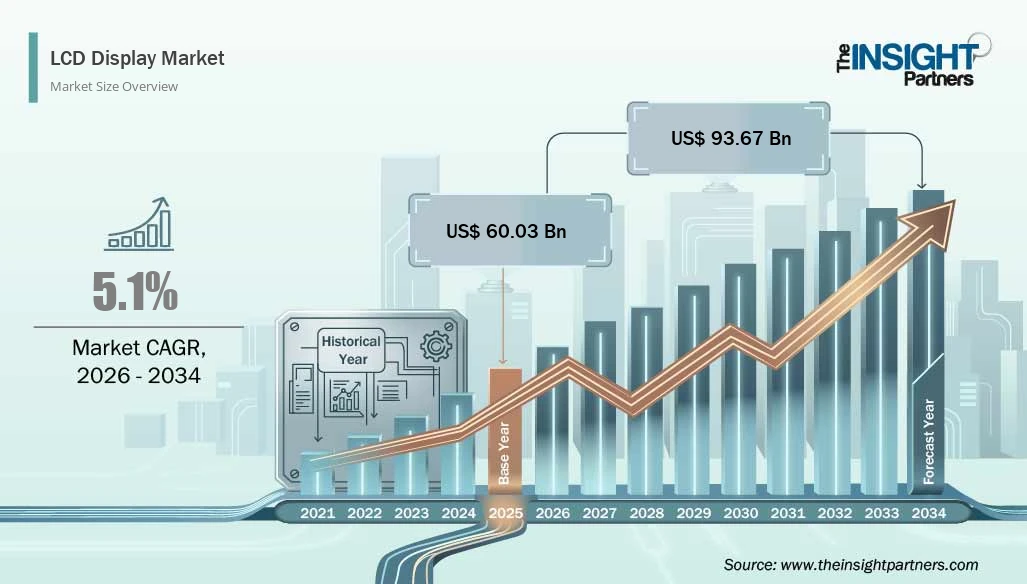
Segmentation Analysis
Panel Size
Panel Size comprises Microdisplays, Small & Medium-sized Panels, and Large Panels. Large Panels represent the largest category, supported by television, monitor, digital signage, and large-format display demand. The overall segment is projected to grow at a CAGR of 7.0% during 2026–2034.
- Microdisplays: Microdisplays serve compact optical and near-eye applications where high pixel density, low power consumption, and small physical dimensions are important. They support specialized imaging, wearable, viewfinder, and visualization requirements.
- Small & Medium-sized Panels: Small and medium-sized panels serve portable electronics, automotive interfaces, industrial equipment, tablets, and selected consumer devices. Their strategic importance reflects widespread embedded display requirements and compact product designs.
- Large Panels: Large panels support televisions, monitors, digital signage, and large-format systems. Their importance is reinforced by established fabrication infrastructure, strong consumer preference for larger viewing areas, and broad commercial deployment.
Panel Type
Panel Type includes Flat Panel Display, Flexible Display, Foldable Display, Curved Display, and Others. The segment is characterized by the continuing dominance of established flat-panel configurations alongside specialized form factors. The Panel Type segment is projected to expand at a CAGR of 4.5–5.2% during 2026–2034.
- Flat Panel Display: Flat panels remain the mainstream configuration across televisions, monitors, laptops, automotive systems, and commercial displays because mature production supports broad availability and predictable integration.
- Flexible Display: Flexible displays enable conformable and curved product designs, creating opportunities where mechanical adaptability, lightweight construction, and differentiated industrial design influence purchasing decisions.
- Foldable Display: Foldable configurations support compact device architectures and specialized interfaces, with strategic relevance linked to space efficiency, premium product differentiation, and evolving device form factors.
- Curved Display: Curved displays remain relevant in selected televisions, gaming monitors, and professional visualization systems where immersive viewing, ergonomic positioning, and differentiated design are valued.
Product Type
Product Type includes Smartphones and Tablets, Television Sets, Monitors and Laptops, Digital Signage and Large Format Displays, Automotive Displays, Wearables, and Others. The segment is expected to grow at a CAGR of 4.5–5.5% during 2026–2034.
- Smartphones and Tablets: Smartphones and tablets require compact, high-resolution, energy-efficient displays and remain important volume applications, although premium devices increasingly use alternative display technologies.
- Television Sets: Television Sets remain a major LCD application because mature manufacturing, extensive size availability, and competitive panel economics support broad adoption across mainstream and large-screen categories.
- Monitors and Laptops: Monitors and laptops require high resolution, refresh performance, color accuracy, and energy efficiency, with gaming, professional computing, and hybrid work supporting product differentiation.
- Digital Signage and Large Format Displays: Digital signage and large-format displays support advertising, wayfinding, customer communication, and information delivery across retail, transportation, hospitality, education, and corporate environments.
- Automotive Displays: Automotive displays are gaining strategic importance as vehicles adopt larger infotainment screens, digital clusters, passenger displays, and integrated cockpit interfaces.
- Wearables: Wearables require compact dimensions, low power consumption, outdoor readability, and mechanical resilience, supporting specialized display requirements in connected watches, fitness devices, and related products.
Industry Vertical
Industry Vertical comprises Consumer Electronics, Automotive, Sports and Entertainment, Retail, BFSI, Education, Healthcare, Aerospace and Defense, and Others. The segment is projected to grow at a CAGR of 4.8–5.5% during 2026–2034.
- Consumer Electronics: Consumer electronics provides broad demand across televisions, monitors, personal devices, and connected products, with pricing, visual performance, energy efficiency, and industrial design shaping procurement.
- Automotive: Automotive applications prioritize environmental durability, readability, reliability, integration, and long service life, resulting in demanding qualification requirements and longer product development cycles.
- Sports and Entertainment: Sports and entertainment venues use displays for audience engagement, advertising, information, broadcasting, and immersive experiences, supporting large-format and high-brightness deployments.
- Retail: Retailers use digital displays for promotions, product information, navigation, advertising, and interactive experiences, encouraging replacement of conventional static signage.
- BFSI: BFSI organizations deploy displays across branches, customer-service areas, corporate offices, and operational environments, emphasizing reliability, visibility, security, and extended operating cycles.
- Education: Education applications include classroom displays, monitors, interactive systems, and campus signage, supporting digital teaching, collaboration, communication, and administrative functions.
- Healthcare: Healthcare applications require dependable visualization, appropriate brightness and contrast, reliability, and long operating life across clinical, patient-information, monitoring, and administrative environments.
- Aerospace and Defense: Aerospace and defense applications require ruggedized displays capable of operating under demanding environmental conditions, with readability, reliability, customization, and lifecycle support influencing procurement.
Opportunity Snapshot
| Industry Vertical | Revenue Contribution (High/Medium/Low) | Trend Tag | Adoption Stage |
| Consumer Electronics | High | Large Screens | Mature |
| Automotive | Medium | Cockpit Digitization | Scaling |
| Sports and Entertainment | Medium | Venue Visualization | Scaling |
| Retail | Medium | Digital Signage | Scaling |
| BFSI | Low | Branch Modernization | Mature |
| Education | Medium | Interactive Learning | Scaling |
| Healthcare | Medium | Clinical Visualization | Scaling |
| Aerospace and Defense | Low | Rugged Displays | Mature |
LCD Display Market Growth Drivers and Impact Analysis
Expansion of Large-Screen Television Adoption
Televisions will continue to be an important source of demand due to consumers' preference for larger screens, better resolution, contrast, and connectivity. The move towards larger screens means that there will always be greater needs for larger panel areas, even in cases where growth in units is not high. It means that panel companies can make their panels more valuable by migrating to larger screen sizes, offering premium features, and better backlights without necessarily increasing the number of shipments. LCD technology is especially important in the mass market and large screen segment due to its maturity in fabrication, wide supplier base, and low cost of production. The replacement cycle at retail and upgrades at home offer continuous demand.
Accelerating Automotive Display Integration
Automotive display integration applications have widened the use of panels from being a component used in consumer electronics only to include automotive applications such as digital instrument clusters, infotainment interfaces, passenger displays, rear seat displays and connected cockpits. It means that each platform may have several panels of various sizes and specifications and different operating environments. The automotive business cycle is characterized by a longer qualification and validation process and thus reliability and product life cycle management is an important competitive advantage. This is because suppliers will need to deal with issues like temperature range, vibration performance, optical performance, touch screen capabilities and product availability.
Expansion of Digital Signage and Commercial Visualization
Digital signage is growing in retail, transportation, hospitality, education, health care, entertainment, and corporate environments. Organizations are making use of connected displays for advertising, way-finding, operational information, customer communications, and dynamic content management. LCD is still relevant since large-format displays have established manufacturing processes and an extensive system integrator base. The need for high brightness, operating hours, remote management, and durability will increasingly define commercial purchase decisions. Retail establishments are able to update promotional information, whereas transportation and public facilities can distribute scheduling and operational information. Entertainments centers make use of large screens to increase audience interaction and advertising opportunities. This leads to an increased demand not just from purchases of panels but from installation, replacements, maintenance, and content management ecosystems.
LCD Display Market Future Trends
Advanced Backlighting and Premium LCD Architectures
Advanced backlighting such as that which uses Mini-LEDs is expected to bolster the premium status of LCD through the forecast period. The advanced backlighting will increase the local dimming capabilities and brightness and contrast of LCD allowing for high-end applications such as TVs, monitors, laptops, and some automotive products. Development in the future will most likely center on enhancing uniformity of light, minimizing component counts, optimizing power consumption, and streamlining assembly. As the technology matures, the backlighting technology can shift from its use in flagship products to premium product lines. This trend allows panel makers a route to upgrading their LCD technology while still utilizing existing manufacturing facilities.
Intelligent and Integrated Display Interfaces
Intelligent interfaces are becoming more common in displays by incorporating touch screens, cameras, sensors, connectivity, software, and context. Automotive dashboards are good examples of such transformation by integrating the navigation systems, controls of the vehicle, entertainment system, personalization features, and driving information. Some of these transformations are also taking place in retail stores, healthcare organizations, schools, and businesses where the display can be used to integrate with sensors and software platforms. Future products will be focused more on reducing power consumption, embedded sensors, enhanced touch functionalities, and modular architecture that makes integration easier. This evolution can affect the competition structure because specifications of the panel itself might not be enough for differentiation.
LCD Display Market Opportunities
Localization and Diversification of Display Supply Chains
Localizing the supply chain allows for assembling of panel modules, manufacturing of components, testing, repairing, integrating and regional distribution. There is growing interest from electronics manufacturers and governments in addressing the problem of excess dependency on centralized production facilities which encourages the expansion of more capabilities within the emerging manufacturing hubs. In particular, India is a case in point since the expansion of electronics production and increased domestic consumption will help in generating downstream demand for the display modules. The same applies to Southeast Asia since there is room for diversifying assembly as well as regionalization of the supply chain. Investments need not necessarily involve the immediate establishment of big fabrication facilities but can be made through module integration, backlighting, driver electronics, testing, optical bonding, customizations and after-sales service provision.
Specialized Automotive and Professional Display Solutions
Applications such as automotive, healthcare, industrial, aerospace, defense, and other professional uses offer avenues for suppliers interested in moving up the value chain by occupying display positions. Such applications usually give more weight to factors such as reliability, customizability, qualification, environmentality, and longer availability than normal consumer electronics. Some of the requirements that could be demanded for an automotive display application include temperature range, optical bonding, sunlit visibility, vibration resistance, and longer period of manufacturing. Healthcare and visualization applications could require consistency of image properties and reliability, while aerospace and defense application could call for a ruggedized design and specialized interface.
Recent Developments
- August 2026: 3M and BOE today announced the opening of the 3M and BOE Joint Laboratory at the BOE Technology Innovation Center, expanding a more than 20-year collaboration to advance the future of display technology. The joint research and development platform brings together BOE’s display innovation and end-use application expertise with 3M’s materials science capabilities to accelerate higher-performance solutions across LCD, OLED and MLED applications.
- January 2026: TCL Technology Group Corporation - TCL CSOT continued advancing its display technology portfolio across LCD, OLED, and Mini-LED technologies, reflecting the company's strategy of maintaining LCD scale while expanding higher-value display architectures. Its technology development spans televisions, IT products, automotive applications, commercial displays, and specialty solutions, reinforcing diversification beyond conventional LCD panel applications.
- June 2025: Samsung Electronics, the Official Art TV of Art Basel, today announced the launch of the Art Basel in Basel (ABB) Collection, an exclusive curation of digital art available across Samsung TVs with Samsung Art Store.1 Representing the most extensive Art Basel collection to date, the ABB Collection introduces 38 curated works from globally renowned artists.
Frequently Asked Questions

- Comprehensive Market Sizing and Forecast Analysis
- Detailed Segmentation Analysis
- In-Depth Market Dynamics Assessment
- Regional and Country-Level Insights
- Competitive Landscape and Company Benchmarking
- Strategic Business Intelligence
Recent Reports
Testimonials

The Insight Partners provided valuable market intelligence that supported our global go-to-market strategy. Their team was professional, responsive, and attentive to our feedback, providing thoughtful analysis and helpful methodological clarifications throughout the project.
Junmo Kim Chief Financial Officer (CFO), Enertech Co., Ltd.
The Insight Partners' SCADA System Market report is comprehensive, with valuable insights on current trends and future forecasts. The team was highly professional, responsive, and supportive throughout. We are very satisfied and highly recommend their services.
RAN KEDEM Partner, Reali Technologies LTDs
I requested a report on a very specific software market and the team produced the report in a few days. The information was very relevant and well presented. I then requested some changes and additions to the report. The team was again very responsive and I got the final report in less than a week.
JEAN-HERVE JENN Chairman, Future Analytica
We worked with The Insight Partners for an important market study and forecast. They gave us clear insights into opportunities and risks, which helped shape our plans. Their research was easy to use and based on solid data. It helped us make smart, confident decisions. We highly recommend them.
PIYUSH NAGPAL Sr. Vice President, High Beam Global
The Insight Partners delivered insightful, well-structured market research with strong domain expertise. Their team was professional and responsive throughout. The user-friendly website made accessing industry reports seamless. We highly recommend them for reliable, high-quality research services
YUKIHIKO ADACHI CEO, Deep Blue, LLC.
This is the first time I have purchased a market report from The Insight Partners.While I was unsure at first, I visited their web site and felt more comfortable to take the risk and purchase a market report.I am completely satisfied with the quality of the report and customer service. I had several questions and comments with the initial report, but after a couple of dialogs over email with their analyst I believe I have a report that I can use as input to our strategic planning process.Thank you so much for taking the extra time and making this a positive experience.I will definitely recommend your service to others and you will be my first call when we need further market data.
JOHN SUZUKI President and Chief Executive Officer, Board Director, BK Technologies
I wish to appreciate your support and the professionalism you displayed in the course of attending to my request for information regarding to infectious disease IVD market in Nigeria. I appreciate your patience, your guidance, and the fact that you were willing to offer a discount, which eventually made it possible for us to close a deal. I look forward to engaging The Insight Partners in the future, all thanks to the impression you have created in me as a result of this first encounter.
DR CHIJIOKE ONYIA MANAGING DIRECTOR, PineCrest Healthcare Ltd.Reason to Buy
- Informed Decision-Making
- Understanding Market Dynamics
- Competitive Analysis
- Identifying Emerging Markets
- Customer Insights
- Market Forecasts
- Risk Mitigation
- Boosting Operational Efficiency
- Strategic Planning
- Investment Justification
- Tracking Industry Innovations
- Aligning with Regulatory Trends





 Get Free Sample for