
Fixed Air Quality Monitoring System Market Trends, Demand & Growth by 2034
Coverage: By Component (Hardware, Software, and Services), Product Type (Outdoor and Indoor), Sampling Method (Active Monitoring Systems, Passive Monitoring, Manual Monitoring, and Others), End User Industry (Government and Regulatory Bodies, Industrial and Manufacturing Sector, Commercial and Institutional Buildings, Residential Users, and Environmental Research and Academia), and Geography (North America, Europe, Asia Pacific, Middle East and Africa, and South and Central America)
- Status : Published
- Report Code : TIPRE00043822
- Category : Electronics and Semiconductor
- No. of Pages : 331
- Available Report Formats :


- Last update date : September 02, 2026


2025 Market Size
US$ 4,779.53 Mn
Base year value
2034 Forecast
US$ 9,110.02 Mn
Projected by 2034
CAGR 2026-2034
7.4 %
Growth rate
Addressable Market
US$ 62,517.49 Mn
(2026-2034)
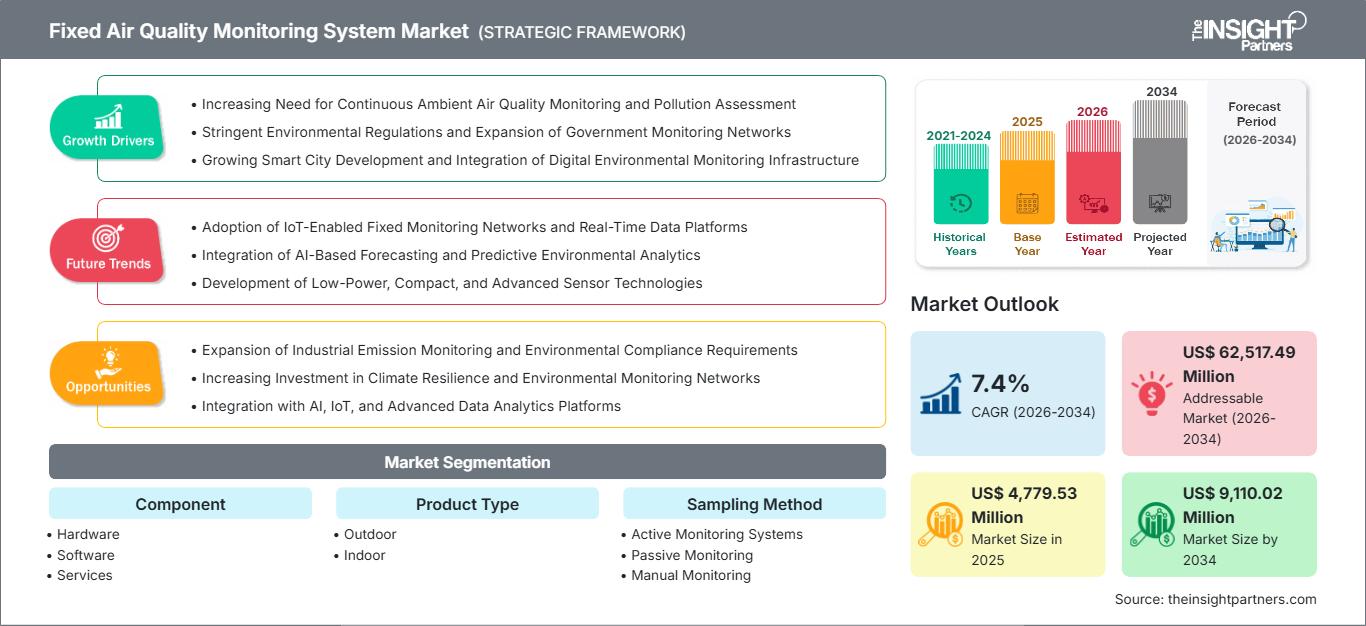
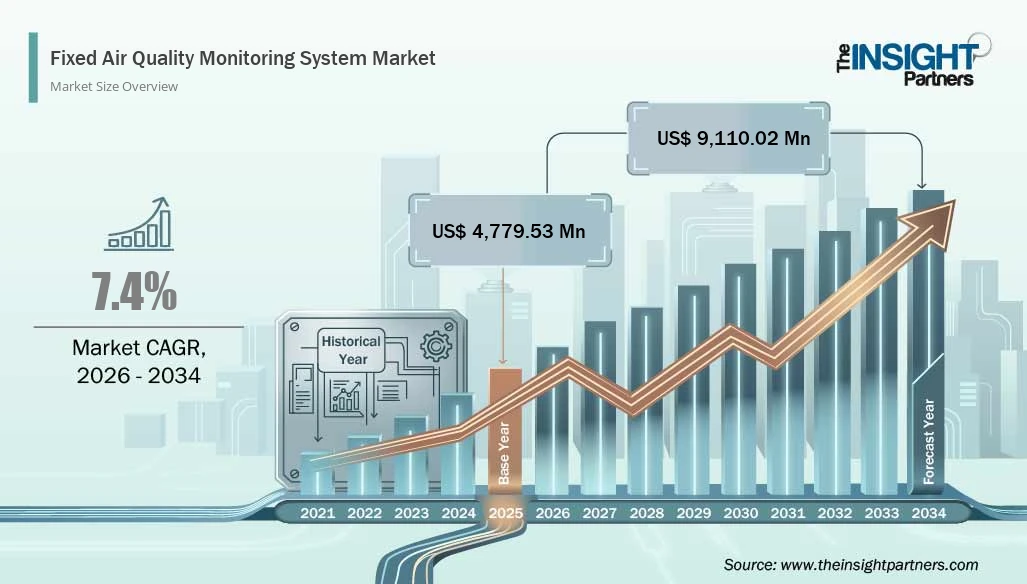
Fixed Air Quality Monitoring System Market is positioned for sustained expansion as regulatory agencies, industrial operators, municipalities, and building owners increase investment in continuous pollution measurement. The market is valued at US$ 4,779.53 Million in 2025 and is projected to reach US$ 9,110.02 Million by 2034, registering a CAGR of 7.4% during 2026–2034. Demand is being shaped by tighter emissions oversight, expanding sensor networks, and the integration of monitoring with digital environmental-management platforms.
North America remains a technically mature arena, with the Fixed Air Quality Monitoring System Market expected to advance at an estimated 7.8–8.2% CAGR through 2034. Replacement of aging regulatory equipment, community-scale monitoring initiatives, and stronger industrial emissions oversight are supporting demand, while connected sensors are extending monitoring coverage across transportation corridors, industrial zones, and commercial facilities.
Fixed Air Quality Monitoring System Market Assessment and Insights
- North America: North America represented a 27.6% share in 2025 and is projected to grow at a 8.0% CAGR between 2026–2034. Mature regulatory infrastructure, industrial compliance programs, and network modernization support recurring equipment demand.
- US: The US accounted for 60.4% of North America’s 2025 share and is expected to expand at a 8.6% CAGR between 2026–2034, supported by federal, state, and community monitoring programs.
- Europe: Europe held a 43.2% share in 2025 and is forecast to grow at a 8.7% CAGR between 2026–2034. Germany, the UK, France, Italy, and Spain remain important markets as air-quality requirements become more comprehensive.
- Asia Pacific: Asia Pacific captured a 19.4% share in 2025 and is estimated to register an 5.7% CAGR between 2026–2034. China, Japan, India, South Korea, and Australia are driving deployment through urbanization, industrialization, and environmental programs.
- Largest Segment: Outdoor product systems held a 75.4% market share in 2025 and are expected to grow at a 7.7% CAGR during 2026–2034, reflecting regulatory and ambient monitoring requirements.
- High Growth Segment: Active Monitoring Systems are estimated at a 59.3% market share in 2025 and are projected to grow at an 8.1% CAGR during 2026–2034, benefiting from continuous measurement requirements.
- Key companies analyzed in detail: Agilent Technologies, Inc.; Emerson Electric Co.; Thermo Fisher Scientific Inc.; Siemens AG; Teledyne Technologies Incorporated; Honeywell International Inc.; HORIBA, Ltd.; 3M Company; Testo SE & Co. KGaA; Aeroqual Limited.
Source: The Insight Partners' analysis based on proprietary research, government publications, company annual reports, investor presentations, industry databases, and expert interviews.
Fixed Air Quality Monitoring System Market has evolved from isolated reference-grade stations toward interconnected monitoring architectures combining analyzers, telemetry, calibration equipment, data-management software, and remote diagnostics. Optical particulate measurement, electrochemical sensing, automated gas analysis, and compact communications modules are broadening deployment options. Manufacturing has consequently shifted toward modular assemblies that can be configured for pollutant portfolios, climatic conditions, communications protocols, and regulatory requirements.
Over the forecast period, procurement is likely to extend into secondary cities, industrial corridors, ports, and enclosed public environments. Public funding for environmental infrastructure, stricter emissions reporting, and increased interest in localized exposure data should support deployment. Investment priorities are also moving toward interoperability, cybersecurity, automated calibration workflows, and cloud-enabled visualization, allowing operators to manage geographically distributed instruments without proportionately increasing field personnel requirements.
Fixed Air Quality Monitoring System Market Report Scope
| Report Attribute | Details |
|---|---|
| Market size in 2025 | US$ 4,779.53 Million |
| Market Size by 2034 | US$ 9,110.02 Million |
| Global CAGR (2026 - 2034) | 7.4% |
| Historical Data | 2021-2024 |
| Forecast period | 2026-2034 |
Fixed Air Quality Monitoring System Market Analysis
Demand is increasingly influenced by the need for continuous, defensible measurements rather than periodic sampling. The Fixed Air Quality Monitoring System Market growth reflects expanding requirements for particulate matter, nitrogen oxides, sulfur dioxide, ozone, carbon monoxide, and volatile organic compounds across regulated and supplemental networks. Equipment suppliers operate within an ecosystem involving sensor manufacturers, analyzer specialists, enclosure providers, calibration-gas suppliers, communications vendors, system integrators, environmental consultants, and public authorities.
The supply chain remains technology intensive because reference and equivalent methods require controlled sampling, calibration, data validation, and environmental protection. Low-cost sensors are expanding spatial coverage, but regulatory-grade installations still require stronger metrological performance and documented quality assurance. This creates a layered market in which compact devices supplement established stations rather than fully replacing them, particularly where compliance decisions depend on traceable measurements.
Fixed Air Quality Monitoring System Market analysis indicates competition is increasingly based on measurement breadth, reliability, integration capability, service coverage, and software functionality rather than analyzer hardware alone. Agilent Technologies, Inc., Thermo Fisher Scientific Inc., HORIBA, Ltd., and Teledyne Technologies Incorporated bring strong analytical and instrumentation capabilities, while Siemens AG, Honeywell International Inc., and Emerson Electric Co. can connect environmental measurements with broader automation and control ecosystems.
Strategic investment is moving toward multi-parameter platforms, remote diagnostics, data interoperability, and recurring service models. 3M Company and Testo SE & Co. KGaA participate through sensing and measurement capabilities, while Aeroqual Limited addresses compact monitoring requirements. Procurement decisions increasingly evaluate lifecycle cost, calibration intervals, network compatibility, data ownership, and technical support, making software and services important differentiators alongside analyzer specifications.
● REPORT CUSTOMIZATION
Tailor This Report To Align With Your Specific Business Requirements
This report can be customized to align precisely with your business objectives, scope, and target markets. Customization options include tailored segmentation, geography, competitive analysis, and strategic insights to support informed decision-making.
Customize This Report →WHAT YOU CAN ADJUST
- ● Segmentations
- ● Geography
- ● Competitive Analysis
- ● Language Preferences
Fixed Air Quality Monitoring System Market: Strategic Insights
Regional Insights
North America Fixed Air Quality Monitoring System Market
North America accounted for a 27.6% share in 2025 and is expected to record a 8.0% CAGR through 2034. The region benefits from established ambient monitoring networks, mature industrial permitting frameworks, and substantial demand for particulate and gaseous pollutant measurement. The US represents the principal market, while Canada contributes through municipal, industrial, transportation, and environmental research applications.
Regional demand is also supported by interest in supplemental monitoring around ports, highways, communities, and industrial facilities. The US Environmental Protection Agency continues to evaluate emerging sensor technologies and their suitability for non-regulatory applications, encouraging more granular data collection. Replacement cycles for aging reference equipment, integration with centralized databases, and requirements for reliable field calibration should sustain spending across public and private monitoring networks.
U.S. Fixed Air Quality Monitoring System Market
The US represented 60.4% of North America’s 2025 market share and is projected to grow at a 8.6% CAGR through 2034. Demand spans federal and state agencies, municipalities, refineries, utilities, manufacturing facilities, universities, and community monitoring initiatives. Procurement commonly emphasizes compliance capability, data integrity, remote communications, and documented performance.
Company presence is broad, with Agilent Technologies, Inc., Thermo Fisher Scientific Inc., Honeywell International Inc., Emerson Electric Co., Teledyne Technologies Incorporated, and 3M Company serving different portions of the monitoring ecosystem. Applications are expanding from fixed regulatory stations toward fence-line monitoring, industrial hotspot assessment, environmental research, and indoor environmental management. The resulting purchasing pattern favors systems that combine accurate analyzers with scalable data infrastructure.
Europe Fixed Air Quality Monitoring System Market
Europe held a 43.2% share in 2025 and is expected to register a 6.9% CAGR through 2034, with Germany representing a leading national market. Policy emphasis on pollutant reduction, urban exposure assessment, industrial emissions control, and transparent environmental information supports investment in fixed monitoring infrastructure across major economies.
The UK maintains demand through established regulatory monitoring and local authority networks, while Germany combines industrial compliance requirements with extensive municipal monitoring. France, Italy, and Spain are important markets where traffic emissions, urban density, industrial activity, and seasonal pollution episodes sustain measurement requirements. Across the region, procurement is increasingly attentive to automated data validation, interoperability, and network modernization as regulatory frameworks become more demanding.
APAC Fixed Air Quality Monitoring System Market
Asia Pacific held a 19.4% share in 2025 and is forecast to grow at an 8.7% CAGR through 2034, making it the fastest-growing major region. China leads regional deployment, followed by Japan, South Korea, India, and Australia. Industrial expansion, urban air-quality programs, and infrastructure investment underpin demand.
China combines large monitoring networks with industrial emissions management, while India is expanding measurement capacity in polluted urban areas. Japan and South Korea emphasize advanced instrumentation and industrial control, while Australia supports monitoring across urban and resource-intensive environments. Policy-led environmental programs and increasing use of connected measurement platforms should support broader deployment.
Middle East & Africa Fixed Air Quality Monitoring System Market
Middle East and Africa demand is projected at a 5.7% CAGR through 2034. Saudi Arabia is a leading regional market, supported by urban development, energy infrastructure, and environmental modernization. The UAE is investing in smart-city and sustainability infrastructure, while South Africa has established industrial and municipal monitoring requirements.
Across the rest of MEA, monitoring demand is linked to power generation, oil and gas operations, mining, transportation, and rapidly developing urban centers. Harsh climates increase requirements for robust enclosures, stable calibration, and dependable remote communications. New infrastructure projects provide opportunities to incorporate fixed monitoring during initial design rather than through later retrofit programs.
Segmentation Analysis
Component
The Component segment is expected to expand at a 7.8% CAGR from 2026–2034. Hardware remains essential for measurement, while software and services are gaining strategic importance as networks become larger and more distributed. Fixed Air Quality Monitoring System Market scope increasingly includes lifecycle management, remote diagnostics, analytics, calibration, and data integration.
- Hardware: Hardware remains the foundation of fixed monitoring deployments, encompassing analyzers, sensors, sampling systems, controllers, communication modules, and environmental protection assemblies. Demand favors ruggedized, serviceable equipment.
- Software: Software supports data acquisition, visualization, validation, alarms, reporting, and network administration. Its strategic role increases as operators consolidate measurements from heterogeneous instruments.
- Services: Services cover installation, commissioning, calibration, maintenance, validation, and technical support. Recurring service requirements help preserve measurement quality and reduce operational interruptions.
Product Type
The Product Type segment is projected to register a 7.7% CAGR during 2026–2034. Outdoor systems retain the larger position because ambient monitoring remains central to regulatory programs, while indoor installations gain relevance in workplaces, public buildings, laboratories, and controlled environments.
- Outdoor: Outdoor systems address ambient pollution, industrial perimeter monitoring, transportation corridors, and municipal networks. Their strategic importance stems from exposure assessment and regulatory reporting requirements.
- Indoor: Indoor systems measure pollutants and environmental conditions within buildings, laboratories, industrial spaces, and public facilities. Demand is strengthened by ventilation management and occupant-exposure considerations.
Sampling Method
The Sampling Method segment is estimated to grow at a 8.1 % CAGR between 2026–2034. Continuous automated measurement is gaining strategic importance because it captures temporal variations and supports faster response, while passive and manual approaches remain relevant for specific study designs and cost-sensitive deployments.
- Active Monitoring Systems: Active systems continuously or routinely draw air through controlled sampling paths, supporting accurate pollutant measurement and dependable temporal profiles for regulatory and industrial applications.
- Passive Monitoring: Passive approaches rely on diffusion or accumulation over defined periods, providing useful spatial information where continuous instrumentation is unnecessary or operational complexity must remain limited.
- Manual Monitoring: Manual methods remain relevant for reference sampling, validation studies, research, and locations where automated equipment is impractical. Their value is linked to methodological comparability.
- Others: Other approaches address specialized sampling configurations and emerging measurement architectures, providing flexibility for applications requiring unusual deployment conditions or combinations of monitoring technologies.
End User Industry
The End User Industry segment is expected to advance at a 8.7% CAGR during 2026–2034. Government and industrial users remain core purchasers, while commercial buildings, residential applications, and research organizations broaden demand for localized monitoring and actionable environmental information.
- Government and Regulatory Bodies: These users require defensible measurements for standards, permitting, public reporting, network management, and environmental planning, making reliability and traceability central procurement criteria.
- Industrial and Manufacturing Sector: Industrial operators deploy monitoring for emissions management, worker protection, process oversight, and community relations, with system selection influenced by pollutant mix and operating conditions.
- Commercial and Institutional Buildings: Offices, campuses, hospitals, and public facilities increasingly require indoor environmental visibility, encouraging integration between monitoring platforms, ventilation systems, and building management software.
- Residential Users: Residential deployment remains comparatively specialized, focused on exposure awareness, building diagnostics, and localized pollution assessment rather than formal regulatory compliance.
- Environmental Research and Academia: Researchers use fixed systems to generate longitudinal datasets, validate emerging sensors, study pollutant behavior, and support atmospheric modeling across diverse environments.
Opportunity Snapshot
| End User Industry | Revenue Contribution (High/Medium/Low) | Trend Tag | Adoption Stage |
| Government and Regulatory Bodies | High | Network Expansion | Mature |
| Industrial and Manufacturing Sector | High | Fence Monitoring | Scaling |
| Commercial and Institutional Buildings | Medium | IAQ Integration | Scaling |
| Residential Users | Low | Exposure Mapping | Emerging |
| Environmental Research and Academia | Medium | Data Networks | Scaling |
Fixed Air Quality Monitoring System Market Growth Drivers and Impact Analysis
Stricter Environmental Compliance and Emissions Accountability
Regulatory tightening is increasing the operational value of continuous, auditable air-quality measurements. The World Health Organization reports that 99% of the global population lived in locations where its air-quality guideline levels were not met in 2019, underscoring the scale of exposure concerns. For industrial operators, stronger emissions accountability raises the importance of dependable fixed monitoring around plants, power facilities, ports, and transportation corridors. Procurement is consequently shifting toward systems with automated diagnostics, stable calibration, secure data transmission, and documented measurement performance. The commercial impact extends beyond initial equipment sales because regulated users require installation, verification, maintenance, calibration, and replacement services. This creates recurring revenue opportunities while raising technical barriers for suppliers that lack field-service infrastructure.
Expansion of Distributed and High-Resolution Monitoring Networks
Environmental authorities and industrial operators increasingly need information at finer geographic and temporal resolution than conventional sparse networks can provide. Fixed stations remain important, but supplemental monitoring is being deployed closer to roads, industrial boundaries, communities, and sensitive locations. The US Environmental Protection Agency recognizes that emerging air sensors can provide more localized and higher-time-resolution information, while also emphasizing data-quality evaluation. This dynamic creates demand for hybrid architectures that combine regulatory-grade analyzers with supplementary instruments and centralized software. Vendors able to support heterogeneous devices can capture larger network projects because buyers increasingly evaluate the entire monitoring architecture rather than individual instruments. The resulting market impact includes greater demand for communications infrastructure, data platforms, calibration services, and analytics alongside physical monitoring equipment.
Integration of Monitoring With Industrial and Building Control Systems
Air-quality measurements are increasingly becoming operational inputs rather than standalone environmental records. In industrial environments, pollutant readings can inform process adjustments, ventilation strategies, maintenance decisions, and incident response. In commercial buildings, indoor measurements can support demand-controlled ventilation and filtration management. Honeywell, for example, describes multi-parameter indoor sensing integrated with building management systems, illustrating how environmental data can feed control decisions. Similar integration opportunities exist across factories, laboratories, hospitals, campuses, and smart infrastructure. The market impact is a gradual shift in purchasing criteria toward open protocols, software compatibility, remote management, and actionable analytics. Suppliers that combine measurement hardware with integration capabilities can address higher-value projects where environmental monitoring becomes part of broader operational technology.
Fixed Air Quality Monitoring System Market Future Trends
AI-Assisted Interpretation and Predictive Environmental Intelligence
Future Fixed Air Quality Monitoring System Market trends are likely to center on software that interprets measurement streams rather than simply displaying pollutant concentrations. Machine learning models can identify anomalies, distinguish recurring pollution patterns, correlate measurements with meteorological conditions, and prioritize maintenance events. As networks become denser, automated quality checks will become increasingly important because manual review does not scale efficiently across numerous stations. Predictive functionality could also help operators anticipate exceedance conditions, optimize inspection schedules, and identify sensor drift before it compromises datasets. Integration with satellite observations, traffic information, weather models, and industrial process data should further improve contextual interpretation. The strongest solutions will therefore combine measurement integrity with transparent analytical workflows, allowing environmental specialists to understand why an alert or prediction was generated.
Autonomous Monitoring and Self-Diagnosing Station Architectures
The next generation of fixed stations is expected to incorporate greater autonomy in calibration management, fault detection, communications recovery, and component health assessment. Remote diagnostics can reduce unnecessary site visits, particularly where monitoring locations are geographically dispersed or difficult to access. Instrument designs will increasingly emphasize modular components that technicians can replace without extensive station downtime. Power-management improvements may also enable installations in locations where grid availability is limited, while robust communications architectures can maintain data transmission through multiple network pathways. Self-diagnosing systems should become particularly valuable for industrial fence-line networks and municipal deployments requiring high availability. Over time, buyers are likely to evaluate stations according to measurable uptime, maintenance burden, remote serviceability, and data continuity rather than analyzer specifications alone.
Fixed Air Quality Monitoring System Market Opportunities
Urban Monitoring Infrastructure Modernization
Urban modernization provides an attractive investment opportunity as municipalities seek more granular information about pollution across transport corridors, residential districts, commercial zones, and industrial interfaces. Investors and technology suppliers can target projects that combine fixed analyzers with compact supplemental sensors, communications gateways, centralized data platforms, and public dashboards. The most defensible opportunities are likely to emerge where monitoring is integrated with broader smart-city infrastructure, allowing environmental data to support transportation planning, public-health analysis, and emergency response. The Fixed Air Quality Monitoring System Market Forecasts therefore point toward platform-oriented procurement rather than isolated station purchases. Vendors can strengthen project economics by offering lifecycle maintenance, calibration, software subscriptions, and network optimization. Partnerships with engineering firms and municipal technology integrators can also shorten deployment cycles.
Industrial Compliance and Environmental Risk Management
Industrial facilities represent a substantial opportunity for suppliers able to address both compliance and operational risk. Refineries, chemical plants, cement facilities, mining operations, power stations, and manufacturing sites increasingly require localized monitoring near potential emission sources. Investment can focus on modular fence-line networks, multi-pollutant analyzers, automated alarms, remote diagnostics, and software that correlates environmental measurements with production conditions. These systems can create value by helping operators investigate abnormal events, document environmental performance, and prioritize maintenance. Suppliers should design offerings around pollutant-specific regulatory requirements and harsh operating environments rather than applying generic monitoring configurations. Long-term contracts covering calibration, replacement parts, data management, and technical verification can improve lifecycle economics while giving industrial customers predictable operating expenditure and stronger continuity of environmental records.
Recent Developments
- January 2025, WellStat, a US-based leader in energy management and air quality solutions, has acquired UK-based Iknaia Limited and its highly innovative Airscan product range. This acquisition enhances WellStat’s global reach and expands its integrated product portfolio, combining Iknaia’s indoor and outdoor air quality monitoring expertise with WellStat’s existing capabilities in air quality management, energy optimization and intelligent building management.
- August 2025: Emerson has announced the new PACSystems RX3i CPS400 Safety Controller, designed to enable Safety Integrity Level 2 (SIL2) strategies for infrastructure, fire and gas, burner management systems, and other emergency shutdown systems. The PACSystems Safety Controller is a compact, high-performance solution with robust security measures and a scalable architecture with 2,000 available I/O points, ideal for complex projects with evolving requirements
- October 2025, The Bangkok Metropolitan Administration (BMA) and IQAir signed a Memorandum of Understanding (MoU) to advance air quality initiatives in Bangkok. The signing ceremony, held at Bangkok City Hall, featured the Governor of Bangkok, H.E. Chadchart Sittipunt, Director-General of the BMA Environment Department, Mr. Prapas Lueangsirinapha, and IQAir Global CEO, Mr. Frank Hammes. This collaboration marks a major milestone in Bangkok’s efforts to address urban air pollution and protect public health.
Frequently Asked Questions

- Comprehensive Market Sizing and Forecast Analysis
- Detailed Segmentation Analysis
- In-Depth Market Dynamics Assessment
- Regional and Country-Level Insights
- Competitive Landscape and Company Benchmarking
- Strategic Business Intelligence
Recent Reports
Testimonials

The Insight Partners provided valuable market intelligence that supported our global go-to-market strategy. Their team was professional, responsive, and attentive to our feedback, providing thoughtful analysis and helpful methodological clarifications throughout the project.
Junmo Kim Chief Financial Officer (CFO), Enertech Co., Ltd.
The Insight Partners' SCADA System Market report is comprehensive, with valuable insights on current trends and future forecasts. The team was highly professional, responsive, and supportive throughout. We are very satisfied and highly recommend their services.
RAN KEDEM Partner, Reali Technologies LTDs
I requested a report on a very specific software market and the team produced the report in a few days. The information was very relevant and well presented. I then requested some changes and additions to the report. The team was again very responsive and I got the final report in less than a week.
JEAN-HERVE JENN Chairman, Future Analytica
We worked with The Insight Partners for an important market study and forecast. They gave us clear insights into opportunities and risks, which helped shape our plans. Their research was easy to use and based on solid data. It helped us make smart, confident decisions. We highly recommend them.
PIYUSH NAGPAL Sr. Vice President, High Beam Global
The Insight Partners delivered insightful, well-structured market research with strong domain expertise. Their team was professional and responsive throughout. The user-friendly website made accessing industry reports seamless. We highly recommend them for reliable, high-quality research services
YUKIHIKO ADACHI CEO, Deep Blue, LLC.
This is the first time I have purchased a market report from The Insight Partners.While I was unsure at first, I visited their web site and felt more comfortable to take the risk and purchase a market report.I am completely satisfied with the quality of the report and customer service. I had several questions and comments with the initial report, but after a couple of dialogs over email with their analyst I believe I have a report that I can use as input to our strategic planning process.Thank you so much for taking the extra time and making this a positive experience.I will definitely recommend your service to others and you will be my first call when we need further market data.
JOHN SUZUKI President and Chief Executive Officer, Board Director, BK Technologies
I wish to appreciate your support and the professionalism you displayed in the course of attending to my request for information regarding to infectious disease IVD market in Nigeria. I appreciate your patience, your guidance, and the fact that you were willing to offer a discount, which eventually made it possible for us to close a deal. I look forward to engaging The Insight Partners in the future, all thanks to the impression you have created in me as a result of this first encounter.
DR CHIJIOKE ONYIA MANAGING DIRECTOR, PineCrest Healthcare Ltd.Reason to Buy
- Informed Decision-Making
- Understanding Market Dynamics
- Competitive Analysis
- Identifying Emerging Markets
- Customer Insights
- Market Forecasts
- Risk Mitigation
- Boosting Operational Efficiency
- Strategic Planning
- Investment Justification
- Tracking Industry Innovations
- Aligning with Regulatory Trends





 Get Free Sample for