
OLED Display Market Size, Growth & Trends by 2034
Coverage: By Panel Size (Microdisplays, Small & Medium-sized Panels, and Large Panels), Panel Type (Flat Panel Display, Flexible Display, Foldable Display, Curved Display, and Others), Product Type (Smartphones and Tablets, Television Sets, Monitors and Laptops, Digital Signage and Large Format Displays, Automotive Displays, Wearables, and Others), Industry Vertical (Consumer Electronics, Automotive, Sports and Entertainment, Retail, BFSI, Education, Healthcare, Aerospace and Defense, and Others) and Geography (North America, Europe, Asia Pacific, Middle East and Africa, and South and Central America)
- Status : Published
- Report Code : TIPRE00043797
- Category : Electronics and Semiconductor
- No. of Pages : 326
- Available Report Formats :


- Last update date : September 02, 2026


2025 Market Size
US$ 29.78 Bn
Base year value
2034 Forecast
US$ 50.16 Bn
Projected by 2034
CAGR 2026-2034
6.0 %
Growth rate
Addressable Market
US$ 362.74 Bn
(2026-2034)
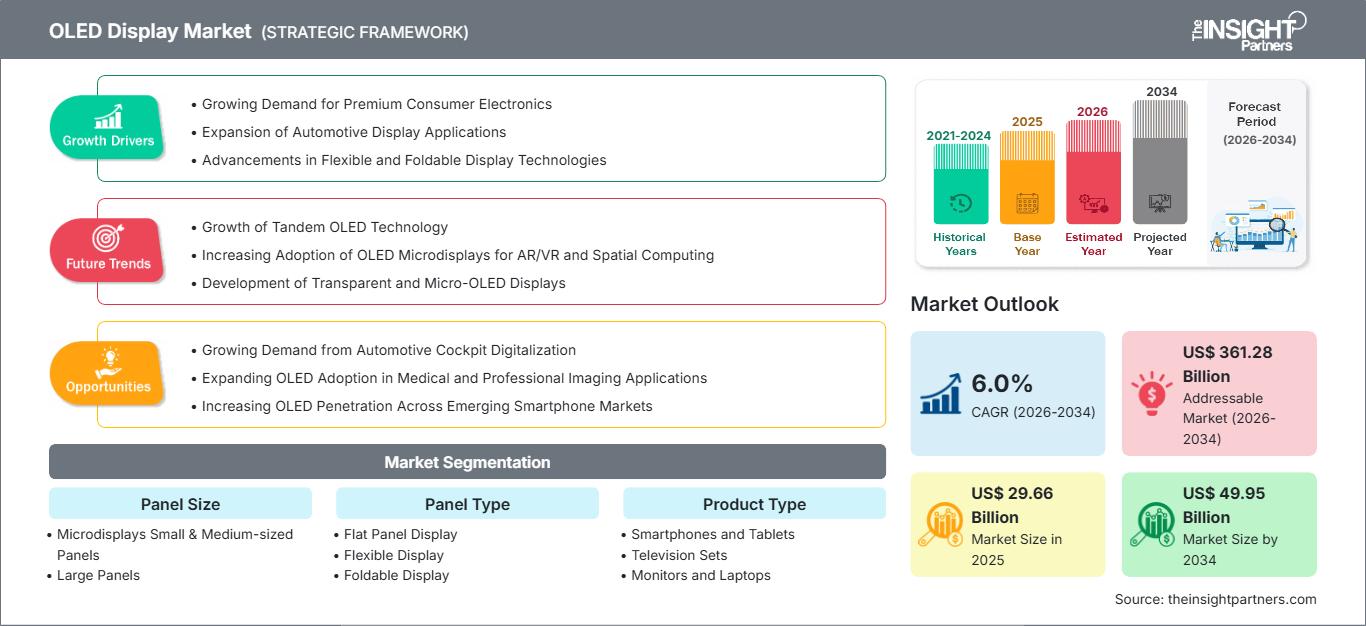
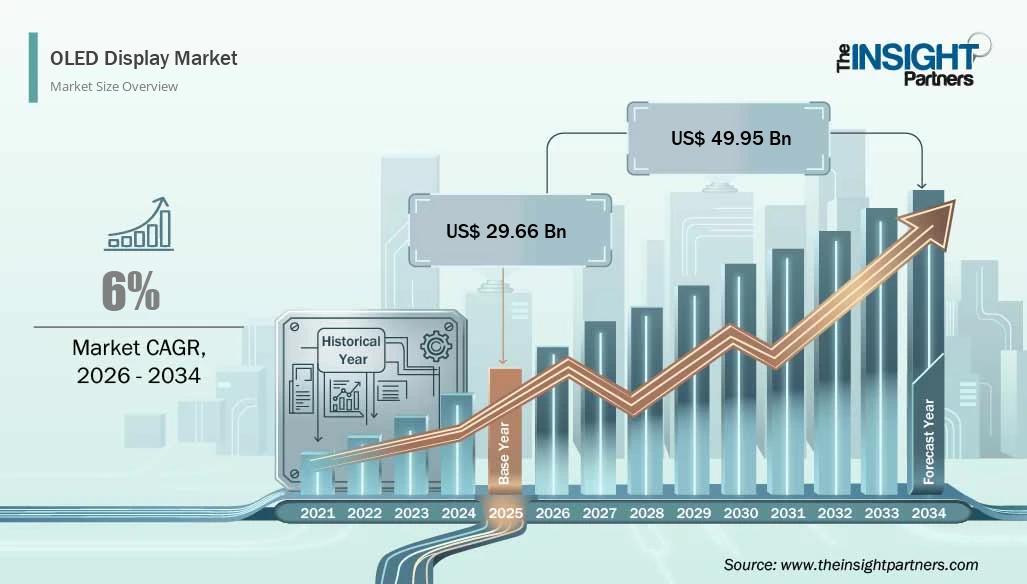
The OLED Display Market size reached $29.78 billion in 2025 and is forecasted to reach $50.16 billion by 2034, growing at a CAGR of 6.0% from 2026-2034. The OLED Display Market includes organic light emitting diode panels found in smartphones, television, computer, automotive, wearable, and other niche displays, wherein technology differences are focused on efficiency, brightness, resolution, flexibility, and cost.
Premium consumer electronics, gaming monitors, automotive cockpit upgrades, and enterprise need for high-performance visualizations drive the growth in the OLED Display Market size in Asia Pacific with a CAGR of 7.5% during 2026–2034. Structural growth drivers include replacement cycles, increased adoption of OLEDs in computing, and new display technology developments, while premiumization helps drive pricing strength in certain applications.
OLED Display Market Assessment and Insights
- North America: The region represented 28% share in 2025 and is expected to expand at a CAGR of 5.2% between 2026–2034, supported by premium televisions, computing displays, automotive visualization, gaming, and enterprise applications requiring high contrast and rapid response.
- US: The US accounted for 86% of North American demand in 2025 and is projected to grow at a CAGR of 5.3% during 2026–2034, supported by premium devices, gaming, and automotive displays.
- Europe: Europe held 22% share in 2025 and is expected to grow at a CAGR of 4.7% during 2026–2034, with Germany, the UK, France, Italy, and Spain supported by automotive displays, premium electronics, industrial visualization, and energy-efficiency priorities.
- Asia Pacific: Asia Pacific represented 40% share in 2025 and is projected to grow at a CAGR of 7.5% during 2026–2034. China, South Korea, Japan, and India remain important manufacturing and consumption centers, supported by mobile devices, televisions, IT displays, and expanding panel capacity.
- Largest Segment: Large Panels held a 49% market share in 2025 and is expected to grow at a CAGR of 5.0% during 2026–2034, reflecting television and large-format display demand.
- High Growth Segment: Television accounted for 14.8% share in 2025 and is projected to expand at a CAGR of 7.1% during 2026–2034, supported by premium home entertainment and larger OLED screen adoption.
- Key companies analyzed in detail: Samsung Electronics Co., Ltd.; BOE Technology Group Co., Ltd.; LG Electronics Inc.; TCL Technology Group Corporation; SHARP CORPORATION; Panasonic Holdings Corporation; AUO Corporation; Sony Group Corporation; Innolux Corporation; and Truly International Holdings Limited.
Source: The Insight Partners' analysis based on proprietary research, government publications, company annual reports, investor presentations, industry databases, and expert interviews.
The market for OLED Display has progressed from a high-end technology used in smartphones to an expanded display platform covering televisions, notebooks, monitors, automotive, wearable and immersive devices. Manufacturing technologies have increasingly moved towards more advanced generation substrates, flexible displays, tandem designs, QD-OLED designs, and enhanced deposition process. Panel makers are at the same time trying to improve materials efficiency, yield rates and reduced power requirements due to increased specifications in products. The market also has more and more differentiation between smaller/mid-sized OLEDs manufacture for mobile and wearables and large OLEDs manufacture for televisions, monitors and new IT applications. Recent supplier analysis has shown that Samsung Display and LG Display are among active players while BOE and Chinese manufacturers are continuing their growth.
In terms of the future, investments will be made more and more in IT OLED, automotive display, premium monitors, foldable panels and advanced processes. New demand regions would be India, Southeast Asia and some Middle Eastern countries where increased adoption of smartphones, televisions and digital infrastructure takes place. Attention to energy efficiency and sustainable electronics development may be beneficial for OLEDs application where low power consumption and thin architecture provide definite advantages.
OLED Display Market Report Scope
| Report Attribute | Details |
|---|---|
| Market size in 2025 | US$ 29.78 Billion |
| Market Size by 2034 | US$ 50.16 Billion |
| Global CAGR (2026 - 2034) | 6.0% |
| Historical Data | 2021-2024 |
| Forecast period | 2026-2034 |
OLED Display Market Analysis
There is diversity in demands for OLED display applications across smartphones, premium televisions, monitors, notebooks, automotive cockpits, and wearables. This diversity will enhance growth in the OLED Display Market since the suppliers will be able to counter any weaknesses in one area by expansion in another. The value chain includes organic materials, substrates, TFT backplanes, deposition, encapsulation, touch integration, driver electronics, modules, and device assembly. The competitive advantage in suppliers is dependent on yield, brightness, lifetime, power efficiency, color performance, and volume.
The dominance of the supply in Asian panel manufacturers, although the sources have been diversified. Participants in the supply chain include Samsung Electronics Co., Ltd., BOE Technology Group Co., Ltd., LG Electronics Inc., TCL Technology Group Corporation, SHARP CORPORATION, Panasonic Holdings Corporation, AUO Corporation, Sony Group Corporation, Innolux Corporation, and Truly International Holdings Limited. There is an emphasis on capacity utilization, substrate size, flexible production, and premium panels' specifications during investment decision-making.
The competitive position will depend on the specialization in technology rather than the capacity. Premium mobile and television ecosystems are ensuring the strong position of Samsung Electronics Co., Ltd., while BOE Technology Group Co., Ltd. is positioning itself in flexible and IT oriented OLEDs. Premium television ecosystems are still the strength of LG Electronics Inc. and Panasonic Holdings Corporation, while Sony Group Corporation focuses on high-end visuals and professional positioning.
The investments are also directed at larger OLED substrates and more effective manufacturing. Recent industry evidence shows that there is growth in the shipments of OLED monitors and note-books due to suppliers' allocation of the capacity for IT products. There is still the involvement of Samsung Display and LG Display in OLED production, while Chinese manufacturers are entering the market.
● REPORT CUSTOMIZATION
Tailor This Report To Align With Your Specific Business Requirements
This report can be customized to align precisely with your business objectives, scope, and target markets. Customization options include tailored segmentation, geography, competitive analysis, and strategic insights to support informed decision-making.
Customize This Report →WHAT YOU CAN ADJUST
- ● Segmentations
- ● Geography
- ● Competitive Analysis
- ● Language Preferences
OLED Display Market: Strategic Insights
Regional Insights
North America OLED Display Market
In 2025, the share of North America in the OLED Display Market was estimated at 28%, with an expected CAGR of 5.2% from 2026 to 2034. The U.S. emerges as the key national market with the assistance of premium TVs, smartphones, gaming monitors, notebooks, automotive displays, and professional visualization solutions. Replenishment sales benefit from a high penetration rate of household electronics, while premium products generate room for value-added OLED designs. In addition, car makers boost digital cockpit content, which creates demand for high-contrast displays featuring curved and integrated designs.
More and more investments are allocated for premium products rather than commodity panels. Gaming monitors, high-end notebooks, connected cars, and large TVs create several sales channels and reduce reliance on a particular product group. Technological implementations can be facilitated not only by well-developed device ecosystems but also by advanced semiconductor value chains.
U.S. OLED Display Market
In 2025, the U.S. comprised 86% of North America’s demand, and it is forecasted to grow at a CAGR of 5.3% over 2026–2034. High investments in premium TVs, smartphones, notebooks, monitors, and gaming consoles by consumers drive adoption. Larger digital instrument clusters, center displays, rear seat entertainment, and passenger interface systems in vehicles offer further chances for advanced OLED panels. The nation stays an important downstream market regardless of production concentration of panels in Asia.
Companies such as Samsung Electronics Co., Ltd., LG Electronics Inc., Sony Group Corporation, Panasonic Holdings Corporation, and TCL Technology Group Corporation possess market relevance due to consumer electronics and display partnerships. Demand is shifting from smartphones to premium monitors, notebooks, televisions, and vehicles. Enterprise visualization and niche applications offer additional ways to adopt OLEDs.
Europe OLED Display Market
Europe represented 22% share of the OLED Display Market in 2025 and is projected to grow at a CAGR of 4.7% through 2034. Germany remains a leading country because of automotive production and advanced engineering capabilities. The UK, France, Italy, and Spain contribute through premium consumer electronics, automotive applications, digital signage, and professional visualization. Regional demand increasingly emphasizes efficiency, durability, and advanced cockpit interfaces.
Germany's automotive ecosystem creates a significant opportunity for OLED displays in instrument clusters, center consoles, rear-seat systems, and premium passenger interfaces. European automakers increasingly evaluate display technologies based on optical quality, reliability, operating temperature, and integration flexibility. The UK and France provide additional demand through premium electronics, media, retail, and professional applications, while Italy and Spain contribute through automotive, tourism, retail, and digital infrastructure deployments.
APAC OLED Display Market
APAC represented 40% share in 2025 and is projected to grow at a CAGR of 7.5%, making it the fastest-growing major region. China, South Korea, Japan, India, and Australia contribute across manufacturing and consumption. South Korea remains a leading technology center, while China continues expanding production capabilities.
Industrial policy, electronics manufacturing ecosystems, smartphone production, television demand, and expanding IT-device adoption support regional growth. China is strengthening domestic panel capacity, Japan retains advanced display engineering capabilities, India is developing electronics manufacturing, and Australia represents a smaller downstream market.
Middle East & Africa OLED Display Market
Middle East and Africa demand is projected to grow at a CAGR of 4.5% through 2034. Saudi Arabia and the UAE lead regional adoption through smart infrastructure, premium hospitality, entertainment venues, retail modernization, and automotive applications. South Africa remains an important commercial and consumer electronics market.
Infrastructure diversification and investment in tourism, entertainment, airports, commercial developments, and digital services support display deployment. Large-format entertainment and premium televisions remain important applications, while automotive and professional displays provide incremental demand.
Segmentation Analysis
Panel Size
Panel Size represents a fundamental production and application dimension, with OLED technologies serving microdisplays, mobile and computing devices, and large-screen applications. The segment is expected to expand at a CAGR range of 5.4–8.0% during 2026–2034.
- Microdisplays: Microdisplays address high-pixel-density requirements in near-eye applications, including AR and VR devices. Their strategic importance stems from compact architectures, demanding optical specifications, and potential adoption in specialized professional and consumer systems.
- Small & Medium-sized Panels: These panels remain central to smartphones, tablets, wearables, and portable computing. Demand is shaped by thinness, flexibility, power efficiency, touch integration, and increasingly sophisticated industrial designs.
- Large Panels: Large panels remain the dominant category, supported by premium televisions, monitors, and selected commercial applications. Production economics depend heavily on substrate utilization, yield, panel size, and manufacturing process maturity.
Panel Type
Panel Type reflects the industry's transition toward differentiated architectures capable of supporting thinner products, unconventional form factors, and higher performance. The segment is projected to grow at a CAGR range of 5.1–7.1% during 2026–2034 as device manufacturers pursue differentiated designs.
- Flat Panel Display: Flat architectures remain the broadest deployment format across televisions, monitors, notebooks, and mobile devices. Their established manufacturing ecosystem supports predictable integration, supply availability, and broad consumer acceptance.
- Flexible Display: Flexible OLED enables curved, lightweight, and bendable products while supporting new industrial designs.
- Foldable Display: Foldable panels support compact device storage and larger usable screens after deployment. Continued engineering improvements in durability, crease management, hinge integration, and manufacturing yield are central to broader adoption.
- Curved Display: Curved OLED supports immersive viewing and cockpit integration. Demand is concentrated in premium televisions, gaming monitors, automotive interiors, and specialized visualization systems where viewing geometry creates tangible product differentiation.
Product Type
Product Type captures the broadest application structure and is projected to expand at a CAGR range of 4.5–7.7% during 2026–2034. Demand is shifting toward applications that can monetize OLED's contrast, response time, thinness, and design flexibility.
- Smartphones and Tablets: Mobile devices remain a major OLED application because manufacturers use high contrast, thinness, low response times, and flexible architectures to differentiate premium products.
- Television Sets: Television demand is increasingly concentrated in premium and larger-screen products, where contrast, black levels, viewing quality, and advanced image processing support OLED positioning.
- Monitors and Laptops: OLED monitors and notebooks are gaining traction in gaming, creative production, professional visualization, and premium computing because high refresh rates and image quality create differentiated user experiences.
- Digital Signage and Large Format Displays: Specialized signage applications use OLED where thinness, visual quality, architectural integration, and premium presentation justify higher panel costs compared with conventional display technologies.
- Automotive Displays: Automotive OLED adoption is supported by premium cockpits, curved interfaces, instrument clusters, passenger displays, and design-led interiors requiring high contrast and flexible integration.
- Wearables: OLED is well suited to smartwatches and compact wearable devices because thinness, low power requirements, and high pixel density support small-form-factor designs.
Industry Vertical
Industry Vertical demand is projected to grow at a CAGR range of 4.1–7.1% during 2026–2034. Adoption varies by purchasing cycles, regulatory requirements, application criticality, and the value placed on visual performance.
- Consumer Electronics: Consumer electronics remains the largest adoption base, spanning smartphones, televisions, tablets, monitors, laptops, and wearables. Premiumization remains important for sustaining OLED demand across mature markets.
- Automotive: Automotive applications emphasize reliability, operating temperature, optical performance, and integration. Large curved displays and digital cockpit architectures provide expanding opportunities for OLED technologies.
- Sports and Entertainment: Stadiums, venues, broadcasters, and entertainment operators use advanced displays to improve visual engagement, premium presentation, and content visibility in high-value environments.
- Retail: Retailers deploy premium displays for product presentation, digital merchandising, experiential environments, and branded installations where image quality can influence customer engagement.
- BFSI: Banks and financial institutions use sophisticated displays across branches, trading environments, customer experience areas, and executive facilities where visual quality and professional presentation are relevant.
- Education: Educational institutions increasingly deploy interactive and high-resolution displays for classrooms, laboratories, training environments, and collaborative learning, particularly in digitally enabled facilities.
- Healthcare: Healthcare applications include visualization, patient interfaces, diagnostic support environments, and specialized equipment where high contrast and accurate image reproduction can support usability.
- Aerospace and Defense: Aerospace and defense applications require ruggedized, reliable, high-contrast displays for cockpits, command systems, portable equipment, and mission environments with demanding operating conditions.
Opportunity Snapshot
| Industry Vertical | Revenue Contribution (High/Medium/Low) | Trend Tag (MAX 2 words) | Adoption Stage (Emerging/Scaling/Mature) |
| Consumer Electronics | High | Premium Devices | Mature |
| Automotive | High | Digital Cockpit | Scaling |
| Sports and Entertainment | Medium | Immersive Venues | Scaling |
| Retail | Medium | Visual Merchandising | Scaling |
| BFSI | Low | Executive Displays | Emerging |
| Education | Medium | Digital Classrooms | Scaling |
| Healthcare | Medium | Clinical Visualization | Scaling |
| Aerospace and Defense | Low | Mission Displays | Emerging |
OLED Display Market Growth Drivers and Impact Analysis
Expansion of OLED in IT and Premium Computing
Use of OLED in notebooks and monitors is one of the key incremental demand generators as manufacturers are looking for differentiated display performance in terms of gaming, creation, visualization, and premium productivity. Based on industry shipment numbers for 2026, it is evident that there will be robust year-on-year growth in OLED notebook panels and monitors. This is a clear indication that there is a move from smartphone-driven demand. High refresh rates, high contrast ratio, fast response time, and slim design will enable premium positioning. With respect to panel manufacturers, IT use cases will provide a chance to optimize utilization of their generation larger wafer production capacity.
Automotive Display Integration and Premium Interior Design
Car companies have been adding more screen content into their instrument panels, center stack panels, passenger screens, and cockpit architecture. There are some characteristics in OLEDs that fit well into the car design such as high contrast, slimness, curvature, and good visual performance. However, the commercial effects will not be only measured by the volume of the panel but rather due to the longer qualification process, high reliability needed, and more engineering integration as compared to other consumer products. As more vehicles move towards software-defined interiors, display systems will transition from individual screens to coordinated displays. In such a case, there is an opportunity for panel makers, module companies, material suppliers, and automotive electronics makers. The implementation of OLED in cars will rely on lifetime, heat management, burn-in resistance, operational temperature, and cost.
Advancement of Manufacturing Efficiency and Panel Performance
Manufacturing innovation is becoming a direct market driver because OLED competitiveness depends heavily on yield, material utilization, substrate economics, and performance consistency. New deposition and pixel-patterning techniques aim to reduce limitations associated with conventional fine metal masks, particularly for larger and higher-resolution panels. Recent technology announcements indicate that mask-free or photolithographic approaches can improve aperture ratio, brightness, lifetime, and power efficiency while expanding design flexibility. Such developments can alter the economics of larger OLED formats and strengthen the feasibility of additional IT, television, automotive, and immersive applications.
OLED Display Market Future Trends
Shift Toward Larger-Generation IT OLED Production
OLED Display Market trends increasingly point toward larger-generation fabrication for notebooks, monitors, tablets, and related IT products. Suppliers are reallocating capacity toward applications that can utilize larger substrates efficiently, while equipment and process developers are improving deposition, backplane, encapsulation, and yield-management technologies. Gen 8.x manufacturing is becoming strategically important because larger substrates can increase the number of panels produced per motherglass and potentially improve cost structures. The transition also creates opportunities for higher refresh rates, larger monitor sizes, and premium notebook configurations. Over time, competition is likely to shift from simple capacity expansion toward process stability, customer qualification, and application-specific yield.
Convergence of OLED With Advanced Form Factors
Future OLED deployment is likely to extend further into foldable, rollable, curved, transparent, microdisplay, and highly integrated automotive architectures. These formats can expand addressable applications by allowing display systems to become structural elements of devices rather than separate components. Wearables may benefit from smaller curved panels, while automotive interiors can use integrated surfaces spanning multiple functional zones. AR and VR systems can also require extremely high pixel densities in compact packages, creating opportunities for specialized OLED microdisplays. Commercial adoption will depend on durability, optical efficiency, manufacturing yield, and component integration. Suppliers are therefore likely to invest in new encapsulation approaches, improved flexible backplanes, advanced materials, and more precise patterning.
OLED Display Market Opportunities
Localization of Display Supply Chains in Emerging Economies
OLED Display Market Forecasts indicate opportunities for ecosystem development in emerging electronics manufacturing locations where governments and companies are seeking greater domestic value addition. India and selected Southeast Asian economies can attract investment in module assembly, device integration, materials handling, testing, and potentially panel manufacturing as local electronics production expands. The opportunity is broader than establishing fabrication facilities because display ecosystems require equipment maintenance, chemicals, components, driver electronics, logistics, quality testing, and engineering talent. Investors can therefore target less capital-intensive portions of the value chain while building capabilities for future localization. Partnerships between technology providers, device manufacturers, and industrial-policy programs could improve supply resilience and reduce dependence on concentrated production hubs.
Premium Automotive and Professional Display Solutions
The strongest investment opportunities may increasingly arise in applications where OLED performance can command a premium over conventional display technologies. Automotive cockpit systems, premium gaming monitors, professional visualization, specialized healthcare equipment, aerospace interfaces, and high-end digital signage can support higher-value panel configurations. Investors and suppliers can focus on application-specific modules rather than competing exclusively in high-volume consumer markets. Engineering capabilities in thermal management, optical calibration, burn-in mitigation, touch integration, and ruggedization can create differentiation. Strategic partnerships with automotive tier suppliers, display integrators, and equipment manufacturers can accelerate qualification and reduce market-entry barriers. Opportunities are particularly attractive where customers value long product lifecycles, design flexibility, and visual performance enough to absorb higher system costs.
Recent Developments
- August 2026: LG Display Co., Ltd. introduced FLiPP, an FMM-less OLED pixel-patterning technology using photolithography. The company stated that the approach can increase brightness, extend panel lifetime, reduce power consumption, and improve manufacturing flexibility. LG Display indicated that the technology is intended initially for IT applications, with potential expansion into monitors, tablets, wearables, automotive, and larger displays.
- June 2026: BOE Technology Group Co., Ltd. advanced its B16 Gen-8.6 AMOLED production program in Chengdu, with the line targeting substantial substrate capacity as production ramps. The investment supports larger-area OLED applications, particularly IT displays, and increases competitive pressure on established suppliers as OEM customers diversify panel sourcing and suppliers expand next-generation manufacturing capabilities.
- May 2026: Samsung Display Co., Ltd. unveiled a 31.5-inch 4K 360Hz QD-OLED monitor panel at SID Display Week 2026 and announced plans for mass production during the second half of 2026. The development strengthens Samsung's positioning in premium gaming and professional monitors, where high refresh rates, resolution, contrast, and image quality are increasingly important purchasing criteria.
Frequently Asked Questions

- Comprehensive Market Sizing and Forecast Analysis
- Detailed Segmentation Analysis
- In-Depth Market Dynamics Assessment
- Regional and Country-Level Insights
- Competitive Landscape and Company Benchmarking
- Strategic Business Intelligence
Recent Reports
Testimonials

The Insight Partners provided valuable market intelligence that supported our global go-to-market strategy. Their team was professional, responsive, and attentive to our feedback, providing thoughtful analysis and helpful methodological clarifications throughout the project.
Junmo Kim Chief Financial Officer (CFO), Enertech Co., Ltd.
The Insight Partners' SCADA System Market report is comprehensive, with valuable insights on current trends and future forecasts. The team was highly professional, responsive, and supportive throughout. We are very satisfied and highly recommend their services.
RAN KEDEM Partner, Reali Technologies LTDs
I requested a report on a very specific software market and the team produced the report in a few days. The information was very relevant and well presented. I then requested some changes and additions to the report. The team was again very responsive and I got the final report in less than a week.
JEAN-HERVE JENN Chairman, Future Analytica
We worked with The Insight Partners for an important market study and forecast. They gave us clear insights into opportunities and risks, which helped shape our plans. Their research was easy to use and based on solid data. It helped us make smart, confident decisions. We highly recommend them.
PIYUSH NAGPAL Sr. Vice President, High Beam Global
The Insight Partners delivered insightful, well-structured market research with strong domain expertise. Their team was professional and responsive throughout. The user-friendly website made accessing industry reports seamless. We highly recommend them for reliable, high-quality research services
YUKIHIKO ADACHI CEO, Deep Blue, LLC.
This is the first time I have purchased a market report from The Insight Partners.While I was unsure at first, I visited their web site and felt more comfortable to take the risk and purchase a market report.I am completely satisfied with the quality of the report and customer service. I had several questions and comments with the initial report, but after a couple of dialogs over email with their analyst I believe I have a report that I can use as input to our strategic planning process.Thank you so much for taking the extra time and making this a positive experience.I will definitely recommend your service to others and you will be my first call when we need further market data.
JOHN SUZUKI President and Chief Executive Officer, Board Director, BK Technologies
I wish to appreciate your support and the professionalism you displayed in the course of attending to my request for information regarding to infectious disease IVD market in Nigeria. I appreciate your patience, your guidance, and the fact that you were willing to offer a discount, which eventually made it possible for us to close a deal. I look forward to engaging The Insight Partners in the future, all thanks to the impression you have created in me as a result of this first encounter.
DR CHIJIOKE ONYIA MANAGING DIRECTOR, PineCrest Healthcare Ltd.Reason to Buy
- Informed Decision-Making
- Understanding Market Dynamics
- Competitive Analysis
- Identifying Emerging Markets
- Customer Insights
- Market Forecasts
- Risk Mitigation
- Boosting Operational Efficiency
- Strategic Planning
- Investment Justification
- Tracking Industry Innovations
- Aligning with Regulatory Trends





 Get Free Sample for