
Display Material Market Size, Share & Demand by 2034
Coverage: by Technology (LCD, OLED); Component and Material (Polarizer, Substrate, Color Filter Layer, Liquid Crystals, Backlighting Unit, Emitter and Organic Layer Materials, Encapsulation, Others); Application (Television, Smartphone and Tablet, Laptop and Desktop, Large Format Display, Automotive, Others) , and Geography (North America, Europe, Asia Pacific, and South and Central America)
- Status : Data Released
- Report Code : TIPRE00004796
- Category : Electronics and Semiconductor
- No. of Pages : 150
- Available Report Formats :


- Last update date : August 06, 2026


2025 Market Size
US$ 14.33 Bn
Base year value
2034 Forecast
US$ 27.25 Bn
Projected by 2034
CAGR 2026-2034
8.37 %
Growth rate
Addressable Market
US$ 196.95 Bn
(2026-2034)
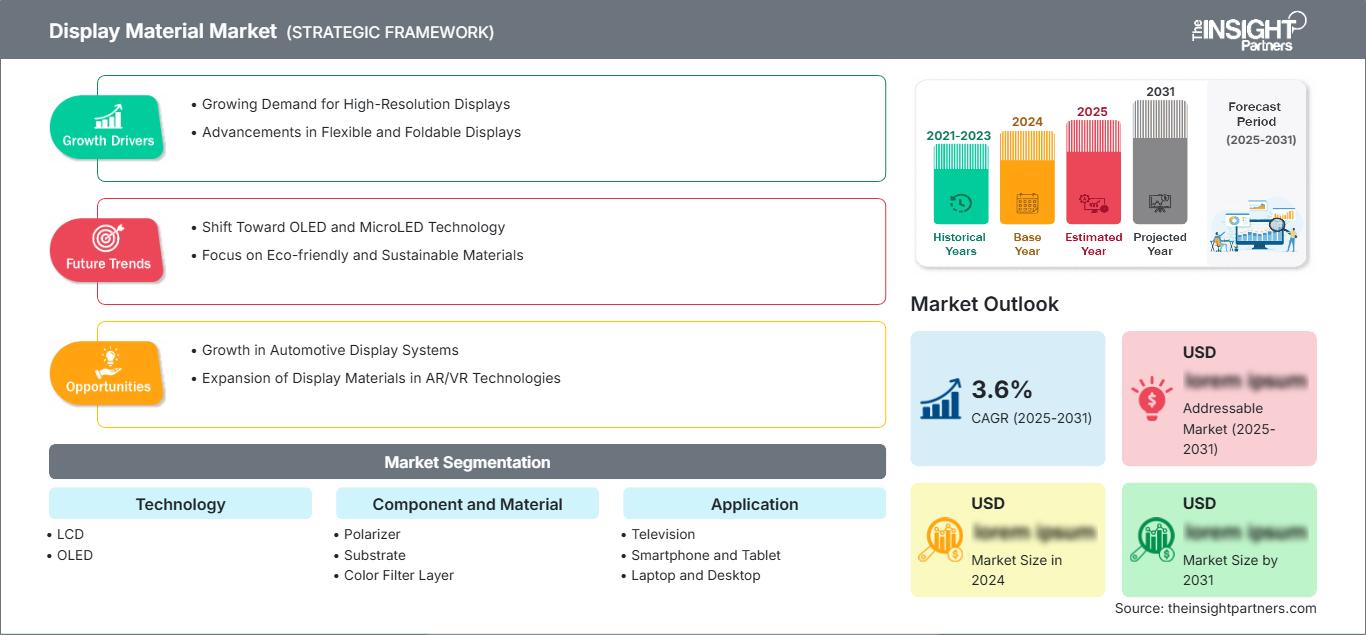
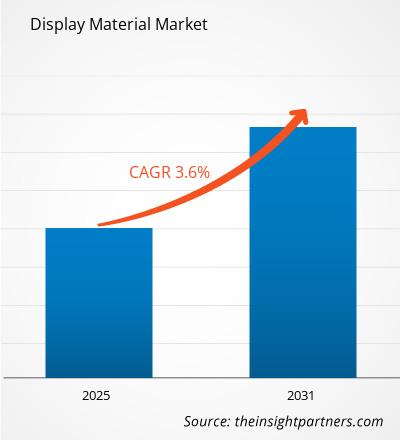
The Display Material Market is expected to reach from US$ 14.33 Billion in 2025 to US$ 27.25 Billion by 2034 at a CAGR of 8.37% during 2026–2034. The growth of the market is being driven by the cycles of LCD replacements, shifting towards OLED technologies, consumption of increased screen area, and higher material intensity in consumer electronics, automotive cockpit displays, and public displays.
North America continues to remain a high value demand center with a 2026–2034 CAGR of 7.6–8.2%, driven by premium television upgrades, application of displays in automobiles, and enterprise adoption of large format displays. In addition, the Display Material Market Size in North America is driven by the cycles of replacement of devices, stricter specifications on the quality of glass and films, and investments in local semiconductor and electronics supply chain.
Display Material Market Assessment and Insights
- North America accounted for 29–31% share in 2025 and is expected to grow at a CAGR range of 7.6–8.2% during 2026–2034, led by premium electronics, vehicle cockpit digitization, and enterprise display upgrades.
- US represented 86–88% of North America in 2025 and is projected to grow at a 7.7–8.3% CAGR during 2026–2034, supported by high device spending.
- Europe held 18–20% share in 2025 and is set to expand at 6.9–7.5% CAGR during 2026–2034, with Germany, the UK, and France leading automotive and industrial demand.
- Asia Pacific captured 43–45% share in 2025 and is forecast to grow at 8.8–9.4% CAGR during 2026–2034, driven by China, South Korea, Japan, India, and display manufacturing clusters.
- Largest Segment LCD held 64–66% market share in 2025 and is expected to grow at a 6.8–7.4% CAGR during 2026–2034, reflecting broad television and monitor penetration.
- High Growth Segment OLED held 34–36% market share in 2025 and is projected to grow at 10.4–11.2% CAGR during 2026–2034 as IT, automotive, and premium mobile adoption rises.
- Key companies analyzed in detail: AGC Inc., Corning Incorporated, DIC Corporation, DuPont de Nemours, Inc., Dow Inc., Hodogaya Chemical Co., Ltd., Idemitsu Kosan Co., Ltd., JSR Corporation, LG Chem, Ltd., Nitto Denko Corporation, Samsung SDI Co., Ltd.
Source: The Insight Partners' analysis based on proprietary research, government publications, company annual reports, investor presentations, industry databases, and expert interviews.
Display materials have progressed from conventional LCD input material to a distinct set of optical, chemical, and functional materials. Display manufacturers need to handle material utilization, yield, and qualification simultaneously due to higher requirements for substrates, polarizers, and backlight in larger displays. The use of OLED technology is causing shifts in the purchase requirements towards emitter stacks, thin film encapsulation, and high barrier material. The LCD technology will continue to dominate cost-sensitive television, monitor, and industrial displays.
By 2034, the market is anticipated to benefit from capacity expansions in Asia, steady demand for US replacement, and electronics localization driven by regulations. Regulations to manufacture energy-efficient devices are driving the importance of low power optical stacks and OLED material chemistry. Suppliers who can help automotive reliability, folding display, and regional quality assurance are poised to gain margins.
Display Material Market Report Scope
| Report Attribute | Details |
|---|---|
| Market size in 2025 | US$ 14.33 Billion |
| Market Size by 2034 | US$ 27.25 Billion |
| Global CAGR (2026 - 2034) | 8.37% |
| Historical Data | 2021-2024 |
| Forecast period | 2026-2034 |
Display Material Market Analysis
Display Material Market growth depends more on the growth in area of screens than the shipments of units alone. The shipment of large area displays grew to 910.5 million units in 2025, while shipments of OLED large-area displays grew at a greater rate than those of LCD, emphasizing the importance of high value organic layers and encapsulations.
The supply chain covers specialty chemical synthesis, conversion of glasses and films, panel manufacturing, and device assembly. The supply chain dynamics are still vulnerable to panel utilization rates, power costs, and qualification processes, since display manufacturers do not change their materials rapidly. With the increased use of bright panels in automotive and IT applications, Display Material Market report emphasizes lifetime and thermal stability issues.
The competition is limited to only those companies with proven track records on product validation. AGC Inc. and Corning Incorporated provide competition in display glass and substrates, while Nitto Denko Corporation, DIC Corporation, JSR Corporation, and LG Chem, Ltd. provide competition in films, resins, and electronics materials. Idemitsu Kosan Co., Ltd., Hodogaya Chemical Co., Ltd., and Samsung SDI Co., Ltd. remain strategically positioned for OLED material stacks.
The funding will focus on materials that boost the brightness of the device, conserve energy, and help in the development of thin device designs. DuPont de Nemours, Inc. and Dow Inc. enhance their offerings with specialty polymers, adhesives, and process materials. Strategic positioning involves co-development with display panel manufacturers, continuous production in geographically different areas, strong intellectual property position, and serving LCD cash cows along with OLED materials.
● REPORT CUSTOMIZATION
Tailor This Report To Align With Your Specific Business Requirements
This report can be customized to align precisely with your business objectives, scope, and target markets. Customization options include tailored segmentation, geography, competitive analysis, and strategic insights to support informed decision-making.
Customize This Report →WHAT YOU CAN ADJUST
- ● Segmentations
- ● Geography
- ● Competitive Analysis
- ● Language Preferences
Display Material Market: Strategic Insights
Regional Insights
North America Display Material Market
North America accounted for 29-31% of the Display Material Market in 2025, and is expected to witness a growth rate of CAGR 7.6-8.2% from 2026 to 2034. Factors contributing to the demand include premium TV replacement, high notebook penetration, automobile cockpit displays, and usage of interactive displays in enterprises. The region is importing several panels but consuming high-value material in downstream applications.
Due to the resilient policy of localization within the supply chain and semiconductor investment, specifications of glass, film, and optical adhesive benefit. Large cluster and center stack display systems are on the rise within automotive original equipment manufacturers, favoring materials with heat resistance, low haze, and long lifetime.
U.S. Display Material Market
The US market constituted 86-88% of the North American region in 2025 and is anticipated to grow at 7.7-8.3% CAGR from 2026-2034. Consistent demand for superior quality televisions, laptops, tablets, and infotainment screens in automobiles drives the demand for polarizers, substrates, color filters, and OLED materials. Furthermore, advanced display applications in the US are used in the medical, aerospace, and defense visualization segments
Firms are most active in the innovation of materials, qualification of customers, and technical assistance. The glass, polymer, and process-material ecosystem includes contributions from Corning Incorporated, DuPont de Nemours, Inc., and Dow Inc. Asian companies supply OLED materials to US device manufacturers through their global production network. Automotive OLED and high-brightness LCD material use drive application trends.
Europe Display Material Market
Europe had 18-20% share in 2025 and is projected to grow at a CAGR of 6.9-7.5% from 2026 to 2034. Germany drives regional consumption via automotive cockpit, industrial controls, and high-end appliance displays. The UK drives through consumer electronics sales and signage applications, whereas France is active in aerospace and defense sectors and visualization for professionals.
Italy and Spain drive consumption through digital retail, public information systems, and vehicle electronics. Europe’s laws on energy efficiency and sustainability increase the focus on robust displays and low-power optical stacks. It is as crucial to qualify suppliers for the European market as it is to compete with prices.
APAC Display Material Market
The APAC region accounted for 43–45% market share in 2025 and is expected to expand at 8.8–9.4% CAGR from 2026 to 2034. China boasts the largest share of LCD panel capacity, whereas South Korea and Japan dominate premium OLED, materials science, and equipment ecosystems.
India and Australia contribute to material consumption by way of device consumption, automotive electronics, and business display solutions. Industrial policies, electronics incentives, and investments in panel displays in the region drive the demand for material. The APAC region continues to be the production center of the Display Material Market.
Middle East & Africa Display Material Market
Middle East and Africa is projected to grow at a 6.2–6.8% CAGR during 2026–2034, led by the UAE and Saudi Arabia. Smart city programs, airport modernization, retail displays, and hospitality infrastructure generate demand for large-format displays and durable outdoor materials.
The other regions that contribute to the demand for the LCD screens include South Africa as well as the Rest of MEA through their telecommunication, banking, education and government digitization sectors. The high temperature operation environment increases the significance of optical films, backlighting performance and encapsulation.
Segmentation Analysis
Technology
Technology is expected to grow at a 8.0–8.8% CAGR during 2026–2034. LCD remains the volume anchor for televisions, monitors, and cost-sensitive commercial screens, while OLED increases material value per panel through organic emitters, encapsulation, and advanced substrates. The Display Material Market scope is widening as technology choices increasingly reflect application lifetime, energy efficiency, brightness, and form-factor requirements.
- LCD remains strategically important because installed manufacturing capacity, predictable yields, and cost-efficient large-area production support televisions, monitors, laptops, and public information displays across mature and emerging markets.
- OLED is gaining share in premium smartphones, tablets, laptops, monitors, and vehicles because it enables thinner designs, higher contrast, flexible formats, and improved energy efficiency.
Component and Material
Component and Material is projected to expand at a 8.1–8.9% CAGR during 2026–2034. Demand varies by technology, with LCD requiring mature polarizer, color filter, liquid crystal, substrate, and backlighting inputs, while OLED increases reliance on emitter, organic layer, and encapsulation materials. Qualification depth, defect reduction, and consistent optical performance are decisive purchasing factors.
- Polarizer demand is sustained by LCD scale and premium screen brightness requirements, with suppliers focusing on thinner films, improved viewing angles, and better durability under heat and humidity.
- Substrate materials remain critical to dimensional stability, surface quality, and yield, especially as larger panels and advanced OLED architectures require tighter tolerances and cleaner processing.
- Color Filter Layer demand is linked to color accuracy and efficiency improvement, supporting televisions, monitors, and automotive displays where image quality and brand differentiation matter.
- Liquid Crystals continue to serve LCD panels across mainstream devices, with formulation improvements targeting faster response, lower power use, and dependable performance across temperature conditions.
- Backlighting Unit materials support LCD brightness and efficiency, particularly in televisions, signage, and automotive displays where miniaturization, uniformity, and energy performance remain important.
- Emitter and Organic Layer Materials are central to OLED performance because they influence color, lifetime, efficiency, and premium-panel differentiation across mobile, IT, television, and automotive applications.
- Encapsulation protects OLED stacks from oxygen and moisture, making barrier performance essential for foldable, automotive, and high-lifetime displays exposed to mechanical and environmental stress.
Application
Application is forecast to grow at a 8.2–9.0% CAGR during 2026–2034. Television remains the largest screen-area consumer, while smartphones, tablets, laptops, desktops, automotive displays, and large-format systems diversify demand. Material suppliers must align portfolios with different brightness, durability, thickness, and cost requirements across consumer, mobility, and commercial environments.
- Television drives high material volume because large screen areas consume substantial glass, films, color layers, and backlighting inputs, even when unit growth is modest.
- Smartphone and Tablet applications emphasize thinness, power efficiency, color performance, and flexible form factors, making OLED materials and high-quality cover and substrate systems strategically important.
- Laptop and Desktop demand is shifting toward OLED monitors and premium notebooks, increasing requirements for high brightness, low power consumption, and stable image performance.
- Large Format Display applications require durability, uniform brightness, and long operating life for retail, transport, education, control rooms, and corporate collaboration environments.
- Automotive displays are raising material specifications because cockpit screens must withstand heat, vibration, sunlight exposure, touch interaction, and long product qualification cycles.
Opportunity Snapshot
| Application | Revenue Contribution | Trend Tag | Adoption Stage |
| Television | High | Large Screens | Mature |
| Smartphone and Tablet | High | Foldable OLED | Scaling |
| Laptop and Desktop | Medium | OLED IT | Scaling |
| Large Format Display | Medium | Smart Signage | Scaling |
| Automotive | Medium | Digital Cockpit | Emerging |
| Others | Low | Specialty Screens | Emerging |
Display Material Market Growth Drivers and Impact Analysis
Rising Screen Area Across Consumer and Commercial Devices
Increase in screen size is a straight material demand multiplier. As the growth in device units may be slow, there will be an increased amount of glass, films, colorants, and backlighting material needed for the larger TVs, monitors, tablets, and public displays. Large area display shipments accounted for 910.5 million units in 2025, and OLED monitors shipments soared, implying that there was a move towards material of higher value. The influence can be seen in purchasing where the panel manufacturers need thinner substrates, better optical films, and long-term supply agreements.
Automotive Cockpit Digitization and Reliability Requirements
Car displays have shifted from simple infotainment displays to a multi-display cockpit comprising of cluster, center stack, passenger display, and head-up display. The shift brings about increased specification in materials for the displays since the panels must withstand high temperatures, vibrations, direct sunlight, and long product lifecycles. OLEDs and LTPS LCDs are increasing in terms of revenue share in the automotive display space, whereas manufacturers continue to invest in encapsulation solutions, brightness films, and thermal stability materials.
Energy Efficiency and Lifetime Improvements in OLED Materials
Efficiency improvements are crucial since power consumption, heat dissipation, and lifespan play key roles in product development and cost. Progress in blue OLED materials, tandems, and light extraction contributes to more powerful panels that require less energy. Idemitsu Kosan Co., Ltd. made dual emission layer advances in 2025, while LG Display announced the efficiency increases of fourth-generation OLEDs. Such innovations create more opportunities for the materials used in emitter and organic layers, encapsulants, and high-quality substrates. In the case of materials producers, efficiency-related innovations provide pricing strength and technological cooperation with panel manufacturers.
Display Material Market Future Trends
OLED Materials Shift Toward Tandem and Blue Efficiency
Display Material Market trends are moving toward OLED stacks that combine higher brightness, longer life, and lower power consumption. Tandem OLED structures, blue phosphorescent progress, and improved fluorescent blue systems are expected to reshape material qualification between 2026 and 2034. Panel makers will increasingly evaluate materials by lifetime contribution and energy efficiency rather than only initial luminance. This trend favors suppliers with deep organic chemistry, strong intellectual property, and co-development access to premium IT, television, and automotive programs. The result will be a more specialized and performance-led competitive environment.
Regionalization of Display Supply Chains
Supply-chain regionalization will influence material sourcing as device brands and governments reduce exposure to single-region dependencies. APAC will remain the manufacturing core, but North America and Europe are strengthening electronics, semiconductor, and automotive supply ecosystems. Material suppliers may respond with dual sourcing, regional technical centers, and inventory strategies for qualified products. This trend is especially important for critical OLED layers, specialty glass, and high-performance optical films, where qualification risk can disrupt panel schedules. Companies with global production redundancy will gain strategic preference.
Display Material Market Opportunities
Automotive OLED and Advanced LCD Material Qualification
Automotive represents a high-quality opportunity because display programs run for years and require stable material supply. Suppliers can target encapsulation, high-brightness films, optical adhesives, and substrates suited to curved, integrated, and sunlight-readable cockpits. Display Material Market Forecasts indicate that regions with strong vehicle electronics ecosystems will reward suppliers that qualify early with OEMs and Tier 1 integrators. Investment should focus on automotive-grade reliability testing, local technical support, and materials that reduce power consumption without compromising brightness. This opportunity is action-oriented because qualification decisions made now can determine revenue streams through future vehicle platforms.
Premium IT OLED Materials for Notebooks and Monitors
Premium IT devices offer an attractive path for material suppliers because OLED adoption in notebooks and monitors is rising faster than in televisions. These products require high brightness, reduced burn-in risk, precise color, and efficient power use for portable and gaming applications. Material companies can invest in emitter systems, encapsulation layers, and substrates optimized for Gen 8.6 OLED production. The opportunity is strongest for suppliers that can support panel makers during ramp-up, improve yields, and deliver consistent batches. Early alignment with leading panel manufacturers can create defensible positions before wider commoditization occurs.
Recent Developments
- October 2025: LG Chem and ZEISS announced a strategic alliance for industrial-scale photopolymer film supply for advanced optics. The companies plan to support holographic windshield displays for automotive applications, with serial production targeted for 2029. The collaboration strengthens material supply for mobility, holographic sensors, and optical technologies.
- May 2026: Tata Elxsi, a global leader in design and technology services, announced the launch of ViTel, a Material Intelligence solution for Medical Device manufacturers, co-developed with Viridium AI, a material intelligence platform company. ViTel is being formally introduced at DeviceTalks Boston 2026, where Tata Elxsi is presenting its latest advances in AI-powered MedTech engineering and compliance.
- April 2026: Apple announced a major milestone in its sustainability efforts, reporting that 30% of the materials used across its products shipped in 2025 came from recycled sources — the highest level achieved by the company to date. The update is part of Apple’s broader goal to become carbon neutral across its operations, supply chain, and product lifecycle by 2030.
Frequently Asked Questions

- Comprehensive Market Sizing and Forecast Analysis
- Detailed Segmentation Analysis
- In-Depth Market Dynamics Assessment
- Regional and Country-Level Insights
- Competitive Landscape and Company Benchmarking
- Strategic Business Intelligence
Recent Reports
Testimonials

The Insight Partners' SCADA System Market report is comprehensive, with valuable insights on current trends and future forecasts. The team was highly professional, responsive, and supportive throughout. We are very satisfied and highly recommend their services.
RAN KEDEM Partner, Reali Technologies LTDs
I requested a report on a very specific software market and the team produced the report in a few days. The information was very relevant and well presented. I then requested some changes and additions to the report. The team was again very responsive and I got the final report in less than a week.
JEAN-HERVE JENN Chairman, Future Analytica
We worked with The Insight Partners for an important market study and forecast. They gave us clear insights into opportunities and risks, which helped shape our plans. Their research was easy to use and based on solid data. It helped us make smart, confident decisions. We highly recommend them.
PIYUSH NAGPAL Sr. Vice President, High Beam Global
The Insight Partners delivered insightful, well-structured market research with strong domain expertise. Their team was professional and responsive throughout. The user-friendly website made accessing industry reports seamless. We highly recommend them for reliable, high-quality research services
YUKIHIKO ADACHI CEO, Deep Blue, LLC.
This is the first time I have purchased a market report from The Insight Partners.While I was unsure at first, I visited their web site and felt more comfortable to take the risk and purchase a market report.I am completely satisfied with the quality of the report and customer service. I had several questions and comments with the initial report, but after a couple of dialogs over email with their analyst I believe I have a report that I can use as input to our strategic planning process.Thank you so much for taking the extra time and making this a positive experience.I will definitely recommend your service to others and you will be my first call when we need further market data.
JOHN SUZUKI President and Chief Executive Officer, Board Director, BK Technologies
I wish to appreciate your support and the professionalism you displayed in the course of attending to my request for information regarding to infectious disease IVD market in Nigeria. I appreciate your patience, your guidance, and the fact that you were willing to offer a discount, which eventually made it possible for us to close a deal. I look forward to engaging The Insight Partners in the future, all thanks to the impression you have created in me as a result of this first encounter.
DR CHIJIOKE ONYIA MANAGING DIRECTOR, PineCrest Healthcare Ltd.Reason to Buy
- Informed Decision-Making
- Understanding Market Dynamics
- Competitive Analysis
- Identifying Emerging Markets
- Customer Insights
- Market Forecasts
- Risk Mitigation
- Boosting Operational Efficiency
- Strategic Planning
- Investment Justification
- Tracking Industry Innovations
- Aligning with Regulatory Trends





 Get Free Sample for