
Drone Battery Market Segments and Growth by 2034
Coverage: By Drone Type (Mini Quad and Micro Quad), Battery Type (NiCad, NiMH, and LiPo), Battery Capacity (Below 3,000 mAh, 3,000-5,000 mAh, 5,000-10,000 mAh, and Above 10,000 mAh), and Industry (Agriculture & Forestry, Infrastructure Inspection, Utilities, Construction, Mining, and Others) and Geography.
- Status : Data Released
- Report Code : TIPRE00020263
- Category : Electronics and Semiconductor
- No. of Pages : 150
- Available Report Formats :


- Last update date : August 05, 2026


2025 Market Size
US$ 1.62 Bn
Base year value
2034 Forecast
US$ 6.26 Bn
Projected by 2034
CAGR 2026-2034
16.2 %
Growth rate
Addressable Market
US$ 33.26 Bn
(2026-2034)
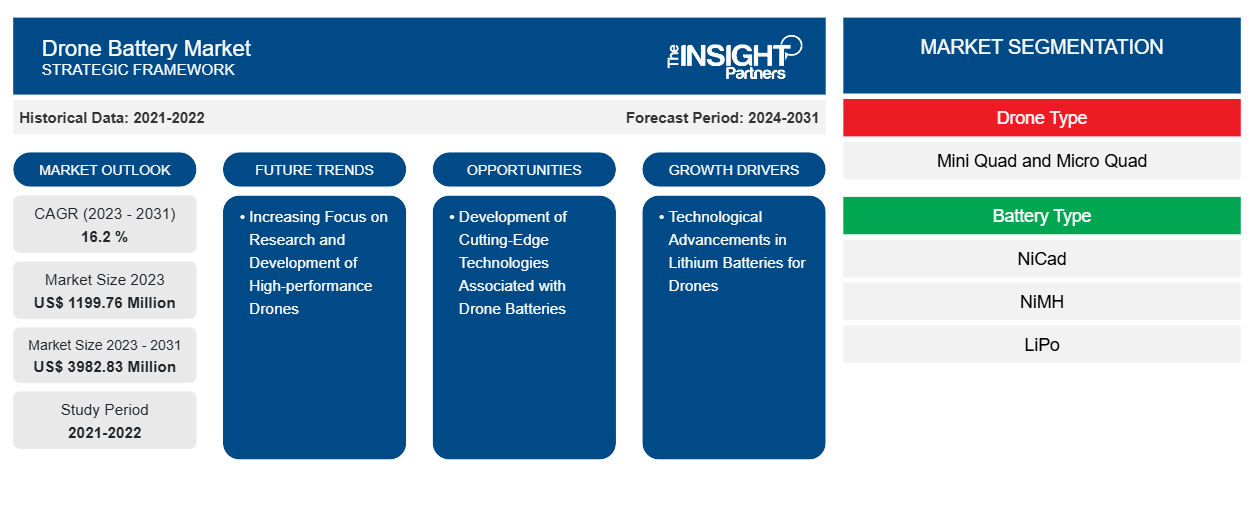
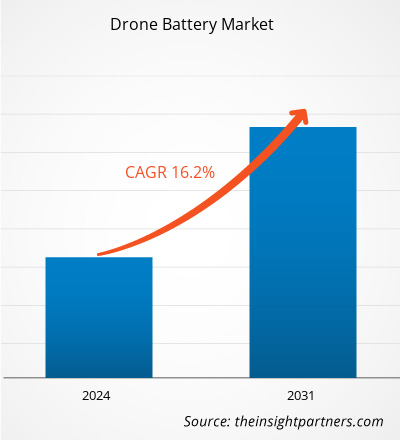
The Drone Battery Market was valued at US$ 1.62 Billion in 2025 and is projected to reach US$ 6.26 Billion by 2034, registering a CAGR of 16.2 % from 2026 to 2034. The Market is expanding as commercial, industrial, and public-sector drone operators require lighter, safer, and longer-duration power systems.
Across North America, Drone Battery Market size is expected to expand at a CAGR range of 14.8–16.0% as drone fleets scale in inspection, emergency response, precision agriculture, and public safety. Battery demand is supported by Federal Aviation Administration modernization, enterprise BVLOS pilots, and operators seeking high-cycle packs that reduce downtime across distributed field operations.
Drone Battery Market Assessment and Insights
- North America held 31–34% share in 2025 and is growing at a CAGR of 5.1–5.7% during 2026–2034, driven by hyperscale data centers, enterprise upgrades, and AI networking.
- US represented 78–82% of North American revenue in 2025 and is growing at a CAGR of 5.2–5.8% during 2026–2034, led by cloud and server demand.
- Europe accounted for 24–27% share in 2025 and is growing at a CAGR of 4.7–5.3% during 2026–2034, with Germany, the UK, France, Italy, and Spain leading deployments.
- Asia Pacific captured 29–33% share in 2025 and is growing at a CAGR of 5.9–6.6% during 2026–2034, led by China, Japan, South Korea, India, and Australia.
- Largest Segment Internal adapters held 58–62% market share in 2025 and are growing at a CAGR of 5.0–5.6% during 2026–2034 because server and desktop integration remains dominant.
- High Growth Segment Quad port adapters represented 18–22% market share in 2025 and are growing at a CAGR of 6.3–7.0% during 2026–2034, supported by dense servers and virtualized workloads.
- Key companies analyzed in detail: Anker Technology (UK) Ltd.; Apple Inc.; Belkin International, Inc.; Broadcom Inc.; Intel Corporation; Lenovo Group Limited; Marvell Technology, Inc.; NVIDIA Corporation; Plugable Technologies; Advanced Micro Devices, Inc.
Source: The Insight Partners' analysis based on proprietary research, government publications, company annual reports, investor presentations, industry databases, and expert interviews.
The drone battery market is evolving from hobbyist batteries to mission-oriented batteries with battery management capabilities and high rate discharge, thermal safety, and fast charging. The production factors for battery include lithium cell availability, packaging, connectors, certification, and battery integration into drone firmware. The market is moving towards customizing the batteries for applications like aerial agriculture spraying, aerial utility inspections, mining exploration, and site construction maps.
Going forward, the demand will expand through the creation of drone flight corridors in new geographies, government purchase of unmanned systems, and companies moving from piloted drones to continuous fleet operations. The investments will focus on high capacity LiPo batteries, semi-solid state batteries, intelligent battery chargers, and battery management analytics.
Drone Battery Market Report Scope
| Report Attribute | Details |
|---|---|
| Market size in 2025 | US$ 1.62 Billion |
| Market Size by 2034 | US$ 6.26 Billion |
| Global CAGR (2026 - 2034) | 16.2 % |
| Historical Data | 2021-2024 |
| Forecast period | 2026-2034 |
Drone Battery Market Analysis
The Drone Battery market is propelled by longer flight times, heavier sensors, automation of mapping, and growing drone usage in asset-heavy industries. The value chain includes cell manufacturers, pack assembly manufacturers, battery management systems engineers, drones OEMS, fleet owners, charger manufacturers, and maintenance vendors. Drones used in agriculture, utilities, inspections, constructions, and mining applications need batteries which offer good trade-offs between payload, flight time, safety, and field recharging time.
The supply situation remains focused on the lithium-polymer type because of its high discharge power and better weight to energy ratio. Nickel types have their importance where durability and low price are important. Buying decision is now being made based on cycle life, swelling resistance, traceability, and charger compatibility, not capacity only.
Positioning in the Drone Battery Market report relies on chemistry, pack customization, relationships with Original Equipment Manufacturer, safety, and services. Shenzhen Grepow Battery Co., Ltd. and MaxAmps compete through specialized LiPo packs for drones, whereas RRC power solutions GmbH provides power solutions for professional drones. The players that have an influence on demand are SZ DJI Technology Co., Ltd., Autel Robotics Co., Ltd., MMC-UAV, and Parrot Drone SAS.
Trends for investments in this market indicate that there should be more development in smart packs which can tell about the state of health, cell balancing, cycling, temperature, and faults to the operator. Such companies like SES AI Corporation and Amperex Technology Limited show the tendency towards more advanced cell technology. AMIT Industries L.T.D. works with batteries distribution regionally.
● REPORT CUSTOMIZATION
Tailor This Report To Align With Your Specific Business Requirements
This report can be customized to align precisely with your business objectives, scope, and target markets. Customization options include tailored segmentation, geography, competitive analysis, and strategic insights to support informed decision-making.
Customize This Report →WHAT YOU CAN ADJUST
- ● Segmentations
- ● Geography
- ● Competitive Analysis
- ● Language Preferences
Drone Battery Market: Strategic Insights
Regional Insights
North America Drone Battery Market
North America accounted for 31–34% market share in 2025 and will have a CAGR growth rate of 14.8–16.0% until 2034. The key drivers of Drone Battery Market share in North America are inspection services for utilities, emergency services, precision agriculture, surveying, and infrastructure monitoring. There is FAA integration of UAS, increased number of enterprise drones, and high demand for battery solutions meeting all safety and logistical needs in the region.
Key drivers of demand for drone battery solutions in North America are public safety in the USA, power grids, mining locations, construction companies, and applications connected to defense in the USA. Canada adds forestry and pipelines inspection, remote infrastructure monitoring, while Mexico is characterized by the need for battery solutions in construction, mining, and industrial security.
U.S. Drone Battery Market
The US represented 78–81% of North America in 2025 and is forecast to grow at a CAGR range of 15.0–16.3%. Company presence includes SZ DJI Technology Co., Ltd., Autel Robotics Co., Ltd., MaxAmps, SES AI Corporation, RRC power solutions GmbH, and Shenzhen Grepow Battery Co., Ltd. through drone platforms, custom packs, chargers, and professional energy solutions.
Usage trends center on line inspection for utility lines, wildfire detection, construction monitoring, law enforcement assistance, and crop scouting. Buyers consider batteries based on their ability to guarantee safe operation and FAA-compliance, thermally protect equipment and offer warranties. Domestic manufacturing of batteries from suppliers like MaxAmps is attractive for critical missions and custom solutions.
Europe Drone Battery Market
Europe held 20–23% share in 2025 and is expected to grow at a CAGR range of 13.9–15.2%. Germany leads through industrial inspection, energy assets, and advanced manufacturing sites. The UK shows demand in surveying, policing, and infrastructure monitoring. France, Italy, and Spain contribute through agriculture, public safety, construction, and renewable energy inspection.
The European consumers give great importance to safety certificates, battery logistics management, and reliable behavior according to EASA regulations for drones. The companies RRC power solutions GmbH, Parrot Drone SAS, SZ DJI Technology Co., Ltd., Autel Robotics Co., Ltd., and Shenzhen Grepow Battery Co., Ltd. provide products in demand with the help of professional battery packs and drone systems.
APAC Drone Battery Market
Asia Pacific had the market share of 36-39% in 2025 and is estimated to grow at a CAGR of 17.0-18.4%. Asia Pacific has its leading role due to China that makes drones in large numbers and uses them for agricultural spraying, mapping, and surveillance. High reliability inspection in Japan and South Korea and mining, utilities, forestry, and agriculture in India and Australia create additional demands.
Drivers for industrial development and government actions are drone-as-a-service adoption, domestic programs of unmanned aerial vehicle manufacture, and increased application of unmanned aerial vehicles in remote locations operations. Closeness of battery suppliers to cell manufacturers and drone OEM assembly plants is beneficial for them. APAC Market is growing the most rapidly in regions where high-capacity batteries are required to fly long distances.
Middle East & Africa Drone Battery Market
Middle East & Africa is projected to grow at a CAGR range of 14.2–15.8% as Saudi Arabia, the UAE, South Africa, and the rest of MEA expand drone use in energy assets, construction megaprojects, mining, and border monitoring. The UAE leads through smart-city programs, while Saudi Arabia contributes through infrastructure and oilfield inspection.
South Africa supports mining, agriculture, and security applications, although procurement remains project-led. Buyers prioritize batteries that tolerate heat, dust, rough transport, and long field days. Regional adoption improves when suppliers bundle chargers, spare packs, operator training, and maintenance support with drone platforms.
Segmentation Analysis
Drone Type
Drone Type is expected to grow at a CAGR range of 15.2–16.8% during 2026–2034 as Drone Battery Market scope covers Mini Quad and Micro Quad platforms. Demand depends on payload, maneuverability, inspection distance, and operator skill. Mini quad drones dominate professional field operations, while micro quad drones support training, indoor inspection, confined-area monitoring, and cost-sensitive deployment.
- Mini Quad platforms require compact high-discharge packs that support stable lift, camera payloads, and repeat field missions across agriculture, construction, mining, and utility inspection workflows.
- Micro Quad drones use smaller batteries optimized for agility, safety, and affordability, serving indoor inspection, education, pilot training, and short-duration monitoring where payload demands remain limited.
Battery Type
Battery Type is projected to grow at a CAGR range of 15.5–17.0% during 2026–2034 as NiCad, NiMH, and LiPo technologies serve different reliability, cost, and performance needs. LiPo dominates because drones require light weight, high current output, and flexible pack shapes. Nickel-based chemistries remain limited to rugged, lower-performance, or legacy uses.
- NiCad batteries retain narrow use where rugged discharge behavior and tolerance for harsh handling matter more than energy density, but environmental restrictions limit broader adoption.
- NiMH batteries offer safer handling and lower memory effects than NiCad, supporting selected training or low-cost drones where high discharge and extreme lightness are not essential.
- LiPo batteries are strategically central because they deliver high energy density, strong discharge rates, and flexible formats for drones carrying cameras, sprayers, sensors, and inspection payloads.
Battery Capacity
Battery Capacity is expected to grow at a CAGR range of 16.0–17.5% during 2026–2034 as operators match pack size to route length, payload, and recharge strategy. Below 3,000 mAh batteries serve micro and training drones, while 3,000–10,000 mAh supports mainstream operations. Above 10,000 mAh packs address heavy-payload and long-endurance missions.
- Below 3, 000 mAh batteries serve micro quad drones, indoor use, and training fleets where short flight cycles, low weight, and affordable replacement matter more than endurance.
- 3, 000-5, 000 mAh batteries support compact professional drones used for inspection, mapping, and light imaging tasks requiring balanced flight time, portability, and quick field swaps.
- 5, 000-10, 000 mAh batteries address more demanding commercial missions where payload stability, longer routes, and repeated sorties create higher dependence on quality cells and chargers.
- Above 10, 000 mAh batteries are critical for spraying, mining survey, infrastructure inspection, and heavy sensor payloads where operators value endurance, safety telemetry, and high-current reliability.
Industry
Industry is projected to grow at a CAGR range of 16.1–17.8% during 2026–2034 as adoption varies by mission frequency, payload, and asset geography. Agriculture and forestry require endurance and field charging, infrastructure inspection and utilities need reliability near critical assets, while construction and mining use batteries for mapping, monitoring, and safety oversight.
- Agriculture & Forestry uses drone batteries for spraying, crop scouting, tree health monitoring, and fire-risk assessment, making uptime and field recharge capability central to fleet productivity.
- Infrastructure Inspection depends on stable power for bridges, roads, towers, and industrial assets where consistent flight behavior improves image quality and reduces repeat missions.
- Utilities require reliable batteries for powerline, pipeline, solar, and wind inspection, where route length, safety margins, and rugged handling influence procurement decisions.
- Construction applies drones for progress monitoring, volumetric measurement, and site safety documentation, favoring batteries that support frequent short missions across multiple project locations.
- Mining relies on higher-capacity packs for pit mapping, stockpile measurement, haul-road monitoring, and hazardous-area inspection where endurance and durability reduce operational interruption.
Opportunity Snapshot
Market Opportunity Snapshot
| Industry | Revenue Contribution | Trend Tag | Adoption Stage |
| Agriculture & Forestry | High | Spray Fleets | Scaling |
| Infrastructure Inspection | High | Asset Scans | Scaling |
| Utilities | High | Grid Patrol | Mature |
| Construction | Medium | Site Mapping | Scaling |
| Mining | Medium | Pit Survey | Scaling |
Drone Battery Market Growth Drivers and Impact Analysis
Commercial Drone Fleets Need Longer Productive Flight Windows
Agricultural spraying, utility inspection, construction mapping, and mining surveying operations have the need for the drone to remain airborne for sufficient time to complete the mission without incurring too many battery changes. The battery performance influences the cost of labor, mission planning, and data consistency. Higher capacity lithium polymer batteries, battery management systems, and fast chargers minimize downtime while also enhancing reliable energy reserves. The effects of the market are seen in terms of fleet acquisition when multiple certified batteries are bought for each drone on the cycle-life schedule.
Industrial Inspection Expands Demand for Rugged Smart Packs
Utilities, mining firms, and infrastructure providers rely more on drones near assets, where any malfunction might pose risks to safety, costs, or regulations. Batteries need to withstand vibrations, dust, temperature changes, high altitudes, and multiple transportation while providing reliable power for the cameras, LiDAR, thermography, and communication modules. "Smart" batteries with cell monitoring, malfunction indication, and tracking of charge cycles minimize uncertainties in operations. It has the most effect in professional applications, where purchase departments buy more expensive batteries because of their proven reliability than capacity.
Advanced Cell Chemistry Improves Payload Economics
Drone operators need more power density since each gram of weight saved extends battery life or adds to payload capacity, with options for better sensors, spray dispensers, or communication modules. Advances in LiPo, high voltage lithium batteries, semi-solid state technology, and AI optimized cell chemistry are creating greater anticipation for extended life and increased safety. The effect on the market is an increasing connection between battery advancements and drone business models. More advanced batteries result in fewer flights, reduced pilot time, and expanded roles for drones in remote operations.
Drone Battery Market Future Trends
AI-Based Battery Health Monitoring
Drone Battery Market trends will increasingly center on AI-based battery health monitoring that predicts degradation before field failure. Future systems will combine voltage curves, temperature history, charge behavior, swelling indicators, and mission profiles to recommend retirement or maintenance. This will matter for fleets operating in utilities, mining, and public safety, where unexpected voltage sag can disrupt inspections or create safety risks. Operators will prefer packs and chargers that generate usable diagnostics rather than simple state-of-charge readings. The trend will also support service-based revenue models because suppliers can offer analytics, lifecycle planning, and warranty validation.
High-Capacity Packs for Heavy Industrial Payloads
Industrial drone payloads are becoming heavier as operators add LiDAR, multispectral cameras, sprayers, gas sensors, and communication modules. Future demand will move toward high-capacity packs with improved discharge stability, thermal design, and rugged enclosures. These batteries will support longer missions in mining, agriculture, utilities, and infrastructure inspection where travel time to assets is costly. Suppliers will need to balance capacity with safe transport, faster charging, and pack standardization. The trend favors companies that can customize battery architecture around real mission profiles rather than selling capacity as a standalone specification.
Drone Battery Market Opportunities
Battery-as-a-Service for Enterprise Drone Fleets
Drone Battery Market Forecasts indicate an opportunity to package batteries, chargers, health analytics, replacement schedules, and compliance documentation into subscription models for enterprise fleets. Operators in utilities, construction, agriculture, and mining often manage dozens of packs across multiple field teams and need predictable availability. Suppliers can reduce procurement friction by offering certified packs, digital cycle records, safe logistics support, and scheduled replenishment. This model creates recurring revenue while helping customers avoid performance variability from aging batteries. The strongest opportunity sits with vendors that combine hardware, software, and maintenance support into one accountable power-management program.
Localized Assembly and Certified Supply Chains
Localized assembly creates an opportunity as public agencies, defense-adjacent buyers, and critical-infrastructure operators scrutinize battery sourcing, transport compliance, and service responsiveness. Suppliers can differentiate by assembling packs closer to demand centers, documenting cell provenance, and offering rapid repair or replacement. This approach is particularly relevant in North America, Europe, and Australia, where mission-critical users value traceable supply and reduced shipping risk for lithium batteries. Investment should focus on quality systems, certified packaging, thermal testing, and customer-specific pack engineering. Localized capability can convert battery procurement from a commodity purchase into a strategic reliability decision.
Recent Developments
- July 2026: Re:Build Manufacturing today announced the launch of U.S.-assembled lithium-ion battery packs for unmanned aerial vehicle (UAV) applications, now available for purchase through Re:Build’s website.
- July 2026: DJI Agriculture announced the global launch of Agras T55 and T100 dual-battery spraying systems, reinforcing demand for high-capacity field-replaceable packs in crop protection and precision farming. The launch highlights how agricultural drones increasingly depend on battery architecture that supports payload, fast turnaround, and operational safety.
- January 2025: SES AI Corporation unveiled an AI-enhanced 2170 cylindrical cell for robotics and drone applications at CES 2025. The company said the cell uses an electrolyte discovered through its Molecular Universe initiative and targets improved low-temperature performance, rate capability, cycling stability, and reduced thermal risk.
Frequently Asked Questions

- Comprehensive Market Sizing and Forecast Analysis
- Detailed Segmentation Analysis
- In-Depth Market Dynamics Assessment
- Regional and Country-Level Insights
- Competitive Landscape and Company Benchmarking
- Strategic Business Intelligence
Recent Reports
Testimonials

The Insight Partners' SCADA System Market report is comprehensive, with valuable insights on current trends and future forecasts. The team was highly professional, responsive, and supportive throughout. We are very satisfied and highly recommend their services.
RAN KEDEM Partner, Reali Technologies LTDs
I requested a report on a very specific software market and the team produced the report in a few days. The information was very relevant and well presented. I then requested some changes and additions to the report. The team was again very responsive and I got the final report in less than a week.
JEAN-HERVE JENN Chairman, Future Analytica
We worked with The Insight Partners for an important market study and forecast. They gave us clear insights into opportunities and risks, which helped shape our plans. Their research was easy to use and based on solid data. It helped us make smart, confident decisions. We highly recommend them.
PIYUSH NAGPAL Sr. Vice President, High Beam Global
The Insight Partners delivered insightful, well-structured market research with strong domain expertise. Their team was professional and responsive throughout. The user-friendly website made accessing industry reports seamless. We highly recommend them for reliable, high-quality research services
YUKIHIKO ADACHI CEO, Deep Blue, LLC.
This is the first time I have purchased a market report from The Insight Partners.While I was unsure at first, I visited their web site and felt more comfortable to take the risk and purchase a market report.I am completely satisfied with the quality of the report and customer service. I had several questions and comments with the initial report, but after a couple of dialogs over email with their analyst I believe I have a report that I can use as input to our strategic planning process.Thank you so much for taking the extra time and making this a positive experience.I will definitely recommend your service to others and you will be my first call when we need further market data.
JOHN SUZUKI President and Chief Executive Officer, Board Director, BK Technologies
I wish to appreciate your support and the professionalism you displayed in the course of attending to my request for information regarding to infectious disease IVD market in Nigeria. I appreciate your patience, your guidance, and the fact that you were willing to offer a discount, which eventually made it possible for us to close a deal. I look forward to engaging The Insight Partners in the future, all thanks to the impression you have created in me as a result of this first encounter.
DR CHIJIOKE ONYIA MANAGING DIRECTOR, PineCrest Healthcare Ltd.Reason to Buy
- Informed Decision-Making
- Understanding Market Dynamics
- Competitive Analysis
- Identifying Emerging Markets
- Customer Insights
- Market Forecasts
- Risk Mitigation
- Boosting Operational Efficiency
- Strategic Planning
- Investment Justification
- Tracking Industry Innovations
- Aligning with Regulatory Trends





 Get Free Sample for