
Eco-Friendly Plasticizers Market Share, Demand & Growth by 2034
Eco-Friendly Plasticizers Market Size and Forecasts (2021–2034), Global and Regional Share, Trends, and Growth Opportunity Analysis Report Coverage : by Product (Bio-based, Non-phthalate); Application (Packaging, Consumer Goods, Automotive & Transportation, Building & Construction, Textile, Agriculture & Horticulture); and Geography (North America, Europe, Asia Pacific, and South and Central America)
- Status : Data Released
- Report Code : TIPRE00040484
- Category : Chemicals and Materials
- No. of Pages : 150
- Available Report Formats :


- Last update date : August 07, 2026


2025 Market Size
US$ 5.46 Bn
Base year value
2034 Forecast
US$ 9.43 Bn
Projected by 2034
CAGR 2026-2034
6.26 %
Growth rate
Addressable Market
US$ 67.39 Bn
(2026-2034)
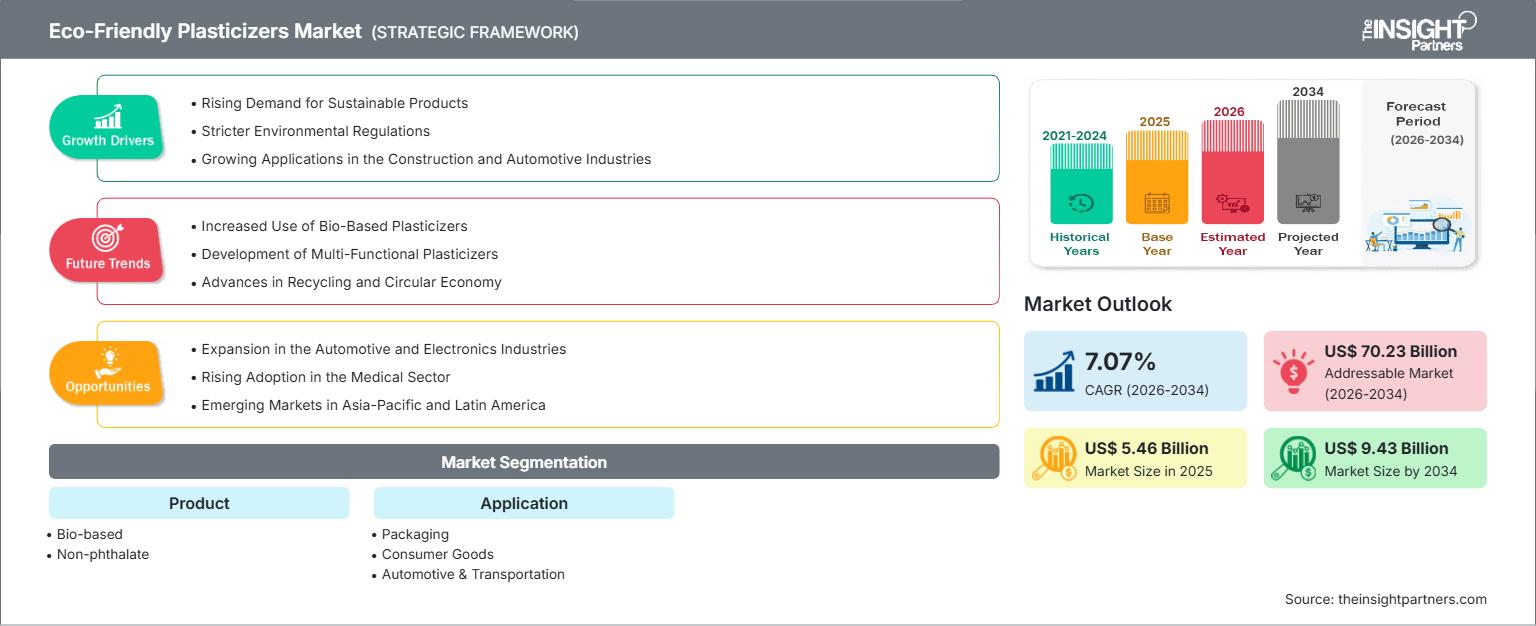
The Eco-Friendly Plasticizers market was valued at US$ 5.46 billion in 2025 and is expected to reach US$ 9.43 billion by 2034; it is estimated to record a CAGR of 6.26% during 2026-2034.
Eco-Friendly Plasticizers Market Assessment and Insights
- North America: Share in 2025 of 28–32% and CAGR between 6.3–7.3%. Demand is supported by regulated packaging, medical, wire and cable, and construction applications requiring safer, traceable, and lower-emission plasticizer systems.
- US: Share in 2025 of 76–80% of North America and CAGR between 6.4–7.4%. Strong compounder capacity, brand sustainability programs, and food-contact clearances support adoption.
- Europe: Share in 2025 of 24–28% and CAGR between 6.0–7.0%. Germany, France, Italy, and the UK lead demand through REACH-driven substitution and specialty PVC processing.
- Asia Pacific: Share in 2025 of 34–38% and CAGR between 7.8–8.8%. China, India, Japan, and South Korea benefit from packaging growth, automotive production, and expanding flexible polymer manufacturing.
- Largest Segment: Non-phthalate products held market share of 58–62% in 2025 and CAGR of 6.6–7.6% during 2026–2034, reflecting broad regulatory acceptance.
- High Growth Segment: Bio-based products held market share of 38–42% in 2025 and CAGR of 7.9–8.9% during 2026–2034, supported by renewable feedstock strategies.
- Key companies analyzed in detail: BASF SE, Avient Corporation, Cargill, Incorporated, DIC Corporation, Dow Inc., Emery Oleochemicals Group, Evonik Industries AG, Goldstab Organics Pvt. Ltd., Jiaao Enprotech Stock Co., Ltd., ACS Technical Products, Inc.
Source: The Insight Partners' analysis based on proprietary research, government publications, company annual reports, investor presentations, industry databases, and expert interviews.
Substitution of material has shifted from compliance exercise to technology transition in flexible polymer systems. Companies have started upgrading their formulations of citrates, adipates, trimellitates, epoxidized oils, and vegetable oil based products to find a balance between migration resistance, volatility, processability, and cost. The change will also affect the procurement strategies of companies as converters now need to see proof of toxicology, carbon footprints, renewability, and food contact suitability before selecting the plasticizer supplier.
Future demand would depend on local capacity, availability of certified feedstock, and validation cycles. Asia Pacific region will continue to be the biggest growth driver, whereas North America and Europe will raise the bar in terms of compliance standards. Investments will be focused on drop-in technologies without reformulation risk, bio-based intermediate, and technical services for performance validation.
Eco-Friendly Plasticizers Market Report Scope
| Report Attribute | Details |
|---|---|
| Market size in 2025 | US$ 5.46 Billion |
| Market Size by 2034 | US$ 9.43 Billion |
| Global CAGR (2026 - 2034) | 6.26% |
| Historical Data | 2021-2024 |
| Forecast period | 2026-2034 |
Eco-Friendly Plasticizers Market Analysis
The Growth Dynamics of Eco-Friendly Plasticizers Industry is the result of the harmonization of chemical regulation policies, sustainability objectives of brands, and functional properties required from PVC. Packaged goods converters, toy makers, automakers, and building materials manufacturers reduce reliance on traditional phthalates where the specifications call for decreased toxicity. Demand is highest when plasticizers affect the flexibility, softness, sealing properties, low-temperature performance, and longevity of consumer goods.
Market forces depend on availability of alcohol, acid, vegetable oil, citrates, and other specialty intermediates. The companies which have backward integration ability, local logistics facility and testing laboratories will be faster in qualifying their products. The value chain includes the suppliers of raw materials, esterification facilities, compounders, original equipment manufacturers, converters and certifiers. This means that technical qualification is equally important as economics.
The Eco-Friendly Plasticizers market report shows that there has been an increased level of competition with regards to low carbon plasticizers, non-phthalate DOTP system, epoxidized soybean oil, and other specific bio-based esters. In terms of BASF SE and Dow Inc., it is because of the advantages they have with regards to chemical knowledge and large-scale customers, whereas for Cargill, Incorporated and Emery Oleochemicals Group, it is because of the renewable resources advantages. Evonik Industries AG and DIC Corporation gain benefits from their specialty chemicals expertise.
In the future, strategic positioning will become more and more associated with sustainability without loss of compatibility. Avient Corporation helps clients with compound design, while Goldstab Organics Pvt. Ltd., Jiaao Enprotech Stock Co., Ltd., and ACS Technical Products, Inc. serve regional and specialty additives demands.
● REPORT CUSTOMIZATION
Tailor This Report To Align With Your Specific Business Requirements
This report can be customized to align precisely with your business objectives, scope, and target markets. Customization options include tailored segmentation, geography, competitive analysis, and strategic insights to support informed decision-making.
Customize This Report →WHAT YOU CAN ADJUST
- ● Segmentations
- ● Geography
- ● Competitive Analysis
- ● Language Preferences
Eco-Friendly Plasticizers Market: Strategic Insights
Regional Insights
North America Eco-Friendly Plasticizers Market
North America held 28–32% of the Eco-Friendly Plasticizers market share in 2025 and is anticipated to register a 6.3–7.3% CAGR from 2025 to 2034. The positioning in the Market is backed by regulations for flexible PVC usage in packaging, healthcare-associated materials, flooring, wire & cables, and consumer goods. The demands are bolstered by the EPA Safer Choice recommendations, food contact regulations by the FDA, and the substitution efforts of brands.
The demand for the eco-friendly products comes from customers who are asking for toxicology data, migration stability information, and carbon footprint analysis of the materials used in the manufacturing process. ISCC PLUS certified North American plasticizer grades from BASF SE provide good examples of the shift towards mass-balance and circular feedstocks models. The compounders are keen on having technical support from the suppliers due to lengthy qualification processes.
U.S. Eco-Friendly Plasticizers Market
In the North American region, the U.S. constituted the share of 76-80% in 2025 and is anticipated to grow at CAGR of 6.4-7.4%. The demand is expected to be prominent in flexible vinyl products, food contact packaging materials, flooring, coated fabrics, and interior automotive applications. The domestic compounders have access to developed testing facilities and relationships with brand owners looking for safer and more stable additives.
The companies operating in this region include BASF SE, Dow Inc., Avient Corporation, Cargill, Incorporated, and ACS Technical Products, Inc. The application trends indicate an increased use of non-phthalate DOTP, trimellitate, citrate, and epoxidized oil-based systems, where there is a need for lower volatility and better durability or safety for consumers.
Europe Eco-Friendly Plasticizers Market
Europe occupied 24–28% share of global revenue in 2025 and is expected to witness a 6.0–7.0% CAGR. Germany is a market leader due to its automotive interiors, flooring, cables, and technical polymer processing industries. REACH restrictions, circular economy goals, and purchaser interest in hazardous substances stimulate the demand for non-phthalate and biobased plasticizers.
The market in the UK is driven by the renovation of constructions, health care purchasing, and retailers' green policies. The contributions of France, Italy, and Spain come from packaging, footwear, coated fabrics, agricultural films, and consumer goods manufacturing. European purchasers have high demand for documents related to compliance, migration information, and producer traceability.
APAC Eco-Friendly Plasticizers Market
Asia Pacific represents 34-38% share of global revenue in 2025 and is expected to grow at a CAGR of 7.8-8.8%. The leading countries include China owing to large capacity of PVC processing, packaging production, and flexible polymers consumption for construction purpose. Japan and South Korea focus on high-end formulations for automotive, electronics, and consumer products industries.
Contribution to growth comes from India and Australia through packaging, infrastructure, footwear, and agricultural films. Pressure for regulation of dangerous additives is becoming less consistent, but multinationals' brand requirements accelerate their implementation in export chains. Larger volumes give an advantage to local producers, but certification for regulated uses requires more documentation and control of processes.
Middle East & Africa Eco-Friendly Plasticizers Market
The Middle East & Africa region is forecast to expand at a CAGR of 5.8-6.8%. Growth in the Middle East region will be driven by investments in infrastructure, wire and cable, flooring, and packaging due to diversification of industries in the region led by Saudi Arabia. In the UAE, growth is supported by construction, hospitality, and consumer goods distribution, which rely on durable flexible polymers.
Growth in South Africa is attributed to packaging, agricultural films, and building applications, while the remaining Middle East & Africa region is driven by projects. Raw material availability in the region through regional integration within the petrochemical industry offers significant advantage to eco-friendly grades that require technology transfer and customer qualification.
Segmentation Analysis
Product
The Product segment is expected to grow at a 7.0–8.0% CAGR during 2026–2034. The market scope is defined by two principal product routes: bio-based systems that improve renewable content and non-phthalate systems that address toxicology and regulatory acceptance. Buyers evaluate performance through migration, volatility, compatibility, odor, color stability, and processing behavior.
- Bio-based: Bio-based plasticizers are gaining strategic importance as brand owners pursue renewable content and lower lifecycle impact. Demand is strongest where vegetable-oil derivatives, citrates, and epoxidized oils meet performance needs.
- Non-phthalate: Non-phthalate plasticizers remain the largest product group because they offer practical substitution for regulated applications. Adoption is supported by DOTP, trimellitate, adipate, and citrate chemistries with broad PVC compatibility.
Application
The Application segment is projected to grow at a 6.8–7.8% CAGR through 2034. Demand is shaped by downstream sectors that require flexible, durable, and safer polymer systems. Packaging and consumer goods drive volume, while automotive, construction, textiles, and agricultural films demand specific performance attributes such as low migration, weatherability, heat stability, and mechanical retention.
- Packaging: Packaging demand is supported by food-contact scrutiny, retailer sustainability commitments, and consumer preference for safer materials. Flexible films, closures, coatings, and seals require validated additives with consistent processing performance.
- Consumer Goods: Consumer goods use reflects demand for safer toys, household items, footwear, and soft-touch products. Brand owners prioritize plasticizers with favorable toxicology profiles, low odor, and durable flexibility.
- Automotive & Transportation: Automotive and transportation applications require low fogging, heat resistance, and stable interior performance. Adoption rises as OEMs tighten restricted-substance lists and seek sustainable material credentials.
- Building & Construction: Building and construction uses include flooring, wall coverings, roofing membranes, sealants, and wire insulation. Demand is supported by durability, fire-performance needs, and compliance-driven substitution.
- Textile: Textile applications use plasticizers in coated fabrics, synthetic leather, protective apparel, and technical textiles. Buyers value flexibility, abrasion resistance, clean aesthetics, and reduced exposure concerns.
- Agriculture & Horticulture: Agriculture and horticulture demand comes from films, hoses, greenhouse covers, and irrigation products. Weather resistance, flexibility, and safer handling characteristics support adoption in intensive farming systems.
Opportunity Snapshot
| Application | Revenue Contribution | Trend Tag | Adoption Stage |
| Packaging | High | Food Contact | Scaling |
| Consumer Goods | High | Toy Safety | Mature |
| Automotive & Transportation | Medium | Low Fogging | Scaling |
| Building & Construction | High | Flexible PVC | Mature |
| Textile | Medium | Coated Fabrics | Scaling |
| Agriculture & Horticulture | Medium | Greenhouse Films | Emerging |
Eco-Friendly Plasticizers Market Growth Drivers and Impact Analysis
Regulatory Substitution of Phthalate Plasticizers
Regulatory pressure remains the most direct catalyst for market conversion because many downstream products are sold into sensitive consumer, food-contact, medical-adjacent, and building environments. Restrictions on substances of concern, supplier restricted-substance lists, and customer audits are forcing processors to qualify safer additives before contract renewal. The impact is visible in flexible PVC packaging, toys, coated textiles, flooring, and wire insulation, where buyers increasingly request non-phthalate documentation. This driver supports premium pricing for certified alternatives, increases technical service demand, and favors producers that can provide migration, toxicology, and lifecycle information. As more procurement teams embed chemical-safety criteria into supplier scorecards, compliant plasticizers are becoming a baseline requirement rather than a specialty option.
Expansion of Sustainable Packaging and Consumer Products
Packaging and consumer goods manufacturers are under pressure to reduce perceived chemical risk while maintaining flexibility, seal integrity, clarity, and processing efficiency. Food-contact films, closures, soft packaging components, toys, footwear, and household products create large-volume opportunities for eco-friendly additives. The market impact is strongest where brand owners set global material standards that cascade through regional suppliers. This creates recurring demand for validated formulations that can be used across multiple plants without extensive redesign. Producers that offer consistent quality and regulatory dossiers can shorten approval cycles for converters. The driver also strengthens demand for renewable content, especially when consumer brands communicate sustainability benefits through packaging claims and responsible sourcing programs.
Performance Improvement in Bio-Based Chemistries
Bio-based plasticizers are gaining wider acceptance because formulation performance has improved across volatility, compatibility, thermal stability, and migration resistance. Earlier adoption was limited by cost and technical trade-offs, but advances in epoxidized vegetable oils, citrate esters, succinate derivatives, and specialty bio-esters are expanding addressable applications. Market impact includes broader use in flexible PVC compounds, coated fabrics, agricultural films, and selected automotive interiors. Improved performance reduces the reformulation burden for processors and helps suppliers position bio-based grades as functional alternatives rather than niche green products. As production scale increases and feedstock sourcing becomes more reliable, bio-based plasticizers can capture greater share in applications where sustainability credentials influence supplier selection.
Eco-Friendly Plasticizers Market Future Trends
Certified Mass-Balance and Circular Feedstock Models
Eco-Friendly Plasticizers Market trends point toward wider adoption of certified mass-balance and circular feedstock approaches as producers respond to customer pressure for measurable carbon and resource benefits. These models allow suppliers to use renewable or chemically recycled inputs while preserving drop-in product performance, which lowers conversion risk for compounders. Certification systems such as ISCC PLUS are likely to become more important in procurement discussions because they provide traceability and auditability. Over the forecast period, producers with certified assets can differentiate in packaging, wire and cable, and automotive supply chains. The trend will also encourage collaboration between plastic waste handlers, petrochemical producers, and additive manufacturers seeking circular material pathways.
Application-Specific Plasticizer Formulation Platforms
Future development will move beyond generic substitution toward application-specific formulation platforms. Automotive interiors require low fogging and heat resistance, packaging needs migration control, construction products need weatherability, and textiles require durable hand feel. Suppliers are therefore expected to build tailored product families supported by test data, processing guidance, and regulatory documentation. This trend will increase the role of technical service teams and joint development programs with compounders. It may also raise switching costs because customers will rely on validated formulations that reduce production risk. Companies able to combine chemistry breadth with application engineering will be better positioned to win long-term supply agreements.
Eco-Friendly Plasticizers Market Opportunities
Scaling Bio-Based Plasticizers in Export-Oriented APAC Supply Chains
Asia Pacific offers a compelling opportunity because many converters supply global consumer brands that increasingly require safer and more sustainable materials. Investment aligned with Eco-Friendly Plasticizers Market Forecasts should prioritize local production, technical qualification centers, and partnerships with packaging, footwear, toy, and textile manufacturers. China and India offer volume scale, while Japan and South Korea provide high-specification demand. Suppliers can gain share by helping exporters meet European and North American chemical-safety requirements without sacrificing cost competitiveness. The opportunity also extends to renewable feedstock sourcing, especially where vegetable oils and bio-based intermediates can be integrated into regional value chains.
Premium Non-Phthalate Systems for Regulated Applications
Regulated applications create attractive opportunities for suppliers that can provide premium non-phthalate systems with strong documentation. Food-contact packaging, medical-adjacent flexible goods, wire and cable, automotive interiors, and building products require additives that meet strict performance and compliance expectations. Investment should focus on migration testing, toxicology support, production consistency, and customer-specific formulation assistance. These areas offer better margins than commodity plasticizers because switching decisions are tied to risk reduction and qualification confidence. Companies with established regulatory expertise can use technical evidence to defend pricing, secure long-term agreements, and deepen relationships with compounders serving multinational end users.
Recent Developments
- April 2026: Effective April 13, 2026, or as contracts allow, Eastman Chemical Company will increase prices by USD 0.10/lb. (USD 0.22/kg) for all grades and packages of Eastman DOP Plasticizer and Eastman DOA Plasticizer.
- October 2025: Bhageria Industries has launched a new product line of Plasticizers & Ethoxylates, disclosed under SEBI's Regulation 30 on 08 October 2025. The plasticizers are designed to improve the flexibility and durability of PVC, targeted for use in cables, flooring, footwear, and automotive components, aiming to cater to both domestic and international markets due to rising demand in polymer-based value chains.
Frequently Asked Questions

- Comprehensive Market Sizing and Forecast Analysis
- Detailed Segmentation Analysis
- In-Depth Market Dynamics Assessment
- Regional and Country-Level Insights
- Competitive Landscape and Company Benchmarking
- Strategic Business Intelligence
Recent Reports
Testimonials

The Insight Partners' SCADA System Market report is comprehensive, with valuable insights on current trends and future forecasts. The team was highly professional, responsive, and supportive throughout. We are very satisfied and highly recommend their services.
RAN KEDEM Partner, Reali Technologies LTDs
I requested a report on a very specific software market and the team produced the report in a few days. The information was very relevant and well presented. I then requested some changes and additions to the report. The team was again very responsive and I got the final report in less than a week.
JEAN-HERVE JENN Chairman, Future Analytica
We worked with The Insight Partners for an important market study and forecast. They gave us clear insights into opportunities and risks, which helped shape our plans. Their research was easy to use and based on solid data. It helped us make smart, confident decisions. We highly recommend them.
PIYUSH NAGPAL Sr. Vice President, High Beam Global
The Insight Partners delivered insightful, well-structured market research with strong domain expertise. Their team was professional and responsive throughout. The user-friendly website made accessing industry reports seamless. We highly recommend them for reliable, high-quality research services
YUKIHIKO ADACHI CEO, Deep Blue, LLC.
This is the first time I have purchased a market report from The Insight Partners.While I was unsure at first, I visited their web site and felt more comfortable to take the risk and purchase a market report.I am completely satisfied with the quality of the report and customer service. I had several questions and comments with the initial report, but after a couple of dialogs over email with their analyst I believe I have a report that I can use as input to our strategic planning process.Thank you so much for taking the extra time and making this a positive experience.I will definitely recommend your service to others and you will be my first call when we need further market data.
JOHN SUZUKI President and Chief Executive Officer, Board Director, BK Technologies
I wish to appreciate your support and the professionalism you displayed in the course of attending to my request for information regarding to infectious disease IVD market in Nigeria. I appreciate your patience, your guidance, and the fact that you were willing to offer a discount, which eventually made it possible for us to close a deal. I look forward to engaging The Insight Partners in the future, all thanks to the impression you have created in me as a result of this first encounter.
DR CHIJIOKE ONYIA MANAGING DIRECTOR, PineCrest Healthcare Ltd.Reason to Buy
- Informed Decision-Making
- Understanding Market Dynamics
- Competitive Analysis
- Identifying Emerging Markets
- Customer Insights
- Market Forecasts
- Risk Mitigation
- Boosting Operational Efficiency
- Strategic Planning
- Investment Justification
- Tracking Industry Innovations
- Aligning with Regulatory Trends





 Get Free Sample for