
Electric DC Motors Market Size, Trends & Demand by 2034
Coverage: By Type (Brushed DC Motors and Brushless DC Motors), Speed (Low, Medium, and High), and Application (Industrial Machinery, Automotive and Transportation, HVAC Equipment, Aerospace & Defense, Household Appliances, and Others), and Geography
- Status : Data Released
- Report Code : TIPRE00014525
- Category : Electronics and Semiconductor
- No. of Pages : 150
- Available Report Formats :


- Last update date : August 12, 2026


2025 Market Size
US$ 18.75 Bn
Base year value
2034 Forecast
US$ 32.16 Bn
Projected by 2034
CAGR 2026-2034
6.18 %
Growth rate
Addressable Market
US$ 230.49 Bn
(2026-2034)
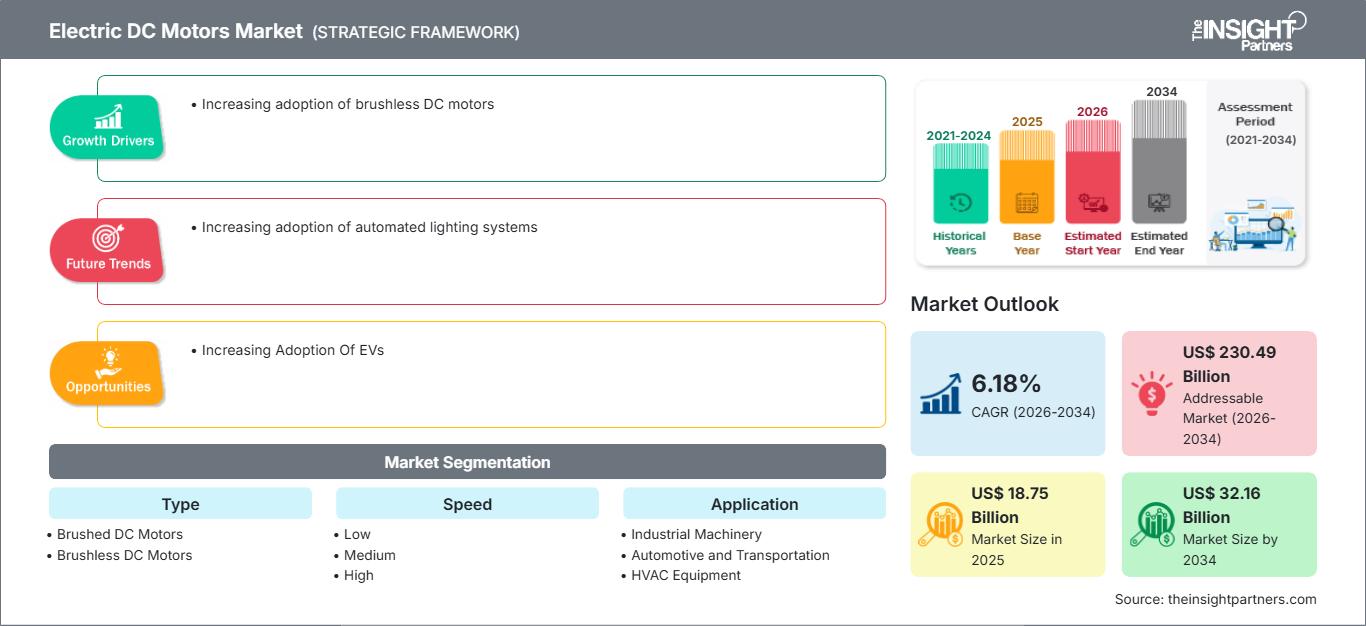
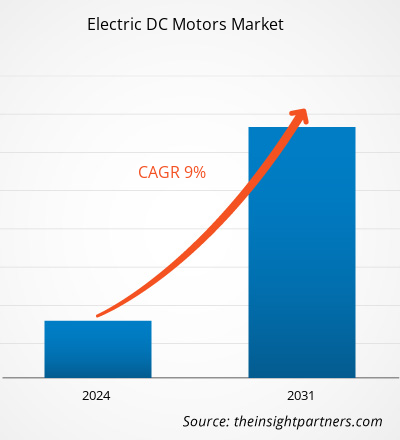
The Electric DC Motors Market was valued at US$ 18.75 Billion in 2025 and is projected to reach US$ 32.16 Billion by 2034, expanding at a CAGR of 6.18% during 2026–2034. Demand is increasing with the adoption of electric motion systems, automation in manufacturing processes, and transition from mechanical to electronic commutation systems in manufacturing companies. Automotive components, industrial machinery, heating ventilation air conditioning units, aerospace systems, and home appliances all together ensure diversified and solid income sources.
In North America, the Electric DC Motors Market growth rate is predicted to grow at 5.4-5.9% per year until 2034. Automation in factories, robotics in warehouses, and vehicle electrification ensure both replacement demand and demand for original equipment, while reshoring increases interest in compact motion systems. Procurement based on efficiency and engineering ecosystem also contribute to increased demand for brushless motors.
Electric DC Motors Market Assessment and Insights
- North America: Share in 2025 reached 30–32%, supported by automation, aerospace, and electrified mobility. The region is projected to record a CAGR between 2026–2034 of 5.4–5.9%.
- US: The country represented 81–83% of North American revenue in 2025 and is expected to grow at a 5.5–6.0% CAGR during 2026–2034.
- Europe: Share in 2025 was 24–26%, led by Germany, the UK, France, Italy, and Spain. Efficiency regulation supports a 5.7–6.2% CAGR between 2026–2034.
- Asia Pacific: Share in 2025 stood at 36–38%, with China, Japan, South Korea, and India leading production. The region should expand at a 6.8–7.3% CAGR between 2026–2034.
- Largest Segment: Brushless DC Motors held 61–64% market share in 2025 and should post a 7.0–7.5% CAGR through 2034 on efficiency and maintenance advantages.
- High Growth Segment: Automotive and Transportation captured 27–30% market share in 2025 and is projected to register a 7.3–7.8% CAGR during 2026–2034.
- Key companies analyzed in detail: ABB Ltd., Allied Motion Technologies Inc., AMETEK, Inc., Yaskawa Electric Corporation, MinebeaMitsumi Inc., Johnson Electric Holdings Limited, maxon motor ag, Nidec Corporation, Regal Rexnord Corporation, and Siemens AG.
Source: The Insight Partners' analysis based on proprietary research, government publications, company annual reports, investor presentations, industry databases, and expert interviews.
The motor design has gradually moved from brush/commutator technology to brushless designs with permanent magnets, electronic commutation, and sensing. Such a change increases power density, reduces friction, and enhances controllability of the motors in small form factors. Production becomes more localized in response to the customer need for short delivery times and reliable access to raw materials such as magnets, copper, semiconductor, and high-quality bearings. The Electric DC Motors Market increasingly favors producers that can offer complete package of motors, drivers, sensors, and applications engineering as opposed to pure components.
Investments in the coming years will extend to India, Southeast Asia, Mexico, and Eastern Europe as manufacturers bring the production of vehicles, household appliances, and automation equipment closer to consumers. This trend will be reinforced by the government’s promotion of efficient equipment and the use of electricity in transport systems, even though localization requirements will have an effect on sources of raw materials. Suppliers who offer a versatile platform for designing their products, easily reprogrammable controls, and easy maintainability will find favor as consumers will begin valuing efficiency and reliability along with low cost.
Electric DC Motors Market Report Scope
| Report Attribute | Details |
|---|---|
| Market size in 2025 | US$ 18.75 Billion |
| Market Size by 2034 | US$ 32.16 Billion |
| Global CAGR (2026 - 2034) | 6.18% |
| Historical Data | 2021-2024 |
| Forecast period | 2026-2034 |
Electric DC Motors Market Analysis
The Drivers for Growth in the Electric DC Motors market include the development of automation, electrified transport, variable speed air flow, and battery-operated devices. The demand starts with the OEM needs and continues through magnetics suppliers, copper suppliers, steel suppliers, bearings providers, sensors suppliers, power electronics suppliers, control components providers to integrators and distributors. Design of the brushless motors is applied where efficiency and reliability are more important than the higher cost of electronics.
The supply side is influenced by the availability of rare earth magnets, delivery period of semiconductors, capability of windings, and precision of machining. The firms use multi-sourcing for major inputs and standardize frames of motors in order to secure their supply chain. In 2024, more than 17 million electric cars were sold by the IEA; motor efficiency standards in Europe from 0.12 to 1,000 kW.
According to Electric DC Motors Market report, the market is highly fragmented due to the existence of diverse automation and motion firms. The competition among the market players includes ABB Ltd., Siemens AG, and Yaskawa Electric Corporation who include the motor in their bundle package together with drive and controller while Nidec Corporation, MinebeaMitsumi Inc., Johnson Electric Holdings Limited, and maxon motor ag target size and specialization in applications.
Capital investments are directed at motor-control packages integration, localization of production, and development of more efficient technologies. Strategic positioning is based on torque density, acoustic properties, thermal management, software compatibility, qualification services, and service network. In addition, suppliers are securing supply of magnets and electronics, establishing R&D centers close to their customers, and developing platforms for various applications, including automobile auxiliary systems, robotics, pumps, fans, and domestic equipment.
● REPORT CUSTOMIZATION
Tailor This Report To Align With Your Specific Business Requirements
This report can be customized to align precisely with your business objectives, scope, and target markets. Customization options include tailored segmentation, geography, competitive analysis, and strategic insights to support informed decision-making.
Customize This Report →WHAT YOU CAN ADJUST
- ● Segmentations
- ● Geography
- ● Competitive Analysis
- ● Language Preferences
Electric DC Motors Market: Strategic Insights
Regional Insights
North America Electric DC Motors Market
In 2025, it constituted 30–32% and is expected to grow at a 5.4–5.9% CAGR from 2026 to 2034. The Electric DC Motors market growth drivers include automation investments, aircraft manufacture, advanced HVAC requirements, and existing installations that need replacements. Growth in automobile and appliance manufacturing in Mexico adds up to demand in the USA and Canada.
Localization efforts encourage suppliers to set up winding, assembly, and application-engineering facilities near the customer. Automated warehousing, semiconductor manufacture, food processing, and data center cooling enlarge the addressable market. There is a trend towards procurement of brushless DC motors with feedback as maintenance is costly.
U.S. Electric DC Motors Market
US contributed 81-83% to the North American revenue in 2025 and is expected to increase by 5.5-6.0% on an annual basis up to 2034. Consumption diversity is due to production of cars, defense projects, logistics automation, and replacement needs for industrial machinery. ABB Ltd., Nidec Corporation, Regal Rexnord Corporation, AMETEK, Inc., and Allied Motion Technologies Inc. have relevant commercial/manufacturing presence. Today’s applications favor electronically commutated motors in ventilation, refrigeration, robots, pumps, and automotive ancillaries. Energy efficiency regulations by the government, cost calculations of customers, and reshoring drive applications for machines, while there is still a market for brushed motors in cost-conscious tools and actuation applications; nevertheless, the brushless approach prevails in new designs.
Europe Electric DC Motors Market
Europe constituted 24-26% in 2025 and is estimated to have a 5.7-6.2% CAGR. Germany is dominant through automation, automotive design and engineering, and machine tools export. The UK is attractive because of the applications that include aerospace, medical devices, and advanced manufacturing. France includes aerospace, rail systems, HVAC, and appliances requirements, while Italian packaging and machine tool clusters require small and more efficient motion control. The Spanish applications include automobile manufacturing and renewable energy applications. The requirements of ecodesign within European Union, which require IE4 standards for certain industrial electric motors, make suppliers create efficient solutions and compliance.
APAC Electric DC Motors Market
The Asia Pacific held 36-38% share in 2025 and is projected to grow at a CAGR of 6.8-7.3%. Leading players from China use electric vehicles, appliances, electronics, and industrial machinery while Japan and South Korea offer expertise in precision engineering and robotics.
Manufacture and investments in infrastructure by India and the manufacture of electric cars result in manufacturing locally while Australia focuses on mining, HVAC, and material handling needs. This is made possible by scale economies in the region in magnets, electronics, and motor assembly.
Middle East & Africa Electric DC Motors Market
The region is expected to grow at a 4.8–5.3% CAGR through 2034. Saudi Arabia leads as industrial diversification, logistics, water, and building programs increase demand for pumps, fans, conveyors, and automated equipment.
The UAE builds data centers, aircrafts and smart building constructions while South Africa provides mining operations and industrial replacements. In Rest of MEA, problems with the grid system and difficult operating environment make durable and efficient motors more preferable despite the small production base in the region.
Segmentation Analysis
Type
The Type segment is projected to grow at a 6.1–6.6% CAGR during 2026–2034. The Market scope spans economical brushed platforms and higher-value brushless architectures. Selection hinges on duty cycle, controllability, acoustic limits, maintenance access, and electronics cost. Brushless adoption accelerates in continuous-duty and precision systems, while brushed products preserve a practical role where simplicity and low initial cost dominate.
- Brushed DC Motors: These units retain a meaningful position in tools, actuators, toys, and intermittent machinery because control is simple, replacement channels are established, and acquisition costs remain comparatively low.
- Brushless DC Motors: This largest sub-segment benefits from high efficiency, long service life, quiet operation, and precise electronic control, making it strategically central to EV auxiliaries, robotics, HVAC, and premium appliances.
Speed
The Speed segment should advance at a 5.9–6.4% CAGR through 2034. Motor speed selection increasingly reflects system-level optimization rather than a standalone rating. Gear ratios, cooling, torque curves, control algorithms, and noise constraints determine fit. Medium-speed platforms serve the broadest industrial base, while high-speed designs gain from compact compressors and blowers and low-speed products support direct-drive motion.
- Low: Low-speed motors support direct-drive conveyors, actuators, pumps, and positioning systems where starting torque, controllability, and reduced gearbox complexity matter more than maximum rotational output.
- Medium: Medium-speed units occupy a broad addressable base across industrial machinery, appliances, HVAC equipment, and automotive auxiliaries, balancing usable torque, thermal performance, component availability, and manageable acoustic behavior.
- High: High-speed designs are strategically important for compact blowers, compressors, spindles, and aerospace systems, where power density and smaller packaging justify sophisticated bearings, balancing, cooling, and electronic control.
Application
The Application segment is forecast to register a 6.2–6.7% CAGR during 2026–2034. Adoption varies by qualification cycle, operating environment, duty profile, and lifecycle economics. Automotive electrification supplies the strongest incremental pull, while industrial machinery provides diversified recurring demand. HVAC, aerospace, and appliances reward suppliers that combine motor efficiency with compact packaging, low noise, and reliable control electronics.
- Industrial Machinery: Automation, robotics, packaging, material handling, and machine tools sustain demand for controllable torque and rapid response, while retrofit projects create recurring opportunities for compatible motors, drives, and feedback systems.
- Automotive and Transportation: Propulsion-adjacent auxiliaries, pumps, fans, seats, steering, braking, and thermal-management systems make this the high-growth application, with qualification rigor favoring scalable, efficient, and traceable platforms.
- HVAC Equipment: Variable airflow, quiet operation, and energy-conscious building codes support brushless adoption in fans, blowers, compressors, and pumps, particularly when integrated electronics simplify installation and enable demand-responsive control.
- Aerospace & Defense: Actuation, environmental control, pumps, and unmanned platforms require high power density, redundancy, and rigorous qualification, creating lower-volume but strategically valuable demand with extended program lifecycles.
- Household Appliances: Premium refrigerators, washers, vacuum cleaners, kitchen equipment, and air-care products increasingly use compact brushless motors to reduce noise and energy consumption while enabling differentiated digital control features.
Opportunity Snapshot
| Application | Revenue Contribution | Trend Tag | Adoption Stage |
| Industrial Machinery | High | Smart Motion | Mature |
| Automotive and Transportation | High | Vehicle Electrification | Scaling |
| HVAC Equipment | Medium | Variable Airflow | Scaling |
| Aerospace & Defense | Medium | Electric Actuation | Emerging |
| Household Appliances | Medium | Quiet Efficiency | Mature |
Electric DC Motors Market Growth Drivers and Impact Analysis
Electrification Expands Motor Content per Vehicle
Electric and hybrid vehicles require multiple compact motors for thermal management, pumps, braking, steering, seats, closures, and battery cooling, even when propulsion uses another motor architecture. The IEA reported that global electric-car sales exceeded 17 million in 2024 and surpassed 20 million in 2025. This rising installed base increases qualification programs and favors brushless units that deliver efficiency, controllability, and long service life. Suppliers benefit not only from vehicle production but also from platform proliferation across passenger cars, commercial vehicles, two-wheelers, and off-highway equipment. Market impact is strongest for manufacturers able to meet automotive quality standards, localize electronics, and demonstrate stable access to magnets and semiconductors.
Factory Automation Raises Precision Motion Demand
Manufacturers are adding robots, conveyors, automated storage, packaging lines, and machine-vision positioning to improve throughput and offset labor constraints. DC motors offer rapid response, broad speed control, and compact integration, making them suitable for auxiliary axes and mobile platforms. Demand extends beyond greenfield factories because legacy equipment can be retrofitted with motors, encoders, and controllers that improve repeatability and enable condition monitoring. The resulting market impact is a wider serviceable base spanning OEM installations, replacement parts, and engineering support. Vendors that package motors with drives, feedback, gearing, and software interfaces can capture more value and reduce integration time for machine builders.
Efficiency and Lifecycle Economics Shift Procurement
Energy, maintenance, and downtime increasingly outweigh initial motor price in procurement decisions. Brushless designs remove mechanical commutation wear, reduce servicing, and support variable-speed control that matches output to load. The European Commission estimates that covered motors represented 380 million units and consumed 1,326 TWh annually in 2020, illustrating why efficiency remains a policy focus. Although many DC configurations sit outside specific induction-motor rules, the regulatory direction influences OEM design standards and customer expectations. Consequently, buyers are requesting documented efficiency, thermal performance, repairability, and digital diagnostics. Suppliers that quantify operating savings and provide long-term service support can defend premium pricing and accelerate replacement cycles.
Electric DC Motors Market Future Trends
Software-Defined Motor Platforms
Electric DC Motors Market trends will increasingly center on configurable platforms in which common hardware supports multiple applications through firmware, sensor selection, and controller tuning. Embedded current, temperature, vibration, and position data will allow adaptive torque control and early fault detection. OEMs can shorten development schedules by reusing qualified motor families across product lines, while suppliers can reduce inventory through parameterized variants. Cybersecurity and functional-safety requirements will become more important as motors connect to industrial networks and vehicles. Competitive advantage will shift toward vendors combining electromagnetic design, power electronics, control algorithms, and lifecycle analytics within a documented integration environment.
Material-Efficient High-Power-Density Designs
Future development will target more torque from smaller packages while reducing exposure to costly magnets and copper. Engineers will refine winding layouts, magnetic circuits, cooling paths, laminations, and rotor structures to improve power density without sacrificing durability. Alternative magnet chemistries, reduced-rare-earth designs, and improved recycling will receive investment as buyers seek resilient supply chains. Additive manufacturing and automated winding inspection may enable geometries and quality controls that were previously uneconomic. The effect will be a broader range of compact motors for robotics, aerospace, mobility, and portable equipment, accompanied by stricter thermal validation and end-of-life material recovery requirements.
Electric DC Motors Market Opportunities
Localize Motor-Electronics Production in Emerging Hubs
Manufacturers can build defensible positions by colocating motor assembly, controller production, testing, and application engineering in India, Mexico, Southeast Asia, and Eastern Europe. These locations combine expanding OEM activity with pressure for shorter lead times and regional content. Investment should prioritize modular lines capable of producing multiple frame sizes, plus supplier-development programs for bearings, stamped laminations, harnesses, and electronics. Joint engineering with anchor customers can secure platform nominations before capacity is fully deployed. A phased approach, beginning with assembly and testing before deeper component localization, limits execution risk while creating service responsiveness that imported products cannot easily match.
Develop Retrofit Kits for Industrial Installed Bases
A large installed base of conveyors, presses, winding equipment, pumps, and material-handling systems creates an opportunity beyond new machines. Suppliers can offer engineered retrofit packages combining efficient motors, drives, feedback, mounting adapters, and commissioning support. Electric DC Motors Market Forecasts favor this approach because customers can improve uptime and controllability without replacing entire production lines. Channel partnerships with system integrators and maintenance providers can identify failure-prone assets and standardize conversions. Financing or performance-based contracts may accelerate adoption where capital budgets are constrained. Successful programs require verified compatibility, documented savings, spare-parts availability, and training that reduces installation risk.
Recent Developments
- July 2026: Domel develops customized BLDC gear motors with encoders and brakes for autonomous guided vehicles (AGVs), autonomous mobile robots (AMRs), unmanned ground vehicles (UGVs), and other mobile robotic platforms.
- October 2025: Delta Line expands its range with the new Brushless DC Servo Motors with integrated Motion Controller IVI100 and IVI110. More power, compactness, and safety for industrial automation and intralogistics. Following the success of our IVI060 and IVI080 integrated servo motors, and in response to numerous customer requests, Delta Line is proud to introduce two new additions to the family: IVI100 and IVI110.
- April 2026: Toshiba Electronic Devices & Storage Corporation (“Toshiba”) has started to ship engineering samples of “TB9M030FG,” the latest addition to its “SmartMCD” series of motor control devices. The new device integrates a microcontroller (MCU) and a motor driver and incorporates sensorless control technology for low‑speed operation of three‑phase brushless DC motors. TB9M030FG is suitable for sensorless control of the three‑phase brushless DC motors used in automotive applications, such as electric water pumps, electric oil pumps, electric fans, and electric blowers.
Frequently Asked Questions

- Comprehensive Market Sizing and Forecast Analysis
- Detailed Segmentation Analysis
- In-Depth Market Dynamics Assessment
- Regional and Country-Level Insights
- Competitive Landscape and Company Benchmarking
- Strategic Business Intelligence
Recent Reports
Testimonials

The Insight Partners' SCADA System Market report is comprehensive, with valuable insights on current trends and future forecasts. The team was highly professional, responsive, and supportive throughout. We are very satisfied and highly recommend their services.
RAN KEDEM Partner, Reali Technologies LTDs
I requested a report on a very specific software market and the team produced the report in a few days. The information was very relevant and well presented. I then requested some changes and additions to the report. The team was again very responsive and I got the final report in less than a week.
JEAN-HERVE JENN Chairman, Future Analytica
We worked with The Insight Partners for an important market study and forecast. They gave us clear insights into opportunities and risks, which helped shape our plans. Their research was easy to use and based on solid data. It helped us make smart, confident decisions. We highly recommend them.
PIYUSH NAGPAL Sr. Vice President, High Beam Global
The Insight Partners delivered insightful, well-structured market research with strong domain expertise. Their team was professional and responsive throughout. The user-friendly website made accessing industry reports seamless. We highly recommend them for reliable, high-quality research services
YUKIHIKO ADACHI CEO, Deep Blue, LLC.
This is the first time I have purchased a market report from The Insight Partners.While I was unsure at first, I visited their web site and felt more comfortable to take the risk and purchase a market report.I am completely satisfied with the quality of the report and customer service. I had several questions and comments with the initial report, but after a couple of dialogs over email with their analyst I believe I have a report that I can use as input to our strategic planning process.Thank you so much for taking the extra time and making this a positive experience.I will definitely recommend your service to others and you will be my first call when we need further market data.
JOHN SUZUKI President and Chief Executive Officer, Board Director, BK Technologies
I wish to appreciate your support and the professionalism you displayed in the course of attending to my request for information regarding to infectious disease IVD market in Nigeria. I appreciate your patience, your guidance, and the fact that you were willing to offer a discount, which eventually made it possible for us to close a deal. I look forward to engaging The Insight Partners in the future, all thanks to the impression you have created in me as a result of this first encounter.
DR CHIJIOKE ONYIA MANAGING DIRECTOR, PineCrest Healthcare Ltd.Reason to Buy
- Informed Decision-Making
- Understanding Market Dynamics
- Competitive Analysis
- Identifying Emerging Markets
- Customer Insights
- Market Forecasts
- Risk Mitigation
- Boosting Operational Efficiency
- Strategic Planning
- Investment Justification
- Tracking Industry Innovations
- Aligning with Regulatory Trends





 Get Free Sample for